Cell Breathing Technique for Load Balancing
in Datacenter Networks
Yazhini.S 1, Dr.N.Umadevi 2
Research Scholar, Department of Computer Science, Sri Jayendra Saraswathy Maha Vidyalaya College of Arts and
Science, Coimbatore, Tamilnadu, India 1
Research Supervisor, Associate Professor, Head, Department of Computer Science, Sri Jayendra Saraswathy Maha
Vidyalaya College of Arts and Science, Coimbatore, Tamilnadu, India 2
ABSTRACT: The consider the issue of load adjusting in datacenter systems, to be specific, allotting the conclusion to-end information streams among the accessible ways with a specific to-end goal to proficiently adjust the heap in the system. The arrangements utilized today depend commonly on ECMP (Equal Cost Multi Path) component which basically endeavors to adjust the heap in the system by hashing the streams to the accessible most brief ways. In any case, it is outstanding that ECMP performs ineffectively when there is asymmetry either in the system topology or the stream sizes, and therefore there has been much intrigue as of late in elective instruments to address these weaknesses. Here, we judge a general system topology where each connection has a cost which is a raised capacity of the connection use. Streams among the different source-goal sets are produced powerfully after some time, each with a size (transmission capacity prerequisite) and a length. Once a stream is allocated to a way in the system, it expends transfer speed equivalent to its size from every one of the connections along its way for its length. The objective of this project is to minimize bandwidth consumption and to provide effective load balancing. This objective is commonly accomplished when the heap of the passageways is adjusted. This undertaking considers the issue of system wide min-max stack adjusting. It demonstrates that this issue is hard and can't be effectively approximated. Regardless of this, it distinguishes a variation of the issue, named min-max need stack adjusting, and present polynomial-time calculations to discover ideal arrangements. Here, the AP stack is characterized as an arranged match of the collected load commitments of its related clients and a remarkable AP need.
I.INTRODUCTION
A basic understanding of computer networks is requisite in order to understand the principles of network security. In the section, we'll cover some of the foundations of computer networking, then move on to an overview of some popular networks. Following that, we'll take a more in-depth look at TCP/IP, the network protocol suite that is used to run the Internet and many intranets.
Once we've covered this, we'll go back and discuss some of the threats that managers and administrators of computer networks need to confront, and then some tools that can be used to reduce the exposure to the risks of network computing.
accessed by their employees whether in their offices over a private communications network, or from their homes or hotel rooms while on the road through normal telephone lines.
Network security involves all activities that organizations, enterprises, and institutions undertake to protect the value and ongoing usability of assets and the integrity and continuity of operations. An effective network security strategy requires identifying threats and then choosing the most effective set of tools to combat them.
NETWORKING GLOSSARY
Before they begin discussing networking with any depth, the must define some common terms that you will see throughout the guide, and in other guides and documentation regarding networking.
These terms will be expanded upon in the appropriate sections that follow:
Connection: In networking, a connection refers to pieces of related information that are transferred through a network. The generally infers that a connection is built before the data transfer (by following the procedures laid out in a protocol) and then is deconstructed at the at the end of the data transfer.
Packet: A packet is, generally speaking, the most basic unit that is transferred over a network. When communicating over a network, packets are the envelopes that carry your data (in pieces) from one end point to the other. Packets have a header portion that contains information about the packet including the source and destination, timestamps, network hops, etc. The main portion of a packet contains the actual data being transferred. It is sometimes called the body or the payload.
Network Interface: A network interface can refer to any kind of software interface to networking hardware. For instance, if you have two network cards in your computer, you can control and configure each network interface associated with them individually.A network interface may be associated with a physical device, or it may be a representation of a virtual interface. The "loopback" device, which is a virtual interface to the local machine, is an example of this.
MEDIA ACCESS CONTROL
Media access control is a communications protocol that is used to distinguish specific devices. Each device is supposed to get a unique MAC address during the manufacturing process that differentiates it from every other device on the internet. Addressing hardware by the MAC address allows you to reference a device by a unique value even when the software on top may change the name for that specific device during operation. Media access control is one of the only protocols from the link layer that you are likely to interact with on a regular basis.
ADVANTAGES OF NETWORKING
Sharing devices such as printers saves money.
Site (software) licenses are likely to be cheaper than buying several standalone licenses.
Files can easily be shared between users.
Network users can communicate by email and instant messenger.
Data is easy to backup as all the data is stored on the file server.
NEED OF THE STUDY
Cell breathing has been examined for the most part with regards to CDMA cell systems. The inclusion and limit of a CDMA cell are contrarily related with one another. The expansion of the quantity of dynamic clients in a cell causes the expansion of the aggregate obstruction detected at the base station. In the way, in clogged cells, clients need to transmit with higher capacity to keep up a specific flag to-impedance proportion at the accepting base station. As the clients in a blocked cell increment their transmission control, they additionally increment their impedance to the neighboring cells since all phones utilize a similar recurrence in CDMA systems. The accomplish the through cell measure dimensioning by controlling the transmission intensity of the AP guide messages. In the paper, a WLAN cell is characterized as a locale in which the AP reference point flag has the most grounded RSSI. Our methodology is reasonably like cell taking in cell systems. Subsequently, the general system limit may diminish. Besides, since the maximal transmission intensity of the clients is limited, the clients who are a long way from the base station may encounter poor administrations. To conquer these issues, the cell breathing methodology was proposed. Generally, they diminish the extent of blocked cells.
OBJECTIVE OF THE PROPOSED SYSTEM
Late investigations on operational IEEE 802.11 remote LANs WLANs) have demonstrated that movement stack is frequently unevenly dispersed among the passageways (APs). In WLANs, naturally, a client checks every accessible channel and connects itself with an AP that has the most grounded gotten flag quality marker (RSSI).
While being careless in regards to the heap of APs. As clients may be, commonly, not equally circulated, some APs will in general experience the ill effects of overwhelming burden, while their adjoining APs may convey just light load. Such load unevenness among APs is unwanted as it hampers the system from completely using its ability and giving reasonable administrations to clients.
In the paper, the present a novel load adjusting plan that decreases the heap of clogged APs by compelling the clients close to the limits of blocked cells to move to neighboring less blocked cells. The accomplish the by means of cell measure dimensioning by controlling the transmission intensity of the AP guide messages. In the paper, a WLAN cell is characterized as a district in which the AP reference point flag has the most grounded RSSI. Our methodology is adroitly like cell taking in cell systems .
II. LITERATURE SURVEY
Datacenter Networks is the procedure of load adjusting the system related information's and to enhance the execution. The undertaking proposes ECMP demonstrate for a powerful customized load adjusting to improve the Datacenter Networks results. ECMP display is proposed by thinking about downsides of different existing works. The section covers different existing models with point by point exact audit of those models.
EMPIRICAL REVIEW
“On the impact of packet spraying in data center networks,” by A. Dixit, P. Prakash, Y. C. Hu, and R. R. Kompella,
Present day server farm systems are ordinarily sorted out in multi-established tree topologies. They ordinarily depend on parallel cost multipath to part streams over various ways, which can prompt critical load lopsidedness. Part singular streams can give better load balance, however isn't favored a result of potential parcel reordering that tried and true way of thinking proposes may contrarily communicate with TCP blockage control. In the paper, the return to the "legend" with regards to server farm systems which have general topologies, for example, multi-established trees. The contend that because of symmetry, the various equivalent expense ways between two hosts are made out of connections that show comparable lining properties. Thus, TCP can endure the initiated parcel reordering and keep up a solitary gauge of RTT. The approve the adequacy of arbitrary bundle showering (RPS) utilizing a server farm testbed containing genuine equipment switches. The additionally uncover the antagonistic effect on the execution of RPS at the point when the symmetry is bothered (e.g., amid connection disappointments) and propose answers for moderate the impact.
III.EXISTING SYSTEM
Cell breathing has been contemplated for the most part with regards to CDMA cell systems. The inclusion and limit of a CDMA cell are contrarily related with one another. The expansion of the quantity of dynamic clients in a cell causes the increment of the aggregate obstruction detected at the base station. In the way, in blocked cells, clients need to transmit with higher capacity to keep up a specific flag to-impedance proportion at the accepting base station. As the clients in a blocked cell increment their transmission control, they likewise increment their obstruction to the neighboring cells since all phones utilize a similar recurrence in CDMA systems. The accomplish the by means of cell measure dimensioning by controlling the transmission intensity of the AP reference point messages. In the paper, a WLAN cell is characterized as an area in which the AP reference point flag has the most grounded RSSI. Our methodology is reasonably like cell taking in cell systems. Therefore, the general system limit may diminish. Moreover, since the maximal transmission intensity of the clients is limited, the clients who are a long way from the base station may encounter poor administrations. To conquer these issues, the cell breathing methodology was proposed. Fundamentally, they lessen the span of clogged cells.
DRAWBACKS OF THE SYSTEM
Data transmission only depends on the server availability
Decreases life time of a server
Cell breathing cannot be handled.
PROPOSED OF THE SYSTEM
AP stack is characterized as an arranged combine of the accumulated load commitments of its related clients and a remarkable AP need.
IV. RESEARCH METHODOLOGY
In the part the approaches utilized in the task are talked about. Approach’s incorporated into the venture are
• Client Model
• Server Model
• Network Model
• Cell Breathing Approach
• Congestion Load Minimization
METHODOLOGY ANALYSIS Client Model
A Client is an application or framework that gets to a remote administration on another PC framework, known as a server, by method for a system. The term was first connected to gadgets that were not fit for running their very own independent projects, however could communicate with remote PCs by means of a system. These stupid terminals were customers of the time-sharing centralized server PC
Server show
In processing, a server is any mix of equipment or programming intended to give administrations to customers. At the point when utilized alone, the term normally alludes to a PC which might run a server working framework, however is ordinarily used to allude to any product or committed equipment equipped for giving administrations.
Network Model
By and large, the channel quality is time-changing. For the ser-AP affiliation choice, a client plays out numerous samplings of the channel quality, and just the flag weakening that outcomes from long haul channel condition changes are used Our heap model can suit different added substance stack definitions, for example, the quantity of clients related with an AP. It can likewise manage the multiplicative client stack commitments.
Cell Breathing Approach
The decrease the heap of clogged APs by diminishing the measure of the comparing cells. Such cell dimensioning can be acquired, for example, by lessening the transmission intensity of the blocked APs. The powers clients close to the blocked cells' limits to move to adjoining (less clogged) APs. The division between the transmission intensity of the information activity and that of the AP reference point messages. On one hand, the transmission bit rate between a client and its related AP is dictated by the nature of the information activity channel.
Congestion Load Minimization
In this, the understand a variation of the min-max issue, named min-max need stack adjusting issue, whose ideal arrangement can be found in polynomial time. As made reference to before, the proposed methodology can be utilized for acquiring different max-min decency goals by partner every client with fitting burden commitments. Lamentably, min-max stack adjusting is NP-difficult issue and it is elusive even an approximated arrangement.
V. IMPLEMENTATION
DATACENTER NETWORK MODEL
The consider a datacenter (DC) including a course of action of servers (have machines) related by a social event of switches and joins. Dependent upon the DC compose topology, all or a subset of the switches are particularly connected with servers; for example, in FatTree (Figure a) simply the edge (top-of-the-rack) switches are related with servers, while in JellyFish (Figure b) all of the switches have a couple of ports related with servers. Everything considered, the can demonstrate any wide DC sort out topology (FatTree, JellyFish, et cetera.) by an outline G(V;E) where V is the game plan of switches and E is the course of action of correspondence joins. A path between two switches is described as a course of action of associations that interfaces the switches and does not unite itself. The routes between a comparable match of source-objective switches may cross with each other or with various courses in DC.
EXPONENTIAL AND EMPIRICAL MODEL
Exponential model Flows are made per Poisson shapes and exponentially appropriated terms. The parameters of range spread is picked reliably at discretionary from 0:5 to 1:5 for different streams. The stream sizes are picked by a log-average scattering.
Correct model Flows are delivered reliant on later trial examinations on depiction of datacenter development. As proposed by these examinations, the consider lognormal between landing times , advantage times subject to the correct result in and log-ordinary stream sizes. Particularly, the most occasions of stop up tend to armada, specifically, over 90% of the streams that are more than 1 second long, are no longer than 2 seconds. In the two models, the stream sizes are log-conventional with mean 1:2 and standard deviation 0:4. The produces stream sizes running from 1% to 40% of association limit which gets the idea of stream sizes similar to "mice" and "elephant" streams. Additionally, the consider a subjective movement plan, i.e., source what's more, objective of streams are picked reliably at sporadic. The association cost parameter is been 1 in the entertainments.
The report the proliferation results the extent that the execution extent between our figuring and a benchmark count. Since the perfect estimation is hard to execute, rather the use a bended loosening up system to find a lower-bound on the perfect cost at each time. Specifically, each time a stream arrives or leaves, the use LUS, to restrain F(Y (t)), by extricating up the combinatorial necessities, i.e., allowing some portion of streams among different ways and rerouting the current streams. The investigate the framework cost under our computation (Algorithm 1) and regular ECMP, institutionalized by the lower-bound on the perfect course of action (to which the insinuate as LUS in the plots)..
VI. PERFORMANCE EVALUATAION
"elephant" streams. Besides, the consider an arbitrary activity design, i.e., source what's more, goal of streams are picked consistently at arbitrary. The connection cost parameter is been 1 in the reenactments.
Under the two models, to change the activity force, the keep alternate parameters settled and scale the entry rates (with parameter r).
(b) Convergence in JellyFish
The report the reenactment results as far as the execution proportion between our calculation and a benchmark calculation. Since the ideal calculation is difficult to actualize, rather the utilize an arched unwinding strategy to discover a lower-bound on the ideal expense at each time. In particular, each time a stream arrives or leaves, the utilize LUS, to limit F(Y (t)), by loosening up the combinatorial requirements, i.e., permitting part of streams among various
ways and rerouting the current streams. The look at the system cost under our calculation (Algorithm 1) and customary ECMP,
standardized by the lower-bound on the ideal arrangement (to which the allude to as LUS in the plots).
VII. EXPERIMENTAL RESULTS
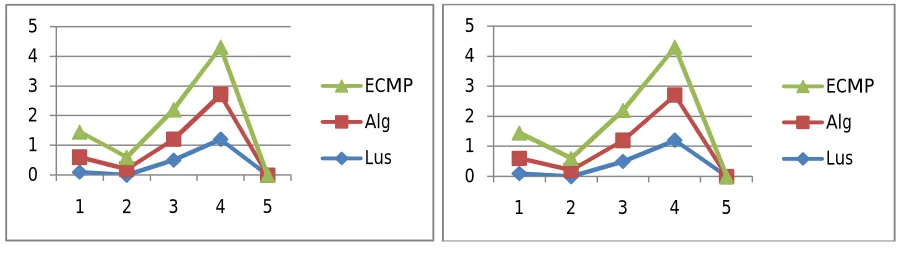
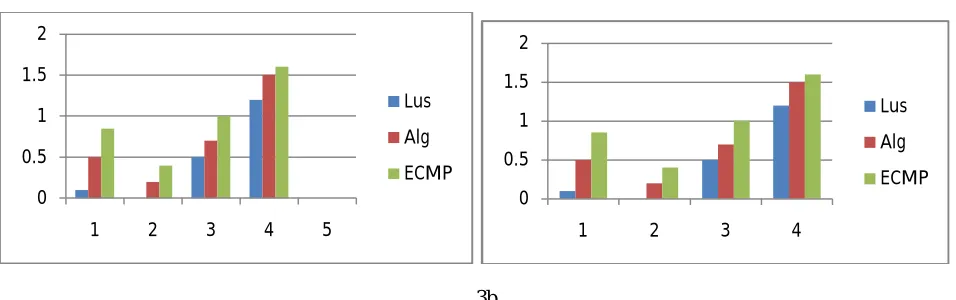
Figure 2a demonstrates that the total expense under Algorithm 1 in reality unites to the ideal arrangement (standardized expense proportion goes to 1) which confirms Theorem 1. Figures 3a and 3b demonstrate the cost execution under Algorithm1 and ECMP, standardized by the LUS bring down bound, under the exponential also, the exact movement models separately. The movement power is estimated as far as the proportion between the enduring state offered stack and the division data transfer capacity. For FatTree, the separation transmission capacity relies upon the quantity of center switches furthermore, their number of ports. As should be obvious, our calculation is close to the lower-bound on the ideal esteem (LUS) for light, medium, and high movement powers. They likewise recommend that Theorem 1 to be sure holds under more broad entry and benefit time forms. In the reenactments, our calculation gave an execution enhancement going structure half to more than 100%, contrasted with ECMP, contingent upon the movement force, under the observational movement display. The standard deviation (SD) of execution proportion ranges from 0:14 to 0:01 for Algorithm 1, what's more, from 0:3 to 0:03 for ECMP as activity power develops.
0 1 2 3 4 5
1 2 3 4 5
ECMP
Alg
Lus
0 1 2 3 4 5
1 2 3 4 5
ECMP
Alg
2b
Performance ratio of Algorithm 1 and ECMP in FatTree, normalized with the lower-bound (LUS)
3b
Performance ratio of Algorithm 1 and ECMP in JellyFish, normalized with the lower-bound (LUS).
Figure 2b demonstrates that the total expense under Algorithm 1 without a doubt merges to the ideal arrangement which again confirms Theorem 1. look at the execution of Algorithm 1 and ECMP, standardized with the lower-bound on the ideal arrangement (LUS), under both the exponential and experimental activity models. As previously, the activity force is estimated by the proportion between the consistent state offered stack and the separation transmission capacity. To decide the cut data transfer capacity, the have utilized the limits revealed in for customary irregular charts. Again the see that our calculation performs exceptionally well in all light, medium, and high traffics. In JellyFish, our calculation yields execution increases running from 60% to 70%, contrasted with ECMP, under the experimental activity show. Relating SD ranges from 0:04 to 0:01 for Algorithm 1, and from 0:1 to 0:05 for ECMP as activity power develops.
0 0.5 1 1.5 2
1 2 3 4 5
Lus
Alg
ECMP
0 0.5 1 1.5 2
1 2 3 4 5 6
Lus
Alg
ECMP
0 0.5 1 1.5 2
1 2 3 4 5
Lus
Alg
ECMP
0 0.5 1 1.5 2
1 2 3 4
Lus
Alg
VIII. CONCLUSION AND FUTURE WORK
The paper presents a direct figuring that continuously changes the association weights as a component of the association uses additionally, puts any as of late created stream on a base weight path in the framework, with no part/development of existing streams. The indicate both theoretically and likely that the computation has a good load modifying execution. In particular, the exhibit that the count asymptotically constrains a framework cost and set up the association between the framework cost and the relating weight create. Notwithstanding the way that our theoretical result is an asymptotic result, our test outcomes show that the count in conviction performs amazingly well under a broad assortment of movement conditions and exceptional datacenter frameworks. While the computation has low unconventionality, the honest to goodness execution depends upon how fast the weight refreshes and scarcest weight ways can be figured in logical datacenters (e.g., in perspective of SDN). One possible way to deal with improve the estimation timescale is to play out the computation infrequently or only for long streams, while using the in advance figured least weight routes for short streams or between the periodic updates. Finally, the should need to observe that our figuring can be particularly associated with booking flowlets instead of arranging streams, which can give higher rate/granularity of streams
FUTUREWORK
The product is totally founded on client's view and portrayal. The product is working effectively with no blunders and the organization has affirmed the product. The application created is planned so that any further improvements should be possible easily. New modules can be added to the current framework with less exertion.
REFERENCES
[1] M. Al-Fares, A. Loukissas, and A. Vahdat, “A scalable, commodity data center network architecture,” ACM SIGCOMM Computer Communication Review, vol. 38, no. 4, pp. 63–74, 2008.
[2] T. Benson, A. Anand, A. Akella, and M. Zhang, “MicroTE: Fine grained traffic engineering for data centers,” in Proceedings of the 7th
Conference on Emerging Networking Experiments and Technologies. ACM, 2011, p. 8.
[3] M. Al-Fares, S. Radhakrishnan, B. Raghavan, N. Huang, and A. Vahdat, “Hedera: Dynamic flow scheduling for data center networks.” in NSDI, vol. 10, 2010, pp. 19–19.
[4] C. Raiciu, S. Barre, C. Pluntke, A. Greenhalgh, D. Wischik, and M. Handley, “Improving datacenter performance and robustness with multipath TCP,” ACM SIGCOMM Computer Communication Review, vol. 41, no. 4, pp. 266–277, 2011.
S. Kandula, D. Katabi, S. Sinha, and A. Berger, “Dynamic load balancing without packet reordering,” ACM SIGCOMM Computer Communication Review, vol. 37, no. 2, pp. 51–62, 2007.
0 10 20 30 40 50 60 70 80
Load Min Max
Server 1
Server2