Improving Retrieval Quality Using Hybrid
Filtering in Recommendation System
Prasad P. Bansode1, Sunil N. Gengaje1, Dipak R. Mundhe1, Meharam B. Chavhan1, Sunita Barve2
BE Student, Dept. of Computer Engineering, MITAOE, Pune, India1
Professor, Dept. of Computer Engineering, MITAOE, Pune, India2
ABSTRACT: Recommendation systems are used to predict items that a user may be interested in that item. The numerous of approaches has been developed for doing recommendation, containing content-based, collaborative and knowledge-based. In content based filtering and collaborative based filtering there are some drawbacks and challenges like cold- start, specialization, new user problem, trust, privacy etc..This can be avoided by using hybrid filtering which is a combination of content based filtering and collaborative based filtering. Due to hybrid filtering accuracy of prediction in recommendation system increases. Hybrid filtering can be used for improving retrieval quality in recommendation system. Most of the web services can use hybrid filtering for improving retrieval quality in recommendation system.
KEYWORDS: Collaborative Filtering Recommender Systems, Content based Recommender Systems, service
discovery in service oriented architecture.
I. INTRODUCTION
After the beginning of web, the internet began growing developing with fast speed. Many opportunities, such as sharing knowledge, information, opinion with other users, came out. The variety of online shops, auctions opened up in the internet. In present days every user of the WWW can buy almost any item being in any country of the world. The amount of information and items got extremely huge, leading to an information overload. It became a big problem to find what the user is actually looking for. The search engines moderately solved that problem, but personalization of information was not given. So developers found a solution in recommender systems. Recommender systems are the software’s for filtering and sorting items and information. They use opinions of a community of users to help individuals in that community to more effectively identify content of interest from a potentially overwhelming set of choices. [1] The diversity of huge algorithms and approaches that help creating personalized recommendations. Two of them became very popular: collaborative filtering and content-based filtering. They are used as a base of most modern recommender systems. There are some modern recommendation systems improving their recommendations accuracies by using context-aware, semantic and other approaches. Today, recommendations are more specific and personalized. Problems of combining different technologies and recommending approaches for better results
II. RELATED WORK
A. Rating-Based Systems:
The various users clearly represent their choices (even though they may not know it) by giving either binary or multi scale scores to items that they experienced. Either the system proposes a user to rate a set of items or users will selection their own a set of items for rating. These are the ratings contains the user profile. The systems that comes into this category are called as collaborative recommenders due to the reality that the user is recommended items that people with same tastes and preferences was liked. This systems are known as social recommender. How the collaborative algorithms work can be found in detail lately some websites, such as amazon.com started collecting users ratings on more attributes of an item to obtain a more refined preference profile.
B. Case-based Systems:
This type of system recommends items on the basis of users interest. A product is treated as a case having multiple attributes. These are the approaches that are used to evaluate the attribute values of remaining products and the preferences of a user, and then predicts one or several best-ranked options according to a ranking scheme.
C. Utility-Based Systems:
This systems recommends the items which are based on critiquing recommenders and users stated preferences on multi attribute of products. The multi-attribute products use to the encoding scheme used to show all available data with the take any value v, from a domain of values d(bi). By taking ex, a data set consisting all digital cameras in an e-store will be represented by the similar set of attributes: these are price, resolution, optical zoom, memory, screen size D. Critiquing-based Systems The two case and utility-based recommenders will be developed by adding the extra interaction step of critiquing. The critiquing product recommendation system affect an artificial that recommends options based on users current preferences and then elicits their feedback in the chance of critiques as He should like something cheaper or with tremendous processor speed. The critiques are helped by the agent upgrade its accuracy in predicting users requirements in the next recommendation cycle. The user to lastly judge her optimal product, a number of these cycles are sometimes required, but the users are to give all of their preferences up front, then for the products that are unknown to them, the choice critiquing agent is the best for way to support of them incrementally construct their preference model.
III. TRADITIONAL APPROACHES
Content Based Filtering The content-based recommender systems effort with profiles of users that are created at the beginning. A profile has information about a user and his taste. Taste is based on how the user rated items. When making a profile, recommender systems make a overall survey, to get starting information about a user in order to ignore the new-user problem. [2] From the recommendation system process, the engine of this compares the items which were already rated by the user with the items he didn’t rate and looks for similarities. The list of items that are mostly similar to the positively rated ones, will
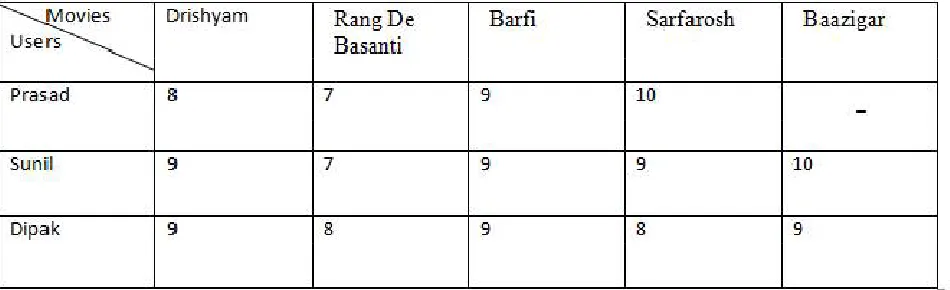
Fig. 1. List of movies the user has watched
Fig. 2. The movies list
based recommender system would find out movies from the list (Figure 2) that the user has already watched and positively rated. Then, it would compare those movies with the rest of the movies from the list (Figure 2) and look for similarities. Similar movies would be recommended the user. In the present ex we will see that there is a movie Bazzigar similar to the movie Drishyam that the user positively rated. The user hasn’t rated Bazzigar so it will be recommended him/her. B. Collaborative Based Filtering It became one of the most developed strategy of recommender system. [1] The idea of collaborative filtering is in finding users in a community that share appreciations [3]. Whenever any two users which has common or almost same rated items in common, then they must have common tastes. This users make a group or a so called neighbourhood. Sudden user will get recommendations to the list of items that users hasnt rated before, but items were already rated by users in his/her neighbourhood. Figure 4 shows that all three users rate the movies positively and with similar marks. That means that they have similar taste and build a neighbourhood. The user A hasnt rated the movie , which probably mean that he hasn’t watched it yet. As the movie was positively rated by the other users, he will get this item recommended. As opposed to simpler recommender systems where recommendations base on the most rated item and the most popular item methods, collaborative recommender systems care about the taste of user. The taste is considered to be constant or at least change slowly.
Fig. 3. Collaborative recommender system example
IV. CHALLENGES
A. Cold-start:
The cold start problem occurred when recommendation system tries to give recommendations on empty users profile data which is almost empty and he hasn’t rated any items. It is unknown to the system. Through survey this problem can be solved in much recommendation system. Cold-start problem not only related to the user but it is also related with the new item and haven’t been rated before.
B. Trust:
The voices of people with a short history may not be that relevant as the voices of those who have rich history in their profiles. This issue of trust can be solved by distribution of priorities to the users.
C. Scalability:
With the growth of numbers of users and items, the system needs more resources for processing information and forming recommendation. The major Resources required to form a small recommendation. This problem can be solved by the combination of various types of filters and incremental critiquing. In our project we are work on that area to create a stable and scalable recommender system.
D. Sparsity:
In online shops that have a huge amount of users and items there are almost always users that have rated few items. By using collaborative and content filtering approaches recommender systems. Generally create neighbourhood of users on the basis of users profile data. Assuming that a user has calculated just some items then it is pretty difficult to determine his taste and he/she could be related to the wrong neighbourhood. The problem of Sparsity is arrived due to lack of information.
E. Privacy:
Privacy has been the most important problem. In order to receive the most accurate and correct recommendation, the system must acquire the most amount of information possible about the user, including demographic data and data around the location of a specific user. Naturally, the question of reliability, security and confidentiality of the given information arises. Many online shops offer effective protection of privacy of the users by utilizing specialized algorithms and programs.
V. CONCLUSION
REFERENCES
[1] V.Adi Lakshmi, J.Kanaka Priya, ”A Hybrid Approach to Movie Recommender System”, International Journal of Advanced Research in Computer Science and Software Engineering-Volume 3, Issue 9, September 2013
[2] Daniar Asanov, ”Algorithms and Methods in Recommender Systems”, Berlin Institute of technology
[3] Mehrbakhsh Nilashi , Othman bin Ibrahim, Norafida Ithnin. ”Hybrid recommendation approaches for multi-criteria collaborative filtering”, Expert Systems with Applications 41 (2014) 38793900
[4] Ana Beln Barragns-Martnez a Esmpnrique Cossmta-Montennegro a, Juamn C. Burgkuillo a, Marta Rey-Lcpmez b, Fernando A. Miknmic- Fonte a, Ana Peln eteiro, ”A item content-based and item-based which is collaborative filtering approach to recommend TV programs enhanced with singular value decomposition”, Information Sciences 180 (2010)
42904311
[5] Milind Munde, Sachin Pawar,”Incremental Critiquing a Modern Approach in Recommender System”, IEE Volume 4, Special Issue (NCRTIETI 2013), January 2015. ISSN 23484 – 48543
[6] Milind Munde, Sachin Pawar,”Increasing Retrieval Quality in Critiquingbased Recommender System” Volume 3, Issue 9, September 2014 ISS 24277 INT Journal of Advanced Research in Computer and Software Engineering
[7] Gedsdsdiminas Adomasdsvicius, Member, IEEE, and Alexaxsxnder Tsxsuzhilin, Member, IEEE, ” the modern Generation of Recommender Systems: A skill and the art and Possible Extensions”. IEEE IN ON KNOWLEDGE AND DATA ENGINEERING, VOL. 10, NO. 3, JUNE 2005
[8] Grefg Lfdinden, Brendt Smdith, and Jeremy York Amazon.com,” Coldlaborative Filtering”,
[9] Kazuyoshi Yoccshii, Student Mecmber, IEEdE, Masdfataka Godfto, Kazudnori Komjatani, Tetcsuyass Ogata, Member, IEEE, and Hiroshi G. Okduno, Senior Member, IEEE,”The modern Hybrid Music Recommendation System” Probabilistic Generative Model” IEEE TRANSACTIONS ON MUSIC, SPEECH, AND LANGUAGE PROCESSING, VOL. 2, NO. 2, FEBRUARY 2015