Mechanical Behaviour of Self Compacting
Concrete Using Rice Husk Ash as Partial
Replacement of Cement A Comparative Study
Vijay Kumar1, Dr.S.R. Pandey2
P.G. Student, Department of Civil Engineering,NIT Jamshedpur, Jharkhand, India1 Associate Professor, Department of Civil Engineering,NIT Jamshedpur, Jharkhand, India2
ABSTRACT:Self-Compacting Concrete is an innovative concrete that does not require vibration for placing and
compaction. It is able to flow under its own weight, achieving full compaction, even in the presence of congested reinforcement. The disadvantage of self-compacting concrete is its cost and durability, associated with the use of high volumes of Portland cement and use of chemical admixtures. One alternative to reduce the cost of self-compacting concrete is the use of mineral admixtures such as rice husk ash which is finely divided material added to concrete during mixture procedure. When RHA replaces a part of the Portland cement, the cost of self-compacting concrete will be reduced especially if the mineral admixtures are waste or industrial by-product. Moreover, the use of mineral admixtures in the production of self-compacting concrete not only provides economical benefits but also reduces heat of hydration making it durable. The incorporation of mineral admixtures also eliminates the need for viscosity-enhancing chemical admixtures. The lower water content of the concrete leads to higher durability, in addition to better mechanical integrity of the structure. This thesis work presents an experimental investigation on strength aspects like compressive, flexural and split tensile strength of self-compacting concrete containing rice husk ash as partial replacement of cement. The methodology adopted is that rice husk ash has been partially replaced with cement with a varying percentage of 0%, 5%, 10%, 15%, 20%, 25% and 30% and the influence of rice husk ash on the mechanical property of self-compacting concrete was investigated. The following inferences were made; optimum dosage of super plasticizer enhanced the flow property of the concrete. As a result, overall improvements in the flow and filling ability of the self-compacting concrete were observed. From this view point, a cost effective self-compacting concrete design can be obtained by incorporating reasonable amounts of rice husk ash.
KEYWORDS:Rice Husk Ash (RHA),Self-Compacting Concrete(SCC),Compressive strength, Split tensile strength,
Flexural strength.
I. INTRODUCTION
Self- compacting concrete (SCC) is a fluid mixture, which is suitable for placing in difficult conditions and also in congested reinforcement, without vibration. Development of self-compacting concrete (SCC) is a desirable achievement in the construction industry in order to overcome problems associated with cast-in-place concrete. A self- compacting must have 1) A fluidity that allows self- compaction without externalenergy. 2) Remain homogeneous in a form during and after the placing process. 3) Flow easily throughreinforcement.
The criteria required for the RHA to be used as partial replacement of cement are 1) it should be burnt under a control temperature between 550℃ and 700℃ for 10 to 12 hr. 2) it should be further ground even finer then cement. 3) it should be available at a cheaper rate. The RHA fulfilling the above condition can be used as a partial replacement of cement.
II. LITERATURE SURVEY
M.A.Ahmadi et al.,[1]It is concluded that RHA provides a positive effect on the Mechanical properties at age after 60 days. Also specimens with 20% replacement of cement by RHA have the best performance.
Syed Mehdi Abbas et al.,[2]Strength of concrete containing 25 percent of RHA is not affected appreciably but the cost is reduced considerably. It is also found that the resistance to chemical attack of RHA concrete is much better than ordinary Portland cement concrete.
Shriram, H. Mahure et al.,[3]RHA being pozzolanic materials shown much better performance after 90 days curing as compared with the same at 28days. It was observed that the water absorption within acceptable limit. Hence the concrete will be impermeable.
Chatveera B, Lertwattanaruk P.,[4]investigated thatRHA provides a positive effect on the autogenous shrinkage and weight loss of concretes exposed to hydrochloric and sulphuric acid attacks.
S. KanakambaraRao et al.,[5] result show that with addition of RHA the interfacial transition zone (ITZ) between the cement paste and the aggregate in self-compacting concrete partially replaced with RHA gets improved.
Obilade, I.O et al.,[6].result revealed thatwhen RHA is used as partial replacement for Ordinary Portland Cement (OPC) in concrete by weight at 0%, 5%, 10%, 15%, 20% and 25% replacement. The results revealed that the Compacting factor decreased as the percentage replacement of OPC with RHA increased.
Ha Thanh, Sang ThanhNguye.,[7]workability of SCC containing RHA decreases at the higher replacement levels compared to that of the control mixture due to the pore structure of RHA. In replacement range of 5-20 % RHA, there exists an optimum RHA content resulting in the highest compressive strength of concrete.
Silvio Delvasto.,[8] revealed that the particular ricehuskash (RHA) consists of 99% of silica, highly amorphous, white in colour and of greater pozzolanic activity than the silica fume and another ricehuskash prepared with only by a thermal treatment.
III. PROPOSED METHODOLOGY AND DISCUSSION
The present study consists of experimental study of SCC using RHA as partial replacement of cement and to check the durability. The experimental method refers to the casting of cubes (150mm x 150mm x 150mm), cylinders (150mm diameter and 300mm long), prisms (500cm x 100mm x 100mm) for M30 grade of concrete as per Indian standard method to determine the compressive strength, split tensile strength, flexural strength of concrete for different proportion of RHA varying from (0%, 5%, 10%, 15%, 20%, 25%, and 30%)Mix design procedure as per modified
nansu mix design method [9] for M30 grade of concrete.
Material properties:
Cement: Ordinary Portland Cement (OPC) of 53-grade Coromandal King Brand, obtained from INDIA Cements Pvt.
Table I Typical Properties of OPC 53 Grade Cement
S. No Properties Results obtained IS:12269-2013 Specifications
1 Fineness retained on IS sieve 90μ 1.7% -
2 Soundness (mm) 3.45 10 (max) 3 Normal Consistency 35 % - 4 Initial Setting Time (min) 67 30 (min) 5 Final Setting Time (min) 365 600 (max) 6 3 days compressive strength (MPa) 26.6 27 7 7 days compressive strength (MPa) 36.2 37 8 28 days compressive strength (MPa) 54.3 53 9 Specific Gravity 3.05 3.15
Aggregate: The test for aggregate is done as per Indian standard procedure confirming to IS383-1970[11]. The
materials were collected from the local market of Jamshedpur of size 20 mm down and 10 mm down. .the 20 mm down aggregate was taken 65% and 10 mm down aggregate was taken 35% to get maximum density.
Table II Typical Property of Aggregate
S. No Property Fine Aggregate Coarse Aggregate 1 Specific gravity 2.48 2.8 2 Fineness modulus 2.65 6.68 3 Water absorption (%) 1.626 0.50 4 Free moisture content (%) 1.87 0.9 5 Silt Content 4.17 % - 6 Bulk density(kg/m3) 1440 1550 7 Aggregate Impact value - 13.74 8 Aggregate Crushing value - 12.10
Mineral admixture: The ash produced by controlled burning of the rice husk between 550℃ and 700℃ incinerating
temperature for 10 to 12 hours, transforms the silica content of the ash into amorphous phase possessing cementatious property. For this project work RHA is being obtained from BMW Industry (Jamshedpur) having particle size finer than 25 micron and specific gravity 2.3 is used.
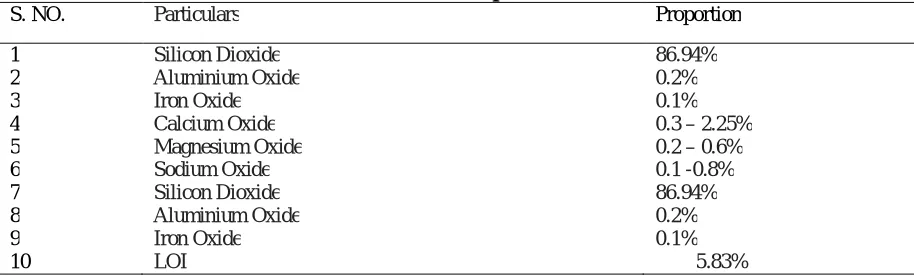
Table III Chemical Composition of RHA
S. NO. Particulars Proportion
1 Silicon Dioxide 86.94%
2 Aluminium Oxide 0.2%
3 Iron Oxide 0.1%
4 Calcium Oxide 0.3 – 2.25%
5 Magnesium Oxide 0.2 – 0.6%
6 Sodium Oxide 0.1 -0.8%
7 Silicon Dioxide 86.94%
8 Aluminium Oxide 0.2%
9 10
Iron Oxide LOI
Chemical admixture: PCE based admixture with viscosity- modifying agent (VMA) i.e MasterGlenium SKY 8567 is used.
Table IV Mix proportion of different mix
% RHA
Cement (kg/m3)
Fine Aggregate
(kg/m3)
Coarse aggregate
(kg/m3)
Water (kg/m3)
SP Dose (kg/m3)
RHA (kg/m3)
No. of cubes
No of cylinder
No of prism
0% 481.25 831.6 732.37 190.5 5.77 0 21 9 9 5% 457.19 831.6 732.37 190.5 5.77 24.06 21 9 9 10% 433.13 831.6 732.37 190.5 5.77 48.12 21 9 9 15% 409.06 831.6 732.37 190.5 5.77 72.18 21 9 9 20% 385.01 831.6 732.37 190.5 5.77 96.24 21 9 9 25% 360.95 831.6 732.37 190.5 5.77 120.3 21 9 9 30% 336.89 831.6 732.37 190.5 5.77 144.36 21 9 9
IV. EXPERIMENTAL TEST AND RESULT
Slump FlowTest:The slump flow test is done to assess the horizontal flow of concrete in the absence of obstruction. It
is most commonly used test and gives good assessment of filling ability. It can be used at sites. The test also indicates the resistance to segregation. According to EFNARC the slump flow should lie between (650 to 800) mm.
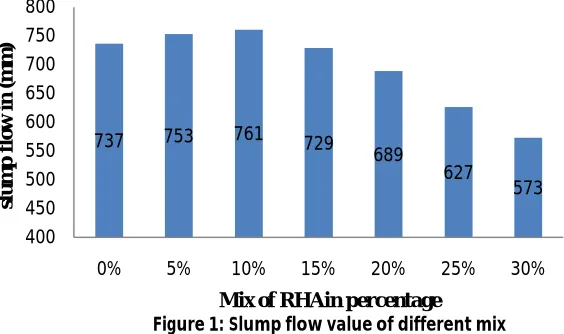
Figure 1 shows thatthe slump flow increases up to 10% replacement of RHA because RHA in little proportion
acts as a ball bearing which increases the flow ability, with further increase of RHA proportion the flow ability decreases because of waterabsorption of RHA due to higher surface area, but up to 20% replacement of RHA the EFNARC guideline for SCC was fulfilled
V-Funnel test: This test is basically used to determine filling ability of concrete. Time taken for the concrete to flow
down isrecorded. If the concrete shows segregation then the flow time will increasesignificantly. According to EFNARC the V-Funnel value should lie between (8 to12) sec.
737 753 761 729
689
627
573
400 450 500 550 600 650 700 750 800
0% 5% 10% 15% 20% 25% 30%
sl
u
m
p
fl
o
w
i
n
(m
m
)
Mix of RHAin percentage
Figure 2: V-Funnel value for different mix
Figure 2 shows that flow time decreases for all age but up to 20% replacement of RHA the EFNARC
guideline for SCC was fulfilled
L- Boxtest:This test is based on a Japanese design for underwater concrete. The test assesses the flow of the concrete,
and also the extent to which it is subject to blocking by reinforcement. According to EFNARC the ratio (H2/H1) should
lie between (0.8 to 1)
Figure 3: L-Box value of different mix
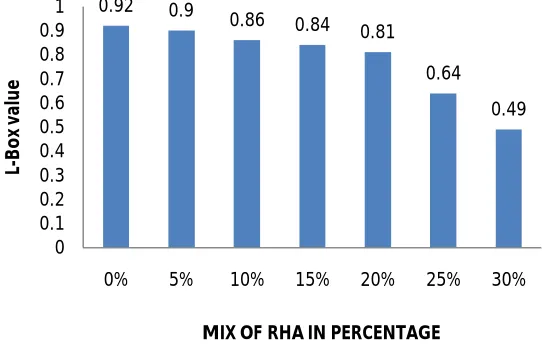
Figure 3 shows that with the increase in % of RHA as partial replacement of cement, the result of L-box i.e
the ratio (H2/H1) decreases. However up to 20% replacement of RHA the EFNARC guideline for SCC was achieved.
Cube Compressive Strength: After finalization of mix proportion of M30 with W/C = 0.35 and superplasticizer dose
of 1.2%, thecubes were casted for different proportion of RHAas partial replacement of cement by weight and tested for compressive strength. Concrete cube specimens of size 150 mm x 150 mm x 150 mm were cast, cured and tested at 7, 28, 60 and 90 days of maturity as per IS:516-1959 [12].
10 9.5
9 8.5
8
6.5
5.5
0 2 4 6 8 10 12
0% 5% 10% 15% 20% 25% 30%
V
-fu
n
n
e
l
v
al
u
e
(s
e
c
)
Mix of RHA in percentage…
0.92 0.9
0.86 0.84 0.81
0.64
0.49
0 0.1 0.2 0.3 0.4 0.5 0.6 0.7 0.8 0.9 1
0% 5% 10% 15% 20% 25% 30%
L-B
o
x
va
lu
e
Table V Compressive Strength test result for all ages:
% RHA 7- days strength (N/mm2)
28-days strength (N/mm2)
60-days strength (N/mm2)
90-days strength (N/mm2)
0% 31 49 50 51
5% 29.03 46.48 47 48
10% 25 37 41 44
15% 22 33 37 39
20% 18 26.93 31 35.48
25% 11 18 21 23
30% 9 14 17 19
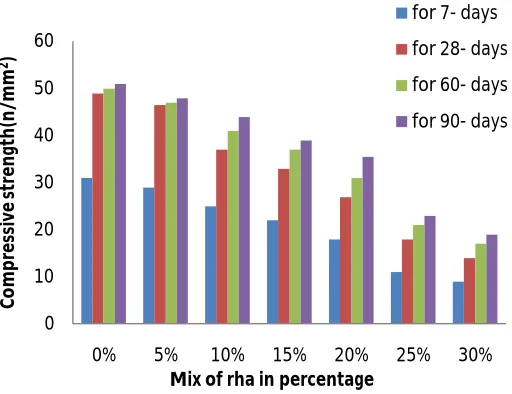
Table V shows that the compressive strength of concrete decreases with increase in % replacement of RHA.
However the result shows that with increase in age of concrete, the compressive strength for a particularmix increases showing that pozzolanic activities increases with age. Up to 20% replacement of RHA the target strength was achieved.
Figure 4: compressive strength of M30 Grade of Concrete
Split Tensile Strength of Concrete: The split tensile strength of concrete was determined after 28, 60, and 90 days of
curing of the cylindrical specimens. The cylindrical mould shall be of 150 mm diameter and 300 mm height using 2000
0 10 20 30 40 50 60
0% 5% 10% 15% 20% 25% 30%
C
o
m
p
re
ss
iv
e
st
re
n
gt
h
(n
/m
m
2)
Mix of rha in percentage
for 7- days
for 28- days
for 60- days
Table VI Split tensile strength test results for all ages:
Mix of RHA 28-days strength (N/mm2)
60-days strength (N/mm2)
90-days strength (N/mm2)
0% 4.20 4.49 4.53
5% 4.13 4.46 4.47
10% 3.97 4.18 4.23
15% 3.49 3.71 3.77
20% 3.22 3.39 3.46
25% 2.15 2.30 2.33
30% 1.42 1.48 1.50
Figure 5: Split tensile strength of M30 Grade of Concrete
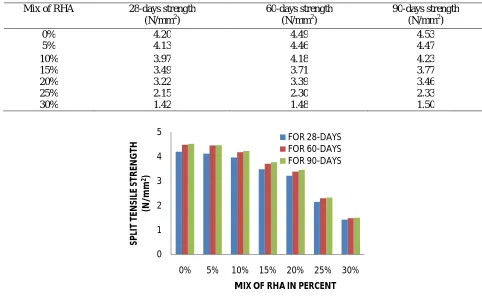
Table VI shows that the split tensile strength of concrete decreases with increase in % replacement of RHA.
However the result shows that with increase in age of concrete, the split tensile strength for a particularmix increases showing that pazzolanic activities increases with age. Up to 20% replacement of RHA the target strength was achieved
Flexural Strength of Concrete: This test was performed in accordance with BIS (IS: 516-1959) on prisms of size 100
x 100 x 500 mm after 28, 60 and 90 days of water curing. for finding flexural strength. The specimen was supported on two roller support spaced at 400 mm c/c. The load was then applied at a rate of 0.7 N/mm2/min through two similar rollers mounted at third point of the span (133.3 mm c/c) till the failure occurred.
Table VII Flexural strength test results for all Ages:
Mix of RHA in percentage
28-days strength (N/mm2)
60-days strength (N/mm2)
90-days strength (N/mm2) 0% 7.26 7.93 8.13 5% 7.13 7.86 8.00 10% 6.93 7.60 7.86 15% 6.73 7.33 7.46 20% 5.06 5.26 5.40 25% 3.13 3.26 3.40 30% 2.20 2.40 2.46
0 1 2 3 4 5
0% 5% 10% 15% 20% 25% 30%
SP
LI
T
TE
N
SI
LE
S
TR
EN
G
TH
(N
/m
m
2)
Figure 6: Experimental Setup for Flexural Strength
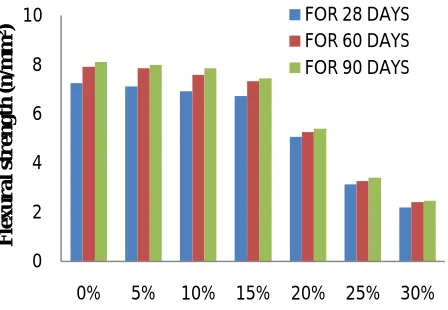
Table VII shows that the split flexural strength of concrete decreases with increase in % replacement of RHA.
However the result shows that with increase in age of concrete, the flexural strength for a particularmix increases showing that pazzolanic activities increases with age. Up to 20% replacement of RHA the target strength was achieved
Sulphate Attack test: Sulphate attack causes concrete deterioration by chemical or physical reactions. In this
phenomenon, the sulphate ions penetrating from soil or ground water react with the aluminate phase of the cement causing deterioration of concrete. The sulphate attack testing procedure was conducted by immersing concrete specimens of the size 150 mm x 150 mm x 150 mm in a water tank containing 5% Sodium sulphate solution for 28 and 90 days. The degree of sulphate attack was evaluated by measuring loss in compressive strength of the specimens at 28 days and 90 days.
0 2 4 6 8 10
0% 5% 10% 15% 20% 25% 30%
F
le
x
u
r
al
s
tr
e
n
gth
(n
/m
m
2)
Mix of RHA in percentage FOR 28 DAYS FOR 60 DAYS FOR 90 DAYS
Table VIII Average reduction in comp strength due to curing in sulphate solution:
% RHA
Normal curing 28 days comp
strength
Sulphate curing 28 daysComp strength after
Comp strength after 90 days
Sulphate curing 90 daysComp strength after
% loss of comp. strength
in 28 days
% loss of comp. strength in 90 days
0% 49 42.91 51 44.83 12.42 12.09 5% 46.48 42.56 48 43.50 9.37 5.77 10% 37 34.45 44 41.50 6.89 5.68 15% 33 30.84 39 37 6.54 5.12 20% 26.93 25.24 35.48 34 6.27 4.17 25% 18 16.69 23 20.94 7.27 8.95 30% 14 12.89 19 17.23 7.92 9.31
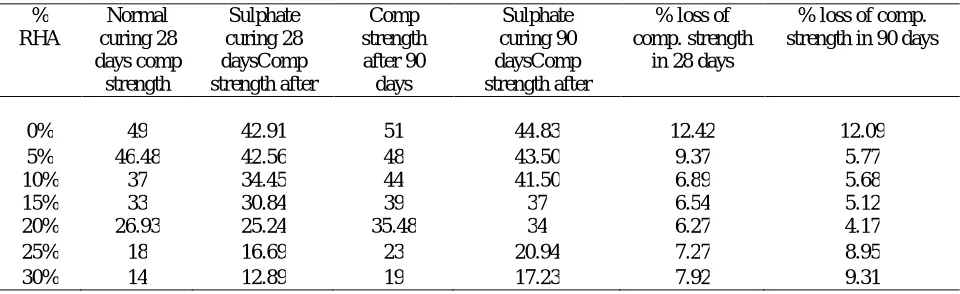
Table VIII shows that % loss of compressive strength decreases with increase in partial replacement of RHA
up to 20% replacement. Above 20% replacement the compressive strength decreases as weak concrete will not be a durable concrete. Also with increase in age the % loss of compressive strength decreases as pozzolanic action has taken place consuming Ca(OH)2 which affects the durability.
Figure 8: Averagelosses in comp strength due to curing in Sulphate solution
Acid Resistance test: Acid resistance was tested on 150 mm size cube specimens at the age of 28 and 90 days of
curing. The cube specimens were weighed and immersed in water diluted with one percent by weight of sulphuric acid for 28 and 90 days. Then, the specimens were taken out from the acid water and the surfaces of the cubes were cleaned. Then, the compressive strength of the specimens were found out and the average percentage of loss of compressive strength was calculated.
0.00% 5.00% 10.00% 15.00%
0% 5% 10% 15% 20% 25% 30%
%
Lo
ss
i
n
c
o
m
p
str
e
n
gth
Mix of RHA in percent
FOR 28 DAYS
Table IX Average reduction in comp strength due to curing in H2SO4 solution:
% RHA
Normal curing 28 days comp
strength
H2SO4
curing 28 days Comp strength
after
Comp strength after 90 days
H2SO4
curing 90 days Comp strength
after
% loss of comp. strength
in 28 days
% loss of comp. strength
in 90 days 0% 49 44.21 51 45.23 13.24 11.31 5% 46.48 41.32 48 43.13 11.1 10.14 10% 37 33.27 44 39.90 10.08 9.31 15% 33 30.12 39 36.43 8.72 6.58 20% 26.93 24.84 35.48 33.77 7.76 4.81 25% 18 16.39 23 19.94 8.94 13.3 30% 14 11.89 19 16.13 15.07 15.1
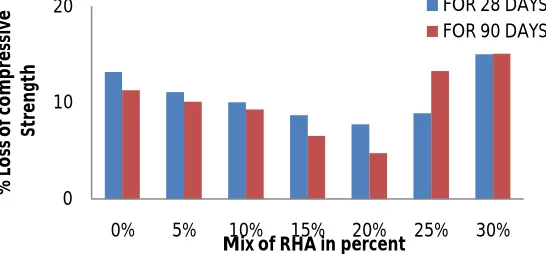
Table IXshows that % loss of compressive strength decreases with increase in partial replacement of RHA up
to 20% replacement. Above 20% replacement the compressive strength decreases as weak concrete will not be a durable concrete. Also with increase in age the % loss of compressive strength decreases as pozzolanic action has taken place consuming Ca(OH)2 which affects the durability.
Figure 9: Average loss in comp strength due to curing in H2SO4solution
V.CONCLUSION
On the basis of the experimental investigations and analysis, the following conclusions can be drawn:
1. RHA being a waste material obtained from the steel plant causing pollution. Partial replacement of RHA with cement reduces environmental problem which is a big concern for the whole world.
2. Incorporating RHA as a partial replacement of cement we can make an economical self -compacting concrete. 3. As per the EFNARC specification, the slump flow value,V-funnel, L-box & J-Ring Test showed acceptable
value up to replacement of 20% cement by RHA.
4. The target strength for Compressive Split tensile and Flexural Strength for M 30 grade concrete was achieved up to a replacement of 20% of cement by RHA.
5. Partial replacement of cement by RHA resists the thermal cracksgenerated due to hydration of cement and makes the concrete durable.
6. Calcium hydroxide released during hydration of cement is mainly responsible for many chemical attacks like acid attack and sulphate attack. The partial replacement of cement by RHA up to 20% replacement resist
0 10 20
0% 5% 10% 15% 20% 25% 30%
%
L
o
ss
o
f
co
m
p
re
ss
iv
e
St
re
n
gt
h
Mix of RHA in percent
8. Results indicate that pozzolanic reactions of rice husk ash in the matrix composite were low in early ages, but by aging the specimens to more than 60 days considerable effect have been seen in strength.
REFERENCES
[1] Ahmadi, M.A., Alidoust, O., Sadrinejad, I., Nayeri, M. Development of Mechanical Properties of Self Compacting Concrete Contain Rice Husk Ash, World Academy of Science, Engineering and Technology 34 2007, Vol no. 1 pp 100-103,2007
[2] Syed mehdiabbas, Use of rice husk ash in concrete as partial cement replacement material, International Journal of Scientific & Engineering Research (ISSN 2229-5518),Vol no. 6 pp 276-278.
[3] Prof. ShriramH. Mahure, Dr. V. M. Mohitkar, Effect of Rice Husk Ashon Fresh and Hardened Properties of Self Compacting Concrete. International Journal of Scientific & Engineering Research (ISSN 2229-5518),Vol no. 5 issue 7 pp 833-839, December 2015.
[4] Chatveera B, Lertwattanaruk P, Durability of conventional concrete containing black rice husk ash.J. Environ. Manage, Vol. no. 92, issue 1, pp 59-66, (sept 2010),
[5] S.KanakambaraRao “A Review on Experimental Behavior of Self Compaction Concrete Incorporated with Rice Husk Ash” International Journal of Science and Advanced Technology (ISSN 2221-8386). Vol. no. 2, pp 75-80, march 2012
[6] Obilade, I.O., use of rice husk ash as partial replacement for cement in concrete, (ISSN2305-8269). Vol. no. 5. No. 04, pp 11-16, Sept. 2014 [7] Ha Thanh, Sang ThanhNguyena, study on high performance fine grained concrete containing rice husk ash, International Journal of Concrete
Structures and Materials. Vol. no. 8, issue 4, pp 301-307, March 2014.
[8] Silvio Delvasto, A Salas, R.MejiaDeveloping high performance concrete incorporating highly reactive rice husk ash, ingenieiraeinvestigacion. Vol. no. 33, issue 2, pp 49-55, 2013.
[9] Nan su, Kung-chung Hsu, His-wen chai, A simple mix design method for self -compacting concrete, Cement and Concrete Research,Cement and Concrete Research 31 volume 3, issue 2, , pp. 1799-1807. December 2001.
[10] IS:12269-2013, Specifications of Ordinary Portland Cement 53 Grade, Bureau of Indian Standards, New Delhi.