OPTIMAL CONTROL OF A QUEUEING SYSTEM
WITH THREE HETEROGENEOUS SERVERS
Ioannis Viniotis
Center for Communications
&
Signal Processing Department of Electrical and Computer EngineeringNorth Carolina State University Raleigh, NC 27695-7914
CCSP-TR-89/5
Abstract
We study the problem of optimally controlling a three server queueing system. Ar-riving customers join a single queue, which is served by three servers, 81,52 and 53. The
servers are exponential, but of different rates. The total expected time a customer spends in the system is to be minimized. We show that the optimal policy can be characterized
by three thresholds, m3,mb and mi, such that: 51, the fastest server, should be always busy; 53, the slowest server, should be activated only when m3 or more customers wait in
the queue, and, given that 53 is idle (busy), 82 should be activated only when mi (mb)
customers wait in the queue. We use stochastic dominance arguments to establish the results.
1. Introduction
We consider the queueing system shown in figure 1. Customers arrive at an (infi-nite capacity) buffer in a Poisson stream of rate ~. The buffer is served by three servers
51' 52, 53, of different capacities PI, P2 and pj respectively. Without loss of generality, we assume that ILl
>
1L2>
1L3>
o.
The service requirements are exponentially distributed, with parameter 1. Thus the time a customer spends at server 5i is exponentially dis-tributed, with parameter Pi. To avoid trivial cases, we assume that 0<
~<
PI+
1-£2+
1-£3.----.~ III~
.1-.
The motivation for studying this model comes from applications in dynamic routing in computer networks and communication systems. The more general system with N servers would be a more appropriate model of real life applications; however, the enormity of the problem forces us to follow a moderate step-by-step approach.
studied in
[1].
In[1],
Lin and Kumar have shown that the optimal policy (i.e., the one thatminimizes the mean sojourn time of customers in the system), is of threshold type. In other
words, the optimal policy keeps the faster server busy, whenever possible, and activates
the slower server only when the number of waiting customers exceeds a certain threshold.
Moreover, they have provided a simple formula to calculate the optimal threshold, as a
function of the statistical parameters of the model. In
[2],
Agrawala et al considered arelated problem, with an arbitrary number, N, of servers, but no arrivals. They have
shown that a threshold type policy minimizes the expected total flow time (sum of all
finishing times). They also provide a simple formula to calculate the threshold for each
server. In [4,7,8,9] other scheduling problems with N servers have been considered.
Our goal is to minimize the expected time a customer spends in the system, by properly
selecting the customer allocation strategy. Whenever one or more servers become idle,
and there are customers waiting for service, one mayor may not decide to forward one
or more customers for service. We show in this paper that the optimal policy (among
all nonanticipative, nonpreemptive policies) is of threshold type (to be precisely defined
later), i.e., it may idle a server, even when there are waiting customers. We used stochastic
dominance arguments to establish this result, as was done in
[3]
for theMtMt2
case. Wewere not able to utilize Dynamic Programming arguments.
The paper is organized as follows. In section 2 we describe the queueing model of the system and inroduce some notation. In section 3 we present the results; the proofs
are provided in the appendix. Since the technique we are using is based on the arguments
presented in [3], we omit lengthy details, whenever they can be readily found there. Where
necessary, we emphasize the basic differences and provide only a sketch of the proof.
We conclude with a conjecture regarding the MIMIN model and some implementation
remarks.
2. The model
The system consists of a single queue, served by three unequal speed servers. Arrivals
are Poisson of rate
A.
The service discipline is nonpreemptive*; service time at serverSi
isgen-exponential, with rate lLi· To ensure stability of the system, we assume that A
<
ILl+
1L2+
1L3' As mentioned above, we may assume without loss of generality that ILl
>
1£2>
1£3'Let
ZOt denote the number of customers waiting in queue, at time
t.
Zit denote the busy-idle condition of server S· ,; -" c, - 1 2 3, , •
If Zit
=
0 (1), we say that the server is idle (busy).Under the statistical assumptions we adopted, the vector
is a suitable state description of the system. The state space of the system is
X~{O,l,
...} x {O,1}3
A policy l'is any (nonanticipative, nonpreemptive) rule which at every time t decides
(on the basis of the history
{x.,
8 ::;t}),
whether to activate one or more idle servers, giventhat the queue is nonempty. We shall refer to allocation decisions as actions of the policy.
Let 1:1;tI~:l;Ot
+
:l;1t+
:l;2t+
:l;3t denote the total number of customers in the system(queue and servers) at time
t.
For a given discount factor 0:>
0, we define the expected,a-discounted cost incurred by policy" when starting from initial state xo
=
z , at timet
= 0, as(1)
Here E~ denotes expectation with respect to the probability law of the process Xt, when
the policy, is used and the initial state is z , We are primarily interested in the average
cost criterion; however, in view of the results in [5], it suffices to consider the discounted
cost criterion only.
eral MI1\JIN case): keep all servers busy and preempt the slowest (currently busy) server
whenever a faster server becomes idle; reallocate the preempted customer to the recently
available server. In computer systems preemptions may be allowed; however, in
A policy is optimal if it minimizes the cost given in equation (1). It is known that
the optimal policy for this problem is Markov, deterministic and stationary [5]. Let 1r be
the optimal policy. It can be described as follows. Whenever a transition (an arrival or
a service completion) occurs, that brings the system to state y, 1r chooses an action that
makes the state jump to the value
To simplify the notation, we shall use
i==1,2,3
to denote the actions of the optimal policy. For example, 1r(YO,Y1,Y2,Y3)3
==
1 (0) meansthat at state (Yo,Yl,Y2, Y3) the optimal policy decides to activate the slowest server (keep it idle).
Remark: When the optimal policy assigns customers to more than one idle servers
simultaneously, we will assume, without loss of generality, that it does so in a sequential
manner, from the fastest to the slowest server.
3. Characterization of the optimal policy.
Our objective in this section is to characterize the structure of the optimal policy, 'Jr.
We shall make use of the following definition.
Definition: A policy / is called a threshold type policy (with thresholds m3,mb,mi) if:
• it keeps 81 , the fastest server, busy whenever possible, i.e., whenever the queue is
nonempty.
• it allocates a customer from the queue to the slowest server, 53, iff at least m3
cus-tomers wait in the queue, and
• it activates server 82 when at least m.; (mb) customers wait in the queue and server
83 is idle (busy).
Remark: The fact that a threshold policy will activate a server only when the queue
size exceeds the corresponding threshold does not mean that the server can not be busy
We wish to show the following theorem.
Theorem: The optimal policy for the cost criterion (1) is a threshold type policy.
The proof is is based on lemmata 1-6 below, which describe certain of the
proper-ties of the optimal policy. The following proposition, our main result, is an immediate
consequence of the ergodicity assumption and the results in [5].
Proposition: The policy that minimizes the expected time a customer spends in the
system is of threshold type.
The following lemmata describe the properties of the optimal policy for the discounted
cost criterion. They are self-explanatory. Their proofs are presented in the appendix.
Lemma 1: The optimal policy should activate a faster rather than a slower server.
Lemma 2: The optimal policy should keep the fastest server busy whenever customers
wait in queue.
An immediate consequence of lemma 2 is that for states (ZO,ZI,Z2,Z3) with Zo
2:
1,we should have Xl
=
1, since states(xo,
0,X2,Z3) will occur only instantaneously (i.e., justbefore 1r takes an action).
Lemma 3 (4) characterizes the actions of the optimal policy for the second server,
when the system visits states in which the slowest server is idle (busy).
Lemma 3: Given that 53 is idle, the optimal policy should activate the second server,
52, only when at least tti; customers wait in the queue.
Lemma 4: Given that 53 is busy, the optimal policy should activate 52, only when
at least fib customers wait in the queue.
From the remark of the previous section and lemma 1 we see that 1r should consider
activating 83 only in states
(Yo,
1, 1,0). The next lemma characterizes these actions.Lemma 5: The optimal policy should activate the slowest server only when at least
m3 customers wait in the queue.
A complete characterization of the optimal policy would require computation of the
three thresholds, as a function of the statistical parameters of the model. We have only
Lemma 6: mi
<
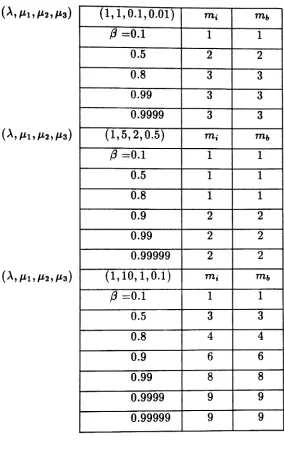
m3,mb ~ m3·We have not been able to provide a relationship between mi and mb· However, we
strongly suspect that mi == ms: In this case, the optimal policy for activating the second
server will be a pure threshold policy, with a threshold that depends on the queue size
only, and not the condition of the third server. This conjecture is in compliance with the
results in [2]. Moreover, it is backed up by extensive numerical calculations of the optimal
policy, using value iteration on the Dynamic Programming Equation.
4. Conclusions
We have studied the structure of the optimal policy for a three server queueing
sys-tem. We have shown that the optimal policy is of threshold type, with the threshold for
the second server possibly depending on the busy /idle condition of the slowest server.
Stochastic dominance arguments were used to obtain the result. They strongly rely on
the number of servers; their extension to the more general case of N
>
3 servers is notstraightforward. It is possible, however, to obtain the structure for this case as well, using
Linear Programming based arguments, as described for example in [6].
The proof presented here is not constructive; therefore it does not suggest how the
optimal policy thresholds can be computed, for the implementation of the optimal policy.
The straightforward method of calculating the cost as a function of the thresholds
[1]
cannot be applied here. We suggest to use the value iteration for the discounted cost as a
reasonable heuristic. In all cases we tried, it converged quite rapidly. Figure 2 shows the
behavior of the optimal thresholds as a function of the discount factor, for given arrival
and service rates. It also "supports" the previously mentioned conjecture, mi == mb.
Appendix
In this appendix we provide the proofs of lemmata 1-6. Throughout this appendix,
Ui will denote an exponential random variable with rate J-Li. It represents the service time
of a typical customer, at server Si. Whenever the proofs are similar, the reader is refered
to [3] for the missing details. The basic idea is to construct a nonstationary, nonMarkov
policy, 1r,which will improve the optimal policy 11",whenever the latter does not have the
Proof of lemma 1: Assume that i
<
j and let O"i,O"; be the service times of a givencustomer, when it is served by server Si or Sj respectively. By stochastic dominance, we
may assume that O"i
<
(Tj.Consider two initial states, s, and 8;, such that at state 8i (8;) server 8i (8;) is active
and server
S; (Si)
idle. The remaining state components are the same. Let T be the firsttime that 7r activates server
Si
when starting from initial stateSi
(T ~ (0). Clearly, ifT
>
CTi,thenJ(Si)
<
J(8;).
If T<
O'i, thenJ(Si)
==J(s;)
and thus the cost when starting from s, is always no more then the cost when starting from 8;.Note, however, that this does not necessarily mean that it is optimal to activate server
5i
in a state with Yo ~ 1,5i==
0,5j == 0. Idling both servers may be optimal.Proof of lemma 2: By lemma 1, whenever server 51 is idle, it should be prefered to
other idle servers. Since idling the fastest server is easily shown to be suboptimal, the
result follows.
Proof of lemma 3: From lemma 1 we know that 71" will not activate server
53
if it doesnot activate (at the same state) server 52. From lemma 2, we should only consider states
of the form (Yo,1,0,0). It is easy to show that there exists at least one state with Yo
<
00,such that
The proof is essentially that of lemma 3.2b in [3], since by hypothesis if 71" does not utilize
server
S2,
it will never utilize server53
as well; in this case, the system behaves essentiallyas an MIMI2 system. Therefore, we will not repeat it here.
Suppose now that for some queue size Yo ,we have that 71"(Yo, 1,0,0)2 == 1 and 71"(Yo
+
1,1,0,0)2
==
o.
Let Tj be the first time that 71" activates server 5j , j==
2,3, when startingfrom an initial state (Yo
+
1,1,0,0). From lemma 1, we have that T2 :::; T3 a.s,Suppose that another policy ;r activates
52
at t==
o.
If CT2 :::; T2, then ;r improves7r. If 0"2
>
T2' then the trajectories under 7r,*
are matched, since att
=
T2 we haveXt
=
(Yo,
1, 1,0) (or(Yo -
1,1,1,1)) and thus Xt=
Xt· Moreover, under 7r, the queue sizenever reached 0 in [0,T2], qed.
which the optimal policy utilizes server 52. We then show that 1r activates the server in
state (Yo
+
1,1,0,1) as well.To show the first part of he claim, choose Yo
>
mi, where mi is defined as in lemma 3 and let the system be at state (Yo, 1, 0, 1) at timet
=
0. Let 0"3 be the service time of thecustomer served by server 53.
By hypothesis, 1r will never activate 52 in
[0,0'3);
let another policy ;r activate 52 when starting from (Yo,1,0,1). Let T be the first time to reach queue size mi from size Yo,under 1r. Clearly T increases (stochastically) as Yo increases.
For all sample paths with 0"3 :::; T, 11" will activate 52, since a state (Yo, 1, 0,0) will be
reached at t
=
0'3, with Yo2:
mi. For those sample paths, 7r can only improve 7T". For allsample paths with 0'3
>
T, 1r does not activate 52, and 7r may incur a higher cost. However,the probability of those paths can be made arbitrarily small, by increasing Yo.
To show the second part of the claim, we may proceed along the lines of the proof of
lemma 3.2(3) in [3], with minor modifications.
Proof of lemma 5: As in the previous two lemmata, again the proof has two parts,
although now it is more elaborate. We first have to show that 1r will activate 53 at some
state (Yo,l,l,O), with Yo
<
00. We then show that it does so at state (Yo+
1,1,1,0) aswell.
The proof of the first part of the claim is quite similar to that of lemma 4. Let T
denote the first time to reach an empty queue, under 7r. We may similarly observe that
for sample paths with 0"3 :::; T, activating 53 is better than idling it. As Yo increases, the
probability of those paths increases.
For the second part, observe that since the optimal policy is ergodic (all thresholds
are finite), the state (0, 0, 0, 0) will be eventually visited. From this state we'll visit state
(Yo
+
1,1,0,0), and from lemma 1 we visit state(Yo,
1, 1,0) before we visit a state withthe slowest server busy. Thus, if at a state (Yo, 1, 1,0) it is optimal to activate 53, at state
(Yo
+
1,1,0,0) it is optimal to activate 82 • With this observation in mind, we may nowproceed as in lemma 3.2(3) of [3].
(1)), when the initial state is z , For any state (Yo,I,O,I) with Yo
<
mb, we haveJ(yo -1,1,1,1)
>
J(yo,l,O,l)since it is better to keep 52 idle. From lemma 1 we have
J(Yo,l,O,l) ~ J(Yo,l,l,O)
and thus
J(yo - 1,1,1,1)
>
J(yo,1,1,0)which implies that Yo
<
m3. Thus mb:S
m3.As already mentioned in the proof of lemma 5, we visi t state (Yo, 1, 1, 0) before we
References
[1] W. Lin-P. R. Kumar, "Optimal Control of a Queueing System with Two Heterogenous
Servers," IEEE Transactions on Automatic Control, vol. AC-29, pp. 696-703, Aug.
1984.
[2] A. Agrawala et aI, "A Stochastic Optimization Algorithm Minimizing Expected Flow
Times on Uniform Processors," IEEE Transactions on Computers, vol. C-33, pp.
351-356, 1984.
[3] J. Walrand, "A Note on Optimal Control of a Queueing System with Two
Heteroge-nous Servers," Systems and Control Letters, Vol. 4, pp. 131-134, 1984.
[4] R. Weber, "On the Optimal Assignment of Customers to Parallel Servers," Journal
Appl. Prob., vol 15, pp. 406-413, 1978.
[5] S. A. Lippman, "Semi-Markov Decision Processes with Unbounded Rewards,"
Man-agement Science, Vol. 19, pp. 717-731, 1973.
[6] I.Viniotis-A. Ephremides, "Optimal Switching of Voice and Data at a Network Node," Proceedings of the 26th CDC, pp. 1504-1507, Los Angeles, CA, December 1987.
[7] E. G. Koffman et al, "Minimizing Expected Makespans on Uniform Processor
Sys-tems," Adv. Applied Prob., 19, pp. 177-201,1987.
[8] P. R. Kumar-J. Walrand, "Individually Optimal Routing in Parallel systems," J.
Applied Probability, vol. 22, pp. 989-995, 1985.
(1, 1,0.1,0.01) mi mb
(3 =0.1 1 1
0.5 2 2
0.8 3 3
0.99 3 3
0.9999 3 3
(1,5,2,0.5) mi mb
(3 =0.1 1 1
0.5 1 1
0.8 1 1
0.9 2 2
0.99 2 2
0.99999 2 2
(1,10,1,0.1) mi mb
{3 ==0.1 1 1
0.5
3 30.8 4 4
0.9 6 6
0.99 8 8
0.9999 9 9
0.99999 9 9
Figure 2.