Misfeasance Activities Detection and
Prevention Method in Cloud Computing
Pattiwar Shravan Kumar1, K. V. Raghavender2
M. Tech. Student, Department of Computer Science and Engineering, Malla Reddy Engineering College(Autonomous),
Hyderabad, Telangana, India1
Associate Professor, Department of Computer Science and Engineering, Malla Reddy Engineering
College(Autonomous), Hyderabad, Telangana, India 2
ABSTRACT: Cloud computing is most emerging technology because of its flexible nature like pay as you use so users feels very flexible and affordable as it is providing software as service, infrastructure as service, platform as service, Data as a service and much more as it is becoming useful number of users are increasing so it’s became a trending business to the service providers and as the part of competition in business they are trying to degrade the service providing capabilities of each other as part of it they are attacking on each other servers as Denial of service attack they are continuously requesting services unnecessarily and the making server busy to serve this attacking requests and the server become slow as the actual user request the service the server is unable to provide the proper response or very slow response as server becoming down as result server performance is degrading to provide the service to its actual customer and the customer dissatisfaction may lead to shifting to other cloud service provider.
So differentiation between actual user request and attacker is required and both requests should be handled differently as actual customer never loses his priority
In this paper we implement a strategy based on that we detect the attacker's request and we block the entertainment of the request coming from that particular IP address. So the attacker requests are detected and services are prevented to provide them and server will serve the services to its actual users properly. And the administrator of cloud can unblock the IP Address after some time if he wants and we provide some customized parameters which can fix by the cloud provider as per his requirement and as a nature of services.
With the tremendous development of Cloud computing services, Cloud services are getting to be noticeably irreplaceable. At the point when the quantity of clients gets expanded getting to the cloud services, the execution of the server gets down. Because of much weight on the server, the reaction time gets deferred. At the point when the procedure turns out to be moderate, the proportion of the clients getting to the cloud benefit additionally goes down. Aside from this, it might likewise occur because of the attack of attackers. We have executed an exceptional sort of system to perceive the attack done by the attackers and deny them from utilizing the cloud benefit. This is named as Denial of Service and therefore is done among the web clients and is ordinarily alluded to as Distributed Denial of Service (DDoS). To enhance server execution and deny the accessibility consents to the attackers are proposed in this paper.
KEYWORDS:Denial of service attack, Cloud computing.
I. INTRODUCTION
capabilities of each different as part of it they are attacking on each different servers as Denial of service attack they are consistently asking for services unnecessarily and the making server busy to serve this attacking solicitations and the server turn out to be moderate as the actual client ask for the service the server is unable to the correct reaction or moderate reaction as server getting to be noticeably down as result server performance is degrading to the service to its actual client and the client dissatisfaction may lead to moving to other cloud service supplier. So differentiation between actual client demand and attacker is required and both solicitations ought to be handled distinctively as actual client never loses his need In this paper we actualize a strategy based on that we identify the attacker's demand and we hinder the entertainment of the demand from that particular IP address. So the attacker solicitations are recognized and services are anticipated to them and server will serve the services to its actual clients appropriately and Quality of Service (QoS) [1] improved. And the administrator of cloud can unblock the IP Address after some time on the off chance that he wants and we have some tweaked parameters which can settle by the cloud supplier according to his necessity and as a nature of services.
The work in this paper is divided in two stages. 1) Request Collector 2) Request Analyser. Request Collector will receives the every request coming to the cloud server and retrieve the request data from request and stores into the database, after completion of request collector request analyser analyse the request by using proposed algorithm and request data and decides whether the request is attacker or not
Paper is organized as follows. Section II describes various Techniques and algorithms in use to detect the Dos Attacks. Section III Describes Proposed system algorithm and technique to detecting the attackers, the flow diagram represents the step of the algorithm. Section IV presents experimental results showing results by applying this technique on cloud server. Finally, Section V presents conclusion.
II. RELATEDWORK
Denial of Service (DoS) attacks represents an inexorably grave danger to the Internet, as confirm by late DoS attacks mounted on both well known Internet sites [2] and the Internet Infrastructure [3]. Alarmingly, DoS attacks are seen regularly on the greater part of the vast backbone networks [4].
Cluster Algorithm:
Cluster algorithm or clustering is the errand of collection an arrangement of items such that articles in a similar gathering called cluster are more comparative in some sense or another to each other than to those in different gatherings clusters. The proper clustering algorithm and parameter settings including qualities, for example, the separation capacity to utilize, a thickness limit or the quantity of expected clusters rely on upon the individual informational index and planned utilization of the outcomes. Clustering algorithms can be classified in view of their cluster demonstrate, there is no unbiased "redress" clustering algorithm, however as it was noted, "clustering is entirely subjective". The most proper clustering algorithm for a specific issue regularly should be picked tentatively, unless there is a scientific motivation to incline toward one cluster demonstrates over another. It ought to be noticed that an algorithm that is intended for one sort of models has no way on an informational collection that contains a fundamentally extraordinary sort of models. Case: k-implies can't discover non-curved clusters [5]
Congestion Algorithm:
Congestion algorithms to recognize upsurges in traffic that can offer ascent to DOS however this approach may apply just short sighted marks and furthermore requires state data to be hung on the hubs which is not an achievable arrangement in sensors in light of restricted memory [7]
DSA:
In computer science, streaming algorithms will be algorithms for handling information streams in which. The information is exhibited as an arrangement of things and can be inspected in just a couple passes normally only one. These algorithms have restricted memory accessible to them a great deal not as much as the info measure and furthermore constrained handling time per thing. These imperatives may imply that an algorithm delivers a surmised answer in light of an outline or "draw" of the information stream in memory. Streaming algorithms have a few applications in networking, for example, checking network joins for elephant streams, tallying the quantity of unmistakable streams, evaluating the appropriation of stream sizes [8]
RSA:
A node will start a distributed lookup as indicated by the particular p2p directing substrate algorithm. A question message or protest key lookup takes O (log N) application layer bounces from source to goal. Every node has a directing table with O (log N) passages where every node section maps a node identifier to an IP address and port number. Utilizing directing table, each halfway node along the steering path will forward the message to the best node in its steering table among all the hopeful nodes put away as directing table sections. Here the best node in the directing table is particular to the specific steering algorithm to follow back the wellspring of the DDOS attacks in the web is to a great degree hard. It is one of the uncommon tests to trackback the DDOS attacks, that assailants create colossal measure of solicitations to casualties through traded off computers zombies keeping in mind the end goal to denying typical administrations or debasing the nature of administrations. IP follow back means the ability of distinguishing the genuine wellspring of any parcel over the web; with the assistance of IP follow back plans recognize the zombies from which the DDOS assault bundles entered the web [9]
III.PROPOSED SYSTEM
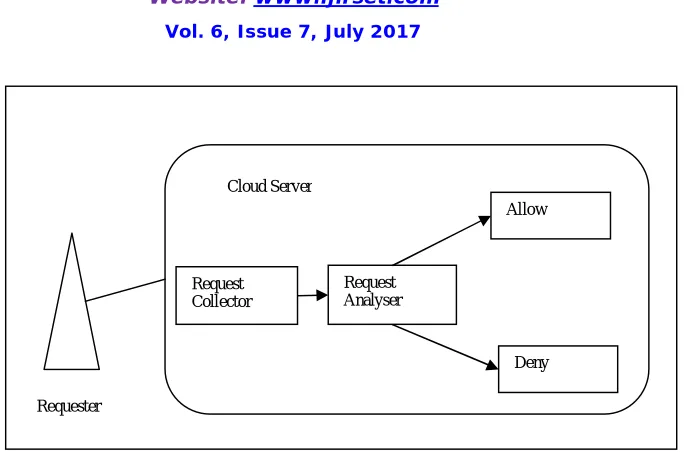
Here we collect the all user information from the each request sent by the user each user request sent to the request analyser and request analyser will extract the all the data regarding the client request like IP address, Request data and time, operating system of the requester, Name of the requester browser, version of that browser, url, input language of the requester, full request address, query String, method type of request.
Fig. 1 Architecture
Here every request coming to the server sent to the request analyser. It will extract all the details of request like date time IP Address input language etc. and stores into request Data table and it will try to analyse the request is attacker or not by using an algorithm By using this algorithm particular request IP Address is decided whether it is attacker or not if it is attacker request will be denied otherwise proceeds to the service
Algorithm
Begin
Maintain the Attackers List, AL Maintain the History of the user, H
Maintain the Last Request Time of IP Address, LRT Maintain the Temper Level of IP Address, Temp Get The Maximum Time deference Tm
User Requested to the Cloud Server, User.
Get the IP Address, Date, Time of the user and store the details in the history, H. if (User.IP == AL.IP)
{
Type = “Existing Attacker” Print: Access Denied. Break
}
if (User.IP exist in Temp)
Requester
Request Collector
Request Analyser
Allow
Add IP Address temper level=1 }
Calculate the time difference, Tcl = tc – tl
If(Tcl <= Tm)
{
Increase Temper level of current request IP Address Proceed the request
} Else {
Reset the temper level Proceed the request
} End.
1. Add all request data into request data table
2. IP address of every request coming to server will be checked in attacker list 3. If it’s found in attacker list than its then request is denied
4. If it’s not found in attacker list we check last request time of this IP address if not found
We add this IP address request time into last request time table
5. If we found last request time of this IP Address then we take this last request time 6. And we calculate the difference between last request time and current time
7. If the difference is below Tm. than we increase the temper level by 1 in the temper table at that particular IP
Address
Flow Chart
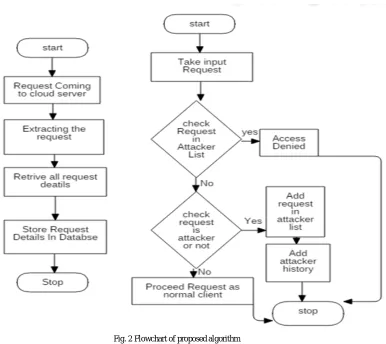
In figure 2 flow chart shows step by step working flow of proposed method, how the attackers are detected and prevented from accessing the cloud services
Fig. 2 Flowchart of proposed algorithm
IV.EXPERIMENTAL RESULTS
encourages the clients to decide the effectiveness of our proposed algorithm named as Time Periodic Algorithm. Along these lines the implementation of the DDoS to keep the server from accessing the server and lower the performance of the server is distributed effectively in this framework.
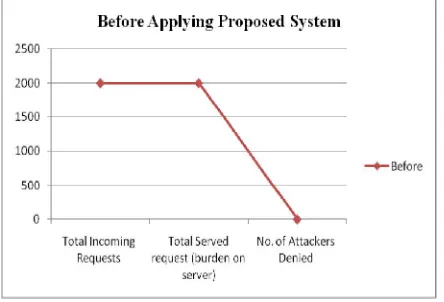
In figure 3 graphical representation of server performance before applying the proposed method is shown here the server serving to all incoming requests no attacker detection method is used so no attackers are detected than total incoming requests, number of Attackers and burden on server is noted and shown in chart
Fig. 3Total Served Request By serevr Before Applying Proposed System
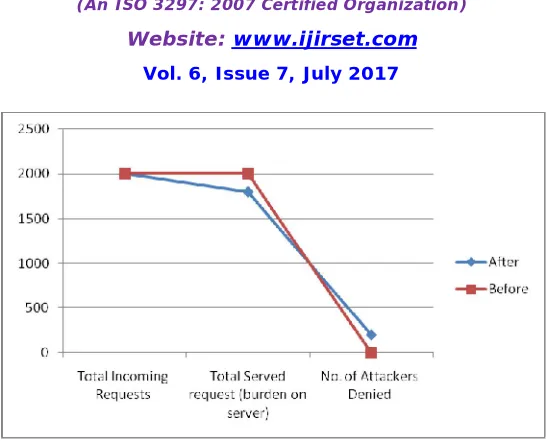
In figure 4 graphical representation of server performance after applying the proposed method is shown here the server serving to all incoming requests proposed attacker detection method is used so attackers are detected than total incoming requests, number of Attackers and burden on server is noted and shown in chart
. Fig. 4 Total Served Request By serevr After Applying Proposed System
Fig. 5 Comparison between Services served after and before Applying Proposed System
V. CONCLUSION
The aim of the paper is to propose a technique to distinguish the attackers getting to the Cloud benefits superfluously limiting the execution proportion of the server. Such attackers are identified utilizing an uncommon strategy which is proposed in this paper and their get to be averted by utilizing the DDoS system. An extraordinary algorithm named Time Periodic Algorithm is executed in this paper to gather the recognized attackers and keep them from getting to the Cloud administrations and in this manner the nature of the server execution is kept up.
REFERENCES
[1] M. C. Mont, K. McCorry, N. Papanikolaou, and S. Pearson, Security and privacy governance in cloud computing via SLAS and a policy orchestration service,” in Proc. 2nd Int. Conf. Cloud Comput. Serv. Sci., pp. 670–674, 2012.
[2] Massive DDoS attack hit DNS root servers, http://www.internetnews.com/ent-news/article.php/1486981, October 2002.
[3] Yahoo attributes a lengthy service failure to an attack. http://www.nytimes.com/library/tech/00/02/biztech/ articles/08yahoo.html, February 2000.
[4] Craig Labovitz, Danny McPherson, and Farnam Jahanian. Infrastructure attack detection and mitigation. SIGCOMM 2005, August 2005. [5] SUN Ji-Gui, and LIU jie. ”Clustering Algorithms Research,” Journal of software, vol.19, pp.48-61, 2008.
[6] Y.Li, B.X.Fang, L.Guo, and Y.Chen,”Network Anomaly Detection Based on TCM-KNN Algorithm,” pp.13-19, 2007.
[7] C. Wan, S. Eisenman, and A. Campbell. “CODA: Congestion Detection and Avoidance In Sensor Networks”, In ACM SASN’03, pp.266-279, 2003.
[8] S. Ganguly, M. Garofalakis, R. Rasto, and K. Sabnani, “Streaming Algorithms for Robust, Real-Time Detection of DDOS Attacks”, Distributed Computing Systems, ICDCS '07. 27th International Conference, 2007.
[9] K. Park and H. Lee. ”On the effectiveness of route-based packet filtering for distributed DOS attack prevention in power-law Internets.” In Proc. ACM SIGCOMM, 2001