THE NUMERICAL RESULTS O F DIVERSE SYSTEMS OF BREEDING, W I T H RESPECT T O T W O PAIRS OF CHAR-
ACTERS, LINKED OR INDEPENDENT, W I T H SPECIAL RELATION T O THE EFFECTS OF LINKAGE'
H. S. JENNINGS
Johns Hofikins University, Baltimore, Maryland
[Received October 2 3 , 19161
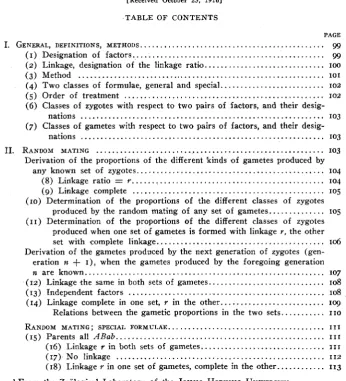
TABLE O F CONTENTS
PAGE
...
I. GENERAL, DEFINITIONS, METHODS. 99
( I ) Designation of factors 99
(2) Linkage, designation of the linkage ratio ... 100
(3) Method
...
IOI(4) Two classes of formulae, general and special
...
102(5) Order of treatment
...
102( 6 ) Classes of zygotes with respect to two pairs of factors, and their desig- nations
...
103(7) Classes of gametes with respect to two pairs of factors, and their desig-
nations 1 0 3
11. RANDOM MATING
...
I03...
...
Derivation of the proportions of the different kinds of gametes produced by any known set of zygotes
...
104(8) Linkage ratio = r.
...
104(9) Linkage complete
...
105 ( I O ) Determination of the proportions of the different classes of zygotesproduced by the random mating of any set of gametes
...
10s
( 1 1 ) Determination of the proportions of the different classes of zygotes
produced when one set of gametes is formed with linkage I, the other set with complete linkage
...
106 Derivation of the gametes produced by the next generation of zygotes (gen-eration n
+
I ) , when the gametes produced by the foregoing generation n are known...
107 (12) Linkage the same in both sets of gametes...
108 (13) Independent factors...
108Iog
Relations between the gametic proportions in the two sets ... I I O
RANDOM MATING ; SPECIAL FORMULAE.
...
I I I ( I S ) Parents all ABab...
1 1 1(16) Linkage r in both sets of gametes..
...
111 (17) No linkage...
1 1 2(18) Linkage r in one set of gametes, complete in the other..
...
113...
(14) Linkage complete in one set, r in the other..
1 From the Zoological Laboratory of the J O H N S HOPKINS UNIVERSITY.
H. S. J E N N I N G S
TABLE OF CONTENTS (continued)
PAGE ...
(19) Parents all AbaR; linkage r in both sets 1 I4 (20) Linkage r in one set; complete in the o t h e r .. ... 1 I4 (21) Original parents ABAB and abab, in equal numbers, with random
mating 1 1 4
111. SELECTION WITH RELATIOX TO A SINGLE CHARACTER ... 1 1 6 Selection of dominants with respect to one of the pairs of characters; gen-
eral formulae
...
1 1 6 (22) Gametes produced when there is selection of dominants with respect... 1 1 6 of zygotes produced in the next generation ( n
+
I ) , when the breeding is by selection for dominant A 1 1 6 (24) Derivation of the gametes produced by the next generation ( n+
I )of zygotes, when the gametes produced by the preceding generation
15 are known ; breeding by selection of dominant A ; linkage the same ( r ) in both sets of gametes.. ... ... I 1 7 (Zj) Linkage complete in one set, r in the other.. ... 1 1 7
(26) Selection of dominants with respect to one pair of characters; special
(27) Illustrative example of the results of selecting dominants ; parents
...
formulae for the effects on the other pair ...
all ARab ... 1 I9
(28) Th e proportions for single factor Selection of recessives ...
(29) Gametes produced when there is selec to one pair of factors
(30) Proportions of the different sorts of zygotes produced in the next gen- eration (11.
+
I ) , when the breeding is by selection of recessives a a . . 123 (31) Derivation of the gametes produced by the next generation TG+
Iwhen the gametic proportions from the preceding generation $2 are
known ... 124
IV. ASSORTATIVE MATING WITH RESPECT TO ONE OF T H E PAIRS OF CHARACTERS;
.
... ...
DOMINAKT W I T H DOMINANT, RECESSIVE W I T H RECESSIVE. ... 124 (32) General ...
(33) Production of gametes from the dominant zygotes ...
(34) Production of gametes from the recessives ...
(35) Proportions of the different types of zygotes (progeny) obtained from the dominants; linkage alike in both sets of gametes.. ... 126
(36) Proportions of the progeny ( t z
+
I ) obtained from the recessives;(37) Proportions of each of the ten possible sorts of zygotes in the next linkage either alike in both sets, o r complete in one set.. ... 127
generation n
+
I ...(38) Linkage complete in one set; general formula.. ...
(39) Summary of the procedure fo r finding the zygotic proport in assortative mating
...
(40) Derivation of the gametic proportions for the gametes
(41) The proportions for the single factor-pairs taken separately..
generation n $. I , when those produced by n are known.. ... 130 1 3 0
V. SELF-FERTILIZATION I34
(43) General formula fo r determining the zygotic proportions in generation are known.. ... 134
(e)
Example to illustrate the use of the tables for assortative mating.. . . . 131...
99 NU M E R I C A L R E S U L T S O F BR E E D I N G WITH LI N K A G E
TABLE OF CONTENTS (continued)
PAGE (4) Special formulae for the case in which the original parents are A B a b . . 135
(45) Parents A b a B 139
Remarks on inbreeding
...
1 3 9SUMMARY 140
LITERATURE CITED 1 4 1
TABLES FOR USE IN COMPUTING THE NUMERICAL RESULTS OF DIVERSE SYSTEMS OF
...
...
...
BREEDING, W I T H RESPECT TO TWO PAIRS OF FACTORS..
...
I 4 1I. GENERAL, DEFINITIONS, METHODS
I n a n earlier paper (JENNINGS 1916) the present author has given formulae for the results of various systems of breeding, with respect to a single pair of characters.’ When more than one pair are considered, the distribution of characters that Mendelism seemed to give has been greatly modified by the further discovery that characters may ’be linked.
A first and perhaps practically most important step in determining the actual distribution is to deal numerically with two pairs of characters, linked or independent; this is what the present paper undertakes. The problem is to discover formulae which for a given system of breeding will give in later generations the proportions of the different classes of individuals (zygotes) with respect to two pairs of characters, when we know the constitution of the original progenitors. The present p q e r deals with: random mating; selection with respect t o a single character
(dominant or recessive) ; assortative mating with respect to a single character ; and self-fertilization. Inbreeding is reserved for separate treatment. Only typical characters, not sex-linked, are dealt with.
( I ) DESIGNATION O F FACTORS
The two members of a pair of alternative factors will be designated
A and a; of a second pair, B and b, the capital letter representing in
( I ) I n section ( 8 ) , page 65, the values given for AA, aa and A a , hold for any later generation ; the constitution of the population does not change with later matings, as stated in the text. This was pointed out to me independently by Dr. C. H. DANFORTH and by Dr. SEWELL WRIGHT. A slip with this correction was enclosed with the reprints distributed. [ I n the meantime the matter has been fully discussed by WENTWORTH and REMICK (1916).--Arote added in cor-
recting the p r o o f . ]
(2) Essentially the formulae of sections (35) and (36), page 7 3 , had been given by DETLEFSEN (1914, p. 95). DETLEFSEN includes in n the first cross, so that his formulae are stated in slightly different terms. I regret that I overlooked
DETLEFSEN’S work, which contains much of great interest on the theoretical results of continued inbreeding.
(3) I n the example under section (28), page 70, the value for nu should be 85/14 in place of 91/14.
(4) In table I, series L , under “How formed,” read “Bn Fe-, G,-,.”
1 Certain points in this earlier paper require mention or correction :
IO0 H. S. JENNINGS
each case the dominant factor. In giving the constitution of an
i d i -
&dual the juxtabosition of the letters will indicate the constitution of the gametes f r o m which the ifidividud was formed, and consequently at the same t i w the linkage, if there is linkage. Thus the individual
ABab is formed from the gametes A B and ab, and if there is linkage, this is ‘between A and B on the one hand, between a and b on the other. The individual AbaB was formed from the gametes Ab and aB, and the linkage, i f any, is between A and b on the one hand, a and B on the other.
( 2 ) LINKAGE ; DESIGNATION OF THE LINKAGE RATIO r
l i h e n two pairs of factors are dealt with, these may be independent or linked. In the former case any possible combination of the two pairs occurs in the gametes as frequently as any other. But when two factors are linked, the combinations found in the gametes which produced the given parents occur in the gametes produced by those parents more fre- quently than do other combinations. Thus, if the individual ABab was produced by union of the two gametes A B and ab, then when this indi- vidual forms gametes, there will be more gametes of the constitutions
A B and ab than of the constitutions Ab and aB.
This number Y
indicates therefore the number of gametes showing the same combina- tion of factors that occurred in the foregoing generation of gametes, in proportion t o I showing other combinations. Thus, if in the case just cited, there are produced 3 gametes of the constitution A B (or a b )
to I of A b (or a B ) , the value of the linkage ratio r is 3. I t is prac- tically important to observe that for the working out of numerical pro- portions, “independence” of factors is merely a special case o i linkage,- the particular case in which the value of the linkage ratio r is I . Thus,
if we derive general formulae for the results of linkage, these will in- clude also the results when the factors are independent; in the latter case for numerical results it will merely be necessary to give to the letter Y
the value I . As is well known, the value of r, the linkage ratio, may vary in different cases from I up to 80 or 100, or more.
I n certain known cases, where linkage occurs, it is complete in one sex, the two factors involved acting in that sex like a single one. Thus, from the parent ABab there are produced in one sex but two sorts of gametes, A B and ab, in equal proportions, while the other sex gives
r A B : I A b : I aB : 7 ab. It is not certain that this completeness of the
NU M E R I CA L R E S U L T S OF BR E E D r N G W . I T E ‘I,J~K&C& 101 with this case, and the case in which linkage is the same in both sexes.
The relative frequency with which the different gametes are formed of course affects the frequency with which individuals (zygotes) with particular combinations of factors appear in the next generation. Our task is to discover general formulae for the proportions of the different classes of zygotes with respect to two characters, whatever the degree of linkage ; formulae from which numerical results are obtainable when the proper values are substituted for r. The solution of this problem is quite independent of the question of the cause of linkage. It merely requires that there shall be in each case some fairly constant average ratio between the number of gametes which show the original combina- tions and those vhich show the new combinations; the work of many investigators has shown that this is the case.
When two pairs of factors are dealt with, whether linked or inde- pendent, it is not possilble from a knowledge of the constitution of the zygotes with respect to each pair taken separately, to tell how the two pairs will be combined; the rules of combination must b e worked out for themselves. This principle will receive illustration in the present paper (see section ( 2 1 ) ) .
(3) METHOD
With respect to two pairs of factors there are 4 diverse sorts of gametes, A B , A b , aB and ab. T h e combinations of these 4 kinds of gametes give I O diverse kinds of zygotes; these ind their origin from the gametes are illustrated in table 6. Owing to this considerable num- ber of diverse kinds of zygotes, direct formulae for the zygotes of a later generation in terms of those of an earlier generation become com- plex, unless we begin with parents of a single simple type. On this account it is, wherever possible, simpler to break the computation into two steps : ( I ) to obtain the proportions of the four different kinds of gametes derivable from the given zygotes; ( 2 ) from the gametic pro- portions thus reached, the proportions of the different sorts of zygotes for the next generation are obtained. W e shall therefore present formulae f o r each of these steps, and the computations for any par- ticular case will usually require the use of ’both these formulae, save in special cases where it is possible to develop single, more comprehensive, formulae.
This method of proceeding by two steps (first finding the gametes, then from these the zygotes) depends upon the principle that rmdom mating of zygotes gives the s a w results as random m t h g of tho
. I ., %I. S. JENNINGS . . .. , .
I02
gametes which they produce. The particular way in which the gametes have been united in the parental zygotes does not affect the results of random mating.
Where the mating is not a t all at random, as in self-fertilization, the principle cannot be employed; we must devise formulae for the direct transformation of one generation of zygotes into a later one.
This principle is easily demonstrated algebraically.
(4) TWO CLASSES O F FORMULAE; GENERAL AND SPECIAL Two classes of formulae are obtainable :
General formulae f o r transforming generation n into generation n
+
I . One class is of general application, so that whatever the con- stitution of the parental population, by means of the formulae the con- stitution of the population in later generations is obtainable. For example, the original population may be composed of diverse individuals in the proportions 3 A B A B+
I abab+
I AbaB+
4 A B a B , and we may desire to know the constitution of the lpopulation in some later genera- tion after breeding by random mating or assortative mating, or the like. Such general formulae can as a rule be given only for determining the constitution of the next following generation; the formulae can then be reapplied for determining the constitution of the next generation, and so on indefinitely. Thus such general formulae may be characterized as formulae for transforming generation n into generation n+
I .The second class consists of special formulae, for important particular cases, the main such case being that in whic'h the original parents are all alike and are of the type
ABab or AbaB. For such parents, which represent the case to which the formulae will most commonly be applied, it is possible, for some systems of breeding, to obtain formulae that will give directly the con- stitution of the population in any later generation, without working out the constitution in the intervening generations. For example, if the original progenitors are ABab, we may by a proper formula determine a t once what will be the constitution of the population after seven suc- cessive random matings, or ten successive self-fertilizations, o r the like.
Special formulae for parents ABab, etc.
( 5 ) ORDER O F TREATMENT
W e shall first set forth the different classes of zygotes and gametes with respect t o two pairs of factors, and propose algebraic designations f o r the proportional numbers in which each occurs in any case.
NU M E R I CA L R E S U L T S OF BREEDING W I T H L I N K A G E 103 in which linkage is the same in the formation of both sorts of gametes, and that in which linkage is complete in forming one of the sets of gametes. The formulae derived will be grouped in a series of num- bered tables, which for convenience of reference will be placed all to- gether at the end of the paper.
(6) CLASSES OF ZYGOTES WITH RESPECT TO TWO PAIRS OF FACTORS, A N D
With respect to two pairs of factors, and having regard to linkage, there are ten diverse types of zygotes, the origin of which is illustrated in table 6. Any or all of these ten types may be included, in various proportions, in any population. The proportional numbers of these various classes of zygotes in any generation will be designated by the letters
c
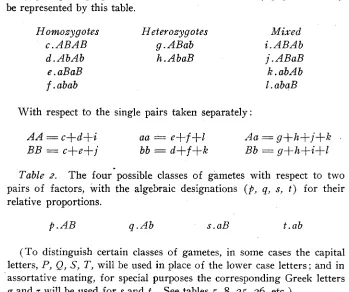
to 2, with the significations shown in table I (page 141). I n table I we classify as homozygotes those that are homozygotic with respect to both pairs of factors ; as heterozygotes those heterozygotic with respect to both pairs of factors; as mixed those homozygotic with respect to one pair, heterozygotic with respect to the other. Any popula- tion maybe
represented by table I , when proper values are given to the letters c to 1.I n the later treatmenlt the letters c to
I
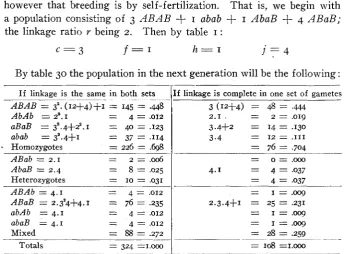
will be used to designate in brief the proportions of the various types of zygotes to which the given letter is assigned in this table I ; thus, g will be understood to signify always the number of zygotes having the constitution ABab; j the num- ber of AB&, etc. I n specific cases the values of c to I will be diverse. Thus in the population composed of 3 A B A B+
I abab+
I AbaB+
4 ABaB, the value of c is 3 , f = I , h = I , j = 4, while the value of the other letters is 0.THEIR DESIGNATIONS
( 7 )
CLASSES OF GAMETES W I T H RESPECT TO TWO PAIRS O F FACTORS, AND THEIR DESIGNATIONSThere are four classes of gametes with respect to two pairs of factors. W e shall designate their (relative) numbers in any given case by the letters
p,
q, s and t, with the significations shown in table 2 (page 141 ).
As in the case of the zygotes, so here, the letterp
will at times be used by itself to designate the number of gametes of the type A B , q the number of A b , etc.11. RANDOM MATING
104 H. S. JENNINGS
generation n ) ; these will be the gametes for producing generation FZ
+
I . Next we shall get formulae for the zygotes (of generation n+
I ) re- sulting from the random mating of this (or of any) set of gametes.Third, we shall develop formulae by which the proportions of the
gaiizetes for the next following generation may be obtained when we
know the proportions of the gametes for the foregoing generation,- so that the proportions of the zygotes may be omitted from considera- tion until the generation is reached for which the zygotic proportions are desired.
Finally we shall take up special formulae for particularly important cases, such as that in which the original parents are all ABab or AbaB.
DERIVATION O F T H E PROPORTIONS OF T H E DIFFERENT KINDS OF GAMETES PRODUCED BY ANY KNOWN SET O F ZYGOTES
Any population of zygotes may be represented in the way shown in table I , by giving proper values to c
. . .
1. Our present question is : W h a t will be the relative numbers of the four different sorts of gametes pro- duced by such a imptilation? Or since the relative proportions of the four sorts of gametes are designated by the lettersp,
q, s and t (table 2 ) , what we require is t o derive the values ofp,
q, s and t in terms of c to 1(of table I ) .
I n deriving the gametes from the zygotes, it is t o be remembered that the original gametic union that produced the zygotes of table I (and hence the linkage), is indicated by the juxtaposition of the letters, and that the linkage ratio is Y.
(8) LINKAGE RATIO
=
rTaking first one of the heterozygotes, as ABab, the gametes are
r A B : I A b : I aB : Y ab. I n order to realize these proportions it is evidently necessary that each such zygote should produce 2r
+
z gametes. T o keep the proportions correct throughout, each gamete of table I , whatever its constitution, must be considered to produce z r+
2 gametes,although from a homozygote these will all be alike, and from a mixed zygote there will be but two sorts, in equal numbers. W e shall there- fore find that the zygotes of table I give the gametes shown in the first column of table 3.
Having obtained table 3, we collect from the column “linkage = r”
the various values f o r each of the f m r kinds of gametes AB, A b , aB and
ab. As in table 2 , the total values f o r the different kinds are to be desig-
N UM E R I C A L R E S U L T S OF B RE E D IN G WITH L I N K A G E (9) LINKAGE COMPLETE
105
I n the case that the linkage is complete in forming one of the sets of gametes, the proportions of the gametes of that set will not ‘be those in table 4. Where linkage is complete, each parent zygote produces but two kinds of gametes in equal number,-these being the same two kinds by which this parent was formed. Thus the individual A B a b produces gametes A B and ab in equal numbers; the individual AbaB produces
Ab and
aJ3,
etc. T o get the correct proportions throughout we require to assume only that each zygote produces two gametes. The results are given in the second column of table 3. Collecting the values for the four sorts of gametes, and calling their proportions, when linkage is complete, by the capital letters P, Q, S and T, in place of the cor- responding small letters, we obtain table 5.( I O ) DETERMINATION OF THE P R O P O ~ ~ T I O N S OF T H E DIFFERENT CLASSES OF ZYGOTES PRODUCED BY T H E RANDOM MATING OF
ANY SET OF GAMETES
The population at the beginning is that shown in table I (which of
course represents any population whatever, if the correct values are given to the letters c t o
2).
The proportions of the gametes (that is, the values ofp,
q, s: andt )
are determined by table 4.Having thus obtained the values of
p,
q, s and t, we must next observe the zygotes produced by the random mating of the four sets of gametes,p
.
AB, q.
A b , s.
aB and t.
ab. The mating and results are repre- sented in table 6.It will be observed that of the resulting zygotes (table 6), the four forming the diagonal from the left upper corner to the right lower corner are homozygotes; the ,four forming the other diagonal are hetero- zygotes, and the other eight are mixed. The zygotes resulting from the first random mating (a = I ) are therefore those shown in table
7.
Table
7
is the fundamental general table for determining the zygotic proportions resulting from the random mating of any given set of gametes. It will be employed in working out the results of selection and of assortative mating, a s well as of random mating.Example. Tables 4 and
7
furnish the formulae for the two steps necessary to obtain the proportional numbers of the different classes of individuals (zygotes) in the generation n f I , when we know those in generation n,-the mating being a t random, and the linkage being the same for both sets of gametes.I 06 H. S. JENNINGS
For example, suppose that the original population consists of 3 A B A B
+
I abab+
I AbnB+
4 A B a B ; that the linkage ratio r is 2, and that breeding is by random mating. What various types of individuals will be present in the next generation, and in what proportions?Here evidently (referring to table I),-
c = 3 , f = I , h = I , j = 4
while d, E, g, i,
k
andI
are 0. Therefore the gametes produced will be,by table 4 (since 7
+
I = 3) :P = 3 . ( 6 + 4 )
+
1 = 3 ' 2 -q = 2.1 -
s = 3.4
+
2.1 = 14 t = 3.2+
I = 7f l + q + s + t = j 4
The gametes will therefore be in the proportions 31 A B : 2 A b : 14 aB : 7 ab.
Then the zygotes of the next generation (vz
+
I ) will be, by table 7, the following :7
A B A B = 3 1 ~ =961 AbaB = 2 . 2 . 1 4 =
56
A b A b = z2 = 4 A B A b = 2 . 3 1 . 2 =124A B a B = 1 4 ~ =196 ABaB =2.31.14=868
abab = 7' = 49 abAb = 2 . 2 . 7 = 28
ABab = 2 . 3 1 . 7 = 4 3 4 ab& = 2 . 1 4 . 7 =196 By now substituting these values for c to 1 in table I , and using anew tables 4 and 7, we may find the zygotic proporti'ons for the third genera- tion, and so on indefinitely. If desired the values for c to 2 may be re- duced to decimal fractions in each case, giving all later proportions in decimals.
( I I ) DETERMINATION O F THE PROPORTIONS O F THE DIFFERENT CLASSES O F ZYGOTES PRODUCED WHERE O N E SET O F GAMETES FORMED
WITH LINKAGE ( T ) (TABLE 4) MATES WITH ANOTHER SET WITH COMPLETE LINKAGE (TABLE 5 )
This represents what appears to be the usual condition, where the gametes from one sex (eggs or sperm) are produced with linkage r,
the other set with complete linkage.
N UM E R I C A L R E S U L T S OF BR E E D I N G W I T H L I N K A G E
107
W e determine by table 4 the values forp,
q, s and t, and by table5
the values forP,
Q, S and T.Now to obtain the zygotic proportions in the next generation, in table 6 we substitute in one of the columns of gametes the values P,
Q,
Sand
T
forp,
q, s and t ; then we multiply as before to obtain the 16 lots of zygotes. Having performed this operation and classified the results in the same way as was done for table7,
we obtain for the zygotic proportions the table 8.T o transform the zygotes of generation n into those of generation n
+
I , when linkage is complete in one set of the gametes, we therefore use successively the formulae of tables 4,5
and 8. Sup- pose that we take the same example given in section ( I O ) , page 106, but assume that linkage is complete in one set of gametes.Then by tables 4 and 5 the two sets of gametes are:
Example.
P
=3'
P = IOs = 1 4
s =
5q = 2 Q = I
t = 7
T =
2And by table 8 the individuals (zygotes) of the next generation ( n
+
I ) are :A B A B =
3 1 0
AbaB = 24A b A b = 2 A B A b = 51
aBaB = 70 A B a B = 295
abab = I4 abAb = 1 1
ABab =
132
abaB =63
By substituting these values for c to I in table I , we may determine the proportions of the different types of individuals in the next later generation, and so on. W e may of course, if we prefer, reduce all the proportions to decimal fractions, and employ these decimals in working out results for later generations.
DERIVATION O F T H E GAMETES PRODUCED BY THE NEXT GENERATION O F ZYGOTES (GENERATION n
+
I ), WHEN THE GAMETES PRODUCED BYI
os
H. S. JENNINGSof the gametes produced by generation 2 ; thence the gametic propor- tions from generation 3 ; thence those from generation 4, thence from
5.
Only for this final generation do we determine the zygotic proportions. Our problem is therefore to obtainpntl,
qntl, s,,,~ and tn+l fromp,,,
qn, sn and L.
( 1 2 ) Linkage the s a w in both sets of gametes
To derive our formulae, we first obtain the gametes from the original parents (generation n ) by table 4 ; then from these gametes we derive the zygotes (generation n
+
I ) by table7.
From these zygotes, by the method of section (8) and table 3, we find that the gametes pro- duced are the following:Zygotes of n
+
I Gametes f r o m n+
Ip 2 .
A B A B - -p 2 .
( z r+
2 ) A Bq 2 . A b A b
-
-
q 2 . (2r+
2 ) A bs 2 . aBaB
-
- s 2 . ( 2 7+
2 ) aBt2 .ubab
-
-
t 2 . ( 2 r+
2 ) a b2pt.ABab = 2 p t . r . A B + z p t . A b
+
zpt.aB+
zpt.r.ab 2qs.AbaB = 2qs.r.Ab+
2qs.AB+ 2qs.ab+
2ps.r.aBz p q . A B A b = 2pq. ( r + I ) A B
+
2pq. ( + + I ) A b2ps.ABaB = 2ps. ( r + ~ ) A B
+
z p s . ( + + I ) aB2qt.abAb = z q t . ( r + ~ ) ab
+
zqt.
( r + I ) A b2st .abaB = 2 s t . ( r + ~ ) ab
+
zst.
( r + I ) aBCollecting the values for the gametes A B , Ab, uB, and ab, (fpom
n
+
I ) , and removing from each the factor 2, we obtain the formulae given in table 9.By the continued use of these formulae we may find the proportions of the different gametes produced by any later generation of random mating, without troubling to find the zygotic constitution in any genera- tion save the final one in which we are primarily interested. At any time the zygotic constitution is found by the formulae of table 7.
( I 3 ) Independent factors
If the factors are independent ( r = I ) , the gametic formulae of table 9 may be simplified through the substitution of I for r, giving table IO.
En-ampEe. In the example given in section ( I O ) , the following values were found for
p,
q, s and t for the first random mating:NU M E R I CA L R E S U L T S OF B RE E D IN G WITH LINKAGE 19
Then by the formulae of the table g the values of
p ,
q, s and t for the second random mating will be (when r=
2) :p
= 3.31.47+
2.31.7+
2.14 = 4833q = 3.2.40
+
2.2.14+
31.7 = 513 s = 3.14.52+
2.2.14+
31.7 = 2457t = 3.7.23
+
2.31.7+
2.14 = 945 -P
+
q+
s+
t = 3.542 = 8748Now by the formulae of table 7, we may if we desire, obtain from these results the relative numbers of the different kinds 'of zygotes re- sulting from the second random mating.
O r we can by a repeated use of the formulae of the present section obtain the gametic constitution for the third, fourth and later genera- tions; finding in addition the zygotic constitution for any desired gen- eration.
(14) Linkage complete in one sex, r in the other
I n this case we derive two sets of gametes from the original parents, by means of tables 4 and
5,
and these give for generation n+
I , the zygotes of table 8. Fpom these zygotes of table 8, we must find two sets of gametes, one with linkage r (by the method illustrated in sec- tion ( S ) ) , the other with complete linkage (by the method illustrated in section (9)). We must assume that both sexes are represented in each kind of zygote of table 8, so that we must form a first set of gametes from all the kinds of zygotes of table 8 by the method of sec- tion (S), then a second set from all by the method of section (9). Performing these operations and collecting the results, we obtain table I I.I n comparing the gametes of set I with those of set 2 (in table I I ) certain constant relations between the two sets become evident. These are shown in table 12. These relations are of consequence for certain problems, particularly in selection and assortative mating ; they are also useful in checking up the correctness of computations.
W e will take the example employed in section ( I O ) , but now assuming that linkage is complete in one sex. The parent zygotes were 3 ABAB
+
I abab+
I AbaB+
4 ABaB; and r = 2.As shown in section (IO), before the first random mating the gametes of the first set, with linkage r, are:
Exanzple.
I I O H. S. JENNINGS
According to section ( 1 1 ) , further, the gametes of the second set,
with complete linkage, are :
P = I O Q = I S = 5 T = 2
The zygotes resulting from the first random mating are therefore, by table 8 :
A B A B = 31. I 0 = 310 AbaB = 1.14+ 2 . 5 = 24
A b A b = 2 . 1 = 2 A B A b x I o . 2 + 3 1 . 1 = 5 1
aBaB = 1 4 . 5 = 70 A B & = 1 0 . 14
+-
31.5 = 295 ,a,bab =
7.2
= 14 abAb = 1 . 7+
2 . 2 = 1 1A B a b = I o . 7 + 3 1 . 2 = 1 3 2 abaB =
5.7
+ 1 4 . 2 = 63The gametes for the second rando" mating ( n = 2 ) are obtained from the values of
pl,
ql, etc., given above, by the formulae of table 1 1 , giving the following :Set I : Linkage r
=
2, in both sexes:p ,
= 3 . 3 1 . 1 6 + 3.10.47+ 2 . ( 7 0 + 6 2 )+
1 4 + 1 0 = 3 1 8 6 q2 = 3 . 2 . 1 3 + 3 . 1 . 4 0 + 2 ' . ( 1 4 + 1 0 ) + 7 0 + 6 2 = 378sp = 3 . 1 4 . 1 7 + 3 . 5 . 5 2 + 2 . ( 1 4 + 1 0 ) + 7 0 + 6 2 = 1674 t, = 3 . 7 . 8 +3.2.23 + 2 . ( 7 0 + 6 2 )
+
1 4 + 1 o = 594-
p + q + s + t = 5832
Set 2 : Linkage complete in one sex:
P , ,= 10.54+31.18= 1098
Q 2 = I . 5 4 + 2 . 1 8 = 90
s,
=
5 . 5 4 + 1 4 . 1 8 = 522T ,
=
2.54+ 7 . 1 8 = 234I t will be observed that the sum
( p
+
q+
s+
t ) is just 3 times the sum of ( P+
Q+
S+
T ),
3 \being the value of ( r+
I ).
NU M E R I C A L R E S U L T S OF B R E E D I NG W I T H L I N K A G E 1 1 1 RANDOM MATING : SPECIAL FORMULAE
( 1 5 )
Parents all A B a bFor the specially important case in which the parents are a first cross between A B A B and abab, ( s o that they are themselves A B a b ) , we may obtain a general formula which shall give us directly the proportions of gametes (and indirectly of zygotes) for producing any generation n, without working out the proportions for intervening generations. For this the following points must be noticed :
Evidently the number of gametes A B is the same as the number of
ab; while the number of A b is the same a s of &, and this equivalence will be found to hold throughout randtom mating. W e have therefore, so far as the gametes go, but two unknown quantities to deal with in place of four. I n tables 2 and 5, therefore, we can put:
p = t
P = T q - s Q = SW e require therefore but to find
p,
P, q and Q; these will give us the others.Now, if at the beginning the parents are all ABab, and the linkage ratio is r, then evidently the gametes from these parents are Y A B : I A b
: I aB : r ab, so that for producing generation I the gametes are:
p = r
q = I p + q = r + ~ p - q = r - ~In the sex (if there is such) in which the linkage is complete, the gametes formed by A B a b are evidently simply A B and ab in equal num- bers, so that ( f o r producing generation I ) :
P = I Q = o P + Q = I P - Q = I
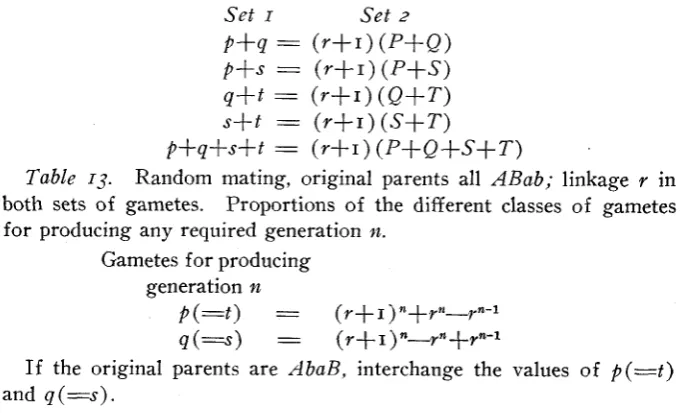
(16) Linkage r in both sets of gametes, parents all A B a b
Now, if we take first the case in which linkage is r in both sexes, we may by table 9 from the above gametic proportions for producing generation I determi.ne the gametic proportions for producing genera- tion 2 . W e shall find these to be as follows:
p,
= 2 r 3 + 3 r 2 + 2 r + ~ = ( r + ~ ) ( 2 r 2 + r + 1 )q z = 3r2
+
4r+
I = ( r+
I ) (3r+
I )Since it is the relative proportions that we desire, we can take out the common factor ( r
-I-
I ) , and we have:p 2 = z r 2 + r + ~
p ,
+
q2 =2r’+
4r+
2 = 2 ( Y+
I ) ’q 2 = 3 r + I
fi2
- q, = 2 Y 2-
2r= 2(r2-
r )I I2 H. S. JENNINGS
If we continue in this way, finding successively the values of
p3,
p 4 ,
p,,
q3, q4, q5, etc., certain general relations manifest themseives, par- ticularly with regard to the sums ofp
and q, and their differences. I t turns out that for producing any generation nP n
+
q n = 2 ( r+
1)"p ,
- qn = 2 ( r * - rn-l )Solving these two equations for the values of
p ,
and qn (and omit- ting from the result the common factor, 2 ) , we obtain the formulaeof table 13.
Having determined the values of
Pn,
q,, s, and t, by table 13, the proportions of the different classes of individuals (zygotes) in genera- tion 12 is obtained from table7.
(17) If there is no linkage ( r = I ) and the parents are all ABab
the population will be found to remain constant, in the following pro- portions :
The four sorts of homozygotes, each = I The two sorts of heterozygotes, each = 2 The four sorts of mixed, each
Parents all ABab, linkage ratio r = 3 .
constitution of the population (zygotes) after 4 random matings? table 13:
- - 2
Example. What will be the
By
p 4 ( = t 4 ) ~4~ f 3 4 - 3 3 = 3 1 0
q 4 ( = S 4 ) = 4 " - 3 ' + S 3 = 2 0 2
p 2
( = t 2 ) =96,100q2 ( = s 2 ) = 40,804
2pq ( =2St) = 125,240
Total zygotes = (620
+
404) = 1 0 2 4 ~ = 1,048,576.proportions of the different sorts of zygotes a r e :
From which it is evident that by the zygotic formulae of table 7 the
96, I 00
A B A B = = .0916
1,048,576
abab z . 0 9 1 6
A b A b = .os89
aBaB =.0389
Total homozygotes = .261 I A B a b = .1833
AbaB = .0778
Total heterozygotes = .261 I
Each of 4 sorts of mixed = .1194
NUMERICAL RESULTS O F BREEDING W I T H LINKAGE 113
( I S ) Parents all ABab; linkage Y in one set of gametes, complete in
the other
Here, as in section
(IS),
the number of gametes A B is equal to that of ab, while the number of A b is equal to that of aB, so that:Also, as we saw in ( I S ) , for the first mating ( n = I ) : p = t * q = s P = T Q = S
p = r q = I P = I Q = o
p + q = r + r ; p - q = = r - ~ . , P + Q = 1 ; P - Q = r .
Now by the use of table 1 1 , we obtain the corresponding values of
p,
q, P and (2 f o r producing generation 2 . W e find thus that:p 2 = 2 P + 2 y + I P 2 = 2 r + I
(12 = 27
+
I Q 2 = IP 2
+
q 2 = z ( r+
I > 2p ,
- q, = zr2 P , - Q ,=zr
P2
+
Q 2 = 2 ( r+
1)Now i f by continued use of table 11, we find the corresponding values fo r successive generations, we discover that f or any number n of genera- tions the gametes which mate to form that generation show the follow- ing relations :
p ,
+
4n=2"-1 ( r+
I ) "p n - q , = z r 2 ( z r
+
I)"-,P,
+
Q,= z,-' (Y+
1 ) ~ - 1E',- Q,=zr ( z r
+
I ) " - ~Solving these equations for the values of
p ,
q, P and Q, we obtain the formulae of table 14.Having determined thus the proportions of the gametes, the constitu- tion of generation PZ in zygotes is obtained by the use of table 8.
Example:-Parents ABab; linkage ratio r = 3 ; four generations of random mating ( n = 4 ) . What is the constitution of the population? By table 14, the gametic proportions preliminary to generation 4 will be :
p,
= z2.4*+
9 . 7 2 = 1465 q4 = 2 2 . 4 4 - 9 . 7 2 = 583$4
+
q4 = 2048P , = 2 2 . 4 3 + 3 . 7 2 = 403
Q , = z 2 . 4 3 - 3 . 7 2 = 109 -
P ,
+
Q 4 - S I 2To obtain the zygotes resulting from the mating of these gametes it is well to note the following:
H. S. J E N N I N G S
PP = 590,395
(24 = 63,547
pq = 234,949
PQ
= 159,685pfl
+
Qq-k
pq+
$0
= 1,048.30.1.Then by table 8 (remembering that
p
= t, q = s, P = T and Q = S ) ,we find that the total number of zygotes ( P
+
Q+
S+
T )( p
+
q+
s+
t ) is 4,194,304. Working out, by table 8, the propor- tions f o r each of the classes of zygotes, and dividing each by 4,194,304 in order to reduce them to decimals, we find that the population in the fourth generation is :Homozygotes, A B A B and abab, each . I ~ I
A b A b and aBaB, each .or5
Total .3I'
AbaB ' .030
Heterozygotes, ABab .282
Total Mixed, four sorts, each
.SI" .094 Total mixed 3 7 6
(19) Parents AbaB; linkage r
in
both sets of gametesI n this case simply interchange the values of
p
and q in table 13 (of course therefore also the values of t and s j , then obtain the zygotic proportions by table 7.( 2 0 ) Parents AbaB; linkage r i n one set of gametes, conzplete i n the
other
I n this case simply interchange the values of
p
and q ; also of P and Q, in table 14 (of course therefore also the values of t and s, as well as of T and S) ; then obtain the zygotic constitution by table 8.(21 j Original parents A B A B and abab i n equal niiinbers, r a n d o m m a t k g
I n this case if there is linkage the proportions of gametes and zygotes for any generation must be worked out by the general formulae for random mating, given in sections (8) to (14).
NU M E R I C A L R E S U L T S OF B RE E D IN G WITH L I N KA GE 1 1 5 case with that in which the parents are all A B a b (and there is no link- age). If we examine the results with respect to single pairs of charac- ters taken separately, we find them to be identical for the two cases. That is, when the parent population is either ABab, or is A B A B
+
abab,random mating gives for all later generations with respect to one pair of characters the uniform constitution
%
A A+
%
A a+
%
aa; with respect to the other the constitution%
B B+
5
Bb+
%
bb. But when we consider the two pairs together, we find that the two cases give diverse results ; the two pairs of characters are combined diversely in the two cases. This is therefore an example of the fact, mentioned in section ( 2 ) , that we cannot from a knowledge of the constitutionwith respect to two pairs of characters taken separately determine what will be the constitution with respect to combinations of the two pairs. I n the case of the population derived from the random mating of ABab,
the proportion of any combination of the two pairs is merely the pro- duct of the proportions for the two component pairs taken separately, thus the proportion that are A A B b is
%
X%
=%,
etc. But when the original parents are A B A B+
abab, this rule does not hold. The gametes from such parents are in any generation PZ the following:p,
= t, = 2,-1 + Iqn = s, = 2"-1 - 1
The zygotic proportions are then obtainable by table
7.
It will be found that these zygotic proportions change from generation to genera- tion, although for each pair of characters taken by itself the proportions are constant. The zygotic proportions in successive generations are :Random matings I 2 3 ?a
A B A B and abab, each 4 9 25 D2*
A b A b and CrBaB, each 0 I 9
c2,-1
AbaB 0 2 IS 2C2,-,
ABab S IS 50 2D2,
Mixed, 4 sorts, each ' 0 6 30 zD,C,_,
-
For- the n'th generation the proportions are above given in terms of the. series of table I in my earlier paper ( JENNINGS 1916) ; thus the value for A B A B and abab is the square of the n'th term of series D of that paper; the value for AbaB is twice the square of the ( 1 2 - r ) t h term of series C of that paper; etc.
I 16 H. S. J E N N I N G S
111. SELECTION WITH RELATION TO 4 SINGLE CHARACTER
Suppose that in breeding, selection is exercised with respect to a single character forming one of a pair; for example suppose that of the pair A and a, individuals showing the character
A
are always selected for further propagation. I n our previous contribution ( JENNINGS 1916) we have dealt lvith the results on the constitution of the population with respect to this pair on which selection is based. But what will be the effect on the constitution with respect to another pair of factors, B andb, which is linked with the pair on which selection is based? That is, in a population composed of individuals having A , a , B and b in the various possible combinations, what will be the resulting constitution due to selecting for the character A for a given number i a of generations? W e shall take up first the case in which the selected character is dominant, next that in which it is recessive. W e may proceed upon the same general plan employed for random mating, employing primarily the proportions of gametes in the successive generations as the bases for our work, and deriving the proportions of zygotes secondarily from those for the gametes that produce them.
SELECTION O F DOMIN4NTS WIT H RESPECT TO ONE O F T H E PAIRS O F CHAR- ACTERS ; GENERAL FORMULAE
( 2 2 ) Gametes produced echeiz there is selection of domiizaizts a i t h re-
spect to one pair
If we have such a population as is shown in table I , and breed only from those that are dominants with respect to the pair A and a, this is equivalent to omitting all the zygotes that do not contain A ; that is, it omits e, f and I of table I . The gametes produced when there is such selection of dominants are therefore in the proportions shown in table
15
(compare with tables 4 and5).
t23) Proportiom of the different classes of zygotes produced iir the
iiext geizeratioiz ( i a
-/-
I ) , wheiz the breeding is byselection f o r dominaizt A
The selection has taken place in the production of the gametes (table I S ) . These gametes now simply mate at random, so that we can em- ploy directly the tables 7 and 8, for random mating. Therefore when there is selection for dominant A , the procedure for finding the propor- tions of the population in the next generation is as follows:
NUMERICAL R E S U L T S OF BREEDING W t I T H L I N KA GE 117 If linkage is the same ( = r ) in both sets of gametes, employ first the formulae of table
15,
(set I ) ; then those of table7 ;
this gives thedifferent classes of individuals in the next generation n
+
I .If linkage is complete in one set of gametes, employ first table
15
(both sets), then table 8; thus obtaining the proportions of the different classes of individuals in the next generation ( n+
I ) .If it be desired to find the zygotic proportions only for some later generation (as for example the seventh), it is not necessary to find the zygotic proportions for the intervening generations, but one works for these intervening generations with the gametes alone, according to the methods of the following sections (24) and ( 2 5 ) .
(24) Derivation of the gametes produced by the next generation ( n + I )
of zygotes, when the gametes produced b y the preceding genera- tion n are known, (breeding by selection of dominant A )
If we desire to obtain the zygotic proportions only for some later generation, we may work for the intervening generations only with the gametes, by methods analogous to those set forth for random mating Linkage the same ( = r ) in both sexes. W e use the method set forth in sections ( 12), ( 1 3 ) and ( 1 4 ) .
in section ( 1 2 ) , but exclude from gamete formation the zygotes aBaR, abab, and abaB (since these do not contain A ) . W e thus obtain the formulae given in table 16.
Of course the zygotic proportions for generation n
+
I may nowif desired be found from the zygotic formulae of table
7.
O r by re- peated use of these formulae of table 16 we may find the gametic pro- portions for any later generation, then by table7
find the zygotic proportions for that generation.(25) Linkage complete in one set, r in the other
Derivation of the gametes that produce the succeeding generation
( n
+
I ),
from those that produce the preceding generation ( n )W e use the methods set forth in ( 1 4 ) ~ but exclude from gamete formation the zygotes aBaB, abab and abaB (since these do not con- tain A ) . T h e formulae we require are indeed obtained directly from those of table 1 1 , by omitting in all cases the factors Ss, Tt, St and
sT.
The results are given in table 17.I I8 H. S. J E N N I N G S
the zygotic proportions f o r that generation. See the example in sec- tion (27).
No formula has been found obtainable for determining the propor- 'tions in any given later generation $2, without working out the values
for the intervening generations. Even when the original parents are
ABab or AbaB, the general methods ( 2 2 ) to (25) must be employed. The most important case, in which the original parents are ABab, will be found worked out illustratively in section
(27).
(26) SELECTION OF DOMINANTS WITH RESPECT TO ONE OF THE PAIRS OF CHARACTERS ; SPECIAL FORMULAE FOR T H E EFFECT
ON T H E OTHER PAIR
Possibly the most interesting question in selection with reference to one pair of characters is its effect on another pair of characters, linked with the first pair. W e shall take this up here, giving formulae for both the single factor-pairs taken separately.
Proportions of the single factor-pairs taken separately, when there is selection of dominant A : From the formulae of table
15,
or of tables 16 and17,
taken in connection with those of tables 7 and 8, as set forth in sections ( 2 2 ) to (25), we may readily obtain for the de- sired generation the proportions of the population with relation to the members of either pair of factors taken separately; that is, with relation to A and a; or to B and b. After obtaining for the next generation the gametic proportions of table 16 (if linkage is the same in both sets) ; or those of table17
(if linkage is complete in one of the sets of gametes), we observe that the gametic proportions for A and a, andfor B and b, are those given in table 18.
The zygotic proportions in the next generation ( n
+
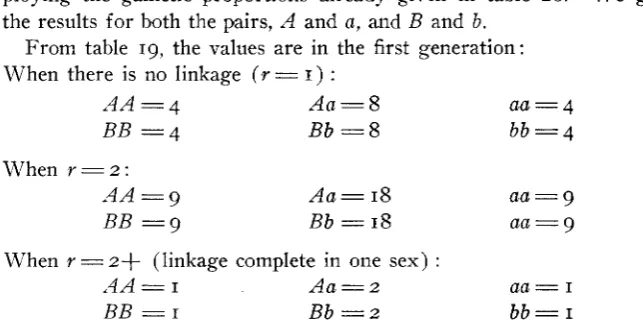
I ) are then,with relation to the single factor-pairs taken separately, those given in table 19.
The same proportions for each pair separately would be obtained by deriving the zygotic proportions for the two pairs together according to (24) and (25), then tabulating the constitution with reference to
the factors taken separately.
NUMERICAL RESULTS OF BREEDING W,ITH LINKAGE IIg With relation to BB, B b and bb, the proportions depend on the amount of linkage; the formulae of the present section enable us to determine precisely how selection with reference to one character ( A )
affects the proportions with respect to another character linked with it
( B and b ) . If there is no linkage (Y= I ) , the formulae given in table
19 for BB, B b and bb give the same results as for those of random mating (sections ( I ) to (12) in my earlier paper) ; that is, selection with reference to A and a is random mating with reference to B and b,
if the two pairs are not linked.
All these matters are illustrated in the concrete example given in the following sections (27) and (28).
(27) Illustrative example of the results of selecting dominants ; parents all A B a b
To illustrate the use of the formulae for selection of dominants, we will take the most important typical case, in which the parents at the beginning are the dihybrid ABab. W e will determine the results for several generations of selecting for propagation only those having the dominant factor A. W e shall compare the results when there is linkage and when there is none; also the results when linkage is alike in both sexes, and those when linkage is complete in one sex. To keep the numbers relatively small we shall assume the linkage to be 2.
As the original parents ( A B a b ) all contain A , none are excluded in the first mating. When there is no linkage the gametes are evidently I A B : I A b : I aB : I ab. When the linkage is 2, the gametes are 2 A B : I A b : I aB : 2 ab.
I n this case for the first mating, as we have seen,
p ,
= I, q1 = I , s1 = I , t, = I. W e now find the proportions for the succeeding generations, by the formulae of table 16. For the next generation ( n = 2 ) ‘they are evidently as follows (since r+
I = 2).No linkage ( r = I ) .
p,
= 2 . 1 . 3+
1 . 1+
1 = 8 ( = 2 )q2 = 2 . 1 . 3 + 1 . 1
+
1 = 8 ( = 2 ) s , = 2 . 1 + I + 1 = 4 ( = 1 )t , = 2 . 1 + I + 1 = 4 ( = 1 )
As it is only the proportional numbers that we desire, we may divide
Repeating our use of the formulae of table 16, we find that when through by 4, giving the numbers in the last column.
I20 H. S. JENNINGS
there is no linkage the gametic proportions for the first four genera- tions a r e :
11. -- I 2 3 4
3
I I 3 4
I 2 3 4
- - - -
1"
4
t
I I I I
I I I I
- -
S
-
-
- - - -
4 6 8 I O
I n general, it appears that for any generation 1 2 .
p
and q are eachLinkage 2 , alike in both sexes ( I = 2 ) .
For generation I, as we have seen, p = 2 ; q = I ; s = I ; t = 2 .
Applying now the formulae of table 16 and noting that Y
+
I = 3, the proportions for generation 2 are found to be the following:p ,
= 3 . 2 . 4 + 2 . 4 + 1 = 3 3 = I I equal to n, while s and t are each I .q2 = 3 . 1 . 5 + 2 . 1 + 4 = 2 1 =
7
s2 = 3 . 2 + 2 . 1 - + 4 = 1 2 = 4
t2 = 3 . 2 + 2 . 4 + I = I 5 = 5
( W e reduce to lowest integral terms by dividing all the proportions by 3.1
I n the third generation, by renewed application of table the proportions to be :
p ,
= 3 . 1 1 . 2 2 + 2 . 5 j + 2 8 = 8 6 4 = 3 2q3 = 3.7.23 + 2 . 2 8 + 55==j94=22
s, = 3.44 + 2 . 2 8 + 5 5 = 2 4 3 = 9
t, = 3.35 + 2 . 5 , + 2 8 = 2 4 3 = 9 ( W e divide through by 27 to reduce to lowest terms.) Thus when Y is z in both sexes, the gametic proportions
four generations are :
I 2 3 4
-
12 -
16, we find
NU M E R I C A L R E S U L T S OF BR E E D I N G W.ITH L I N K A G E I 2 1
2
Set I Set a
n
Linkage complete in 0.e sex; r = 2 . In the sex in which the linkage
is r, the parents A B a b of course produce gametes in the proportions
2 A B : I A b : I a B : 2 ab; these form the gametes of set I . I n the
sex in which linkage is complete, the gametes formed are evidently
I A B :
o
A b :o
aB : I ab (set 2 ) . Using the lettersp ,
q, s andt
f o r the set I and P, Q, S and T for set 2, the gametes for the first genera- tion (. = I ) are therefore:Set I Set 2
p = 2
P = I4 = 1
Q = o
S = I s = o
t = 2
T = I
To obtain the gametic proportions in preparation for the next genera- tion, we begin with the values just given, and employ the formulae of table 17. W e thus find that for % = 2 :
Set I Set 2
p , = 3 . 2 . 1 + 3 . 1 . 4 + 2 . 4 + 0 + 0 = 2 6 P 2 = 1.6 + 2 . 2
=
I O4, = 3 . I . 2
+
3 . o .5
+
2 .O+
2+
2 = IO Q2 = I . 2s , = 3 . 1 + 2 . 0 + 2 + 2 - -
7
S , = I . I2 I - - - -
t, = 3 . I + 2 . 4 + o f 0 = I I T , = I . ~ + ~ . I
=
5
- -
54 I 8
Repeating the use of the formulae of table 17, but now beginning with the values f o r n=2, and so on, we find that for the first four generations the gametic proportions are as follows (under each value of n is given in the first set the, value of
p ,
q, etc., in the second the value of P, Q, etc.) :3
Set I Set 2
p and P ( = A B ) = 2 I
q and Q ( = A b ) = I 0
s and S ( = a B ) = I 0
Totals 6 2
t and T (= a b ) = 2 I
--
~ ~ - ~~ ~~
26 IO 117 4
IO 2 45 12
7 I 24 5
I1 5 30 I3
54 IS 216 72 -
~ _ _ _ _ _ _ _ _
4
Set I Set 2
310 108
122 36
53 I3
55 23
540 180