Efficient Cluster-Head Selection in Wireless
Sensor Network With Energy Effective
Parameter
Sandeep Bhullar1, Sapna2
Assistant Professor, Department of Electronics and Communication, Ram Nagar BANUR, Punjab Technical University
of Jalandhar, Jalandhar, India1
P.G. Student, Department of Electronics and Communication, Ram Nagar BANUR, Punjab Technical University of
Jalandhar, Jalandhar India2
ABSTRACT: In WSNs energy consumption is one of major issues which need to be carefully consume by sensor node to “maximize the network lifetime. Wireless Sensor Networks is an auspicious arch type of interacting and computing, where a node is self-powered and all discrete node have the ability to intellect and interconnect. Node can be used as efficient tool for sensing and collecting data among various platforms using large number of wireless sensor networkRouting is the process of choosing the best paths in a network. Formerly, the term routing was used to forward network traffic among the networks. However this function is better described as simple forwarding. This paper presents a survey on the routing in wireless sensor network, need of routing protocol and the various works done in this field.
KEYWORDS: Wireless Sensor Network; routing; network life time,
I. INTRODUCTION
Wireless communication technology is trending nowadays, due to which several mobile applications have been used. Mobile networks are used because of their flexibility in nature and cost. In comparison with wired network, mobile networks have unique characteristics as node can move freely anywhere that cause frequently changes in the topology of the network. Wired networks bounds; whereas wireless link capacity varies through the impact of noise, fading and interference. On the other hand, wireless mobile networks also have some demerits like high error rate, power restrictions as well as bandwidth limitations.Uses of WSN are increasing day by day without any kind of limitations. Different type of applications have different type of network bearing constraints and features but still most of the issues are common or same which makes them comparable
Routing is basically used to forward the traffic among networks to attain less traffic on the network as the speed and performance of the network will be increased. Thus routing helps to obtain the best path in a network to send the traffic on that path. Routing is performed on telephone network, electronic data networks and transportation network.
information to all adjacent nodes. The whole process will go like same until or unless all the nodes in a network receive updates and able to discover new paths that are still reachable.
II. RELATED WORK
In this comprehensive survey of literature the work of the other researches has been highlighted. Researchers have been involved in the research related to Wireless sensor network since several years. Here the study work carried in this field of wireless sensor network and related algorithms have been highlighted:
Cheng-fuchou et al [1] In this paper, the main focus is on the wireless sensor networks, thus energy efficient routing protocol has been proposed. The proposed protocols also known as straight line routing algorithm i.e. SLR that is being used in wireless sensor network. Broad cast based routing protocols do not use in this paper so on the behalf of these protocols, SLR protocols have been used. Thus to obtain the same concept follows in broadcasting, source and sink host constructs event path and query path respectively. Query path helps in finding the routing path and event path first intersect. SLR algorithm does not want any type of geographic information to find the event and query path for a network. Performance has been evaluated on straight line and rumor routing protocols with the help of simulations. Thus result shows that the SLR performs better in comparison with rumor routing in terms of energy consumption, path quality and ratio of successful routing. SLR saves more energy consumption and ratio of finding a best path improves.
Adnan Fidaet al [2]This paper focuses on the selection of the path or route and its optimization in mobile sensor network. Transmission has been done between the source and the destination through multiple intermediate routers between them across presence of noise, path loss, multipath fading and interference. This paper proposes a route optimization technique known as COMPARE named as communication and position aware reconfigurable route optimization which provides end to end transmission. This approach selects the route after checking the quality of the link of the network and this quality has been checked through the probability of the successfully receiving packets over a link. After the selection of the path, route is reconfigured. At the end, experiments has been performed and results shows that proposed approach is better than conventional approach.
EhsanAhvar et al [3] Energy consumption in a network plays a vital role in wireless sensor network. Energy aware routing protocols are used to less consumption of the energy. These protocols are divided into two categories known as energy balancers and energy savers. In energy savers, it reduces the overall energy consumed whereas energy balancers distribute the energy at the time of overhead at one node. But energy savers and energy balancers do not provide good saving and good balancing of energy respectively. Thus these protocols are not better due to which proposed energy aware routing protocols are mentioned in this paper. Proposed approach helps in decreasing the total energy consumption through fuzzy sets and learning automata techniques.
Monica R Mundada et al [4]– This paper concludes that a wireless sensor network consists of low power, low cost, smaller in size and multifunctional sensor nodes. Routing protocols used in WSNs lay emphasis on data broadcasting and collection, limited battery power consumption and bandwidth constraints to assist efficient working of the whole network, thus increasing the lifetime of the whole network. Routing protocols which are used in WSNs are also application explicit which has directed to the expansion of a variety of protocols. Based on the basic underlying network structure, the routing techniques can be categorized into three sets: location based, data-centric and hierarchical routing. In this research paper, a survey of state of the art routing techniques under all the three categories is carried out. The study is being carried out about these routing techniques and conclusion of the advantages and disadvantages followed by their application domain is being done
DušanmTeodorović et al [5]– This research paper proposed the concept of Swarm intelligence which is basically the
M. J. Handy et al [6]this paper mainly focused on the reduction of the power consumption of wireless micro sensors. Therefore, another communication protocol named LEACH i.e. Low-Energy Adaptive Clustering Hierarchy is amended. This paper used a new approach that defines the lifetime of micro sensor network that used three new metrics i.e. FND-First Node Dies, HNA -Half of the Nodes Alive, and LND -Last Node Dies. The paper extend LEACH’s cluster head selection algorithm by a deterministic approach. An increase of network lifetime by about 30 % can be accomplished depending on the network configuration.
Christine E. Jones et al [7] – The paper represents an ample summary of recent work that addresses the low-power design and energy efficient within all the layers of the wireless network protocol stack. As the wireless networks have become a fundamental component of this modern communication infrastructure, therefore energy efficiency will now be an important design concern due to this limited battery life of the mobile terminals. The power conservation techniques are basically and commonly used in hardware design of such systems. Therefore a considerable research has been enthusiastic to this low-power design of this entire network protocol stack of the wireless networks in reference to enhance the energy efficiency.
Mahesh K. Marina et al [8]-Mobile ad hoc networks are one of the most emerging areas whereas different routing
techniques have been mentioned. In this paper, proposed approaches are used to evaluate the performance of dynamic routing techniques with othertechniques. Several routing techniques like proactive, reactive, on demand etc routing techniques are also discussed in this paper. This paper also concludes the future scope of different techniques
III. EXPERIMENTAL RESULTS
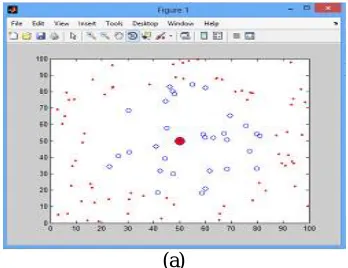
(a)
Fig a. network parameter are initialized
(b) (c)
(d)
Fig d represents the cluster node goes on decerease
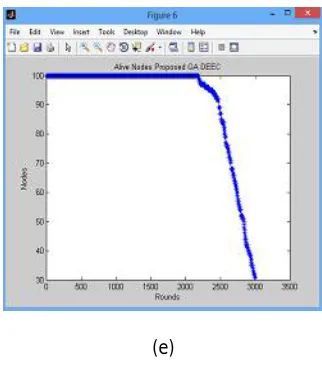
(e)
Fig ‘e’ represents the regular and alive node
Figures shows first the crossover has been performed on the cluster and if the fitness function of a cluster is decreased or the fitness function maximum is decreased then check and save it. In the else case, mutation is perform. After the mutation process, a regular node can become the cluster head or the cluster head can become the regular node. If the cluster head becomes a regular node after mutation; members of that cluster join nearest cluster head. But if the regular node becomes the cluster head, for that reason nodes which are close to it will join this cluster.
IV. CONCLUSION
REFERENCES
[1] Cheng-Fu Chou “Straight line routing for wireless sensor networks”, IEEE, 2005, Pp 110 - 115
[2] Adnan Fida, “Communication- and position-aware reconfigurable route optimization in large-scale mobile sensor networks”, EURASIP, 2014. [3] Ehsan Ahvar “An Energy-Aware Routing Protocol for Query-Based Applications in Wireless Sensor Networks”, Scientific World Journal, Vol
2014, Pp 9, 2014
[4] Mundada, Monica. R. (3 May,2012) “ A study on energy efficient routing protocols in wireless sensor networks” vol. 1, no. 2-3, pp. 293–315. [5] Dušan, Teodorovic. “Swarm intelligence systems for transportation engineering: Principles and applications”,2008
[6] M.J. Handy, “ Low Energy Adaptive Clustering Hierarchy withDeterministic Cluster-Head Selection” 2002 vol.5, pp. 4661-4664. [7] Christine, E. Jones. “A Survey of Energy Efficient Network Protocols for Wireless Networks” 2001 vol. 38, no. 4, pp. 393–422. [8] Mahesh K. Marina et al, “Routing in Mobile Ad Hoc Networks”
[9] Latiff, L.A., Ali, A. and Fisal, N. . “Power Reduction Quadrant-Based Directional Routing Protocol (Q-DIR) In Mobile Ad Hoc Network”, Proceedings of the IEEE International Conference on Telecommunications and Malaysia Intemational Conference on Communications, Penang, Malaysia. ,2007.
[10] Long Liu, Jenn.) “LEACH-GA: Genetic Algorithm-Based Energy-Efficient Adaptive Clustering Protocol for Wireless Sensor Networks” 2013 ,vol.5,pp. 87-94.
[11] Loscrì, V. , “A Two-Level Hierarchy for Low-Energy Adaptive Clustering Hierarchy (TL-LEACH)” , 2005 vol. 5, pp. 477–491. [12] Manzoor, B. ,”Q-LEACH: A New Routing Protocol for WSNs” 2013 vol. 23, pp. 496– 506.
[13] Mundada, Monica. R. “A study on energy efficient routing protocols in wireless sensor networks” 2012 ,vol. 1, no. 2-3, pp. 293–315. [14] Ramanathan, R., Redi, J., Santivanez,C., Wiggins,D. and Polit,S. “Ad hoc networking with directional antennas: a complete system solution,”
IEEE Journal on Selected Areas in Communications, vol. 23, pp. 496– 506, March 2005.
[15] Shankarkumar,V., Ko, Y. B. and Vaidya, N. H. (2000), “Medium access control protocols using directional antennas in ad hoc networks,” INFOCOM 2000. Nineteenth Annual Joint Conference of the IEEE Computer and Communications Societies. Proceedings. IEEE, vol. 1, pp. 13–21, March 2000.
[16] Sharath, S.T,”Quad Clustering Routing Protocol to Enhance the Stability in WSN”, 2004, vol. 13, pp. 77–83. [17] Sharma, Nishi. ,”Heterogeneous LEACH Protocol for Wireless Sensor Networks.2014
[18] Smaragdakis, Geogios. “SEP: A Stable Election Protocol for clustered heterogeneous wireless sensor networks” 2004 , vol. 5, pp. 477–491. [19] Takai, M., Martin, J., Ren, A., and Bagrodia, R. (2002), “Directional virtual carrier sensing for directional antennas in mobile ad hoc networks,”
Proc. Mobihoc’02, pp. 183–193, June 2002.