Reliability Analysis of Circular RC Chimney
Anusha S1, Sowjanya G.V2, Madhusudhan 3
PG Student, Department of Civil Engineering, SSIT Tumukur, Karnataka, India
Assistant professor, Department of Civil Engineering, SSIT Tumukur, Karnataka, India
Assistant Professor, Department of Civil Engineering Govt. Polytechnic, Karnataka, India
ABSTRACT: It is essential to ensure that a structure like an RC chimney shall exhibit uninterrupted performance in respect of the intended functions successfully over its expected life span. It is important to note that such expectation is made under inherent uncertainties and randomness of the basic design variables in different design situations corresponding to different limit states. The design situation as such is rendered probabilistic and it requires the application of statistical and probabilistic methods to establish the reliability of a given design. It becomes imperative to determine the probability of successful performance also called the reliability of a given RC chimney. The statistics of basic random variables are extracted from the literature. The resistance statistics and its probability distribution are generated by the Monte Carlo simulation technique. The limit state corresponding to the working stress in concrete and steel exceeding the permissible stresses is considered. The tapering cross section of the chimney and the possibility of deviations in designed geometry are modelled using STAADPRO. The randomness in the cross sectional properties are simulated and the magnitudes of stresses are generated. The probability of failure can be shown by plotting histogram.
KEYWORDS:RCC Chimney, Wind load, combined effect, Probability of failure, cantilever beam
I.INTRODUCTION
Chimneys are the structures which are built to greater heights as tall structure. In early days, as household vents and over the year; they are properly known as chimneys 1].chimneys or stacks are used as a medium to transfer highly contaminated polluted gases to atmosphere at greater height, the main function of chimney is to take highly poisonous gases which are not acceptable at ground level were taken to greater height with sufficient velocities. Chimneys are relatively tall structures subjected to three types of stresses. (I)Stresses due to self weight, (ii) Stresses due to wind moment and (iii) Stresses due to temperature variation between the inside and outside of the chimney. Brick chimneys are suitable only for short height as they become bulky with the increase in height and require heavy foundations also due to large temperature gradient. Brick chimney frequently cracks and become unstable. In contrast to this concrete chimneys are lighter and stronger and are less vulnerable to cracks due to the temperature difference. If the temperature of the fire gases does not exceed 4000 c, concrete chimneys can be used without any special fire brick lining. For higher temperatures, fire brick lining is provided with an air gap between the inner face of chimney and the lining. Concrete chimneys are generally constructed vertical without batter so that sliding shuttering may be used. The thickness may vary from a minimum of 150mm at the top to 450mm at the bottom depending upon the height of chimney. Sufficient amount of vertical steel is provided to resist the bending moment due to wind. In addition to this horizontal steel (hoop reinforcement) is provided to resist horizontal shear and also reduce the effect of temperature gradient on concrete. The loads acting on the RC circular chimneys are the self weight of the chimney, self weight of the brick lining, Wind load and the earthquake load. The self weight of the chimney and lining depends upon the shape, size and the height of the chimney. The wind load depends on the height and wind speed. The lateral load depends on the zone, type of the structure and type of the soil. Due to this moment will be caused at the base of the chimney.
Monte Carlo simulation is also carried out to check the failures occurring due to increase in stresses in concrete and steel due to temperature effects inside the chimney and the failures occurring due to increase in bending moment occurring at the base of the chimney due to wind. By using this method the Reliability based design of the RC circular chimney is carried out.
The stresses induced in the concrete due to wind load and self weight can be obtained by using Staad pro with modelling the chimney as a cantilever beam with the property of the beam as a tapered element. The stresses obtained from software package are compared with theoretical results and the correlation is made.
II.LITERATUREREVIEW
A literature review is carried out on the design and analysis of RC chimneys with special interest the slide presents a brief report on literature review as part of the project.
Asham kareem (1998) This paper addresses the influence of parametric uncertainties on the wind excited response of structure. Based on the available experimental data from the wind environment and meteorological data, kinematics of wind flow field, wind structure interaction and structural properties is assessed The random variability in the parameter space is propagated to ascertain its influence on structural response statistics utilizing a Monte Carlo simulation on the dynamic response of tall reinforced concrete chimney is presented
Anil pradeep.K, C.V Siva rama prasad (2014) The present paper will analysis 60m reinforced concrete chimney, industrial chimney is generally intended to support critical loads produced by seismic activities and wind. So it is essential to evaluate the dynamic response of chimney to seismic and wind loads. Response to earthquake and wind are more critical as chimney is a slender structure. They made comparison for wind load and seismic analysis, wind analysis as per draft code CED (7892) as done.
Kareem, J. Hsein (1990) In this paper Reliability analysis of tall RC chimneys under wind load is discussed. The safety criteria that is excessive deflection at the top of the chimney and exceedence of the ultimate moment capacity of the chimney cross section at any level are used to evaluate the risk in term of probability of failure. The ultimate moment capacity is estimated using the ultimate stress –strain relationship for concrete. Both load effects and structural resistance parameters are treated as random variables. An AFOSM approach is used to examine their uncertainties and a reliability analysis is carried out.
Ranganathan R., A.Muftha (1998) In this paper reliability evaluation of RC concrete chimneys is discussed. Four existing serving chimneys in India have been considered for evaluation. Safety of these chimneys at limit state of collapse in flexure along wind moment and circumferential moment and limit state of serviceability in deflection are quantified through structural reliability. Available field data on strengths of concrete and reinforcing steel bars, Young’s modulus of steel, wind speed etc are used in the reliability analysis. Safety has been checked at critical sections including flue opening. The sensitivity analysis is carried for wind speed which affects reliability of chimney.
III. WIND LOAD ON THE CHIMNEY
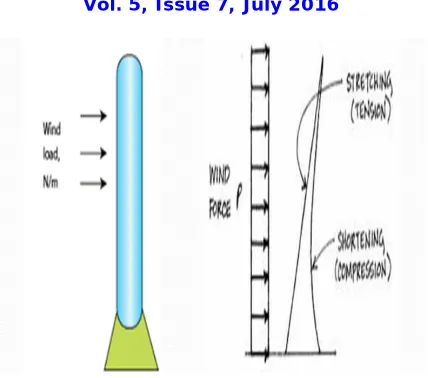
Figure 1: Shows wind load acted on chimney
When wind meets an obstruction it exerts pressure on the obstruction. The intensity of pressure depends on the wind velocity which in turn depends upon the elevation above ground. Hence intensity of wind the height of the chimney IS – 875 specifies the wind pressure at various heights.
IV.RELIABILITY ANALYSIS
The reliability analysis is carried out by using Monte Carlo simulation for stresses in concrete and steel due to wind load and also for combined effect of wind load, self weight and temperature. The number of cases which correspond to the generated stress being larger than the permissible stress is counted. The probability of failure Pf is computed by
considering resistance and action to be normal deviates. The details on randomness of design variables are presented The fundamental goal in designing a structure is to provide an economical structure that will, with the desired level of reliability, remain functional throughout its design life. The goal can be expressed as,
Resistance ≥ load effect
Where resistance includes strength, stiffness or any other measure of load carrying capacity, and load effects are the forces, moments, deflections, stresses or other measures of the results of loads, which are to be compared with the resistance. The reliability of the structure is controlled by the methods used in selecting minimum resistance and maximum load effects for each of its components. The resistance of the materials and components in a structure and the loads acting upon it do not have single known values; rather they are random. A variable whose variability must be somehow considered in the design processes. The strength and load parameters are non-deterministic, they nevertheless exhibit statistical regularity
V.STAAD PRO
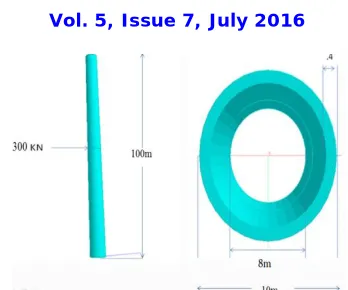
The circular RC chimney can be analysed by using the software package such as STAAD PRO by modelling the chimney by this methods.
A CANTILEVER BEAM:
Figure 2: Model of chimney in staad pro by cantilever beam method
VI. RESULTS
Computation of Stresses (N/mm2)
Table 1: represent the stress in concrete are computed by using the above methods and are tabulated the stress at the top which are obtained from cantilever method are zero in both theoretical and by and by considered as a cantilever beam
Table 2: represents the stress in concrete are computed by using above methods and are tabulated the stress at the centre height which are obtained from cantilever method it is noted that the stress in concrete obtained from first method is approximately equal to the theoretical results
Table 3: represents the stress in concrete are computed by using above methods and are tabulated the stress at the base which are obtained from cantilever method it is noted that the stress in concrete obtained from first method is approximately equal to the theoretical results.
METHODS STRESS IN CONCRETE IN N/mm^2 AT THE TOP
Theoretical 0
As a cantilever beam 0
METHODS STRESS IN CONCRETE IN N/mm^2 AT THE CENTRE
HEIGHT
Theoretical 0.864
As a cantilever beam 0.885
METHODS STRESS IN CONCRETE IN N/mm^2 AT THE BASE
Theoretical 3.75
MONTE CARLO SIMULATION METHOD
The steps involved in Monte Carlo Simulation are 1) Generation of random numbers.
2) Calculation of u1 and u2 from the formula. 3) Selection of mean and Co efficient of Variation. 4) Calculation of Standard Deviation.
5) Calculation of random variables. 6) Calculation of stresses from the formula.
7) Observation of number of failures occurring in the model. The Pf is calculated based on the number of failures
Table 4: The mean and coefficient if variation of design variables
No. of failures/Total No. of samples
VII.MONTECARLOSIMULLATIONMETHODS
VALUES OF PROBABILITY OF FAILURE USING FOR 1000 SAMPLES
Probability of failure for stresses due to wind load for different grade of concrete and for different zones are
Table 5 : represent the percentage of probability of failure by finding the stress induced in concrete and steel
Probability of failure for streeses due to combined effect for different grade of concrete and zones are
Compression zone
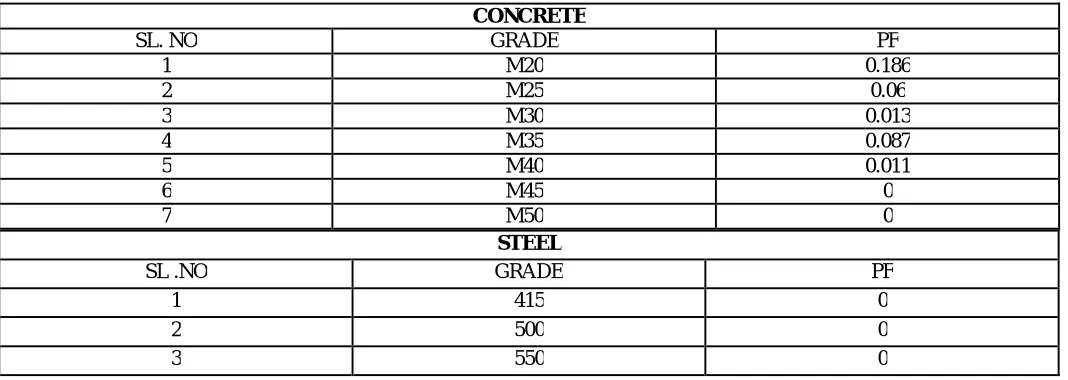
Table 6 : represent the percentage of failure by finding the stresses induced in concrete and steel in compression zone the stress induced in concrete and steel due to combined effect are identified as a cause of failure so the stresses are to
be within permissible limits the stresses which are exceeds the permissible stress are considered as probability of failure.
GRADE ZONES
Concrete 0
Concrete 0
Steel 0
Steel 0
CONCRETE
SL. NO GRADE PF
1 M20 0.186
2 M25 0.06
3 M30 0.013
4 M35 0.087
5 M40 0.011
6 M45 0
7 M50 0
STEEL
SL .NO GRADE PF
1 415 0
2 500 0
3 550 0
STEEL
SL .NO GRADE PF
1 415 0
2 500 0
Tension zone
Table 7: represent the percentage of failure by finding the stresses induced in concrete and steel in Tension zone the stress induced in concrete and steel due to combined effect are identified as a cause of failure so the stresses are to be within permissible limits the stresses which are exceeds the permissible stress are considered as probability of failure.
Histogram
VIII CONCLUSION
Reliability analysis of an RC chimney subjected to wind load and temperature stresses is presented. Probability of stress up-crossing is computed using the MC simulation method. The method demonstrates that there is always a probability, however small, that the induced stress may exceed the permissible stress, even though deterministically the condition is satisfied. By establishing the probability distribution to describe the failure rate, it is possible to keep the failure rate as low as possible. This being an on-going work, other methods of reliability analysis will be applied, finally to develop reliability based design of RC chimneys for a target reliability level.
REFERENCES
1.S. N. Manohar, “Tall Chimneys design and construction”, Tata McGraw-Hill Publishing company limited, volume 3 issue 5 161-1761985
2.Krishna Raju , “Advanced Reinforced Concrete Design”, CBS Publisher, volume 6 585-598 1986
3.A. Kareem and j. Hseih, , “Reliability analysis of concrete chimney under wind load”,” journal of wind engineering and industrial aerodynamic” 30,223-241,1988
4.Ahsan Kareem, “Reliability Analysis of wind-sensitive structures”, ” journal of wind engineering and industrial aerodynamic” 33,495-514, 1990
5.Durga C. Rai, Kamlesh Kumar, Hemant B.Kaushik: “strength of reinforced concrete circular hollow sections” The Indian concrete journal, dec 2006
6.Rajkumar, vishwanath B. Patil “Anaysis of self supporting of chimney” ,IJITEE, Volume 3,issue 5,oct 2013
7.K.Anil Pradeep, C.V Shiva rama Prasad: “Governing loads for design of a 60m industrial rcc chimney” IJIRSET volume 3,issue 8,2014
8.Lokeshwaran N, G. Augustine,”Effect of dynamic loads on tall circular cross section “ IOSR, volume 11, issue 4,63-67 Aug 2014
9.Rakshith B.D, Ranjith A, “Analysis of cantilever steel chimney as per IS” IJERA, volume 5, issue 5 (part5), 151-162, 2015
10.M.C Choppalli kalyani R, Dr yogesh D. Patil “Effect of flue support in the analysis of multi-flue RCC chimney” IJSER , volume 6 , issue 3, march 2015
0 0.1 0.2 0.3
M20 M25 M30 M35 M40 M45 M50
P ro b a b ili ty o f fa ilu re
Grade of concrete
Probability of failure for different grade of concrete
compression zone
Tension zone
CONCRETE
SL. NO GRADE PF
1 M20 0.194
2 M25 0.032
3 M30 0.005
4 M35 0