DOI: 10.1534/genetics.106.067801
Brc1-Mediated Rescue of Smc5/6 Deficiency: Requirement for
Multiple Nucleases and a Novel Rad18 Function
Karen M. Lee,* Suzanne Nizza,* Thomas Hayes,* Kirstin L. Bass,* Anja Irmisch,
†Johanne M. Murray
†and Matthew J. O’Connell*
,1*Department of Oncological Sciences, Mount Sinai School of Medicine, New York, New York 10029 and
†Genome Damage and Stability Centre, University of Sussex, Brighton BN1 9RQ, United Kingdom
Manuscript received November 3, 2006 Accepted for publication January 24, 2007
ABSTRACT
Smc5/6 is a structural maintenance of chromosomes complex, related to the cohesin and condensin complexes. Recent studies implicate Smc5/6 as being essential for homologous recombination. Each gene is essential, but hypomorphic alleles are defective in the repair of a diverse array of lesions. A particular allele of smc6(smc6-74) is suppressed by overexpression of Brc1, a six-BRCT domain protein that is required for DNA repair during S-phase. This suppression requires the postreplication repair (PRR) protein Rhp18 and the structure-specific endonucleases Slx1/4 and Mus81/Eme1. However, we show here that the contribution of Rhp18 is via a novel pathway that is independent of PCNA ubiquitination and PRR. Moreover, we identify Exo1 as an additional nuclease required for Brc1-mediated suppression of smc6-74, independent of mismatch repair. Further, the Apn2 endonuclease is required for the viability ofsmc6mutants without extrinsic DNA damage, although this is not due to a defect in base excision repair. Several nucleotide excision repair genes are similarly shown to ensure viability ofsmc6mutants. The requirement for excision factors for the viability ofsmc6mutants is consistent with an inability to respond to spontaneous lesions by Smc5/6-dependent recombination.
E
UKARYOTIC cells contain three highly conserved multi-protein complexes that contain hetero-dimers of large ATPases known as thestructuralm ain-tenance ofchromosomes (SMC) proteins (Harveyet al. 2002). These complexes are critical for chromosome integrity in interphase and for chromosome segregation at mitosis (Hirano2006). The cohesin complex is es-sential for sister-chromatid cohesion. In its absence, the lack of cohesion manifests as an inability to repair double-stranded DNA breaks (DSBs) by homologous recombination (HR) in the G2phase of the cell cycle(Birkenbihland Subramani1992; Tatebayashiet al. 1998; Nagaoet al. 2004). In the absence of DSBs, the lack of cohesion manifests as chromosome segregation de-fects in mitosis (Hirano2006).The condensin complexes, together with type II topoisomerases, are required for mitotic chromosome condensation. Without condensin, chromosomes are too disorganized to segregate into daughter cells at mitosis. However, genetic studies impli-cate condensin as also playing a role in DNA repair during G2by an as yet undefined mechanism (Aonoet al. 2002).
The function of these complexes in sister-chromatid cohesion and chromosome condensation was readily inferred from yeast mutants and depletion experiments in Xenopus oocyte extracts. Unfortunately, this has not
been the case for the third SMC complex, currently known as Smc5/6. This complex contains at least six stoichiometric subunits: Smc5 and -6, and four non-SMC elements, Nse1–4 (Hazbunet al. 2003; Sergeant
et al. 2005). Genes for each of these subunits are essen-tial, as is a substoichiometric factor, Rad60 (Morishita
et al. 2002). Two recently identified additional members of the complex, Nse5 and Nse6, are not essential for viability although they are required for DNA repair (Pebernardet al. 2006).
The Smc5/6 complex was initially defined by a hypomorphic allele ofsmc6in the fission yeast Schizosac-charomyces pombe. Initially known asrad18-X, and subse-quently renamedsmc6-X, this mutation resulted in DNA repair defects that by epistasis analysis were attributed to an HR defect (Lehmannet al. 1995). An additional allele,
smc6-74, was identified by virtue of DNA damage check-point maintenance defects (Verkadeet al. 1999). How-ever,smc6-74cells are proficient in the initiation of a DNA damage checkpoint response as determined by activation of the Chk1 protein kinase (Harveyet al. 2004), which is both necessary and sufficient to signal G2 arrest in
response to DNA damage (denElzenand O’Connell 2004; Latifet al. 2004). Like classical checkpoint mu-tants, irradiated smc6-74 cells enter mitosis without completing the repair of DSBs, but unlike checkpoint mutants, an enforced delay to mitosis does not rescue their sensitivity to DNA damage. The recruitment of HR proteins to lesions is normal insmc6-74mutants, and a
1Corresponding author: Department of Oncological Sciences, Mount
Sinai School of Medicine, 1 Gustave L. Levy Place, Box 1130, New York, NY 10029. E-mail: [email protected]
checkpoint response can be restored to these cells by deletion of HR genes (Verkadeet al. 1999; Ampatzidou
et al. 2006; Miyabeet al. 2006). Together, these observa-tions are consistent with the model that the smc6-74 mutation defines a role for the Smc5/6 complex late in recombination and that the checkpoint machinery is unable to detect a defect in this to prevent mitotic entry with unresolved lesions still present in the chromosomes. Understanding this defect will be important both in defining Smc5/6 function and in understanding how the checkpoint signal is terminated.
Brc1 is a six-BRCT domain protein that is required for the repair of a variety of lesions during S-phase, but not during G2(Sheedyet al. 2005). It was identified as an allele-specific high-copy suppressor of smc6-74; modest overexpression of Brc1 completely rescues the sensitivity ofsmc6-74to DNA damage in both S- and G2-phases.brc1
is not an essential gene, but it is essential for the viabil-ity of strains with compromised Smc5/6 function (Verkadeet al. 1999; Sheedyet al. 2005). There is no evidence that Brc1 physically associates with the Smc5/6 complex, and so this suppression is likely to be a functional bypass that enables cells to repair lesions that result from Smc5/6 dysfunction.
We have used this suppression ofsmc6-74by Brc1 as an assay to determine which factors are required for this response and as a means to define the nature of the repair and checkpoint maintenance defect insmc6-74(Sheedy
et al. 2005). Initially, we studied components of check-point control, HR, nucleotide excision repair (NER), and postreplication repair (PRR). In response to alkylation damage by high doses of methyl methanesulfonate (MMS), Brc1-mediated suppression ofsmc6-74required PRR lesion bypass promoted by the Rad18 homolog Rhp18. This tolerance mechanism enables completion of replication and passage into G2but not DNA repair. In
response to lesions in G2cells, Brc1-mediated suppression
ofsmc6-74relied upon the HR pathway and two structure-specific nucleases implicated in the recombination-dependent restart of stalled replication: Slx1/4 and Mus81/ Eme1. Further, deletion ofslx1, which by itself results in little phenotype, abolished the residual MMS resistance ofsmc6-74cells. These data led to the model that DNA structures, which are not sensed by the checkpoint, ac-cumulate insmc6-74, and hence cells enter mitosis without their repair. However, such lesions, in a Brc1-dependent manner, can be processed by the nucleases into alterna-tive structures that both signal a checkpoint and can be repaired by HR even though Smc5/6 function is attenuated. Recently, Smc5/6 was shown to be essential for repair at collapsed replication forks (Ampatzidou
et al. 2006). The combined roles for Smc5/6 in repair and checkpoint maintenance at these and other spon-taneous lesions are a likely explanation as to why Smc5/6 genes are essential for viability, while HR genes are not. These studies left open several unanswered questions. Under the assay conditions used, Rhp18 and lesion bypass
were required for Brc1-mediated suppression of lesions in S-phase, which predicted that this response would act via mono-ubiqutination of proliferating cell nuclear antigen (PCNA) on lysine-164 (K164), although this had not been shown. Rhp18 is also required for the suppression of ultraviolet-C (UV-C, 254 nm) sensitivity during G2, where lesion bypass should be irrelevant.
Further, base excision repair (BER) and mismatch repair (MMR) needed to be considered as alternative mecha-nisms to reverse lesions in these assays. Finally, as Smc5/6 mutants are predicted to be defective in HR, they should have a heightened requirement for excision pathways to tolerate lesions, although we had tested this with only one gene involved in NER, the XP-G homolograd13.
Here we address the following issues. We show that the requirement for Rhp18 in this context defines a novel Rhp18 function that is independent of lesion bypass and PCNA ubiquitination. Moreover, we identify additional nucleases, Apn2 and Exo1, as being required for the repair of spontaneous and induced lesions insmc6-74 cells. Finally, we show that NER genes are indeed critical to the full viability ofsmc6-74, suggesting some redun-dancy for XP-G function inS. pombe. The requirement for several different nucleases suggests that different types of lesions accumulate insmc6-74, and we speculate that Brc1 may facilitate the cleavage of these structures by the nucleases and subsequent processing into HR.
MATERIALS AND METHODS
Fission yeast genetic methods: All strains used were
derivatives of 972h and 975h1. Standard procedures and media were used for propagation and genetic manipulation (Morenoet al. 1991). Methods for UV-C and MMS survival
assays and transformation have been described previously (O’Connellet al. 1997; Verkadeet al. 1999, 2001;denElzen
and O’Connell2004; Harveyet al. 2004). Table 1 shows a list
of strains used in this study. Methods for Brc1-mediated suppression of smc6-74 were as described (Sheedy et al.
2005). For these assays, expression from the attenuated (pRep41) promoter (referred to as pBrc1) under repressing conditions (5 mm thiamine) was used and compared to
controls containing pRep41 only (referred to as a vector). For suppression of MMS sensitivity, cultures were grown to 4 3 106 cells/ml, and 5 ml of 10-fold serial dilutions were
spotted onto plates containing a range of MMS doses. For suppression of UV-C sensitivity, plates were inoculated in triplicate with 100, 1000, or 10,000 cells, irradiated with 0–250 J/m2of UV-C (254 nm) using a Stratalinker (Stratagene,
La Jolla, CA), and colonies left to form for 4 days at 30°. Data were normalized to unirradiated controls.
Construction of the RING domain mutantrhp18-1:Using a
genomic clone of rhp18 (Verkadeet al. 2001), codons for
cysteine 44, serine 45, and histidine 46, at positions 3 and 4 of the cross-brace of the RING domain, were mutated to serine, glycine, and alanine, respectively, using the method of Kunkel (Kunkelet al. 1987) and the oligonucleotide 59-CGCGCCC
Analysis of PCNA ubiquitination: Ubiqutination of PCNA was detected by Western blotting using polyclonal anti-PCNA antisera as described (Framptonet al. 2006). Note that this
antiserum detects a nonspecific band that comigrates with di-ubiquitinated PCNA. Extracts were prepared from untreated exponential cultures, or cells were treated with 50 J/m2with a
30-min recovery or with 0.01% MMS for 3 hr.
Fluctuation rate analysis of mutation rate:Rates of mutation
incan1were calculated using the method of the median as previously described (Fraseret al. 2003) from 11 independent
cultures per treatment, with mutants selected on supplemented EMM2 medium containing 60 mg/ml canavanine. UV-C-induced mutagenesis was performed in cells irradiated with 100 J/m2. MMS-induced mutagenesis was performed on cells
treated with 0.05% MMS for 60 min, with MMS then inactivated with 5% sodium thiosulfate; each condition was chosen to give 50% survival forrhp18alleles (Sheedyet al. 2005).
RESULTS
Brc1 suppresses smc6-74 via a novel PRR pathway:
The DNA damage sensitivity of the S. pombe smc6 hypo-morphic allele smc6-74 is efficiently suppressed by over-expression of Brc1. We have previously shown that this suppression was reliant on the Rad18 homolog, Rhp18, but was independent of Ubc13 (Sheedy et al. 2005). On the basis of the current models of PRR (Prakash
et al. 2004; Friedberg2005), these observations predicted that lesion bypass, but not template switching, was pro-moted by Brc1 and thus should be dependent on mono-ubiquitination of PCNA by Rhp18 and its E2 partner, Rhp6. S. pombestrains deleted for rhp6 show very poor viability and are infertile (Reynoldset al. 1990). However,
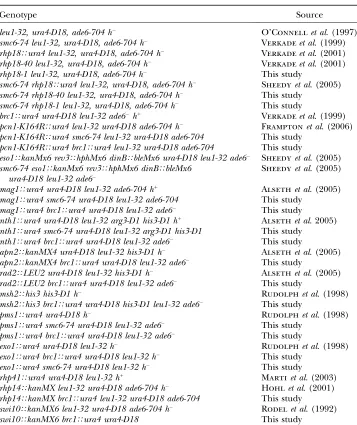
TABLE 1
Strains used in this study
Genotype Source
leu1-32, ura4-D18, ade6-704 h O’Connellet al. (1997)
smc6-74 leu1-32, ura4-D18, ade6-704 h Verkadeet al. (1999)
rhp18Tura4 leu1-32, ura4-D18, ade6-704 h Verkadeet al. (2001)
rhp18-40 leu1-32, ura4-D18, ade6-704 h Verkadeet al. (2001)
rhp18-1 leu1-32, ura4-D18, ade6-704 h This study
smc6-74 rhp18Tura4 leu1-32, ura4-D18, ade6-704 h Sheedyet al. (2005)
smc6-74 rhp18-40 leu1-32, ura4-D18, ade6-704 h This study
smc6-74 rhp18-1 leu1-32, ura4-D18, ade6-704 h This study
brc1Tura4 ura4-D18 leu1-32 ade6 h1 Verkadeet al. (1999)
pcn1-K164RTura4 leu1-32 ura4-D18 ade6-704 h Framptonet al. (2006)
pcn1-K164RTura4 smc6-74 leu1-32 ura4-D18 ade6-704 This study pcn1-K164RTura4 brc1Tura4 leu1-32 ura4-D18 ade6-704 This study
eso1TkanMx6 rev3ThphMx6 dinBTbleMx6 ura4-D18 leu1-32 ade6 Sheedyet al. (2005)
smc6-74 eso1TkanMx6 rev3ThphMx6 dinBTbleMx6 ura4-D18 leu1-32 ade6
Sheedyet al. (2005)
mag1Tura4 ura4-D18 leu1-32 ade6-704 h1 Alsethet al. (2005)
mag1Tura4 smc6-74 ura4-D18 leu1-32 ade6-704 This study
mag1Tura4 brc1Tura4 ura4-D18 leu1-32 ade6 This study
nth1Tura4 ura4-D18 leu1-32 arg3-D1 his3-D1 h1 Alsethet al. 2005)
nth1Tura4 smc6-74 ura4-D18 leu1-32 arg3-D1 his3-D1 This study
nth1Tura4 brc1Tura4 ura4-D18 leu1-32 ade6 This study
apn2TkanMX4 ura4-D18 leu1-32 his3-D1 h Alsethet al. (2005)
apn2TkanMX4 brc1Tura4 ura4-D18 leu1-32 ade6 This study
rad2TLEU2 ura4-D18 leu1-32 his3-D1 h Alsethet al. (2005)
rad2TLEU2 brc1Tura4 ura4-D18 leu1-32 ade6 This study
msh2This3 his3-D1 h Rudolphet al. (1998)
msh2This3 brc1Tura4 ura4-D18 his3-D1 leu1-32 ade6 This study
pms1Tura4 ura4-D18 h Rudolphet al. (1998)
pms1Tura4 smc6-74 ura4-D18 leu1-32 ade6 This study
pms1Tura4 brc1Tura4 ura4-D18 leu1-32 ade6 This study
exo1Tura4 ura4-D18 leu1-32 h Rudolphet al. (1998)
exo1Tura4 brc1Tura4 ura4-D18 leu1-32 h This study
exo1Tura4 smc6-74 ura4-D18 leu1-32 h This study
rhp41Tura4 ura4-D18 leu1-32 h1 Martiet al. (2003)
rhp14TkanMX leu1-32 ura4-D18 ade6-704 h Hohlet al. (2001)
rhp14TkanMX brc1Tura4 leu1-32 ura4-D18 ade6-704 This study
swi10TkanMX6 leu1-32 ura4-D18 ade6-704 h Rodelet al. (1992)
swi10TkanMX6 brc1Tura4 ura4-D18 This study
we have previously reported an allele ofrhp18,rhp18-40, which encodes a truncated protein that lacks the Rhp6-binding domain (Verkadeet al. 2001). We therefore used this allele to test the hypothesis that Brc1-mediated suppression of smc6-74 was via Rhp18/Rhp6-catalyzed ubiqutination.
Whilerhp18Dsmc6-74strains showed no rescue of MMS or UV-C sensitivity by Brc1 overexpression (Figure 1, A and C; Sheedyet al. 2005),rhp18-40 smc6-74were indeed proficient for suppression at lower concentrations of MMS (0.0025%, Figure 1A). At higher concentrations, both strains failed to be rescued by Brc1. Considerable suppression of the UV-C sensitivity ofrhp18-40 smc6-74 was also seen upon overexpression of Brc1 (Figure 1D). These data suggested that the lack of suppression in rhp18Dsmc6-74strains was due to an Rhp6-independent function of Rhp18.
It was formally possible that, in these assays, Rhp18 was still acting as an E3 ubiquitin ligase, although utilizing another E2 enzyme. To test this hypothesis, we mutated conserved cysteine residues within the Rhp18 RING domain. This allele,rhp18-1, showed a similar level of sensitivity to DNA-damaging agents such asrhp18Dand rhp18-40. When combined withsmc6-74,rhp18-1behaved essentially the same asrhp18-40(Figure 1, A and E). Each allele ofrhp18increased the MMS and UV-C sensitivity ofsmc6-74and the MMS sensitivity of brc1D(Figure 1, A–E; data not shown). We conclude that Rhp18 has an E3-independent function and that this function is required for Brc1 to suppresssmc6-74.
Lysine 164 (K164) on PCNA is the best-characterized site for Rhp18-catalyzed ubiquitination (Matunis2002;
Lehmann 2006; Watts 2006). We considered that in the rhp18-1 and -40 strains, another ubiquitin ligase might compensate for Rhp18. To test this, we assayed Brc1-mediated suppression in a background where K164 of PCNA had been mutated to arginine ( pcn1-K164R). While this mutation significantly enhanced the MMS and UV-C sensitivity ofsmc6-74, this was readily suppressed by Brc1 overexpression for UV-C and at lower (,0.005%), but not higher ($0.005%), MMS concentrations (Figure 2, A and B). Further, we con-firmed that each allele ofrhp18was defective in PCNA ubiqutination (Figure 2C), and thus PCNA ubiqutina-tion is not required for Brc1-mediated suppression of smc6-74.
We had previously shown that translesion synthesis polymerases were required for Brc1 to suppress the MMS (but not UV-C) sensitivity ofsmc6-74, but this was only observed at relatively high doses (0.005–0.01%) and also required the triple deletion of polymerases
h,k, andz(Sheedyet al. 2005). We therefore retested suppression at lower levels (0.001–0.002%) of MMS and indeed found that the triple polymerase deletion (3TLSD) was unaffected for suppression of smc6-74, although the quadruple mutant had significantly en-hanced MMS sensitivity (Figure 2A). Such enhancement of MMS sensitivity was also observed when the3TLSD
mutants (Sheedyet al. 2005) orpcn1-K164R (supplemen-tal material at http://www.genetics.org/supplemen(supplemen-tal/) were combined withbrc1D.
Lesion bypass is error prone and leads to mutagenic DNA replication. We confirmed that bothrhp18-1 and rhp18-40are indeed defective in MMS- and UV-C-induced Figure 1.—Brc1-mediated
suppression ofsmc6-74is inde-pendent of Rhp6 binding and the RING domain of Rhp18. (A) The indicated strains were transformed with vector (V) or pBrc1 (B) and grown to 4 3 106 cells/ml,
mutagenesis that is a byproduct of lesion bypass. In fluctuation tests for canavanine resistance caused by mutations in can1, wild-type cells showed a 7.7-fold induction of mutation rate by MMS treatment (6.73
10 6) and a 18.4-fold increase by UV-C irradiation (1.63
10 5) compared to untreated cells (8.7310 7).rhp18-1
andrhp18-40showed4-fold higher rates of spontane-ous can1 mutations (3.7 3 10 6 and 3.4 3 10 6,
re-spectively). This is consistent with data forSaccharomyces cerevisiae rad18D, which shows a 4.6-fold increase (Stelter and Ulrich2003). MMS treatment increased this only 2.2-fold forrhp18-1(8.3310 6) and 1.5-fold forrhp18-40
(5.2310 6). Similarly, UV-C irradiation increasedcan1
mutation rates only 1.9-fold forrhp18-1(7.2310 6) and
2.9-fold forrhp18-40(1.0310 5).
Combined, these data show that under high levels of alkylation damage, Rhp18-mediated lesion bypass via PCNA and the translesion synthesis polymerases are required for Brc1 to suppress lethality in smc6-74cells and for MMS resistance inbrc1Dandsmc6-74cells. This tolerance mechanism allows for completion of DNA replication and for subsequent repair. Our previous findings strongly implicate that HR is ultimately required for DNA repair in this context (Sheedyet al. 2005).
At lower doses of MMS, lesion bypass and PCNA ubi-quitination are not required for Brc1 to suppresssmc6-74.
This pathway of repair is independent of the Rhp6-binding and RING domains of Rhp18 and thus defines a novel function for Rhp18 insmc6-74cells. We note that thepcn1-K164Rmutation confers greater MMS sensitivity than does the3TLSDstrain and thatpcn1-K164Rcells are sensitive to UV-C irradiation in G2, whereas3TLSDcells
are not (Framptonet al. 2006). We also note that the requirement for Rhp18 extends to the repair of lesions in cells irradiated in G2(Verkadeet al. 2001). Therefore,
this cryptic function for Rhp18 uncovered by the Brc1-mediated suppression ofsmc6-74is unlikely to be related to its tolerance function to promote the bypass lesions during DNA replication.
AP endonuclease Apn2 is critical for survival of smc6-74:BER is a predominant pathway in the response to DNA alkylation in most eukaryotes (Martiet al. 2002). In S. pombe, however, cells lacking the mag1-encoded DNA glycosylase that initiates the BER response to DNA alkylation show wild-type sensitivity to alkylating agents such as MMS, and genetic data implicate both NER and HR as options to repair alkylation damage (Memisoglu and Samson2000; Alsethet al. 2004, 2005; Sugimoto
et al. 2005). With the HR defects insmc6-74mutants, we decided to investigate the contribution of BER to both the residual MMS resistance ofsmc6-74and the suppres-sion of MMS sensitivity by Brc1 overexpressuppres-sion.
Figure2.—PCNA
Currently there are four genes known to function in BER in S. pombe: mag1, nth1, apn2, and rad2 (Fen1 homolog), although rad2 is also required for other repair pathways (Lieber1997). Mag1 converts alkylated bases to abasic (AP) sites, which can then be repaired by either short- or long-patch BER. Short-patch BER involves cleavage 39 to the AP site by the AP lyase, Nth1. This lesion is further processed by a 59cleavage by the AP endonuclease Apn2, and the resulting gap is filled by replication. In long-patch BER, Apn2 cleaves 59to the AP site, and the Rad2 flap endonuclease cleaves a further 39to leave a longer gap that is also filled by replication. HR and NER can also repair alkylated bases not processed by Mag1 or intermediates in the Mag1 pathway. Deletion ofmag1reduces the MMS sensitivity of HR mutants as cells are unable to commit to BER and therefore do not rely on HR to repair cleavage products (Alsethet al. 2005).
We constructed double mutants betweensmc6-74and mag1D and betweennth1Dand apn2D.rad2Dhas pre-viously been shown to be epistatic withsmc6-74for MMS sensitivity. Althoughmag1Drescues the MMS sensitivity of HR mutants,mag1Dsmc6-74strains were slightly more sensitive to MMS, although this was efficiently rescued by Brc1 overexpression (Figure 3).nth1Dsmc6-74mutants were significantly more sensitive to MMS than either parent, although in this contextnth1was not required for Brc1-mediated suppression of smc6-74. However, apn2Dsmc6-74mutants formed microcolonies of highly aberrant cells that could not be propagated. An identical phenotype was observed inapn2D smc6-X double mu-tants (data not shown), and so was not allele specific. This synthetic lethality could be due to two possible scenarios. First, Apn2 may have a function outside of the BER pathway. Second, Mag1-dependent
commit-ment to Apn2-dependent long-patch BER in smc6-74 may need to be completed by replication rather than by shunting of cleavage products into an HR- or NER-dependent pathway. However, as Rad2 is required for long-patch BER andrad2Dsmc6-74cells are fully viable, the former is the most likely explanation. In keeping with this, from 30 dissected tetrads no viable mag1D
apn2D smc6-74 colonies were obtained in a cross of mag1Dsmc6-743apn2D(data not shown).
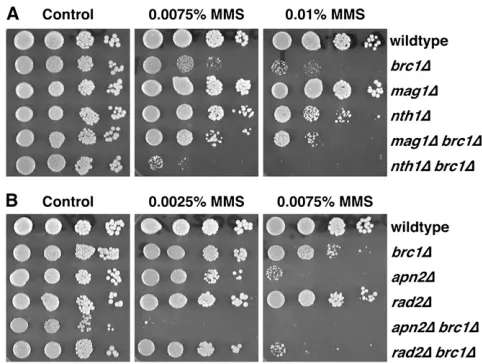
We also investigated the relationship betweenbrc1D
and null alleles of the BER genes (Figure 4). As seen with HR mutants,mag1Dbrc1Dcells were less sensitive to MMS than the brc1D parent (mag1D is not MMS sensitive). Conversely,apn2D,nth1D, andrad2Dincreased the MMS sensitivity of brc1D. These data suggest that BER is important for the residual MMS resistance in brc1Dcells, most likely due to a defect in recombination, asbrc1Dis epistatic torhp51D(Sheedyet al. 2005).
Exo1 is required for Brc1-mediated suppression of smc6-74: MMR is another excision-based pathway that is essential in genome integrity for removing mismatched nucleotides that arise from replication errors or chemical modification (Martiet al. 2002). InEscherichia coli, MutS recognizes the mismatch and then together with MutL activates the MutH endonuclease. S. pombe, like many other eukaryotes, contains multiple MutS and MutL homologs, but lacks a gene with homology to MutH. The 59–39exonuclease and endonuclease Exo1 is thought to substitute for MutH in MMR (Tranet al. 2004). We constructed double mutants between smc6-74 and null alleles for the major MutS (msh2) and MutL (pms1) homo-logs. Neithermsh2Dnorpms1Dstrains were significantly sensitive to MMS, nor did they enhance the MMS sensi-tivity ofsmc6-74(Table 2). Moreover, neither gene was required for Brc1-mediated suppression ofsmc6-74 or Figure3.—Synthetic lethality ofsmc6-74 with
enhanced the MMS sensitivity ofbrc1D (supplemental material at http://www.genetics.org/supplemental/). These data suggest that mismatch repair is not required when Smc5/6 function is compromised or when Brc1 is absent.
In addition to its role in mismatch repair, Exo1 is required for processing of DSBs in S. pombe (Tomita
et al. 2003), and inS. cerevisiaeExo1 has been shown to have an overlapping function with the Mre11–Rad50– Xrs2 complex for resection of a DSB for HR (Tsubouchi and Ogawa2000; Llorenteand Symington2004). It has also been shown to process stalled replication forks (Cotta-Ramusinoet al. 2005). Deletion ofexo1resulted in only a minor increase in MMS sensitivity, but, when combined with smc6-74, resulted in a substantial en-hancement of MMS sensitivity (Figure 5A). Importantly, this was not rescued by Brc1 overexpression on plates with .0002% MMS. Similarly, exo1D significantly en-hanced the MMS sensitivity ofbrc1Dcells (supplemental material at http://www.genetics.org/supplemental/). Together, these data suggest that Brc1 and Exo1 have overlapping and nonoverlapping roles.
We also investigated whether Exo1 was required for Brc1 to suppress the UV-C sensitivity ofsmc6-74(Figure 5B).exo1Dcells were only modestly sensitive to high doses of UV-C, but whenexo1Dwas combined withsmc6-74, the double mutant had an enhanced UV-C sensitivity com-pared to that of thesmc6-74parent. However, the double mutant was not rescued by Brc1 overexpression. Thus, Exo1 is another nuclease that becomes essential for the repair of lesions when Smc5/6 function is compromised.
Mutations in NER genes cause synthetic growth defects withsmc6-74:Previous studies have investigated the relationship among Smc6, Brc1, and only one factor in NER, the rad13-encoded XPG nuclease (Lehmann
et al. 1995; Sheedyet al. 2005). XPG nucleases remove the flap generated by the NER-dependent synthesis at sites of UV-induced lesions such as cyclobutane dimers Figure4.—Epistasis of the MMS sensitivity of brc1D with
BER mutants. Plate assays of MMS sensitivity ofbrc1D com-bined with (A)mag1Dandnth1D; (B)apn2Dandrad2D. Con-trol (0% MMS) and a range of MMS concentrations are shown.mag1Dbrc1D(A) shows reduced sensitivity compared to thebrc1Dparent.nth1Dbrc1D(A),apn2Dbrc1D, andapn2D brc1D(B) synergize for MMS sensitivity, but the double mu-tants grow as wild-type cells on the control plate.
TABLE 2
Interactions ofsmc6andbrc1with excision repair genes
Pathway Gene
S. cerevisiae
homolog smc6-74a brc1Da
Brc1 supp of smc6-74
BER mag1 MAG1 Not epistaticb Partial rescuec Yesb
nth1 NTH1 Not epistaticb Not epistaticc Yesb
apn2 APN2 SLb Not epistaticc NA
rad2 RAD27 Epistaticd Not epistaticc NA
MMR msh2 MSH2 NAe NAe Yese
pms1 PMS1 NAe NAe Yese
exo1 EXO1 Not epistaticf Not epistatice Nof
NER rhp41 RAD4 SGDg ND NA
rhp14 RAD14 SGDg Not epistatice NA
swi10 RAD10 SGDg Not epistatice NA
rad13 RAD2 Not epistaticd Not epistatich Yesh
SL, synthetic lethal; SGD, synthetic growth defect; ND, not determined; NA, not applicable.
a
Phenotype in combination withsmc6-74(for MMS and UV-C) orbrc1D(for MMS).
b
See Figure 3.
c
See Figure 4.
d
From Lehmannet al. (1995).
e
Supplemental figures (http://www.genetics.org/supplemental/).
f
See Figure 5.
g
See Figure 6.
h
and 6-4 photoproducts. rad13D enhances the DNA damage sensitivity ofsmc6-74, although it is not required for Brc1 to suppress this. As members of other excision pathways are required for either Brc1-mediated sup-pression ofsmc6-74or, indeed, viability of this mutant, we considered whether there may be some redundancy for Rad13 function. We constructed double mutants between smc6-74 and null alleles for the NER genes swi10 (ERCC1/XPF/RAD10 homolog; Hang et al. 1996), rhp41 (XPC/RAD4; Marti et al. 2003), and
rhp14(XPA/RAD14; Hohlet al. 2001), involved in 59 incision (swi10) and lesion recognition (rhp41,rhp14). In each case, the growth of doubles was inhibited, particularly with swi10D smc6-74 and rhp41D smc6-74 strains (Figure 6). In each case, spontaneous suppressors of this slow growth arose, which made interpretation of smc6-74epistasis studies and Brc1-mediated suppression unfeasible. Nevertheless, these observations do indeed show that NER becomes more important for process-ing of spontaneous lesions when Smc5/6 function is compromised, most likely as recombinational repair is
significantly attenuated in this circumstance. Not sur-prisingly, therefore, these mutations also enhanced the MMS sensitivity ofbrc1D(Table 2; supplemental mate-rial at http://www.genetics.org/supplemental/).
DISCUSSION
The Smc5/6 complex is a key determinant of genome integrity. Since it is structurally related to cohesin and condensin, it is reasonable to hypothesize that the com-plex plays a fundamental role in chromosome organiza-tion and that the dysfuncorganiza-tional response to DNA damage is a consequence of this. Brc1 serves to activate a pathway that can bypass defects in Smc5/6 mutants and is re-quired for viability when Smc5/6 function is compro-mised. The experiments described in this article extend our previously published studies and provide four key findings. First, Rhp18 has a function that is independent of Rhp6, its RING domain (and therefore E3 ligase activity), and of PCNA ubiqutination and lesion bypass. This can be seen by the requirement of Rhp18 for Brc1 to suppress the sensitivity of smc6-74 to lower doses of alkylation damage and to UV-C irradiation in G2. Second,
the AP endonuclease Apn2 is critical for the survival of smc6mutants, and this is independent of its role in BER. Exo1 is another nuclease required for Brc1 to suppress the MMS and UV-C sensitivity ofsmc6-74, although the exo1null mutant itself is only slightly sensitive to these agents. Finally, Swi10 (XPF/RAD10) is yet another nuclease required for the viability ofsmc6-74, as are other components of the NER pathway.
Homologs of Rad18, such as S. pombe rhp18, are involved in the tolerance of lesions that impede DNA rep-lication. To this end, Rad18 proteins mono-ubiquitinate PCNA, and this promotes the recruitment of the trans-lesion polymerases to replicate beyond the trans-lesion, some-times in an error-prone manner (Friedberg 2005). However,S. pombe rhp18Dstrains synchronized at various points of the cell cycle are sensitive to DNA-damaging Figure 6.—Synthetic growth defects of smc6-74 with the
NER mutantsswi10D,rhp41D, andrhp14D. Tetrads were dis-sected and grown on YES for 4 days at 30°; squares indicate double mutants.
Figure 5.—Exo1 nuclease is required for Brc1-mediated
agents (Verkadeet al. 2001), suggesting roles for Rhp18 outside the realm of DNA replication. This observation was corroborated by the finding that, while Rhp18 was required for Brc1 to suppress the UV-C sensitivity of G2smc6-74cells, the translesion polymerases were not.
Here, we have shown that the bypass synthesis indepen-dent function for Rhp18 is not related to its E3 ubiquitin ligase activity. Recent studies have implicated Rad18 in HR in avian DT40 cells (Szutset al. 2006), and as HR is required for Brc1 to suppress smc6-74 (Sheedy et al. 2005), we speculate that this may be a relevant function for Rhp18 in our experiments. Thus, the current models of DNA damage tolerance are perhaps incomplete. We also note that thepcn1-K164Rmutation confers greater sensitivity to UV-C and MMS than the3TLSDstrain. Thus, either there are additional bypass polymerases inS. pombe or modification of K164 on PCNA promotes additional repair or tolerance functions. Further, it is pertinent to note that thepcn1-K164Rsensitivity to UV-C irradiation was assayed in G2 cultures, and it was recently shown
that PCNA is mono-ubiquitinated inS. pombein G2, even
following ionizing radiation (Framptonet al. 2006). Thus, the ubiquitination of PCNA in G2may define a function
that is not related to lesion bypass, further highlighting the need to refine models for Rad18 function.
Deletion of apn2, which encodes the major AP endonuclease inS. pombe, is synthetic lethal with smc6-74andsmc6-X. In principle, this effect could be via the AP endonuclease activity of Apn2, although it is not clear whysmc6mutants should accumulate more AP sites than wild-type cells, nor did we see such an effect with other BER mutants. Apn2 is a member of the exo-nuclease III family, which displays the additional activi-ties of a 39–59 exonuclease, 39-phosphodiesterase, and 39-phosphatase (Unket al. 2001; Boiteuxand Guillet 2004). Therefore, another possible function for Apn2 in this context is the processing of 39-blocked ends to enable repair synthesis. In budding yeast, the Rad1-Rad10 nuclease (also known as ERCC1-XPF) has also been shown to process 39-blocked ends (Guzderet al. 2004), as has the Mus81/Mms4 39-flap endonuclease (Boiteuxand Guillet2004). TheS. pombehomologs, Rad16-Swi10, and Mus81/Eme1 also show strong ge-netic interactions with smc6 alleles; swi10D smc6-74 double mutants showed a strong synthetic growth defect (Figure 3), and mus81D smc6-74 double mutants are poorly rescued by Brc1 overexpression (Sheedy et al. 2005). These data suggest that 39-blocked ends may be one structure that accumulates insmc6mutants during incomplete HR, and, given thatbrc1becomes essential in smc6 mutants, increasing Brc1 levels may aid in the processing of blocked ends to enable repair.
The other nuclease identified here as being required for Brc1 to suppresssmc6-74is Exo1. Exo1 possesses 59–39
exonuclease activity, although it is also a 59-flap endonu-clease that is related to the structure-specific nuendonu-cleases Fen1 and XP-G (Tranet al. 2004), encoded byrad2and
rad13inS. pombe. Another 59-flap endonuclease, Slx1/4, showed interactions withsmc6that are very reminiscent of Exo1; slx1D cells show wild-type sensitivity to MMS but greatly sensitizesmc6-74to MMS and are required for Brc1-mediated suppression (Sheedyet al. 2005). Similarly for UV-C, both exo1D and slx1D show little sensitivity themselves and yet enhance the sensitivity ofsmc6-74and again are required for Brc1 to rescue smc6-74. These enzymes have the capacity to remove 59-blocked ends, which may be rare in wild-type cells, explaining why these strains are not MMS sensitive, but become more abundant when Smc5/6 function is compromised. Rad2, and perhaps Rad13, could also carry out this function, although Rad13 is not required for Brc1 to suppress smc6-74, andrad2mutants are epistatic withsmc6.
An alternative explanation as to why these nucleases are required for Brc1 to suppresssmc6-74would be the requirement to excise 59- and 39-flaps. Epistasis analysis predicts that mutants of the Smc5/6 complex are defective in Rad51-dependent HR (Lehmann et al. 1995; DePiccoliet al. 2006) so flaps could arise from Rad51-independent recombination, such as single-stranded annealing (SSA). The nature of the flap would be dependent on the polarity of the exonuclease activity that processes a particular DSB. However, the suppres-sion of smc6-74 by Brc1 requires the recombination mediator complexes consisting of Rhp55/Rhp57 (ho-mologs of Rad55/57) and Swi5/Sfr1 (Sheedy et al. 2005) and these proteins are not required for SSA. Thus, the majority of the lesions arising from HR defects in smc6-74 cells are likely to be processed back into Rhp51-dependent HR substrates by Brc1 and the nucle-ases. A direct requirement for Rhp51 in Brc1-mediated suppression of smc6-74 cannot be assayed due to the epistatic nature ofsmc6-74andrhp51D.
We have no evidence that Brc1 directly modifies the activities of the nucleases or that it modifies the novel function for Rhp18. Indeed, where applicable, double mutants between these genes andbrc1Dare significantly more sensitive to DNA damage. Further, Brc1 appears to be required only for DNA damage responses during S-phase in wild-type cells, although clearly it can rescue smc6-74when DNA damage is inflicted during G2. It is
possible, therefore, that Brc1 somehow stabilizes recom-bination intermediates insmc6mutants to allow them to be modified by these nucleases, or perhaps aids in their recruitment to the sites of lesions.
The budding yeast homolog of Brc1, known as Esc4/ RTT107, is similarly required for resistance to MMS (Rouse2004), but its relationship to Smc5/6 is currently not known. The closest human homolog, PTIP, may function in DNA damage responses (Jowseyet al. 2004), but its expression inS. pombeis not able to rescuebrc1D
that we have uncovered in these studies is conserved. Molecular function(s) for Smc5/6 are only beginning to emerge, and understanding how Brc1 can bypass defects in the function of this complex will be an important tool in deciphering what appears to be a very complex series of events.
We thank Felicity Watts, Antony Carr, Jurg Kohli, Oliver Fleck, and Magnar Bjoras forS. pombestrains; Felicity Watts for the anti-PCNA antibody; and Edgar Hartsuiker for advice with fluctuation tests. This work was supported by the National Cancer Institute/National Institutes of Health grant CA100076 (M.J.O.) and Cancer Research United Kingdom and the Biotechnology and Biological Sciences Research Council (J.M.). K.M.L. is supported by National Institutes of Health/National Cancer Institute training grant T32 CA78207.
LITERATURE CITED
Alseth, I., H. Korvald, F. Osman, E. Seeberg and M. Bjoras,
2004 A general role of the DNA glycosylase Nth1 in the abasic sites cleavage step of base excision repair inSchizosaccharomyces pombe. Nucleic Acids Res.32:5119–5125.
Alseth, I., F. Osman, H. Korvald, I. Tsaneva, M. C. Whitbyet al.,
2005 Biochemical characterization and DNA repair pathway in-teractions of Mag1-mediated base excision repair in Schizosacchar-omyces pombe. Nucleic Acids Res.33:1123–1131.
Ampatzidou, E., A. Irmisch, M. J. O’Connelland J. M. Murray,
2006 Smc5/6 is required for repair at collapsed replication forks. Mol. Cell. Biol.26:9387–9401.
Aono, N., T. Sutani, T. Tomonaga, S. Mochidaand M. Yanagida,
2002 Cnd2 has dual roles in mitotic condensation and inter-phase. Nature417:197–202.
Birkenbihl, R. P., and S. Subramani, 1992 Cloning and
character-ization of rad21, an essential gene of Schizosaccharomyces pombe
involved in DNA double-strand-break repair. Nucleic Acids Res. 20:6605–6611.
Boiteux, S., and M. Guillet, 2004 Abasic sites in DNA: repair and
bi-ological consequences inSaccharomyces cerevisiae. DNA Rep.3:1–12. Cotta-Ramusino, C., D. Fachinetti, C. Lucca, Y. Doksani, M.
Lopeset al., 2005 Exo1 processes stalled replication forks and
counteracts fork reversal in checkpoint-defective cells. Mol. Cell 17:153–159.
denElzen, N. R., and M. J. O’Connell, 2004 Recovery from DNA
damage checkpoint arrest by PP1-mediated inhibition of Chk1. EMBO J.23:908–918.
De Piccoli, G., F. Cortes-Ledesma, G. Ira, J. Torres-Rosell, S.
Uhle et al., 2006 Smc5-Smc6 mediate DNA
double-strand-break repair by promoting sister-chromatid recombination. Nat. Cell Biol.8:1032–1034.
Frampton, J., A. Irmisch, C. M. Green, A. Neiss, M. Trickeyet al.,
2006 Postreplication repair and PCNA modification in Schizo-saccharomyces pombe. Mol. Biol. Cell17:2976–2985.
Fraser, J. L., E. Neilland S. Davey, 2003 Fission yeast Uve1 and
Apn2 function in distinct oxidative damage repair pathways in vivo. DNA Rep.2:1253–1267.
Friedberg, E. C., 2005 Suffering in silence: the tolerance of DNA
damage. Nat. Rev. Mol. Cell Biol.6:943–953.
Guzder, S. N., C. Torres-Ramos, R. E. Johnson, L. Haracska, L.
Prakashet al., 2004 Requirement of yeast Rad1-Rad10 nuclease
for the removal of 39-blocked termini from DNA strand breaks induced by reactive oxygen species. Genes Dev.18:2283–2291. Hang, H., D. N. Hager, L. Goriparthi, K. M. Hopkins, H. Shihet al.,
1996 Schizosaccharomyces pombe rad23 is allelic with swi10, a mating-type switching/radioresistance gene that shares sequence homology with human and mouse ERCC1. Gene170:113–117. Harvey, S. H., M. J. Krienand M. J. O’Connell, 2002 Structural
maintenance of chromosomes (SMC) proteins, a family of con-served ATPases. Genome Biol.3:REVIEWS3003.
Harvey, S. H., D. M. Sheedy, A. R. Cuddihyand M. J. O’Connell,
2004 Coordination of DNA damage responses via the Smc5/ Smc6 complex. Mol. Cell. Biol.24:662–674.
Hazbun, T. R., L. Malmstrom, S. Anderson, B. J. Graczyk, B. Fox
et al., 2003 Assigning function to yeast proteins by integration of technologies. Mol. Cell12:1353–1365.
Hirano, T., 2006 At the heart of the chromosome: SMC proteins in
action. Nat. Rev. Mol. Cell Biol.7:311–322.
Hohl, M., O. Christensen, C. Kunz, H. Naegeliand O. Fleck,
2001 Binding and repair of mismatched DNA mediated by Rhp14, the fission yeast homologue of human XPA. J. Biol. Chem.276:30766–30772.
Jowsey, P. A., A. J. Dohertyand J. Rouse, 2004 Human PTIP
facil-itates ATM-mediated activation of p53 and promotes cellular resistance to ionizing radiation. J. Biol. Chem. 279: 55562– 55569.
Kunkel, T. A., J. D. Robertsand R. A. Zakour, 1987 Rapid and
ef-ficient site-specific mutagenesis without phenotypic selection. Methods Enzymol.154:367–382.
Latif, C., N. R. Elzenand M. J. O’Connell, 2004 DNA damage
checkpoint maintenance through sustained Chk1 activity. J. Cell Sci.117:3489–3498.
Lehmann, A. R., 2006 Translesion synthesis in mammalian cells.
Exp. Cell Res.312:2673–2676.
Lehmann, A. R., M. Walicka, D. J. F. Grittiths, J. M. Murray, F. Z.
Wattset al., 1995 The rad18 gene ofSchizosaccharomyces pombe
defines a new subgroup of the SMC superfamily involved in DNA repair. Mol. Cell. Biol.15:7067–7080.
Lieber, M. R., 1997 The FEN-1 family of structure-specific nucleases in
eukaryotic DNA replication, recombination and repair. BioEssays 19:233–240.
Llorente, B., and L. S. Symington, 2004 The Mre11 nuclease is
not required for 59 to 39 resection at multiple HO-induced double-strand breaks. Mol. Cell. Biol.24:9682–9694.
Marti, T. M., C. Kunzand O. Fleck, 2002 DNA mismatch repair
and mutation avoidance pathways. J. Cell. Physiol.191:28–41. Marti, T. M., C. Kunzand O. Fleck, 2003 Repair of damaged and
mismatched DNA by the XPC homologues Rhp41 and Rhp42 of fission yeast. Genetics164:457–467.
Matunis, M. J., 2002 On the road to repair: PCNA encounters
SUMO and ubiquitin modifications. Mol. Cell10:441–442. Memisoglu, A., and L. Samson, 2000 Contribution of base excision
repair, nucleotide excision repair, and DNA recombination to al-kylation resistance of the fission yeastSchizosaccharomyces pombe. J. Bacteriol.182:2104–2112.
Miyabe, I., T. Morishita, T. Hishida, S. Yoneiand H. Shinagawa,
2006 Rhp51-dependent recombination intermediates that do not generate checkpoint signal are accumulated in Schizosacchar-omyces pomberad60 and smc5/6 mutants after release from repli-cation arrest. Mol. Cell. Biol.26:343–353.
Moreno, S., A. Klarand P. Nurse, 1991 Molecular genetic analysis
of fission yeast Schizosaccharomyces pombe. Methods Enzymol. 194:795–823.
Morishita, T., Y. Tsutsui, H. Iwasaki and H. Shinagawa,
2002 TheSchizosaccharomyces pomberad60 gene is essential for repairing double-strand DNA breaks spontaneously occurring during replication and induced by DNA-damaging agents. Mol. Cell. Biol.22:3537–3548.
Nagao, K., Y. Adachiand M. Yanagida, 2004 Separase-mediated
cleavage of cohesin at interphase is required for DNA repair. Nature430:1044–1048.
O’Connell, M. J., J. M. Raleigh, H. M. Verkadeand P. Nurse,
1997 Chk1 is a wee1 kinase in the G2 DNA damage checkpoint inhibiting cdc2 by Y15 phosphorylation. EMBO J. 16: 545– 554.
Pebernard, S., J. Wohlschlegel, W. H. McDonald, J. R. Yates, III
and M. N. Boddy, 2006 The Nse5-Nse6 dimer mediates DNA
re-pair roles of the Smc5-Smc6 complex. Mol. Cell. Biol.26:1617–1630. Prakash, S., R. E. Johnsonand L. Prakash, 2005 Eukaryotic
trans-lesion synthesis DNA polymerases: specificity of structure and function. Annu. Rev. Biochem.74:317–353.
Reynolds, P., M. H. Koken, J. H. Hoeijmakers, S. Prakashand L.
Prakash, 1990 The rhp61gene ofSchizosaccharomyces pombe: a
structural and functional homolog of the RAD6 gene from the dis-tantly related yeastSaccharomyces cerevisiae. EMBO J.9:1423–1430. Rodel, C., S. Kirchhoffand H. Schmidt, 1992 The protein
switching gene swi10 ofSchizosaccharomyces pombeand the human excision repair gene ERCC1. Nucleic Acids Res.20:6347–6353. Rouse, J., 2004 Esc4p, a new target of Mec1p (ATR), promotes
resump-tion of DNA synthesis after DNA damage. EMBO J.23:1188–1197. Rudolph, C., O. Fleckand J. Kohli, 1998 Schizosaccharomyces pombe
exo1 is involved in the same mismatch repair pathway as msh2 and pms1. Curr. Genet.34:343–350.
Sergeant, J., E. Taylor, J. Palecek, M. Fousteri, E. A. Andrewset al.,
2005 Composition and architecture of theSchizosaccharomyces pombeRad18 (Smc5–6) complex. Mol. Cell. Biol.25:172–184. Sheedy, D. M., D. Dimitrova, J. K. Rankin, K. L. Bass, K. M. Lee
et al., 2005 Brc1-mediated DNA repair and damage tolerance. Genetics171:457–468.
Stelter, P., and H. D. Ulrich, 2003 Control of spontaneous and
damage-induced mutagenesis by SUMO and ubiquitin conjuga-tion. Nature425:188–191.
Sugimoto, T., E. Igawa, H. Tanihigashi, M. Matsubara, H. Ide
et al., 2005 Roles of base excision repair enzymes Nth1p and Apn2p fromSchizosaccharomyces pombe in processing alkylation and oxidative DNA damage. DNA Rep.4:1270–1280.
Szuts, D., L. J. Simpson, S. Kabani, M. Yamazoeand J. E. Sale,
2006 Role for RAD18 in homologous recombination in DT40 cells. Mol. Cell. Biol.26:8032–8041.
Tatebayashi, K., J. Katoand H. Ikeda, 1998 Isolation of a
Schizo-saccharomyces pomberad21ts mutant that is aberrant in chromo-some segregation, microtubule function, DNA repair and sensitive
to hydroxyurea: possible involvement of Rad21 in ubiquitin-mediated proteolysis. Genetics148:49–57.
Tomita, K., A. Matsuura, T. Caspari, A. M. Carr, Y. Akamatsuet al.,
2003 Competition between the Rad50 complex and the Ku heterodimer reveals a role for Exo1 in processing double-strand breaks but not telomeres. Mol. Cell. Biol.23:5186–5197. Tran, P. T., N. Erdeniz, L. S. Symington and R. M. Liskay,
2004 EXO1-A multi-tasking eukaryotic nuclease. DNA Rep.3: 1549–1559.
Tsubouchi, H., and H. Ogawa, 2000 Exo1 roles for repair of DNA
double-strand breaks and meiotic crossing over inSaccharomyces cerevisiae. Mol. Biol. Cell11:2221–2233.
Unk, I., L. Haracska, S. Prakashand L. Prakash, 2001 39
-Phos-phodiesterase and 39/59 exonuclease activities of yeast Apn2 protein and requirement of these activities for repair of oxidative DNA damage. Mol. Cell. Biol.21:1656–1661.
Verkade, H. M., S. J. Bugg, H. D. Lindsay, A. M. Carrand M. J.
O’Connell, 1999 Rad18 is required for DNA repair and
check-point responses in fission yeast. Mol. Biol. Cell10:2905–2918. Verkade, H. M., T. Teli, L. V. Laursen, J. M. Murrayand M. J.
O’Connell, 2001 A homologue of the Rad18 postreplication
repair gene is required for DNA damage responses throughout the fission yeast cell cycle. Mol. Genet. Genomics265:993–1003. Watts, F. Z., 2006 Sumoylation of PCNA: wrestling with
recombina-tion at stalled replicarecombina-tion forks. DNA Rep.5:399–403.