Maximum Power Point Tracking
Implementation of Z-Source Inverter through
Finite Step Model Predictive Control Strategy
Chirantan K1, Mr. Mallikarjuna B2
M.Tech Student, Dept. of E&E, RNSIT, Bengaluru, India1 Asst. Professor, Dept. of E&E, RNSIT, Bengaluru, India 2
ABSTRACT: This paper presents a model predictive based Maximum Power Point Tracking (MPPT) method for a photovoltaic energy harvesting system based on a single-stage grid-tied Z-source inverter. First it provides a brief review of Z-source inverters, MPPT methods and Model Predictive Control (MPC). Next it introduces the proposed model predictive based MPPT method. Finally, it provides experimental results to verify the theoretical outcomes.
KEYWORDS: Text Impedance-Source Inverter, Model Predictive Control, Maximum Power Point Tracking, Photovoltaic Systems.
I. INTRODUCTION
Photovoltaic (PV) systems are one of the most promising electric power generation systems due to their low environmental impact and high availability of solar irradiation in most geographical locations [1, 2]. The energy generated by the PV systems is highly dependent on the environmental and ambient conditions such as the solar irradiance level and the module temperature. In order to ensure extraction of the maximum available energy in any ambient condition, MPPT for PV systems is essential [3]. The PV system efficiency can be degraded easily if the PV module is not forced to operate at its Maximum Power Point(MPP) at all times regardless of the environmental conditions.
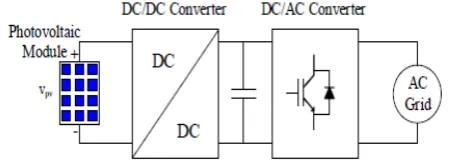
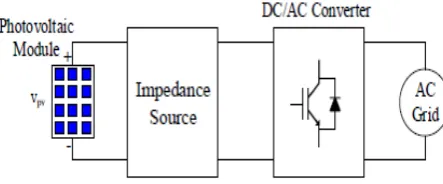
The MPP voltage of a PV module can be higher/lower than the grid voltage based on the environmental conditions, necessitating a power conversion system that can step up/down the voltage freely to track the MPP accurately. Recently a new converter topology, denoted as the impedance-source converter, is developed by the researchers that undermines the limitations with the conventional VSIs and CSIs [11-12]. In particular, a class of dc/ac inverters designed based on the concept of impedance-source conversion, denoted as Z-Source Inverter (ZSI), can step up/down the voltage freely, and thus is very well suited for designing single-stage PV harvesting systems. Fig. 2 demonstrates a single-stage PV harvesting system built around a ZSI.
Fig. 2 Single stage impedance source grid tied PV system
II. PROPOSED WORK
A. Impedance-Source Converters
The impedance networks can be utilized in a wide range of power conversion applications to provide a flexible means of conversion between different types of sources and loads. A simple impedance-source converter, denoted as a Z-Source Inverter (ZSI) is utilized as the PV harvesting interface in this paper. A distinctive characteristic of a ZSI is its capability to leverage shoot-through switching states for boosting the output voltage [11]. In shoot-through states both switches in one leg of the inverter are turned ON simultaneously. Due to inclusion of the shoot-through states, controlling ZSIs requires innovative modulation strategies. Several novel modulation strategies based on Pulse Width Modulation (PWM) method, have been proposed for ZSIs in the literature lately. Three notable modulation strategies for ZSIs are simple-boost, maximum-boost, and constant-boost techniques. In this paper, the simple boost strategy is chosen for generating the switching signals for the ZSI of Fig. 3.
The simple boost modulation strategy operates similar to a traditional carrier based PWM and its voltage gain is given by,
Where M is the modulation index, B is the boosting factor of the impedance-network, Vac is the amplitude of the
output voltage of the inverter (equivalent to grid peak phase voltage when grid-tied), and Vo is the dc-link voltage.
The boosting factor B is given by,
Where “D” is the shoot through duty ratio.
B. MPPT Techniques
Fast convergence, small power ripples at MPP, accurate and robust tracking of MPP are the key desired properties of a MPPT technique. Several algorithms, architectures, and mechanisms for tracking the MPP of a PV module have been proposed in the literature in the past two decades. Some of the very well-known MPPT methods include: hill-climbing algorithm, power-matching scheme, curve-fitting technique, P&O algorithm, incremental conductance algorithm, and fractional open-circuit voltage (Voc) control. In this work, the idea behind the P&O algorithm is used as grounds to
develop the new model predictive based MPPT technique that features better energy harvesting efficacy can more effectively hedge against dynamic environmental conditions.
C. MPC for Power Electronic Converters
Power electronic converters are nonlinear systems with finite number of switching devices that need to be controlled according to stringent operational goals and constraints. Controlling power electronic converters with the mentioned characteristics demands for elaborated control schemes. As such, the MPC technique has been emerging lately as a promising new control strategy for control of power electronic systems. Comparing to classical control schemes, MPC techniques deliver a fast dynamic response with a high stability margin, making them well suited for MPPT of PV systems operating under dynamic environmental conditions.
The grid-tied ZSI and the block diagram of the proposed MPPT system for this converter are illustrated in Fig. 3.
Fig.3. the grid-tied ZSI and the block diagram of the proposed control system
III.EXPERIMENTAL RESULTS
The proposed controller is implemented in MATLAB/Simulink. A unity power factor is targeted for the entire operation. The performance of the proposed model predictive based MPPT is evaluated by looking into three important merit criteria: the response to a step change in the solar irradiance level, operation in the event of gradually changing solar irradiance (aka clouds moving in sky), and operation in steady-state to evaluate the oscillation around MPP.
Fig.4. Z-source inverter output voltage waveform
Fig.5. power extracted from PV cell
IV. CONCLUSION
This paper presents a highly efficient control scheme for a ZSI based grid-tied PV system. The presented control system has two components: the proposed model predictive based MPPT, and the grid side power injection controller. The experimental results demonstrate low THD of the grid side current that is within the IEEE 519 standards, fast dynamic response to a step change in solar irradiance level, and negligible oscillations around MPP under dynamically changing sky condition.
REFERENCES
[1] H. Abu-Rub, M. Malinowski, and K. Al-Haddad, Power electronics for renewable energy systems, transportation and industrial applications: John Wiley & Sons, 2014.
[2] S. Kouro, J. I. Leon, D. Vinnikov, and L. G. Franquelo, "Grid- Connected Photovoltaic Systems: An Overview of Recent Research and Emerging PV Converter Technology," IEEE Industrial Electronics Magazine, vol. 9, pp. 47-61, 2015.
[3] T. Esram and P. L. Chapman, "Comparison of Photovoltaic Array Maximum Power Point Tracking Techniques," IEEE Transactions on Energy Conversion, vol. 22, pp. 439-449, 2007.
[4] J. Irwin, M. P. Kazmierkowski, R. Krishnan, and F. Blaabjerg, Control in power electronics: selected problems: Academic press, 2002.
[5] S. Sajadian and E. C. d. Santos, "Three-phase DC-AC converter with five-level four-switch characteristic," in Power and Energy Conference at Illinois (PECI), 2014, 2014, pp. 1-6.
[6] M. Peyvandi, M. Zafarani, and E. Nasr, "Comparison of particle swarm optimization and the genetic algorithm in the improvement of power system stability by an sssc-based controller," Journal of Electrical Engineering and Technology, vol. 6, pp. 182-191, 2011.
[7] M. I. Chehardeh, H. Lesani, M. K. Zadeh, and E. M. Siavashi, "An optimal control strategy to alleviate sub-synchronous resonance in VSC-HVDC systems," in Power Electronics and Intelligent Transportation System (PEITS), 2009 2nd International Conference on, 2009, pp. 250-255. [8] N. Farokhnia, M. Ehsani, H. Vadizadeh, H. Toodeji, and M. Mohammad, "Fast closed-form solution of line-to-line voltage total harmonic distortion for three-level inverters," IET Power Electronics, vol. 6, pp. 581-591, 2013.
[9] L. Poh Chiang, D. M. Vilathgamuwa, L. Yue Sen, C. Geok Tin, and L. Yunwei, "Pulse-width modulation of Z-source inverters," IEEE Transactions on Power Electronics, vol. 20, pp. 1346-1355, 2005.
[10] S. Miaosen, A. Joseph, W. Jin, F. Z. Peng, and D. J. Adams, "Comparison of Traditional Inverters and Z -Source Inverter for Fuel Cell Vehicles," IEEE Transactions on Power Electronics, vol. 22, pp. 1453-1463, 2007.
[11] P. Fang Zheng, "Z-source inverter," IEEE Transactions on Industry Applications, , vol. 39, pp. 504-510, 2003.