ISSN(Online): 2319-8753
ISSN (Print): 2347-6710
I
nternational
J
ournal of
I
nnovative
R
esearch in
S
cience,
E
ngineering and
T
echnology
(A High Impact Factor, Monthly Peer Reviewed Journal)
Vol. 5, Issue 2, February 2016
Joint Routing and Resource Allocation for
Delay Minimization in Cognitive Radio Based
Mesh Networks
A.Parimala 1, P.Palani2, R.Raja3
Assistant Professor, Department of Electronics and Communication Engineering, SKP Engineering College
Tiruvannamalai, Tamilnadu, India1, 2, 3
ABSTRACT: This paper studies the joint design of routing and resource allocation algorithms in cognitive radio based wireless mesh networks. The mesh nodes utilize cognitive overlay mode to share the spectrum with primary users. Prior to each transmission, mesh nodes sense the wireless medium to identify available spectrum resources. Depending on the primary user activities and traffic characteristics, the available spectrum resources will vary between mesh transmission attempts, posing a challenge that the routing and resource allocation algorithms have to deal with to guarantee timely
delivery of the network traffic. To capture the channel availability dynamics, the system is analyzed from a queuing theory
perspective, and the joint routing and resource allocation problem is formulated as a non-linear integer programming problem. The objective is to minimize the aggregate end-to-end delay of all the network flows. A distributed solution scheme is developed based on the Lagrangian dual problem. Numerical results demonstrate the convergence of thedistributed solution procedure to the optimal solution, as well as the performance gains compared to other design methods. It is shown that the joint design scheme can accommodate double the traffic load, or achieve half the delay compared to the disjoint methods.
KEYWORDS: Distributed resource optimization, cognitive mesh networks, joint routing and channel allocation, delay minimization.
I. INTRODUCTION
COGNITIVE radio is a promising technology aiming at better utilization of available channel resources by prescribing the coexistence of licensed (or primary) and un-licensed (secondary or cognitive) radio nodes on the same bandwidth [1]. One of the key challenges in the design of cognitive radio networks is the design of dynamic spectrum allocation algorithms, which enable the cognitive nodes to opportunistically access the available wireless spectrum, without interfering with
existing primary nodes. Therefore, dynamic spectrum access techniques have received significant attention. In [2] and [3]
the cognitive radio problem was investigated from an information theoretic standpoint. The cognitive transmitter is assumed to transmit at the same time and on the same bandwidth of the primary link. Interference is mitigated through the use of complex precoding techniques that require perfect prior information about the primary signal. The concept of a time-spectrum block was introduced in [4] and protocols to allocate such blocks were proposed. In [5] the authors derived optimal and suboptimal distributed strategies for the secondary users to decide which channels to sense and access under a Partially Observable Markov Decision Process (POMDP) framework.
The cognitive radio concept is desirable for a wireless mesh network (WMN) in which a large volume of traffic is expected
ISSN(Online): 2319-8753
ISSN (Print): 2347-6710
I
nternational
J
ournal of
I
nnovative
R
esearch in
S
cience,
E
ngineering and
T
echnology
(A High Impact Factor, Monthly Peer Reviewed Journal)
Vol. 5, Issue 2, February 2016
Leveraging interactions between routing and spectrum allocation has been recently investigated in the literature. In[6],
each source node finds candidate paths based on Dynamic Source Routing (DSR) and collects information on link
connectivity and quality. For each candidate route, the algorithm finds all feasible spectrum assignment combinations and
estimates the end-to-end throughput performance for each combination. Based on this computation, it selects the route and spectrum assignment with maximal throughput and schedules a conflict-free channel for this route. The authors in [7] follow a similar path by first constructing a set of possible routes and then find the spectrum allocation policy that maximizes the throughput. The work in [7] differs from [6] in the way the routes are constructed. In [7] the routes are constructed based on what the authors call ”route robustness”, which is a representation of how often a route would be disrupted due to primary users activity. A routing and spectrum selection algorithm for cognitive radio networks was proposed in [8]. The algorithm chooses the path that has the highest probability to satisfy the demands of secondary users in terms of capacity.
Fig. 1. A 3 node network with primary channel idle probability shown on the links .
However, it does not cover the issue of scheduling. In [9], a cross-layer optimization problem for a network with cognitive radios is formulated. The objective is to minimize the required network-wide radio spectrum resources needed to support traffic for a given set of user sessions. The problem is formulated as a mixed integer non-linear problem (MINLP), and a
sequential fixing (SF) algorithm is developed where the integer variables are determined iteratively via a sequence of linear
programs, which provide a near-optimal solution to the original problem. Distributed implementations that build over the AODV routing protocol and enhance it for cognitive scenarios are proposed in [10] and [11]. In [10], a routing metric aiming at achieving lower cumulative delay caused by channel switching, queueing and collisions is proposed. However, the algorithm assumes that each node has global knowledge of the spectrum choices of the other nodes. The target of [11] is to maximize the throughput through the design of cross layer routing, spectrum access, and power control. However, the data packets are routed along channels whose qualities have not been assessed. Therefore, the robustness of the routes is not guaranteed.
ISSN(Online): 2319-8753
ISSN (Print): 2347-6710
I
nternational
J
ournal of
I
nnovative
R
esearch in
S
cience,
E
ngineering and
T
echnology
(A High Impact Factor, Monthly Peer Reviewed Journal)
Vol. 5, Issue 2, February 2016
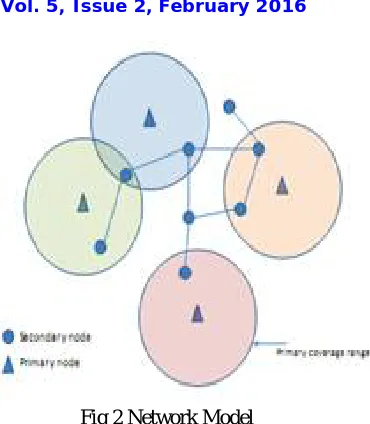
Fig 2 Network Model
Many popular multimedia applications, e.g., voice over IP, IPTV, and online gaming, have strict delay requirements. In this paper, we aim at designing routing and resource allocation protocols to minimize the end-to-end delay. Another unique characteristic of our approach is the queuing theoretic analysis, which is used to estimate the expected end-to-end delay
across different data streams. Each cognitive mesh node is modeled as an infinite length queue. .
A queuing theoretic analysis of the network characterizes the arrival and service rates for each one of these queues given the routes that pass through a node and the resources allocated to that node. The joint routing and resource allocation design problem is then formulated as an optimization problem having as objective the minimization of the end-to-end delay, and having integer valued decision variables. As formulated, the optimization problem is a non-linear integer programming (NIP) problem, which has combinatorial complexity. It is shown that by relaxing the integer constraints
imposed on the decision variables, one can efficiently find a solution to the relaxed optimization problem. Finally, using
the Lagrangian dual function, a distributed solution to the optimization problem is presented. The performance of the proposed protocol is thoroughly studied and compared to the performance of a disjoint protocol. The disjoint protocol
solves the routing problem first and then allocates resources along the constructed routes. The routing metric used favors
links with higher primary idle probability while penalizing the total number of hops. The resource allocation part aims at minimizing the end-to-end delay along the preselected routes.
The rest of the paper is organized as follows. The different aspects of the system model are presented in section II. In section III the joint routing and resource allocation problem is formulated as an integer programming optimization problem and suboptimal approximate solution is provided. Section IV presents an efficient distributed solution algorithm for the routing and resource allocation problem. Numerical results are presented and discussed in V. Finally, the paper is concluded in section VI.
II. SYSTEM MODEL
A. NETWORK MODEL
ISSN(Online): 2319-8753
ISSN (Print): 2347-6710
I
nternational
J
ournal of
I
nnovative
R
esearch in
S
cience,
E
ngineering and
T
echnology
(A High Impact Factor, Monthly Peer Reviewed Journal)
Vol. 5, Issue 2, February 2016
available frequency channels to transmit over. Since the primary network transmissions are also slotted, then it is customary that the cognitive network adjusts the boundaries of its time slots to match those of the primary network [16],[17].
A time slot and a channel pair t, c , is considered as the minimum unit for resource allocation, we will call it
resource element. As defined, a resource element is similar to the resource block concept in LTE systems. At the beginning
of each time slot t, a cognitive mesh node senses channel c assigned to it in that time slot. If the channel is detected as idle, the node transmits the packet at the head of its queue to the next node along the route to its destination, otherwise it remains silent and keeps sensing the channel in subsequent time slots. For simplicity, we will assume that cognitive nodes have access to perfect spectrum sensing information. After any successful transmission, the receiving node acknowledges the reception of the packet by transmitting an ACK packet back to the transmitter.
The cognitive mesh network is modeled as a directed graph G( V,E) , where each vertex v ∈ V corresponds to a cognitive
mesh node. During any given time slot, there will be a set Cv of channels available to node v. An edge e ∈ E exists
between nodes u and v if there exists a channel c ∈ Cu Π Cv and the nodes are within transmission range of each other,
i.e., ||u-v||≤ R,where ||u – v|| is the Euclidean distance between nodes u and v,and R is the transmission range. Since the graph is directed, there will be two edges between nodes u and v in this case, the first has node u as a transmitter, while the
second has node v as transmitter. It is assumed that all cognitive nodes use the same fixed transmission power, therefore,
all nodes have the same transmission range R. Due to primary nodes activity, channel availability will vary with time. Therefore, network connectivity is time varying, which poses a challenge to the routing and resource allocation protocol design.
In this work, the effect of the wireless interference between different nodes is modeled based on the protocol model [18], i.e., simultaneous packet transmissions from interfering nodes result in the loss of all involved packets. We say that two links e1 and e2 interfere with each other if
1) there is a shared node between e1 and e2 (because of half duplexing, unicast communications, or collisions) or 2) any node from e1 is within interference range I>R from any node from e2, and they are using the same channel. Because of the ACK packets sent back to the transmitter, both the link’s transmitter and receiver need to be free of interference.
B. CHANNEL MODEL
The wireless channel between a node and its destination is modeled as a Rayleigh flat fading channel with additive white
Gaussian noise [19]. Success and failure of packet reception is characterized by outage events and outage probabilities. Details of the channel model and outage probability calculation can be found in [19] and [17].
C. QUEUING MODEL
Each node in the cognitive mesh network has an infinite buffer for storing packets of fixed length. The finite buffers case
could also be accommodated into our model with slight modifications to the optimization problem formulated in the next
ISSN(Online): 2319-8753
ISSN (Print): 2347-6710
I
nternational
J
ournal of
I
nnovative
R
esearch in
S
cience,
E
ngineering and
T
echnology
(A High Impact Factor, Monthly Peer Reviewed Journal)
Vol. 5, Issue 2, February 2016
mean λf u [20]. In other words, the probability that a new packet arrives at any given time slot t is λf u.Moreover,the packet arrival processes are assumed to be independent from one data stream to another. Furthermore, each node maintains a separate queue for each traffic flow that is routed through it.
The state (idle or busy) of any of the N primary channels is modeled using a two state Markov chain as shown in Fig. 3. Using the stationary distribution of the Markov chain, at any given time slot channel c will be idle (Markov chain in the ff
state) with probability αc. The evolution of any channel is independent from all other channels.
The main model assumptions can be summarized as follows:
• Primary and cognitive networks both employ a time slotted transmission structure • Cognitive nodes have access to perfect spectrum sensing information
• All cognitive nodes use the same fixed transmissionpower
• In a given time slot, a cognitive node can use at most one channel for packet transmission.
III. JOINT ROUTING AND RESOURCE ALLOCATION STRATEGY
The main objective in this work is to find the best routing and resource allocation strategies in order to minimize the average end-to-end delay of multiple data connections in the cognitive radio based wireless mesh network. Because of the primary nodes activity, the spectrum resources available to the cognitive mesh nodes are varying in both space and time. Therefore, any successful routing strategy will have to work closely with the resource allocation strategy in order to make sure that any selected route will have enough resources available to guarantee the required QoS. Because of this strong interdependence between the routing and resource allocation strategies, we propose to deal with the routing and resource allocation strategies in a joint fashion rather than separating the two problems.
Before presenting joint design strategy we need first to analyze the effect of the routing and resource allocation decisions
on the network performance. This is achieved by relying on queueing theory to model the different aspects of the cognitive mesh network and to form a basis for our routing and resource allocation protocol design.
A. QUEUEING ANALYSIS
We start by calculating the average arrival and service rates at the different nodes in the cognitive mesh network. For this
calculation we need to first introduce the decision variables that define the different routes in the network as well as the
resources allocated to the different links along these routes. We define two sets of decision variables:
It is worth mentioning that the same resource allocation pattern is repeated every TDMA frame, and that the system is assumed to be stationary.
To define the average arrival rate at any node v along the route of data stream f we start by identifying the events necessary for a packet arrival to take place. A packet from data stream f enters the queue of node v in a given time slot if:
1) there is a resource element t, c allocated to one of v’s incoming edges,
2) the primary node owning channel c is either idle during that time slot or the cognitive node v is out of the primary node’s interference range,
3) the preceding cognitive node in the route has at least one packet in its queue to transmit to node v.
Therefore, the probability of a packet arrival at node v along the route of the data stream f is the joint probability of these three events. Since these events are independent, this probability can be written as at ,
where Einv is the set of incoming edges to node v, e s is the source node for edge (link) e, λfe(s)is its arrival rate andμfe(s)
ISSN(Online): 2319-8753
ISSN (Print): 2347-6710
I
nternational
J
ournal of
I
nnovative
R
esearch in
S
cience,
E
ngineering and
T
echnology
(A High Impact Factor, Monthly Peer Reviewed Journal)
Vol. 5, Issue 2, February 2016
probability that the queue has at least one packet [21], and hence will transmit a packet to the following node on the route whenever it has a chance. αc is the probability that channel c is idle, Pout e is the outage probability between the transmitter and receiver of link e. Finally, Ice if the primary node owning channel c interferes with transmissions over link e,otherwise Ice . Note that for simplicity we assume perfect sensing at all cognitive mesh nodes. Interference from other cognitive nodes is not reflected in (1), since the resource allocation scheme discussed below makes sure that no two interfering links can share the same resources.
It is clear that the packet arrival probability can vary from one time slot to another within the same frame since assigned channels can vary between time slots. This dependence is emphasized in (1) by the use of the superscript t (which is the index of the time slot in a TDMA frame). Since the same resource allocation pattern is repeated each TDMA frame, a given time slot within any frame will always have the same packet arrival probability. For the purpose of mathematical tractability, instead of using different packet arrival probabilities for the different time slots in a TDMA frame, we calculate the average packet arrival probability per time slot and use it for all the time slots. The average packet arrival probability can be calculated as,
which is interpreted as the probability that a packet from data stream f arrives at node v in any time slot. It should be noted that, using the average arrival rate for all time slots instead of the time slot dependent arrival rates does not affect the average behavior of the queues (which is what the following analysis is based on). In other words, the rate at which queues are filled (or emptied) as well as the probability that a queue becomes empty are the same in the two cases. Given this definition, packet arrivals can be approximated as Bernoulli trials at each time slot with average success probability λfv . Therefore, the packet arrival process can be approximated as a Bernoulli process with average arrival rate λfv .Similarly, to calculate the average service rate at any node v along the route of data stream f, we start by identifying the events necessary for a successful packet transmission. This will take place if in a given time slot t
1) there is a resource element t, c assigned to one of v’s outgoing edges,
2) the primary node owning channel c is either idle during that time slot or cognitive node v is out of its interference range.
Therefore, the probability of a packet being serviced from node v along the route of data stream f is defined as the joint
probability of these two events, which is given by,
Where Ev is the set of outgoing edges to node v.
Similar to the arrival probabilities, the service probability vary between time slots. Here also we resort to using the average service probability per time slot, calculated as
which is the probability that a packet from data stream f leaves the queue of node v in any time slot. Similar to the arrival events, the service events can be seen as Bernoulli trials at each time slot with average success probability μfv . Therefore, the packet service process can be approximated as a Bernoulli process with average service rate μfv .
ISSN(Online): 2319-8753
ISSN (Print): 2347-6710
I
nternational
J
ournal of
I
nnovative
R
esearch in
S
cience,
E
ngineering and
T
echnology
(A High Impact Factor, Monthly Peer Reviewed Journal)
Vol. 5, Issue 2, February 2016
the server before departing). This result can be easily proved by analyzing the underlying Markov chain model of the queue.
Applying this result to our system, it is noted that the rate at which packets depart a given queue is equal to that queues arrival rate. Therefore, in a multi-hop system with single path routing, all the nodes along that path will have the same arrival rate as the source node, since the departures from a node are the arrivals to the next node. This observation will allow us to deal with the arrival rates at different nodes as constant values.
B. END-TO-END DELAY
Having calculated the average arrival and service rates for each node in the network, we can now quantify the delay incurred by routing data through any given node. As discussed above, the arrival and services processes to and from any node are Bernoulli processes with average rates λfv and μfv , respectively. A queueing system with such arrival and departure processes is a discrete time M/M/1 queue [22]. Therefore, given the average arrival and service rates, the average delay incurred by data stream f packets when passing through cognitive node v is given by [22],
The end-to-end delay is the accumulation of the incurred delay by a packet when it goes through the different nodes along
its route from source to destination. Therefore, the average end-to-end delay for the packets of data flow f is given by Df
=∑v∈V f Dfv , where Vf is the set of nodes forming the route for the packets of data stream f. Using the fact that the arrival rates can be considered as constants as observed above, it can be easily shown that the delay is a convex function of the service rates μfv . To validate our analytical model, we simulate a 4 node network with two traffic streams. Fig. 4 shows a comparison between the average delay based on our analytical model and that based on Monte Carlo simulation. The results show that the delay calculated based on the analytical model is within 10% to 15% from that of the simulation.
C. SUBOPTIMAL RELAXATION
To reduce the high complexity of the nonlinear integer programming problem presented in the previous section we propose to relax the binary value constraints (14) and (15) and allow the decision variables to take any value in the interval [0,1]. The resulting optimization problem has the same form as in (6) to (13), with (14) and (15) rewritten as
follows
This relaxation transforms the nonlinear integer program into a convex optimization problem with real valued variables for which efficient solution algorithms exist [23]. However, the resulting optimal solution for the relaxed problem is not guaranteed to be optimal for the original integer-valued problem.In the relaxed problem, the routing variables xf,e take values in the range , . Therefore, the constraints in (7) and (8) can no longer guarantee single path routes transform the resulting stochastic routing and resource allocation solutions into the required deterministic ones. For this transformation to take place, the decision variables xf,e and yt,cf,e have to be converted back into binary valued variables. In the course of this conversion process, it is crucial not to violate any of the original problem constraints.
Algorithm 1 describes our proposed scheme for real-valued to binary-valued (RV-BV) solution conversion while obeying the constraints imposed by the optimization problem. Fig. 5 illustrates a mesh network with 4 nodes (n1 though n4) and 5 edges (e1 through e5). The network has a single data stream having node 1 as source and node 4 as destination. Assume
that after solving the relaxed optimization problem the resulting routing variables xf,e are as shown in the figure. We note
that although edge e5 is the only edge coming out of node n3, xf,e5 . and not 1.0 because constraint (8) forces xf,e5 xf,e2 xf,e4 .
The first step in our conversion scheme is to use the routing variables xf,e to construct all the possible paths through
which the packets are routed. From the values xf,e, it can be seen that there exists 3 possible paths; Path1 e1 → e3, Path2
ISSN(Online): 2319-8753
ISSN (Print): 2347-6710
I
nternational
J
ournal of
I
nnovative
R
esearch in
S
cience,
E
ngineering and
T
echnology
(A High Impact Factor, Monthly Peer Reviewed Journal)
Vol. 5, Issue 2, February 2016
Once all the possible paths for the given data stream are identified, the next step is to calculate the probability of routing
packets through each of these paths. Let the probability for using Pathi equals pi. At node n1 packets are routed though links e1 and e2 with probabilities 0.6 and 0.4, respectively. Since link e1 is the first link in both Path1 and Path3,we set the probabilities p1 p3 . .Link e2 is the first link in Path2,soweset p2 . . At node n2, packets are routed through links e3 and e4. The probability of using each of these links is calculated by normalizing the corresponding xf,e so that the sum over all outgoing edges adds up to 1, thus, representing a probability. Therefore, the probability of routing packets through e3 is calculated as
xf,e3 xf,e3+xf,e4. Since e3 and e4 have the same weights, packets are divided equally between them. So we update Path1 and Path3 probabilities to p1 p3 . ∗ . . . Finally, since node n3 has a single outgoing link e5, all packets will go through this link with probability 1 despite the fact that xf,e5 . .The final paths probabilities are p1 . , p2 . ,and p3 . , note that the sum of the probabilities should sum up to 1 for each data stream in the network. Since Path2 has the highest probability, it
is selected for packet routing and all other paths are deleted. So we set xf,e2 xf,e5 ,and xf,e1 xf,e3 xf,e4 . After selecting a single path for routing packets we release all the resources that were allocated to any link not on that path
by setting yt,cf,e for those links. For the links on the selected path we need to convert the stochastic resource allocation
into a deterministic one. First we define the set Z of all resource elements that are assigned to any of the network links.
Then we find the highest assignment probability and set the corresponding decision variable to yt∗,c∗f∗,e∗ . Given the
constraints (10), (11), and (12) we define a new set Q of all the resource elements with assignments that conflict with the
above assignment. We then release all the conflicting assignments, and update the set Z by removing the element f∗,e∗,t∗,c∗ and all elements in Q. These steps are repeated till all the elements are removed from the set Z.
IV. PROPOSED SYSTEM
ISSN(Online): 2319-8753
ISSN (Print): 2347-6710
I
nternational
J
ournal of
I
nnovative
R
esearch in
S
cience,
E
ngineering and
T
echnology
(A High Impact Factor, Monthly Peer Reviewed Journal)
Vol. 5, Issue 2, February 2016
The proposed solution also aims in reducing the end to end delay and increase the throughput by applying the Recursive Algorithm and Hidden Terminal Communication concept to the network using DORP Protocol.
Quality of service (QoS) is the overall performance of a telephony particularly the performance seen by the users of the network. To quantitatively measure quality of service, several related aspects of the network service are often considered, such as error rates, bandwidth, throughput, transmission delay, availability, jitter, etc. Quality of service is particularly important for the transport of traffic with special requirements. In particular, much technology has been developed to allow computer networks to become as useful as telephone networks for audio conversations, as well as supporting new applications with even stricter service demands.
Packet Delivery Rate in telecommunication networks, the transmission time, is the amount of time from the beginning until the end of a message transmission. In the case of a digital message, it is the time from the first bit until the last bit of a message has left the transmitting node. The packet transmission time in seconds can be obtained from the packet size in bit and the bit rate in bit/s as:
Packet transmission time = Packet size / Bit rate
Example: Assuming 100 Mbit/s Ethernet, and the maximum packet size of 1526 bytes, results in Max packet transmission time = 1526×8 bit / (100 × 106 bit/s) ≈ 116 μs .
In case of a network connection mediated by several physical links and forwarding nodes, the network delivery time depends on the sum of the delivery times of each link, and also on the packet queuing time (which is varying and depends on the traffic load from other connections) and the processing delay of the forwarding nodes. In wide-area networks, the delivery time is in the order of milliseconds. The network throughput of a connection with flow control, for example a TCP connection, with a certain window size (buffer size), can be expressed as:
Network throughput ≈ Window size / roundtrip time
In case of only one physical link between the sending and transmitting nodes, this corresponds to:
Link throughput ≈ Bitrate × Transmission time / roundtrip time
The packet delivery time or latency is the time from the first bit leaves the transmitter until the last is received. In the case of a physical link, it can be expressed as:
Packet delivery time = Transmission time + Propagation delay
Recursive Algorithm:
Priority mechanisms are used to optimize the network utilization, while meeting the requirements of each type of traffic. The user may generate different priority traffic flows by using the loss priority bit capability and when buffer overflow occurs, packets from the low priority flow can be selectively discarded by network elements. Priority mechanisms can be classified into two categories: time priority and space priority.
Time priority mechanisms control the transmission sequences of buffered packets while space priority mechanisms control the access to buffer. Chipalkatti et al. studied the performance of time priority mechanisms including Minimum Laxity Threshold (MLT) and Queue Length Threshold (QLT) under mixed traffic of real-time and non-real-time packets. Their results show that the First In First Out (no special priority) policy causes relatively high losses for time traffic while providing low delays for non-time traffic. The converse holds true when priority is given to real-time traffic unconditionally. Space (or loss) priorities propose to provide several grades of services through the selectively discarding low priority packets. This type of priority mechanisms exploit the fact that low priority packets may be discarded in case of congestion, without significantly compromising the source‟s QoS requirements.
Space priority mechanisms that have been investigated are primarily the Pushout mechanisms and Partial Buffer Sharing (PBS). In both the mechanisms, each source marks every packet with a priority level, indicating high priority and low priority packet. A description of several space priority mechanisms are given below,
ISSN(Online): 2319-8753
ISSN (Print): 2347-6710
I
nternational
J
ournal of
I
nnovative
R
esearch in
S
cience,
E
ngineering and
T
echnology
(A High Impact Factor, Monthly Peer Reviewed Journal)
Vol. 5, Issue 2, February 2016
A Proportional Loss Rate (PLR) dropper to support proportional differentiated services is presented in [8]. With the PBS mechanism, both high priority packets and low priority packets are accepted by the queue until it reaches a threshold level. When this threshold has been filled only high priority packets will be accepted, provided that queue is not full. The threshold in all the existing PBS schemes are constants and do not change during operation. Their results show that the independent assumption underestimates the consecutive packet loss probabilities. They also conclude that high correlation between consecutive packet losses may restrict the efficiency of forward error correction.
V. EXPERIMENTAL RESULTS
NS2.35 Network simulator is used to simulate a wireless network with DORP Protocol(applied Recursive Algorithm). The simulation results are given below,
DELAY ANALYSIS
Delay refers to the time taken for a packet to be transmitted across a network from source to destination. Hence delay has to be reduced in DORP protocol in order to improve the reliability. Delay for the existing system using DORP protocol and proposed DORP protocol (Recursive Algorithm) is given below.
THROUGHPUT ANALYSIS
ISSN(Online): 2319-8753
ISSN (Print): 2347-6710
I
nternational
J
ournal of
I
nnovative
R
esearch in
S
cience,
E
ngineering and
T
echnology
(A High Impact Factor, Monthly Peer Reviewed Journal)
Vol. 5, Issue 2, February 2016
LOSS ANALYSIS
Packet loss occurs when one or more packets of data travelling across a computer network fail to reach their destination. Packet loss for both existing and proposed system is simulated using DORP and DORP protocol (Recursive Algorithm applied) and their graphs are simulated.
PACKET DELIVERY RATIO ANALYSIS
ISSN(Online): 2319-8753
ISSN (Print): 2347-6710
I
nternational
J
ournal of
I
nnovative
R
esearch in
S
cience,
E
ngineering and
T
echnology
(A High Impact Factor, Monthly Peer Reviewed Journal)
Vol. 5, Issue 2, February 2016
SOURCE FREQUENCY
Source frequency is calculated for both existing and proposed system using DORP and DORP protocol (Recursive Algorithm applied) and their comparison graph is shown below.
DESTINATION FREQUENCY:
ISSN(Online): 2319-8753
ISSN (Print): 2347-6710
I
nternational
J
ournal of
I
nnovative
R
esearch in
S
cience,
E
ngineering and
T
echnology
(A High Impact Factor, Monthly Peer Reviewed Journal)
Vol. 5, Issue 2, February 2016
CHANNEL MEASUREMENT:
Channel measurements are indispensable for wireless system design. It is the wireless channel that determines the ultimate performance limits of any communication system. In the beginning of cellular communications, fading and path loss of narrow band channel were the key figures of merit. This has changed with wide band multi antenna, multiuser system. New important of the radio channel became obvious: the channels frequency selectivity, directivity, Polari metric properties and their relation to channel of the users.
VI. CONCLUSION
Joint design of routing and resource allocation schemes in cognitive radio based WMNs. For this class of networks, cross layer design schemes are crucial since disjoint design strategies lead to lower performance (in terms of delay, or the number of admissible traffic streams) or infeasible solutions in many cases. It was shown that the proposed design scheme with DORP Protocol using the Recursive Algorithm can accommodate higher traffic load, and achieve lower delay. DORP Protocol (Recursive Algorithm applied) will improve the other parameters in the Wireless Mesh Network and enhance the performance of wireless mesh network. The other parameters that are improved in the Mesh/Random network are Quality of Service, Channel Measurement, Packet loss and Packet delivery rate.
REFERENCES
[1] S. Haykin, “Cognitive radio: brain-empowered wireless communications,” IEEE J. Sel. Areas Commun., vol. 23, no. 2, pp. 201–220, Feb.2005. [2] N. Devroye, P. Mitran, and V. Tarokh, “Achievable rates in cognitive radio,” IEEE Trans. Inf. Theory, vol. 52, no. 5, pp. 1813–1827, May 2006. [1] S. Haykin, “Cognitive radio: brain-empowered wireless communications,” IEEE J. Sel. Areas Commun., vol. 23, no. 2, pp. 201–220, Feb.2005. [2] N. Devroye, P. Mitran, and V. Tarokh, “Achievable rates in cognitive radio,” IEEE Trans. Inf. Theory, vol. 52, no. 5, pp. 1813–1827, May 2006. [3] A. Jovicic and P. Viswanath, “Cognitive radio: an information-theoretic perspective,” in Proc. 2006 IEEE Intl. Symp. Inf. Theory, pp. 2413–2417. [4] Y. Yuan, P. Bahl, R. Chandra, T. Moscibroda, and Y. Wu, “Allocating dynamic time-spectrum blocks in cognitive radio networks,” in Proc.2007 ACM MobiHoc, pp. 130–139.
[5] Q. Zhao, L. Tong, A. Swami, and Y. Chen, “Decentralized cognitive MAC for opportunistic spectrum access in ad hoc networks: a POMDP framework,” IEEE J. Sel. Areas Commun., vol. 25, no. 3, pp. 589–600, Apr. 2007.
[6] Q. Wang and H. Zheng, “Route and spectrum selection in dynamic spectrum networks,” in 2006 IEEE Consumer Commun. Netw. Conf.
ISSN(Online): 2319-8753
ISSN (Print): 2347-6710
I
nternational
J
ournal of
I
nnovative
R
esearch in
S
cience,
E
ngineering and
T
echnology
(A High Impact Factor, Monthly Peer Reviewed Journal)
Vol. 5, Issue 2, February 2016
[8] H. Khalife, S. Ahuja, N. Malouch, and M. Krunz, “Probabilistic path selection in opportunistic cognitive radio networks,” in 2008 IEEE GLOBECOM.
[9] Y. T. Hou, Y. Shi, and H. D. Sherali, “Optimal spectrum sharing for multi-hop software defined radio networks,” in Proc. 2007 IEEE Intl. Conf. Comput. Commun., pp. 1–9.
[10] G. C., W. Liu, Y. Li, and W. Cheng, “Joint on-demand routing and spectrum assignment in cognitive radio networks,” in Proc. 2007 IEEE International Conf. Commun., pp. 6499–6503.
[11] L. Ding, T. Melodia, S. Batalama, and M. J. Medley, “Rosa: distributed joint routing and dynamic spectrum allocation in cognitive radio ad hoc networks,” in Proc. 2009 ACM International Conf. Modeling, Analysis Simulation Wireless Mobile Syst., pp. 13–20.
[12] D. Cabric, S. M. Mishra, and R. W. Brodersen, “Implementation issues in spectrum sensing for cognitive radio,” in Proc. 2004 Asilomar Conf. Signals, Syst., Comput., pp. 772–776.
[13] A. Ghasemi and E. Sousa, “Collaborative spectrum sensing for opportunistic access in fading environments,” in Proc. 2005 IEEE Symp. New Frontiers Dynamic Spectrum Access Netw., p. 131-136.