ISSN(Online) : 2319-8753 ISSN (Print) : 2347-6710
I
nternational
J
ournal of
I
nnovative
R
esearch in
S
cience,
E
ngineering and
T
echnology
(An ISO 3297: 2007 Certified Organization)
Vol. 5, Issue 3, March 2016
Time Improvement and Accuracy
Enhancement in Detection and Rectification of
Distorted Fingerprint Using PCA Algorithm
Nishi Garg1,Akhil Pratap Singh2, Kalpana Chaturvadi3
Student, Dept of Electronic and communication, Vindhya Institute of Technology and Science, Satna, MP, India Prof, Dept of Electronic and communication, Vindhya Institute of Technology and Science, Satna, MP, India Asst. Prof, Dept of Electronic and communication, Vindhya Institute of Technology and Science, Satna, MP, India
ABSTRACT: One of the open come outs in unique mark affirmation is the absence of vigor against picture quality corruption. Low quality pictures result in presumptive and missing components, therefore debasing the execution of the general framework. Subsequently, it is critical for a unique finger impression affirmation framework to evaluate the quality and legitimacy of the caught unique mark pictures. Likewise the versatile contortion of fingerprints is one of the significant foundations for false non-match. While this issue affects all unique mark recognized applications, it is particularly hazardous in negative acknowledgment applications, for example, watch list and reduplication applications. In such applications, malevolent clients might intentionally mutilate their fingerprints to escape recognizable proof. In this paper, we proposed novel calculations to identify and correct skin mutilation taking into account an individual unique finger impression picture. Bending notice is seen as a two-class grouping issue, for which the enlisted edge introduction map and period guide of a unique mark are utilized as the component vector and a SVM classifier is readied to perform the characterization errand. Twisting correction (or proportionally contortion field estimation) is considered as a relapse issue, where the data utilized is a mutilated unique mark and the yield is the bending field. With a specific end goal to determine this issue, a database (known as reference database) of different mutilated reference fingerprints and comparing bending fields
is inherent the disconnected from the net stage, and afterward in the on-line arrange, the closest neighbor of the info unique finger impression is experienced in the reference database and the relating contortion field is utilized to change the information twisted finger impression into an ordinary one.
KEYWORDS: Fingerprint,distortion, registration, nearest neighbor regression, rectification, classifiers.
I. INTRODUCTION
Although automaton like fingerprint recognition technologies have speedily advanced during the last forty years, there
still exist several challenging research problems, for example, recognizing low quality fingerprints [2]. Fingerprint matcher is very sensitive to image quality as watched in the FVC2006 [3], where the matching accuracy of the same
algorithm alters significantly among different data-sets due to fluctuation in image quality. The difference betwixt the
accuracies of plain, rolled and latent fingerprint matching is even bigger as observed in technology evaluations
conducted by the NIST [4].The issue of low quality fingerprints is dependent on the type of the fingerprint recognition
system. Basically there are two types of recognition systems that is: positive recognition system and negative recognition system. In a positive recognition system, i.e physical access control systems, the user is supposed to be
cooperative and wants to be identified. In a negative recognition system, such as identifying persons in watch lists and
detecting multiple enrolments under different names, the user (e.g., criminals) is supposed to be uncooperative and does not want to be identified. In a positive recognition system, degraded qualities causes false reject of legitimize users and thus bring inconvenience. The issue of low quality for a negative recognition system, however, is much more serious
ISSN(Online) : 2319-8753 ISSN (Print) : 2347-6710
I
nternational
J
ournal of
I
nnovative
R
esearch in
S
cience,
E
ngineering and
T
echnology
(An ISO 3297: 2007 Certified Organization)
Vol. 5, Issue 3, March 2016
fingerprint system from finding the true identity [6]. In point of fact, law enforcement officials have found a number of
cases where criminals attempted to avert identification by damaging or surgically changing their fingerprints [7].Hence
it is especially important for negative fingerprint recognition systems to find degraded quality fingerprints and amend
their quality so that the fingerprint system is not compromised by malicious users. Degradation of fingerprint quality
can be of two types that is: photometric or geometrical. Photometric degradation is usually caused by non-ideal skin
conditions, dirty sensor surface, and complex image background (especially in latent fingerprints).
II. RELATED WORK
Due to the importance of recognizing distorted fingerprints, Researchers have proposed a number of methods and several fingerprint matching approaches. Few of them are as follows:
Xinjian Chen, Jie Tian suggested Algorithm based on Normalized Fuzzy Similarity Measure for Distorted Fingerprints Matching. This paper suggests a novel algorithm, normalized fuzzy similarity measure (NFSM), to handle the nonlinear distortions. The proposed algorithm consists of two main steps. In the first step, the template and input fingerprints were lined up. In this process, the local topological structure matching was presented to amend the robustness of global alignment. In the second step, the method NFSM was presented to compute the similarity betwixt the template and input fingerprints. In Luo’s method, an uncertain bounding box was used during the matching process. The process is robust to nonlinear deformations betwixt the fingerprint images. However, the distortion among the fingerprints from the same finger are captured from the Cross Match sensor is too large. In order to endure matching minutiae pairs that are further obscure because of distortions, the size of the bounding boxes has to be increased. However, as a side effect, it gives a very high probability for those non matching minutiae pairs to get paired, which results in a higher false acceptance rate. The suggested algorithm was assessed on fingerprints databases of FVC2004.
Disadvantage of this system: the algorithm used leads to false acceptance which occasionally happens. It depicts a similar pair although it is of some different fingerprint.
Fernando Alonso-Fernandez and Javier Ortega-Garcia, proposed a relative study of Fingerprint Image-Quality Estimation Methods. In this work, existing approaches have been divided into three parts. First, those that uses local features of the image. Second, those that use global features of the image. Third, those that address the problem of quality assessment as a classification problem. Local and global image features are extracted utilizing different sources: direction field, Gabor filter responses, power spectrum, and pixel intensity values. They have also tried a selection of fingerprint image–quality estimation algorithms. The consequence of low-quality samples in the verification performance is also studied for a widely available minutiae-based fingerprint matching system. Experimental results show high correlation betwixt genuine scores and quality, whereas almost no correlation is encountered betwixt impostor scores and the quality measures. As a final result, the highest betterment when rejecting low-quality samples is obtained for the purpose of false rejection rate at a given false acceptance rate. High correlation is found betwixt quality measures in most cases. However, different correlation values are obtained depending on the sensor. Disadvantage of this system; they suggest that quality measures work differently with each sensor. Due to their different physical principles, some quality measures could not be suitable for a certain kind of sensor.
Jianjiang Feng, Jie Zhou proposed work for Orientation Field Estimation for Latent Fingerprint Enhancement. In this case, identifying latent fingerprints is of critical importance for law enforcement agencies to arrest criminals and terrorists. The image quality of latent fingerprints is much lower, with complex image background, unclear ridge structure, and even overlapping patterns as compared to live-scan and inked fingerprints. A robust orientation field estimation algorithm is essential for enhancing and recognizing poor quality latent. However, conventional orientation field approximation algorithms, which can process most live-scan and inked fingerprints, do not provide satisfactory results for most latent. We believe that a major limitation of conventional algorithms is that they do not utilize anterior knowledge of the ridge structure in fingerprints. Invigorated by spelling correction techniques in natural language processing, we suggest a novel fingerprint orientation field estimation algorithm based on anterior knowledge of fingerprint structure. Automatic latent feature extraction is suitable for several reasons:
ISSN(Online) : 2319-8753 ISSN (Print) : 2347-6710
I
nternational
J
ournal of
I
nnovative
R
esearch in
S
cience,
E
ngineering and
T
echnology
(An ISO 3297: 2007 Certified Organization)
Vol. 5, Issue 3, March 2016
2. Improving the compatibility betwixt minutiae in latent and full fingerprints. This problem can be alleviated provided features in latent are also extracted by automatic algorithms.
3. Amending repeatability/reproducibility of latent identification. The minutiae in the identical latent marked by different latent examiners or even by the same examiner (but at different times) may
not be the same. This is one of the reasons why different latent examiners or the same examiner (but at different time intervals) make different matching decisions on the same latent-exemplar pair [5], [6].
III. PROPOSED SYSTEM MECHANISM
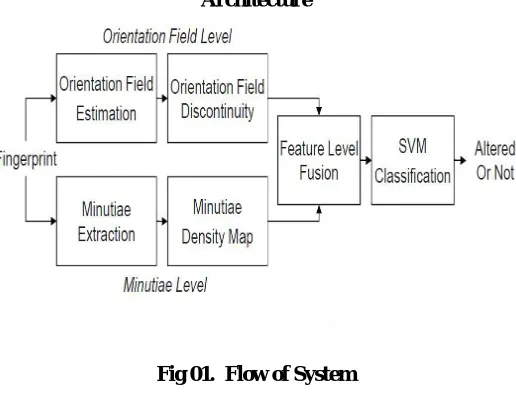
In this paper, we have tried to enforce robust method for detection and rectification of distorted fingerprints. Distortion detection is believed as a two class classification problem, where the registered ridge orientation map and period map of a particular fingerprint are utilized as the feature vector and a SVM classifier is trained to execute the classification task. Distortion correction (or equivalently distortion field estimation) is considered as a regression problem, the input is a distorted fingerprint and the output is the distortion field. To solve this problem, a database of several distorted reference fingerprints and accompanying distortion fields is made in the offline stage, and then in the online stage, the closest neighbor of the input fingerprint is found in the database of distorted reference fingerprints and the corresponding distortion field is used to correct the input fingerprint.
Architecture
Fig 01. Flow of System
IV. EXPERIMENTAL SETUP
Fingerprint distortion detection
Fingerprint distortion detection can be considered as a two class classification problem. We have used the registered ridge orientation map and period map as the feature vector, which is further classified by SVM classifier.
Fingerprint Registration
In order to take out meaningful feature vector, fingerprints have to be registered in a secure coordinate system. We suggest a multi-reference based fingerprint registration approach in which we depict how the reference fingerprints are prepared in the offline stage, and how to register an input fingerprint in the online stage.
Reference Fingerprints
ISSN(Online) : 2319-8753 ISSN (Print) : 2347-6710
I
nternational
J
ournal of
I
nnovative
R
esearch in
S
cience,
E
ngineering and
T
echnology
(An ISO 3297: 2007 Certified Organization)
Vol. 5, Issue 3, March 2016
accumulation. Each participant is asked to press a finger on the scanner in a usual way, and then distort the finger by applying a sidelong force or a torque and bit by bit increase the force. In the online stage the online fingerprint registration, given an input fingerprint, we execute the registration w.r.t. registered cite fingerprints.
Statistical Modeling of Distortion Fields
The distortion field between a pair of fingerprints can be approximated based on the corresponding minutiae of the two fingerprints. Unfortunately, due to the terrible distortion between paired fingerprints, existing minutiae matchers cannot find corresponding minutiae dependably. Hence, we extract minutiae in the first frame using Verifier and execute minutiae tracking in each video. Since the relative motion between adjacent frames is little, reliable minutiae correspondences between the first frame and the last frame can be found by this method.
Distorted fingerprint rectification
A distorted fingerprint can be thought of being generated by applying a strange distortion field to the normal fingerprint, which is also strange. If we can calculate the distortion field from the given distorted fingerprint, we can easily correct it into the normal fingerprint by applying the inverse of d. So we need to turn to a regression problem, which is quite hard because of the high dimensionality of the distortion field (although if we use a block-wise distortion field). We use nearest neighbor regression approach for this job.
Distorted Reference Fingerprint Database
The distortion fields are brought forth by uniformly trying the subspace spanned by the initial two principle components. For each basis, 11 points are uniformly sampled in the interval. For visualization purpose, only one reference fingerprint (the fingerprint located at the origin of the coordinate system) is utilized to generate the database of distorted reference fingerprints, and for each basis, five points are sampled. In reality, multiple reference fingerprints are used to achieve better execution.
Distortion Field Estimation by Nearest Neighbor Search
Distortion field approximation is equal to finding the nearest neighbor among all distorted reference fingerprints. The quality of being similar is measured based on level 1 feature of fingerprint, viz. ridge orientation map and period map. We speculate that distortion detection and rectification of human experts also depends on these features instead of minutiae.
V. RESULT
In this paper we have seen improvement from the existing system in the following manner listed below
1) Improvement in time taken during detection and rectification of distorted fingerprints: The time needed to detect and
rectify distortion of fingerprint is improved (become very less) as compare to time taken in existing system. Although the time taken changes every time as the sample fingerprint changes but average time to detect and rectify distortion is less then average time taken in existing system. The time needed to detect and rectify distorted fingerprint is improved by making the orientation map and period map to extract feature vectors of fingerprints during registration process and in detection and rectification process nearest neighbor algorithm is used in which similarity score is measure for every input fingerprint w.r.t. the registered reference fingerprint. This process take less time for detection and rectification of distorted fingerprint without detecting its center core point.
Speed of the Proposed Distortion Detection and Rectification Algorithm
Algorithm Time (sec)
Detection without center point 8.2
ISSN(Online) : 2319-8753 ISSN (Print) : 2347-6710
I
nternational
J
ournal of
I
nnovative
R
esearch in
S
cience,
E
ngineering and
T
echnology
(An ISO 3297: 2007 Certified Organization)
Vol. 5, Issue 3, March 2016
Speed of the Distortion Detection and Rectification Algorithms proposed in existing system
Algorithm Time (sec)
Detection without center point 15.3
Rectification without center point 67.1
2) Accuracy of the system in enhanced in proposed algorithm:
The above figure shows the ROC ( Receiver Operating Characteristic ) of proposed algorithm and algorithm used in existing systems. The ROC curves are plotted using TPR (True Positive Rate ) at y axis and FPR ( False Positive Rate ) at x axis. Distorted fingerprints are viewed as positive samples and normal fingerprints as negative samples. If a distorted fingerprint is classified as a positive sample, a true positive occurs. If a normal fingerprint is classified as a positive sample, a false positive occurs. By observing the above ROC plot we can say that the AUC ( area under the curve ) or ACC ( accuracy ) of the system proposed by us is much high as compare to the existing system because value of true positive rate is high and false positive rate is less and here TPR affect the accuracy of the system because if we detect the samples correctly we can rectify the distortion correctly . If a distorted fingerprint is classified as a positive sample, a true positive occurs. Here if we detect the sample correctly as if it is distorted then distorted sample and if it is normal then normal sample then we also can rectify it correctly which increases the accuracy of the system performance.
VI. CONCLUSION
ISSN(Online) : 2319-8753 ISSN (Print) : 2347-6710
I
nternational
J
ournal of
I
nnovative
R
esearch in
S
cience,
E
ngineering and
T
echnology
(An ISO 3297: 2007 Certified Organization)
Vol. 5, Issue 3, March 2016
REFERENCS
[1] X. Si, J. Feng, and J. Zhou, “Detecting fingerprint distortion from a single image,” in Proc. IEEE Int. Workshop Inf. Forensics Security, 2012, pp. 1–6.
[2] D. Maltoni, D. Maio, A. K. Jain, and S. Prabhakar, Handbook of Fingerprint Recognition, 2nd ed. Berlin, Germany: Springer-Verlag, 2009. [3] FVC2006: The fourth international fingerprint verification competition. (2006). [Online]. Available: http://bias.csr.unibo.it/fvc2006/
[4] V. N. Dvornychenko, and M. D. Garris, “Summary of NIST latent fingerprint testing workshop,” Nat. Inst. Standards Technol., Gaithersburg, MD, USA, Tech. Rep. NISTIR 7377, Nov. 2006.
[5]NeurotechnologyInc.,VeriFinger.(2009).[Online].Available: http://www.neurotechnology.com
[6] L. M. Wein and M. Baveja, “Using fingerprint image quality to improve the identification performance of the U.S. visitor and immigrant status indicator technology program,” Proc. Nat. Acad. Sci. USA, vol. 102, no. 21, pp. 7772–7775, 2005.
[7] S. Yoon, J. Feng, and A. K. Jain, “Altered fingerprints: Analysis and detection,” IEEE Trans. Pattern Anal. Mach. Intell., vol. 34, no. 3, pp. 451– 464, Mar. 2012.
[8] E. Tabassi, C. Wilson, and C. Watson, “Fingerprint image quality,” Nat. Inst. Standards Technol., Gaithersburg, MD, USA, Tech. Rep. NISTIR 7151, Aug. 2004.