DOI: 10.1534/genetics.106.056788
Functional Analysis of Genes Differentially Expressed in the Drosophila
Wing Disc: Role of Transcripts Enriched in the Wing Region
Thomas L. Jacobsen, Donna Cain, Litty Paul, Steven Justiniano, Anwar Alli, Jeremi S. Mullins,
Chun Ping Wang, Jon P. Butchar and Amanda Simcox
1Department of Molecular Genetics, The Ohio State University, Columbus, Ohio 13210
Manuscript received February 7, 2006 Accepted for publication September 22, 2006
ABSTRACT
Differential gene expression is the major mechanism underlying the development of specific body regions. Here we assessed the role of genes differentially expressed in the Drosophila wing imaginal disc, which gives rise to two distinct adult structures: the body wall and the wing. Reverse genetics was used to test the function of uncharacterized genes first identified in a microarray screen as having high levels of expression in the presumptive wing. Such genes could participate in elaborating the specific morphological characteristics of the wing. The activity of the genes was modulated using misexpression and RNAi-mediated silencing. Misexpression of eight of nine genes tested caused phenotypes. Of 12 genes tested, 10 showed effective silencing with RNAi transgenes, but only 3 of these had resulting phenotypes. The wing phenotypes resulting from RNAi suggest thatCG8780is involved in patterning the veins in the proximal region of the wing blade and thatCG17278andCG30069are required for adhesion of wing surfaces. Venation and apposition of the wing surfaces are processes specific to wing development providing a correlation between the expression and function of these genes. The results show that a combination of expression profiling and tissue-specific gene silencing has the potential to identify new genes involved in wing development and hence to contribute to our understanding of this process. However, there are both technical and biological limitations to this approach, including the efficacy of RNAi and the role that gene redundancy may play in masking phenotypes.
A
fundamental question in development is how primordial cell groups are patterned to give rise to differentiated body structures with distinct morpholo-gies. The Drosophila imaginal wing disc has been extensively studied as a model for tissue development. The single-layer columnar epithelium, which comprises the major cell layer of the disc, gives rise to two adult derivatives: the body wall (notum) and the wing/hinge (Bryant 1975). Many components of evolutionarilyconserved signaling pathways are involved in division of the early wing disc into cell lineage compartments (reviewed in Cohen1993; Blair1995; Dahmannand
Basler1999; Striginiand Cohen1999; Morata2001;
Tabataand Takei2004). The subsequent specification
and elaboration of the body-wall and wing/hinge regions is also controlled by the region-specific activity of signaling pathways and the expression of their target genes (e.g., Lawrenceand Morata1977; Halderet al.
1998; DiezDel Corral et al. 1999; Wanget al.2000;
Cavodeassi et al. 2002; Zecca and Struhl 2002a,b;
Villa-Cuesta and Modolell 2005). Genes with
potential roles in wing but not body-wall development are expected to be expressed primarily in the presump-tive wing region. To identify such genes, a microarray-based approach was used by Butler et al. (2003) to
assay differential expression between the presumptive body-wall and wing/hinge regions. Genes known to be required for development of a given region were identified (e.g.,pannier,Bar, andstripein the body wall and nubbin, Distalless, andvestigial in the wing). Addi-tionally, many uncharacterized genes also displayed enriched expression in either the body wall or the wing pouch.
Here we used a reverse genetic approach to examine the developmental roles of several of these uncharac-terized genes. We identified three genes required for wing development that had not previously been found using traditional forward genetic methods. Most genes, however, did not display loss-of-function phenotypes following RNA interference (RNAi). Each of the three genes with phenotypes affected a process specific to wing development that does not occur in the body-wall region. We conclude that transcript profiling, followed by a reverse genetic analysis, is an effective way to iden-tify novel genes with functions in the developing wing. We also discuss limitations to this approach that
Sequence data from this article have been deposited with the EMBL/ GenBank Data Libraries under data accession no. DQ375488.
1Corresponding author:Department of Molecular Genetics, The Ohio
State University, 484 W. 12th Ave., Columbus, OH 43210. E-mail: [email protected]
are both technical and biological, including RNAi effi-cacy and the role that redundancy may play in masking phenotypes.
MATERIALS AND METHODS
Generation of misexpression constructs: For genes with available full-length cDNA clones, cDNAs were excised from the parental plasmid and cloned into pUAST (Brand and Perrimon 1993). The Drosophila Gene Collection (DGC; http://www.fruitfly.org/EST/index.shtml) clones used were as follows: Cyp310a1/CG10391, LD44491; Doc2/CG5187, RE40937; Nep1/CG5894, GH03315; CG5758, GH27705; CG8483, LD39025; CG8780, RE33994; CG9008/BG:DS00797.2, GH14910; CG14534, RE71854; and CG17278, SD04019.
Generation of RNAi constructs:To create hairpin double-strand RNA (dsRNA) constructs, a 650-bp or larger portion of a given gene, the RNAi ‘‘trigger,’’ was cloned into pBlueScript-KS, with a 360-bp heterologous spacer fragment as in Piccin
et al.(2001). This sense-strand ‘‘trigger1spacer’’ fragment was then cloned into pUAST. The dsRNA construct was completed by adding the trigger fragment in reverse orientation into pUAST containing the ‘‘trigger1 spacer’’ fragment. When necessary, appropriate restriction sites were added using PCR primers. For constructs containing smaller trigger sequences, an artificial intron derived from the third intron of thevngene was used as a spacer between the inverted repeats to increase dsRNA activity (Schneppet al.1996; Reichhartet al.2002). Sequences used were from cDNA clones or were cloned from genomic DNA using PCR.
Trigger sequences used in upstream activating sequence (UAS)–RNAi constructs (sequence coordinates from DGC cDNA clones or FlyBase annotated exons) were Cyp310a1, LD44491 (nt 1–891); dNAB/CG15000, exon 2 from CG15000 (nt 22–840); Nep1/CG5894, GH03315 (nt 808–1573); Ugt86Di/CG6658, exon 3 (nt 57–707); LpR1/CG4861, exon 6 (316–1373); CG8483, LD39025 (nt 329–1120); CG8780, RE33994 (nt 740–1696); CG9008, GH14910 (nt 327–1442); CG14534, RE71854 (nt 513–1216); CG15489, single exon (nt 38–799); CG17278, SD04019 (nt 13–741); CG30069, LP06813 (3159–3995). Constructs made using an artificial intron as a spacer were dNAB/CG15001, CG15001 exon (1–321); Doc2, RE40937 (663–1104); CG5758, exon 8 (nt 23–417); CG15488, single exon (nt 1–432).
Generation of UAS lines:Constructs were co-injected with the ‘‘wings clipped’’ helper plasmid (Karessand Rubin1984) into yw embryos. Transformants were then mapped and homozygous or balanced stocks were generated and used for the GAL4 crosses. If fewer than three independent trans-formed lines were obtained, one of the existing inserts was mobilized to generate new insertions by crossing to the trans-posase stock w; Dr/TMS, P{ry[1t7.2]¼Delta2-3}99B. The fly lines generated for each construct are detailed in supplemen-tal data at http://www.genetics.org/supplemensupplemen-tal/.
GAL4-UAS crosses:Generally, we maximized GAL4 expres-sion by carrying out crosses at 29°and, if a phenotype was seen, a given cross was repeated at 25°to see the effects resulting from lower activity of the temperature-dependent GAL4-UAS system (Duffy 2002). A minimum of three lines for each misexpression and RNAi construct were used for these ana-lyses. The driver–responder crosses performed and the result-ing phenotypes are detailed in supplemental data at http:// www.genetics.org/supplemental/.
Fly stocks:GAL4 driver lines used wereTub-GAL4/TM3(Lee and Luo1999),71B-GAL4(Brandand Perrimon1993),
1348-GAL4(Huppertet al.1997),69B-GAL4(Brandand Perrimon 1993), da-GAL4-UH1 (Wodarz et al. 1995), en-GAL4 (Aza
-Blanc et al. 1997), ey-GAL4 [P{GAL4-ey.H}3-8 from the Bloomington Stock Center], ap-GAL4/CyO (Calleja et al. 1996), and Act5C-GAL4 [P{Act5C-GAL4}17bFO1 from the Bloomington Stock Center].
PiggyBac insertion stocks from the Bloomington Stock Center used were CG5758[c01197], an insertion in CG5758
intronic sequence;CG5758[e01537], no sequence information;
Ugt86Di[e00862], an insertion upstream of predicted coding sequence. Insertion sites were determined from the reported flanking sequences for the alleles. For CG5758[e01537], no flanking sequence data were available.
In situanalysis:In situanalysis was carried out as described in Butleret al.(2003). Probes for examining RNA knockdown were generated using PCR to add a 39T7 site to a region of a given transcript not included in the corresponding RNAi construct. PCR fragments were gel purified and used as templates in the T7 transcription reactions. The T7 sequence added was 59-GAATTTAATACGACTCACTATAGG-39.
RT analysis of CG15488 and CG15489:RNA was extracted from third instar wing discs using QIAGEN (Chatsworth, CA) RNeasy columns. Reverse transcription was carried out ac-cording to standard protocols from Ambion (Austin, TX). Sequence specific to the third exon of the known nubbin
transcript [59-CCACCATTGGCGTCATCGTAATCC-39] was used as the 39-primer for reverse transcription. 59 primers containing sequence from CG15488 [59-CTGCAACCAGCT CAGATTGCC-39] orCG15489[59-GGCAACGGCAACAGCAA CACC-39] were used to amplify resulting cDNAs in a PCR reaction. Products were cloned into the pDrive vector from the QIAGEN PCR cloning kit and sequenced. The GenBank accession number for the reverse transcription product is DQ375488.
Sequence analysis:Sequence analysis was performed using sequences, annotations, and tools from these databases: FlyBase (http://flybase.bio.indiana.edu), Ensembl (http:// www.ensembl.org), EMBL-EBI (http://www.ebi.ac.uk/tools), SMART (http://smart.embl-heidelberg.de), NCBI (http:// ncbi.nih.gov), BeetleBase (http://www.bioinformatics.ksu. edu/beetlebase), and SilkBase (http://papilio.ab.a.u-tokyo. ac.jp/silkbase). The MEME program for repeat analysis (Grundyet al. 1996) was obtained from http://meme.sdsc. edu/meme/website/intro.html.
RESULTS AND DISCUSSION
Functional analysis of uncharacterized genes using the GAL4-UAS system:We used microarrays to identify 25 transcripts with enriched expression in a wing/hinge sample that did not have known wing expression pat-terns and confirmed their differential expression using
in situexpression analysis (Butleret al.2003; Figures 1
and 2). Here, 12 of these were selected for functional analysis. This set was chosen by excluding genes that have been characterized genetically (dve, pdm2, b-gal,
ana, opa, Doc1, and wgn) and genes predicted to en-code chitin-binding proteins (CG32039/CG6469 and
CG14301). Transcripts, annotated as separate genes but which we or others in fact found to comprise segments of other genetically characterized genes, were also excluded: RT–PCR analysis showed thatCG15489
andCG15488comprise contiguous exons in an alterna-tive transcript of the wing development gene nubbin
levels ofnubbintranscripts containing these two exons caused effects on wing morphogenesis and polyphasic lethality, indicating a requirement for this alternate transcript during development (supplemental data at http://www.genetics.org/supplemental/).CG15000 and
CG15001 are reported to be exons in the dNAB gene (Clementset al.2003). The remaining 12 genes
repre-sent loci for which no genetic data existed prior to the beginning of our analyses.
RNAi experiments were carried out for all 12 genes and ectopic expression was performed for the 9 genes with complete cDNAs available. Each construct was tested with the same set of GAL4 drivers: Tub-GAL4, which directs ubiquitous expression (Lee and Luo
1999);69B-GAL4, which is expressed in embryonic epi-dermis and in imaginal tissues (Brandand Perrimon
1993);71B-GAL4, which is expressed in the wing pouch during the third larval instar and in intervein regions in the pupal wing (Brandand Perrimon1993; Wessells et al.1999); and1348-GAL4, which is expressed in pupal
interveins (Huppertet al.1997). Some additional
driv-ers were used for examining specific developmental effects of certain genes and for assaying thein vivo effi-cacy of RNAi.
Misexpression phenotypes were seen with eight of the nine genes tested while knockdown of three genes with RNAi caused phenotypes (Table 1; Figures 2 and 3; supplemental data at http://www.genetics.org/ supplemental/). These three genes,CG8780,CG17278, and CG30069, are each novel single-copy genes with no previously described roles in development. Two of these, CG8780 and CG17278, showed phenotypes fol-lowing both misexpression and RNAi. Overexpression ofCG30069was not tested due to the lack of a complete cDNA. The phenotypes observed for the various genes in the misexpression and RNAi experiments included effects on wing development, eye development, notal microchaete patterning, pupal morphogenesis, and eclosion and viability. A summary of these results is shown in Table 1.
Figure1.—Wild-type ex-pression patterns and visu-alization of RNAi-mediated knockdown by in situ hy-bridization. Wing imaginal discs are oriented with anterior to the left and dor-sal at the top. For discs ex-pressing RNAi transgenes, an inset diagram indicates the GAL4-driver expression pattern. en-GAL4 is ex-pressed throughout the posterior compartment of the disc and ap-GAL4 is expressed throughout the dorsal compartment. All GAL4/UAS flies are hetero-zygous for the given driver and responder and grown at 29° to maximize GAL4 activity. (A)Cyp 310a1 wild-type expression. (B) Cyp 310a1 expression in en-GAL4; UAS-Cyp 310a1-RNAi
disc. Posterior expression is strongly reduced. (C)Nep1wild-type expression. (D)Nep1expression inap-GAL4; UAS-Nep1-RNAidisc. Dorsal compartment expression is absent (arrowhead). (E)Ugt86Diwild-type expression. (F)Ugt86Diexpression inen-GAL4; UAS-Ugt86Di-RNAidisc. Posterior expression is strongly reduced. (G)CG5758wild-type expression. (H)CG5758expression inen-GAL4; UAS-CG5758-RNAi
disc. Expression in the posterior compartment throughout the dorsal hinge is absent. (I)CG8483wild-type expression. ( J)CG8483
Ectopic expression of Doc2, Nep1, CG5758,CG8483,
CG9008, andCG14534results in developmental effects, while RNAi does not: Dorsocross2 (Doc2/CG5187) en-codes a T-box domain transcription factor, with similarity to the vertebrateTbx6subfamily of T-box genes, located
in a complex with two closely related and redundant genes,Doc1andDoc3(Reimet al.2003; Hamaguchiet al.
2004). Our examination of Doc2, which was initiated prior to these studies (Reimet al.2003; Hamaguchiet al.
2004), complements the published findings. Overex-pression of Doc2 protein caused complete lethality when misexpressed with all GAL4 drivers tested, with the exception of a singleUAS-Doc2line that gave a small number of survivors with 1348-GAL4 at 25° (supple-mental data at http://www.genetics.org/supple(supple-mental/). Embryonic, larval, and pupal lethality, depending on the driver used, were observed. For drivers with broad early embryonic expression such asda-GAL4and 69B-GAL4, no larval hatching was observed. Survivors from the cross to the 1348-GAL4 driver had ectopic vein material between L3 and L4 and in the region below L5 (data not shown), indicating that ectopic Doc2 can cause specific patterning defects during pupal wing development. These results indicate that Doc2 is toxic when ectopically expressed, consistent with its role as a transcription factor involved in the patterning of multiple tissues during development. RNAi resulted in some lethality when ubiquitously expressed with Tub-GAL4, but the results were inconsistent and no specific developmental effects were observed in any other GAL4-driver crosses (supplemental data at http://www.genetics. org/supplemental/). Experiments testing the UAS-Doc2-RNAi construct suggest that the construct may have been nonfunctional (Figure 1, O and P, and seeIn vivo analysis of RNAi efficacy).
Neprilysin1 (Nep1) together with three other genes in Drosophila,Nep2/3/4, encodes an M13-metallopep-tidase with homology to the human Neprilysin gene Figure2.—Wing phenotypes resulting from RNAi gene
si-lencing. All GAL4/UAS flies are heterozygous for the given driver and responder. (A) Wild-type wing. (B) 69B-GAL4; UAS-CG17278 (25°) wing showing typical blistering pheno-type. Inset shows the wild-typeCG17278 expression pattern. (C)71B-GAL4; UAS-CG30069-RNAi(25°) wing showing typical blistering phenotype. Inset shows the wild-typeCG30069 ex-pression pattern. (D) Costal area of wild-type wing (29°). The different sections of the costa and the costal vein are la-beled: mCo, medial costa; dCo, distal costa; L1, anterior wing margin. (E) Costal area fromTub-GAL4; UAS-CG8780-RNAi
(29°) wing blade. Fusion is evident between the dCo and L1 eliminating the gap present in (D). Fusion is also observed between the mCo and dCo regions and there is narrowing and deposition of vein material between the costal and sub-costal veins. Inset shows the wild-typeCG8780expression pat-tern. Arrowheads in D and E indicate the pattern changes.
TABLE 1
Gene function assays and resulting phenotypes
Gene Overexpression phenotype RNAi phenotype
Wing-disc
expression Function/homology
Cyp310a1 None None Figure 1A Cytochrome P450
Doc2 Extra veins, lethality NDb Figure 1O T-box transcription factor
LpR1 NDa NDb Figure 1Q LDL receptor
Nep1 Wing-expansion defects, lethality None Figure 1C Neprilysin metalloprotease
Ugt86Di NDa None Figure 1E UDP-glucosyl transferase
CG5758 Wing adhesion/expansion defects, lethality
None Figure 1G b-Ig-H3/fasciclin domains
CG8483 Wing adhesion/expansion defects, lethality
None Figure 1I SCP domain
CG8780 Localized cell death, lethality Costal vein patterning Figure 2E Unknown
CG9008 Bristle patterning defect, lethality None Figure 1K Aldose epimerase-like CG14534 Tubby phenotype, lethality None Figure 1M DM5/DUF243 domain CG17278 Abdominal swelling, melanization,
lethality
Wing blistering, lethality Figure 2B Similarity to serpins
CG30069 NDa Wing blistering and
adhesion, lethality
Figure 2C Unknown
ND, not determined. a
No full-length cDNA was available. b
(Turner et al. 2001). Mammalian neprilysins show a
wide range of substrate specificities and play a role in regulating the action of several peptide signals and other proteins in the extracellular space through degra-dation of substrates (Turneret al.2001). In third instar
wing discs, Nep1 is expressed in limited areas of the mesopleura and wing hinge (Figure 1C; Butleret al.
2003). Silencing of Nep1 expression by RNAi had no effect on these or other tissues. Overexpression ofNep1
withTub-GAL4caused pupal and pharate lethality with no survivors. Crosses with 69B-GAL4, 1348-GAL4, and
da-GAL4 resulted in many flies with bent or wrinkled wings, but most striking was that a significant percent-age of flies had nonexpanded wings (supplemental data at http://www.genetics.org/supplemental/). Nep1 is predicted to have peptidase activity, so ectopic expres-sion of the protein may cause degradation of some substrate(s) within the extracellular space required to mediate normal wing adhesion and expansion.
CG5758 is predicted to encode a secreted protein that contains two b-Ig-H3/FasI domains (SMART an-notations), a domain known to be involved in cell adhesion (Elkins et al. 1990). In addition to other
drosophilids, the mosquito and the beetle also contain likely homologs of CG5758(data not shown). Expres-sion ofCG5758is detected primarily in the dorsal hinge region of third instar wing discs (Figure 1G; Butler et al. 2003). RNAi silencing of CG5758 resulted in a variable effect on viability when expressed with the Tub-GAL4driver (supplemental data at http://www.genetics. org/supplemental/). However, no defects were seen in derivatives of the dorsal hinge or elsewhere following RNAi with drivers expressed in the wing or more glob-ally (supplemental data at http://www.genetics.org/ supplemental/). Overexpression of CG5758 showed a range of developmental effects. Misexpression with
Tub-GAL4 and da-GAL4 resulted in widespread pupal lethality at 29°. At 25°, seven of the eight indepen-dent UAS-CG5758 lines were completely lethal when crossed to Tub-GAL4. At 25°, misexpression with da-GAL4 resulted in pupal lethality but there were also some survivors. Most of these escapers displayed wing defects, including wrinkling, blistering, and nonexpan-sion (supplemental data at http://www.genetics.org/ supplemental/). These results suggest that while re-duction ofCG5758expression does not affect wing de-velopment, excess amounts of this putative adhesion protein can disrupt normal morphogenesis and adhe-sion in the wing.
CG8483 encodes a predicted secreted protein con-taining a domain variously referred to as an SCP/V5/ TPX domain. This domain is found in proteins such as insect venom allergens, reptile toxins, plant pathogen-esis proteins, and human GliPR/RTVP-1 (Henriksen et al.2001). While the function of this domain is unclear, recent work suggests that the human GliPR/RTVP-1 may act as a tumor suppressor with proapoptotic activity (Renet al.2002).CG8483is expressed along the wing
margin and in clusters of cells in other regions of the third instar wing disc (Figure 1I; Butleret al. 2003).
While RNAi silencing of CG8483 had no discernible effects, misexpression of the gene resulted in a mixture of low-penetrance adult phenotypes and lethality. Tub-GAL4-mediated overexpression at 25°and 29°resulted in nearly complete pupal or pharate lethality. Misex-pression with other drivers resulted in variable levels of pharate adult lethality. Adults from some of these crosses showed low numbers of wing adhesion and expansion defects and the presence of blackened tissue behind the labial palps, depending on the GAL4-driver used (supplemental data at http://www.genetics.org/ supplemental/). These results indicate that excess
CG8483 is toxic during pupal development, although the cause of lethality is not clear. This is the first case in which a Drosophila SCP domain protein has been shown to have any developmental effects and may Figure 3.—Nonwing phenotypes caused by
overexpres-sion. All GAL4/UAS flies are heterozygous for the given driver and responder. (A) Dorsocentral region of notum from
Tub-GAL4 adult at 25°. (B) Dorsocentral region of notum from a Tub-GAL4; UAS-CG9008 adult at 25°. Several micro-chaete rows are disorganized with bristles displaying altered polarity. (C–E) Pupae raised at 25°. (C)TM6B, Tb/1 pupa showingTubbyphenotype. (D) Wild-typeCanton Spupa. (E)
da-GAL4; UAS-CG14534 pupa. The da-GAL4; UAS-CG14534
pupa shows a shortened, rounded phenotype similar to that seen in the Tubby mutant pupa. (F) Head from a ey-GAL4
potentially be useful for examining general aspects of SCP domain function.
The predicted product(s) of the CG9008/BG: DS00797.2gene displays limited similarity to the active site of known aldose epimerases (SMART and NCBI– CDS annotations). However, CG9008 shows no signif-icant overall similarity to any vertebrate genes or to other Drosophila genes predicted to encode aldose epimerases.CG9008homologs in mosquito, honeybee, beetle, and silkworm show a high degree of conserva-tion with homologs present in yeast, bacteria, and Arabadopsis, as determined by BLAST analysis (data not shown), indicating that the proteins represent an evolutionarily conserved group. No function has yet been described for these ‘‘aldose epimerase-like’’ genes. Although CG9008 is expressed throughout the third instar wing pouch (Figure 1K; Butleret al.2003) and
appears to be a unique gene, RNAi silencing of expression had no effects. Overexpression ofCG9008
using the ubiquitous Tub-GAL4 driver at 29° affected viability, with 2 of 10UAS-CG9008lines giving rise to no survivors and 3 other lines showing,5% survival when compared to the control class (supplemental data at http://www.genetics.org/supplemental/). At 25°, mis-expression of all UAS-CG9008 lines with Tub-GAL4 resulted in survivors. Adults from these crosses showed patterning effects on the arrangement of notal micro-chaetes with the rows near the dorsal central region showing various degrees of disorganization and effects on bristle polarity (Figure 3B). Misexpression with other widely expressed drivers showed similar microchaete phenotypes (supplemental data at http://www.genetics. org/supplemental/).
CG14534 is predicted to be a secreted protein containing a DM5/DUF243 domain, an uncharacter-ized domain found in proteins from mosquito, honey-bee, and silkworm as determined by BLAST analysis (data not shown). In third instar wing discs,CG14534
expression is limited to the posterior wing margin (Figure 1M; Butler et al. 2003). RNAi silencing of CG14534had no effects on the posterior margin or any other structures. Overexpression ofCG14534 with the
Tub-GAL4driver at both 29°and 25°resulted in pupae displaying a Tubby-like phenotype of shortened and rounded pupal cases (Figure 3E). At 29°, Tub-GAL4; UAS-CG14534progeny died during the pharate stage. Pharate adults dissected from their pupal cases showed no obvious developmental defects. At 25°, a small number of escapers were seen, again with no apparent phenotypes other than aTubby-like appearance. Over-expression using da-GAL4 resulted in different num-bers of pupae with aTubby-like phenotype depending on the UAS-CG14534 transgenic line used with one line tested showing 100% Tubby-like pupae (supplemental data at http://www.genetics.org/supplemental/). While
CG14534 overexpression appears to phenocopy the classical dominant Tubby mutant, CG14534 and Tubby
map to different regions of the genome, the 2L and 3R chromosome arms, respectively. TheTubbymutation has been localized by recombination mapping to a region of the third chromosome (3–90; Lindsley and Zimm
1992) that is near a cluster of several annotated genes containing DM5/DUF243 domains in a 22-kb region located in the 97C cytological region according to FlyBase cytological maps. However, whetherTubby cor-responds to a gene in this cluster and how CG14534
elicits aTubby-like phenotype remain to be determined. CG8780, CG17278, and CG30069 are unique genes required for wing development: From the set of 12 genes tested, 3 showed developmental effects with RNAi-mediated gene silencing:CG8780,CG17278, and
CG30069. All three are novel single-copy genes with no previously described roles in development.
CG8780 is required for patterning the costal region of the wing blade: CG8780, a novel protein with limited sim-ilarity to any proteins outside of Drosophila species (data not shown), is expressed in regions of the third instar wing disc that give rise to the costal area of the wing (Figure 2E; Bryant 1975; Butler et al. 2003).
Consistent with the expression pattern, RNAi silencing ofCG8780affects the development of the costal region in the adult wing. When induced with Tub-GAL4, da-GAL4, ap-GAL4, and 69B-GAL4 drivers, RNAi caused fusion of the costal vein with the L1 vein, resulting in a contiguous wing margin lacking any separation between the end of the costal vein and L1 (Figure 2E; supplemen-tal data at http://www.genetics.org/supplemensupplemen-tal/). Expression withTub-GAL4also caused fusion between the normally distinct medial and distal regions of the costal vein (Figure 2E). Thickening of the costal vein is also seen, sometimes to the extent of spanning the re-gion normally found between the costal and subcostal veins of the wing (Figure 2E; supplemental data at http://www.genetics.org/supplemental/). Depending on the UAS-CG8780-RNAi line used, a variable reduction in the ability to fly was observed (data not shown), possibly resulting from a loss of flexibility at the fused junction between the costal vein and L1. None of the crosses demonstrated significant levels of lethality or overt signs that reduction ofCG8780activity affected any other tissue. These results suggest thatCG8780plays a role in patterning the specific region of the wing blade where it is expressed.
The cDNA clone available for CG8780 (RE33994) contains a single nucleotide deletion, which should result in a truncated protein 370 amino acids longvs.
717 amino acids long for the full-length protein pre-dicted from the Drosophila melanogaster genomic se-quence and an ortholog identified in D. ananassae. However, comparison of the phenotype from overex-pressing this cDNA with similar experiments in D. ananassae suggests that the truncated protein retains function. Yoshida et al. (1994) showed that ectopic
developing eye ofD. ananassaeresults in extensive cell death and a reduced eye phenotype. We found ectopic expression of CG8780 resulted in complete lethality with all of the drivers tested except ey-GAL4 (supple-mental data at http://www.genetics.org/supple(supple-mental/). Mostey-GAL4; UAS-CG8780flies died before the pharate stage but those that reached this stage or eclosed showed a nearly complete loss of eye tissue (Figure 3G). The effects of overexpression are like those seen withOm(2D)
while showing no resemblance to the RNAi phenotypes, likely ruling out the possibility that the truncated protein acts in a dominant-negative fashion.
The molecular role that CG8780 plays in wing patterning is difficult to predict due to the lack of any clear homologies to known functional domains or proteins in other non-drosophilid species. Its expres-sion pattern and the RNAi results suggest thatCG8780
may represent a gene that evolved to play only a very specific, although critical, role in patterning the costal region of Drosophilidae. The results of misexpression in the eye, as well as the lethal effects seen in other crosses, suggest thatCG8780has the potential to mediate cell death or suppress proliferation, processes central to differentiation and the morphogenesis of adult tissues.
CG17278 is required for viability and adhesion of wing surfaces: CG17278 is predicted to encode a short se-creted protein 80 amino acids long that shows similarity to Kazal-type serine protease inhibitors (SMART anno-tation). CG17278 also shows similarity to predicted Kazal domain proteins from the moth speciesManduca sexta,Lonomia oblique, andBombyx mori(data not shown). In third instar wing discs,CG17278is highly expressed throughout the developing wing pouch except along the dorsal/ventral boundary where it is downregulated (Figure 2B; Butleret al.2003). Both misexpression and
RNAi-mediated gene silencing showed effects on wing development.
Overexpression usingTub-GAL4andda-GAL4at 29°
resulted in nearly complete pupal and pharate adult lethality (supplemental data at http://www.genetics. org/supplemental/). At 25°, da-GAL4 crosses to the two lines tested resulted in many adults with wing morphogenesis defects such as bending or mild wrin-kling of the wing blade. Most flies also displayed grossly swollen abdomens (Figure 3I). Additionally, many flies displayed dark spotting in the abdomen (supplemental data at http://www.genetics.org/supplemental/).
WhenCG17278transcript levels were reduced using RNAi, clear effects on wing adhesion were seen (Figure 2B).Tub-GAL4-directed expression of the three stron-gest UAS-CG17278-RNAi lines caused pharate adult lethality at 29°. A weaker line resulted in many survivors with70% of the flies showing blistering in at least one wing. At 25°, three of the four lines gave rise to survivors with wing blistering. Crossing the stronger transgenic lines to69B-GAL4and71B-GAL4also resulted in wing blistering and expansion defects with the wings partially
inflated to different degrees (supplemental data at http://www.genetics.org/supplemental/).
CG17278, consistent with its high expression level in the wing pouch (Figure 2B), is required for adhesion of the wing surfaces and expansion. Although similarity to Kazal-type serine protease inhibitors suggests that CG17278 may be a serine protease inhibitor, whether it displays such activity and which molecules it may interact with during wing development remain to be determined. In addition to wing development,CG17278
is also required for viability, indicating a necessary role in other processes. One study has found thatCG17278
expression is induced severalfold soon after bacterial infection (De Gregorio et al. 2001). These results
suggest thatCG17278could play a role in activating an immune response that possibly underlies the melaniza-tion and apparent producmelaniza-tion of excess lymph seen in the abdomen whenCG17278was overexpressed.
CG30069, a protein containing a large tandem repeat region, is required for viability and adhesion of wing surfaces: CG30069is expressed throughout the third instar wing pouch except within the wing margin and presumptive vein regions (Figure 2C; Butler et al. 2003).
RNAi-mediated silencing demonstrated a requirement for
CG30069 in mediating adhesion between the two sur-faces of the wing blade as well as an earlier require-ment during embryonic developrequire-ment.Tub-GAL4-driven misexpression with all UAS-CG30069 lines resulted in embryonic lethality. RNAi withda-GAL4resulted in em-bryonic and early larval lethality (supplemental data at http://www.genetics.org/supplemental/). RNAi with
71B-GAL4 and 1348-GAL4 showed some degree of lethality at 29° and 69B-GAL4-driven RNAi was com-pletely lethal for all lines tested. Among the survivors of crosses at 29° and 25°, wing blistering was wide-spread especially in the relatively stronger RNAi lines (Figure 2C; supplemental data at http://www.genetics. org/supplemental/). Flies also showed other apposi-tion defects such as curved/bent wings and wings that were partially inflated.
The predicted transcript forCG30069encodes a large protein with .3600 residues. While BLAST analysis identifies potential homology to some proteins of known function (e.g., RNA pol II), these results appear to be due to the amino acid composition of a large tandem repeat array in CG30069 and not to any specific sequence homology. However, BLAST analysis of geno-mic sequences from several insects identified genes encoding orthologous proteins in mosquito, flesh fly, honeybee, silkworm, and beetle (data not shown). The fact that homologs of CG30069 have been found in all these insects suggests that it may play a critical role in wing development or in some other common devel-opmental process for all insects. Analysis using the MEME program to detect motifs (Grundyet al.1996)
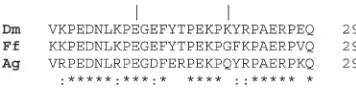
respectively) identified a 29-amino-acid unit repeated up to 80 times in a contiguous array in these proteins. The consensus sequences for the repeats from the three proteins are nearly identical (Figure 4), with some repeat-to-repeat variation within each protein. When the entire set of repeats among these three proteins are examined, the periodicity of the repeats, 29 residues, and the sequence Asp-Asn-Leu-X-X-Asp/Glu-Gly (D-N-L-X-X-D/E-G) are nearly invariant with only two repeats in the Drosophila and mosquito sequences showing variation in size and/or sequence (data not shown). Sequence conservation is also observed between differ-ent insects for some regions of the protein between the end of the repeat region and the C-terminal (data not shown).
In the flesh fly (Sarcophaga peregrina), the homolog of CG30069 designated as the ‘‘210-kDa protein,’’ was identified as a substrate for the C1-peptidase cathepsin L and localized by antibody staining to the basal lamina of imaginal discs (Homma and Natori 1996; Fujii
-Tairaet al.2000). While no secretion signals are evident
in the predicted CG30069 protein, the flesh fly results suggest that the Drosophila protein may be a basal laminar protein and perhaps mediate adhesion between the apposing surfaces of the wing pouch. Adhesion of the wing surfaces during pupal development and meta-morphosis is a multi-step process, with the dorsal and ventral surfaces adhering and disengaging before finally becoming stably apposed (Brown et al. 2000).
Mole-cules such as integrins on the basal surfaces of the dorsal
and ventral wing pouch play a necessary role in mediating this process and reduction of integrin func-tion can lead to blistering in adult wings (Brown et al. 2000), which is similar to the effects seen with expression ofUAS-CG30069-RNAitransgenes. Whether CG30069 interacts directly with integrins or other known molecules during adhesion is unknown. The early lethality observed indicates that CG30069 is also required during embryonic development.
In vivo analysis of RNAi efficacy: Although RNAi assays were performed for all 12 genes, only the 3 genes described above had specific phenotypes. This lack of effect could be due to a number of reasons: the RNAi construct used was inactive, the protein encoded by a given transcript might play no significant role in de-velopment, or the gene is functionally redundant. To test the first possibility,in vivoanalysis was carried out usingin situhybridization and genetic assays.
In situ hybridization was used to determine if the endogenous transcript was downregulated by the RNAi transgene. The nine genes without RNAi phenotypes were examined (Figure 1). RNA probes that did not hybridize to the RNAi trigger sequences were used to monitor endogenous gene expression (materials and methods). Clear knockdown of transcript levels was
seen for seven genes:Cyp310a1,Nep1,Ugt86Di,CG5758,
CG8483, CG9008, and CG14534 (Figure 1, A–N). No obvious reductions were seen in transcript levels for
Doc2 or LpR1 (Figure 1, O–R) even though the RNAi transgenes were expressed robustly (insets in Figure 1, P and R). This suggests that the RNAi constructs were either nonfunctional or unable to lower RNA levels sufficiently to be recognized by this assay.
A genetic approach was also used to test the activity of the RNAi transgenes. Six genes had lethal overexpres-sion phenotypes but no effects from RNAi. Thus we tested the ability of the RNAi transgenes to suppress lethality associated with overexpression. The genes tested wereDoc2,Nep1,CG5758,CG8483,CG9008, and
CG14534. TheUAS-Doc2-RNAitransgene was unable to suppress lethal and visible phenotypes caused by mis-expression of Doc2 (Table 2). This finding and the inability to reduce transcript accumulation suggest that
TABLE 2
RNAi transgenes suppress lethal overexpression phenotypes
Gene Overexpression RNAi Overexpression/RNAi
Transgenes expressed withTub-Gal4
Doc2a Extra veins, few survivors No effect Same as overexpression
Nep1 Pupal lethal No effect Adult viable
CG5758 Pupal lethal No effect Adult viable CG8483 Pupal lethal No effect Adult viable
CG9008 13% survival, bristle phenotype No effect 30% survival, bristles normal CG14534 Pupal lethal,Tb-like pupae No effect Adult viable, fewerTb-like pupae
a
Doc2 was assayed using 1348-GAL4.
the Doc2 RNAi transgene is ineffective. In contrast, due to their ability to suppress overexpression effects (Table 2), we conclude that the RNAi transgenes for Nep1,
CG5758, CG8483, CG9008, and CG14534 were func-tional at least to some degree. As a control, we also tested whether co-expression of UAS-GFP had any rescuing ability. This was to exclude the possibility that suppres-sion was due to a titration of GAL4 activity caused by introducing an additional transgene. Overexpression phenotypes were unchanged in the presence of UAS-GFP (supplemental data at http://www.genetics.org/ supplemental/).
While RNAi is a powerful means to reduce gene expression, only a null mutation can provide a definitive indication of gene function. There are currently no alleles other than wild type for the genesNep1,CG8483,
CG9008, and CG14534. Currently, the Bloomington Stock Center has two PiggyBac insertion stocks for
CG5758 and one for Ugt86Di (see materials and methods). We tested these over appropriate
deficien-cies and also madetrans-heterozygotes forCG5758. All crosses yielded viable adults displaying no phenotypes (data not shown). While these findings are in keeping with our results from RNAi, the insertion mutants have not been characterized in detail and additional alleles will need to be examined before a definitive conclusion can be made that these genes do not have loss-of-function phenotypes.
Redundancy may mask phenotypes: We effectively
reduced the function of 10 genes using RNAi but only 3 showed phenotypes. Two of the 7 genes without RNAi phenotypes,CG9008andCG5758, appear to be unique genes in Drosophila on the basis of BLAST analysis, although each contains domains with limited similarity to known gene families. Even though these genes are expressed specifically, they may have no physiological role in the wing or could be functionally redundant with proteins displaying no clear molecular similarity. The remaining 5 genes,Cyp 310a1(cytochrome P450),Nep1
(Turner et al. 2001), Ugt86Di (Luque and O’Reilly
2002), CG8483 (SMART/Ensembl annotations), and
CG14534 (SMART/Ensembl annotations), are mem-bers of multi-gene families. Therefore, it is possible that effects from loss of function are masked by the activity of another family member. In keeping with this idea, at least one other gene from each of these families is expressed at similar levels in the wing pouch according to our microarray data: 9 cytochrome P450 genes; the neprilysins Nep3 and Nep4; UDP-glucosyltransferase
Ugt86Da; SCP domain proteins Ag5r2 and CG5106/ scpr-C; DM5/DUF243 domain proteins CG14254,
CG14643, CG8986, and CG5812/GCR(ich). These data are available from the Gene Expression Omnibus database (Butler et al. 2003). To test the potential
effects of redundancy, it will be necessary to simulta-neously reduce the function of multiple genes in a given family.
Concluding remarks: Reverse genetics was used to assay the function of 12 uncharacterized genes with expression in the developing Drosophila wing. Ten genes showed effective silencing with RNAi but only 3 of these had resulting pattern defects. Most of the genes failing to show defects are members of gene families, suggesting that functional redundancy will mask phe-notypes. The findings highlight the difficulty whereby the function of a large number of Drosophila genes, not already discovered by traditional forward genetics, may prove refractive to single-gene analysis. The 12 genes were selected for analysis by virtue of high specific expression in the wing region (Butler et al. 2003);
however, no genes, even those for which RNAi produced a phenotype, had a dramatic effect on wing develop-ment. This may reflect the fact that these genes belong to a large category of Drosophila genes that have not been identified by mutation because they have subtle roles. We conclude that transcriptional profiling fol-lowed by RNAi knockdown is an efficient way to analyze genes expressed in a given tissue but the approach is limited to some extent by the efficacy of RNAi and gene redundancy. Furthermore, it is likely that in many cases resulting phenotypes will be subtle.
We thank the Bloomington Stock Center for flies and Mandi Butler for clones. This work was supported by grants from the National Science Foundation to A.S.
LITERATURE CITED
Aza-Blanc, P., F. A. Ramirez-Weber, M. P. Laget, C. Schwartzand
T. B. Kornberg, 1997 Proteolysis that is inhibited by hedgehog
targets Cubitus interruptus protein to the nucleus and converts it to a repressor. Cell89:1043–1053.
Blair, S. S., 1995 Compartments and appendage development in
Drosophila. BioEssays17:299–309.
Brand, A. H., and N. Perrimon, 1993 Targeted gene expression as a
means of altering cell fates and generating dominant pheno-types. Development118:401–415.
Brown, N. H., S. L. Gregory and M. D. Martin-Bermudo,
2000 Integrins as mediators of morphogenesis in Drosophila. Dev. Biol.223:1–16.
Bryant, P. J., 1975 Pattern formation in the imaginal wing disc of
Drosophila melanogaster: fate map, regeneration and duplication. J. Exp. Zool.193:49–77.
Butler, M. J., T. L. Jacobsen, D. M. Cain, M. G. Jarman, M. Hubank
et al., 2003 Discovery of genes with highly restricted expression patterns in the Drosophila wing disc using DNA oligonucleotide microarrays. Development130:659–670.
Calleja, M., E. Moreno, S. Pelazand G. Morata, 1996
Visuali-zation of gene expression in living adult Drosophila. Science
274:252–255.
Cavodeassi, F., I. Rodriguezand J. Modolell, 2002 Dpp
signal-ling is a key effector of the wing-body wall subdivision of the Dro-sophila mesothorax. Development129:3815–3823.
Clements, M., D. Duncan and J. Milbrandt, 2003 Drosophila
NAB (dNAB) is an orphan transcriptional co-repressor required for correct CNS and eye development. Dev. Dyn.226:67–81. Cohen, S. M., 1993 Imaginal disc development, pp. 747–841 inThe
Development of Drosophila melanogaster, edited by M. Bateand A.
MartinezArias. Cold Spring Harbor Laboratory Press, Cold
Spring Harbor, NY.
Dahmann, C., and K. Basler, 1999 Compartment boundaries: at
the edge of development. Trends Genet.15:320–326. DeGregorio, E., P. T. Spellman, G. M. Rubin and B. Lemaitre,
by using oligonucleotide microarrays. Proc. Natl. Acad. Sci. USA
98:1590–12595.
Diez Del Corral, R., P. Aroca, J. L. G. mez-Skarmeta, S. F.
Cavodeassi and J. Modolell, 1999 The Iroquois
homeo-domain proteins are required to specify body wall identity in Drosophila. Genes Dev.13:1754–1761.
Duffy, J. B., 2002 GAL4 system in Drosophila: a fly geneticist’s Swiss
army knife. Genesis34:1–15.
Elkins, T., M. Hortsch, A. J. Bieber, P. M. Snowand C. S. Goodman,
1990 Drosophila fasciclin I is a novel homophilic adhesion mol-ecule that along with fasciclin III can mediate cell sorting. J. Cell Biol.110:1825–1832.
Fujii-Taira, I., Y. Tanaka, K. J. Homma and S. Natori,
2000 Hydrolysis and synthesis of substrate proteins for cathep-sin L in the brain basement membranes of Sarcophaga during metamorphosis. J. Biochem.128:539–542.
Grundy, W. N., T. L. Baileyand C. P. Elkan, 1996 ParaMEME: a
parallel implementation and a web interface for a DNA and pro-tein motif discovery tool. Comput. Appl. Biosci.12:303–310. Halder, G., P. Polaczyk, M. E. Kraus, A. Hudson, J. Kimet al.,
1998 The Vestigial and Scalloped proteins act together to di-rectly regulate wing-specific gene expression in Drosophila. Genes Dev.12:3900–3909.
Hamaguchi, T., S. Yabe, H. Uchiyama and R. Murakami,
2004 Drosophila Tbx6-related gene, Dorsocross, mediates high levels of Dpp and Scw signal required for the development of am-nioserosa and wing disc primordium. Dev. Biol.265:355–368. Henriksen, A., T. P. King, O. Mirza, R. I. Monsalve, K. Menoet al.,
2001 Major venom allergen of yellow jackets, Ves v 5: structural characterization of a pathogenesis-related protein superfamily. Proteins45:438–448.
Homma, K., and S. Natori, 1996 Identification of substrate
pro-teins for cathepsin L that are selectively hydrolyzed during the differentiation of imaginal discs of Sarcophaga peregrina.Eur. J. Biochem.240:443–447.
Huppert, S. S., T. L. Jacobsenand M. A. Muskavitch, 1997
Feed-back regulation is central to Delta-Notch signalling required for Drosophila wing vein morphogenesis. Development 124:
3283–3291.
Karess, R. E., and G. M. Rubin, 1984 Analysis of P transposable
element functions in Drosophila. Cell38:135–146.
Lawrence, P. A., and G. Morata, 1977 The early development of
mesothoracic compartments in Drosophila. An analysis of cell lineage and fate mapping and an assessment of methods. Dev. Biol.56:40–51.
Lee, T., and L. Luo, 1999 Mosaic analysis with a repressible cell
marker for studies of gene function in neuronal morphogenesis. Neuron22:451–461.
Lindsley, D. L., and G. G. Zimm, 1992 The Genome of Drosophila
mela-nogaster.Academic Press, San Diego.
Luque, T., and D. R. O’Reilly, 2002 Functional and phylogenetic
analyses of a putativeDrosophila melanogaster UDP-glycosyltransfer-ase gene. Insect Biochem. Mol. Biol.32:1597–1604.
Morata, G., 2001 How Drosophila appendages develop. Nat. Rev.
Mol. Cell Biol.2:89–97.
Piccin, A., A. Salameh, C. Benna, F. Sandrelli, G. Mazzottaet al.,
2001 Efficient and heritable functional knock-out of an adult phenotype in Drosophila using a GAL4-driven hairpin RNA in-corporating a heterologous spacer. Nucleic Acids Res.29:E55. Reichhart, J. M., P. Ligoxygakis, S. Naitza, G. Woerfel, J. L. Imler
et al., 2002 Splice-activated UAS hairpin vector gives complete RNAi knockout of single or double target transcripts inDrosophila melanogaster.Genesis34:160–164.
Reim, I., H. H. Leeand M. Frasch, 2003 The T-box-encoding
Dorso-cross genes function in amnioserosa development and the pat-terning of the dorsolateral germ band downstream of Dpp. Development130:3187–3204.
Ren, C., L. Li, A. A. Goltsov, T. L. Timme, S. A. Tahiret al.,
2002 mRTVP-1, a novel p53 target gene with proapoptotic activ-ities. Mol. Cell. Biol.22:3345–3357.
Schnepp, B., G. Grumbling, T. Donaldson and A. Simcox,
1996 Vein is a novel component in the Drosophila epidermal growth factor receptor pathway with similarity to the neuregulins. Genes Dev.10:2302–2313.
Strigini, M., and S. M. Cohen, 1999 Formation of morphogen
gra-dients in the Drosophila wing. Semin. Cell Dev. Biol.10:335–344. Tabata, T., and Y. Takei, 2004 Morphogens, their identification and
regulation. Development131:703–712.
Turner, A. J., R. E. Isaac and D. Coates, 2001 The neprilysin
(NEP) family of zinc metalloendopeptidases: genomics and func-tion. BioEssays23:261–269.
Villa-Cuesta, E., and J. Modolell, 2005 Mutual repression
be-tween msh and Iro-C is an essential component of the boundary between body wall and wing in Drosophila. Development132:
4087–4096.
Wang, S. H., A. Simcoxand G. Campbell, 2000 Dual role for
Dro-sophila epidermal growth factor receptor signaling in early wing disc development. Genes Dev.14:2271–2276.
Wessells, R. J., G. Grumbling, T. Donaldson, S. H. Wangand A.
Simcox, 1999 Tissue-specific regulation of vein/EGF receptor
signaling in Drosophila. Dev. Biol.216:243–259.
Wodarz, A., U. Hinz, M. Engelbertand E. Knust, 1995
Expres-sion of crumbs confers apical character on plasma membrane do-mains of ectodermal epithelia of Drosophila. Cell82:67–76. Yoshida, K., N. Juni, T. Awasaki, Y. Tsuriya, N. Shaya et al.,
1994 Retrotransposon-induced ectopic expression of the Om(2D) gene causes the eye-specific Om(2D) phenotype in Dro-sophila ananassae.Mol. Gen. Genet.245:577–587.
Zecca, M., and G. Struhl, 2002a Control of growth and patterning
of the Drosophila wing imaginal disc by EGFR-mediated signal-ing. Development129:1369–1376.
Zecca, M., and G. Struhl, 2002b Subdivision of the Drosophila
wing imaginal disc by EGFR-mediated signaling. Development
129:1357–1368.