TESTS FOR RECOMBINATION AMONGST T H R E E LETHAL MUTATIONS I N THE HOUSE MOUSE'
L. C. DUNN AND S. GLUECKSOHN-SCHOENHEIMER Columbia University
Received July 15, 1942
N T H E mouse a peculiar relation exists amongst three lethal mutations
I
which produce similar effects on development. Animals which inherit two doses of the same lethal die as early embryos, while those which inherit one dose each of two different lethals of this group may be viable. This is the result t o be expected when the lethals involved occupy different loci, but in the present case the different lethals have shown no recombination with each other and may therefore be considered either as unilocal or as occupying dif- ferent loci amongst which crossing over is prevented.If the first alternative were proved to be correct, there would be revealed a type of complementary interaction amongst alleles which could not be recon- ciled readily with theories which regard changes a t the same locus as purely quantitative in character. It is a fact, however, that the mutations in ques- tion have certain other effects in common and thus resemble other series of multiple alleles, the members of which appear to differ in quantity of effect.
The first step in resolving this contradictory situation is t o determine whether or not the mutations involved are unilocal. In the present paper the question will be examined as to whether or not any recombination occurs in animals heterozygous for different members of this group of lethals.
MATERIAL
The mutations used were first found and described by DOBROVOLSKAIA- ZAWADSKAIA and KOBOZIEFF (1927, 1932). The genetical analyses upon which the current interpretations rest were carried out by CHESLEY and DUNN (1936), DUNN (1937 and 1939), and D U N N and GLUECKSOHN-SCHOENHEIMER (1939). The theory proposed by the above workers has been independently confirmed by KOBOZIEFF and POMRIASKINSKY-KOBOZIEFF (1939a, 1939b). In brief it rests upon the behavior of three lines of tailless mice, each of which breeds true as a balanced lethal system. One component of this system is the same in all lines. This is the Brachyury mutation T which when heterozygous ( T + ) produces a short tail and when homozygous produces characteristic abnormal embryos which die before birth. I n Line A, this is combined with a recessive to, which when homozygous acts as an early lethal, and in combina- tion with T produces taillessness (TtO). Line 29 (Ttl) is similarly tailless, t1
exerting its lethal effect before implantation of the embryo. Line 19, a true- breeding tailless line, behaved in all respects like Line 29 and was probably Ttx, is having arisen as a recurrence of t l . From matings within Line A ( T t o
by TP) the only viable zygotes recovered are TtO; recombination gametes
The authors are indebted to the Fund for Research of COLUMBIA UNIVERSITY and the JOSIAR MACY FOUNDATION for financial support and to DR. A. G. STEINBERC and DR. VERNON BRYSON for valuable help in the laboratory.
30 L. C. DUNN AND S. GLUECKSOHN-SCHOENHEIMER
lacking both T and t o are not found. Similar reasoning applies to the balanced lethal behavior of Line 29 and Line 19. The proof of absence of recombination depends of course on the number of individuals observed which could have been detected as recombinants, and these data, derived from balanced lethal lines, will be presented first.
Secondly, the results of crosses between tailless animals from the balanced lines and individuals lacking one or both mutant factors will be given as tests of recombination in outcross progeny.
Thirdly, the evidence from crosses between members of different balanced lines will be examined. One of the genotypes produced by such crosses was interpreted by DUNN (1937) as a viable compound between two different lethal alleles (tot1), one from each of the balanced lines. Since this type yields the major part of the recombination data, it has been studied in detail. It proved to be a type which suffers a high mortality before birth; and in the course of embryological observations which this fact required us to make, a new type of abnormality associated with the tot' genotype was discovered. These ob- servations provided the clue to an interpretation of some of the puzzling ratio variations encountered in crosses between different balanced lethal lines. Without such an interpretation, the data on segregation would be subject to a degree of uncertainty which would preclude their use in a study of crossing over.
THE ABSENCE OF RECOMBINATION WITHIN THE BALANCED LETHAL LINES The balanced lethal lines have maintained themselves without selection for more than ten years and have behaved similarly in each of the laboratories in which they have been bred (COLUMBIA UNIVERSITY and INSTITUT CURIE). While this is evidence that the lethals "balance," it does not by itself prove that crossing over does not occur. From parents Tt' by Tt' in which the non- crossover gametes are T and t l , crossover gametes
++
would be detectable when in combination with regular gametes T (T+ = Brachy) or t' (+t'=nor- mal). The reciprocal type of crossover gamete (Tt') would fail to survive in combination either with T or tl. Hence half of the crossover gametes should be detectable. A careful watch has been kept for such exceptional young.LETHAL MUTATIONS I N T H E MOUSE 31
Clearly they tend t o transmit their exceptional phenotype while maintaining their balanced lethal behavior.
TABLE I
Results of matings m'thin balanced tailless lines; offspring classified on day of birth.
TOTAL OFFSPRING
TAILLESS STUMP SHORT
TAILLESS PARENTS CLASSIFIED
Line AXLine A'
Line ngXLine 299
Line 19XLine 193 Line AXLine A4 Line agXLine 29'
Line AXLine As Line AX Line A 6
Line q X L i n e 296 Line q X L i n e 296
5 73 549 85 458 53 7 63 329 I94 116
573 '
I3 562
85
23 3 484
23 I O 5 70
63 3 29 I94 116
Totals 2904 59 I 3 2976
Tailless Line A backcrossed and extracted from inbred Bagg albino stock. Tailless Line 29 backcrossed and extracted from inbred Bagg albino stock.
Tailless Line 19 backcrossed and extracted from inbred Bagg albino stock (DUNN 1939).
New lines extracted from outcrosses. From KOBOZIEFF 1935.
From KOBOZIEFF et al. 1939.
The same statements may be made concerning the exceptional animals which appeared in Line A after recovery of this line from an outcross.
Although not all exceptional animals have yet been tested, it is safe t o say that the short-tailed animals which appear in certain tailless families are in general not the result of recombination.
TESTS FOR RECOMBINATION GAMETES I N OUTCROSSES O F TAILLESS ANIMALS If no recombination occurs between T and t' (or T and to) then when l t ' (or TtO) animals are crossed with normal (+ +) or Brachy (+ T ) , all 8 1 normal- tailed offspring should be +tl (or +to) without exception. Crossing over be- tween T and t' would result in the production of
++
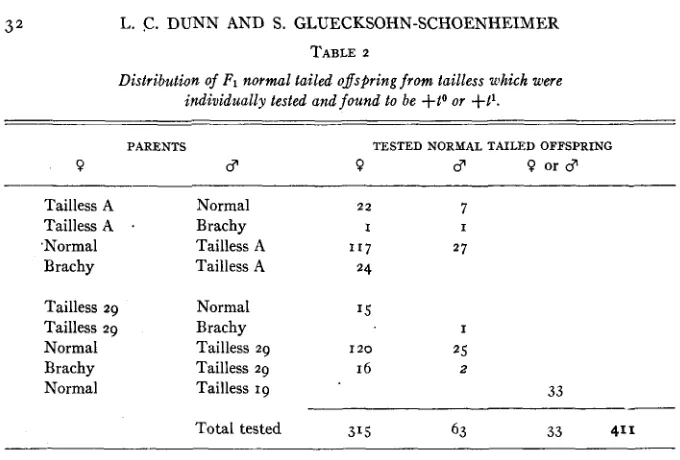
gametes, hence in F1 normals which do not contain t* (or t o ) .Progeny tests of F1 normal-tailed animals have been carried out in a search for such exceptions. The test was to cross the F1 animal to Brachy ( + T ) . If t o or t' is present in the F1, then tailless progeny ( T i o or Ti') appear. As table 2
shows, this occurred in the case of 378 FI animals, and t o this we should add 33 tested offspring from Line 19 tailless (DUNN 1939). It did not occur in progenies produced by three F1 animals, but since these progenies consisted of only 2 , 4, and 4 normal offspring, respectively, it is clear that the absence of tailless offspring is probably due t o the small samples and that no valid excep- tion occurred.
32 L. fZ. DUNN AND S. GLUECKSOHN-SCHOENHEIMER
TABLE 2
Distribution of F1 normal tailed ojspring from tailless which wwe
individually tested and found to be +to or +I1.
PARENTS TESTED NORMAL TAILED OFFSPRING
0 CT 0 CT 0 o r 8
Tailless A
Tailless A
,Normal Brachy
Tailless 29 Tailless 29 Normal Brachy Normal
Normal Brachy Tailless A
Tailless A
22
I
1 1 7
24
7
2 7 I
Normal Brachy Tailless 29 Tailless 29 Tailless 19
'5
I 2 0 16
I
25 2
33
Total tested
CROSSES BETWEEN DIFFERENT TAILLESS (BALANCED LETHAL )LINES It had been shown by KOBOZIEFF (1935) that crosses of tailless animals of Line A by tailless animals of Line 29 produced normal-tailed offspring in addi- tion to tailless ones. DUNN (1937) explained these and similar results of his own by assuming that the recessive lethals in Lines A and 29 were different and that the compound containing different recessive lethals was viable and normal-tailed. The scheme proposed is reproduced in figure I .
(Tailless Line A) T P X Ttl (Tailless Line 29)
I
I
I
I
tot1
Fi T T
I
Tto Ttldies tailless tailless normal tail
The first results obtained conformed qualitatively to the above scheme, and in tests of the tot1 type no recombination between t o and t1 was observed in 155 test gametes, suggesting that t o and t1 were alleles. All males of this genotype which were thoroughly tested proved to be sterile. These observations were too few to constitute a rigid test of the theory proposed, and the ratio of tailless to normal-tailed animals obtained (81 : 41), while in apparent agreement with that expected from the theory, was actually a t variance with a fact which was proved in other experiments-namely, that Tto and Ttl males always pro- duce a considerable excess of offspring which inherit t o or t*. New experi- ments were undertaken to investigate this point.
LETHAL MUTATIONS I N T H E MOUSE 33
TtO males and of +to females by Ttl males. From these crosses further tot1
females were obtained for t he crossing over tests.
Th e combined results of crosses between tailless animals of Line 29 and tail- less animals of Line A are shown in table 3. Here the results fit the theory in so far as only two classes of offspring appear-that is, tailless and normal- tailed. This fact shows that recombination between T a nd t o or T a nd t1 prob- ably does not occur, since t he recombination gamete
++
when uniting withT from the other parent would produce Brachy offspring +T. Out of 1208
offspring observed three were classed as Brachy a t birth. One of these with a tail one-third of normal length died before it could be tested. Another with a tail one-fourth of normal length proved to be Tio, since when mated with
TtO it produced only tailless
(7),
an d when crossed with Ttl it produced only normal and tailless (12: 28). The latter is conclusive evidence that it was notT+, hence not due t o recombination. Both of these exceptions were probably phenotypic variants of the expected tailless class.
TABLE 3
Res& of crosses between tailless animals of Line 29 by tailless froin Line A .
_ _ ~ __
~~~~
-~
PROGENY
MOTHER FATHER NORMAL TAIL (tot1) TAILLESS ( Tt0; Ti')
9 ? 3 Total 9 ? 3 Total n
Line A ( T P ) Line 29 (Ttl) 142 4 93 239 266 5 2 2 2 493* 732
Line 29 (72') LineA ( T P ) 68 4 48 IZO$ 176 177 353t 473
Totals 210 8 141 359 442 5 399 846 1205
('alculated I : 2 ratio 401.6 803.4
Deviation - 4 2 . 6 k 1 6 . 3
_ _____
- ~ - _ _ ~ ~ ~~ _ ~ _ -
* Does not include one animal with stump tail which died before it could be tested.
t
Does not include two short-tailed animals, one of which was tested and shown t o be T t -$ Including one animal classed a t birth as having tail of normal length; when tested did not that is, a phenotypic variant of the tailless type.
transmit T , hence a as probably phenotypic variant.
The third exception was noted a t birth as having a tail slightly truncated a t t h e tip and was suspected of being an accidental variant of the normal class. This proved t o be correct, since when tested by normal mates it pro- duced 17 normal young and thus did not transmit T . None of these exceptions can be regarded as recombinations.
When calculating the ratio in which the two classes of offspring in table 3 should appear, additional assumptions must be made concerning ( I ) th e ratio of T and t o or T and t1 gametes from tailless males, ( 2 ) the viability of the tito
34
A very marked deficiency of normal-tailed animals a t birth was found when two particular Line 29 tailless males (brothers) and their progeny were tested by Line A tailless females. The data from these tests are not included in table 3. One of the males produced 49 tailless only; the other produced 26 tailless only. Both produced only tailless when mated with females of their own line, so the exceptions€ result was not due to misclassification of the parents. Sons and daughters of these exceptional animals (from matings with Line 29 tail- less) were tested by Line A tailless and repeated the exceptional behavior of their parents, giving 117 tailless (66 0 5 1 8 ) and only three normal-tailed offspring, all females. We assumed that the very great deficiency of normal- tailed offspring in these crosses was due t o the death of many tot1 zygotes be- fore birth, possibly because other genetic factors in the particular Line 29 family adversely affected the development of the weaker tot1 type.
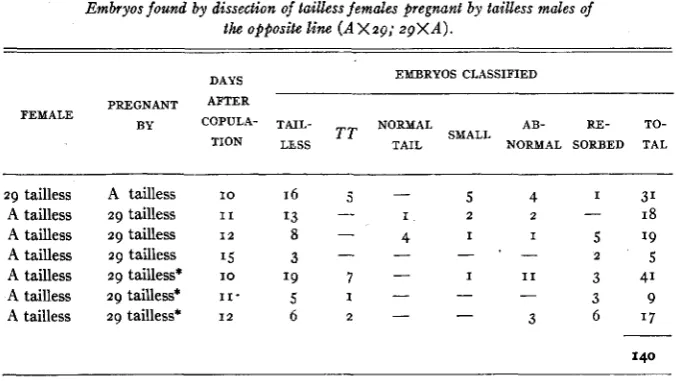
The most direct test of such an hypothesis is to look for dead or abnormal embryos a t various stages before birth. We therefore examined embryos arising from the cross of Line A tailless by Line 29 tailless and its reciprocal a t about the middle of the gestation period (10-15 days after fertilization). Three classes of zygotes are to be expected: Brachy homozygotes, T T , recognized by their typically abnormal structure (CHESLEY 1g35), tailless, TtO and Tt’, and normal-tailed, tot1. These would normally be expected in a I : 2 : I ratio,
but due to the abnormal segregation ratios of t o and tl from males, departures
from expectation will occur.
TABLE 4
Embryos found by dissection of tailless females pregnant by tailless males of the opposite line ( A X 2 9 ; 2gX A ) .
L. C. D U N N AND S. GLUECKSOHN-SCHOENHEIMER
EMBRYOS CLASSIFIED DAYS
PREGNANT AFTER
BY COPULA- TAIL- NORMAL AB- RE- TO-
TION LESS T T TAIL NORMAL SORBED TAL FEMALE
SMALL
29 tailless A tailless I O 16 5 - 5 4 1 31
A tailless 29 tailless 11 13
-
I 2 2 I 8A tailless 29 tailless 1 2 8 - 4
A tailless 29 tailless 15 3
-A tailless 2 9 tailless* IO ‘9 7 - I I 1 3 41 A tailless 29 tailless* I I - 5 I
-A tailless 29 tailless* 1 2 6 2 - 3 6 ‘7 -
I I 5 19
2 5
3 9
-
-
-- -
-
140
* Two males which had produced no living normal-tailed young at birth.
LETHAL MUTATIONS IN THE MOUSE 35 nosed as normal, while six of them were too young to permit this diagnosis. The “abnormals” were not only smaller and younger than their tailless litter- mates but showed definite new abnormalities : microcephaly, microphthalmia, and even anencephaly. Only three were enough developed to permit tail diag- nosis; these had normal tails. The dead and resorbed embryos could not be classified. One died in the decidua stage probably from accidental causes; the others died after formation of the chorion.
I n order t o exclude the possibility that the microcephalic and microphthal- mic embryos might represent T T embryos, modified as a result of outcrossing the stocks, three test matings were made of Brachy ( T + ) females with one of the Line 2 9 tailless males (Ti’) which had given microcephalics in crosses with
TtO females. The females were dissected after 1 1 and 1 2 days of pregnancy.
Out of 2 1 embryos found, 2 0 were clearly normal-tailed, Brachy or tailless, while one dead embryo seemed abnormal and possibly microcephalic, although it was too necrotic to permit diagnosis. On the other hand, in two matings of + t o female by +tl male, where no abnormal genotype except tot1 is expected, two definitely abnormal microcephalic embryos were found out of a total of 2 2 , as well as two physiologically younger embryos and four others which had died after formation of a chorion. From crosses of Line 2 9 tailless by Line A tailless occasional small normal-tailed animals are found a t birth, and one of these showed a marked microphthalmia.
The fact that no embryos like those classed as abnormals above, nor em- bryos retarded t o such an extent as those classed as “small,” had been found in any of the large number of litters from other experiments dissected in this laboratory seems to justify their inclusion in the tot1 genotype. All that lived long enough showed normal tails, and in the cross made only tot1 has this phenotype.
These statements apply both t o the progeny from “regular” tailless males and t o those from the exceptional males which produced no living normal- tailed young a t birth. I n the case of the latter, however, the proportion of abnormal embryos was high, all fourteen of them were microcephalic, and of these, two were enough developed t o be diagnosed as normal-tailed. Four control litters from matings of these exceptional males by females of their own line (29) yielded no abnormal embryos in a total of 2 5 . The microcephalic
embryos are considered t o represent the tot1 genotype which in the exceptional family suffers a much higher mortality and is nearly always abnormal.
The answer to our question is clear: normal-tailed tot* embryos suffer a heavier mortality and show certain abnormalities by which many of them may be identified. The factors which cause only certain of the tot1 embryos to become microcephalic or microphthalmic abnormals are unknown, but indications have been found of the presence of factors other than those a t the T locus which tend to reduce the viability of the tot1 zygote.
36 L. C. DUNN AND S. GLUECKSOHN-SCHOENHEIMER
frequency. The deficiency of tot1 is due t o prenatal mortality brought about jointly by the action of t o and t1 supplemented by other factors which have not become constant in our stocks. Variations in the ratios of t o and t1 sperms from TtO and Ttl males have been shown in new experiments (unpublished) t o be independent of the variations causing prenatal mortality of tot1. Consequently the varied proportions of normal-tailed off spring appearing from crosses be- tween different balanced tailless lines are due t o variations in viability super- imposed upon variations in sperm frequency.
TEST O F RECOMBINATION I N tot1 FEMALES
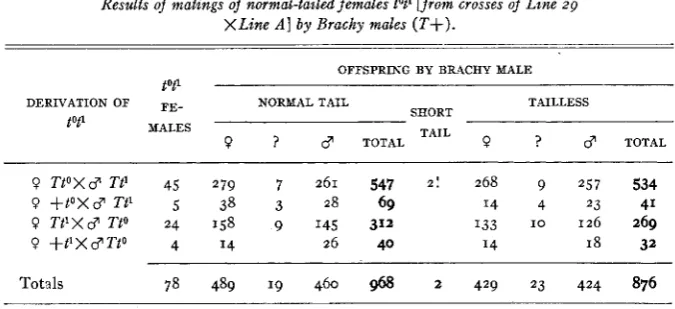
We may now utilize the compound type tot1 for a test of recombination be- tween t o and t'. Males tot1 are entirely sterile (DUNN 1937; BRYSON 1942) and cannot be used. The best test is t o mate females tot1 (from crosses between tailless A and tailless zg, and from crosses of
+lox
Ttl and of + t l X TtO) with Brachy males(T+).
If no recombination occurs, the progeny from tot1 X T+ will consist of only two classes: tailless (TtO, Tt') and normal tail (+to, + t l ) ;recombination gametes
++
would lead t o production of normal and of Brachy offspring, while recombination gametes tot1 would probably lead t o the same phenotypes as t o or tl gametes. I n practice then only the exceptional Brachy offspring could be detected, and these should represent half of the+ +
recombination gametes produced. Although the test is only 50 percent efficient, it is otherwise reliable.TABLE 5
Results of matings of normal-tailed females tot' [from crosses of Line 29
XLine A ] by Brachy males ( T f ) .
OFFSPRING BY BRACHY MALE
tot'
DERIVATION OF FE- NORMAL TAIL TAILLESS
SHORT TAIL
tot1 MALES
9 ? 3 TOTAL 9 ? c? TOTAL
9 TtOXd' Tt' 45 279 7 261 547 2 ! 268 9 2 5 7 534
9 +toXc? Tt' 5 38 3 28 69 I4 4 23 41
9 TtlXc? TtO 24 158 9 145 312 I33 1 0 126 269
0 +t'XC?Tto 4 I4 26 40 I4 18 32
Totals 78 489 19 460 968 2 429 23 424 876
LETHAL MUTATIONS I N THE MOUSE 37
less only (5); while when tested by a Line A male it gave tailless and normal only (4: 2). This behavior is consistent with the assumption that the genotype
of the exception was Ttl, hence its origin did not involve recombination.
The other exception had an even longer tail, about one-half the normal length and was also classed as Brachy. However, when tested by Line 29 tail- less it gave only tailless progeny (4), and by Line A tailless it gave tailless and normal (7:3) and no Brachys. Its genotype was thus Tt', and it, too, was a phenotypic variant of the tailless type, albeit a rather extreme one. Both of these cases occurred after the tailless balanced lines had been outcrossed and probably are due to segregation of modifiers as discussed above.
We may thus conclude that no evidence of recombination was observed in 1846 tested gametes, although since only half of the
+ +
recombinations could be detected, the ratio is better expressed as o/g23.SUMMARY OF RECOMBINATION DATA
The data from the several matings in which recombination could be de- tected are summarized in table 6. The 6775 negative observations should be reduced by about 50 percent, since in most cases only half of the possible recombinants could be detected. Even this figure justifies the conclusion that recombination, if it occurs a t all, is so rare as not be detectable in any ordinary sample. In all cases, progeny tests of the rare individuals which phenotypically resembled recombinants showed that they were, in fact, phenotypic variants of the non-crossover type.
TABLE 6
Summary of matings i n which recombination aniong T , to and t' could be detected. _ _ _ ~ _ _ _ _ _ ~
PARENTS
TOTAL
CLASSIFIED AS REFERENCE NON-RECOMBINANTS
Tailless balanced (intra-line) Fl's tested from taillessXnorma1 TaillessX tailless (inter-line) TaillessX tailless (inter-line) Taillessxtailless (19XA; 29x19)
tot' X Brachy (+ T )
2976 Table I 41 1 Table 2
I205 Table 3
195 Page 34
1846 , Table 6
142 DUNN 1939
Total
DISCUSSION
38 L. C. DUNN AND S. GLUECKSOHN-SCHOENHEIMER
arrangements or otherwise prevent crossing over. There is no evidence, like that above, t o disprove this assumption. Neither to nor t1 has yet shown any recombination with
Ki
or Fu, although these tests are not yet completed. No other loci in the T chromosome are available for tests with t o and t l . If thesemutations are rearrangements (for example, inversions), they probably repre- sent different aberrations, since although each is lethal when homozygous, the compound tot1 may be viable. The gross morphological effect of each is recessive, although this cannot be used as an argument against the rearrangement hypothesis, since each mutation has other dominant effects on segregation (DUNN and
GLUECKSOHN-SCHOENHEIMER
1939) and since many position ef- fects are recessive. One is reminded here of the case described by DUBININ and SIDOROFF (1934) in which each of two different wild type alleles in Drosophila melanogaster was so modified by translocation as t o acquire dif- ferent properties, although the compound of the two modified alleles was normal. If t o and tl are wild type alleles and owe their properties to their position, then because of their similar properties we should have t o regard them as different alterations of the same wild type allele. I n the absence of any evidence of chromosomal change, this hypothesis cannot be distinguished from that which regards them as different alterations of the same locus in situ. However, if we assume that T , to, and t1 are not unilocal, we must explain the peculiar phenotypic interactions among these factors which in many ways resemble those t o be expected of alleles. Thus t o and t1 each interact with T t o produce taillessness, although they do not have this effect in combination with the similar and nearby but non-allelic mutationsKi
and Fu (DUNN andCASPARI 1942) nor with any other of the several tail mutations with which they have been tested. The mutations t o and tl apparently have just the same interaction effect with T and are alike in the otherwise unique property of altering segregation ratios and producing “clusters” of offspring of one geno- type. The two mutations answer all the criteria of allelism except that the compound tot‘ has a normal tail. T h a t the two mutations do interact both morphologically and physiologically is shown by the appearance of micro- cephaly and microphthalmia and of complete male sterility in the compound. The above facts coupled with the absence of recombinations between t o and t‘ strongly suggest that they are alleles. The present evidence also makes it reasonable to assume that T is an allele of t o and tl, although a final conclu- sion cannot be drawn now.
LETHAL MUTATIONS IN THE MOUSE 39 described in this paper effects of different kinds accompany genetically unitary alterations like t o or 2'. The structure of the tail and axial skeleton is one type of effect; the behavior of the genetic factors in spermatogenesis is another, t o which the partial sterility effect is probably related (BRYSON 1942); while the early lethal effect may be another. These different effects while related geneti- cally show a certain degree of independence in development. The most reason- able guess here would seem t o be that each of the three mutations alters some part of one process underlying the organization of the axial system. The same mutation may or may not alter another process underlying viability, since in this respect to, tl, and T act as though they affected different processes. Here we must note, however, that under certain conditions to and t1 do interact t o lower the viability of the compound, although this may occur because develop- ment has been rendered unstable by reason of their effect on a common organi- zation process. The effects of t o and t1 on spermatogenesis are clearly similar and show cumulative interaction in the sterility of the tot1 males; yet T does not show this effect a t all nor does it enhance this effect when combined with
t o or tl.
To point out differences among the pleiotropic effects of alterations in one genetic unit, however, may lead to false conclusions, since it is always possible that a complete study of early development might reveal a common source from which diverse effects arise. Pleiotropism, as a descriptive term, merely indicates that several characters are modified by the same mutation. For this reason GRUNEBERG'S (1938) classification of false and true pleiotropism, the latter restricted t o those cases in which the same gene has different primary effects (as assumed in the present case), seems superfluous, since so sharp a distinction could be based only on a knowledge of early developmental events which we do not have and since, a priori, other alternative views are possible. A t present it seems wiser to restrict our hypotheses concerning the mechanism of the developmental effect t o those which are compatible with diversity in the types of mutation a t the same locus even though similarity is the rule; and con- versely our conception of mutation should be flexible enough t o permit such early diversity in the processes affected by one locus. It seems very doubtful, however, if evidence from one set of facts (developmental or phenotypic affect) can be used to provide positive proof of one view concerning the other-that is, the mode of mutation.
SUMMARY
Three lethal mutations with similar morphological effects in the mouse, T , t o and t', were studied in various combinations (TtO, Ttl, tot1) in order to deter- mine whether or not recombination among them occurs, No recombination was found in 6775 test animals.
40 L. C. DUNN AND S. GLUECKSOHN-SCHOENHEIMER
The factor T shows no crossing over with t o or t1 and is probably an allele, al- though it does not share the effects of t o and t’ on spermatogenesis and differs in its lethal effect, since Tto and Tt’ are viable.
It is suggested that mutations a t the same locus may affect different proc- esses, as well as different parts of the same process.
LITERATURE CITED
BRYSON, V., 1942 Spermatogenesis and fertility in Mus muscuh, as affected by factors at the T locus (in press).
CHESLEY, P., 1935 Development of the short-tailed mutant in the house mouse. J. Exp. Zoo]. 70: 429-459.
CHESLEY, P., and L. C. DUNN, 1936 The inheritance of taillessness (anury) in the house mouse. Genetics 21 : 525-536.
DOBROVOLSKAIA-ZAWADSKAIA, N., and N. KOBOZIEFP, 1927 Sur la reproduction des souris anoures, C. R. Soc. Biol. Paris. 97: 116-118.
1932 Les souris anoures et la queue filiforme qui se reproduisent entre elles sans disjonction.
C. R. Soc. Biol. Paris 110: 782-784.
DUBININ, N. P., and B. N. SIDOROFF, 1934 Relation between the effect of a gene and its position in the system. Amer. Nat. 68: 377-380.
DUNN, L. C., 1937 A third lethal in the T (Brachy) series in the house mouse. Proc. Nat. Acad. Sci. 23: 474-477.
1939 The inheritance of taillessness (anury) in the house mouse. 111. Taillessness in the balanced lethal line 19. Genetics 24: 728-731.
DUNN, L. C., and E. CASPARI, 1942 Close linkage between mutations with similar effects. Proc. Nat. Acad. Sci. 28: 205-210.
DUNN, L. C., and S. GLUECKSOHN-SCHOENHEIMER, 1939 The inheritance of taillessness (anury) in the house mouse. 11. Taillessness in a second balanced lethal line. Genetics 24: 587-609.
GRUNEBERG, H., 1938 An analysis of the “pleiotropic” effects of a new lethal mutation in the rat (Mus norvegicus). Proc. Roy. Soc. London 125: 123-144.
KOBOZIEFF, N., 1935 Recherches morphologiques et ghn6tiques sur l’anourie chez la souris. Bull. biol.
69:
267-405.KOBOZIEFF, N., and N. A. POMIXIASKINSKY-KOBOZIEFF, 1939a Nouvelles recherches sur la con- stitution ghotypique de souris anoures appartenant il la lign6e 29 et se reproduisant sans sCgrCgation. C. R. Soc. Biol. Paris 132: 406-409.
1939b Nouvelles recherches sur la constitution genotypique de souris anoures appartenant