NUMERICAL AND EXPERIMENTAL SEISMIC PERFORMANCE
EVALUATION OF THE NEW CONCEPT OF PRECAST CONCRETE
CONECTIONS
Amin Ghafooripour1, Francesco Presta2, Seyed Mohammad Shahidi3
1 Assistant Professor, School of the Built Environment, Heriot Watt University, UK,(Dubai
Campus)([email protected])
2 Ph.D., MIStructE, CEng, Principle Bridge Engineer, Atkins Consulting Engineers, UAE 3 Post Graduate research student, Islamic Azad University, UAE branch, Dubai
ABSTRACT
This paper aimed to introduce a new concept of precast concrete connection for the purpose of mass construction for low-rise buildings. Performance of connection was assessed based on FEMA 356 and the level of ductility has been calculated. Also to find the practical guideline for using of this connection, numerical evaluation has been carried out and compared with full scale tests results. Results shows that connection can be used for ordinary level of ductility based on ASCE7-2010 and to predict the realistic elastic deformation the moment of inertia modifier should be applied. Also special safety factor to achieve the expected performance shall be considered for some parts of the connection. Conclusion shows a good correlation with previous researches and confidence for the use of current design procedures with proposed modifications in this paper.
INTRODUCTION
Growing of demand for the residential housing in Middle East is experiencing the new challenge for the use of new competitive models of precast concrete structures with a proper design to the existing condition. Some part of region categorized as the medium to high seismic zone. This grow in use is attributed again to increasing studies by both designers and researchers to find alternatives for existing models of precast concrete system. Similar to the California, the major problem for that region is to have a clear idea about the seismic performance of the connections.
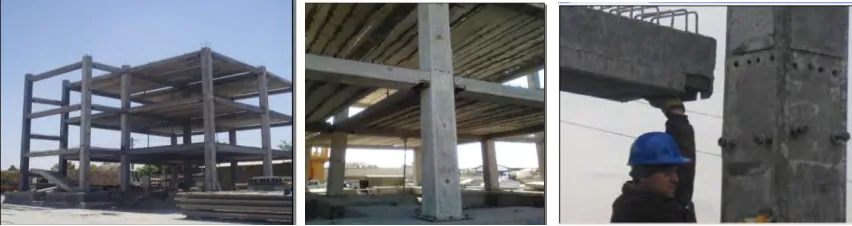
A new model of beam-column connection introduced a mixed up dry and wet connection systems (Figure 1).
Using a steel connector segment as a part of precast beam helps the system for simplicity in dry connection without using post tensioning such as available experiences (Giok 1993, Saqan, 1995,
Kulkarni et al, 2008, Maya, et al, 2012) (Figure 2).
Figure 2, Structural assembling process
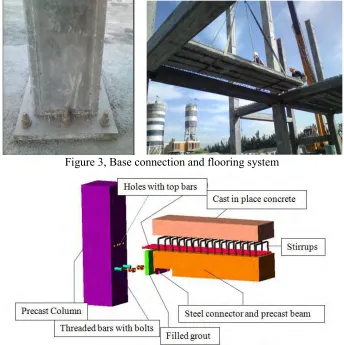
Connection to foundation is also designed by using base plate and hollow core system has used for flooring system. A layer of cast in situ concrete filled on slabs and on top of precast beams as well and it will create the structural integrity. It would be considered as the wet part of the beam column connection (Figure 3 & 4). This system has been designed to provide for rapid field assembly without using of concrete corbels.
Figure 3, Base connection and flooring system
Figure 4, Assembly scheme
Filled with Grout
A pair of full scale specimens subjects to a cyclic inelastic loading were tested for this reaserch. Tests were initiated by Building and Housing Research Center (BHRC) in Iran. The main aim for these experiments was to evaluate the perfomance and develop a guideline for analysis and design for the users and designers. Performance of connection has been evaluated and compared by FEMA 356.
TEST SET UP
A rigid test frame with 2.5m height were set up for testing of specimens. Maximum allowable loading for this test frame was given equal to 600 KN while the maximum applied load on specimens was 250 KN. A data logger with 24 chanel has been connected to LVDT sensors for gathering the displacements in diffenerent sensors (Figure 5&6). Three Concrete cubic samples with 150*150*150 mm were used to find the strength on the day of tests.
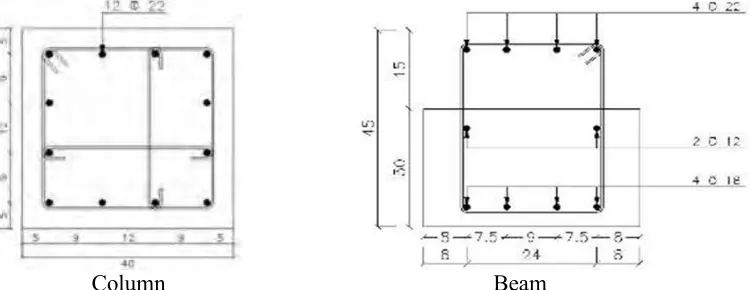
Two specimens (PCF-1 and PCF-2) with 2.5m height of column and 2m length precast beams were tested. The column base was pinned and all other connections were roller supported. Sections of columns and beams were designed based on standard procedures for concrete elements using ACI 318 practice code (Figure 7).
Figure 5, Data logger and LVDT sensor placement scheme
Figure 6, Sensor placement and test setup
German section was used for this segment. This element was connected to column by 2 No. 32mm bars and bolted properly. The only difference between 2 specimens is to use 2 nuts for this connection in PCF-2 instead on using 1 nut in PCF-1. The column laterally loaded on top head. Loading started from 6 KN. Tests setup, loading arrangement and LVDTs arrangement for measurements are used based on the FEMA 461 loading protocol. Lateral deflection and deformations in connection measured at each step of static cyclic loading by increasing rate equal to 1.4 (FEMA 461, 2007). Tests were continued to find first yield displacement and occurrence of plastic hinging which represents failure mechanism. Related displacement to the failure has been described in FEMA 356 for the precast connections as a qualitative description. The 80% drop in forces from the second yielding point or failure displacement equal to 2 times than yielding displacement are also other criteria (Geok et al, 1993). Ductility was calculated given equal to the ratio of maximum displacement to the yield displacement. Therefore, the performance evaluation can clearly give a guideline and modifiers for using the code criteria for the precast system.
Column Beam Figure 7, Sensor placement and test setup
MATERIAL SPECIFICATION
Characteristic strength of concrete (f'c) is equal to 30MPa and steel grades are S400 with Fy=400 MPa. Master flow 515 grout mortar was used for filling the joint between column and beams. The steel connector element was made of German steel type (ST37) steel with Fy= 240 MPa.
TESTS' RESULTS
The hysteresis and load deflection curves for column head of both specimens (PCF1 & PCF2) show clearly the elastic, Elasto-plastic and plastic behavior which represent the normal behavior of a concrete structure (Figure 8&9). The hysteresis loops shows pinching that were because of inelastic behavior of the steel connector element and its deformation at the stage of 19 however in PCF-1 some failures occurred in nuts at connection which shows more pinching (e.g. PCF-1 had 1 nut and PCF-2 had a pair of nuts to connect steel connector to bars). The history of load-deflection for PCF-2 shows linear behavior up to point 15. There is no significant change in behavior and the structure shows an elastic behavior. First yield occurred at the loading cycle 16 and cycle 17 shows the 2nd
-20 -15 -10 -5 0 5 10 15 20 25
-200 -100 0 100 200 300
Displacement (mm) F or ce ( T on )
-30.00 -20.00 -10.00 0.00 10.00 20.00 30.00
-300.00 -200.00 -100.00 0.00 100.00 200.00 300.00
Displacment (mm) F o rc e (T o n )
Figure 8, Hysteresis curves, Left PCF-1, Right PCF-2
Figure 9, Hysteresis and Load Deflection of the column head
VERIFICATION OF FINITE ELEMENT MODEL
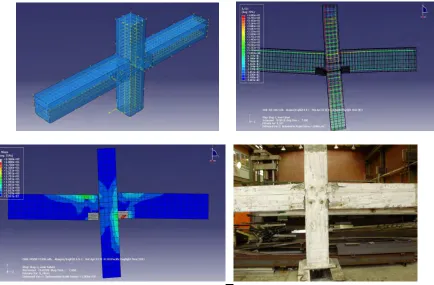
Finite element model (FEM) evaluated and verified with tests' results. This will support to understand the behavior and to have a proper model for study on steel connector segment. Solid and Truss type finite elements functions were used for the FEM using ABAQUS software to represent concrete and steel bars respectively. The same loading history applied for both model and test samples (Figure 10). Attempted has been made to evaluate the model for a close consistency between theoretical and experimental hysteresis loops (Figure 11).
-4000 -3000 -2000 -1000 0 1000 2000 3000 4000
0 5 10 15 20 25
Time (s) A m p li tu d e D is p la c m e n t (m m )
Both studies show pinching in hysteresis loops and the behavior of steel connector for both models are similar and this conveys that the real behavior of precast beam and column are predictable and consistent to theories however, the connection behavior shows deviation from the cast in place concrete (Figures 12,13).
-30.00 -20.00 -10.00 0.00 10.00 20.00 30.00
-400.00 -300.00 -200.00 -100.00 0.00 100.00 200.00 300.00
Displacement (mm)
For
ce
(T
on) Numerical
Experimental
Figure 11, Comparison on Theoretical and experimental hysteresis loops
Figure 12, Comparison on Theoretical and experimental models at the final stage of loading
CALIBRATION OF THE FRAME TYPE ELEMENT FOR THE USE IN FEM
element will have overall effect of the behavior of structure. For modeling of structures normally the frame type element with static and pushover analysis are used. Therefore for making a guideline for the use of this connection and have realistic results from normal FEM modeling with frame elements some modifications might be needed to represent the effect of pinching and loss of strength.
Figure 13, Comparison on Theoretical and experimental behavior of steel connector at the final stage of loading
SAP 2000 has been used for this study. A series of static linear analysis on the frame type model (Figure 14) were carried out to find the first yield point and compare the theoretical and experimental elastic deformations. The effect of precast connection and flexibility of steel connector shows more drift for the structure. This comparison shows that a multiplier on moment of inertia is circa 16%. This value is half of the proposed value for the cracked reinforced concrete beams (e.g. 35% I). Cycle 17 and 18 shows a significant change in modifier which is prorating to the load deflection curve so, cycle 17 is considered as yield point. The trend of deflections clearly shows the point of concrete cracking and the cycle number for the first yield as well.(e.g. cycle number 16 = Δy) (Table 1).
Table 1, Results of calibration of model and tests' displacements
Left; required moment of inertia modifier at each step, Right; modifier variation at each cycle
SEISMIC PERFORMANCE OF CONNECTION
Seismic performance of the connection was analyzed by Pushover Static Analysis Method (PSAM) from the cycle 17 as yield point (Figure 9). The levels of immediate occupancy (IO), Life
Final stage in elastic zone
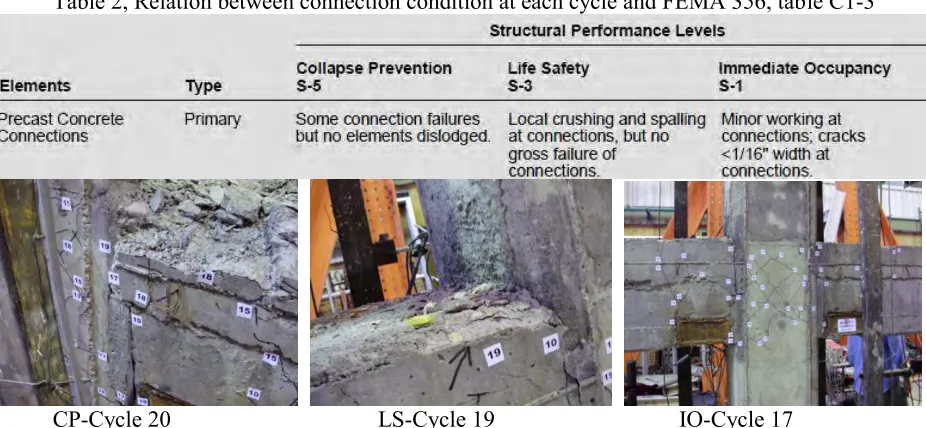
safety (LS) and collapse prevention (CP) have been considered based on FEMA 356, table C1-3. There are no quantified values exists for precast connections in the mentioned code, so those qualitative description for precast connections has been used to find those levels based on test observations. Observations show that cycle No. 20 was the last step and would be considered as CP, Cycle 19 was LS and cycle 17 was behaved as IO condition (table 2).
Figure 14, Second numerical model for study on elastic and plastic behaviors
Table 2, Relation between connection condition at each cycle and FEMA 356, table C1-3
CP-Cycle 20 LS-Cycle 19 IO-Cycle 17
A series of PSAM analysis were carried out based on the standard load deflection curve in FEMA 356 (Figure 15). In order to understand the relation between real performance and FEMA descriptions by using an iterative approach, the relation between each performance level, the applied load and deflection were studied. Deflections and loads has been extracted based on computer output on for each performance level prorata (Sample in figure 16).
CP condition, the steel connector shall be designed for circa 35% more safety factor on usual AISC-ASD89 design criteria.
Figure 15, FEMA 356 standard load-deformation curve and performance levels
Figure 16, A sample of push over nonlinear analysis for finding the performance level
Figure 17, inelastic deformations and performance levels of precast connection 20-CP
19-LS
17-IO
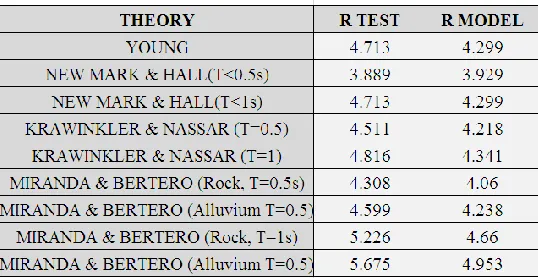
Calculation of response modification factor (Rµ) carried out by finding the displacement ductility (µ=Δmax (cycle 20)/ Δy (cycle 17)) by using different available methodologies. Strength factor (RS)
was calculated based on the ratio of Δy (cycle 17)/ Δe (cycle 16) and redundancy factor (RR) for this
case considered as 1. Rµ can be taken equal to µ. RR . RS (Naeim F., 2004). Results for different
approaches show more ductility for the tests’ results in compare with numerical model (Table 3).
Table 3, comparison of response modification factor for test and numerical model based on FEMA 356 assumptions
For an applicable proposal on response modification factor a simple probability analysis were carried out. Gauss (Normal) distribution factor with 2% & 5% probability of failure was used to find the Rµ from different approaches. Therefore, having Rµ(Average) = 4.717 and Rµ(Standard Deviation) = 0.512 yields to find Rµ(for 2% risk of failure) = 3.51 and Rµ(for 5% risk of failure) = 3.87.
Comparing the result with the ASCE7-2010 for the response modification factor, clearly shows that the structure can be classified as the frame with ordinary ductility and the suggested response modification factor for this class is given equal to R=3.5.
CONCLUSION
This paper introduced and has given the guideline for design of a new type of precast concrete connection which might be used for the purpose of mass construction for low-rise buildings. Performance of connection assessed based on FEMA 356 and the level of ductility has been calculated. Also to find the practical guideline for using of this connection, numerical evaluation has been carried out and compared with tests' results. Results show:
Installation procedure of this connection is much easier in compare with other existing solutions such as post tensioned connections.
Comparing of tests’ results and finite Element analysis shows consistency between structural behavior with current theories and the use of existing codes design procedures will be possible. Also this analysis confirmed that it will be possible to use FRAME type element for FE analysis of structure.
Both Finite element analysis and tests results show the weakness of steel connector element at the stage of plastic hinging and the need for some modification in its design procedure.
be taken equal to 16% of gross one. This shows more reduction in compare with current suggestions by code (i.e. 35% for beams).
Nonlinear static analysis shows that the performance of structure in IO and LS condition will be conservative by using the FEMA 356 criteria, however, 10% lack of strength has been observed for the CP condition.
A safety factor of 1.35 for design of steel connector based on AISC-ASD89 has been suggested to maintain the performance for CP, LS and IO prorata. However this paper suggests to do further research for improving the performance of the steel connector.
This research shows ordinary ductility of this structure for designing in the seismic areas; however, based on current codes, this structure for the purpose of mass construction of residential buildings can be used for Middle East countries in high seismic risk areas.
The level of obtained ductility for this structure is given equal to 3.5 and has classified similar to the concrete frame system with ordinary ductility in ASCE7-2010.
ACHNOWLEDGEMENT
This project was conducted by the first author under grant No. 209-8901 supported by Iran Frameco Company as precast manufacturer. Also, the first author would like to grateful Mr. Bijan Khatibi for his management, Mr. Hussein Kiamehr for his role in tests and Mr. Amir Taheri Rizi for his role in finite element analysis.
REFERENCES
ASCE standard-7, (2010), “Minimum design loads for buildings and other structures”, ASCE Standard ASCE/SEI 7-10, USA.
Applied Technology Council (ATC), (2007), “Interim testing protocol for determining the seismic performance characteristics of structural and nonstructural components-FEMA 461”, Federal emergency Management Association (FEMA), Washington D.C., USA.
Federal Emergency Management Association, (2000), “Prestandard and commentary for the rehabilitation of buildings-FEMA 356”, FEMA, Washington D.C., USA.
Ghafooripour A., (2011), “Analysis of tests results for the precast concrete connection” unpublished report or the client, Pars Padir Consulting Engineers, Tehran, Iran.
Geok, S.G., Lew, H.S., (1993) “Model precast beam-column connections subjected to cyclic loading”, PCI Journal, July-August, PP(80-92).
Kulkarni S., Li, B., Yip W. K., (2008), “Finite element analysis of precast hybrid-steel concrete connections under cyclic loading”, Journal of constructional steel research, Elsevier, 64, PP(190-201)
Naeim, F., (2002), “Seismic Design handbook”, 2nd edition, e-book (Companion CD-Rom), John A.
Martin consulting Engineers, CA, USA
Restrepo, J.I., Park, R., (1995), “Tests on connections of earthquake resisting precast reinforced concrete perimeter frame of buildings”, PCI Journal, July-August, PP(44-52).
Shahidi, S.M., (2013). “Numerical and experimental investigation on a new precast concrete connection for high seismic risk areas” MSc. thesis, (Supervisor; A. Ghafooripour), Islamic Azad University, Dubai, UAE.
Sritharan, S., Nigel P.M., Seible, F., Igarashi, A., (2000) , “A Five-story precast concrete test building for seismic conditions- An overview), 12WCEE conference, Auckland, New Zealand
Saqan, E.I., (1995), “Evaluation of ductile beam-column connections for use in seismic-resistant precast frames”, Ph.D. dissertation, University of Texas at Austin, USA.