
ISSN(Online): 2319-8753 ISSN (Print) : 2347-6710
I
nternational
J
ournal of
I
nnovative
R
esearch in
S
cience,
E
ngineering and
T
echnology
(An ISO 3297: 2007 Certified Organization)
Vol. 5, Issue 6, June 2016
Wireless Point to Point Data Transmission for
Data Acquisition
Premkumar.R 1, Dr.P.Gnanasundari 2, Abhiram.K 3
P.G. Student, Department of Electronics and Communication Engineering, SNS College of Engineering, Coimbatore,
TN, India1
HOD, Department of Electronics and Communication Engineering, SNS College of Engineering, Coimbatore, TN,
India1
P.G. Student, Department of Electronics and Communication Engineering, SNS College of Engineering, Coimbatore,
TN, India1
ABSTRACT: In industry monitoring of system and data acquisition for a system is done manually. Now the
technology has developed. Aim of this paper is to get the data acquisition report of a system for day, week and month automatically using wireless technology. Temperature data is collected through a sensor and it is given to a system and stored in database using wireless technology. Data is transferred from one point of the system to a server at a different location using Wi-Fi and automated report of temperature data is generated.
KEYWORDS:Wireless Sesnsors; Wi-Fi; Temperature; Data Transmission; Database.
I. INTRODUCTION
In earlier days temperature measurement and database management was done manually. The worker will have to take temperature readings every hour and keep a record this is not real time and is also very time consuming. There was no proper database maintenance for data acquisition. In a big industry various temperature units will be spaced by a larger distance and record keeping will be a tedious job for a worker.
In this paper a real time data transmission and database management system is implemented using wireless technology .Unlike the older systems temperature measurements are transmitted automatically and real time database is updated periodically using Wi-Fi technology. An automated data acquisition report is generated for day, week and month. Here we discuss how the data is transmitted automatically from one location of industry to server and the database is maintained for each data at equal time intervals. This method doesn’t require any human intervention to carry measured data from one location to another location; once data is measured it will be sent from system to database server using Wi-Fi technology. The future work of this project involve building an Android application that will show a report generated by the microprocessor .This report can be checked in real-time using the app and it is more convenient and efficient than the conventional method.
II. SYSTEM OVERVIEW
ISSN(Online): 2319-8753 ISSN (Print) : 2347-6710
I
nternational
J
ournal of
I
nnovative
R
esearch in
S
cience,
E
ngineering and
T
echnology
(An ISO 3297: 2007 Certified Organization)
Vol. 5, Issue 6, June 2016
Fig. 1. Overall System Block diagram
Fig .1 shows how the temperature value is obtained and transferred to system. From the machine the value is sensed by IR sensor and the value is transferred to the system, from system the digital value is transferred over Wi-Fi to the processor where they are collected and stored in the database. From the database the report generated by processor are checked over the android device.
The application will receive the sensed data transferred from one point to other point. Wi-Fi device is connected through system which will send the data to server wirelessly. The data received in the application is programmed to transfer via serial port to Wi-Fi device. WI-FI device is programmed to collect data from serial port and transfer it. The program running on the system will automatically transfer it once the digital data is received by application to COM port where Wi-Fi device will be connected and the automated program will detect the COM port to which device is connected. There is a serial convertor through which Wi-Fi device is connected and data is sent serially. They can also be connected to RS232 pin. The Wi-Fi device will act both as station and receiver. Once the data is transferred it is collected by a processor and stored in data base. The report will generated by application running on the processor. The application will generate the report based on user for day, week or month. An android application is to be developed to access the data base and check the report from their smart phone through Wi-Fi.
III.SOFTWARE IMPLEMENTATION
The system has to be implemented combining both software and hardware. In software implementation an application is first developed and installed in system where temperature readings are collected.
Fig. 2. Serial Port Detection And Data Transmission.
ISSN(Online): 2319-8753 ISSN (Print) : 2347-6710
I
nternational
J
ournal of
I
nnovative
R
esearch in
S
cience,
E
ngineering and
T
echnology
(An ISO 3297: 2007 Certified Organization)
Vol. 5, Issue 6, June 2016
They are developed in way that when the data is sent to system, it collects data and transfer to serial port. After transferring data a program will detect and open the serial port automatically. The figure shows the detection and opening of serial port.Serial port is detected and opened automatically after the data is transferred from system. The serial data has to be transferred from serial port to Wi-Fi device. Then a program takes data from serial port to device and transfers the data. The device will be acting both as the station and receiver to transfer data from system and receive data from sensors and for other needs. Once data is transferred they are received by Wi-Fi device at other end which is connected to processor. The processor is programmed to collect data from the device serially. It is programmed in a way that it will check for incoming every minute to collect data from device and store it in database. Once the data are stored in data base a report will be generated according to the program and according user input value from android device.
IV.HARDWARE IMPLEMENTATION
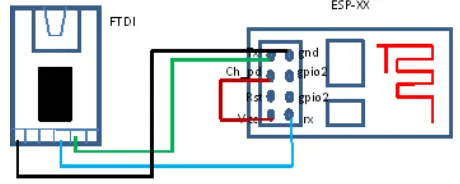
Hardware implementation is comparatively simple. Only few hardware components are required for the point to point data transmission. Wi-Fi device is converted into a serial transmitter by connecting a FTDI.
Fig. 3. Pin connection of ESP and FTDI
Above figure. 3 shows howconnections are made between ESP and FTDI .The connections are made accordingly between ESP and FTDI
FTDI RX to ESP-xx
TDI GND to GND
ESP-xx GND to G
TDI CP_PD to TX
FTDI TX to ESP-xx RX
ESP-xx GND to GND
Fig. 4. ESP-XX.
ISSN(Online): 2319-8753 ISSN (Print) : 2347-6710
I
nternational
J
ournal of
I
nnovative
R
esearch in
S
cience,
E
ngineering and
T
echnology
(An ISO 3297: 2007 Certified Organization)
Vol. 5, Issue 6, June 2016
FTDI TX is 5V which needs to be brought down to 3.3v. This is done with a voltage divider. FTDI RX can be connected to ESP-xx TX directly. The FTDI will accept the 3.3v signal from the ESP-xx as HIGH.
Fig. 5. Wi-Fi and FTDI connection
Above figure. 5 shows how the connection are made between the ESP and FTDI product for sending data from system to database serially and to receive data serially.
It is common that a 3.3v out on the Arduino is used to power the ESP-xx but the Arduino cannot really provide enough power and may damage the components. Plug the FTDI adaptor in to an usb port on your computer and power up the ESP-xx. The power LED on the ESP-xx should come on. Once Wi-Fi device connected we have to make the connection to processor so that the processor has to receive wirelessly transmitted data automatically to transfer it to data base.
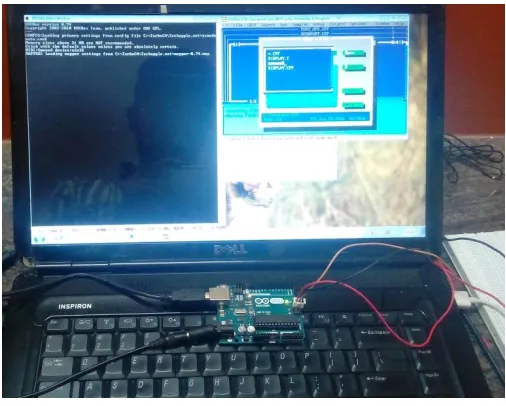
Fig. 6. Arduino Connection
ISSN(Online): 2319-8753 ISSN (Print) : 2347-6710
I
nternational
J
ournal of
I
nnovative
R
esearch in
S
cience,
E
ngineering and
T
echnology
(An ISO 3297: 2007 Certified Organization)
Vol. 5, Issue 6, June 2016
Then we have to make hardware connection for arduino to connect to system to receive and store values in database. Arduino Wi-Fi Shield is used to connect board with Wi-Fi. After connectivity with Wi-Fi, one can perform many tasks using this shield. We can build a complete server on it and can also use it as a client. Servers designed on an Arduino Wi-Fi Shield are usually quite simple as it doesn’t have much processing power to support heavy server. Once they are connected to receive Wi-Fi data they will receive the data. They are connected to receiving pins and they monitored and store data to data base after receiving.
V. RESULT
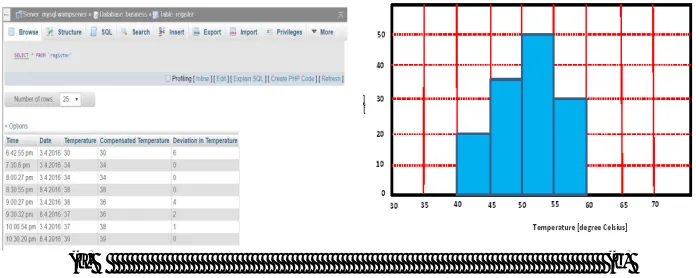
We used the SQLite database to store data sent from one point of the location where the temperature readings are measured. The values are stored in digital format in database and figure 7 shows one unit’s temperature value and how they are stored in database. The database contains time, date, and temperature value, deviated and compensated temperature values. These values from the database are taken by the processor to generate the report. Figure 8 shows comparison of different temperature readings of the particular day. The general analysis of temperature for one day is shown in graph.
(a) (b)
Fig. 7. Result (a)Database of the day (b)Analysis graph of a day
Above figure. 7.a shows the database that is containing the collected temperature data and deviated data for particular day and second figure 7.b shows the comparision graph for particular day report.
VI. CONCLUSION
We have accomplished point to point data transfer and stored it in a database for data acquisition. Then an automated report is also generated for analysis. The future work of this project is to develop an android app to check the report and analysis data from database using wireless method for the convenience of the employees where they can sit at their table and access the information from their smart phone.
REFERENCES
[1] André Moreira and Daniel E. Lucani, “Coded Schemes for Asymmetric Wireless Interfaces: Theory and Practice, “Proc. IEEE Journal on
Selected Areas In Communications, Vol. 33, No. 2, February 2015, pp.171-184.
[2] Sergey Andreev, Olga Galinina, Alexander Pyattaev, Kerstin Johnsson and Yevgeni Koucheryavy, “Analyzing Assisted Offloading Of Cellular
User Sessions Onto D2d Links In Unlicensed Bands, ,” Proc. IEEE Journal On Selected Areas In Communications, Vol. 33, No. 1, January 2015,pp.67-80.
[3] Lin Gao, George Iosifidis, Jianwei Huang, Leandros Tassiulas And Duozhe Li, “Bargaining-Based Mobile Data Offloading ,” Proc. IEEE
Journal On Selected Areas In Communications, Vol. 32, No. 6 , June 2014, pp.1114-1125.
[4] R.Nagarajanand R.Dhanasekaran,” Implementation of Wireless Data Transmission in Monitoring and Control,” Proc. International Conference
on Communication and Signal Processing, April 3-5, 2013,pp.83-87.
[5] Zizhan Zheng, Prasun Sinha, and Santosh Kumar,” Sparse Wi-Fi Deployment For Vehicular Internet Access With Bounded Interconnection
ISSN(Online): 2319-8753 ISSN (Print) : 2347-6710
I
nternational
J
ournal of
I
nnovative
R
esearch in
S
cience,
E
ngineering and
T
echnology
(An ISO 3297: 2007 Certified Organization)
Vol. 5, Issue 6, June 2016
[6] Chris C. P. Cheung, Alfred C. H. Yu, Nazila Salimi, Billy Y. S. Yiu, ,Ivan K. H. Tsang, Benjamin Kerby, Reza Zahiri Azar, and Kris Dickie,”
Multi-Channel Pre-Beamformed Data Acquisition System for Research On Advanced Ultrasound Imaging Methods,” proc. IEEE Transactions On Ultrasonics, Ferroelectrics, And Frequency Control, Vol. 59, No. 2, February 2012,pp.243-253.
[7] Yu Xiao, Wei Li, Matti Siekkinen, Petri Savolainen,Antti Yla¨ -Ja¨A¨ Ski, Member, Ieee, And Pan Hui, Member, Ieee,” Power Management
For Wireless DataTransmission Using Complex Event Processing,”Proc. IEEE Transactions On Computers, Vol. 61, No. 12, December 2012,pp.1766-1777.
[8] S.Sundar D.C.E , M. Krishna Kumar , P. Selvinpremkumar,M.Chinnadurai ,” Voice Over Ip Via Bluetooth/Wi-Fi Peer To Peer, ”Proc.
IEEE-International Conference On Advances In Engineering, Science And Management, March 30, 31, 2012,pp.828-837.
[9] Yang Liu, Yanyan Han, Zhipeng Yang, and Hongyi Wu,” Efficient Data Query In Intermittently-Connected Mobile Ad Hoc Social
Networks,”Proc. IEEE Transactions On Parallel And Distributed Systems, Vol. 26, No. 5, May 2015,pp.1301-1312.
[10] Takahiro Chiba, Myungryun Yoo And Takanori Yokoyama,” A Distributed Real- Time Operating System With Distributed Shared Memory
For Embedded Control Systems,”Proc. IEEE 11th International Conference On Dependable, Autonomic And Secure Computing, 2013,pp. 248-255.
[11] Xin Kang, Yeow-Khiang Chia, Sumei Sun and Hon Fah Chong,” Mobile Data Offloading Through A Third-Party Wi-Fi Access Point: An
Operator’s Perspective,”Proc.IEEETransactions On Wireless Communications, Vol. 13, No. 10, October 2014,pp.5340-5351.
[12] Panayiotis Kolios, Christos Panayiotou, And Georgios Ellinas,” Extract Expediting Offloading Transfers Through Intervehicle Communication
Transmissions, ”Proc. IEEE Transactions On Intelligent Transportation Systems, Vol. 16, No. 3, June 2015,pp.1238-1248.
[13] Jianwei Niu, Bowei Wang, Lei Shu,Trung Q. Duong and Yuanfang Chen,” An Energy-Efficient Indoor Localization System Using Zigbee
Radio To Detect Wi-Fi Fingerprints,” Ieee Journal On Selected Areas In Communications, Vol. 33, No. 7, July 2015, pp.1431-1442.
[14] Guangdong Qiu, Zhijie Luo and Guofu Zhou,” Design Of a Wireless Data Transmission System and Display Terminal Based On MemS
Sensors and Bluetooth 4.0,” Proc. IEEE International Conference On Nano/Micro Engineered And Molecular Systems, April 7-11, 2015,pp.541-544.
[15] R.Nagarajanand R.Dhanasekaran,” Implementation of Wireless Data Transmission in Monitoring and Control,” Proc. IEEE Conference on
Communication and Signal Processing, April 3-5, 2013, India, pp.83-84.
[16] Fang-Jing Wu and Wen-Ching Lin,” Understanding Wireless Network Coverage, Connectivity, And Locations Using Opportunistic Sensing
For a Wi-Fi Advisory System,” Proc. IEEE International Conference On Intelligent Sensors, Sensor Networks and Information Processing Singapore, 7-9 April 2015, pp.1-6.
[17] I. Constandache, R. R. Choudhury, and I. Rhee, “Towards mobilephone localization without war-driving,” in Proc. IEEE INFOCOM, 2010, pp.
1–9.
[18] D. Malone, K. Duffy, and D. Leith, “Modeling the 802.11 distributed coordination function in nonsaturated heterogeneous conditions,” IEEE
Trans. Netw., vol. 15, no. 1, Feb.2007, pp. 159–172.
[19] I. Aad, J.-P. Hubaux, and E. W. Knightly, “Impact of denial ofservice attacks on ad hoc networks,” IEEE Trans. Netw., vol. 16, no. 4, Aug.

![Multidomain IT architectures for next generation communications service providers [Next Generation Telco IT Architectures]](data:image/gif;base64,R0lGODlhAQABAIAAAP///wAAACH5BAEAAAAALAAAAAABAAEAAAICRAEAOw==)