Automatic Seed Sowing and Moisture Control
Using ARM Controller
Anuradha G Parvatikar 1, Meghana Kulkarni2
P.G. Student, Department of VLSI Design and Embedded Systems, VTU, Belagavi, Karnataka, India 1 Associate Professor, Department of VLSI Design and Embedded Systems, VTU, Belagavi, Karnataka, India 2
ABSTRACT: Increasing population requires the food production to be increased, which requires better cultivation in the form of proper utilization of seeds and fertilizers with minimum labour work. The qualitative approach is to develop a system which minimizes the work of farmer and also reduces the time for seed sowing operation, digging operation and water wastage. Moisture level indicator is important which helps for water saving. A soil sensor is used to measure the moisture level in the soil and is sent to the ARM controller. The robotic system developed is completely automatic, which reduces the farmers work.
KEYWORDS: ARM controller (LPC2148), YL-38, seed sowing, L293D, agriculture robot.
I. INTRODUCTION
Before independence production and productivity of crops were quite low. The production was not sufficient to feed the Indian population. The country used to import them in large quantities for fulfilling the needs of our people from many countries. The reason for low production and productivity were unavailability of machines in the cultivation field. In India most of the farming work is done manually when compared with other countries. There were no machines for sowing the seeds and it is done by man power only. The cost spent for man power was more and the speed of the operation was very less. In the present scenario, most of the cities in India do not have sufficient skilled man power in agricultural sector and that affects the progress of developing country. Therefore farmers have to use upgraded technology for cultivation activity. Seed sowing machine developed so far are operated manually or there is no smartness of work done by it except seed sowing. Manual method includes broadcasting the seeds by hand. A pair of bullocks is used to carry the heavy equipment of levelling and seed dropping. The energy needed for robotic machine is less as compared with other machines like tractors or any agriculture tools. The main application area of robots in agriculture is at the harvesting stage and seed sowing stage. Sowing and growing periods of crops are different [1]. It also performs digging operation. Seed sowing has to be done in a proper path in the field [2]. Driverless robots are designed to replace human labour. The cost of the robot is less. Water is the main source in the agriculture field. The required amount of water has to be used due to this water wastage can be reduced. When the moisture level is less, it is sensed by soil moisture and signal is sent to the controller. It is easy tomaintain, time required for seed sowing is also less. There are different types of sensors can be used for the measurement of soil humidity. Hygrometer is also used as the soil moisture sensor [3]. The hygrometer has both digital and analog outputs. But it cannot change with the rapid variations in the temperature. Stevens HydraProbe II is the soil moisture sensor, but the disadvantage of this is in stony area it does not work properly [4].Hence to avoid this agriculture robot is developed. The agriculture robot developed in this project performs seed sowing and sensing the moisture content in the field and digging operation.
II. THEORY of SEED SOWING
Many seed sowing methods are used in the agriculture field. They require man power and are cost effective. Using agriculture robot cost is reduced and human requirement is also less. In many states seed sowing is done manually. Opening the furrows by plough and sowing the seeds in that furrows. Seed dropping is done by hand or using the bamboo/meta funnel attached to the plough to sow in the smaller area. Hence traditional seed sowing method has limitations like seeds are not uniformly distributed in the field. So the human requirement is more. During kharif season placement of seeds at uneven depth may result in poor emergence of seed. After seed sowing water has provided on the field. If excess water is poured seeds may go along with the water. So there is wastage of water. Hence soil moisture sensor has to be inserted in the field. The main purpose of developing agriculture robot is to perform seed sowing operation and maintaining moisture level in the field.
III. SYSTEM DESIGN and HARDWARE
Figure.1 Block diagram of the agriculture robot.
The block diagram of agriculture robot shown in figure 1, consists of soil moisture sensors, RS-232, DC motors, chases, wheels, ARM controller (LPC2148), funnel are used. All the hardware components are placed on 16cm Length, 12cm width chassis. Features of all the hardware components are explained below.
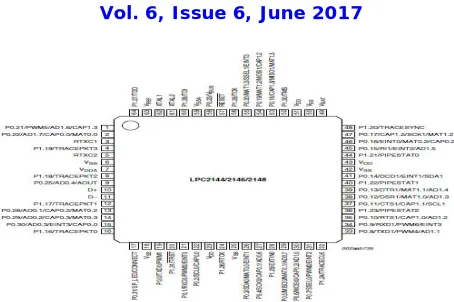
A. ARM Controller(LPC2148)
Figure.2 Pin configuration of ARM controller
B. DC MOTORS and MOTOR DRIVER
DC motors of 12V, 7.5A and 60 rpm is used in the project. The L293 and L293D are quadruple high-current half-H drivers. The L293D is designed to provide bidirectional drive currents of up to 600-mA at voltages from 4.5 V to 36 V. L293Dis designed to drive inductive loads such as relays, solenoids, dc and bipolar stepping motors, as well as other high current/high-voltage loads in positive-supply applications [6]. L293D is used to drive the DC motor.
Table I
DIRECTION OF DC MOTOR
Table I delivers the behaviour of the DC motor for various input conditions. The DC motors are attached to the two wheels, when the input commands are given the robot moves forward, reverse, clockwise (right), and anticlockwise (left).
C. Soil Moisture Sensors
YL-38 Soil Moisture Sensor is used to measure the moisture level in soil. It is widely used for performing experiments in courses like soil science, environmental science and botany. The YL-38 ranges from 0 to 45% volumetric water content in soil. It operates on 3mA at 5V DC. Its operating temperature is from -400 to +600 C [7].
D. Servomotor
Figure.3. Connection of servomotor
A servomotor is a closed-loop servomechanism that uses position feedback to control its motion and final position. The input to its control is a signal (either analog or digital) representing the position commanded for the output shaft. The motor is paired with some type of encoder to provide position and speed feedback [8]. Servomotor pin connection to ARM board is shown in figure 3.
E. Seed Sowing Mechanism
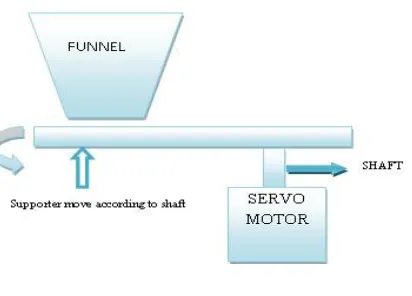
Figure.4. Servomotor mechanism
Figure 4 shows the seed sowing mechanism. For seed sowing application servomotor is used in this proposed system. Servomotor is a simple electrical motor. When the shaft of the servomotor turned by required degree which is attached to the funnel containing seeds, seeds fall when shaft opens.
F. Voltage Used by Different Modules
TABLE II
POWER SUPPLY REQUIRED FOR DIFFERENT MODULES OF THE SYSTEM
Table II delivers the power supply required for different modules of the system.
IV. WORKING PRINCIPLE
The two wheels of robot are connected to the DC motors and other two wheels connected at the front without DC motors. These all are connected to the chases. For the proper growth of the plants moisture has to be maintained. This is done by using the soil moisture sensor (YL-38).
Figure.5. Flowchart of the agriculture robot working.
Agriculture robot is started with giving the supply and input is given from the computer. Input given to the robot are L (left), R (right), F (forward), B (reverse). According to these commands robot moves in left, right, forward or reverse direction. When it is moving in the forward direction it moves for three seconds then servomotor activates and the seed falls on the ground. Thus the seed sowing is done. UART is used for sending the data. After completion of seed sowing soil moisture sensor is used as shown in figure 5.
V. RESULTS
The proposed system gives low power, low cost and compact system with efficient output. Table III
RESULTS OF SEED PLACEMENT
Placement of seeds by agriculture robot (Distance between two seeds)
Farm land
Grassy Land
Hard surface Jowar seed 10cm 12cm 11.5cm Soybean seed 5.5cm 5.3cm 5cm
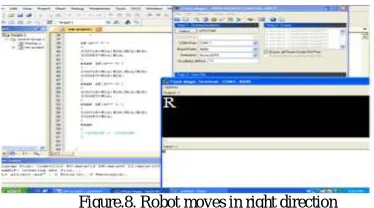
Table III shows the placement of seeds in three different contours effectively. The robot moves according to the input given. Baudrate is set to 9600.Simulation result shown in figure 6,7,8,9 explains the movement of robot in four direction.
Figure.6. Robot moves in forward direction
Figure 6 explain that robot moves in the forward direction for three seconds and stops, at that time servomotor works, when the input command ‘F’ is given to the robot and process continuous. Digging is done along with this operation only.
Figure.7 Robot moves in reverse direction
Whenever robot has to move in reverse direction, input command ‘B’ is to be given and robot moves in reverse direction till the distance required by the user as shown in figure 7. Here seed sowing and digging operation is not done.
Figure.8. Robot moves in right direction
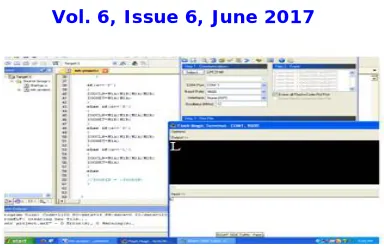
Figure.9. Robot moves in left direction
To move the robot in left direction ‘L’ command is given as shown in figure 9. Required distance it can be rotated by the user. While moving seed sowing and digging operation is not performed. Hence it can be controlled in all four directions.
Figure.10 No moisture content in the soil
Figure 10 gives the percentage of water content in the field. It is observed during the working of sensor, there is no water content in the field, and it is dry. Hence the output is shown 0%. Then farmer has to supply the water to the field. This helps the proper growth of crops.
Figure.11. Moisture content present in the soil
Table IV
Measurement of moisture content in the soil
Amount of water in the soil (ml) Moisture content in the soil
5 15%
10 24%
15 33%
20 41%
25 48%
Table IV shows that amount of water used and moisture percentage. The system is validated for the moisture content in the soil, by taking 100gms of soil in a container and water is poured in the increment of 5ml. Thus the moisture percentage can be found.
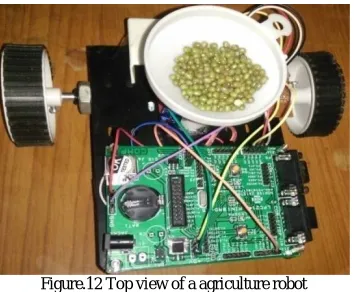
Figure.12 Top view of a agriculture robot
Figure 12 shows the top view of the agriculture robot. ARM controller, servomotor, DC motor driver are placed on the chassis.
Figure.13. Front view of the agriculture robot
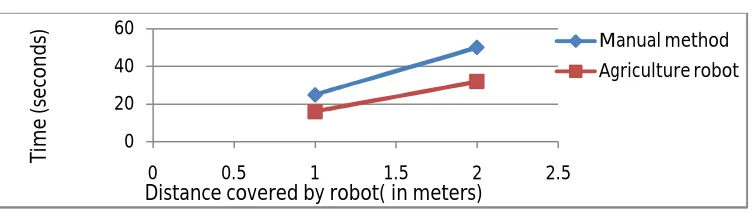
Figure.14. Graph of comparing seed sowing methods
Figure 14 shows the distance covered by the robot during seed sowing. It is observed that to cover one meter of distance it takes 16 seconds and manual method takes 25 seconds. By comparing the time taken by robot and manual method 21% of the time is saved for the farmer.
VI. CONCLUSION
For more production of food farmer has to work a lot in the field. To reduce the farmers work, agriculture robot has been developed. The system developed is compared with the manual method. It does the seed sowing, digging and measuring the moisture content in the soil. The robot is designed for movement in forward, reverse, right and left. So that entire field can be covered. The Cost for the robot is less. It is observed that 21% of time reduced for seed sowing. It costs around Rs.8000/-. Moisture content in the soil is measured. As per the requirement farmer has to supply the water to the field. The water can be saved.
REFERENCES
[1]. S. Shepeleva, V. Shepelevb, Z. Almetovab, “Optimization of Technical Equipment for Crop Sowing Processes”, Science Direct Procedia Engineering 150 ( 2016 ) 1258 – 1262.
[2]. Pratap Tokekar, Joshua Vander Hook, David Mulla, and Volkan Isler, “Sensor Planning for a Symbiotic UAV and UGV System for Precision Agriculture”, IEEE transactions on robotics, Vol. 32, no. 6, December 2016.
[3]. Suraj Nandkishor Kothwade, Shaikh Mohammed Furkhan,Abdul Raoof and Kunjan Suresh Mhaske, “Efficient water management for Greenland using soil moisture sensor”, IEEE International conference on power electronics, Intelligent control and energy systems(ICPEICES-2016),978-1-4673-8587-9/16-2016 IEEE
[4]. Andrew J.Phillips, Nathaniel K.Newlands, Stew H.L.Liang, Benjamin H. Ellert, “Integrated sensing of soil moisture at the field-scale: Measuring,
modeling and sharing for improved agricultural decision support”, ELSEVIER Computers and Electronics in Agriculture 107 (2014) 73–88. [5]. http://www.nxp.com/documents/data_sheet
[6] http://www.ti.com/lit/ds/symlink/l293.pdf
[7]. http://www.diyspacepk.com/yl-38-soil-moisture-sensor
[8]. http://akizukidenshi.com/download/ds/towerpro/SG90.pdf
[9]. Mr. Deepak Kumar Roy and Mr.Murtaza Hassan Ansari "Smart Irrigation Control System", International Journal of Environmental Research and Development. ISSN 2249-3131 Volume 4, Number 4 (2014), pp. 371-374.
[10]. S. T. Jawaid and S. L. Smith, “Informative path planning as a maximum travelling salesman problem with submodular rewards,” Discrete Appl. Math., vol. 186, pp. 112–127, 2015.
0 20 40 60
0 0.5 1 1.5 2 2.5
Manual method Agriculture robot
Distance covered by robot( in meters)