Secure Data Deduplication with Dynamic
Ownership Management in Cloud Storage
Dr.S.Masood Ahamed1, N.Mounika2, N.vasavi3, M.Vinitha Reddy4
HOD, Department of Computer Science & Engineering,, Guru Nanak Institutions, Ibrahimpatnam, Hyderabad, India1 B.Tech Student, Department of Computer Science & Engineering, Guru Nanak Institutions, Hyderabad, India2 B.Tech Student, Department of Computer Science & Engineering, Guru Nanak Institutions, Hyderabad, India3 B.Tech Student, Department of Computer Science & Engineering, Guru Nanak Institutions, Hyderabad, India4
ABSTRACT: In cloud storage services, deduplication technology was introduced to reduce the space and bandwidth requirements of services by eliminating redundant data and storing only a single copy of them. Deduplication is most effective when multiple users upload the same data to the cloud storage, but it raises issues relating to security and ownership. Proof of- ownership schemes allow any owner of the same data to prove to the cloud storage server that he owns the data in a different way. Recently, several deduplication schemes are proposed to solve this problem by allowing each owner to share the same encryption key for the same data. However, most of the schemes suffer from security issues, since they do not consider the dynamic changes in the ownership of the data that occur frequently in a practical cloud storage service. In this paper, we propose a server-side deduplication scheme for encrypted data. It allows the cloud server to control access to outsourced data even when the ownership changes dynamically by providing convergent encryption and secure ownership group key distribution. This prevents data leakage not only to revoked users even though they previously owned that data, but also to any honest curious cloud storage server. In addition, the proposed scheme guarantees data integrity against any tag inconsistency attack. Thus, security is enhanced in the proposed scheme. The efficiency analysis results demonstrate that the proposed scheme is almost as efficient as the previous schemes, while the additional computational overhead is negligible.
KEYWORDS: Deduplication, cloud storage, encryption, proof-of-ownership
I.INTRODUCTION
Cloud computing provides seemingly unlimited “virtualized” resources to users as services across the whole Internet, while hiding platform and implementation details. Today’s cloud service providers offer both highly available storage and massively parallel computing resources at relatively low costs. As cloud computing becomes prevalent, an increasing amount of data is being stored in the cloud and shared by users with specified privileges, which define the access rights of the stored data. One critical challenge of cloud storage services is the management of the ever-increasing volume of data. To make data management scalable in cloud computing, deduplication has been a well-known technique and has attracted more and more attention recently.
Deduplication can also take place at the block level, which eliminates duplicate blocks of data that occur in non-identical files [1].
Providers of cloud-based storage such as Google drive can save on storage costs via deduplication: should two clients upload the same file, the service detects this and stores only a single copy [2]. Convergent encryption [2][9] has been proposed to enforce data confidentiality while making deduplication feasible. It encrypts/decrypts a data copy with a convergent key, which is obtained by computing the cryptographic hash value of the content of the data copy. After key generation and data encryption, users retain the keys and send the cipher text to the cloud.
II.RELATED WORK
Bellare et al. [3] showed Data confidentiality by transforming the predictable message into unpredictable message. Introduces a key server as third party to generate the file tag for duplicate check. Bugiel et al. [6] provided an architecture consisting of twin clouds for secure outsourcing of data and arbitrary computations to an untrusted commodity cloud. Xu et al. [9] also addressed the problem and showed a secure convergent encryption for efficient encryption, without considering issues of the key-management and block-level deduplication.
Anderson,Le Zhang. [1] proposed backup solutions for fast and secure backups,used an encrypted deduplication algorithm. This algorithm supports client-end per-user encryption which is necessary for confidential personal data. It also supports a unique feature which allows immediate detection of common sub trees, avoiding the need to query the backup system for every file.
III.EXISTING SYSTEM
In the existing deduplication system, each user is issued a set of privileges during system initialization. Each file uploaded to the cloud is also bounded by a set of privileges to specify which kind of users is allowed to perform the duplicate check and access the files. Before submitting his duplicate check request for a file, the user needs to take this file and his own privileges as inputs. The user is able to find a duplicate for this if and only if there is a copy of this file and a matched privilege stored in cloud.
EXISTING TECHNIQUE:
Symmetric encryption technique.
TECHNIQUE DEFINITION:
Symmetric encryption uses a common secret key to encrypt and decrypt information.
DRAWBACKS:
The user needs to know private key.
Less protect security.
These deduplication systems cannot support differential authorization duplication check.
IV.PROPOSED SYSTEM
PROPOSED TECHNIQUE:
Convergent encryption technique.
TECHNIQUE DEFINITION:
A user derives a convergent key from each original data copy and encrypts the data copy with the convergent key.
ADVANTAGES:
The user don't needs to know private key
Better protect security.
These deduplication systems can support differential authorization duplication check.
V. SYSTEM ARCHITECTURE
Whenever someone wants to give information or take information from cloud they have to take permission i.e. authentication is done. If not a member they have to register first. Then the user will request private cloud to get a file token .Private cloud will issue file token and Convergent key generation takes place. With that key user will upload a file to the public cloud, then there will be a deduplication system to check whether the file already exist or not. If the file already exists then the file will not upload in public cloud.
Fig1: System architecture
AUTHENTICATION:
a) Authentication REGISTER:
In this Module If he is a new user he needs to enter the required data to register the form and the data will be stored in server for future authentication purpose.
b) Register
CONVERGENT KEY GENERATION
In this module, if user wants to upload a file user needs to get key from private cloud.
C) Convergent Key Generation
FILE UPLOADING
AUTHORIZED DUPLICATE CHECK SCHEME (ADS)
The public cloud performs duplicate check directly and tells the user if there is any duplicate. Public Cloud can store and retrieve file. De-duplication has a removing duplicate file. Its will find out duplicate file.
e) Authorized Duplicate Check Scheme
VI. ALGORITHM USED
CONVERGENT ENCRYPTION TECHNIQUE
A user derives a convergent key from each original data copy and encrypts the data copy with the convergent key. The key generation algorithm that maps a data copy to a convergent key. The symmetric encryption algorithm that takes both the convergent key and the data copy as inputs and then outputs a cipher text. The decryption algorithm that takes both the cipher text and the convergent key as inputs and then outputs the original data copy and the tag generation algorithm that maps the original data copy and outputs a tag.
VII. APPLICATIONS
CtrlS Real Cloud:
The CtrlS Real Cloud has a multi-layered management model. The cloud controller server enables everything, from system architecture to VM root access, to be managed via the user interface and API. Real Cloud enables you to put up applications and manage them, all remotely and with utmost ease.
Cloud Layer Services:
VIII. RESULT
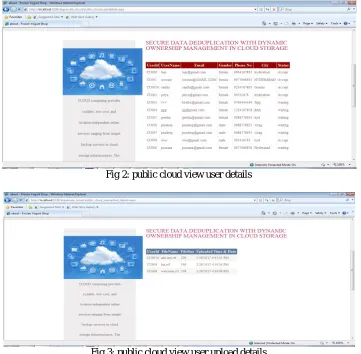
Where the public cloud view user details which gives who viewed the uploaded file and public cloud view user upload details give details of users who uploaded files into public cloud.
Fig 2: public cloud view user details
Fig 3: public cloud view user upload details
IX. CONCLUSION
In this paper, the notion of authorized data deduplication was proposed to protect the data security by including differential privileges of users in the duplicate check. In which the duplicate-check tokens of files are generated by the private cloud server with private keys.
REFERENCES
[1] P. Anderson and L. Zhang, “Fast and secure laptop backups with encrypted de-duplication,” in Proc. 24th Int. Conf. Large Installation Syst. Admin., 2010, pp. 29–40.
[3] M. Bellare, S. Keelveedhi, and T. Ristenpart, “Message-locked encryption and secure deduplication,” in Proc. 32nd Annu. Int. Conf. Theory Appl. Cryptographic Techn., 2013, pp. 296–312.
[4] M. Bellare, C. Namprempre, and G. Neven, “Security proofs for identity-based identification and signature schemes,” J. Cryptol., vol. 22, no. 1, pp. 1–61, 2009.
[5] M. Bellare and A. Palacio, “Gq and schnorr identification schemes: Proofs of security against impersonation under active and concurrent attacks,” in Proc. 22nd Annu. Int. Cryptol. Conf. Adv. Cryptol., 2002, pp. 162–177.
[6] S. Bugiel, S. Nurnberger, A. Sadeghi, and T. Schneider, “Twin clouds: An architecture for secure cloud computing,” in Proc. Workshop Cryptography Security Clouds, 2011, pp. 32–44.
[7] J. R. Douceur, A. Adya, W. J. Bolosky, D. Simon, and M. Theimer, “Reclaiming space from duplicate files in a serverless distributed file system,” in Proc. Int. Conf. Distrib. Comput. Syst., 2002, pp. 617–624.
[8] D. Ferraiolo and R. Kuhn, “Role-based access controls, ” in Proc. 15th NIST-NCSC Nat. Comput. Security Conf., 1992, pp. 554–563.