Evaluation of CIDI Engine Performance Using
Rice Bran Oil Methyl Ester as Biodiesel
Sirivella Vijaya Bhaskar1, G.Satish Babu2
Professor, Dept. of Mechanical Engineering, St.Martin’s Engineering College, Dhulapally, Hyderabad, India1
Professor, Dept. of Mechanical Engineering, JNTUH College of Engineering, Kukatpally, Hyderabad, India2
ABSTRACT: Biodiesel was identified as a potential alternative to petro-diesel fuel because it has diesel like fuel properties. Use of edible oils in biodiesel production causes for raise of food prices, but few edible oils such as rice bran oil have higher heating value when compared with non-edible oil and available abundantly in some countries such as soybean oil in USA. In this work, the performance analysis of single cylinder, 4-stroke, and water cooled diesel engine was carried-out using jatropha curcas oil methyl ester as biodiesel alternative to diesel fuel. Experimental tests have been conducted with range of engine loads using rice bran oil methyl ester (RBOME) and its diesel blends with biodiesel in the ratio of 20:80 (B20R), 40:60 (B40R), 60:40 (B60R), RBOME 100% (B100R) and petro-diesel 100% by volume. In this research work, brake thermal efficiency (BTE), brake specific fuel consumption (BSFC), brake specific energy consumption (BSEC) and exhaust gas temperature (EGT) are considered as engine performance characteristics. The experiment results revealed that B20R blend of biodiesel has comparable brake thermal efficiency as diesel. B20R has lowest and B100R has highest BSFC, BSEC among all the biodiesel blends. B20R has shown comparable performance as diesel and it can be considered as alternative to diesel fuel.
KEYWORDS:Biodiesel, Direct injection diesel engine, Engine performance, Rice bran oil, Transesterification.
I. INTRODUCTION
Worldwide industrialization, population growth, and declining fuel reserves lead to search for alternative renewable fuels. Free fatty acid methyl esters known as biodiesel which is considered as alternative to petro-diesel is gaining ground as a bio-degradable, environmental friendly, easily available, energy conservation and management [1]. Biodiesel is derived from renewable feedstock such as vegetable oils or animal fats. Both edible and non-edible oils have been successfully employed in biodiesel production [2]. Vegetable oil or biodiesel or blended with diesel can be directly used in the existing diesel engines without any further modifications [4]. The past research reviews revealed that vegetables oils such as palm oil, sunflower oil, soybean oil, rice bran oil etc., can be directly used as fuel in diesel engines, but it is not preferable [3]. Biodiesels prepared from edible oils has raised a debate on fuel vs. food, especially in thickly populated developing countries. The research and development in the production of biodiesel is then moved towards production of biodiesel using non- edible oils such as Jatropha oil, Pongamia, Cotton seeds oil, Mustard oil, Neem etc. Undoubtedly, biodiesel production using non-edible oil naturally encourages the rural economic growth, reduces the dependency on fuel imports and reduces the environmental pollution. But, due to usage pesticides and fertilizers the cost of production of feedstock for non-edible oils became as costly as edible oil feedstock. Moreover edible oils have higher heating value and lower density when compared with edible oils. Rice bran oil is a non-conventional, inexpensive and low-grade edible oil. Crude rice bran oil is also source of high value added by-products. Thus, if the by-products are derived from the crude rice bran oil and the resultant oil is used as a feedstock for biodiesel, the resulting biodiesel could be quite economical and affordable.
used soya methyl ester and canola methyl ester diesel blends in a Detroit Diesel engine and observed that the emissions of CO2, NOx, and particulate matter has increased and reductions in total hydrocarbons. It was also reported that the engine wear was within acceptable limits during durability tests conducted [7]. Kalam et al., have conducted experiments to investigate using preheated crude palm oil and the results shown that preheated crude palm oil reduced exhaust emissions such as containing less CO, HC and PM as compared to diesel [8]. Grimaldi et al., have reported the results of a comparative analysis performed on a modern DI, common-rail, turbocharged engine using three different bio-derived fuels (rape seed, soybean, waste cooked oil) and diesel fuel. It was observed that NOx emissions of biodiesel fuels were same or marginally higher than fossil fuels. Smoke emission was further reduced by bio-fuels by a factor 3 to 4 and all the three bio-derived fuels performed in a very similar manner [9]. McCormick et al., have tested number of approaches for NOx reduction for 20% biodiesel blend (B20). Biodiesel produced from soybean oil and from yellow grease blended with 10% aromatic diesel, zero aromatic Fisher-Tropsch diesel with fuel additives was tested in a 1991 DDC Series 60 truck engine. Relative to base diesel, 20% lower PM emissions but NOx emissions for soybean and yellow grease based blends increased by 3.3% and 1% were exhibited by B20 fuels respectively. The 10% aromatic fuel exhibited 12% lower PM and 6% lower NOx. NOx emission was decreased by 6.5% for 20% blend of soybean with diesel [10]. Humke et al., were conducted an experiment on a single cylinder naturally aspirated direct injection diesel engine to evaluate the performance and emission characteristics of soybean oil and its blends with diesel and de-gummed soybean oil. In comparison to diesel, thermal efficiency lowered 1 to 2% and 1 to 2 g/kWh lower NOX, 2 to 20 g/kWh more CO, 1 to 2 g/kWh more hydrocarbons and 1 to 2 g/kWh more particulates with vegetable oils. High smoke level is also reported with soybean oil in comparison to diesel. During 25 hours of testing at 2200 rpm with vegetable oil, thermal efficiency losses ranged from 1 to 6% and particulate emissions increased from 2 g/kWh to 14 g/kWh due to nozzle deposits [11]. Rakopoulos et.al have conducted experiments to evaluate the use of sunflower and cottonseed oil methyl esters with blend ratios of 10/90 and 20/80, in a fully instrumented, six-cylinder, turbocharged and after-cooled, direct injection Mercedes-Benz, mini-bus diesel engine installed at the authors’ laboratory. When working with neat diesel fuel and the two bio-diesels are determined and compared. Theoretical aspects of diesel engine combustion with the differing physical and chemical properties of these blends, aid the correct interpretation of the observed engine behaviour [12].
Vegetable oils are triglycerides of free fatty acids and alcohol esters of fatty acids have been prepared by the transesterification of the glycerides, wherein linear, monohydroxy alcohols reacts with the vegetable oils in the presence of catalyst to produce alcohol esters of vegetable oil. The alcohol esters of vegetable oil when used as an alternative diesel fuel have been identified as a biodiesel. Vegetable oils will have high viscosity that causes major problems in their use as fuels in diesel engines such as thermal cracking, oil ring sticking etc. Further, it is difficult to operate CIDI engine in cold weather conditions due to poor flow property of biodiesel [14]. These problems can be resolved, by chemically converting the vegetable oils into biodiesel [15] using chemical processes such as Micro emulsification, Pyrolysis, Dilution and Transesterification process [16]. In this research work, rice bran oil was converted into biodiesel using transesterification and blended with diesel.
II. MATERIALSANDMETHODS
Rice bran oil was bought from local vendor and employed transesterification process to prepare biodiesel. In the transesterification process, methanol was used in presence of catalysts for transesterification include sodium hydroxide, and potassium hydroxide. A triglyceride has a molecule of glycerine as its base with three long chain fatty acids attached and fat characteristics can be determined by the nature of the fatty acids attached to the glycerine. The nature of the fatty acids can, in turn, affect the characteristics of the biodiesel. In this work methyl alcohol was used in transesterification process in the presence of sodium hydroxide was used.
Fig. 1. Chemical reaction of Transesterification Process
As shown in figure 2, sodium hydroxide participates as catalyst and methyl alcohol as driver for the transesterification process. First rice bran oil of 1000 ml was poured into biodiesel reactor and then, the catalyst/alcohol mixture was pumped into rice bran oil. The final mixture is stirred vigorously for 2 hr at 340 K in ambient pressure.
Fig. 2. Transesterification Process Flow
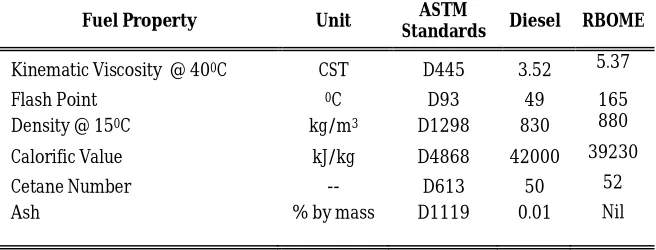
A successful reaction results in 2 phases in the reactor and the bottom layer consisted of glycerine and top layer rice bran oil methyl ester. Glycerine, the heavier liquid will collect at the bottom after several hours of settling and then separated by using separation flask. Then the ester obtained is further treated with 23 % water in two stages in order to remove any glycerin present in the ester and finally pure ester is obtained by heating the ester up to 1000 C in order to remove completely the water content. The properties of biodiesel depend on molar ratio of alcohol to oil and many other factors and the rice bran oil methyl ester that was used in the present research work is presented in Table 1.
Table 1. Properties of Rice Bran Oil based biodiesel and Diesel
Fuel Property Unit ASTM
Standards Diesel RBOME
Kinematic Viscosity @ 400C CST D445 3.52 5.37
Flash Point 0C D93 49 165
Density @ 150C kg/m3 D1298 830 880
Calorific Value kJ/kg D4868 42000 39230
Cetane Number -- D613 50 52
III.EXPERIMENTAL SETUP
A series of experimental runs was carried-out using a single cylinder, 4-stroke, water cooled diesel engine to evaluate the performance characteristics of the diesel engine and the test engine bed picture is presented in figure 3.
Fig. 3. Test Bed of Diesel Engine
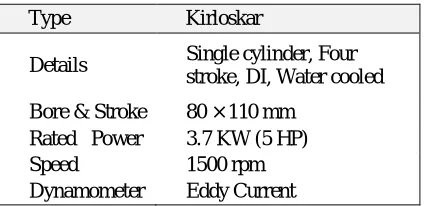
As shown in figure 4, an eddy current dynamometer was arranged to test engine to apply different engine loads as per the predefined test conditions, a fuel consumption meter, DP transmitter were used for measuring the specific fuel consumptions of the engine and the engine specifications are presented in Table 2.
Fig 4. Schematic diagram of test engine
Nomenclature:
T1,T3: Inlet water temperature (0C);
T2: Outlet engine Jacket Water Temperature (0C); T4: Outlet Calorimeter Water Temperature (0C); T5 & T6: Exhaust Gas Temperature before and after
Calorimeter (0C);
F1: Fuel Flow Differential Pressure (DP) unit; F2: Air Intake DP Unit;
PT: Pressure Transducer
Rice bran biodiesel of B20R, B40R, B60R, B100R and diesel fuel were used as fuel in the test diesel engine. After the engine has reached the stabilized working condition at constant speed of 1500 rpm, readings were recorded for each applied load for each blend percentage, and then calculated the selected performance characteristics of CIDI engine.
Table 2. Engine Specifications
Type Kirloskar
Details Single cylinder, Four stroke, DI, Water cooled
Bore & Stroke 80 × 110 mm Rated Power 3.7 KW (5 HP)
Speed 1500 rpm
IV.EXPERIMENTAL RESULTS AND DISCUSSION
The experimental test results obtained from single cylinder, 4-stroke and water cooled diesel engine when fuelled with rice bran oil methyl ester were analysed and presented in the subsequent paragraphs.
A. Brake Thermal Efficiency
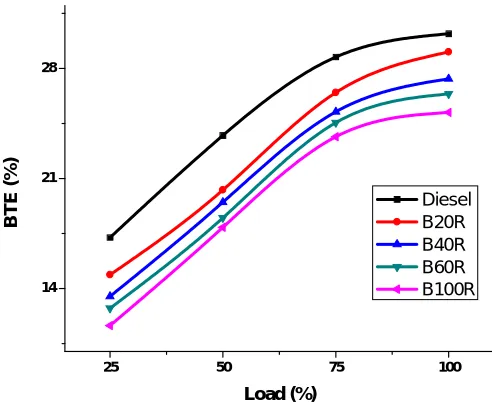
As shown in figure 5, brake thermal efficiency (BTE) has decreased with increase of RBOME blend percentage. As load increases, BTE has also increased and at full load condition both diesel and biodiesel and diesel has highest brake thermal efficiency. In among all the blends of biodiesel, B20R has closest BTE with diesel fuel when compared with biodiesel blends.
25 50 75 100
14 21 28
B
T
E
(
%
)
Load (%)
Diesel B20R B40R B60R B100R
Fig 5 Load vs. Brake thermal efficiency
It is also confirming that the rate of increase in thermal efficiency is higher at lower loads and low at higher loads. The reason that B20R has comparable brake thermal efficiency, because B20R and petro-diesel has comparable fuel characteristics and are within the recommended standard fuel range for use in a diesel engine.
B. Brake Specific Fuel Consumption (BSFC)
25 50 75 100 0.2
0.4 0.6 0.8
B
S
F
C
(
k
g
/k
W
h
)
Load (%)
Diesel B20R B40R B60R B100R
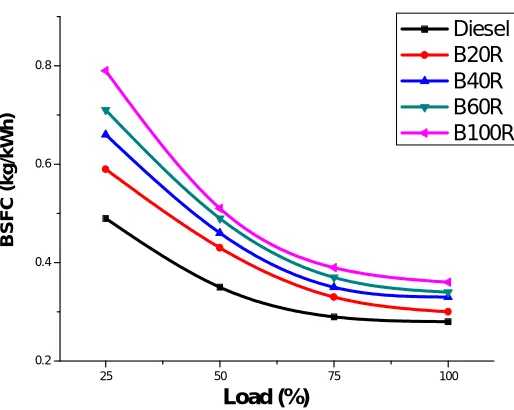
Fig 6 Load vs. Brake specific fuel consumption
C. Brake Specific Energy Consumption (BSEC)
Figure 7 shows the variation of brake specific energy consumption for all tested blends of biodiesel with varying engine load conditions. The load conditions are 25%, 50%, 75% and 100% of rated power of 3.7 kW. The brake specific energy consumption of the engine with biodiesel operation at all load conditions is higher when compared to diesel fuel. It is because RBOME biodiesel contains lower calorific value and higher density than petro-diesel. It was observed that the BSEC has increased with increase of percentage of biodiesel blend and diesel has shown lowest among all the tested fuels. Neat biodiesel has exhibited highest BSEC in all load conditions. B20R blend showed lower BSEC compared to all others blends. At lower load conditions the BSEC is higher and gradually decreasing when load is increasing. At higher loads, it is noticed that the brake specific energy consumption is lowest for all fuels.
25 50 75 100
16 24 32
B
S
E
C
(
M
J/
K
W
h
)
Load (%)
Diesel B20R B40R B60R B100R
D. Exhaust Gas Temperature (EGT)
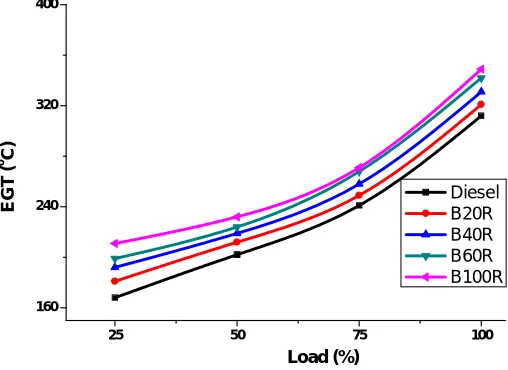
Technically exhaust gas temperature is higher means higher energy is unutilized by the engine and there is more heat loses. Lowest exhaust temperature signify the higher utilization of combustion energy by the engine. The variation of exhaust gas temperature with varying loads is presented in figure 8.
25 50 75 100
160 240 320 400
E
G
T
(
0 C
)
Load (%)
Diesel B20R B40R B60R B100R
Fig 8. Load vs. Exhaust Gas Temperature
Increase of exhaust gas temperature (EGT) with the increase of percentage of biodiesel blend and diesel has observed. As the load increases the exhaust gas temperature is also increased and at full load conditions both diesel and biodiesel has highest exhaust gas temperature. In among all the blends of biodiesel, B20R has closest exhaust gas temperature to petro-diesel fuel when compared all biodiesel blends. In figure 8, it can be observed that at higher load condition, B60R and B100R almost same exhaust gas temperatures.
V. CONCLUSION
Experimental results of performance characteristics of single cylinder, 4-stroke, and water cooled CIDI engine using rice bran oil methyl ester and its diesel blends have confirmed that RBOME is a suitable fuel as bio-fuel for diesel engine without any engine modifications. The blend B20R has comparable performance characteristics as petro-diesel, because the brake thermal efficiency (BTE) of the test engine with B20R biodiesel is slightly lesser than the petro-diesel at all load conditions. Brake specific fuel consumption (BSFC) of the engine is slightly more with biodiesel for the same power developed due to its lower calorific value and higher density. The brake specific energy consumption (BSEC) of the engine is significantly higher at lower loads and slightly more with biodiesel for same power developed. The exhaust gas temperature (EGT) from the test engine is significantly higher with biodiesel for the same power developed when compared with diesel. In among all the blends of RBOME, B20R has the best performance characteristics when brake thermal efficiency, brake specific fuel consumption, brake specific fuel consumption and exhaust gas temperature considered.
REFERENCES
[1] T. F. Adepoju and O. Olamide, "Acid-catalyzed esterification of waste cooking oil (WCO) with high FFA for biodiesel production," Chemical and Process Engineering Research, vol. 21, pp. 80-85, 2014.
[3] Bari S, Yu CW, Lim TH, “Performance deterioration and durability issues while running a diesel engine with crude palm oil”, Proc. Instn. Mechanical Engrs Part-D, Journal of Automobile Engineering vol 216, pp. 785-792, 2002.
[4] S. M. A. Rahman, H. H. Masjuki, M. A. Kalam, M. J. Abedin, A. Sanjid, and H. Sajjad, “Production of palm and Calophyllum inophyllum based biodiesel and investigation of blend performance and exhaust emission in an unmodified diesel engine at high idling conditions”, Energy Conversion and Management, vol. 76, pp. 362–367, 2013.
[5] A. Faiz and P. J. Sturm, “New directions: air pollution and road traffic in developing countries,” Atmospheric Environment, vol. 34, no. 27, pp. 4745–4746, 2000.
[6] Dhinagar, S., Nagalingam, B., and Gopalakrishnan, K., "Experimental Investigation of Non-Edible Vegetable Oil Operation in a LHR Diesel Engine for Improved Performance," SAE Technical Paper 932846, 1993,
[7] Spataru, A. and Romig, C., "Emissions and Engine Performance from Blends of Soya and Canola Methyl Esters with ARB #2 Diesel in a DCC 6V92TA MUI Engine," SAE Technical Paper 952388, 1995.
[8] Kalam, M.A. and H.H. Masjuki, "Emissions and deposit characteristics of a small diesel engine when operated on pre heated crude palm oil", Science Direct, Biomass and Bio energy Vol.27, Sept 2004, pp.289-297, 2004.
[9] Grimaldi, C., Mariani, F., and Postrioti, L., "Performance and Emissions of a Common Rail DI Diesel Engine Using Fossil and Different Bio-Derived Fuels," SAE Technical Paper 2001-01-2017, 2001.
[10] McCormick, R., Alvarez, J., Graboski, M., Tyson, K. et al., "Fuel Additive and Blending Approaches to Reducing NOx Emissions from Biodiesel," SAE Technical Paper 2002-01-1658, 2002.
[11] Humke, A.L. and Barsic, N.J. “Performance and Emission Characteristics of a Naturally Aspirated Diesel Engine with Vegetable Oils (Part-2)”, SAE, No. 810955, 1981.
[12] C.D. Rakopoulos, D.C. Rakopoulos, D.T. Hountalas, E.G. Giakoumis and E.C. Andritsakis , “Performance and emissions of bus engine using blends of diesel fuel with bio-diesel of sunflower or cottonseed oils derived from Greek feedstock”, Fuel ,Vol. 87, Issue 2, , pp: 147-15, 2008. [13] Van Gerpen, John H., Peterson, Charles L., Goering, Carroll E. “Biodiesel: An Alternative Fuel for Compression Ignition Engines.” ASAE
Distinguished Lecture No. 31, pp. 1-22, 2007.