Predictive Active Control of Single Mode Response of Building Frames Using ANN
M.M. Rao and T.K. Datta
Department of Civil Engineering, Indian Institute of Technology Delhi, Hauz Khas, New Delhi – 110016, INDIA ABSTRACT
Efficient control schemes using neural network controller (neurocontroller) are presented for the response reduction of building frames subjected to earthquake excitation. The control schemes are intended to control only a single mode response of the frame which predominantly governs its over all response. The neurocontroller has a feedback structure providing two kinds of control schemes. In the first, displacement, velocity and acceleration are taken as the feedbacks. In the second, only acceleration is taken as a feedback. Both control schemes use the ground excitation as input to the neural net. Further, they consider the time delay that exists between the measurement of response and the actual application of the control force. Response measurements are taken from only one point of the structure. Neurocontroller is directly trained to provide the control force signal for a predetermined response reduction, called the target reduction. No emulator neural network is used to aid the training scheme. As an illustrative example, a 10-storey shear-building frame is considered whose period of first mode of vibration is about three times that of the second mode of vibration. For training the neurocontroller, a number of synthetically generated earthquake records having different frequency compositions are used. The efficiencies of the control schemes are demonstrated by controlling the first mode response of the frame subjected to El Centro earthquake record. It is shown that the control schemes provide response reductions close to the target reductions even for a time delay of 2δt, δt being the sampling interval of the time histories of response.
INTRODUCTION
In the past, a number of studies on the active control of building frames subjected to earthquake excitation have been reported [1, 2, 11]. Most of these studies deal with the development of different control algorithms, both linear and nonlinear, for the response reduction of building frames [7, 10, 9]. Also, these studies deal with the limitations of the control schemes developed, and their implementability [8]. The state of the art review papers on active control of structures [5, 8] provide a comprehensive knowledge on the subject. Two major problems that have been addressed in respect of the limitation of the active control schemes and their implementability are the time delay effect and the measurement of response quantities of interest. Incorporation of the time delay effect in control algorithms is somewhat complicated and can not be fully realised. The problem of the measurement of response quantities of interest is faced with several practical difficulties [2,9]. Artificial neural network (ANN) has been recently used for the active control of structures [4, 6]. The use of ANN obviates the need for the development of an analytical control algorithm. Further, potentially it is capable of considering the practical problems mentioned above. However, the use of ANN for the control of building frames by considering the time delay effect and limited number of response feedback is not widely reported in the literature since it involves complex and computationally intensive training scheme for the neural network. For a certain class of problem, this difficulty may not arise and the training scheme may become simple and straightforward. One such case is the control of the response of building frames where responses are predominantly governed by the first mode response. For this type of building frames, responses can be obtained by solving a single degree of freedom equation leading to a considerable simplification of the development of ANN based control schemes for such structures. Since many building frames respond primarily in the first mode of vibration under seismic excitation, it is worthwhile to develop such ANN based control schemes.
The present paper attempts to develop ANN based control schemes which deal with (i) the control of the predominant modal response of building frames, (ii) consideration of limited number of response measurement, (iii) explicit treatment of the time delay effect and (iv) realisation of a predetermined target level of response reduction. Unlike other ANN based control schemes [4], only one ANN is used for developing the control strategy. Two types of control schemes are presented. In the first, feedback responses include displacement, velocity and acceleration, while in the second only acceleration response is taken as feedback. Both control schemes are developed with the ground excitation being considered as input to the neural net. The control force is applied at the top storey of the frame. Responses of the top-storey are only used as feedback information. Effectiveness of the control schemes is illustrated by controlling the first mode response of a 10-storeyed shear frame (having ω1/ω2 ≈ 1/3) subjected to El Centro excitation.
ASSUMPTIONS
For the development of the control strategies, it is assumed that (i) the responses remain within the elastic range under seismic excitation, (ii) for testing the ANN (neurocontroller) for unknown problems, the measured responses to be used as feedbacks are assumed to be equal to the target controlled responses (in the absence of available experimentally/ actually measured responses); target response = uncontrolled response × (1−P/100), P being the predetermined target percentage reduction, (iii) the base of the frame is assumed to be fixed and soil structure interaction is ignored, (iv) the solution of the controlled equation of motion with control force predicted by the trained neurocontroller is assumed to be equal to the actually measured controlled responses, (v) performance of the neurocontroller is assumed to be satisfactory if the difference between the actually measured responses and the target controlled responses remain within a specified limit.
THEORY
For the shear frame model shown in Fig. 1, the equations of motion for the controlled structure can be written as
Fig. 1 Shear frame model with earthquake excitation and control force.
M
x
&
&
+
C
x
&
+
K
x
+
R
u
(
t
)
=
−
MI
&
x
&
g (1) in which, M, C and K are mass, damping and stiffness matrices of size n×n, R is the vector,T
.}
.
.
0
0
0
1
{
, I is the vector of unity, x is the vector of structural displacements, u(t) is the control force to be applied as shown in Fig. 1 and&
x
&
gis the ground acceleration. In terms of modal coordinates, the equations of motion can be written as
&
z
&
i+
2
ηω
iz
&
i+
ω
i2z
i+
u
i(
t
)
=
−
λ
ix
&
&
g,
i
=
1
.
.
.
.
.
N
(2)in which, N is the number of modes,
ω
i is the ith natural frequency,η
is the percentage critical modal damping,i i
m
MI
=
λ
i i i
m
)
t
(
u
)
t
(
u
=
, where,m
i=
φφ
TiM
φφ
i (3)in which,
φ
i is the ith mode shape normalised such that the mode shape coefficient for the top storey is unity.If it is assumed that the response is predominantly governed by the first mode response, then the response of the system can be written as
x
=
φφ
1z
1 (4)1
z
is solved from Eq. (2), ifu
1 is known.u
1 is obtained from the neurocontroller.ANN BASED CONTROL SCHEME
Assuming that only the control of the first mode response is desired,
u
1(
t
)
is obtained from the trained neural net. Neural net is trained using the following methodology.A feedback control scheme is adopted in which the feedback of the responses is considered as input to the neural net. Two types of neural nets are trained. In the first, structural displacement, velocity and acceleration are taken as inputs, while in the other, only acceleration response is taken as input. The output of the neural net is
u
1(
t
)
. The control schemes are developed with ground acceleration being considered as input to the neural net. The neural nets are trained for a predetermined reduction of response, called the target reduction and for an assumed time delay between the measurement of response and the application of control force. For P percentage reduction of responses, the controlled first modal response would be given by)
z
1100
P
1
(
−
,)
z
1100
P
1
(
−
&
, etc., in whichz
1,z
&
1, etc., are the uncontrolled responses. Using Eqns. (2) and (3), the modal control forceu
1(
t
)
is given by1 1 1
m
)
t
(
u
)
t
(
u
=
=−
λ
1&
x
&
g−
(
&
z
&
1+
2
ηω
1z
&
1+
ω
12z
1)
(5)in which, controlled responses
z
1,z
&
1 etc., are given by1
)
z
1100
P
1
(
z
=
−
; 1)
z
1100
P
1
(
z
&
=
−
&
; 1)
z
1100
P
1
(
z
&
&
&
&
=
−
(6)Using the uncontrolled response of the structure and the target reduction P,
u
1(
t
)
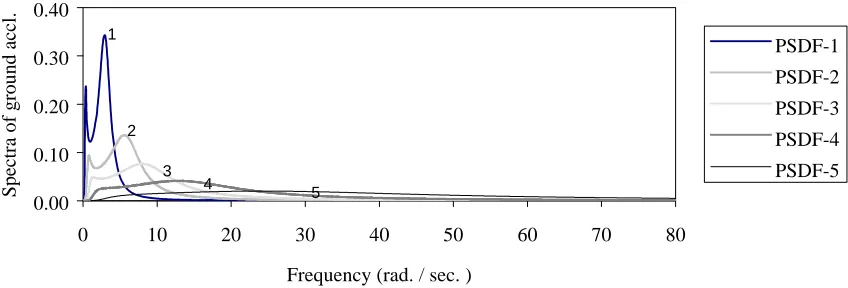
can be obtained from Eqs. (5) and (6). The data pairs for training the neural nets are generated from responses and control forces obtained for a set of artificially generated earthquake records. These records are simulated from the double filtered power spectral density functions (PSDF) given by Clough and Penzien [3] as shown in Fig. 2.0.00 0.10 0.20 0.30 0.40
0 10 20 30 40 50 60 70 80
Frequency (rad. / sec. )
Spectra of ground accl.
In all, five earthquake records, one from each PSDF having 1501 data points sampled at an interval of 0.02 s are generated. Using the generated earthquake records, uncontrolled responses
z
1,z
&
1 and&
z
&
1 are obtained by solving Eq. (2) withoutu
1(
t
)
. The responses are obtained for a given set of values ofω
1,η
andλ
1. The controlled responses and the corresponding control forceu
1(
t
)
are obtained from Eqs. (5) and (6). 7504 data pairs are generated in all and used for training the neural nets. The input output pairs for the neural nets developed for different control schemes are shown in Fig. 3 for a time delay of 2δt. The time delay is caused due to the computational time and implementaional time required for the generation and application of the control force respectively. Zero time delay denotes the hypothetical case of instantaneous control.A fully connected feed-forward net architecture, with ‘Act_TanH’ as activation function, ‘BackpropMomentum’ as learning function and ‘Topological_order’ as update function along with ‘Randomize_weights’ initialising function is used for the training. SNNS package is utilised for training the neural nets.
Fig. 3 Typical input-out pairs
TESTING OF THE NEURAL NET
In order to show the efficiency of the neurocontroller for controlling the response of a building frame whose response is predominantly governed by the first mode response, a 10-storey shear frame is considered as shown in Fig. 1. The first three natural frequencies of the system are 6.2347, 21.9902, and 33.5161. The values of
λ
1 and m1 are computed as 1.1923,24611.95 kg. The neural nets are trained for
ω
1= 6.2347,η
= 0.02 andλ
1= 1.1923. The feedback responses are considered-60 -40 -20 0 20 40 60
1 1.5 2 2.5 3 3.5 4 4.5 5
Time (s)
Force (KN)
Scheme-1
-60 -40 -20 0 20 40 60
1 1.5 2 2.5 3 3.5 4 4.5 5
Time (s)
Force (KN)
Scheme-2
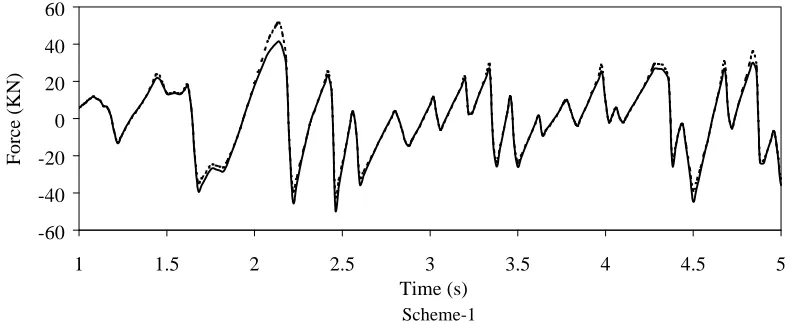
Fig. 5 Time histories of control force for El Centro Earthquake (Target reduction = 50%, Time delay = 0.0 s, - - - - Analytical, ANN)
as those of the top storey of the frame. The time histories of control forces obtained from ANN are multiplied by m1 to obtain
the actual control force to be applied to the structure. The controlled and uncontrolled responses are obtained for the El Centro earthquake (N-S record). First 5 seconds time histories of the control force to be applied at the top storey are shown in Figs. 4 and 5 for 50% target reduction of response as obtained by the two proposed control schemes. Analytical control
-0.25 -0.20 -0.15 -0.10 -0.05 0.00 0.05 0.10 0.15 0.20 0.25
0 2 4 6 8 10
Time (s)
Displacment (m)
Scheme-1
-0.25 -0.20 -0.15 -0.10 -0.05 0.00 0.05 0.10 0.15 0.20 0.25
0 2 4 6 8 10
Time (s)
Displacment (m)
Scheme-2
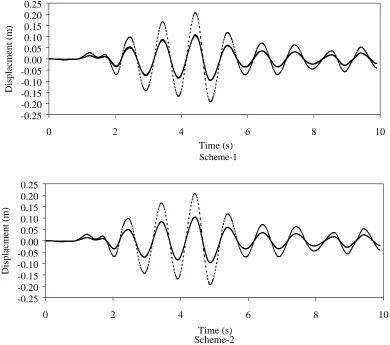
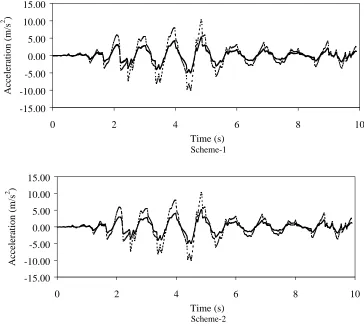
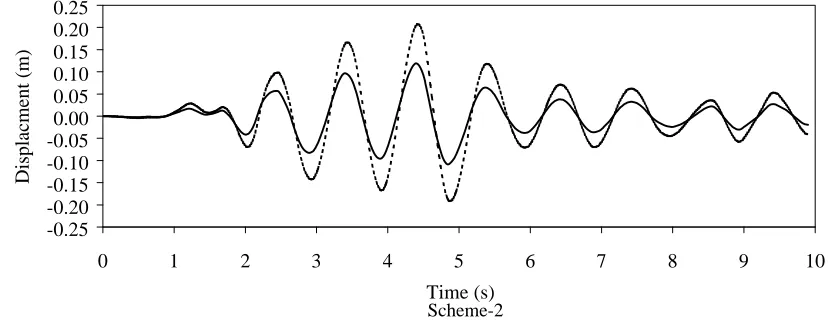
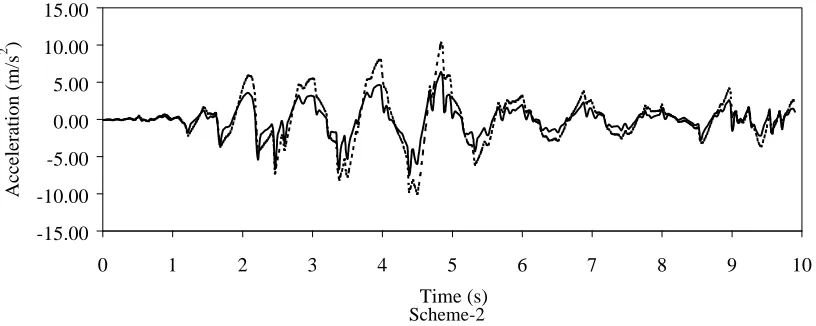
forces are obtained from Eq. (5). It is seen from the figures that the time histories of control forces predicted by the ANN compare well with those obtained analytically. Figs. 6 and 7 compare between the first 10 seconds time histories of the controlled and uncontrolled responses considering the first mode response only. Note that the maximum responses occur within this segment of the time history. It is seen from the figures that the reduction in maximum displacement and acceleration responses are 47.89%, 49.97% and 47.89%, 49.37% for control schemes 1 and 2 respectively. From these figures, it may be seen that both control schemes perform extremely well. Note that the target and ANN controlled responses are almost indistinguishable in the figures.
-15.00 -10.00 -5.00 0.00 5.00 10.00 15.00
0 2 4 6 8 10
Time (s)
Acceleration (m/s
2 )
Scheme-1
-15.00 -10.00 -5.00 0.00 5.00 10.00 15.00
0 2 4 6 8 10
Time (s)
Acceleration (m/s
2 )
Scheme-2
Fig. 7 Controlled and uncontrolled acceleration time histories of the top storey (Target reduction=50%, Time delay = 0.0s, - - - - Uncontrolled, ---- Target, ANN)
-0.15 -0.10 -0.05 0.00 0.05 0.10 0.15
0 2 4 6 8 10
Time (s)
Displacment (m)
Scheme-2
Figs. 8 and 9 show the comparison between the controlled responses for a time delay of 2δt and for scheme-2 (which considers the measured accelerations as feedback only). It is seen that the two time histories match quite well for the displacement response (Fig. 8). Reductions in (absolute) maximum displacement are about 49.96% and 42.6% for time delays of 0 and 2δt (0.04 s) respectively. Note that the target reduction is 50%. For the acceleration response, the two time histories differ at certain peak points (Fig. 9). Except those points, the difference between the two time histories is marginal. Because of the differences between the two time histories at some peak points, the reduction in (absolute) maximum acceleration are 49.37% and 27.83% for time delays of 0 and 2δt (0.04 s).
-10.00 -8.00 -6.00 -4.00 -2.00 0.00 2.00 4.00 6.00 8.00
0 1 2 3 4 5 6 7 8 9 10
Time (s)
Acceleration (m/s
2 )
Scheme-2
Fig. 9 Comparison between the controlled acceleration time histories of the top storey with and without a time delay (Target reduction=50%, - - - - 0.04s, 0.0s)
Figs. 10 and 11 show the comparison between the controlled and uncontrolled responses when the effect of all modes is considered and a time delay of 2δt is taken into consideration. Note that the control force remains the same as that for the control of single mode response only (in control scheme-2). It is seen from the figure that reductions in maximum displacement and acceleration are 42.6% and 27.83% respectively. The corresponding reductions for single mode response are 42.6% and 27.83%. This shows that the proposed control schemes are highly effective in controlling the response of the type of building frames considered here.
-0.25 -0.20 -0.15 -0.10 -0.05 0.00 0.05 0.10 0.15 0.20 0.25
0 1 2 3 4 5 6 7 8 9 10
Time (s)
Displacment (m)
Scheme-2
Fig. 10 Comparison between the controlled and uncontrolled displacement time histories of the top storey of the building considering contribution of 10 modes
-15.00 -10.00 -5.00 0.00 5.00 10.00 15.00
0 1 2 3 4 5 6 7 8 9 10
Time (s)
Acceleration (m/s
2 )
Scheme-2
Fig. 11 Comparison between the controlled and uncontrolled acceleration time histories of the top storey of the building considering contribution of 10 modes
(Target reduction=50%, Time delay = 0.04s; - - - - Uncontrolled, Controlled) CONCLUSION
ANN based control schemes are presented for the control of the modal response of building frames. The control schemes are developed for the case when the first mode predominantly governs the response. Two control schemes are developed using response measurements from a single point on the frame, and applying the control force at the top storey. In the first control scheme, displacement, velocity and acceleration feedbacks are used, while in the other only acceleration feedback is used. Both control schemes are capable of handling the time delay effect and uses ground acceleration as input to the neural net. The control schemes are shown to be highly effective in controlling the response of a 10-storey building frame whose responses are predominantly governed by the first mode response. Even when a time delay of 0.04 s existed between the measurement of responses and the actual application of control force, the control schemes provide reductions in responses about 7.4% to 22.17% less than the target value.
REFERENCES
1. Abdel-Rohman, M., and Leipholz, H. H. E., “Active Control of Tall Buildings,” Journal of Structural Engineering, ASCE, Vol. 109, No. 3, 1983, pp. 628-645.
2. Chung, L. L., Lin, R. C., Soong, T. T., and Reinhorn, A. M., “Experimental Study of Active Control for MDOF Seismic Structures,” Journal of Engineering Mechanics, ASCE, Vol. 115, No. 8, 1989, pp. 1609-1627.
3. Clough, R. W., and Penzien, J., Dynamics of Structures, 2nd edn. McGraw Hill, New York, 1993.
4. Ghaboussi, J. and Joghataie, A., “Active Control of Structures using Neural Networks,” Journal of Engineering
Mechanics, ASCE, Vol. 121, No. 4, 1995, pp. 555-567.
5. Housner, G.W., Bergman, L.A., Caughey, T.K., Chassiakos, A.G., Claus, R.O., Masri, S.F., Skelton, R.E., Soong, T.T., Spencer, B.F. and Yao, J.T.P., “Structural control: Past, Present and Future,” Journal of Engineering Mechanics, Vol. 123, No. 9, 1997, pp. 897-971.
6. Liut, D. A., Matheu, E. E., Singh, M. P., “Neural-Network Control of Building Structures by a Force-Matching Training Scheme,” Journal of Earthquake Engineering and Structural Dynamics, Vol. 28, 1999, pp. 1601-1620.
7. Meirovitch, L. and Stemple, T. J., “Nonlinear Control of Structures in Earthquake,” Journal of Engineering Mechanics, ASCE, Vol. 123, No. 10, 1997, pp. 1090-1095.
8. Soong, T. T., “State-of-the-Art Review: Active Structure Control in Civil Engineering,” Journal of Engineering
Structures, Vol. 10, No. 2, 1988, pp. 73-84.
9. Soong, T. T., and Skinner, G. T., “Experimental Study of Active Structural Control,” Journal of Engineering Mechanics,
ASCE, Vol. 107, 1981, pp. 1057-1068.
10. Suhardjo, J., Spencer Jr., B. F., and Sain, M. K., “Non-linear Optimal Control of a Duffing System,” International
Journal of Non-Linear Mechanics, Vol. 27, No. 2, 1992, pp. 157-172.
11. Yang, J. N. and Soong, T. T., “Recent Advances in Active Control of Civil Engineering Structure,” Probabilistic