CALVIN B. BRIDGES Golumbia University, N e w York City
[Receivetd February 24, 19171
T A B L E QF CONTENTS
PAGE ...
INTRODUCTORY SUMMARY 445
The occurrence of deficiency for bar 446
The lethal action of deficiency
...
447Stock of deficiency 448
The inclusion of forked in the deficient region ... 449 The maximum and the minimum lengths of the deficient region as measured by
the haploid tests with the recessives..
... :. ...
The absence of crossing over within the deficient region.. ... 450 The extent of the deficient region measured by linkageThe dominance relations of bar and the nature of the bar-deficient mutation.. ... 451 Deficiency and the “presence and absence” hypothesis.
The reality of the chromosome maps
APPENDIX 456
...
...
449 45 1
454 455 ...
... ... ...
INTRODUCTORY S U M M A R Y
T he general term “deficiency” is used to designate the loss or inactiva- tion of an entire, definite, and measurable section of genes and frame- work of a chromosome. A case of deficiency in the X chromosome of Drosophila ampelophila occurred in September 1914, and has given rise to a whole series of correlated phenomena.’ T he first indication of this deficiency was the occurrence of a female which had failed to inherit from her father his sex-linked dominant mutant “bar”,3 though she in- herited in a normal manner his sex-linked recessive mutant “white.” This female, when bred, gave only about half as many sons a s daughters, the missing sons, as shown by the linkage relations, being those which had received that X which was deficient for bar. This lethal action in- 1 Contribution from the Zoological Laboratory of COLUMBIA UNIVERSITY, and the CARNEGTE INSTITUTION OF WASHINGTON.
’ A brief account of deficiency was included in “Non-disjunction as proof of the chromosome theory of heredity.” Genetics 1 : 1-52, 107-163, Jan.-Mar., 1916. A fuller account was read before the American Society of Naturalists a t the meeting held at
COLUMBIA UNIVERSITY on December 29, 1916.
3 F o r information about the various mutants, and for an explanation of the terms and symbols used, see appendix, p. 456.
CALVIN B. BRIDGES
416
dicates that the deficiency mutation involved not simply the bar, but was also a deficiency for one or more genes necessary to the life of the fly. I t was next found that the deficiency was extensive enough so that it in- cluded the locus for “forked,” a recessive mutant whose gene lies in the
X chromosome about half a unit from the locus of bar. -1 deficient- bearing female behaves as though haploid for forked, so that a
female is forked although forked is a strict recessive. That the region between forked and bar was likewise affected, was demonstrated by the disappearance of crossing over between these loci in females having a deficient
S.
The deficiency mutation is thus proved not only to have affected a region of adjacent genes but also to have affected the frame- work of the chromosome on which crossing over must primarily depend. The maximum and the minimum lengths of the deficient region were measured by two genetic methods-by means of haploid tests and by means of linkage. The length of the chromosome as tested by linkage was found to be shorter than normal by an amount corresponding to the length of the deficient region. Unfortunately the stock of deficiency was lost before a cytological examination was made. The fact that the fe- male with one X deficient for bar and the other X carrying bar)
is an intermediate like the normal bar heterozygote, leads to the conclusion that the intermediate eye shape is due to the broaden- ing action of genes outside the bar locus rather than to a broadening action of the normal allelomorph of bar ( b ’ ) . Of the two alternative ex- plaiiations of the nature of deficiency, viz., physical loss and complete inactivation, the loss view is perhaps slightly favored by the evidence. The origin of the dominant mutant bar can not be explained on the “presence and absence” hypothesis as due to the loss of an inhibitor, for the loss of the inhibitor region through deficiency does not give a result comparable to the bar mutation. Sex differentiation was not affected by the occurrence of deficiency; hence sex is determined by specific differ- entiators which are in some part of the X other than the region from forked to bar. This case of deficiency enables us to establish an identity between the actual localization of certain genes in the X chromosome and their positions as mapped by means of linkage.-
f
-
(
B’T H E OCCURRENCE O F T H E DEFICIENCY FOR BAR
1
I
Regular 8 8we
1
we V1
Regular 0 9 I---
--;-
I V I
("'
z,1
type female heterozygous fo r eosin and for vermilion
which had been outcrossed to a white bar male
("
B ' ) of a pure stock (table I ) . Bar is a dominant mutant, for which reason all-~
'Exceptions by
lsecondary non- Exception by
1
disjunction bar-deficiency*This culture appeared in table 9, p. 23, of "Nondisjunction as proof of the
Culture 546 is not included in the sum- chromosome theory of heredity," Genetics 1 :
mary of table 14, appendix.
B,) or simply B,),-except one, which was white-eosin but $tot bar
).
That is, she had inherited the white f r o m her f a t h e r but had not idaerited his bar. If the genes for all the sex-linked characters are transmitted to daughters by means of a common vehicle, viz., the single X chromosome, then so long as this X is intact and behaves as unit there shouldbe
no chance for him t o transmit some of his sex- linked characters without transmitting all of them, as occurred in this case.The mutation responsible for the bar-deficiency occurred in the germ tract of the white bar mile a t or close to the maturation division; for he produced many regular daughters but only one with the bar gene de- ficient.
(
e: the daughters were bar,-either white-eosin barbar
(
z, W(ZP
-THE LETHAL ACTION O F D E F I C I E N C Y
The white-eosin exceptional daughter, outcrossed to a wild male, gave (table 2 ) no bar offspring whatever,-a fresh proo,f of the deficiency of Ear. T he sons were of the two expected classes, eosin and white; white was thus again proved to have been transmitted. But the total of the
CALVIN B. BRIDGES TAELE 2
The lethal rcstrlt g i i $ e n b y the whzte-cosilk bar-dcficicizt f e m a l e o f cirlture 546 whet%
outcrossed to a wild nialc.
448
Culture
N O .
593
_ _ _ _ _ ~
Daughters
84
s o n s
Dies 'io0 w Dies
sons (51 j was only about half the total of the daughters (84 j , and the white sons
(14)
were much fewer than the eosin (37). The culture which produced the bar-deficient exception (table I ) contained no suchlethal, as is shown by the equality of the sexes (1309 : 1358 ) and by the equality of all contrary classes. The appearance of an inequality of sexes and of contrary classes indicates that whatever cause had removed or transformed the bar of the white bar chromosome was sufficiently damaging so that every male which received the deficient chromosome was unable to come to maturity. The deficiency was then not simply for bar but was also a deficiency for one or more genes whose normal action is es- sential to the life of the fly. The amount of linkage shown between the lethal effect and white is that expected on the view that the lethal change occurred at or near the bar locus. The white sons which did live were
-
)
had received(
wethose which by crossing over in the mother
from the eosin-bearing chromosome a normal piece to replace the datn- aged piece containing the region formerly occupied by bar and the vital allelomorphs.
STOCK O F DEFICIENCY
-)
does not kill the fe- male, which is saved by the action of the dominant vital allelomorphs carried by the other X. Half of the daughters of such a female receive this deficient X and repeat the genetic results of their mother. A stock of deficiency was kept by selecting in each generation the daughters coii- taining the deficient X, and, as is the practice with all lethals, this selec- tion was' rendered certain by linkage.(
T H E I N C L U S I O N O F FORKED I N THE D E F I C I E N T REGION
I t now seemed probable that the X chromosome of that particular sperm which gave rise to the exceptional daughter must have lost4 a fragment containing the bar gene and also one o r more genes necessary to the life of the animal. If this were the true explanation the chromo- some should be deficient for all the genes within a definite distance of bar. I t was anticipated that the section might be long enough to in- clude more known loci than bar and the vital allelomorphs, and accord- ingly systematic tests were carried out with the mutations whose genes lie in the neighborhood of bar. T h e male, having but one X chromo- some, is normally haploid with respect to all sex-linked genes; those females which have one normal X and one X deficient in the locus for
a particular gene should behave with respect to that gene as if haploid and not as if diploid. That is, any recessive character whose locus lies opposite the deficient region should show itself in such a heterozygous female in spite of the fact that the character is normally a strict recessive, for in the deficient regian there should be no active allelomorph to domi- nate.
Accordingly the next step was t o test females carrying the deficient
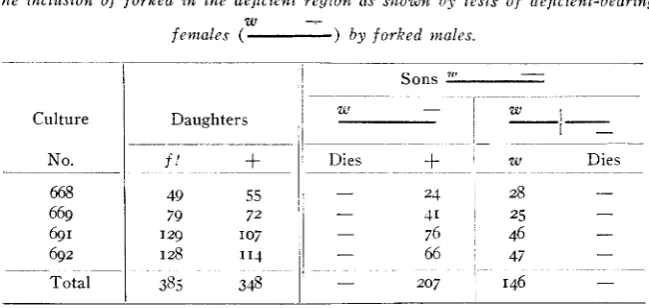
X, by forked, by rudimentary, and by fused, these being the recessive mutants with loci closest to bar (see map p. 457). The expected result was obtained with forked. Females heterozygous for deficiency, when outcrossed to forked males, gave half of their daughters forked, though these daughters were only heterozygous for forked ! These forked daughters were derived from that half of the eggs which retained the deficient X, as was proved by the lethal result, as well as by the linkage relations shown by these forked females when they were bred (tables
4-8). This evidence shows that the mutation which removed the gene
f o r bar and the vital allelomorphs, involved not simply these genes but also the normal genes of a section of the chromosome extensive enough to include the locus for forked.
THE M A X I M U M A N D T H E M I N I M U M L E N G T H S O F THE D E F I C I E N T REGION AS MEASURED BY T H E H A P L O I D TESTS W I T H THE RECESSIVES
I n the case of the other recessives (rudimentary and fused) the result obtained with forked did not occur (tables 4 and 5, appendix), which shows that the maximum length of the deficient region is the interval be-
4 Since the results expected from complete inactivation are practically indistinguish- able from those due to physical loss, consideration o'f the inactivation alternative will be deferred to a special section.
450 CALVIN B. BRIDGES
TABLE 3
T h e inclusion o f f o r k e d in the deficient region a s shown b y tests of deficient-bearing
-
W
f e m a l e s ( ) b y f o r k e d males.
Culture No.
668
669
6 9 1 6 9 2
Total
~
Daughters
tween and exclusive of these two recessives, which are the nearest unaf- fected characters on either side. This maximum length is about 4.4 units. These same tests together with the data from the origin of de- ficiency show that the minimum length is the interval between and in- cluding forked and bar (about half a unit). The test with fused, which lies nearer the end of the chromosome than forked and bar (see map p. 457), brought out another significant point, namely, that the deficient
X had not lost the entire end of the chromosome, but rather was deficient for a section near the end, leaving the genetic materials unchanged be- yond this region. By crossing over between the deficient region and fused, females have been obtained in which the deficient X carries fused in the normal piece beyond the deficient region (table 6, appendix).
T H E ABSENCE O F CROSSING OVER W I T H I N T H E D E F I C I E N T REGION
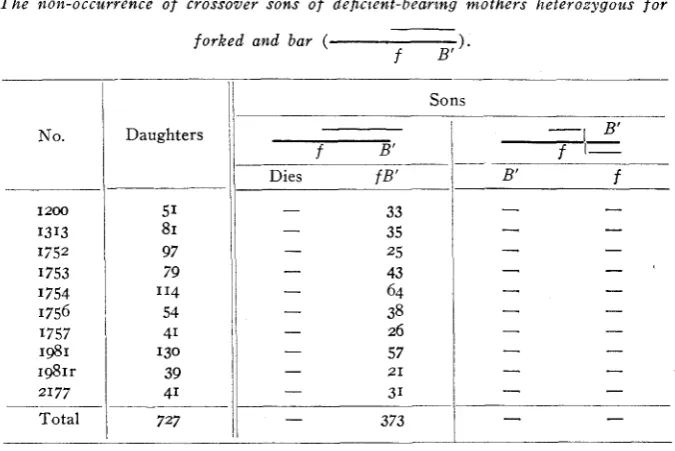
I t seemed probable that the lethal effect of deficiency was not simply due to the deficiency for forked and bar, but rather that the deficiency had affected all the loci between forked and bar, including one or more whose normal action was essential to the life of the fly. In general it is to be anticipated that cases of deficiency should act as lethals, since it seems probable that any very extensive piece includes a locus vital to the animal. Very small deficiencies might conceivably fail to include such :L vital locus, and it was thought that such smaller sections of the forked- bar deficiency might be obtained by crossing over in a female carrying forked-bar deficiency in one X and forked and bar in the other X. In an effort to test this possibility 1716
males were raised, but these did not show any crossovers (table 14, ap- - 1 U'
pendix). Either all crossover males died because of having a lethal fragment of the deficient region, o r there were no crossovers to live o r die. I n testing this question an experiment (table 9, appendix) was de- vised so that the crossovers among the females could be detected, there being n o question that the crossover females would live. There were raised 3138 such females and not one of them was a crossover! I n this number of females 16 were expected to be crossovers. It is evident that crossing over in the deficient region is abnormally low, if indeed there is any crossing over whatever in this region. This disappearance of crossing over from the deficient region is practically proof that the entire region was involved, a section between and including forked and bar and certain vital genes.
T H E E X T E N T O F THE D E F I C I E N T REGION MEASURED BY L I N K A G E
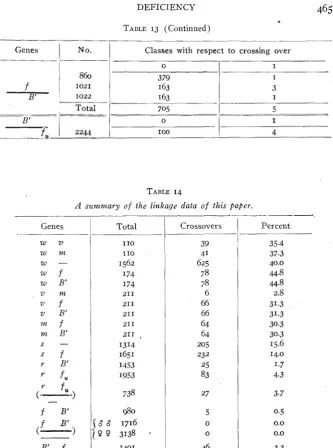
It was found that crossing over in other parts of the deficient X was of approximately normal frequency (table 14, appendix), and this fact made it possible to find out more nearly the maximum length of the deficient region. The elimination of genes and of crossing over from the deficient region results in a shortening of the genetic chromosome by an amount equal to the length of the deficient region. How much closer together have rudimentary and fused been brought by the occur- rence of deficiency? Normally there is 4.4 percent of crossing over be- tween rudimentary and fused. When deficiency was present there was a drop of 0.7 unit in this value (table IO, 9 9 , and table 14). This drop of
0.7
unit is in agreement with the previous data which showed that the minimum length of the deficient region is0.5
unit. Evidently, how- ever, the deficient region does not extend much beyond the forked-bar section.THE D O M I N A N C E RELATIONS O F BAR A N D T H E N A T U R E O F THE BAR-DEFI- C I E N T M U T A T I O N
The mutative process, of which the first detected effect was ( I ) the loss of the dominant bar gene, involved also ( 2 ) the loss of the normal allelomorph of the recessive mutation forked, whose locus is about halt a unit distant from that of bar, and (3) the loss of certain vital allelo- morphs, which, from the linkage relations probably occupied the section between forked and bar; and (4) the disappearance of crossing over from this same region, due presumably to the loss of the physical frame- work of the chromosome. All of these four distinct but correlated effects can therefore be met and explained by the single hypothesis of the physi-
CALVIN B. BRIDGES 452
cal loss of a definite section of chromosome which has been measured by two genetic methods. I t seems unreasonable that one of these effects should be due to a cause different from that of the others but initiated a t the same time, as, for example, that the apparent loss of the bar gene
(a’)
should have been in reality due to a remutation to its original wild- type allelomorph ( b ’ ) , a process which will in nowise account for the other observed changes which had their origin in the same region at the same time.I t will be recalled that the eye shape of the normal heterozygous bar
female
(
8.I>
is an intermediate between the narrow bar of thehomozygote and the round eye of the wild female. I t was found (table
7, appendix) that the female carrying bar in one X and bar-deficiency in was in somatic appearance like the normal bar the other
heterozygote and not like the homozygous bar female. The fact that the bar male with its one X chromosome carrying a single bar gene has an eye practically as narrow as that of the homozygous bar female, shows that one bar gene is sufficient t o produce a fully narrow eye. That the
.bar gene of the - female does not make her eye fully narrow
must be due to some opposing action tending to broaden the eye. Since the other X is deficient for the bar locus this broadening action must be
due to genes outside of the bar locus.
female there are two sets of such broadening genes but only one nar- rowing gene ( B ‘ ) , while in the narrow-eyed homozygous bar female there are two narrowing genes. The narrowness of the eye of the bar male can be ascribed to its having the same ratio of narrowing action
( I B’ gene: I set of broadening genes) as has the narrow-eyed homozy-
gous female ( 2 B’ genes: 2 sets o f broadening genes). Likewise the broadness of the normal heterozygous bar female is not due to the action of the b‘ gene, as formerly supposed, but is due to the half ratio of nar- rowing to broadening genes ( I B’ gene : 2 sets of broadening genes).
females owed their
broadness to being in reality -” females, due to the occurrence
- I I - 6.‘
)
somewhere in the ancestry,of a crossover
is met by the evidence that in the ancestry opportunity to become such a crossover had been open to but a single female, and that she should be
(
TJ
1
B’
-
In the broad-eyed
h
~
The suggestion that the broad-eyed
B’
B f
-
such a crossover is incredible in view of the fact that in an experiment to test the amount of crossing over in the deficient region not one female in a total of over three thousand had proved to be a crossover.
The mutation responsible for deficiency may not have been, as so far assumed, the physical loss of a section of the chromosome; it may have been some kind of “inactivation,” such as an internal rearrangement with change of properties, the loss of essential materials, or the addition of inhibiting agents. If inactivation is the explanation of deficiency then it must be complete inactivation; for in every case in which characteristics have disappeared, they have disappeared entirely. Thus, for example, the dominant bar gene retains no trace of its narrowing effect: the eye is wholly round, and the eye of of a heterozygous female
- female is no narrower than that of the regular heterozy- the
gote. In favor of the inactivation view may be cited the striking an- alogy with the Y chromosome: the Y, while cytologically of the same nature as other chromosomes, is genetically of little significance, as is proved by the fact that the effect of sex-linked genes in the male is in no case altered by anything in the Y, by the fact that the supernumerary Y’s obtained through non-disjunction are without effect upon the visible characters, and by the lethal effect,-a fly having one or two Y’s
but no X being unable to live. Furthermore, there is no crossing over between Y and X even when the Y is in a female (XXY) in which there is certainly synapsis between Y and X and in which the occurrence of crossing over between the other chromosomes shows that the failure of crossing over in the case of the Y is due to a peculiarity of the Y it- self. Since the Y offers a case of a chromosome inactive with respect to both the genetic materials and the framework, it becomes possible to sup- pose that the case of deficiency is an example of the same process that has produced the inactivation of the Y. That a piece of the Y chrom- osome has actually been substituted for the corresponding piece of the
X seems impossible because such a substitution would involve three very improbable occurrences, viz., ( I ) crossing over in the male, ( 2 ) crossing over of the Y chromosome, and ( 3 ) a double crossover embracing a section only about a half unit long, while the shortest section in which a double crossover is known to have occurred is 13.5 units long.
On the other hand, the “loss” view offers a more comprehensible so- lution f o r the fact that character genes different in nature but adjacent in position were affected by the one mutative change, and also for the fact that this one mutation affected, at the same time, the crossing over,
~
(
6 ’ )B’
CALVIN B. BRIDGES
454
which seems to depend upon the framework of the chromosome rather than upon the character genes. As evidence that pieces may be lost bodily from chromosomes and that fragments may join together, there may be offered two distinct cases of “duplication” (unpublished), a phenomenon, the explanation of which seems to be that a section taken from the mid-region of one X has become attached to the end of the other X, its mate. The mid-region of the latter chromosome is repre- sented twice, once in the normal location and again a t the end. I t seems probable that the first X, from which the duplicating fragment was taken Lodily, would show the characteristics of deficiency, though in the two cases of duplication there was no evidence as to the fate of these terminal sections.
I t seemed that a cytological examination might definitely settle this question, for on the loss view of deficiency the chromosome should be visibly shorter by an amount corresponding to the section lost. If the lost section were long enough, a difference in length between the two
X’s of a female having one deficient X should be observable. As stated in the beginning, the stock of deficiency was lost before the examination could be made. Several new cases which are possibly deficiencies in various parts of the X and even in other chromosomes have arisen, and it is hoped that combined cytological and genetic studies of these cases will make the subject clearer.
DEFICIENCY A N D T H E “PRESENCE A N D ABSENCE” HYPOTHESIS
By following up the clue that a certain observed change might be due to the loss of a section of chromosome, we have been able to demonstrate
i
I i
Z I’ t
-
B-+
--
B-+-
Round Half narrow Narrow
Now, it should make no difference whether this inhibitor were lost by a special loss involving only the inhibitor or whether it were lost because of being situated in a particular section which itself became lost. I n other words, the chromosome which is deficient for the region carrying the inhibitor should allow the occurrence of the same narrowing effect that is allowed by the simple loss of the inhibitor. In point of fact, the deficiency of the region in which the inhibitor must be hypothecated does not produce an effect like that of the mutation responsible for bar. For, the female carrying one deficient X and one normal X shows no narrow- ing of the eye shape, and likewise the female carrying one deficient“ X and one bar X is no narrower in eye shape than a normal heterozygous bar. Thus, in the only case which has a direct bearing on the presence and absence hypothesis, it is seen that the expedient of the loss of in- hibitors to explain the origin of a dominant mutation is of no avail.
If, however, the appearance of the bar character were due to the creation of a new presence, then of course the loss of this presence by deficiency should restore the original condition ; but that advocates of “presence and absence’’ have little liking for this type of explanation of the origin of a dominant is evident from the lengths they go in some recent expositions to avoid the vexed question of the origin of presences.
D E F I C I E N C Y A N D S E X D I F F E R E N T I A T I O N
With non-disjunction the proof was complete that two X chromo- somes determine a female and one a male. However, it has been sus- pected that the determiner of sex is not the “X-as-a-whole,” but that in some definite part or parts of the X there are specific sex-differentiators. The case of deficiency favors this view; for, an X X individual having one deficient X is a f e m l e , normal in appearance and function. T wo intact X’s are not necessary for the production of a female; that is, sex- production is a function of some particular part of the X rather than of the X as a whole. Sex-differentiation was not affected by the occurrence of deficiency because the diff erentiators are in some region of the X other than the section from forked to bar.
THE REALITY O F THE CHROMOSOME M A P S
From the evidence of non-disjunction we know that the genes for the By means of sex-linked characters are parts of ‘the X chromosome.
CALVIN B. BRIDGES
linkage studies we have been able to construct maps of the location of these sex-linked genes in a linear order which we believe to correspond to the linear structure of the chromosome. I t has been objected that these maps may be only expressions of some “force” and that they do not cor- respond to an actual localization of genes along the chromosome. De- ficiency furnishes the first direct evidence that the maps do correspond to a real localization of genes along the chromosome. That a single dis- turbing cause-the deficiency mutation-should exert a selective effect upon a certain few genes-bar, forked, vital allelomorphs-while leav- ing numerous other genes unaffected must be due to the possession by the few of a similarity either of properties or of location unshared by other genes. Nothing of the known properties of the dominant bar eye shape, the recessive forked bristle modification, ancl of the vital allelo- morphs, are unique or suggest marked similarity to each other or dis- similarity between them and ofher sex-linked genes.
t 12 e 1 oca ti0 1 1 , 11 uwezv Y , t herr is i i 1 dep r i z d r i z t a I i if co i i cl itsisle ei i d r i i ce f Y O PIC the liiikage that these yeizrs constitute a definitely localized aiid i ~ i c a s i u - able sectioii uf the
X
cIzromusonze. The deficiency mutation was dis- covered because of its effect upon a single gene, viz., bar. It was then found to have affected at the same time one or more vital allelomorphs. When these vital allelomorphs are mapped according to the linkage shown, they are seen to occupy the region adjacent to bar. The argu- ment from the location of forked within the deficient region is still stronger, for this location was detected and proved as the result of a deliberate search among those genes which had prcTioiisly bcrrz mapped closest to bar! Nor does the evidence stop here, for not only did the deficiency mutation affect a section of adjacent genes but it also removed the crossing over from a definite section of chromosome. Now when the section from which the crossing over has been removed is compared upon the map with the section in which the genes are affected the two are seen to be identical. F or a definite section of genes an identity has been established between the map and an actual distribution o f genes. 456A P P E N D I X
The sex-linked mutants referred to in this paper are: white eye color
forked bristles
(f)
; bar eye shape ( B ' ) ; fused venation(tu)
; and de- ficiency for the region between and including forked and bar (-). Flies whbch show no mutant characters are said to be wild-type (+). The symbols included in parentheses do double duty, both to represent the genes for the mutants, and to tell the somatic appearance of flies (table headings, etc.) ; the small letters represent recessive mutants, and the primed capitals dominant mutants. The localization of these genes along the X chromosome as calculated from the linkage relations is given by the accompanying map5 in which one unit of distance is one percent of total crossing over.w , we
V
m
S
r
f
B'
fu
The two X chromosomes of the
1.1
33.0 36. I
. 55.1 56.5
. 57.0 - 59.5
nale are represented by two paral- lel lines with symbols showing the relative positions of the mutant genes
involved ( w
),
o r more often by a single line, in which case thespace above the line with its symbols represents one X and the space be- low, the other X
("
The chromosome which has the mu-tant gene farthest to the left of those involved in the cross is arbitrarily
).
5 From MORGAN and BRIDGES 1916, Carnegie Institution of Washington publication
237.
CALVIN B. BRIDGES
458
is a contraction of I
represented in the top space. T h e symbol we I
we we V w e v
B-k-B-+
,
and denotes that,by crossing over in a female which carries eosin in one X and ver- milion in the other, the two eggs, eosin vermilion and wild-type, are produced. The zygote arising from the egg represented by the upper space is always written in the column to the left in the double column beneath the crossover symbol ; likewise the column to the right corre- sponds to the egg of the lower space. By following this convention, we may often omit from the tables the individual headings of the two in- cluded columns (e.g., see table I I ). I n place of the crossover symbol, it
is often advantageous to use the “crossover formula” as in table 13. Thus, in the first case in table 13,
(@
zrmfs,)
, the “0” represents thesum of the flies that came from the two non-crossover gametes, eosin forked and vermilion miniature bar ; the “ I ” represents the single cross-
overs between eosin and vermilion, that is, in the “first crossing over region”; the “ I , 3 double crossovers” represent the flies resulting from
V
the gametes we vm
i,;
etc.TABLE 4
T h e non-inclusion of rudimentary i n the deficient region a s s h o w n by t h e tests o f
deficient-bearing fcniales b y rudimentary ntales.
we -
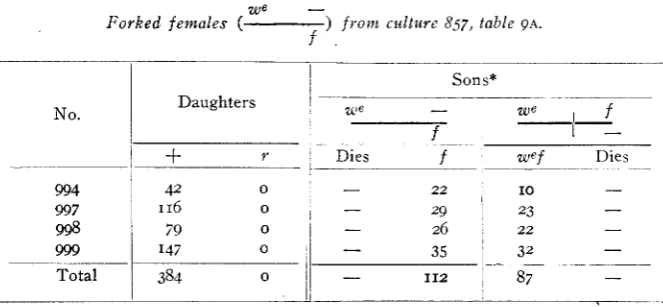
Forked f e m a l e s ( ) f r o m culture 857, table 9.4.
f
I
I Sons*994
997
998
999
Total
-
42 0
I 16 0
79 0
I47 0
384 0 - I 1 2
IO
23
32
22
__ -
87
*When females are heterozygous for deficiency and for forked, crossing over in the deficient region (if it occurs) should give the two contrary classes, non-forked sons and forked sons (
I-).
These sons should live only if they escaped retaining a lethal fragment of the deficient origin. The observed total lack-
-of any non-forked sons among the -offspring is then additional evidence that no cross- overs occur, or that these crossovers die. However, the forked crossovers would not be distinguished from the forked non-crossovers, and therefore this sort of evidence is equivalent only to a half amount as compared with the data of tables 6 and 8. Accordingly, in table 14, the data from males on crossing over in the deficient region includes all the males of tables 6 and 8, but only half the males of tables 4, 5, 7, 9, and g A.
No.
________
988 989
9 9 1
993 Total
Sons
w e - W e -1- f
Daughters
I
-f
+
f , Dies f w e f DiesI 18 0 37 I3
71 0
206 0 50 44
175 0 40 27
570 0 - I54 IO0
-
-
16 -
27
-
-
-
-
-
-
GENETICS 2: S 1917
~ N O . _ _9 9
I755 I34
2176 30
Total 164
-_____
$ $ *
'
Dies -=?
fB'f,'-
I 1
-
2
-
-CALVIN B. BRIDGES 460
TARLE 7
T e s t s of the relation between deficiency and bar hy outcrossing deficient-bearing f e - males ( f r o m culture 668, table 3 ) to bar males.
~-
No.
1
P O
TABLE 8
T h e non-occurrence of crossover sons of deficient-bearing mothers heterozygous f o r
forked and bar ( ).
f B'
No.
Total
Daughters
51 SI 97 79
1 I4
54
41
130
39
41
I/
Sonsf B'
727
/I
- 373B'
-
-
f I-
B' f
461
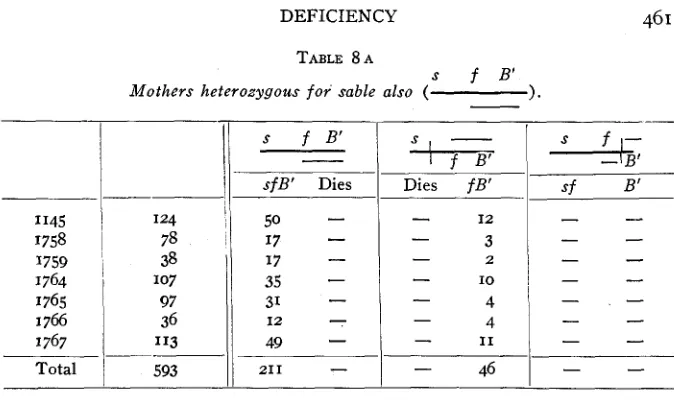
TABLE 8~
s f B’
Mothers heterozygous f o r sable also ( 1.
TABLE 9
T h e non-occurrence of crossover daughters when deficient-bearing mothers heterozy-
-
gous f o r bar ( ) were backcrossed t o f o r k e d males.
B’ No. 2222 2223 2224 2234* 2235 2236 2238 2239 2240 2241 2246 2260 2261 2264 2265 2286 2290 2316 2320 Total _ _ _ _ Daughters B‘
f
77 69 60 75 77 51 51 68 82 54 77 85 42 86 62 48 93 79 B‘ 90 66 64 64 81 50 71 53 61 59 70 82 32 73 90 49 127 IO6 -37 70 273 I358
4
f B ’
+
Sons
B’
Dies B’ B’
+
462 CALVIN B. BRIDGES
TABLE Q A
we
-
B’
Mothers heterozygous f o r eosin also (
>.
-. -
I
857 ~ fk 83
858 108 121
859* 60 75 Total I I 228 279
- -~
* I n each of the cultures 2234 and 859 a sterile forked male (XO) appeared, due to primary non-disjunction.
TABLE IO
T h e crossing over in deficient-bearing females heterozygous f o r rudimentary and
r f ,
fused (
>.
No.
I775 I778 I779 1905
1 6
2106
2107 2175 Total
- -
Daughters
rftk -
I7 &J
4 3 8 9
27 51 45 66 38 59
21 37
18 37 15 21 21 26 245 4%
q=-
fu-
! - - - f l L
0 2
I I
3 I
2 3
I 3
I I
0 2
2 0
I 3
11 16
___. ~
463
Y f u
-
393
r Dies
of table IO. But when a lethal also is present (as in the case of the males of table
IO), the lethal kills one of each pair of contrary classes and hence certain classes are
relatively too low (as, in table IO, the non-crossover class rudimentary fused and the
“2” crossover class rudimentary), while certain other classes are relatively too high (as the “I” crossover class fused). That the males of table IO are in agreement with
the females is evident after a correction has been made f o r the disturbance due t o the unbalanced non-viability. The females of table IO gave the intterval between
rudimentary and fused as 3.7 units, instead of the normal 4.4, a decrease of .7 unit due to the deficient region. T h e percentage expectation f o r the males on this basis (the distance from rudimentary to the deficient region = 1.4, the length of the defi- cient region = .7 unit, and deficiency to fused = 2.3) is “0” = 96.3, “I” = 1.4, and
2 = 2.3. These percentages become “o” = 94.24 “I” = 3.11, and “2” = 2.65 if 4
percent of the rudimentary and 88 percent of the fused zygotes hatch. The observed percentages are “0” = 94.24, “I” = 3.12, and “2” = 2.64. The assumed percentages of viability of rudimentary and of fused are in agreement with the results of other
experiments in which these mutants are involved. TABLE 11
T h e linkage of white and deficiency.
‘ I , f
s
-
s
34 39 34 39 41 52 73 73
29‘ 20
238 249 27 26 No.
s
--1-
I
f s f +
5 8
5 7
6 9
8 11
8 I4
5 3
37 52 Total
-
Daughters
11
I66123
264
216 58 827
W
1-
I -
No.
I 024
1025 1026 1m1* 1242
I244
Total 867
goo
975
I I20
Total
TABLE 12
T h e linkage of sable and deficiency.
S
females backcrossed to sable f o r k e d males.
363
Sons S
S Dies Dies
+
* I n culture 1201 a sterile sable forked male
disjunction.
464 CALVIN 3. BRIDGES
_____-
- Genes _ - - ~No. ~
we
-
f862
8 6 K
863 864
v m B'
~ _ _ - _
- ~
__
--w
f
I-=--
4--
-__ v m B'-i
-
f
________ - __I_
Classes with respect to crossing over
I j 2 / 3 1 3 1 2 3
-
P
0___________
i
30-2
L23_1.8
-i
-=I-!= - -____O
I
- _ _ _ - . _ _ _ _ . _ _ - _ _ _ _- ~ - - _ _ _ _ _ _ _ _ - 6 8 1
-2
I
45
II_
I __
7-
0 __ 42 _____ ~ _ _ _ _ _ _ ~ ~ _ _- _ _ _ _ _ _ - _ - _ _ _ -~ 0 ~ 27,
I0222 18
I 9
~
865 ~ 123
866 92
80
868 I
8 7 1 75
872 131
'5 1 9 9 7 27
i
873
1
77885 44
267 1419
I
1243 I_-l_______l______~______ --- --
1
--TTaI-'-
_I- -_ I _ _ _ _ _________;- - ~
r 0
39 232 I _ - ____ _ - - _ _ --- --- r
f#
B' -_ -- 8I 2
2
3
l
2243
,
662245 1 24 I ~
2262
1
15 I ~ 02267
1
192 03
I
7
5 5
2289 131 2
2291 132 I 3
2317 1 1 2 3 I
2318 157 4 5
I
I
2287 X I A
I
3 42 _ _ _ _ ~ - _ ~
____
I__
-2352 85 94
1 :
222319
- _ _ Total ._ I233
I
I _ _ _ ~-~ -________ ___ ~ _ _ --__ _ -- -___________
0 I
- __ __ _ ~ _ _ - - __-
1174 49 0
1 I75 20 0
1207 I IO 3
91 5
Y
1
::
I
I O 11281
1
I 06I282 47
fa
3 3
TABLE 13 (Continued) Genes
1
No.,
I O 2 1f
~B‘ I022
______
~ ~- ~
Total
B’ 1
fi
I
2244Classes with respect to crossing over
0 I
-
379 I
163 3
163
705 5
I O 0 4
I ~-
_ _ _ _ _ _ ~-
-_ -_ -_ -_ -_ -_ -_ -_ -_ ~ _ _ _ _ _ _ ~
I
-
0
Genes ~ Total
._ _______
w v I I O
GENETICS 2: S 1917
Crossovers Percent
I 35.4
39
w nc I I O I 41
625
w f I 78
2c, B’ I I74 78
6 66 66 64 64
a f 21 I
v B‘ 211
9% f 211
nz B’ 211 ,
20.5
s f 232
~
v m 211
I 25
1 738 27
f B’ ( 8 8 1716 0
(- 1 0 0 3138
.
0B’ f u 1401 46
i
83r B’ I453
fu I953
(---. f,
-
f B’ 980 5
.__I-
-37.3 40.0 44.8 44.8
2.6
31.3 31.3 30.3 30.3 15.6 14.0 1.7 4.3 3.7
0.5
0.0 0.0