Type of the Paper (Article, Review, Communication, etc.)
1
Exploring Basic Components Effect on the Catalytic
2
Efficiency of Chevron-Phillips Catalyst in Ethylene
3
Trimerization
4
Ebtehal Naji-Rad,1 Martí Gimferrer,2 Naeimeh Bahri-Laleh,1,* Mehdi Nekoomanesh-Haghighi,1
5
Roghieh Jamjah1 and Albert Poater,2,*
6
1 Polymerization Engineering Department, Iran Polymer and Petrochemical Institute (IPPI), P.O. Box
7
14965/115, Tehran, Iran; [email protected]
8
2 Institut de Química Computacional i Catàlisi, Departament de Química, Universitat de Girona, Campus de
9
Montilivi sn, 17003 Girona, Catalonia, Spain; [email protected]
10
* Correspondence: [email protected]; Tel.: +34-972418358
11
Abstract: In the present work, effect of basic components on the energy pathway of ethylene
12
oligomerization by landmark Chevron-Phillips catalyst has been explored in detail using density
13
functional theory (DFT). Studied factors were chosen considering the main components of
14
Chevron-Phillips catalyst, i.e. ligand, cocatalyst and halocarbon compounds, comprising i) the type
15
of alkyl substituents in pyrrole ligand as methyl, iso-propyl, tert-butyl, and phenyl, as well as the
16
simple hydrogen, and the electronwithdrawing fluoro and trifluoromethyl; ii) the number of Cl
17
atoms in Al-compound (as AlMe2Cl, AlMeCl2 and AlCl3) which indicates halocarbon amount and
18
iii) cocatalyst type as alkylboron, alkylaluminium, or alkylgallium. Besides main ingredients,
19
solvent effect, from toluene or methylcyclohexane, on oligomerization pathway was explored as
20
well. In this regard, the full catalytic cycles for the main product (1-hexene) formation as well as
21
side reactions, i.e. 1-butene release and chromacyclononane formation, were calculated on the basis
22
of the metallacycle based mechanism. Based on results, a modification on the Chevron-Phillips
23
catalyst system, to reach higher 1-hexene selectivity and activity, is suggested.
24
Keywords: Chevron-Phillips; chromium; trimerization; polymerization; reaction pathway
25
26
27
1. Introduction
28
29
Linear α-olefins are valuable products from petrochemical industry. They are commonly
30
used in polyethylene industry and as plasticizer alcohols, synthetic lubricants or surfactants
31
between other applications. Among all α-olefin monomers, 1-hexene attracted considerable
32
attention since superior copolymer properties are achieved using it as comonomer as
33
compared to the characteristics of 1-butene/ethylene copolymers [1]. Although 1-hexene is
34
currently mainly produced via full-range processes, catalytic selective trimerization of
35
ethylene to 1-hexene is an area of intense research activity [2,3,4]. Even though many
36
companies are interested in the topic, only the Chevron−Phillips trimerization process was
37
commercialized so far [5]. The main reasons for choosing this system over other trimerization
38
systems, such as Cr/PNP, and Cr/SNS, are the followings: 1) high activity and selectivity for
39
1-hexene production, 2) its cocatalyst, i.e. triethylaluminium (TEAL), is much cheaper than
40
the methylaluminoxane (MAO), 3) the synthesis of mono-dentate ligands is much easier and
41
cheaper than tri-dentate ones, used in Chevron-Phillips catalyst and in Cr/PNP and Cr/SNS
42
systems, respectively [6,7].
43
The Chevron-Phillips catalyst mainly consists of a Cr-containing precursor, a pyrrole ligand,
44
an Al-alkyl cocatalyst and a promoter [8]. Due to the importance of the Chevron-Phillips
45
ethylene trimerization catalyst, various experimental and theoretical studies have been
46
conducted in the recent years, which allowed us to establish some widely accepted ideas
47
[9,10]. For example, there is a compromise that catalytic cycle is accomplished via the
48
formation of metallacycle pathway in which chromium centre operates via a redox Cr(I/III)
49
metallacyclic mechanism [11]. In fact, theoretical studies of activation energies for different
50
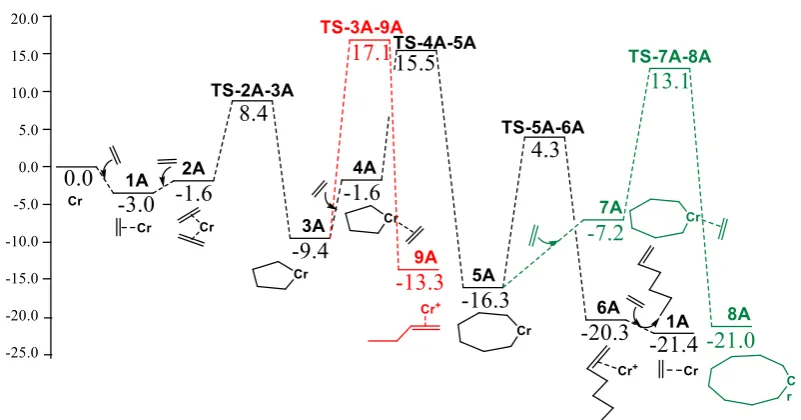
stages of trimerization process revealed that the model containing Cr (I/III) redox has lower
51
energy levels than the Cr(II/IV) species due to the more stability of the oxidation state in
52
Cr(I/III) system [12]. This finding was further supported by the experimental results from an
53
electron paramagnetic resonance (EPR) investigation on the same catalytic system [13].
54
Due to massive investigations in Chevron-Phillips catalytic system, the following precursors
55
presented the highest activity: chromium(III) 2-ethylhexanoate (Cr(EH)3) as catalyst,
56
2,5-dimethylpyrrole (2,5-DMP) as ligand, AlEt3 as cocatalyst and a modifier [6]. Studies
57
revealed that halocarbons containing two or more Cl atoms are good candidates in
58
trimerization process. However, their exact role as modifiers is still in debate.
59
Based on the mentioned catalytic precursors, the active site model, depicted in Scheme 1, is
60
considered as an active catalyst in the trimerization process [14,15]. This catalyst mainly
61
consists of a pyrrole ring coordinated to the Cr centre together with a pendant R2AlCl group
62
σ-bonded to the pyrrole ligand, via Al-N linkage, and to the Cr metal, via Cr-Cl linkage. It is
63
supposed that the R2AlCl formation is produced via the simple reaction of TEAL with
64
halocarbon promoters.
65
66
67
Scheme 1. Model catalyst A.
68
69
Despite existing proved good performance of such system, the development of improved
70
catalysts is one of the chief areas of research in this field. For this reason, in this work a
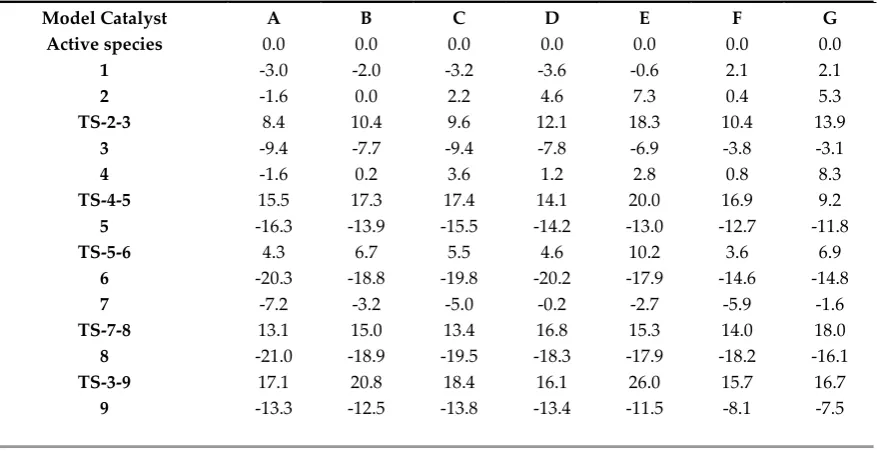
71
systematic study was done to shed light on: i) the effects of alkyl substituents in ligand
72
structure, ii) the number of Cl atoms in the Al compound, iii) the revenue of Al substitution
73
for B or Ga and iv) the solvent-type effect in the energy profile of the reaction pathway (See
74
Scheme 2). Consequently, we have suggested modifications on the Chevron-Phillips system.
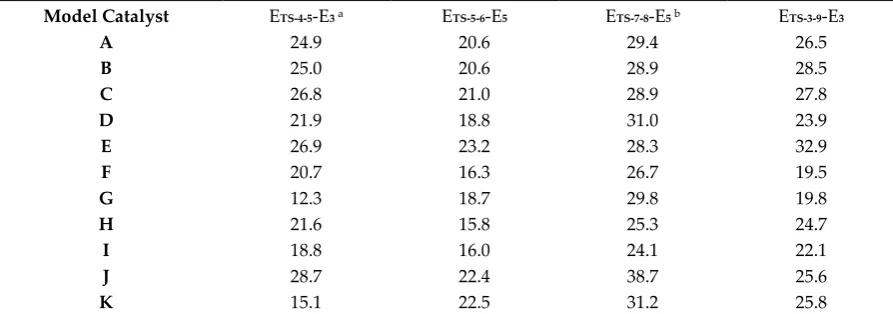
75
76
77
Scheme 2. Ethylene oligomerization catalytic cycle (the ligands on chromium centre are omitted for the
78
sake of clarity).
79
80
2. Results and Discussion
81
The mechanism of ethylene oligomerization by the Chevron-Phillips catalyst is illustrated in Scheme
83
2. In this procedure, the reaction starts with the coordination of the first and second ethylene
84
molecules into the empty site of chromium (I) (steps 1 and 2) and proceeds to the first 5-membered
85
metallacycle formation (3), via oxidative addition through the transition state TS-2-3. In this step, the
86
catalyst can undergo two different mechanisms: i) the main reaction, which consists of the
87
coordination and insertion of a third ethylene molecule (4), leading, subsequently, to the formation
88
of the 7-membered metallacycle (5). ii) the side reaction, which the elimination of 1-butene (9) occurs
89
(dimerization, red diagram in Scheme 2). The main product, 1-hexene, is formed via the opening of
90
the ring (5) and reductive elimination of 1-hexene from the rather unstable chroma cycloheptane
91
(trimerization, black diagram in Scheme 2). Another side reaction also can occur in this pathway,
92
based on first the coordination of a fourth ethylene molecule and then its insertion to the
93
7-membered chromic cycloheptane (5) leading to the 9-membered metallacycle 8 (ethylene
94
tetramerization, green diagram in Scheme 2). Further, a two step process that leads to 3A from 2A
95
was also attempted, bearing a first H transfer, but it was omitted of the analysis since kinetically was
96
found to be much more disfavoured.
97
For the parent model system A, the energy profile we calculate in Figure 1 is very similar to that
98
calculated earlier by Liu and coworkers [12].The rate determining step (rds) turns out to be the
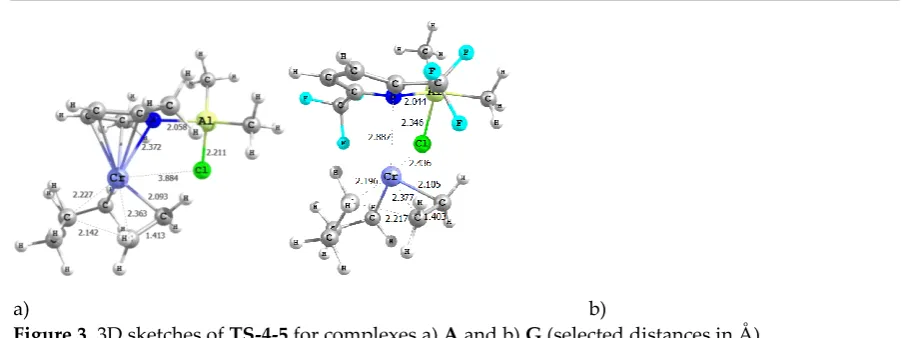
99
transition state leading to the formation of the 7-membered metallacycle 5A with an upper barrier
100
placed 24.9 kcal/mol over intermediate 3A, which is slightly more disfavoured with respect to
101
previous results of Liu [12]. The alternative undesired reactions that lead to 8 and 9 are found to be
102
less favoured kinetically by 8.8 and 1.6 kcal/mol, respectively. For going further into details and to
103
unveil the complexity of the described reaction pathway, ten other model catalysts were tested in the
104
following sections.
105
106
107
108
Figure 1. Calculated reaction profile for model A catalyst (free energies in kcal/mol). Black and red lines
109
illustrate Gibbs free energies in solvent of ethylene tri- and dimerization, respectively, in green the alternative
110
formation of the 9-membered ring.
111
112
2. 1. Effect of alkyl substituents on the pyrrole ligand
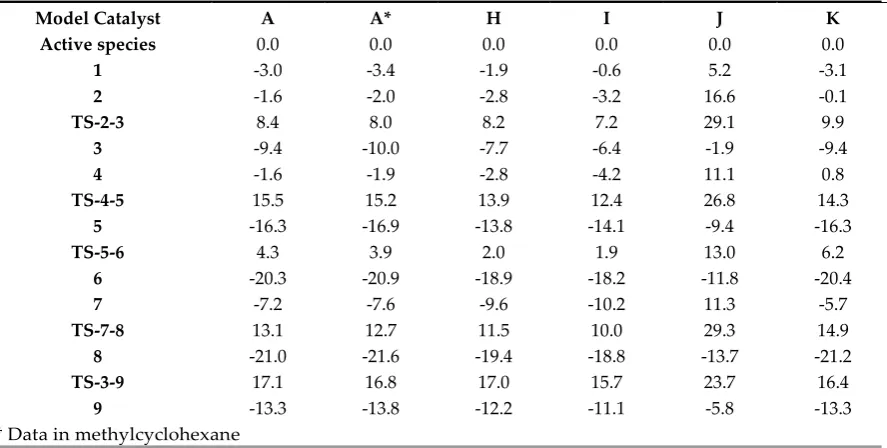
113
As a first step, the effect of the steric hindrance from dialkylpyrole type ligands on the energetic
114
profile of the reaction pathway was elucidated. For this purpose, the three different molecular
115
models B, C and D (Scheme 3), corresponding to dihydride-, diisopropyl-, and ditertbutyl-pyrrole,
116
respectively, were employed and compared to the dimethyl-pyrrole (model A). The selected models
117
differ mainly in the alkyl group of the pyrrole ligand. First, the steric hindrance of the catalysts was
118
analyzed by the SambVca2 Web application [16]. This application extracts the topographic maps
119
(Figure 2), which are simple two-dimensional isocontours representing the interaction surface, by
120
%VBur values were obtained by analyzing the steric bulk of the pyrrole ligands in the DFT
122
optimized structures of the A, B C and D model complexes. %VBur values of 63.3, 64.6, 66.8 and 69.1
123
% in B, A, C and D, respectively, highlighted an obvious difference in steric bulkiness between these
124
four complexes, with A clearly less bulky than C and much less with respect to D.
125
126
127
Scheme 3. Model catalysts (A-G) to study the steric and electronic effects of alkyl substituents on the
128
pyrrole ligand.
129
130
a) b)
131
Figure 2. Topographic steric maps of the pyrrole ligands (plane xy) for the optimized complexes a) A and b) D.
132
The Cr atom is at the origin and the centre of mass of the pyrrole is on the z axis. The isocontour curves of the
133
steric maps are given in Å.
134
135
The whole energy profile of the reaction pathway for ethylene oligomerization using model
136
catalysts B, C, and D is shown in Table 1, together with the study of the electronic effect of
137
the substituents on the pyrrole ligand, by means of model catalysts E, F, and G, bearing
138
phenyl, fluoro and trifluoromethyl groups, respectively.
139
140
Table 1. Relative Gibbs free energies in toluene for models A-G of the ethylene dimerization, trimerization,
141
and the formation of the 7- and also the 9-membered ring. All energies are in kcal/mol.
142
Model Catalyst A B C D E F G
Active species 0.0 0.0 0.0 0.0 0.0 0.0 0.0
1 -3.0 -2.0 -3.2 -3.6 -0.6 2.1 2.1
2 -1.6 0.0 2.2 4.6 7.3 0.4 5.3
TS-2-3 8.4 10.4 9.6 12.1 18.3 10.4 13.9
3 -9.4 -7.7 -9.4 -7.8 -6.9 -3.8 -3.1
4 -1.6 0.2 3.6 1.2 2.8 0.8 8.3
TS-4-5 15.5 17.3 17.4 14.1 20.0 16.9 9.2
5 -16.3 -13.9 -15.5 -14.2 -13.0 -12.7 -11.8
TS-5-6 4.3 6.7 5.5 4.6 10.2 3.6 6.9
6 -20.3 -18.8 -19.8 -20.2 -17.9 -14.6 -14.8
7 -7.2 -3.2 -5.0 -0.2 -2.7 -5.9 -1.6
TS-7-8 13.1 15.0 13.4 16.8 15.3 14.0 18.0
8 -21.0 -18.9 -19.5 -18.3 -17.9 -18.2 -16.1
TS-3-9 17.1 20.8 18.4 16.1 26.0 15.7 16.7
9 -13.3 -12.5 -13.8 -13.4 -11.5 -8.1 -7.5
143
For a direct comparison, the energy barriers of competitive mechanisms (dimerization versus
145
the third ethylene insertion and trimerization versus the fourth ethylene insertion) are
146
reported in Table 2. It is worth mentioning that the formation of chromocycloheptane and
147
chromocyclononane are the key steps to understand the 1-hexene selectivity using the mostly
148
accepted metallacycle based mechanism proposed by Briggs for ethylene oligomerization
149
[17,18]. The coordination of the first ethylene to the active centre was slightly exergonic by an
150
average of 2.0-3.0 kcal/mol in all active systems, except for fluoro containing models F and G.
151
Its explanation comes from the electron-withdrawing character of the fluorides and the
152
trifluoromethyl groups on the pyrrole ligand, which reduces the nucleophilic capacity of the
153
chromium centre [19].
154
When increasing the steric hindrance from A to D, the second monomer coordination became
155
disfavoured. The formation of the 5-membered chromocyclopentane required to overcome
156
energy barriers of 11.4 and 15.7 kcal/mol (TS-2-3) for catalysts A and D, respectively. The
157
stable chromocyclopentane 3, showed low tendency towards β-H transfer to Cr, i.e. red
158
mechanism in Scheme 1. As a result, the formation of 1-butene from intermediate 3 required
159
conquering an effective barrier of 26.5 kcal/mol for A whereas 23.9 kcal/mol for D model
160
catalysts. Thus, this step is unaffected by the sterical hindrance of the sterically demanding
161
tertbutyl groups of the latter system, which indeed even help to decrease the energy barrier.
162
The insertion of the third ethylene that leads to the chromocycloheptane 5, required only
163
24.9, 25.0, 26.8, 21.9, and 26.9 kcal/mol, for the series of A-E model catalysts, respectively,
164
which means that the insertion of the third monomer somehow anticipated the
165
chromocycloheptane opening. The bad performance of system E is attributed to the aromatic
166
delocalization of the phenyls with the pyrrole ring. On the electronic point of view, fluoro
167
containing electron-withdrawing groups reduce the kinetic cost to reach 5 by 4.8 and 12.6
168
kcal/mol comparing B with F, and A with G, respectively.
169
170
171
a) b)
172
Figure 3. 3D sketches of TS-4-5 for complexes a) A and b) G (selected distances in Å).
173
174
In the following, the chromocycloheptane 5 required energy barriers of 20.6, 20.6, 21.0, 18.8,
175
and 23.2 kcal/mol (TS-5-6) in A-E model catalysts, respectively, to release 1-hexene product.
176
Thus, at least 5 kcal/mol lower in energy than the barrier defined by the previous TS-4-5.
177
However, for the occurrence of second side reaction, i.e. insertion of a forth ethylene moiety
178
into 5, a barrier at least 5.1 kcal/mol higher in energy (TS-7-8) should be overcome. This fact
179
makes the latter side reaction not affordable. The lowest preference for the formation
180
9-membered metallacycle 8 is hold by system D, for which this process is kinetically
181
disfavoured by 12.2 kcal/mol. It was deduced from reported energy results that: by moving
182
from dimethyl- to diisoproply- and ditertbutyl-pyrrole ligand, the selectivity toward
183
1-hexene formation increased. This was in line with experimental results for similar
184
catalysts.6,20,21 The fluorinated systems F and G increase the preference for the generation of
185
1-hexene, with a lower kinetic cost for TS-5-6 of 2.1 and 2.3 kcal/mol, respectively. Even
186
though results for model G are more promising than for the catalysts A-F series, actually,
187
with the five-membered ring ligand completely dissociated from chromium (see Figure 3),
189
which leads to the decomposition of the catalytic center afterwards, behaving potentially as a
190
nanoparticle, partially stabilized by the chloride atom of the Al(Me)2Cl moiety. The
191
electronwithdrawing character of the trifluoromethyl group is thus clearly competitive with
192
the chromium affinity for the electron density of the five-membered ring.
193
194
Table 2. Effect of substituents and metal (B, Al, Ga) of the pyrrole ligand on the dimerization and trimerization
195
energies, and 7- and 9-membered ring formation energies. All energies are in kcal/mol.
196
Model Catalyst ETS-4-5-E3 a ETS-5-6-E5 ETS-7-8-E5 b ETS-3-9-E3
A 24.9 20.6 29.4 26.5
B 25.0 20.6 28.9 28.5
C 26.8 21.0 28.9 27.8
D 21.9 18.8 31.0 23.9
E 26.9 23.2 28.3 32.9
F 20.7 16.3 26.7 19.5
G 12.3 18.7 29.8 19.8
H 21.6 15.8 25.3 24.7
I 18.8 16.0 24.1 22.1
J 28.7 22.4 38.7 25.6
K 15.1 22.5 31.2 25.8
aChromocycloheptane ring formation, bChromocyclononane ring formation
197
198
199
2.2. Effect of the number of Cl atoms in Al compound
200
In the catalyst active centre, the Al compound is represented in the expected active form of AlEt2Cl,
201
although this Al based cocatalyst is usually charged to the reactor as AlEt3 precursor.6,8 It seems that
202
the Cl-Et exchange occurs, during the catalyst activation, between AlEt3 and either halocarbon
203
promoter or catalyst precursor. Here, we assumed that at higher halocarbon/catalyst ratios, AlMeCl2
204
and AlCl3 could also be formed. As a result of such assumption, the catalytic system can be
205
represented as Scheme 4.
206
207
208
Scheme 4. Illustration of model catalysts (H-K).
209
210
In this section, ethylene oligomerization cycle via these catalysts was explored. Table 3 shows the
211
Gibbs energies of the reaction pathway of ethylene oligomerization catalyzed by the model catalysts
212
H and I with respect to A. Since the energy trend in the ethylene oligomerization was nearly the
213
same as studied catalysts (A-E), here, for simplicity, we focus the analysis only on the energy barrier
214
Table 3. Relative Gibbs free energies in toluene for the models H-K, with model A for comparison, for the
216
ethylene dimerization, trimerization, and formation of the 7- and also the 9-membered ring. All energies are in
217
kcal/mol.
218
Model Catalyst A A* H I J K
Active species 0.0 0.0 0.0 0.0 0.0 0.0
1 -3.0 -3.4 -1.9 -0.6 5.2 -3.1
2 -1.6 -2.0 -2.8 -3.2 16.6 -0.1
TS-2-3 8.4 8.0 8.2 7.2 29.1 9.9
3 -9.4 -10.0 -7.7 -6.4 -1.9 -9.4
4 -1.6 -1.9 -2.8 -4.2 11.1 0.8
TS-4-5 15.5 15.2 13.9 12.4 26.8 14.3
5 -16.3 -16.9 -13.8 -14.1 -9.4 -16.3
TS-5-6 4.3 3.9 2.0 1.9 13.0 6.2
6 -20.3 -20.9 -18.9 -18.2 -11.8 -20.4
7 -7.2 -7.6 -9.6 -10.2 11.3 -5.7
TS-7-8 13.1 12.7 11.5 10.0 29.3 14.9
8 -21.0 -21.6 -19.4 -18.8 -13.7 -21.2
TS-3-9 17.1 16.8 17.0 15.7 23.7 16.4
9 -13.3 -13.8 -12.2 -11.1 -5.8 -13.3
* Data in methylcyclohexane
219
220
As seen vide supra, the chromocyclopentane 3 could either undergo dimerization, with the
221
release of the 1-butene side product, or face the third ethylene coordination to yield
222
chromocycloheptane, 5. Elimination of the 1-butene side product would cost 26.5, 24.7, and
223
22.1 kcal/mol in studied catalysts A, H, and I, respectively, while consecutive coordination of
224
the third ethylene molecule, which leads to 5, needed to overcome a much lower energy
225
barriers of 21.6 and 18.8 kcal/mol for models H and I, respectively, to be compared with 24.9
226
kcal/mol for A. Further, Liu and coworkers stated that apart from the b-H elimination, the
227
subsequent reduction elimination was even more expensive kinetically [12]. Thus, the energy
228
results here clearly indicated that the third ethylene insertion represented a favourable
229
reaction for all systems, especially for the catalysts with the higher Cl content i.e. H and I
230
model systems.
231
Similarly, chromocycloheptanes 5 could undergo trimerization with the release of the main
232
product 1-hexene or subsequent insertion of an ethylene moiety to yield chromocyclononane
233
8. 1-hexene could be released from 5, throughout direct reductive elimination with energy
234
barriers of 15.8 and 16.0 kcal/mol (TS5-6) for models H and I, respectively, thus again the
235
addition of chlorides on the aluminium center facilitates the reaction since for A this barrier is
236
20.6 kcal/mol. Through coordination and subsequent insertion of an ethylene molecule to 5,
237
complex 8 was formed with energy barriers of 29.4, 25.3, and 24.1 kcal/mol (TS-7-8) in
238
models A, H and I, respectively. According to our theoretical results, the 1-hexene formation
239
is more favourable for catalysts H and I with high chloride level so that the fourth ethylene
240
coordination anticipates 1-hexene release due to its lower barrier.
241
Concluding this remark, according to Table 3, by increasing the number of chlorides
242
substituted with the methyl group in the composition of the Al-compound, which indicates
243
an increase in the halocarbon/chromium molar ratio, the trimerization requires to overcome
244
lower energy barriers [14]. In other words, an increase in halocarbons leads to an increase on
245
the 1-hexene selectivity [22]. It verifies higher catalyst activity towards 1-hexene formation at
246
higher halocarbon amounts, which had already been obtained experimentally by Liu and
247
coworkers, with the best performance using 1,1,2,2-tetrachloroethane (TCE) [23].
248
249
2.3. Effect of metal type in the cocatalyst structure
250
As mentioned before, the presence of an Al-compound, provided by cocatalyst, is
251
indispensable to configure Chevron-Phillips active centre of Scheme 1. In this section, the
252
investigated. In this regard, the Al was substituted by two other elements of group III in the
254
periodic table, boron (B) and gallium (Ga), which are considered as metalloid and metal,
255
respectively. This produces the two new active catalysts models J and K, respectively (data
256
included in Tables 2 and 3). To point out that the generation of 1 from the active catalyst is
257
endergonic for system J, by 5.2 kcal/mol, because of the slightly higher stability of the sextet
258
ground multiplicity state of the latter species.
259
Comparing quantitatively the catalyst selectivity toward the 1-butene formation with the
260
third ethylene coordination to form 5, the data clearly showed that progress of the reaction,
261
i.e. third ethylene coordination, was more beneficial energetically for catalyst A (20.6
262
kcal/mol), than J and K, which show higher energy barriers, by 1.8 and 3.1 kcal/mol,
263
respectively. Compare these values with the competitive fourth ethylene coordination that
264
leads to the extension of the metallacycle size, with larger energy barriers of 16.3 and 8.7
265
kcal/mol for catalysts J and K, respectively. However, for boron, the catalyst would be
266
selective towards 1-butene, rather than 1-hexene, by 3.1 kcal/mol, due to the electron
267
deficiency. Further, since the catalytic active species the boron cocatalyst imposes structural
268
differences with respect to the other two studied types of cocatalysts, and thus, at this point
269
we must consider the boron behaves differently with respect to aluminium and gallium.
270
From an energetic point of view, 1-hexene selectivity increases by the following order: Ga >
271
Al. Concluding this section, calculations suggest a new structure, aluminium based model I,
272
containing relatively electron-withdrawing groups like chlorides, as the catalyst with the
273
highest activity (upper barrier placed at 18.8 kcal/mol), and selectivity.
274
275
2.4. Effect of solvent
276
Typically, ethylene oligomerization is conducted in a solvent media in both industrial and
277
laboratory scale using Chevron-Phillips catalytic system. Typical oligomerization solvents
278
employed in both academic laboratories and industrial settings are toluene and some
279
saturated alkanes such as methylcyclohexane [24,25,26]. For this reason, the effect of two
280
most widely used solvents, methylcyclohexane and toluene, on the catalytic cycle was
281
studied.
282
According to the results obtained, compiled for model A catalyst in Table 3, the inclusion of
283
solvent effects did not change the trend, and quantitatively the difference between both types
284
of solvent was by far less than 1 kcal/mol in most of cases. Since many authors reported less
285
productivity of trimerization systems in aromatic solvents such as toluene, this indicates that
286
toluene molecules compete with the ligand for coordination to the chromium centre to
287
form/stabilize non-selective species.
288
289
3. Conclusions
290
291
It is shown here that besides ligand and cocatalyst type, even fine details as halocarbon
292
amount and solvent are controlling productivity and chemoselectivity. Predictive catalysis
293
suggests a modification on the Chevron-Phillips catalyst system, to reach higher selectivity
294
and activity, leading to 1-hexene as a product. The increase of steric hindrance on the pyrrole
295
ring improves the catalytic performance (model D), as well as the addition of
296
electron-withdrawing groups (models F and G), but when this effect is too exaggerated
297
(model G), leads to decomposition by means of the decoordination of the five-membered
298
ring ligand from chromium centres, and thus less electron-withdrawing halides like chloride
299
improve the catalytic performance (model I), whereas the rather costly gallium is slightly
300
better (model K) than aluminium as a metal.
301
302
4. Computational Details
303
304
To simulate the Chevron-Phillips catalytic system, a molecular model proposed by Liu et al.
305
[12] (Scheme 1) was used. All DFT calculations were performed using the Gaussian 09 set of
306
and Yang [28] was employed since as reported before, in the simulation of transition metal
308
containing systems [29,30,31]. The electronic configuration of the studied molecules was
309
described with the standard split valence basis set with a polarization function for H, C, Cl,
310
Al and N (SVP keyword in Gaussian) of Ahlrichs and co-workers [32]. The quasi relativistic,
311
small-core effective core potential of Stuttgart/Dresden, with an associated valence basis set
312
(SDD keyword in Gaussian) was used for Cr atom [33].
313
Apart from CrIII and CrI, unpaired electrons exist for other Cr based complexes. Due to the
314
tendency of Cr to exhibit high spin states, the spin multiplicity was studied thoroughly and
315
sextet was found as the ground state multiplicity for the active catalyst, whereas quadruplet
316
for all the other studied complexes, including ethylene coordination, metallacycle and
317
product formation, and the corresponding transition state, even though the sextet is around
318
only 1 kcal/mol above in energy once bonded an ethylene molecule on the metal.
319
Solvent effects on the potential energy surfaces of oligomerization cycle were estimated
320
based on the polarizable continuum solvation model (PCM) using methylcyclohexane and
321
toluene as the solvents [34,35], and triple-ζ basis set (cc-pVTZ keyword in Gaussian) [36],
322
again B3LYP, together with the Grimme D3BJ correction term to the electronic energy [37].
323
Thus, the free energies discussed throughout the manuscript include the electronic energies
324
in solvent are corrected by the thermal corrections calculated in gas phase at T = 198.15 and P
325
= 1 atm.
326
To determine the steric hindrance around the metal [16,38], topographical steric maps of
327
NCH ligands were obtained by SambVca 2.0 [39,40], developed by Cavallo et al. The radius of
328
the sphere around the metal centre was set to 3.5 Å, whereas for the atoms we adopted the
329
Bondi radii scaled by 1.17, and a mesh of 0.1 Å was used to scan the sphere for buried voxels
330
[41].
331
332
Acknowledgements
333
Supplementary Materials: The following are available online at www.mdpi.com/xxx/s1, xyz coordinates,
334
energies, and 3D sketch of all computed species
335
Author Contributions: All authors have run calculations and contributed to write the manuscript.
336
Funding: This research was funded by Spanish MINECO for a project CTQ2014-59832-JIN, and EU for a FEDER
337
fund (UNGI08-4E-003).
338
Acknowledgments: N. B.-L. thanks MOLNAC (www.molnac.unisa.it) for its computer facilities and Iran
339
Polymer and Petrochemical Institute (IPPI) for the granting of the project.
340
341
342
343
344
345
346
347
348
349
References
351
1. Bazvand, R.; Bahri-Laleh, N.; Nekoomanesh-Haghighi, M.; Abedini, H. Highly efficient FeCl3 doped
Mg(OEt)2/TiCl4-based Ziegler–Natta catalysts for ethylene polymerization. Des Monomers Polym.2015, 18, 599-610.
2. Alferov, K.A.; Babenko, I.A.; Belov, G.P. New catalytic systems on the basis of chromium compounds for
selective synthesis of 1-hexene and 1-octene. Petrol. Chem.2017, 57, 1-30.
3. Haghverdi, M.; Tadjarodi, A.; Bahri-laleh, N.; Nekoomanesh Haghighi, M. Synthesis and characterization
of Ni(II) complexes bearing of 2-(1H–benzimidazol-2-yl)-phenol derivatives as highly active catalysts for
ethylene oligomerization. Appl. Organomet. Chem.2018, 32, e4015.
4. Haghverdi, M.; Tadjarodi, A.; Bahri-laleh, N.; Nekoomanesh Haghighi, M. Cobalt complexes based on
2-(1H-benzimidazol-2-yl)-phenol derivatives: preparation, spectral studies, DFT calculations and catalytic
behavior toward ethylene oligomerization. J. Coord. Chem.2017, 70, 1800-1814.
5. Agapie, T. Selective ethylene oligomerization: Recent advances in chromium catalysis and mechanistic
investigations. Chem. Rev.2011, 255, 861-880.
6. Alferov, K.A.; Belov, G.P. Meng, Y. Chromium catalysts for selective ethylene oligomerization to 1-hexene
and 1-octene: Recent results. Appl. Catal. A: Gen.2017, 542, 71-124.
7. Dixon, J.T.; Green, M.J.; Hess, F.M.; Morgan, D.H. Advances in selective ethylene trimerisation – a critical
overview. J. Organomet. Chem. 2004, 689, 3641-3668.
8. Bahri-Laleh, N.; Karimi, M.; Kalantari, Z.; Fallah, M.; Hanifpour, A.; Nekoomanesh-Haghighi, M. H2 effect in Chevron–Phillips ethylene trimerization catalytic system: an experimental and theoretical investigation.
Polym. Bull.2018, https://doi.org/10.1007/s00289-017-2228-3.
9. Makhaev, V.D.; Petrova, L.A.; Alferov, K.A.; Belov, G.P. A Failed Late-Stage Epimerization Thwarts an
Approach to Ineleganolide. Russ. J. Org. Chem.2013, 86, 1819-1824.
10. T. Jiang, R. Ji, H. Chen, C. Cao, G. Mao and Y. Ning, Y. Effect of Alkylaluminum Activators on Ethylene
Trimerization Based on 2,5-DMP/Cr(III)/TCE Catalyst System. Chin. J. Chem.2011, 29, 1149-1153.
11. Gong, M.; Liu, Z.; Li, Y.; Ma, Y.; Sun, Q.; Zhang, J.; Liu, B. Selective Co-Oligomerization of Ethylene and
1-Hexene by Chromium-PNP Catalysts: A DFT Study. Organometallics2016, 35, 972-981.
12. Yang, Y.; Liu, Z.; Cheng, R.; He, X.; Liu, B. Mechanistic DFT Study on Ethylene Trimerization of Chromium
Catalysts Supported by a Versatile Pyrrole Ligand System. Organometallics2014, 33, 2599-2607.
13. Skobelev, I.Y.; Panchenko, V.N.; Lyakin, O.Y.; Bryliakov, K.P.; Zakharov, V.A.; Talsi, E.P. In Situ EPR
Monitoring of Chromium Species Formed during Cr−Pyrrolyl Ethylene Trimerization Catalyst Formation.
Organometallics2010, 29, 2943-2950.
14. Qi, Y.; Dong, Q.; Zhong, L.; Liu, Z.; Qiu, P.; Cheng, R.; He, X.; Vanderbilt, J.; Liu, B. Role of 1,
2-dimethoxyethane in the transformation from ethylene polymerization to trimerization using chromium
tris (2-ethylhexanoate)-based catalyst system: a DFT study. Organometallics2010, 29, 1588-1602.
15. Riache, N.; Dery, A.; Callens, E.; Poater, A.; Samantaray, M.; Dey, R.; Hong, J.H.; Lo, K.; Cavallo, L.; Basset,
J.M. Silica-supported tungsten carbynes (=SiO)(x)W(CH)(Me)(y) (x=1, y=2; x=2, y=1): new efficient catalysts
for alkyne cyclotrimerization. Organometallics2015, 34, 690-695.
16. Poater, A.; Cosenza, B.; Correa, A.; Giudice, S.; Ragone, F.; Scarano, V.; Cavallo, L. SambVca: A Web
Application for the Calculation of Buried Volumes of N-Heterocyclic Carbene Ligands. Eur. J. Inorg. Chem.
17. Tobisch, S.; Ziegler, T. Catalytic Oligomerization of Ethylene to Higher Linear α-Olefins Promoted by the
Cationic Group 4 [(η5-Cp-(CMe2-bridge)-Ph)MII(ethylene)2]+(M = Ti, Zr, Hf) Active Catalysts: A Density
Functional Investigation of the Influence of the Metal on the Catalytic Activity and Selectivity. J. Am. Chem.
Soc. 2004, 126, 9059-9071.
18. Briggs, J.R. The selective trimerization of ethylene to hex-1-ene. J. Chem. Soc.Chem. Commun.1989, 674-675.
19. Manzini, S.; Urbina-Blanco, C.A.; Nelson, D.J.; Poater, A.; Lebl, T.; Meiries, S.; Slawin, A.M.Z.; Falivene, L.;
Cavallo, L.; Nolan, S.P. Evaluation of an olefin metathesis pre-catalyst with a bulky and electron-rich
N-heterocyclic carbene. J. Organomet. Chem.2015, 780, 43-48.
20. Licciulli, S.; Albahily, K.; Fomitcheva, V.; Korobkov, I.; Gambarotta, S.; Duchateau, R. A Chromium
Ethylidene Complex as a Potent Catalyst for Selective Ethylene Trimerization. Angew. Chem. Int. Ed.2011,
50, 2346-2349.
21. Araki, Y.; Nakamura, H.; Nanba, Y.; Okano, T. Process for producing α-olefin oligomer, 1999, US Pat
5856612 A.
22. Khasbiullin, I.I.; Belov, G.P.; Kharlampidi, Kh.E.; Vil’ms, A.I. Ethylene oligomerization on the chromium
ethylhexanoate-triethylaluminum-2,5-dimethylpyrrol catalytic system in the presence of carbon
tetrachloride. Petrol. Chem.2011, 51, 450–455.
23. Tang, S.; Liu, Z.; Yan, X.; Li, N.; Cheng, R.; He, X.; Liu, B. Kinetic studies on the pyrrole–Cr-based
Chevron-Phillips ethylene trimerization catalyst system. Appl. Catal. A: Gen.2014, 481, 39-48.
24. Jabri, A.; Mason, C.B.; Sim, Y.; Gambarotta, S.; Burchell, T.J.; Duchateau, R. Isolation of Single-Component
Trimerization and Polymerization Chromium Catalysts: The Role of the Metal Oxidation. State. Angew.
Chem. Int. Ed.2008, 47, 9717-9721.
25. Jeon, J.Y.; Park, D.S.; Lee, D.H.; Eo, S.C.; Park, S.Y.; Jeong, M.S.; Kang, Y.Y.; Lee, J.; Lee, B.Y. A chromium
precursor for the Phillips ethylene trimerization catalyst: (2-ethylhexanoate)2CrOH. Dalton Trans.2015, 44, 11004-11012.
26. Zilbershtein, T.M.; Kardash, V.A.; Suvorova, V.V.; Golovko, A.K. Decene formation in ethylene
trimerization reaction catalyzed by Cr–pyrrole system. Appl. Catal. A: Gen.2014, 475, 371-378.
27. Gaussian 09, Revision E.01, Frisch, M.J.; Trucks, G.W.; Schlegel, H.B.; Scuseria, G.E.; Robb, M.A.;
Cheeseman, J.R.; Scal-mani, G.; Barone, V.; Mennucci, B.; Petersson, G.A.; Nakatsuji, H.; Caricato, M.; Li,
X.; Hratchian, H.P.; Izmaylov, A.F.; Bloino, J.; Zheng, G.; Sonnenberg, J.L.; Hada, M.; Ehara, M.; Toyota, K.;
Fukuda, R.; Hasegawa, J.; Ishida, M.; Nakajima, T.; Honda, Y.; Kitao, O.; Nakai, H.; Vreven, T.;
Montgomery, J.A., Jr.; Peralta, J.E.; Ogliaro, F.; Bearpark, M.; Heyd, J.J.; Brothers, E.; Kudin, K.N.;
Staroverov, V.N.; Kobayashi, R.; Normand, J.; Raghavachari, K.; Rendell, A.; Burant, J.C.; Iyengar, S.S.;
Tomasi, J.; Cossi, M.; Rega, N.; Millam, N.J.; Klene, M.; Knox, J.E.; Cross, J.B.; Bakken, V.; Adamo, C.;
Jaramillo, J.; Gomperts, R.; Stratmann, R.E.; Yazyev, O.; Austin, A.J.; Cammi, R.; Pomelli, C.; Ochterski,
J.W.; Martin, R.L.; Morokuma, K.; Zakrzewski, V.G.; Voth, G.A.; Salvador, P.; Dannenberg, J.J.; Dapprich,
S.; Daniels, A.D.; Farkas, Ö.; Foresman, J.B.; Ortiz, J.V.; Cioslowski, J.; Fox, D.J. Gaussian, Inc., Wallingford
CT, 2009.
28. Becke, A. Density-functional exchange-energy approximation with correct asymptotic behaviour. Phys.
Rev. A 1988, 38, 3098−3100.
29. Bahri-Laleh, N.; Nekoomanesh-Haghighi, M.; Mirmohammadi, S.A. A DFT study on the effect of
hydrogen in ethylene and propylene polymerization using a Ti-based heterogeneous Ziegler–Natta
30. Bahri-Laleh, N.; Poater, A.; Cavallo, L.; Mirmohammadi, S.A. Exploring the Mechanism of Grignard
Methathesis Polymerization of 3-alkylthiophenes. Dalton Trans.2014, 43, 15143-15150.
31. Correa, A.; Bahri-Laleh, N.; Cavallo, L. How well can DFT reproduce key interactions in Ziegler–Natta
systems? Macromol. Chem. Phys.2013, 214, 1980-1989.
32. Schäfer, S.; Horn, H.; Ahlrichs, R. Fully Optimized Contracted Gaussian Basis Sets for Atoms Li to Kr. J
Chem Phys.1992, 97, 2571-2577.
33. Küchle, W.; Dolg, M.; Stoll, H.; Preuss, H. Energy‐Adjusted Pseudopotentials for the Actinides. Parameter
Sets and Test Calculations for Thorium and Thorium Monoxide. J. Chem. Phys.1994, 100, 7535-7542.
34. Barone, V.; Cossi, M. Quantum Calculation of Molecular Energies and Energy Gradients in Solution by a
Conductor Solvent Model. J. Chem. Phys. A1998, 102, 1995-2001.
35. Tomasi, J.; Persico, M. Molecular Interactions in Solution: An Overview of Methods Based on Continuous
Distributions of the Solvent. Chem. Rev.1994, 94, 2027-2094.
36. Kendall, R.A.; Dunning Jr., T.H.; Harrison, R.J. Electron affinities of the first‐row atoms revisited.
Systematic basis sets and wave functions. J. Chem. Phys.1992, 96, 6796-6806.
37. Grimme, S.; Antony, J.; Ehrlich, S.; Krieg, H. A Consistent and Accurate Ab Initio Parametrization of
Density Functional Dispersion Correction (DFT-D) for the 94 Elements H-Pu. J. Chem. Phys. 2010, 132,
154104.
38. Jacobsen, H.; Correa, C.; Poater, A.; Costabile, C.; Cavallo, L. Understanding the M-(NHC) (NHC =
N-Heterocyclic Carbene) Bond. Coord. Chem. Rev.2009, 253, 687-703.
39. Falivene, L.; Credendino, R.; Poater, A.; Petta, A.; Serra, L.; Oliva, R.; Scarano, V.; Cavallo, L. SambVca 2. A
Web Tool for Analyzing Catalytic Pockets with Topographic Steric Maps. Organometallics 2016, 35,
2286-2293.
40. Poater, A.; Cavallo, L. Comparing families of olefin polymerization precatalysts using the percentage of
buried volume. Dalton Trans.2009, 2009, 8878-8883.
41. Poater, A.; Ragone, F.; Giudice, S.; Costabile, C.; Dorta, R.; Nolan, S.P.; Cavallo, L. Thermodynamics of
N-heterocyclic carbene dimerization: The balance of sterics and electronics. Organometallics 2008, 27,