Real-time control of multiple MHD instabilities on TCV by
ECRH/ECCD
F. Felici12,a, J.X. Rossel1, G. Canal1, S. Coda1, B.P. Duval1, T.P. Goodman1, Y. Martin1, J-M. Moret1, O. Sauter1, D. Testa1, and the TCV Team1
1 Centre de Recherches en Physiques des Plasmas, ´Ecole Polytechnique F´ed´erale de Lausanne (EPFL)
(CRPP-EPFL), Lausanne Switzerland, CH-1015
2 Present address: Eindhoven University of Technology, Den Dolech 2, P.O. Box 513, Eindhoven,
5600 MB, The Netherlands.
Abstract. Highly localized deposition of ECRH/ECCD is particularly suited for MHD control, in particular when combined with real-time beam orientation and power con-trol capabilities. The powerful (4.5MW) and flexible (7 steerable launcher) EC system on TCV has recently been complemented by an equally flexible digital real-time control system with the aim of developing and testing integrated MHD control methods [1]. Saw-tooth pacing is one such method [2]. The crash time of stabilized sawteeth can be precisely controled by removing the EC power at a given time after the last sawtooth crash, causing the crash to occur at a short and reproducible time thereafter. This control strategy is com-bined with efficient neoclassical tearing mode (NTM) preemption by depositing power at the mode rational surfaces only during a short time synchronized with the island-seeding sawtooth crash. If an NTM appears nevertheless, full power is applied to stabilize the mode. The real-time steerable launchers have also been employed to stabilize fully satu-rated NTMs and to investigate the precise requirements for deposition localization for full island stabilization. Finally, though ELM dynamics is markedly different, recent results show that ELM pacing is possible using a similar control technique as used for sawtooth pacing. In this case, edge EC power is removed after each ELM, and is reapplied after a programmable time interval. The ELM period can be real-time controlled by adjusting the length of this interval. While the overall trend conforms to the increase of ELM fre-quency with increasing power, this technique provides a means to significantly regularize the ELM cycle.
1 Introduction
ECRH/ECCD constitutes a prime surgical tool for controlling plasma MHD mode activity. Recent experiments on TCV have focused on developing and testing several new methods of MHD control employing real-time steerable launchers and variable EC power levels. Control of the sawtooth in-stability, the edge localized mode, and neoclassical tearing mode is thus demonstrated. This paper provides an overview recent experimental results. More detailed information can be found the cited references.
2 ECRH/ECCD system and control hardware
The MHD control experiments presented in this paper fully utilise the operational flexibility of the TCV X2 ECH system, which features 6 independent, poloidally steerable launchers injecting power
a e-mail:[email protected]
DOI: 10.1051/
C
Owned by the authors, published by EDP Sciences, 2012 epjconf 201232/ 0200
This is an Open Access article distributed under the terms of the Creative Commons Attribution License 2.0, which permits unrestricted use, distribution, and reproduction in any medium, provided the original work is properly cited.
DMPX (Soft X) 64
CRPPRT01
ECH Launchers & Powers 8+3
FIR 12 CRPPRT01 Diagnostics triggers any
XTe 4
CRPPRT01
All magnetics 153
CRPPRT02
ECH Launchers & Powers 8+3 All coil currents 20
CRPPRT02
PF+OH coils 16+2Central FIR 1
CRPPRT02
Gas 1Photodiodes 12
CRPPRT02
Diagnostics triggers any
Real-time computation node No acquisition & control Real-time computation node
No acquisition & control CRPPRT03 Envisaged for RT equilibrium codeEnvisaged for RT equilibrium code Real-time computation node
No acquisition & control Real-time computation node
No acquisition & control CRPPRT03 Envisaged for RT equilibrium codeEnvisaged for RT equilibrium code
Spare node
Spare node CRPPRT04 Use not yet decidedUse not yet decided Spare node
Spare node CRPPRT04 Use not yet decidedUse not yet decided
Wednesday, 10 August 2011
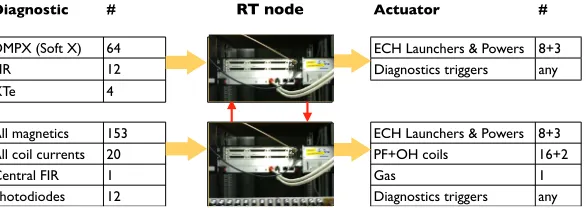
Fig. 1.Schematic representation of control system nodes and connections used for the experiments presented in this paper. Each nodes can run at a different clock rates and communicate with other nodes via a shared memory. Adapted from [5].
from 6 gyrotrons powered by two independent power supplies (3 gyrotrons per power supply [3]). These powerful heating and current drive actuators receive commands from the recently commissioned digital control system [4]. This system processes information from serveral multi-chord diagnostics and provides command references to the poloidal steering mirrors and/or gyrotron power supplies (cf. Figure 1). Several nodes make up the system, and each node can be tasked with a different control algorithm. In typical MHD control experiments, the system operates independently from the main plasma control system which controls bulk parameters of the plasma (current, position, density, etc). In practice, the first node contains a real-time sawtooth detector based on x-ray signals, as well as the real-time decision-logic algorithms to actuate the various phases of the discharge. This node operates at a clock rate of 10kHz in these experiments. The second node treats signals from magnetics and photodiodes at 50kHz and runs a digital PLL (Phase Locked Loop) for NTM detection and/or an ELM detector algorithm based on a threshold of the photodiode (Hα) emissions.
3 Sawtooth pacing
The sawtooth instability appears as a sudden relaxation of the core temperature and density profiles. While its period can often be controlled by appropriately changing the deposition location ECCD in the vicinity of theq=1 surface [6], the performance of this type of control is often limited by the me-chanical characteristics of the launcher. The effect of localized ECCD can be qualitatively understood as accelerating or retarding the time at which a crash threshold (often a condition on the magnetic shears1atq=1) is reached. In this case, control by changing the deposition location has its origin in
varying the time rate of change of the magnetic shear. Sawtooth pacing [2], instead, relies on removing the stabilizing power atq=1 during the sawtooth cycle. This causes the shear to increase more rapidly and the crash threshold to be attained sooner. It is then possible to control the time of each sawtooth crash by varying the time at which the power is switched off(τsetin figure 2).
Using this technique, it is possible to regularly control the sawtooth, as shown in figure 3, and even to prescribe the period of each individual sawtooth. In sawtooth pacing, each crash is detected by a sawtooth detector based on a discrete-time high-pass filter. A related technique, called sawtooth lock-ing, does not rely on real-time detection of the sawtooth crash time but instead uses fixed modulation of the ECCD power to which the sawtooth can lock in some cases [M. Lauret, this conference and [7]].
4 ELM pacing
Time since last sawtooth crash τset
τs,stab
τs,controlled
crash PEC
Control by varyingτset
threshold
D
ist
a
n
ce
f
rom
cra
sh
t
h
re
sh
o
ld
Fig. 2.Cartoon illustration of sawtooth pacing principle: the EC power which otherwise slows the evoltuion of the plasma towards the crash threshold is switched offduring the sawtooth cycle, giving precise control of the sawtooth period by varying the switch-offtimeτset(Figure from [5])
0.7 0.71 0.72 0.73 0.74 0.75 0.76 0.77
0 1 2 3 4
time[s] Central MPX [au] and trig
0 0.5 1 1.5
Total EC on q=1 [MW]
set
Command Measurement
TCV#42299
Fig. 3.Demonstration of sawtooth pacing in TCV. The gyrotron power is switched on after each detected crash and switched offafter a pre-determined periodτset. The sawtooth crash is seen to appear shortly thereafter. The
EC system hardware causes a short delay between the power command and obtained forward power. From [5].
0.7 0.705 0.71 0.715 0.72 0
1 2
3 H (photodiode)
time [s] 0
0.5 1
Edge X2 EC power
set
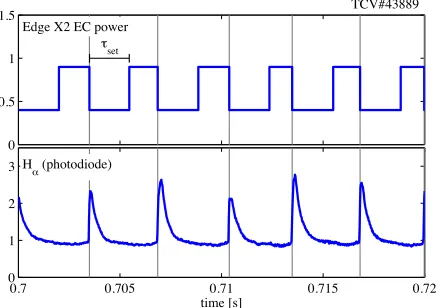
Fig. 4.Detail of ELM pacing: the EC power is switched offafter the detection of each ELM crash. The power is switched back ON after a prescribed time, stimulating the appearance of the next ELM. From [5].
5 NTM control
NTMs are regularly destabilized in TCV, their origin being either local current profile effects or to seed-island generating sawtooth crashes. Control tools for NTM stabilization with steerable mirrors have recently been tested on TCV. The so-called “scan-and-stop” method is a rather simple NTM control scheme, which however does not require dedicated hardware or complex signal processing and equilibrium reconstruction like many other proposed schemes. This strategy consists of the following steps:
– Pre-determinine the approximate range of location of the rational where then NTM is expected (usually theq = 2 surface) from equilibrium reconstruction and determinine the corresponding poloidal mirror angle range.
– During the shot, monitor the presence of NTMs in real-time using a digital PLL (phase-locked-loop) which processes a Mirnov probe signal with 50kHz sampling rate.
– When a mode is detected, scan the launcher angle across the range expected to cross the rational mode surface.
– When the mode is stabilized, or reduced below a given threshold amplitude, hold the mirror posi-tion in place.
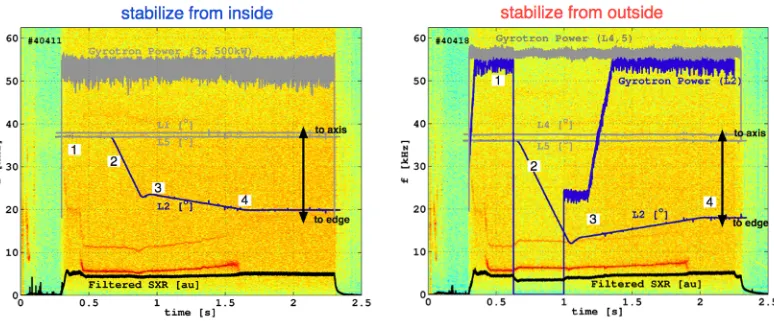
Two examples of successful NTM stabilization using this method are shown in figure 5. NTMs are stabilized both with an EC beam coming from the outside, and one coming from the inside with respect to the mode. Analyzing the deposition location at the time of stabilization reveals that the deposition locations are within 1/2 beam width of each other. The marginal island size, i.e. the size of the island at the time of full NTM stabilization, also appears to be independent of the direction of the incoming EC beam. For more details and further discussion, see [1].
6 Integrated control of sawteeth and NTMs
Usually, large sawteeth are not desirable since they can destabilize NTMs at lowerβ[10]. However, preemptive action can be taken to stabilize the NTM before it grows into a saturated island [11]. Since the crash time is known, one only needs to apply preemptive power for a short time around the instant of the sawtooth crash making the preemptive action more efficient.
Fig. 5.Stabilization of NTMs by sweeping the ECCD deposition location towards the island from both inside (left) and outside (right). An NTM is first created by three gyrotrons (total 1.5MW) injecting co-ECCD at approximately
ρψ=0.3 (1). Some time after the magnetic island is detected, one of the launchers is moved towards the location of the island (2) and then slowly scanned towards the expected location (3) . When the mode disappears, the angle is held constant (4). Note that when stabilizing from the outside (right panel) the gyrotron power is temporarily switched offto allow the launcher angle to go to the requested location without depositing power on the island. From [5].
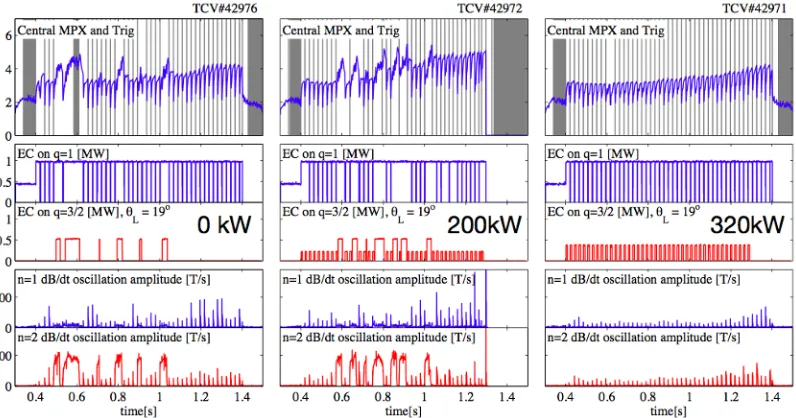
gyrotron (500kW) is aimed at the q = 3/2 surface location. The optimum injection angle for this gyrotron has been decided based on NTM suppression experiments with sweeping launcher angles described in Section 5. This gyrotron is switched on for 7ms at the time the power atq=1 is removed. This means that the power is present at the time of the seed-island generating sawtooth crash, and is removed during the quiescent phase before the next sawtooth crash.
Figure 6 illustrates that this control strategy is effective. The case without NTM preemption (left) shows NTM activity appearing periodically and then being rapidly suppressed by the NTM suppres-sion scheme. On the other hand, adding 300kW of well-timed preemptive power completely prevents NTMs from developing.
7 Conclusions and Outlook
This paper has shown new results obtained during TCV experiments on real-time MHD control. In-dividual sawtooth crashes and ELM events have been shown to be precisely controllable by suitably timed EC power. NTMs in TCV can be stabilized simply by scanning the EC deposition location across the pre-calculated, approximate rational surface location, and stopping once the NTM is stabi-lized. NTM stabilization is combined with sawtooth pacing in a preemptive NTM suppression strategy, where power is added just at the sawtooth crash time to preempt a possible seed island from grow-ing into a fully saturated NTM. This provides an integrated MHD control method where multiple EC sources are used for stabilizing multiple MHD modes.
Fig. 6.Preemptive stabilization by 300kW of power, periodically applied a the 3/2 surface, successfully prevents NTMs from appearing in this stabilized long-sawtooth plasma. Reproduced with permission from [1].
provide flexible and reliable tools for further physics studies and for enhanced experimental repro-ducibility. Also, testing these strategies in existing large tokamaks on high-βplasmas with significant fast-particle content would provide a further confirmation of their effectiveness. “Whipping the plasma into shape” rather than allowing it to do what it likes may ultimately be the best path to fusion power.
This work has been supported in part by the Swiss National Science Foundation
References
1. F. Felici, T.P. Goodman, O. Sauter, G. Canal, S. Coda, B. Duval, J. Rossel, the TCV Team, Ac-cepted for publication in Nuclear Fusion (2012)
2. T.P. Goodman, F. Felici, O. Sauter, J.P. Graves, Physical Review Letters106, 245002 (2011) 3. T.P. Goodman, the TCV team, Nuclear Fusion48, 054011 (2008)
4. J. Paley, S. Coda, B. Duval, F. Felici, J.M. Moret, Architecture and commissioning of the TCV distributed feedback control system, in17th IEEE-NPSS Real Time Conference (RT)(2010), pp. 1 –6
5. F. Felici, Ph.D. thesis, Ecole polytechnique f´ed´erale de Lausanne EPFL, Lausanne (2011) 6. J. Paley, F. Felici, J. Berrino, S. Coda, N. Cruz, B. Duval, T. Goodman, Y. Martin, J.M. Moret,
F. Piras et al.,Real Time Control of Plasmas and ECRH Systems on TCV, inProceedings of the 22nd IAEA Fusion Energy Conference(IAEA, Vienna, 2008), pp. EX/P6–16
7. M. Lauret, F. Felici, G. Witvoet, T. Goodman, G. Vandersteen, O. Sauter, M. de Baar, the TCV team, Nuclear Fusion52, 062002 (2012)
8. J. Rossel, J.M. Moret, S. Coda,et al., Nuclear Fusion52, 032004 (2012)
9. J. Rossel, Ph.D. thesis, Lausanne (2012),http://library.epfl.ch/theses/?nr=5311
10. I.T. Chapman, R.J. Buttery, S. Codaet al., Nuclear Fusion50, 102001 (2010)
11. O. Sauter, M.A. Henderson, G. Ramponi, H. Zohm, C. Zucca, Plasma Physics and Controlled Fusion52, 025002 (2010)
![Fig. 2. Cartoon illustration of sawtooth pacing principle: the EC power which otherwise slows the evoltuion ofthe plasma towards the crash threshold is switched off during the sawtooth cycle, giving precise control of thesawtooth period by varying the switch-off time τset (Figure from [5])](https://thumb-us.123doks.com/thumbv2/123dok_us/8075307.1347199/3.482.108.367.308.516/cartoon-illustration-sawtooth-principle-evoltuion-threshold-sawtooth-thesawtooth.webp)