High temperature Bose-Einstein condensation
Viktor Begun1,a
1Institute of Physics, Jan Kochanowski University, Kielce, Poland
Abstract.The indications of a possible pion condensation at the LHC are summarized. The condensation is predicted by the non-equilibrium hadronization model for 2.76 TeV Pb+Pb collisions at the LHC. The model solves the proton/pion puzzle and reproduces the lowpTenhancement of the pion spectra, as well as the spectra of protons and antiprotons,
charged kaons,K0
S,K∗(892)
0andφ(1020). The obtained parameters allow to estimate the
amount of pion condensate on the level of 5% from the total number of pions at the LHC. The condensate is located atpT <250 MeV.
1 Introduction
Bose-Einstein condensation (BEC) was predicted right after the introduction of Bose statistics [1]. However, it took 70 years to observe BEC experimentally [2]. The main difficulty for obtaining BEC in a gas of atoms is that they form a liquid or a solid before reaching BEC. It can be avoided, if extremely low densities and temperatures are achieved. This was done only after the development of the corresponding technologies, and the leaders of the two groups that created the condensate received the Nobel Prize in 2001 [3]. It might be the reason for the widespread delusion that BEC means low temperatures and atomic gases only. However, all conventional two-quark mesons are bosons and may condense. The temperatures that are reached in high-energy collision are of the MeV scale. It corresponds to∼1010Kelvin and is far above the BEC temperatures for cold atoms. The ratio of the BEC temperature in atomic gases,TC(A), to that in the pion gas,TC(π), is even larger, because one
should take into account a possible size of the system and the masses of the particles. One obtains 1012times higher temperature for the gas of pions [4]:
TC(π)
TC(A)
mA
mπ
rA
rπ 2
mA
mπ10
10 1012. (1)
Besides of much higher temperature, the properties of a BEC of mesons could be very different from the low-temperature BEC of atoms. The most obvious differences are the much smaller volumes, much higher densities, and different interaction forces involved in the formation of the high tempera-ture BEC. The clear advantage of the pion BEC is that pion system is in the form of gas at freeze-out. The reason to consider pion BEC now is the recent data from Pb+Pb collisions at √sNN =2.76 TeV
energies at Large Hadron Collider (LHC), that contain the set of puzzles.
• The predictions of the hadron-resonance gas (HRG) were too high for ratios to pions, especially for proton to pion ratio [5].
• The best fit of the LHC data by the HRG still gives nearly three standard deviations for protons [6].
• The low-transverse-momentum pion spectra show up to 50% enhancement compared to hydrody-namic models [5].
• The temperature obtained in HRG at the LHC falls out from the freeze-out line deeply in the hadronic phase [7].
The HRG worked well for smaller collisions energies. Pions and protons are among the most abundant particles. Therefore the problems with their description look suspicious. There are several solution proposed to explain the proton to pion ratio. The hadronization and freeze-out in a chem-ical non-equilibrium [8]. The separate freeze-out for strange particles [9]. An incomplete list of hadrons [10], and hadronic rescattering in the final stage [11]. However, none of them is commonly accepted yet.
There are deep physical reasons for the non-equilibrium and pion condensation at the LHC. It can be due to fast expansion and overcooling of the QGP [12, 13], or due to gluon condensation in Color Glass Condensate [14], and subsequent hadronization of the low pT gluons into low pT
pions [15]. The non-equilibrium hadronization can explain the measured particle ratios [8], and also the spectra [16, 17] very well. The obtained parameters indicate the possibility that 5% of the total number of pions can be in BEC at the LHC [18]. The calculations of the pion spectra with the assumption of BEC show that the maximal transverse momentum that the BEC can obtain due to the expansion of the fireball ispT < 250 MeV [18]. It is the same region where ALICE Collaboration
observes the emission of 23% of pions from a coherent source [19].
2 The non-equilibrium model
The thermodynamic motivation behind the non-equilibrium HRG (NEQ) is the following. The fast expansion of the fireball may cause it’s overcooling, so that the number of quarks and anti-quarks is larger than their equilibrium value at the reached temperature. Therefore, the subsequent freeze-out may lead to the formation of mesons and baryons with the multiplicities that are higher than the corresponding equilibrium numbers at the given temperature. The phase-space distribution of the primordial particles in NEQ is similar to the usual HRG:
fi = gi
d3p
(2π)3
1
γ−1
i exp(
p2+m2/T)±1, (2)
wheregiis the degeneracy factor,p−momentum,m−mass,T−temperature, and
γi = γNq+i Niq¯
q γ
Ns+i Ni ¯ s
s exp
μ
BBi+μQQi+μSSi
T
. (3)
Theγicontains the chemical potentials and corresponding conserved charges (Q,B,S) of a particle
iin equilibrium HRG (EQ), and the non-equilibrium parametersγq,γs. TheNqi,Nqi¯ andNsi,Ni¯sare
the numbers of light (u,d) and strange (s) quarks and anti-quarks in thei−th hadron, correspondingly. Note the plus sign between the number of quarks and anti-quarks, in contrast to the usual conserved charges, that are defined as the difference between particles and anti-particles. One can exponentiate
model, where each particle has it’s own freeze-out, but the relation between them is fixed by Eq. (3). The NEQ is advocated by J. Rafelski and collaborators since a long time, see Ref. [20] for the review. It is implemented in the SHARE model [21] and allows for the HRG fit of the particle multiplicities and ratios. The THERMINATOR Monte-Carlo event generator [22] inherits the same particle and decay list and allows for further calculation of the particle spectra from the Cooper-Frye formula at the freeze-out hypersurfaceΣμ:
dN dyd2p
T =
dΣμpμf(p·u), t2=τ2f+x2+y2+z2, x2+y2 ≤r2max, (4)
whereτf andrmaxare the characteristic time and radius of the hypersurface. There are several
hy-persurfaces implemented in THERMINATOR following the paper [23]. For the LHC we use Cracow model, that assumes the Hubble-like flow of particles:uμ=xμ/τf, because it fits the data the best. At
the LHCμB μQ μS 0 due to large collision energy compared to the rest mass of the colliding
nuclei. Therefore, EQ model has two parameters left - temperature and volume, while NEQ has also
γqandγs. The measured set of particles, that was used in [16–18, 24], includes 6 to 8 multiplicities depending on centrality. It allows to determine both the parameters in EQ and in NEQ.
There is only one additional parameter in the model that allows to describe the spectra, because the productπ τf rmax2 is equal to the volume per unit rapidity, while the ratiormax/τf determines the slopes
of the spectra. The procedure is the following: first, the volume and temperature are found from the fit of all mean multiplicities, and then thermax/τf is found from the best fit to the spectra of pionsπ++π−
and kaonsK++K−. This approach gives unexpectedly good results in NEQ. The fit that was made for the spectra of pions and kaons only, appears also very good forp+p¯,K0
S,K∗(892)0andφ(1020), see
Figs. 1, 2. The temperature in EQ is much higher, therefore the amount of secondary pions is larger
10-1 1 10 102 103
0.5 1.0 1.5 2.0 2.5
10-1 1 10 102 103 1 2 πpT d 2N dpT dy [GeV /c ] − 2
pT[GeV/c]
chemical equilibrium
T= 165.6 MeV
μB= 0.0,μS= 0.0
τf= 8.5 fm,rmax = 11.0 fm
χ2
π+K/dof =19976= 2.62
π++π−
K++K−
p+ ¯p
1 2 πp T d 2N dpT dy [GeV /c ] − 2 chemical non-equilibrium
T= 138 MeV
λq= 1.0,λS= 1.0
γq= 1.63,γS= 2.05
τf= 7.68 fm,rmax = 11.7 fm
χ2
π+K/dof =12176= 1.6
Pb+Pb√sN N= 2.76 TeV
c= 0%÷5%
0 500 1000 1500 2000 2500 3000 3500
0.1 0.2 0.3 0.4
0 500 1000 1500 2000 2500 3000 3500
1 2πp
T d 2N dpT dy (GeV /c ) − 2
pT(GeV/c)
chemical equilibrium
primordial + secondary pions secondary pions only
1 2 πp T d 2N dp T dy (GeV /c ) − 2 chemical non-equilibrium
Pb+Pb√sN N= 2.76 TeV
c= 0%÷5%
Figure 2.The spectra of strange particles in NEQ. The figure is from Ref. [16].
in NEQ. However, it is not enough to reproduce the steepness of the spectrum atpT <250 MeV, see
Fig. 1 (right). The best state of the art fit of pion, kaon and proton spectra in EQ allows to describe protons taking into account rescattering mechanism [25]. Unfortunately, the authors of Ref. [25] do not provide the plot for pions in a linear scale, or the data/model ratio. However, one can see that they still have about 30% deficit of pions in the model at pT < 250 MeV. The simultaneous fit of
K∗(892)0 andφ(1020) in NEQ is as surprising, as the applicability of the pion-kaon fit to protons. TheK∗(892)0is short living, whileφ(1020) is long living. They should feel a long rescattering phase differently [26]. The successful simultaneous description of protons, pions, K∗(892)0 andφ(1020)
in NEQ without rescattering may indicate that the rescattering phase is well parameterized by the non-equilibrium parameters (3).
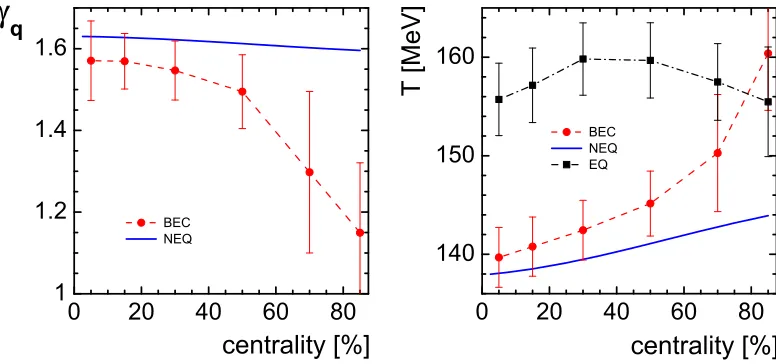
The numerical value of theγqrecalculated into the corresponding chemical potential is very close
to the pion mass:μπ =2Tlnγq134 MeV mπ0 134.98 MeV. It suggests that a substantial part of
π0mesons tend to form the condensate, but this possibility is not allowed in the HRG implementation
in SHARE and THERMINATOR. It can be done by explicit treatment of hadronic ground states. When chemical potential approaches the mass of a particle,μ → m, the discrete sum over the low momentum quantum levels should be taken, instead of the integral over momentum. It can be shown that in the infinite volume limit,V → ∞, only the zero momentum level, p0 =0, can be taken into
account [4]. Then the total mean multiplicity of a particle,Ntot, receives one more term:
Ntot =
j
1
exp[(
p2
j+m2−μ)/T]−1
1
exp[(m−μ)/T]−1 +V
∞
0
d3p
(2π)3
1
exp[(p2+m2−μ)/T]−1 (5) = Ncond + Nnorm,
whereNcond is the number of particles in the condensate. When chemical potential approaches the
mass, theNcondgrows infinitely and competes with arbitrarily large volume, therefore theγqdoes not
model with explicit treatment of the ground state (BEC)1 gives rather different results, see Fig. 3. The inclusion of the ground state makes equilibrium and non-equilibrium models closer. They even
Figure 3. The non-equilibrium parameterγq (left) and temperature (right) as the function of centrality. The
figures are from Ref. [24]
coincide at high centrality, becauseγBEC
q 1 there, whileγEQq =1 by definition.
Pion spectra with the condensate were calculated in Ref. [18] using the appropriately modified THERMINATOR. The condensate is at rest only in it’s reference frame and is moving with the freeze-out hypersurface. The approximation (5) leads to the step at pT ∼ 230 MeV, because the
corresponding momentum distribution is given by:
dN dydφppTdpT
= Ncond
V
τ3
f
m2 θ
rmax−pTτf/m . (6)
whereθis the Heaviside step function. The inclusion of several more low lying levels would lead to finer steps that tend to a continuous line with increasing number of steps, and have the same area under the curve. The current approximation shows the maximal momentum that the condensate may obtain from the movement of the freeze-out hypersurface, which ispT <250 MeV.
The condensate rate grows with centrality in BEC, but the similar growths shows EQ model, see Fig. 4 (left). It is the finite volume effect, which meas that the ground stateN0EQ=Ncond(μ=0)
should be taken into account even in equilibrium for very peripheral, proton-proton, or proton-nucleus collisions. The gray area shows the 10% deviation from the best fit. It is well within the error bars at central, but not in peripheral collisions, see Fig. 4 (right). The combined data on multiplicities and spectra are compatible with 5% of pions in the condensate [18].
The recent PDG reviews [27] report much lower mass and width of the f0(500) resonance, or the
sigma meson (σ), see Fig. 5, and Ref. [28, 29] for explanations. Lower mass results in higher multi-plicity in HRG. Theσmeson decays 100% into pions, therefore the inclusion of the updatedσcould have added some of the missing pions and weaken the BEC signal. The Breit-Wigner distribution
Figure 4. The pion spectra (left) and the condensate rate that was found in BEC (right) by the fit of mean multiplicities at the LHC. Solid line is for BEC, while dashed line is for EQ. The figures are from Ref. [18].
101 102 103
0 2 4 6
with repulsion
π+
π
-Contri
buti
on from
σ
[%
]
s1/2NN [GeV]
without repulsion
LHC
Figure 5.The change of the width and mass of theσmeson since 2010 (left), and the contribution to pion yields from the decay ofσ(right). The left figure is from Ref. [30].
is not accurate enough for so wide resonances asσ. However, the width of theσcan be obtained from the derivative of the experimentalππphase shift, that we take from [28]. It has attractive (0;0) and repulsive (2;0) isospin-spin channel. The attractive one is responsible for the emergence of the f0(500) resonance, however, the repulsive one cancelsf0(500) until f0(980) takes over above the mass
Mππ ∼ 0.85 GeV, see Ref. [31]. The cancellation happens on the level of the distribution function,
therefore it is present in all isospin-averaged observables. Theσimplemented as a Breit-Winger pole withMσ = 484 andΓσ/2 = 255 MeV produces up to 5% of pions, while the truth contribution is
3 Conclusions
The non-equilibrium thermal model combined with the single freeze-out scenario explains very well the spectra ofπ,K,p,K0
S,K∗(892)0andφ(1020) particles at the LHC. The introduction of the
ground state decreases the non-equilibrium parameters and increases the temperature with centrality. The enhancement of the low pT pion spectra may be interpreted as a signature of the onset of pion
condensation at the LHC. The missing pions from theσ meson in HRG enhance the proton-pion puzzle at the LHC, and allow for larger amount of the condensate. Many efforts and attention of the community is required to obtain high temperature BEC and study it’s properties. However, it could open a wide new field of research.
Acknowledgments
The author is thankful to W. Florkowski, M. Rybczynski, M. Gorenstein, W. Broniowski and F. Giacosa for fruitful collaboration. This work was supported by Polish National Science Center grant No. DEC-2012/06/A/ST2/00390.
References
[1] S. N. Bose, Z. Phys.26, 178 (1924); A. Einstein, Sitz. Ber. Preuss. Akad. Wiss. (Berlin)1, 3 (1925).
[2] M. H. Anderson, et al., Science269, 198 (1995); K. B. Davis, et al., Phys. Rev. Lett.75, 3969 (1995).
[3] Editor Tore Frangsmyr,Les Prix Nobel, (The Nobel Prizes 2001, Nobel Foundation, Stockholm, 2002) 77-108.
[4] V. V. Begun and M. I. Gorenstein, Phys. Rev. C77, 064903 (2008) [arXiv:0802.3349 [hep-ph]]. [5] B. Abelevet al.[ALICE Collaboration], Phys. Rev. C88, 044910 (2013) [arXiv:1303.0737
[hep-ex]].
[6] J. Stachel, A. Andronic, P. Braun-Munzinger and K. Redlich, J. Phys. Conf. Ser.509, 012019 (2014) doi:10.1088/1742-6596/509/1/012019 [arXiv:1311.4662 [nucl-th]].
[7] J. Cleymans, EPJ Web Conf.95, 03004 (2015) [arXiv:1412.7045 [hep-ph]].
[8] M. Petran, J. Letessier, V. Petracek and J. Rafelski, Phys. Rev. C 88, no. 3, 034907 (2013) [arXiv:1303.2098 [hep-ph]].
[9] S. Chatterjee, B. Mohanty and R. Singh, Phys. Rev. C92, no. 2, 024917 (2015) [arXiv:1411.1718 [nucl-th]].
[10] J. Noronha-Hostler and C. Greiner, Nucl. Phys. A931, 1108 (2014) [arXiv:1408.0761 [nucl-th]]. [11] F. Becattini, M. Bleicher, T. Kollegger, T. Schuster, J. Steinheimer and R. Stock, Phys. Rev. Lett.
111, 082302 (2013) [arXiv:1212.2431 [nucl-th]]. [12] E. Shuryak, arXiv:1412.8393 [hep-ph].
[13] T. Csorgo and L. P. Csernai, Phys. Lett. B333, 494 (1994) [hep-ph/9406365].
[14] J. P. Blaizot, F. Gelis, J. F. Liao, L. McLerran and R. Venugopalan, Nucl. Phys. A873, 68 (2012) [arXiv:1107.5296 [hep-ph]].
[15] F. Gelis, Nucl. Phys. A931, 73 (2014) [arXiv:1412.0471 [hep-ph]].
[16] V. Begun, W. Florkowski and M. Rybczynski, Phys. Rev. C 90, no. 5, 054912 (2014) [arXiv:1405.7252 [hep-ph]].
[18] V. Begun and W. Florkowski, Phys. Rev. C91, 054909 (2015) [arXiv:1503.04040 [nucl-th]]. [19] B. B. Abelev et al. [ALICE Collaboration], Phys. Rev. C 89, no. 2, 024911 (2014)
[arXiv:1310.7808 [nucl-ex]].
[20] J. Rafelski, Eur. Phys. J. A51, no. 9, 114 (2015) [arXiv:1508.03260 [nucl-th]].
[21] G. Torrieri, S. Steinke, W. Broniowski, W. Florkowski, J. Letessier and J. Rafelski, Comput. Phys. Commun.167, 229 (2005) [nucl-th/0404083].
[22] M. Chojnacki, A. Kisiel, W. Florkowski and W. Broniowski, Comput. Phys. Commun.183, 746 (2012) [arXiv:1102.0273 [nucl-th]].
[23] W. Broniowski and W. Florkowski, Phys. Rev. Lett.87, 272302 (2001) [nucl-th/0106050]. [24] V. Begun, EPJ Web Conf.97, 00003 (2015) [arXiv:1412.6532 [nucl-th]].
[25] S. Ryu, J.-F. Paquet, C. Shen, G. S. Denicol, B. Schenke, S. Jeon and C. Gale, Phys. Rev. Lett.
115, no. 13, 132301 (2015) [arXiv:1502.01675 [nucl-th]].
[26] A. G. Knospe, C. Markert, K. Werner, J. Steinheimer and M. Bleicher, arXiv:1509.07895 [nucl-th].
[27] K. A. Oliveet al.[Particle Data Group Collaboration], Chin. Phys. C38, 090001 (2014). [28] R. Garcia-Martin, R. Kaminski, J. R. Pelaez and J. Ruiz de Elvira, Phys. Rev. Lett.107, 072001
(2011) [arXiv:1107.1635 [hep-ph]]. [29] J. R. Pelaez, arXiv:1510.00653 [hep-ph].
[30] R. Kaminski, Acta Phys. Polon. Supp.8, no. 1, 103 (2015).
[31] W. Broniowski, F. Giacosa and V. Begun, Phys. Rev. C 92, no. 3, 034905 (2015) [arXiv:1506.01260 [nucl-th]].

![Figure 2. The spectra of strange particles in NEQ. The figure is from Ref. [16].](https://thumb-us.123doks.com/thumbv2/123dok_us/8154234.1360022/4.482.99.396.534.612/figure-spectra-strange-particles-neq-gure-ref.webp)