THE COMPARABILITY BETWEEN
MODULAR AND NON-MODULAR
EXAMINATIONS AT
GCE ADVANCED LEVEL
Elizabeth A Gray
PhD
ABSTRACT
The prime concern of this thesis is the comparability of two types of assessment now prevalent in Advanced levelGeE examinations. The more conventional linear scheme assesses all candidates terminally, and the only way to improve the grade awarded is to re-take the whole examination. In contrast, the relatively new modular schemes of assessment include testing opportunities throughout the course of study. This not only has formative effects but allows quantifiable improvements in syllabus results through the medium of the resit option. There are obvious differences between the two schemes, but this does not necessarily imply that they are not comparable in their grading standards. It is this standard which the thesis attempts to address by considering the different variabilities of each of the schemes, and how these might impinge upon the outcomes of the grading process as evidenced in the final grade distributions. A key issue is that of legitimate and illegitimate variabilities - the former perhaps allowing an improvement in performance while maintaining grading standards; the latter possibly affecting the grading standard because its effect was not fully taken into account in the awarding process.
INDEX
List of tables 5
List of Figures 6
Acknowledgements 7
CHAPTER 1: The Hunt for Comparability 8
The Relevance of Examinations 9
Two Approaches to Comparability 13
The Problem 17
Methodology 19
Outline for Chapters 21
CHAPTER 2: A More Forcible Word - the Literature on Comparability 26
Definitions of Comparability 27
Comparability Methodologies 41
Factors Influencing Comparability 45
Aggregation and Awarding 47
Discussion 49
CHAPTER 3: It is Ages Ahead of the Fashion - The Modular Context 51
Some History - Pre 1951 52
The Control of Public Examinations 56
Reform 63
The Rise of Modular Examinations 65
Project Examinations - and Mathematics 67
Modular Curriculum and Modular Assessment.. 70
Discussion 74
CHAPTER 4: Enveloped in Absolute Mystery - The Search for
Comparability 76
The Three Domains 79
Domain of Behaviour 82
Domain of Assessment 84
Domain of Measurement 95
Generalisability 98
Discussion 99
CHAPTER 5: A Perfect and Absolute Blank - Within Subject
Comparability 101
Some Basic Data 105
Patterns of Behaviour within Modules 109
Relationship between Modules 122
CHAPTER 6: Keeping One Principal Object in View - Multi-level
Modelling 136
The Variance Components Univariate Model 139
Random Coefficients Multivariate Model 150
Discussion 153
CHAPTER 7: But Much Yet Remained to be Said - Question Paper
Analysis 157
Methodology 161
Syllabus Content 162
The Question Papers 165
Question Performance 177
Discrimination and Facility 180
Reliability 188
Populations and Gender 190
Discussion 191
CHAPTER 8: If I Had but the Time - Longitudinal Analysis 195
The Data 197
The Model 199
The Results -1994 201
The Results -1995 216
Combined Data 221
Discussion 225
CHAPTER 9: On to the Last 228
Variability within Modular Schemes 228
Variability of Demand between Syllabuses 232
Variability of Performance 234
Rationale and Generalisability 236
Why Modular? 238
Validity 245
In the End 245
APPENDIX A - Anomalies, UMS and the Regression Allowance 248
APPENDIX B - Drawing the Line 254
APPENDIX C - Modular Syllabus 273
APPENDIX D - Linear Syllabus 290
APPENDIX E - Question Level Data 297
APPENDIX F - Modelling Likelihood Ratios 308
BIBLIOGRAPHy 309
List of Tables
Table:
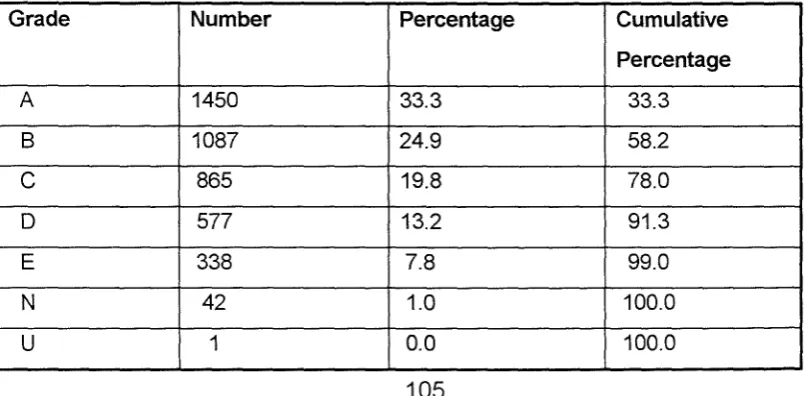
5.1 1994 Grade Distribution for Modular Mathematics 105 5.2 1994 Grade Distribution for Linear Mathematics 106 5.3 Grade Distribution for Single Subject Modular Candidates 109 5.4 Modules with Significantly Different Syllabus Grades 115
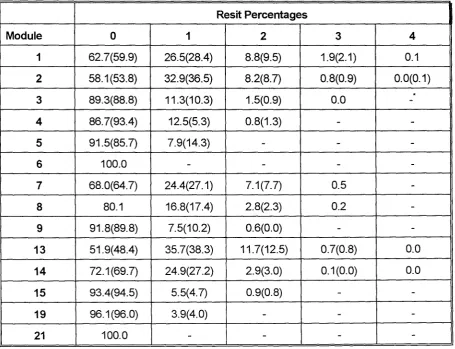
5.5 Resit Pattern for Each Module 117
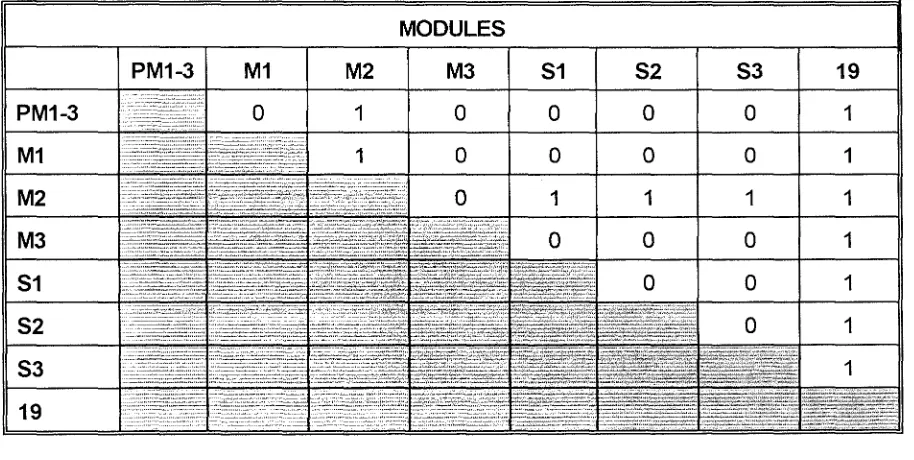
5.6 Grade Distribution by Module Combination 122
5.7 Grade A Mean Marks for Two Module Combinations 123 5.8 Grade A Mean Marks for Two More Module Combinations 124
5.9 Correlation Coefficients between Modules 125
5.10 Mean UMS Differences between Modules 128
5.11 Weightings Achieved by Optional Modules 132
6.1 Module Data for Mathematics 137
7.1 Question Paper Format. 166
7.2 Syllabus Coverage for All Written Papers (Weighted Marks) 170
7.3 Difference in Syllabus Coverage 172
7.4 Comparison of Compulsory Questions 172
7.5 Percentages of Marks Required at Each Grade 176
7.6 Correlation Coefficients for Components 180
7.7 Correlation Coefficients for Modules 181
List of Figures
Figure:
3.1 The Relationship between Boards, Schools and Universities 57
3.2 The Pace of Reform 64
5.1 Proportion Taking PM1, 2& 3 by Examination Session 111 5.2 Proportion Taking M1, 2 & 3 by Examination Session 113 5.3 Proportion Taking S1, 2 & 3 by Examination Session 114
5.4 Cumulative Percentage of Modules Resat. 116
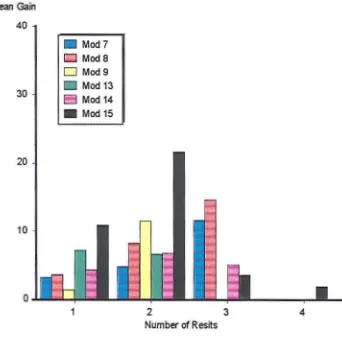
5.5 Gains on Resit for Modules 1 to 5 118
5.6 Gains on Resits for Modules 7 to 9 and 13 to 15 119 5.7 Indexed Entry by Gender to Optional Modules 121
5.8 Coefficient Alpha 130
5.9 Achieved Weightings of the First Three Compulsory Components 131
7.1 Percentage of Component Marks Required for Each Grade 175 7.2 Percentage of Module Marks Required for Each Grade - Compulsory
Modules
... 175 7.3 Percentage of Module Marks Required for Each Grade - Optional Modules. 176 7.4 Facility and Discrimination Differences for Component 1 182 7.5 Facility and Discrimination Differences for Component 2 182 7.6 Facility and Discrimination Differences for Module 1 183 7.7 Facility and Discrimination Differences for Module 2 183 7.8 Facility and Discrimination Differences for Module 3 184 7.9 Facility and Discrimination Differences for Module 7 184 7.10 Facility and Discrimination Differences for Module 8 185 7.11 Facility and Discrimination Differences for Module 13 185 7.12 Facility and Discrimination Differences for Module 14 185 7.13 Summary of Facility and Discrimination Values for Components and
Modules
... 186 7.14 Reliability Coefficients for Each Component/Module 189
8.1 Predicted A level Grade from Simple Regression 202
8.2 Predicted A level Grade from Fixed Effects 204
8.3 Standardised Level 1 Residual Plot 205
8.4 Level 1 Variance 206
8.5 Level 2 Variance 208
8.6 Predicted Normalised A level Grade from Fixed Effects 212
8.7 Level 1 Variance 213
8.8 Standardised Level 1 Residuals 214
8.9 Level 2 Variance 214
8.9a Level 2 Variance as a Function of Predicted A level Grade 215
8.10 Results from Simple Regression Analysis 217
8.11 Predicted Normalised A level Grade from Fixed Effects 218
8.12 Standardised Level 1 Residuals 219
8.13 Level 1 Variance 220
8.14 Level 2 Variance 220
ACKNOWLEDGEMENTS
First of all I must acknowledge my debt to the Oxford and Cambridge Schools Examination Board, in the person of its Secretary Mr H.F. King, who was not only prepared to finance this Ph.D. thesis, but also allowed me to use the data on which this research is based: and to UCLES who took over responsibility for my fees when the two Boards merged. For
a
woman must have money anda
room ofher own if she is to writeVirginia Woolf 1928
I am also grateful to the Joint Forum for the GCSE and GCE who allowed me to use the data from the 16/18 database.
I must also thank my supervisor, Professor Harvey Goldstein, without whose gentle persistence and expertise the completion of this thesis would not have been possible. To Dr Helen Patrick thanks are due not only for her encouragement, but also for reading parts of this thesis and offering intelligent and helpful suggestions. Also to Mr Alastair Pollitt who allowed me time to do my thinking and writing. Finally I have to thank my husband and children who let me get on with it, in a room of my own!
CHAPTER1
The Hunt for Comparability
It is instructive to note the words of UCAS (1994) on the subject of modular syllabuses:
It should be clearly understood that modular syllabuses are no easy option, as all modules are assessed to full GCE A level standard without allowance for maturation, including those taken at an early stage in the course. If some candidates perform better in modular syllabuses, this may well reflect the positive effects of modularity rather than
the standard of assessment. (p4)
However there is not universal belief in the invariant nature of A level standards in general and particularly where modular schemes are concerned. There is much in current (non-modular) A level syllabuses which would not be recognised by an A level candidate of 30 years ago. This does not necessarily reflect a variation in standards, merely the changing nature of the world about us - 30 years ago for example computers were in their infancy! No more should a change in assessment necessarily bring about
any alteration of standards.
That there is still much concern is evidenced by the 1995 Interim Dearing Report on the Review of 16-19 Qualifications. This comments in reply to a question concerning the
demand of modular syllabuses:
Whilst SCAA and ACAC have an extensive monitoring programme I propose that in consultation with SCAAand ACAC and the GCE Examining Boards, the Review should commission further research to examine the facts. (p17)
There is little doubt that modular schemes have both defenders and detractors within the
teaching profession, and it is the purpose of this thesis to investigate those claims of both sides in the argument in order to establish what has been gained, or indeed lost, as
the result of the implementation of modular schemes. What exactly is meant by a "change in standards"I for it is too simplistic to claim that candidates are gaining different grades from those expected. That merely begs the question "why?".
The Relevance of Examinations
initially matriculation was the first step in degree qualification, examinations were soon seen as a method of selecting candidates for progression to the professions (prominent amongst them the civil or armed services) and there grew an inter-dependence between school curricula and examination syllabuses which has never been broken. A number of other, more wide-ranging functions for examinations have been adduced. Brereton, writing in 1944, cites two - "as a means of stimulating students to effort" and "as a means of testing and classifying students". Within the former of these purposes he stresses the positive educational effect of concentrating both teaching and student effort along pre-defined channels. Dewey (1930), over a decade earlier, had stressed the need for the linking of activities (educational or otherwise) so that examinations became not a termination but an integral part of a continuing process. However, the competitive
element was very strong as the School and Higher School Certificate were used as the selection instruments for a number of institutions including those of higher education and the armed services. In general they were a means to an end, not an end in themselves.
When the GCSE was implemented in 1988, it was stressed that its purpose was to enable candidates to show what 'they know, understand and can do'; and the examinations were designed to give candidates as much opportunity as possible to demonstrate achievement. Increasingly the 16+ assessment has been seen less of a school leaving examination than as a means of progression, vide Dewey, to the next stage of education, even though this may take place within the 'world of work'. Many of the assessment techniques pioneered by the CSE examinations were adopted for GCSE use and were eventually accepted as a valid. The changes in these examinations
were bound to reflect on the 18+ provision.
The Higginson report 'Advancing A Levels' (1988) quoting from a 1985 white paper
commends six examination objectives:
to raise standards; to support improvements in the curriculum and its delivery; to provide clear aims for teachers and pupils to the benefit of higher education and employers; to record proven achievement; to promote the measurement of achievement based on what candidates know, understand and can do; to broaden the studies of pupils in the 4th and 5th secondary years and of 6th form students. (p6)
motivation, the fourth selection. The fifth, the promotion of different assessment methods, again hints at innovation, and lastly examinations are to broaden the curriculum - the very opposite of what A level examinations are often accused (e.g. Kingdon, 1991; Schools Council Working Paper 45, 1972).
If all these objectives are to be fulfilled, then there can be little doubt of the symbiosis between examinations and the curriculum. But it does beg the question - in which of these objectives should comparability lie? Should all examinations equally seek to raise standards, innovate and broaden the curriculum? In practice, comparability means comparability of evaluation, that the measurement of attainment of a number of candidates in a given subject at a given level under different assessment regimes should produce the same outcome - in short, equivalence of grading standards.
Additionally there is the purpose of control. Brereton suggests examinations aid control of pupil by teacher, but the nature of control has changed over the last decade. There is still the controlling effect of motivation, but to this has been added the control of the educational system as a whole (Broadfoot, 1996). By dictating a large part of the content of the A level examination syllabus, including the assessment scheme, by effectively licensing individual examinations and pre-defining the lines along which all developments should proceed, the (now) statutory regulatory authority exerts a restriction over the post-compulsory curriculum which would have been impossible pre-1988. The publication of various league tables of examination results categorising school performance on the (crude) basis of the quality of GCSE and GCE grades has also had a powerful effect on schools' attitude to examinations. Examination results are used not only to evaluate candidates' performances, but also institutional performance, and increasingly that of teachers within the institutions.
incomparable? Using such a yardstick it may be easy to compare subjects at A level, but the question would be transferred to comparability of degrees. At best this is unhelpful.
The key issue is the fifth of the educational objectives listed by Higginson, namely to promote the measurement of achievement based on what candidates can actually do. Comparability thus centres on asking candidates to perform equivalent tasks for which the reward is demonstrably the same for equal performances. Not only must demand be uniform for comparable examinations so must the evaluation metric. The role of examiners in this is fundamental. They are responsible for setting question papers and marks schemes which, year on year and within a subject are required to be of equal demand and they are also required to set grade boundaries which reward equal levels of attainment year on year and within subject by giving the same grade.
Since 1951, when subject based GCEs were introduced, the outcome of the "test" (whether a percentage or grade) is a measure of attainment within that subject area which is delimited by the published examination syllabus. Thus no two examinations can ever be exactly equivalent because syllabuses always differ. The differences may lie in content, emphasis, philosophy or assessment, even within the same subject area. Strict equivalence has temporal as well as syllabus bounds, and then only within the limits of marking reliability. Orthodox examination regimes, within option choice, do at least guarantee equivalence for a given cohort. Within a modular scheme it is perfectly possible that two candidates, certificated at the same time and for the same syllabus, have never sat the same examination.
invidious aspects of published league tables; namely the switching of centres from one Board/examination to another on the basis of so-called "easier" examinations in order to improve league table positions. The evidence for this, though often anecdotal, is seen in the variation in the numbers of candidates entering for each Group's/Board's examinations (GCSE Inter-Group Statistics and GCE Inter-Board Statistics, all years from 1990 onwards) and the changes which have occurred since the advent of performance tables. This is hard to justify in fact, harder still in educational terms. Sometimes the vindication for such a decision is that "a higher number of As" is awarded by one Board over another. Comparability is thus determined by the raw grade distributions un-moderated by pattern of entry. Alternatively the reason may be given that a particular cohort obtained higher grades in one subject over another - a subject pairs comparison. Ignored are the other contributory factors to examination success -teaching effectiveness (albeit allied to syllabus choice) being probably the most influential within individual centres.
Johnson and Cohen (1983) aver, when distinguishing between two definitions based on achievement and aptitude, that the appropriate definition of grade comparability depends
....on which of anumberofpossible functions the examination aims to serve. (p1)
Because the objectives of examinations as ideally stated are so diverse, it is the purpose of this research to determine comparability independent of any function except that of evaluation - the end is a grade, not a prognosis or league position, and the means to that end is the A level examination requiring a given programme of study and assessment by pre-determined instruments.
Two Approaches to Comparability
variabilities in the examination have been accounted for. Studies in both these strands should come to the same conclusion for the same syllabuses, but it is never possible adequately to take into account all the variabilities in population or all the variabilities in the examinations themselves and such studies using both strands may have different findings from each strand (see Quinlan, 1993 or Ratcliffe, 1993).
Statistical comparability between any pair of syllabuses generally focuses on the average attainment of a specified group, or groups, of individuals by using some second comparative measure such as another subject score, score on a monitor test or a measure of prior achievement, but these raise issues such as bias and relevance which may not be the same for each syllabus. Such methods also fail to address directly the fundamental difficulty of relating examination demand and performance to grading standards, hence the use of judges. There may be imprecision and some unreliability which relate to grade boundary setting within an examination component and when allied to structural and syllabus differences between examinations invests the task of comparison with a complexity not easy to resolve. As Forrest and Shoesmith (1985) remark with reference to setting grade
standards:-...that standard is nowhere explicitly laid down: it lies instead in the experience and minds ofthose teachers and administrators whose task it is tocarrythe standardacross
time. (p23)
and therein lies the central tenet of this thesis, that awarders are able to perform this task in a consistent manner across time and syllabuses and in a manner which reconciles all those unquantifiable variabilities so that all grades awarded at a given level are accepted as equivalent.
35% C and 50% 0 with a total pass rate of 70%, but it was emphasised that these were no more than rough indicators. As discussed in the SSEC report which recommended the guidelines (SSEC, 1960), although Boards try to ensure equality of demands of syllabus and examination
they do not normally control the kind of students who will offer themselves for
examination (p27)
i.e,the aptitude or ability of individual candidates.
In this thesis attainment and achievement can be regarded as synonymous and defined
as the outcome of a specific A level examination as manifested by the grade awarded; aptitude has yet to be defined. In Nuttall, Backhouse and Willmott (1974) the covert definition is:
... the overall ability of
a
candidate to achieve good grades in the examination (p5)which is a specific application of that given by the Oxford English dictionary of aptitude
as fitness; natural propensity; ability. Psychologists however make a temporal distinction between aptitude and ability - aptitude is "the potential to perform", ability is an enabling
faculty now. It could be argued that at the beginning of a course of study a student possesses aptitude, at the end ability and after some relevant test can be said to have demonstrated a given level of attainment. This will reflect ability rather than aptitude. The difference between aptitude and ability is therefore a measure of the effectiveness of a given course of study. Hall (1977) considers general ability as manifest in three forms; general intelligence, general educational ability and general scholastic ability. In a sense,
even though this may be too simplistic (q.v. Christie and Forrest op. cit.) the mix is unimportant since without explicit measurement, impossible within the context of this research, aptitude can only be given by proxy, as for example average GCSE grades, with ability in part demonstrated by A level results in cognate subjects. The thesis that
attainment is functionally dependent upon aptitude assists in the formation of an equation of outcome (such as a regression equation based on prior achievement), but the interdependence of terms in such an equation should not be ignored; i.e. aptitude
....the extent to which the same grades in different examinations represent the same or
equivalent levels of performance. (p21)
This is clearly an "attainment" definition, and is the umbrella under which equivalence should be determined. However, its self-evidence as a definition gives little insight into what comparability means in practice.
Christie and Forrest (ibid.) are equivocal about comparability definitions based upon aptitude. However, in this thesis, the requirement to compare modular with non-modular examinations in the same subject may invest a (construct) validity to such an approach which could be missing with between subject comparisons.
It would be easy to guarantee equivalence in one sense, by norm-relating the grade distributions of all syllabuses. Indeed there is a powerful argument for doing just that, especially for the large entry subjects at GCSE. The definition of comparability taken from Nuttall, Backhouse and
Willmott:-...we can see no logical reason why, if a large group of candidates representative of the population took, for example, both English and mathematics, their average grades
should not be the same. (p12)
was applied to 0 level and CSE examinations. A sufficient (though not necessary) condition for this to hold would be to norm relate the grade distributions for large entry subjects and would endorse the argument above. However, at A level, although the definition could hold, it is difficult to see that the underlying stated assumption would; the
non-homogeneous, self-selecting and often small, candidature is unlikely to be "representative of the population". For modular and non-modular schemes (at least within an individual board) candidature is mutually exclusive by regulation; there may also be some fundamental difference since the two populations have chosen to follow separate syllabuses. An interesting aside relating to the two subjects chosen as examples is the necessity of ensuring strict representativeness. A recent study (Stobart et al 1992) would indicate that the dominance of the group by one gender would materially affect the group average. If the group were predominately male, then because
then the relationship between the mean performances of the group for the two subjects would be very different from that obtained should females dominate. There may also be an issue relating to the quality of teaching of the two subjects, especially given the relative difficulty in recruiting suitably qualified teachers in mathematics.
The Problem
Modular (or "structured',) schemes of assessment involve three processes which differ from the conventional
approach:-(a) that module examinations may not necessarily be terminal (b) they always involve some choice, including the choice to resit;
(c) that module results are strictly additive under the UMS1transformation.
Different modular schemes currently vary in their approach to all of these; the application of (a) has led to the resitting of some modules for some examinations, (b) the suggestion that some routes are easier than others and of (c) to several different methods of combination. The Code of Practice for GCE A and AS Examinations restricts certain choices; terminal examinations must contribute at least 30% of the marks and each module should be worth at least 15% of the total assessment. It is the purpose of this research to investigate definitions and methods of determining comparability and apply them to ascertain whether modular examinations can be considered equivalent to their conventional counter-parts.
Grade descriptors (where they exist) would be crude examples of such criteria.
Attitudes towards marking may also have to change with a greater willingness of the more subjective examiners to utilise the whole of the mark range. The attenuation of the mark bandwidths for, say, English could have profound effects on outcome when compared with, say, mathematics examinations were a universal uniform marks scheme to be adopted. Grading for modular schemes can exhibit characteristics of both continuum and state models in domain-referenced measurement. Although the achievement domain may vary for the ''whole subject" grade, within individual modules it does not and so grading can also be said to be limen-referenced, a rather ad-hoc mixture of criterion and norm-referenced grading (see Christie and Forrest op. cit). The difficulty in pinning down precisely the grading procedures employed relative to conventional measurement models adds to the complexity of defining equivalence.
In a sense it is not necessary precisely to define any variations in grading procedure. If we can make the assumption that grading standards are the same, irrespective of grading scheme, then the task becomes one of looking at the differences between schemes which may, or may not, impinge upon the grading process and discovering if there are any inequalities in outcome which are unexplainable except by differential standards. This applies not only within a modular syllabus but also between a modular syllabus and a linear syllabus in the same subject.
The question to be addressed then becomes not one of comparability, but one of how valid each of the schemes is as a method of assessment. Key to this is a consideration of the threats to validity usually defined as construct underrepresentation and construct-irrelevant variance (Brualdi, 1999). Essentially what needs to be considered is whether the tasks which are evaluated in the two schemes are the same and whether the nature of the questions set or the assessment structure itself inherently lead to different expectations of outcomes i.e. grades. In order to consider the latter, the variabilities between modular and linear schemes need to be exposed and their effect quantified. In this way, should differences be found in attainment by equivalent candidates as defined by, say, a prior achievement measure, it may be possible to determine whether such differences render either scheme invalid.
far in explaining differences in candidate performance but which plays no part in the judgemental process per se, although they may go some way to explaining a better than expected performance. An example of illegitimate variability might be question demand where judges may have to reconcile high attainment on easy material with lower attainment on very much more difficult content. Legitimate variability may, for example, be due to pupil motivation or whether the candidate is resitting, but this would not be a consideration in the grading process where the only concem is determining a grade on the evidence of achievement provided by scripts and coursework.
Whilst it is not possible within this thesis directly to consider legitimate effects due to, say, motivation (of both pupils and teachers), the more mechanical elements of the examining process can be addressed. By assessing the effects of re-sits, of examination session, of the effect of taking further modules and indeed gender, it is possible to estimate the source of differential performances and possibly quantify them. If the quantification of the effect of legitimate variabilities as defined here can explain performance differential then grading standards may be considered sound. The discussion would then move to a debate on what constitutes a legitimate variability.
Methodology
It is proposed that the research centres on one subject area, namely Mathematics, primarily because of the few established modular schemes, one of the most popular is the OCEAC MEl Structured Mathematics Scheme which not only provides a stable data base, but one with an increasing number of candidates. Although other subject areas may help to illuminate certain of the inter-module relationships, inevitably clouded by the resit factor in a well established scheme, most of the work focuses on those candidates who were entered for certification in the summer of 1994.
The variabilities can be categorised under two headings, those occurring either within a syllabus or between syllabuses in the same subject area. Because the flexibility of modular schemes introduces an element of uncertainty regarding the equivalence of modules not seen within conventional schemes, the first part of this investigation centres on an analysis of the modular data to determine and quantify within syllabus legitimate variability whilst the second concentrates on an analysis of syllabuses, question papers and mark schemes as well as item level data for both conventional and modular examinations in an attempt to find any inconsistencies which might indicate a failure of the underlying assumption. Then, by using a measure of prior achievement and looking at differences in attainment between equivalent candidates as defined by the measure, an attempt is made to reconcile such differences with those legitimate variabilities previously found. In this way it is possible to assume that all sources of illegitimate variabilities, including the difficult area of question structure and demand, are subsumed by the grading process - unless proved otherwise.
The statistical methods used for the analyses are, for the most part, tried and tested in the furthering of examination comparability. However, this has been at subject level, and the application of the methodologies to modules has provided an insight into the working of a modular examination which was previously a source of speculation. Such applications can be extended to other modular schemes, and inevitably so too can some of the conclusions, although a number of the findings are subject specific.
Firstly, the research concentrates on the typical behaviour of a modular candidate as exemplified by the chosen scheme. This includes sessional variations, resit patterns and comparability between modules. Multi-level modelling techniques enable us to look beyond the obvious and consider those factors which may impinge upon performance and their variation with centre.
Question level analysis from one modular and one linear scheme for the same year of 1994 enable a direct comparison of the demands within each syllabus and question performance on each of the papers. Insights derived from this analysis enable some tentative conclusions to be drawn about comparative demand.
for the analysis is again multi-level modelling. Some interesting conclusions can also be drawn from this study.
The two chapters involving multi-level modelling techniques are as much an exploration of those techniques as of the modular syllabus under investigation. For that reason, even where not particularly successful, the methodology is reported for its relevance and potential use in other comparability studies.
Outline for Chapters
Whilst the literature on examination comparability is sparse, with nearly all having been produced either by the boards themselves or SCAA (and its predecessors), there is enough to provide the background necessary for this investigation. Methods of determining examination comparability have been developed and refined over the years,
although most are not applicable to the research carried out here since they rely on the input from experienced awarding personnel. Modular schemes have developed in a far from structured manner, and it was not until 1992 that the issues were addressed
properly in a report by David Thomson and an aggregation system proposed. This report can be considered seminal in terms of its influence on the SUbsequent development of modular schemes and the method in which the parts become the whole. Chapter 2
investigates the literature on comparability.
There is a certain amount of disagreement between the A level boards as to which can claim to have set the first modular examinations. However there is little dispute over the existence of modular schemes at GCSE long before they were even considered a suitable regime at A level. This does, however, beg the question ''what is a modular
examination?". There is no doubt that the modular GCSE courses were very different in their assessment methods from those that are now applied to modular A levels, and that even now "modular" tends to be a term applied to any A level, parts of which can be taken early. By looking at the history of examinations in general and modular schemes in particular, specifically in the arena of public examinations, it is possible not only to contextualise the current regimes, but also to trace their development from their
Research into examinations is often one of two types. Either the investigator sets up experiments in order to discover or determine particular behaviour pattems (in their widest context), or (s)he sets down some hypothesis which the research is conducted to test out. In the context of modular schemes, although the candidate may find it a joumey into the unknown, there can be no question of setting up an experiment to test hypotheses. Pilot studies do work in very specific contexts, but it is unlikely that the whole variety of a two year course of study could be the subject of a single experiment, especially when one considers the importance of the result to the candidate. This research therefore must fall into the latter category, and the fourth chapter concems itself with the consideration the sources of invalidity and their relationship to a number of factors, or variabilities, relevant to various examination regimes. A hypothesis, which, if not directly testable, at least questions the conventional wisdom that comparability is simply a matter of ascertaining whether a candidate would have obtained the same result had (s)he followed a different syllabus in the same subject is postulated. It is suggested that the dichotomy between the two major assessment regimes under consideration is sufficiently profound to lead to expectations of different outcomes even when the candidates' ability (using some prior measure) is the same, but that these differences are the result of entirely legitimate definable variabilities, and not necessarily threats to validity. Such variabilities would be entirely relevant to the construct and provided that it can be shown that the evaluated elements within each scheme are essentially the same then each scheme must be valid under its own defined construct. The issue then becomes one of belief in the social equivalence of the results.
For example, if it can be shown that candidates tend to get higher grades from a modular scheme, does it necessarily mean that standards have dropped. It may well be that the assumption of equivalent grading standards still holds, but that the assessment regime is more 'enabling' and by setting targets throughout the course and allowing a certain amount of re-taking within the course, candidates are leaming more. It could be argued that weaker candidates, through their re-sits, are more proficient at the topics covered earlier in the course than they would be had the examination been taken terminally.
The thesis centres its attention on one modular syllabus, the MEl Structured Mathematics scheme, not least because it is incontrovertibly modular. An outline of the scheme, its aggregation method and comparable traditional syllabus (used as a control) are given as are details of the awarding procedures which lead to the various grade boundaries being determined. The two strategies of awarding grades, though dictated by surface factors do disguise quite significant differences in application. On the one hand, traditional schemes allow for "regression" in the aggregation, that is the tendency of candidates to perform less well the more components are taken into account. There are practical problems as well as philosophical objections to attempting to make this allowance in modular schemes (though this was not always the case and rather odd estimates emerged for use as regression allowances) and each module must be graded on a "stand-alone" basis. These differences can cause difficulties where syllabuses declare themselves as both modular and linear. This thesis does not accept the proposition that a syllabus can be both: even if all modules are taken terminally, the examinations themselves and aggregation processes are still sufficient to underpin the basic dichotomy, as there are if certain components in a traditional scheme are taken early in the course.
Investigation of the sources of legitimate variability is the focus of Chapters 5 and 6 and of the comparability of modules. Differences in module standards can arise in two ways; either as a displacement, all the candidates obtain consistently better (or worse) marks on two different modules, in which case the correlation should remain fairly high; or standards are applied inconsistently across boundaries in which case the correlation would probably be somewhat lower given the method of aggregation on a uniform mark scale. However, compounding these two fundamental sources of difference are the different occasions on which the same module may be taken, within different populations each time, and the choice of modules.
It is this effect with which chapter 6 concerns itself. The approach is one of multi-level analysis of the data set aimed at determining the equivalence of modules, the effect of gender and re-sits. To this end a more restricted data set is used, namely that containing only the modules which counted towards certification for the single subject mathematics (i.e. six modules per candidate) rather than the overview of all modules taken by candidates who were certificated (i.e. including extra modules which may have been used for a Further A or AS qualification). Practical difficulties prevent all modules being analysed together, but it is possible not only to look at various combinations of modules, but also to investigate the effects of the different factors at individual module level. Also, with this restricted dataset it is possible to investigate internal consistency, which is a measure of reliability of the examination, and the achieved weight of each module.
The investigation presented in Chapter 7 focuses on the syllabuses, their differences and similarities and the way the two schemes of assessment, modular and linear, each perform in terms of sampling the syllabuses in the question papers. The thrust of the analysis is to determine whether there is construct under-representation in either the modular or linear schemes. This investigation requires a value judgement in order that meaningful comparisons can be made. The function and value of a mark can only be determined within the context in which it is awarded. For example, in a four part mathematics question which has attached to it 10 marks, the first, second and third parts may attract 3 marks each and the last just one. However the function of the first 3 marks is to enable the awarding of the second 3 (i.e. without the first part the second cannot be completed) and so on. This is rather different from, say, a 10 mark question which consists of two, unstructured independent parts of 5 marks each for which the most likely scores are 0, 5 or 10. In structured questions designed specifically so that the first part is accessible to all, the last to very few, it is often easier for weaker candidates to score at least some marks than with the more inaccessible unstructured form. In the modular scheme considered, the aim is for all questions to be structured and this makes comparison with traditional papers even more difficult. Using the mark schemes as a guide it is, however, possible to put a value on each question. Given this data a comparison of the relative requirements of the various question papers can be made.
of performances in the areas of skills and knowledge can be constructed. In this way, a picture of the effectiveness of the two schemes in allowing candidates to demonstrate their various abilities can be constructed.
As has been argued earlier in this chapter, the aim of this research is not just to suggest that it might be easier to gain high grades under one type of assessment scheme. The truth, or otherwise, of the assertion of apparent lowering of standards has to be proved. Since one of the best indicators of performance at 18+ is performance at 16+, a matching of GCSE data and A level data for the same candidates in the subjects under investigation is ideally required. Subjected to the appropriate analyses it is possible to gauge the differences in GCE performance based on expectations derived from GCSE results. In chapter 8 the results of such a multi-level analysis are presented, using results from two consecutive years. So there is not only a comparison between a linear and modular scheme, there is the added dimension of a year-on-year analysis.
CHAPTER 2
A More Forcible Word - The Literature on Comparability
Wood (1991) observes in his survey of research
:-Modularisation is merely question choice writ large. It exists to accommodate personal taste and to make syllabus coverage manageable. (p16)
If it were that simple it would be possible to look to the literature on question choice to inform the research on the comparability of modular and non-modular schemes. There are quite clearly fundamental differences between the two, the very nature of the assessment and aggregation within and between components ensures this. However as Thomson (1992) says of modular
schemes:-Because it is
a
new departure little experience exists of what exactly the philosophical, pedagogical and technical implications of ''rnodularisation'' might be. (p2)Two years after the publication of his report on modular aggregation and comparability,
experience has been gained, but little has been written of the rationale which now govems the awarding of modular schemes or of the impact of such rationale on comparability.
Thomson (ibid.) has also taken Broadfoot's categorisation of the Psychometric and Educationist models as a paradigm for the traditional and modular approaches to
examining. Certainly many features of the Educationist model, with its emphasis on formative aspects of assessment rather than summative measurement, incorporate the ideals towards which compilers of modular examinations strive, and there is evidence that modular schemes are thought to enhance pupil motivation (Gray, 1992; Nickson, 1994), a major element, especially amongst the less able. Whether the essentially different approach of modular examining can ever produce comparable results to those from orthodox regimes depends, at least in part, on what is meant by "comparability".
Pollitt (1993) defines this as "the equivalence of identical labels" and appeals to
all Bs are equal in value, A>B>C etc and we can add up the separate results somehow.
Whilst all three requirements may be desirable, any direct attempt to prove that a C in Physics is equivalent to a C in drama for example is probably doomed to failure (Goldstein and Cresswell, 1996). If one accepts the additivity of grades, then much of the recent work on aggregation of components or modules whether on differentiated or undifferentiated examinations (q.v. Good and Cresswell, 1988; Backhouse, 1976; or Thomson, 1992) is rendered meaningless. In fact grades are too crude a measure to be used within an examination, and too different to be used between examinations. The distances between grades have no meaning per se, and therefore grades should not be assumed to constitute measures on an interval scale, though they are usually taken as such. But they are measures on an ordinal scale, and comparability requires that the ordinal scales are effectively the same i.e the laws of reflexivity, symmetry and transitivity on the relation of equivalence and of irreflexivity, asymmetry and transitivity for the relation of "greater than" hold between the grades of one examination and another. UCAS perpetuate the use of grades as points, and indeed many research studies find assigning numerals to grades allows analytical techniques to be employed where, strictly, they are not appropriate.
Definitions of Comparability
In his book on Assessment and Testing (1991), Wood asserts (p117)
A special case of scaling (or equating) is the very British problem of comparability, though it may not seem so at first glance.
This statement makes the assumption that the determination of comparability is not only possible and meaningful, but that if only one could discover the correct calibration instrument, equivalent outcomes would be assured.
(Goldstein and Cresswell, 1996) are implicit in unsatisfactory definitions as to its meaning.
Whilst the comparability of examinations in different subjects may, in practice, only exist as an abstract concept, there is a need to consider if the same is true of examinations within the same cognitive domain. If equality can exist in some form, then it must be definable and testable
If we take as our starting point the 'social' definition of comparability (Cresswell, 1996, p79):
Two examinations have comparable standards if candidates for one of them receive the same grades as candidates for the other whose assessed attainments are accorded equivalent value by awarders accepted as competent to make such judgements by all interested certificate users.
In fact, 'all interested certificate users' have very little choice. The investment in, specifically, A level examinations by boards, examination centres and most importantly, candidates, means that institutes of higher education (to which the majority of candidates aspire) have little choice but to accept a subject grade at face value, irrespective of board or assessment scheme. The UCAS form, which each prospective university entrant must complete, takes no cognisance of scheme of assessment (although the syllabus board of origin is included), and if a student wishes to advertise early module results it is his/her prerogative to do so, but it is not compulsory.
So we have a situation where, practically, all examinations in a given subject at a given level are deemed comparable, because it is in very few peoples' interest and impractical to do otherwise. In the same way all such examinations are rendered valid because (Cronbach, 1971) the
interpretation of data arising from a specified procedure
However such arguments are relatively superficial, since there may well be a gap between what can be inferred from the assessment and what has been inferred (see Messick, 1989). If all reasonable inferences are valid for two schemes of assessment within the same subject (at the same level), then they must be comparable. If some inferences are not valid for one scheme or another then there is a lack of comparability between the schemes.
This ties in with the definition of comparability which relies on the expectation of similar outcomes (Cresswell, 1996, p70) i.e.
had a group of examinees followed another board's syllabus and taken its examinations, they might reasonably have expected to produce the same distribution of grades
with the all that this implies - specifically that learning outcomes from the course of study should be the same, whether tested or not.
Cresswell (ibid.) expands on three major issues which arise from this definition:
(i) that the examination itself, the schools and the reaction of the students to these variables will affect performance in unpredictable ways
(ii) the content, or value, of what is assessed must be the same
(iii) that distributions should be the same for identifiable sub-groups of candidates as, for example, boys and girls.
Further, if these three factors are re-defined as validity inferences, then a comparability study should aim to examine the extent to which they are true for the syllabuses under consideration. Not all inferences are testable, and this is the main weakness in the determination of comparability, much has to be taken on trust; it is, for example, impossible to measure directly the effects of the syllabus itself (and reference tests are not the answer (see Goldstein and Cresswell, op. cit)). One way to approach consideration of equivalent validity might be to consider the two factors which would together present a threat to that assumption, construct under-representation and construct irrelevant variance.
There is a further complication when one of the schemes of assessment is modular. Since each is a self-contained examination in its own right, there is the assumption that each and every version of the examination is comparable, because, unlike linear schemes where standards are assumed robust with in a given year's cohort (though it must be noted that the internal consistency of examinations where options are available is far from assured), the variablity of modules within each candidate's portfolio can be such that differential validity is possible. Therefore the inferences which may be drawn from a given grade in a given subject must also be seen to be robust from within the syllabus.
However, much of the work on comparability has assumed, conceptually, its existence and a number of papers quote, in some form, the 1977 words of the Expenditure Committee of the House of Commons, (though they probably originate in Nuttall, Backhouse and Willmott, 1974)
....that examining boards strive to ensure that standards be keptassimilaraspossible:
(a)between various boards (b) between the various subjects (c) from one year to the next
(d) between the various mode2and mode3 schemes. (p11)
school devised and moderated), it is reasonable to paraphrase (d) to encompass the different examination structures within a board/group which exist at both GCE and GCSE to certificate what is ostensibly the same subject. This is one type of comparability with which this thesis is concemed. It is also important to recognise the added importance of year on year comparability in modular schemes. The usual model for this type of examining will offer at least four, and possibly six, opportunities within the usual two year A level course to take and/or resit at least some of the modules. The implications of non-comparability year on year would be sufficient to cast doubt upon the validity of such an examination regime. It is a fundamental premise that individual modules are comparable year on year since the candidature often include results from the same module number taken at different module sessions. (More will be said on this later).
Because it may be inferred from the positive choices made by centres to transfer from traditional examining methods to modular schemes, that there may be some essential difference between the two populations of students, before dismissing the issues of mode comparability, it is worth taking as a caveat the point made by Bloomfield, Dobby and Duckworth (1977) in their inter-mode comparability
study:-Hence the probability that pupils are not assigned randomly to examinations of two different modes implies that the results of this study will have to be interpreted with
considerable care. (p17)
with "structures" replacing "modes".
But it must be emphasised that two examinations may be deemed comparable without being equal. Until 1983 when the GCE Examining Boards of England, Wales and Northern Ireland published its "statement of agreed Common cores in certain subjects at the Advanced Level of the General Certificate of Education", it was possible that two subjects with the same syllabus title had no common content. Early workers in the comparability field had first to ensure that there was sufficient material to warrant ''within subject" comparison.
which arise because examinations can never be altogether comparable; and the reasons why this is so need to be explained to a public who subscribe to the generally held view that the grades awarded by the different examining boards are, in some undefined way, the same. Here, in occasional paper 1, is found a statement of the underlying assumption of most, if not all, comparability
studies:-A necessary condition for the achievement ofexplicit comparability between different examinations in termsofskills reflected by equivalent grades, is that the grades awarded to individual candidates who sat the same examination with the same result should
reflect similar performances. (p13)
Strictly the stated requirement relates only to reliability, but this is so closely allied with validity that they are usually considered together as fundamental requisites for an effective examination. Ebel (1965) puts it
succinctly:-validity...is the accuracy with which a test measures what it is intended to measure. This is in contrast with reliability which can be definedas the accuracy with which the test
measures whatever it does measure. (p389)
He also goes on to
say:-Reliability1 isa necessary condition for validity, but it is not a sufficient condition. (p389)
Indeed, Deale (1977), who says much the same thing emphasises this by stating that "validity is the first consideration" because "to be valid, a test must be reliable and also
satisfy other requirements." However, classic psychometric theory is concerned primarily with the establishment of a "true score", which is usually defined as the actual score on a given test plus an error term, not a validity term. In fact validity in most examination research is assumed.
The issue of the indivisibility of validity and reliability is not clear cut - essay questions, for example, are difficult to mark reliably because much of the judgement about the
quality of the work is subjective, and the yardstick for those judgements is founded in the experience and expertise of the examiner. Reliability can be so low as to render the examination results invalid - though the test itself may have been perfectly valid.
Messick's classic work on validity (in Educational Measurement, 1989) is built on a unitary theory i.e. the three conceptions of content, predictive and concurrent criterion-related and construct (Cronbach and Meehl, 1955) are compressed within the 'social settings in which they are made' (Wiliam, 1993). Nuttall (1987) defines validity as:
an inductive summaryof both the existing evidence for and the potential consequences
In terms of this thesis, if it could be proved that modular schemes are valid under this definition, then their 'generalisability' to all possible uses of the results i.e. the universality of application, would be assured. In practice, it would be enough to show that modularity is at least as useful as linearity for the purposes to which these assessments are usually put. The link between this and the aforementioned social comparability definition is unavoidable since within this is the implicit assumption of equivalent validity.
Ebel (1965) lists ten different types of validity, although he notes that they are "not all distinctly different". However this type of taxonomy is out of favour and Wood (1991) points out that validity studies are rare in British examining boards, although estimates of internal reliability coefficients in the form of Cronbach's alpha or Backhouse's Pare routinely made.
There is however another aspect of reliability which needs to be highlighted, and it is found in a definition by Ebel (1965):
The reliability coefficient for a set of scores from a group of examinees is the coefficient of correlation between that set of scores and another set of scores on an equivalent test
obtained independently from the membersof the same group. (p311)
The problem with this is that there is never an entirely equivalent test and in the realm of public examinations there are a number of reasons why the same set of examinees might not produce the same outcome from different, though similar, examinations - they would have been prepared for one examination only, practice papers would have been different, assessment may be by different methods, weighting of components may be
different and so on.
The School's Council paper on comparability (1979) also defines comparability between subjects with the idea that:
it is usually assumed thata group of students of a given level of general ability should be expected to achieve the same average grade in each subject they all attempt (p10)
common others e.g. subject pairs analysis, though it probably poses more questions than it answers, a fact which is recognised by the authors. It is not an assertion which many would defend with any rigour. Correlations between subjects are often low and ability demonstrated in one subject is an imperfect indicator of aptitude in another. Just because a candidate is good at mathematics, say, is no reason why they should demonstrate the same level of ability in, say, art & design (two subjects whose correlations are notoriously low).
They do however give a more general definition of within subject comparability - and though posited for between board comparability can be applied equally well to different
syllabuses offered by the same board, because the essential point is the diversity of syllabuses within a given subject -
namely:-the expectation is that had a group of examinees followed anonamely:-ther board's syllabus and taken its examination, they might reasonably be expected to have obtained the same
average grade. (p11)
This is a generalisation of the 'reliability' definition, and has the merit of being simple and
relatively uncontroversial, given a random sample of sufficient size, and is certainly the goal for which examination boards aim. It also avoids the pitfalls associated with the use
of "ability", itself a difficult concept to define, especially in examination terms. It may be enough to accept the two manifestations which are measurable (at least by examination boards) that of general ability, as for example given by an average GCSE score, and subject specific ability, which might be exemplified by an A level result in that subject. This would be in line with Gardner's (1983) 'multiple intelligences' though, as defined, they are more general than the two defined here.
But there are a number of different ways in which a mean grade could remain invariant and comparability could not be assumed. A more rigorous definition might consider the
idea of congruence which would imply that the rank order of candidates would remain invariant under the two examination regimes as would the grade distribution. These two conditions would separately be necessary for comparability, together would also be sufficient. Averages would be the same, but just as importantly so would the candidates'
could not take two examinations the difficulty with this type of definition lies with determining an equivalent set of candidates.
Two further variations of definition are supplied by Orr and Nuttall (1983) in the second occasional
paper:-There appear to be two basic notions ofcomparability: one is that different examinations should test and reward in a similar manner the attainmentofthe same specified skills; the other is that for a given level ofability, the expectation of a candidate achieving a specific grade should be constant (across syllabuses or across time). The first notion may be seen as a narrow interpretation ofcomparability and the second as a broad
interpretation. (p20)
This is clearly aimed at within subject comparability, although some skills cut across subject boundaries even though not explicitly tested. These notions are analogous to the Cresswell (1996) definitions of 'equal-attainment' comparability and 'value-added' comparability, both of which are subsumed by the social definition of comparability.
However, the two propositions can be characterised in ways other than "narrow" and "broad". As is explained (ibid.) there are two possible and distinct methods of awarding grades:
between the two is probably more semantic than real, hence the term 'criteria-related', and in the context of public examinations the criteria are specified by the mark scheme through which marks are allocated. In the sense that a candidate is either awarded the marks or not, the criteria are defined in the signal-detection sense:
(ii) norm-referenced grading, which is purely relative, is not defined in the sense of a single mean or average, but determines grade boundaries based on given percentages of candidates in each grade. In 1963, when Advanced level was introduced, a set of percentages was suggested as a guideline - 10% at A rising to the 70% who would be expected to gain a pass grade. In general, such grading is usually related to previous grade distributions in the same syllabus and has also been defined as 'cohort-referenced' (Wiliam, 1996)
As Orr and Nuttall (1983) point out:
In practice, grading ofpublic examinations relies on both norm-based and criteria-based
considerations. (p13)
This complexity poses problems for those studying comparability. French, Slater, Vassiloglou and Willmott (1987) would go further:
....it seemsto us that public examinations can be neither norm- nor criterion-referenced
in the strictsense. (p15)
(i) marking (analogous with counting) and aggregation, which is precise within the limits of examiner reliability
(ii) determination of the grade boundaries, which is judgemental.
In their splendidly pragmatic dissertation, French, Slater, Vassiloglou and Willmott (op. cit.) argue that marking is also judgemental:
We believe that the marks are a quantification of the examiners' judgement of the
performance. (p4)
It is probably one of those statements which is more or less true depending on the subject concerned. It is at least arguable that mathematics examinations are fairly objectively marked, whereas English examinations are far more subjective. Such differences are obvious from the marks schemes supplied to each and every examiner. The role of the examiner is therefore seen as fundamental to each of the examination
processes and, if the equivalence of their judgement can be trusted at each stage then comparability under social definition must follow.
The fact that there has never been a universally agreed set of grade-related criteria at A-level, makes definitions of comparability based on mastery skills or hurdles difficult to
untangle. It can be quite possible for two candidates to exhibit very similar skills on some criteria common to two examinations, but sufficiently differently on the non-common elements to be awarded different grades. In short the domains of assessment may overlap, but the elements not in the union of the domains may dominate the marking. Thus, in occasional paper 1 (1979), the definition
that:-..two candidates who have achieved the same grade in a given subject, regardless of board, mode, or year, should be expected to have attained the same mastery ofthat
subject. (p10)
though a narrow one, may still not be specific enough to use in comparability studies.
Standards of performance...can....be defined as statistically comparable if equal proportions of the same group of candidates reach the grade in question on each
component (p24)
and was coined to define comparability for differentiated papers within one examination and is particularly applicable to modular schemes. This method of determining grades from a well-defined population is known as 'equi-percentile grading' and is often used to prevent some of the more obvious discrepancies in standards when determining grade boundaries for different components. It also implies that the grade distribution for a given group of candidates will be the same for those subjects which all sat, even if, at the individual level not all candidates received the same grade for each subject. Norm-relating all grading processes can be done, but few involved in the examining process would wish to dispense with the judging element of the awarding process and at some stage allowances have to be made for different entry patterns.
At Advanced level there has never been any attempt to define a minimum standard for a pass or indeed define a modal or median value (grade C perhaps) in terms of the "average" A level candidate. With a large enough population, such as seen with main-stream subjects at GCSE, it may be reasonable to define the median grade in terms of "average ability", such as grade 4 CSE (SSEC, 1963), but A level populations are very selective and differ greatly between subjects. There can be no concept of a norm group at A level and thus no absolute standard. As Christie and Forrest in 1981 make
clear-Unfortunately there is littleconsensusand even lesssystematic research on the crucial differentiating characteristics ofpopulations with regard to examination achievements.
(p22)
specific variables) to incorporate other measures of aptitude into research on A level comparability. It tums out that the best predictor ofAlevel results is attainment at GCSE (q.v. Tymms and Fitz-Gibbon, 1991 or Tymms and Vincent, 1994), and hence the differentiating characteristics of the entry population to an Alevel are best defined by their GCSE results. Until 1994 all such studies had been carried out on a limited, and partially unrepresentative database. Since then several papers have been published (e.g. Goldstein and Thomas, 1996; Gray et al, 1995) which have resulted from analysis using the DFE funded 16/18 database and multi-level modelling techniques. The database is a national one (England, Wales and Northern Ireland) containing matched and merged data from the cohort of 17 year olds taking A levels in summer 1993 together with their GCSE results. Reservations concerning possible bias in the data would not obtain here, and the papers offer considerable insights into the 'value added' performance of schools. Such a database could also be usefully employed to investigate comparability of syllabuses.
The study of comparability issues is not an exact science, but without the regulatory effect that such studies have, the task of selection for employment and higher education would be rendered even more difficult. However, it is not the business of awarding
bodies to ensure predictive validity, although syllabus content is often influenced by the requirements of those authorities. More importantly, boards have to ensure the "safety" of their awards, and for this comparability has to be attempted.
Good and Cresswell (1988) define two types of comparability - statistical and judgemental. Though strictly the former was applied to different components of the same examination, most methods of determining comparability fall into the same two
categories. Cresswell (1993) has exposed many of the myths surrounding the misapplication of statistical methods and there is no doubt that they should be used with caution. He concludes that:
Crude comparisons of the raw results of examinations...cannot give a reliable indication of their comparability and it would be unwise ever to rely exclusively upon statistical
analysisof results for information about the comparability of public examinations. (p7)
...the main inadequacies ofthe borderline ratification methodologies recently used have been the impossibility of quantifying either the perceived differences in the boards' grading standards or the reliabilityofthese perceptions. (p24)
Maybe the best that can be hoped for is that gross inequalities will be eliminated and that those practices which could give rise to differences can be more closely specified. An attempt has been made by the introduction of a GCE code of practice (SCAA, 1993) to which all boards are signatories.
Comparability Methodologies
Much of the research on comparability within the public examination system has been promulgated either by the Secondary Schools Examinations Council (or one of its later manifestations) or the GCE Boards (latterly including the GCSE Groups). Work carried out under this banner before 1985 has been summarised in two reviews by Bardell, Forrest and Shoesmith (1978) and Forrest and Shoesmith (1985). In his foreword to the earlier of these, A.Robin Davies writes
that:-In a climate ofgrowing public interest in public examinations comparability ofgrading
standards isapopular focusofattention; ... (p5)
Little has changed.
The methodologies used to determine comparability fall into two groups - statistical or judgemental, though it is the former with which this research is primarily concerned.
Statistical