Computing Four-Center Two-Electron Coulomb Integrals
Using Exponential Transformations and Trapezoidal Rule
JordanLovrod1,and HassanSafouhi1, 1Campus Saint-Jean, University of Alberta,
8406, 91 Street, Edmonton, Alberta T6C 4G9, Canada
Abstract. The numerical evaluations of the four-center two-electron Coulomb inte-grals are among the most time-consuming computations involved in molecular elec-tronic structure calculations. In the present paper we extend the double exponential (DE) transform method, previously developed for the numerical evaluation of three-center one-electron molecular integrals [J. Lovrod, H. Safouhi, Molecular Physics (2019)
DOI:10.1030/0026867.2019.1619854], to four-center two-electron integrals. The fast convergence properties analyzed in the numerical section illustrate the advantages of the new approach.
1 Introduction
The double exponential (DE) transformation method for the numerical evaluation of three-center one-electron molecular integrals [1] is extended in the present paper for the evaluation of the notoriously difficult four-center molecular integrals.
The analytical expression of a four-center molecular integral, which can be derived via the Fourier transform method, contains a semi-infinite integralJ(s,t), the integrand of which is slowly decay-ing and involves the spherical Bessel function jλ(vx). In particular, whenλand/orvare large, the
oscillations of the integrand can become huge, thus complicating the accurate approximation of the integral by any of the existing numerical programming platforms. By applying theS transformation [2] followed by the DE transformation [1], we obtain a bi-infinite integral, which can be approximated by a trapezoidal rule. Relatively few collocation points were required in order to obtain accurate ap-proximations.
2 General definitions and properties
The spherical Bessel function jλ(x) of orderλ∈N0, [3, 4], is given by
jλ(x) = (−1)λxλ
d xdx
λ
j0(x) = (−1)λxλ
d xdx
λ
sinx x
. (1)
The reduced Bessel function ˆkn+1
2(z) with half-integral order [5, 6] is given by
ˆ kn+1
2(z) =
2
πz
n+1 2K
n+1 2(z) = z
ne−z n j=0
(n+j)!
j! (n−j)! 1
(2z)j, (2)
wheren∈N, and whereKn+1
2(z) is the modified Bessel function of the second kind [7].
TheBfunctions [6, 8] are defined by
Bm
n,l(ζ,#—r)= (
ζr)l 2n+l(n+l)!kˆn−1
2(ζr)Y
m
l (θ#—r, ϕ#—r), (3)
wheren,l,mare the quantum numbers, Ym
l (θ, ϕ) denotes the surface spherical harmonic, which is defined using the Condon-Shortley phase convention [9] andPm
l (x) is the associated Legendre poly-nomial of thelth degree andmth order.
The Fourier transform ¯Bm n,l(ζ,
#—
p) ofBm n,l(ζ,
#—
r) (3) is given by [10]:
¯ Bm
n,l=
2
πζ
2n+l−1 (−ip)l (ζ2+p2)n+l+1Y
m
l (θ#—p, ϕ#—p). (4)
The four center two-electron Coulomb integrals are given by:
Jn2l2m2,n4l4m4
n1l1m1,n3l3m3 =
#—
R,#—R
Bm1
n1,l1
ζ1,
#—
R−OA# —∗Bm3
n3,l3
ζ3,
#—
R−# —
OC∗ 1
#—
R−#—R
× Bm2
n2,l2
ζ2,
#—
R −OB# —Bm4
n4,l4
ζ4,
#—
R−# —
ODd#—Rd#—R, (5)
wheren,landmare the quantum numbers,A,B,CandDare arbitrary points in the Euclidean space, andOstands for the origin of the fixed coordinate system.
In the case whereA=C, we obtain the expression of three-center exchange integrals. Two-center exchange integrals correspond to the case whereA=CandB=D.
By performing the translations of vectorsOA# —andOD# —, we can write the four center two-electron Coulomb integrals as follows:
Jn2l2m2
n1l1m1,n3l3m3(ζ1, ζ2, ζ3, ζ4,
#—
R21,
#—
R31,
#—
R34) = Bmn11,l1(ζ1,
#—
r)∗Bm3
n3,l3(ζ3,
#—
r−#—
R34)
∗
× 1
#—
r −#—
r−#—R31B
m2
n2,l2(ζ2,
#—
r −#—R21)Bm4
n4,l4(ζ4,
#—
r) d#—
rd#—
r. (6)
where#—
r =#—R−OA# —, #—r=#—R−OD# —, R#—12 =BA# —, #—R31 =AC# —and#—R34=DC# —.
3 Four-center two-electron Coulomb integrals
The analytical expression of the four-center two-electron Coulomb integrals in terms ofBfunctions can be derived via the Fourier transform method [11, 12]. The problematic semi-infinite oscillatory integral involved in the obtained analytical expression is given by:
J(s,t)=
∞
0 x
nxkˆν12
R
21γ12(s,x)
γ
12(s,x)nγ12 ˆ kν34
R
34γ34(t,x)
The reduced Bessel function ˆkn+1
2(z) with half-integral order [5, 6] is given by
ˆ kn+1
2(z) =
2 πz n+1 2K n+1 2(z) = z
ne−z n j=0
(n+ j)!
j! (n−j)! 1
(2z)j, (2)
wheren∈N, and whereKn+1
2(z) is the modified Bessel function of the second kind [7].
TheBfunctions [6, 8] are defined by
Bm
n,l(ζ,#—r)= (
ζr)l 2n+l(n+l)!kˆn−1
2(ζr)Y
m
l (θ#—r, ϕ#—r), (3)
wheren,l, mare the quantum numbers, Ym
l (θ, ϕ) denotes the surface spherical harmonic, which is defined using the Condon-Shortley phase convention [9] andPm
l(x) is the associated Legendre poly-nomial of thelth degree andmth order.
The Fourier transform ¯Bm n,l(ζ,
#—
p) ofBm n,l(ζ,
#—
r) (3) is given by [10]:
¯ Bm
n,l=
2
πζ
2n+l−1 (−ip)l (ζ2+p2)n+l+1Y
m
l (θ#—p, ϕ#—p). (4)
The four center two-electron Coulomb integrals are given by:
Jn2l2m2,n4l4m4
n1l1m1,n3l3m3 =
#—
R,#—R
Bm1
n1,l1
ζ1,
#—
R−OA# —∗Bm3
n3,l3
ζ3,
#—
R−# —
OC∗ 1
#—
R−#—R
× Bm2
n2,l2
ζ2,
#—
R−OB# — Bm4
n4,l4
ζ4,
#—
R−# —
OD d#—Rd#—R, (5)
wheren,landmare the quantum numbers,A,B,CandDare arbitrary points in the Euclidean space, andOstands for the origin of the fixed coordinate system.
In the case whereA=C, we obtain the expression of three-center exchange integrals. Two-center exchange integrals correspond to the case whereA=CandB=D.
By performing the translations of vectorsOA# —andOD# —, we can write the four center two-electron Coulomb integrals as follows:
Jn2l2m2
n1l1m1,n3l3m3(ζ1, ζ2, ζ3, ζ4,
#—
R21,
#—
R31,
#—
R34) = Bmn11,l1(ζ1,
#—
r)∗Bm3
n3,l3(ζ3,
#—
r−#—
R34)
∗
× 1
#—
r −#—
r−#—R31B
m2
n2,l2(ζ2,
#—
r −#—R21)Bm4
n4,l4(ζ4,
#—
r) d#—
rd#—
r. (6)
where#—
r =#—R−OA# —,#—r=#—R−OD# —,R#—12=BA# —,#—R31=AC# —and#—R34=DC# —.
3 Four-center two-electron Coulomb integrals
The analytical expression of the four-center two-electron Coulomb integrals in terms ofBfunctions can be derived via the Fourier transform method [11, 12]. The problematic semi-infinite oscillatory integral involved in the obtained analytical expression is given by:
J(s,t)=
∞
0 x
nxkˆν12
R
21γ12(s,x)
γ12(s,x)nγ12
ˆ kν34
R
34γ34(t,x)
γ
34(t,x)nγ34 jλ(vx) dx, (7)
wheres,t ∈ [0,1],nγ12,nγ34,nx,λare positive integers,ν12andν34are half integers and where:
γi j(α,x)2 = (1−α)ζi2+αζ2j +α(1−α)x2 and v = (1−s)#—
R21+(1−t)#—R43−
#—
R41. (8)
The evaluation ofJ(s,t) is extremely difficult due to the spherical Bessel function jλ(vx), particularly
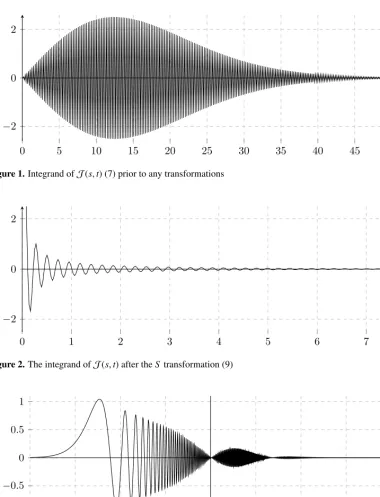
when λ andvare large. The rapid oscillations of the integrand of J(s,t) (7) can be observed in Figure 1.
3.1 Application of theS transformation
TheS transformation [2], converts the integrals involving spherical Bessel functions into sine integrals by first repeatedly differentiating with respect toxfollowed by dividing byx. Using this transforma-tion,J(s,t) Eq. (7) becomes
J(s,t)= 1 vλ+1
∞ 0 d
xdx
λ
xnx+λ+1
ˆ kν12
R
21γ12(s,x)
γ12(s,x)nγ12
ˆ kν34
R
34γ34(t,x)
γ34(t,x)nγ34
sin(vx) dx. (9)
Now by letting
g(s,t,x)≡g(x)=
d
xdx
λ
xnx+λ+1
ˆ kν12
R
21γ12(s,x)
γ12(s,x)nγ12 ˆ kν34
R
34γ34(t,x)
γ34(t,x)nγ34
, (10)
the integral in (9) can be rewritten as:
J(s,t)= 1 vλ+1
∞
0 g(x) sin(vx)dx. (11)
Since g(x) in Eq. (10) is a slowly decaying analytic function on (0,∞) and v is constant, the semi-infinite integral after theS transformation (11) is a suitable candidate for a DE transformation.
4 DE transformation
The DE transformations (see Ooura and Mori [13, 14] for details) provide an efficient way to approx-imate integrals of the form:
I=
∞
0 f0(x) dx =
∞
0 g0(x) sin(vx) dx, (12)
whereg0(x) is a slowly decaying analytic function on (0,+∞), andvis a constant. Letφ(τ) be such thatφ(τ) ∼τasτ→ ∞andφ(τ) ∼0 asτ→ −∞, and letM be some large positive constant. The variable transformationx=Mφ(τ) results in:
I=M
∞
−∞f0(M
φ(τ))φ(τ) dτ. (13)
The trapezoidal formula with a constant mesh sizeh:
I = Mh
∞
n=−∞
f0Mφ(nh)φ(nh) ≈ Mh N+
n=N−
In our application, this summation is not symmetric. For future reference, we define:
Sφ
n = Mh · f0Mφ(nh)φ(nh) =⇒ I ≈ N+
n=N−
Sφ
n. (15)
as well as
Iφ
N+ =
N+
n=0 Sφ
n and IφN−= −1
n=N−
Sφ
n. (16)
Two possible DE transformation functions are [13, 14]:
φ1(τ)=1−exp(−τKsinhτ) and φ2(τ)= 1−exp(−2x−α(1τ−e−τ)−β(eτ−1)), (17)
whereK=6,α=β/1+Mlog(1+M)/4π, andβ=1/4.
4.1 Application to the spherical Bessel integral
Sinceg(x) (10) is slowly decaying and analytic on (0,∞), the integral in (11) is of the same form as the integral in (12). It follows thatJ(s,t) (11) can be approximated using the DE transformation. Applying the transformationx=Mφ(τ) to (11) results in:
J(s,t)≈vMhλ+1 N+
n=N− g
Mφ
nh+ θ
M
φ
nh+ θ
M
=JM(s,t), (18)
wheregis defined in (10).
5 Numerical discussion
The approximation (18) was implemented in Python with the symbolic computation package SymPy, and calculations were completed using IEEE 754 double precision. To ensure that our integrator produced correct approximations, we compared our results with the output of a MATLAB built-in nu-merical integration function that uses global adaptive quadrature. In our implementation, we truncated the summation atN+>0 whenS
φ
N+/I φ
N+
<10−15and atN
−<0 whenSφN−/I φ
N−
<10−15.
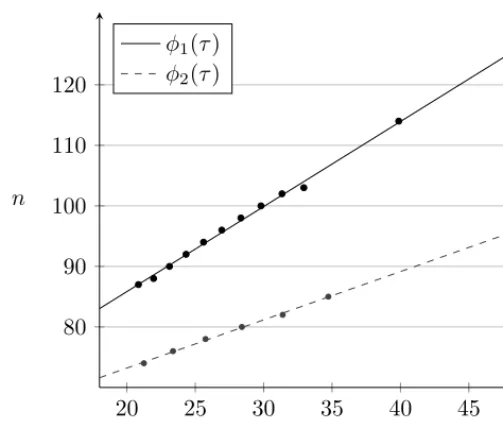
As can be seen in Figure 1 and Figure 2, theS transformation converts the spherical Bessel inte-grals into a simpler sine integral, but the integrand has slow convergence (Figure 2). The convergence is greatly improved by applying a DE variable transformationx = Mφ(τ) (Figure 3). Because the transformation induces rapid convergence to zero, sinc quadrature (trapezoidal rule) renders highly efficient approximation, and very few collocation points are required to obtain accurate results when using either transformationφ1(τ) orφ2(τ) (17). Usually, less collocation points are needed when using the transformationφ2(τ) to approximateJ(s,t) to a given degree of accuracy (Figure 4).
According to [13, 14], the relative error of the summationJM(s,t) (18) converges at a rate of approximately:
εM≈exp
−hc, (19)
wherecis a constant.
In our application, this summation is not symmetric. For future reference, we define:
Sφ
n = Mh· f0Mφ(nh)φ(nh) =⇒ I ≈ N+
n=N−
Sφ
n. (15)
as well as
Iφ
N+ =
N+
n=0 Sφ
n and INφ− = −1
n=N−
Sφ
n. (16)
Two possible DE transformation functions are [13, 14]:
φ1(τ)=1−exp(−τKsinhτ) and φ2(τ)= 1−exp(−2x−α(1τ−e−τ)−β(eτ−1)), (17)
whereK=6,α=β/1+Mlog(1+M)/4π, andβ=1/4.
4.1 Application to the spherical Bessel integral
Sinceg(x) (10) is slowly decaying and analytic on (0,∞), the integral in (11) is of the same form as the integral in (12). It follows thatJ(s,t) (11) can be approximated using the DE transformation. Applying the transformationx=Mφ(τ) to (11) results in:
J(s,t)≈vMhλ+1 N+
n=N− g
Mφ
nh+ θ
M
φ
nh+ θ
M
=JM(s,t), (18)
wheregis defined in (10).
5 Numerical discussion
The approximation (18) was implemented in Python with the symbolic computation package SymPy, and calculations were completed using IEEE 754 double precision. To ensure that our integrator produced correct approximations, we compared our results with the output of a MATLAB built-in nu-merical integration function that uses global adaptive quadrature. In our implementation, we truncated the summation atN+>0 whenS
φ
N+/I φ
N+
<10−15and atN
−<0 whenSφN−/I φ
N−
<10−15.
As can be seen in Figure 1 and Figure 2, theS transformation converts the spherical Bessel inte-grals into a simpler sine integral, but the integrand has slow convergence (Figure 2). The convergence is greatly improved by applying a DE variable transformation x = Mφ(τ) (Figure 3). Because the transformation induces rapid convergence to zero, sinc quadrature (trapezoidal rule) renders highly efficient approximation, and very few collocation points are required to obtain accurate results when using either transformationφ1(τ) orφ2(τ) (17). Usually, less collocation points are needed when using the transformationφ2(τ) to approximateJ(s,t) to a given degree of accuracy (Figure 4).
According to [13, 14], the relative error of the summationJM(s,t) (18) converges at a rate of approximately:
εM≈exp
−ch, (19)
wherecis a constant.
For our calculations, we setM = 65 for the transformationφ1(τ) and M = 25 for the transfor-mationφ2(τ). These values were selected because they proved to be large enough to reach a high
0 5 10 15 20 25 30 35 40 45 50
−2 0 2
x
Figure 1.Integrand ofJ(s,t) (7) prior to any transformations
0 1 2 3 4 5 6 7
−2 0 2
x
Figure 2.The integrand ofJ(s,t) after theStransformation (9)
−1.6 −1.2 −0.8 −0.4 0 0.4 0.8 1.2 1.6
−1
−0.5 0 0.5 1
τ
Figure 3. The integrand ofJ(s,t) after the S and DE transformationφ1(τ) where s = 0.999, t = 0.001,
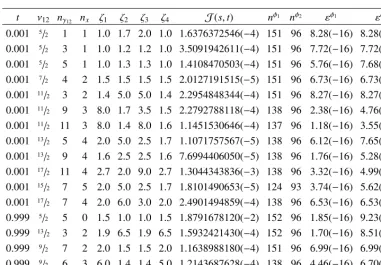
Table 1.Values ofJ(s,t) obtained using the approximation (18) with transformationsφ1(τ) andφ2(τ) (17),
wheres=0.999,ν34=ν12,nγ34 =nγ12,λ=nx,R12=2.5 andR34=5.0.
t ν12 nγ12 nx ζ1 ζ2 ζ3 ζ4 J(s,t) nφ1 nφ2 εφ1 εφ2
0.001 5/2 1 1 1.0 1.7 2.0 1.0 1.6376372546(−4) 151 96 8.28(−16) 8.28(−16)
0.001 5/2 3 1 1.0 1.2 1.2 1.0 3.5091942611(−4) 151 96 7.72(−16) 7.72(−16)
0.001 5/2 5 1 1.0 1.3 1.3 1.0 1.4108470503(−4) 151 96 5.76(−16) 7.68(−16)
0.001 7/2 4 2 1.5 1.5 1.5 1.5 2.0127191515(−5) 151 96 6.73(−16) 6.73(−16)
0.001 11/2 3 2 1.4 5.0 5.0 1.4 2.2954848344(−4) 151 96 8.27(−16) 8.27(−16)
0.001 11/2 9 3 8.0 1.7 3.5 1.5 2.2792788118(−4) 138 96 2.38(−16) 4.76(−16)
0.001 11/2 11 3 8.0 1.4 8.0 1.6 1.1451530646(−4) 137 96 1.18(−16) 3.55(−16)
0.001 13/2 5 4 2.0 5.0 2.5 1.7 1.1071757567(−5) 138 96 6.12(−16) 7.65(−16)
0.001 13/2 9 4 1.6 2.5 2.5 1.6 7.6994406050(−5) 138 96 1.76(−16) 5.28(−16)
0.001 17/2 11 4 2.7 2.0 9.0 2.7 1.3044343836(−3) 138 96 3.32(−16) 4.99(−16)
0.001 15/2 7 5 2.0 5.0 2.5 1.7 1.8101490653(−5) 124 93 3.74(−16) 5.62(−16)
0.001 17/2 7 4 2.0 6.0 3.0 2.0 2.4901494859(−4) 138 96 6.53(−16) 6.53(−16)
0.999 5/2 5 0 1.5 1.0 1.0 1.5 1.8791678120(−2) 152 96 1.85(−16) 9.23(−16)
0.999 13/2 3 2 1.9 6.5 1.9 6.5 1.5932421430(−4) 152 96 1.70(−16) 8.51(−16)
0.999 9/2 7 2 2.0 1.5 1.5 2.0 1.1638988180(−4) 151 96 6.99(−16) 6.99(−16)
0.999 9/2 6 3 6.0 1.4 1.4 5.0 1.2143687628(−4) 138 96 4.46(−16) 6.70(−16)
0.999 9/2 7 3 2.0 1.4 1.4 5.0 6.5370962436(−5) 138 96 4.15(−16) 6.22(−16)
•Numbers in parentheses represent powers of 10.
•nφ1andnφ2represent the total number of collocation points used for the summation in (18). •The values forMused in the summation (18) areM=65 forφ1(τ) andM=25 forφ2(τ).
•εφ1andεφ2are the approximate relative errors as in (20) using transformationφ1andφ2, respectively. •Summation is truncated atN+>0 whenSφN+/IφN+<10−15and atN−<0 whenSφN−/I
φ
N−
<10−15.
accuracy, while still small enough to keep the calculation times low. The need for a higher valueM for the transformationφ1(τ) in comparison with the lower valueM for the transformationφ2(τ) is a feature similar to the results reported in [1] for the three-center molecular integrals.
We calculate the relative approximate error of the approximation by:
εφ =
Sφ
N+
Iφ
N+
(20)
whereSφ
N+andI φ
Table 1.Values ofJ(s,t) obtained using the approximation (18) with transformationsφ1(τ) andφ2(τ) (17),
wheres=0.999,ν34=ν12,nγ34 =nγ12,λ=nx,R12=2.5 andR34=5.0.
t ν12 nγ12 nx ζ1 ζ2 ζ3 ζ4 J(s,t) nφ1 nφ2 εφ1 εφ2
0.001 5/2 1 1 1.0 1.7 2.0 1.0 1.6376372546(−4) 151 96 8.28(−16) 8.28(−16)
0.001 5/2 3 1 1.0 1.2 1.2 1.0 3.5091942611(−4) 151 96 7.72(−16) 7.72(−16)
0.001 5/2 5 1 1.0 1.3 1.3 1.0 1.4108470503(−4) 151 96 5.76(−16) 7.68(−16)
0.001 7/2 4 2 1.5 1.5 1.5 1.5 2.0127191515(−5) 151 96 6.73(−16) 6.73(−16)
0.001 11/2 3 2 1.4 5.0 5.0 1.4 2.2954848344(−4) 151 96 8.27(−16) 8.27(−16)
0.001 11/2 9 3 8.0 1.7 3.5 1.5 2.2792788118(−4) 138 96 2.38(−16) 4.76(−16)
0.001 11/2 11 3 8.0 1.4 8.0 1.6 1.1451530646(−4) 137 96 1.18(−16) 3.55(−16)
0.001 13/2 5 4 2.0 5.0 2.5 1.7 1.1071757567(−5) 138 96 6.12(−16) 7.65(−16)
0.001 13/2 9 4 1.6 2.5 2.5 1.6 7.6994406050(−5) 138 96 1.76(−16) 5.28(−16)
0.001 17/2 11 4 2.7 2.0 9.0 2.7 1.3044343836(−3) 138 96 3.32(−16) 4.99(−16)
0.001 15/2 7 5 2.0 5.0 2.5 1.7 1.8101490653(−5) 124 93 3.74(−16) 5.62(−16)
0.001 17/2 7 4 2.0 6.0 3.0 2.0 2.4901494859(−4) 138 96 6.53(−16) 6.53(−16)
0.999 5/2 5 0 1.5 1.0 1.0 1.5 1.8791678120(−2) 152 96 1.85(−16) 9.23(−16)
0.999 13/2 3 2 1.9 6.5 1.9 6.5 1.5932421430(−4) 152 96 1.70(−16) 8.51(−16)
0.999 9/2 7 2 2.0 1.5 1.5 2.0 1.1638988180(−4) 151 96 6.99(−16) 6.99(−16)
0.999 9/2 6 3 6.0 1.4 1.4 5.0 1.2143687628(−4) 138 96 4.46(−16) 6.70(−16)
0.999 9/2 7 3 2.0 1.4 1.4 5.0 6.5370962436(−5) 138 96 4.15(−16) 6.22(−16)
•Numbers in parentheses represent powers of 10.
•nφ1andnφ2represent the total number of collocation points used for the summation in (18). •The values forMused in the summation (18) areM=65 forφ1(τ) andM=25 forφ2(τ).
•εφ1andεφ2are the approximate relative errors as in (20) using transformationφ1andφ2, respectively. •Summation is truncated atN+>0 whenSφN+/IφN+<10−15and atN−<0 whenSφN−/I
φ
N−
<10−15.
accuracy, while still small enough to keep the calculation times low. The need for a higher valueM for the transformationφ1(τ) in comparison with the lower valueMfor the transformationφ2(τ) is a feature similar to the results reported in [1] for the three-center molecular integrals.
We calculate the relative approximate error of the approximation by:
εφ =
Sφ
N+
Iφ
N+
(20)
whereSφ
N+andI φ
N+are defined in (15) and (16), respectively.
20
25
30
35
40
45
50
80
90
100
110
120
log(ε)
n
φ
1(τ
)
φ
2(τ
)
Figure 4. The number of collocation pointsnneeded to complete the approximationJ(s,t) depending on the natural logarithm of the relative errorεwith the variable assignments from the first row of Table 1.
6 Conclusion
The computation of the multicenter two-electron Coulomb integrals involves the highest degree of difficulty in the molecular electronic structure calculations. The present paper proposed an efficient solution for the computation of the four-center two-electron Coulomb integrals expressed in terms of B functions. To this aim, the starting expression of such an integral is successively transformed by a procedure involving the following steps: (i) simplification using translations; (ii) use of the Fourier transform method yielding an expression in terms of a highly oscillatory semi-infinite integral, the integrand of which involves a spherical Bessel function; (iii) use of theS transform of Safouhi [2] which simplifies the problem by transforming the spherical Bessel integral into a semi-infinite sine integral with slowly decaying oscillatory integrand; (iv) use of the DE transformation of Ooura and Mori [13, 14] which results in a bi-infinite integral with fast decaying integrand at both infinities; (v) Sinc quadrature approximating the integral by a bi-infinite sum which can be truncated on both sides. As demonstrated in the numerical section, relatively few collocation points are needed to approximate such integrals to high accuracy.
References
[1] J. Lovrod, H. Safouhi, Molecular Physics (2019) 12 pp., DOI:10.1030/0026867.2019.1619854
[2] H. Safouhi, J. Phys. A: Math. Gen.34, 2801–2818 (2001)
[5] I. Shavitt,The Gaussian function in calculation of statistical mechanics and quantum mechanics, Methods in Computational Physics. 2. Quantum Mechanics(edited by B. Alder, S. Fernbach, M. Rotenberg, Academic Press, New York, 1963) pp. 1–45
[6] E. Steinborn, E. Filter, Theor. Chim. Acta.38, 273–281 (1975)
[7] G.N. Watson,A Treatise on the Theory of Bessel Functions(Cambridge University Press, Second Edition, Cambridge, UK, 1944)
[8] E. Filter, E.O. Steinborn, Phys. Rev. A.18, 1–11 (1978)
[9] E.U. Condon, G.H. Shortley,The Theory of Atomic Spectra(Cambridge University Press, Cam-bridge, UK, 1951)