Article
1
Genome-Wide Identification and Expression
2
Analysis of Growth-Regulating Factor Family Genes
3
in Sunflower(
Helianthus annuus
L.)
4
Jing Bing 1, Enshi Xiao 1*, Chunlian Li 1, Zhonghua Wang 1,2
5
1 College of Agronomy, Northwest A & F University, Yangling, Shaanxi, 712100, China
6
2 State Key Laboratory of Crop Stress Biology for Arid Areas, Northwest A & F University, Yangling,
7
Shaanxi, 712100, China
8
* Correspondence: [email protected]; Tel.: +86-133-8922-8120
9
Abstract: Growth-regulating factor (GRF) is a plant-specific transcription factor family, which is
10
involved in nearly all of the central developmental processes in plants. However, little is known
11
about GRF family genes in cultivated sunflower. In this study, 17 GRF genes were identified and
12
characterized from sunflower genome. Their gene structures, conserved motifs, chromosomal
13
distributions and phylogenetic relationships were analyzed. The expression patterns of these genes
14
were detected in various tissues of sunflower inbred line SK02R, which revealed that the 10
15
seed-specific GRF genes may play important roles during seed development in sunflower.
16
Additionally, transcripts changes of the GRFs under two major abiotic stresses and phytohormones
17
showed that most of the detected GRFs were reduced significantly by GA3 treatment, and other
18
treatments(ABA, NaCl and PEG6000) differently regulated various sunflower growth-regulating
19
factors at different time points. MiR396 target analysis indicated that there may exist a complicated
20
homeostasis between miR396 and its targets GRF and WRKY transcription factor genes in
21
cultivated sunflower. The phylogenetic and expression analyses of the GRF gene family in
22
sunflower would be useful for further cloning and function exploration of the HaGRF genes.
23
Keywords: sunflower; growth-regulating factor; expression pattern; abiotic stress
24
25
1. Introduction
26
Transcription factors(TF) are major regulators of gene expression, which could be classified into
27
various families mainly according to their conserved functional domains in eucaryotic organisms[1].
28
The growth-regulating factor (GRF) family is a plant-specific TF family, of which the first member
29
named OsGRF1 was identified in rice[2]. As many whole genomes of plants have been published, the
30
GRF family has been identified in various plant species, including Arabidopsis thaliana, Brassica rapa,
31
Nicotiana tabacum, Solanum tuberosum, Oryza sativa, Zea mays,Arachis hypogaeaand Camellia
32
sinensis[3-10]. Recent studies have gradually reported that the TF family members are involved in
33
almost all of the central developmental and some stress-responsive processes in plants[11].
34
GRF TF proteins contain two highly conserved domains named QLQ and WRC in their
35
N-termin regions and variable C-termin. The QLQ domain-contained region functions as an
36
indispensable element for protein interaction[2]. The plant-specific WRC-contained region is
37
predicted to be a nuclear localization signal and DNA binding domain of these TFs in plants[2,3,12].
38
The expression of GRF genes is generally more in growing tissues than that in mature zones, which
39
is accordance with their function in regulating cell proliferation and expansion[9,13,14].
40
GRF-interacting factors (GIF) are a group of transcriptional co-activators, which form a complex
41
with GRFs and regulate cell proliferation in developping of leaf and reproductive organs[14-17]. As
42
an abiotic stress-induced miRNA,miRNA396 targets many GRF transcripts, and then negectively
43
regulates expression of these GRF genes[18-21]. In contrast, it has been reported that some GRFs are
44
induced by abiotic stresses or ABA treatment[5,6] . These may suggest that there would be
45
furthermore complicated regulation network involved in GRF TFs, miRNA396 under abiotic
46
stresses. Genome-wide identification and expression profiles analysis of GRFs would facilitate the
47
revelation of GRF regulatory mechanism on plant development and abiotic stress responses.
48
For the relative wide adaption to various bad environmental conditions such as soil salinity and
49
drought, cultivated sunflower(Helianthus annuus L.) is one of the most important oil crops
50
worldwide, and has been researched as a model for understanding solar tracking of plants for
51
decades[22,23]. Recently, a high-quality assembled genome gave more detailed evolutionary and
52
genomic architecture informations of sunflower[24]. This data made it viable to identify and
53
characterize important gene families from whole genome of domesticated sunflower. In this study,
54
17 GRF family genes were identified from HanXRQ-SUNRISE (https://www.heliagene.org/
55
HanXRQ-SUNRISE/)[24]. We analyzed their gene structure, conserved motif and phylogenetic
56
relationships with newly assembled lettuce, sweet wormwood, arabidopsis, chinese cabbage, grape,
57
rice and maize. Expression patterns of these GRFs in eight tissues/organs were investigated using
58
both RNA-Sequencing(RNA-Seq) and qRT-PCR. RNA-Seq analysis was also performed to obtain
59
their expression responses to salt and simulated drought stresses at different time points within 24
60
hours. Furthermore, after treating with GA3 and ABA, expression levels changes of these genes were
61
also analyzed simultaneously.
62
2. Results
63
2.1. Identification and characterization of GRF genes in cultivated sunflower
64
To find all the GRFs in sunflower, QLQ(PF08880) and WRC(PF08879) domain search against all
65
proteins were performed in the sunflower genome (https://www.heliagene.org/
66
HanXRQ-SUNRISE/). A total of 17 proteins containing both of the two conserved domains were
67
identified. Blastp search using the 9 Arabidopsis GRF proteins as requries resulted in no further hits.
68
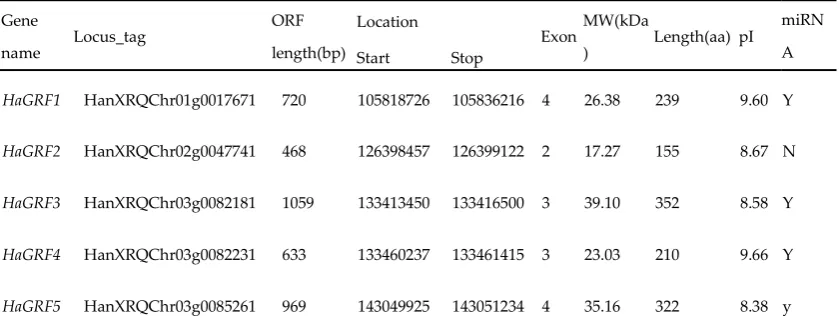
As showed in Table 1, these 17 GRF genes were named based on their chromosomal distribution and
69
location from top to bottom. The 17 GRF genes encode proteins ranging from 155(HaGRF2) to 508
70
(HaGRF12) amino acids in length, and from 17.27(HaGRF2) to 55.47(HaGRF12) kDa in molecular
71
weight respectively. MiR396 target analysis indicated that 14 of these 17 GRFs mRNA contained
72
miRNA396 target position in cultivated sunflower. HaGRFs were unequally distributed on 12 of the
73
17 chromosomes, with 3 members on the chromosome(chr)03, 2 on chr06 and chr13, only one on
74
chr(01,02,05,07,09,10,11,12,15) respectively(Table 1 and Figure S1). The other characteristics of the
75
individual GRF genes, including gene Locus_tag, ORF length, chromosomal location, number of
76
exons and isoelectric point (pI), are also given in Table 1.
77
Table 1 Informations of HaGRF genes
78
Gene
name Locus_tag
ORF length(bp)
Location
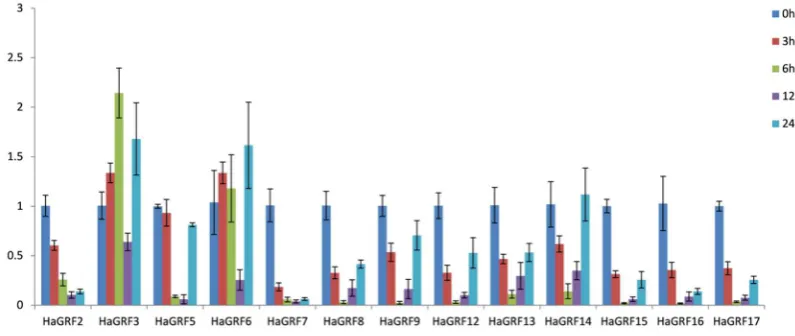
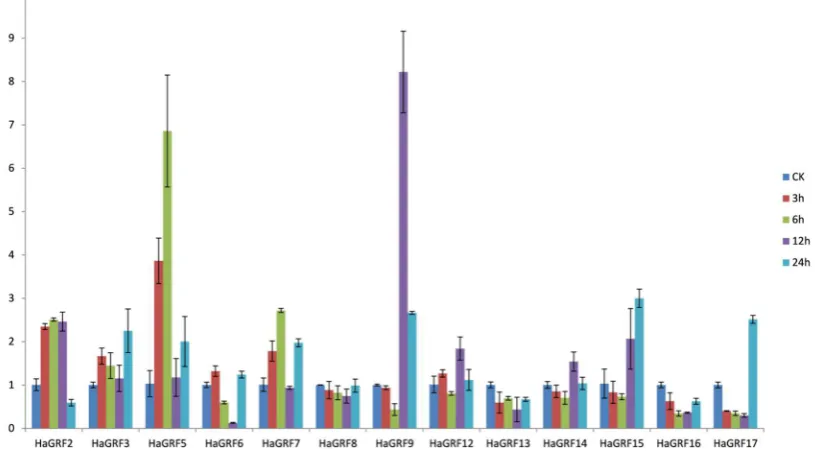
Exon MW(kDa
) Length(aa) pI miRN A Start Stop
HaGRF1 HanXRQChr01g0017671 720 105818726 105836216 4 26.38 239 9.60 Y
HaGRF2 HanXRQChr02g0047741 468 126398457 126399122 2 17.27 155 8.67 N
HaGRF3 HanXRQChr03g0082181 1059 133413450 133416500 3 39.10 352 8.58 Y
HaGRF4 HanXRQChr03g0082231 633 133460237 133461415 3 23.03 210 9.66 Y
HaGRF6 HanXRQChr05g0133051 1473 20408183 20410282 4 53.03 490 8.41 Y
HaGRF7 HanXRQChr06g0166741 1173 6661782 6664364 4 42.81 390 6.40 Y
HaGRF8 HanXRQChr06g0178171 975 46439440 46442161 3 37.19 324 7.27 Y
HaGRF9 HanXRQChr07g0192351 1065 42946365 42948208 4 39.01 354 7.59 Y
HaGRF10 HanXRQChr09g0276951 981 208226201 208227356 3 36.79 326 8.51 Y
HaGRF11 HanXRQChr10g0319661 612 245432914 245433781 4 23.47 203 9.49 N
HaGRF12 HanXRQChr11g0323531 1527 12861091 12866787 4 55.47 508 7.07 y
HaGRF13 HanXRQChr12g0354071 1002 347847 349919 3 38.10 333 8.17 y
HaGRF14 HanXRQChr13g0405031 1068 104381671 104387290 3 39.18 355 8.63 y
HaGRF15 HanXRQChr13g0414361 975 152931243 152933083 3 35.63 324 8.04 y
HaGRF16 HanXRQChr15g0493101 1152 143314681 143316747 4 41.93 383 9.56 N
HaGRF17 HanXRQChr00c0041g05 1515 10979 13270 4 54.50 504 8.45 Y
2.2. Gene structure, protein structure, and phylogenetic analysis of GRF genes
79
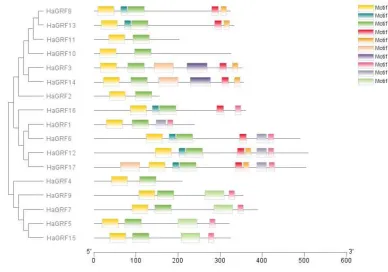
These GRF gene structures were analyzed using the GSDS online suite and schematically
80
illustrated based on their gene names. As showed in Figure 1, the number of GRF gene exons
81
ranges from 2 to 4, with 8 members possessing 3 exons, 8 possessing 4 exons and only the shortest
82
HaGRF2 containing 2 exons. The HaGRF1 gene possesses a 16.6 kb super intron, with a 7814bp LTR
83
retrotransposon. REpeat detector analysis showed that there were two repeat regions in this intron,
84
with 11281bp and 1367bp in length respectively. HaGRF17 was not located to any one of the 17
85
chromosomes, and none of the 17 GRFs located on chr17 of XRQ genome, whereas the gene
86
sequence of HaGRF17 was completely similar to that of HaGRF17-like1(Ha412v1r1_00g106720) in
87
Ha412 genome(Figure S2). Additionally, a 75bp length of inron fragment in HaGRF17 and
88
HaGRF17-like1 was found to be an individual exon in CDS of HaGRF17-like2(Ha412v1r1_17g006360)
89
(Figure S2). These findings indicated that HaGRF17 may be located on the 17th chromosome based
90
on the assembly result of Ha412 genome, HaGRF17-like1 and HaGRF17-like2 transcripts may be the
91
different products of HaGRF17 gene in sunflower. As most of the GRFs reported in other plant
92
species, the conserved WRC(motif1) and QLQ(motif2) domains were located in the N-termini of the
93
17 sunflower GRF proteins(Figure 2 and Figure S3). The HaGRF3, HaGRF6, HaGRF8, HaGRF12,
94
HaGRF13, HaGRF14, HaGRF16, HaGRF17 proteins shared a short stretch of amino acid residues
95
termed FFD(motif5) domain, HaGRF3, HaGRF8, HaGRF12, HaGRF13, HaGRF14, HaGRF17 shared
96
a TQL(motif8) domain, and HaGRF1, HaGRF5, HaGRF6, HaGRF7, HaGRF9, HaGRF12, HaGRF15,
97
HaGRF16, HaGRF17 shared a GGPL(motif3) domain in their C-termini(Figure 2). To further
98
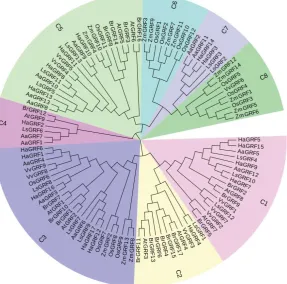
investigate the phylogenetic relationships of GRFs between sunflower and other plant species
99
in/out of compositae family, 13 GRFs were also identified in lettuce and sweet wormwood
100
genomes, respectively. A phylogenetic tree was generated, including the 17 HaGRFs in sunflower,
101
13 GRF proteins in lettuce, 13 members in sweet wormwood, 9 in arabidopsis,12 in rice,14 in
102
maize,17 in chinese cabbage and 9 in grape. All the GRFs were divided into eight subgroups based
103
C4 and C7 only contained GRFs from dicot species, and subgroup C6 only contained monocot
105
species. GRFs from Other subgroups such as C3,C5 and C8 contained GRFs members from both
106
dicot and monocot species.The 17 sunflower GRFs were classified into six of the eight subgroups,
107
except C6 and C8 subgroups. HaGRF5, HaGRF7, HaGRF9 and HaGRF15 which contained both
108
motif3(GGPL) and motif7 were clustered into subgroup C1. HaGRF1, HaGRF6, HaGRF12, and
109
HaGRF17 contained both motif3(GGPL) and motif6 were divided into subgroup C3. HaGRF8 and
110
HaGRF13 in subgroup of C5 contained motif4,motif5 and motif8. HaGRF3, HaGRF14 contained
111
motif5, motif8, motif9 and motif10 were clustered in subgroup C7.
112
113
Figure 1 Structures of the 17 HaGRF genes. Structural analyses of the HaGRF genes were performed using the
114
gene structure display server. The exons and introns are represented by green boxes and black lines,
115
respectively. The blue boxes are upstream/downstream regions.
116
117
Figure 2 Conserved motifs of the HaGRF proteins. The conserved motifs of HaGRF proteins were identified
118
using Multiple Em for Motif Elicitation (MEME). 10 predicted motifs are shown in different colors.
120
Figure 3 Phylogenetic tree of GRF proteins from sunflower(Ha), lettuce(Ls), sweet wormwood(Aa),
121
arabidopsis(At), chinese cabbage(Br), rice(Os), maize(Zm) and grape(Vv) were constructed using the
122
neighbor-jointing method with 1000 bootstrap replications. Eight clades(C1 to C8) were marked in different
123
colors.
124
2.3. Expression parttern of GRF genes in different tissues
125
Previous studies indicated that the gene expression pattern is associated with its function.
126
Expression profiles of sunflower GRF genes were analyzed in eight different sunflower
127
tissues/organs such as root, young leaf, mature leaf, shoot, seed, stamen, pistil and ligule using
128
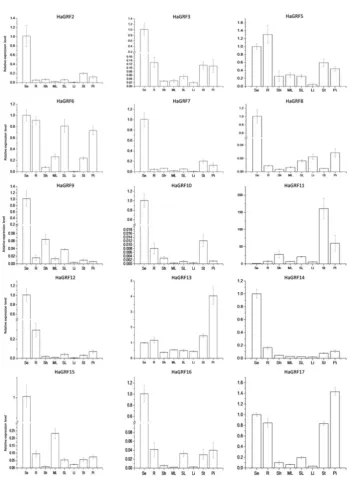
qRT-PCR. 15 of the GRF genes could be detected in at least one of the eight sunflower
129
tissues/organs. According to the results, 10 of the GRF genes(HaGRF2, HaGRF3, HaGRF7, HaGRF8,
130
HaGRF9, HaGRF10, HaGRF12, HaGRF14, HaGRF15 and HaGRF16) were highly expressed in
131
seed(Figure 4). The expression levels of HaGRF6 were relatively high in four
132
tissues(seed,root,young leaf, pistil), HaGRF17 were highly expressed in seed, root, stamen and
133
pistil, HaGRF5 in seed and root, HaGRF11 in stamen, HaGRF13 in pistil(Figure 4). These
134
tissue-specific expression of HaGRF genes indicated that this family genes may specifically play
135
important roles in seed, leaf and/or root development, respectively. It is worth noting that HaGRF3,
136
HaGRF8, HaGRF9, HaGRF10, HaGRF12, HaGRF14, HaGRF15 and HaGRF16 showed the highest
137
expression level in seed, indicating that these GRF genes may play important roles in seed
138
140
Figure 4 qRT-PCR analysis of HaGRF genes expression in eight different tissues, including seed(Se), root(R),
141
Shoot(Sh), mature leaf(ML),Young leaf(SL), Ligule(Li), Stamen(St), Pistil(Pi). Relative expression levels are
142
shown as means±SD.
143
2.4. Expression of GRF genes in response to ABA and GA3 treatments
144
After treating with ABA, the expressions of HaGRF3, HaGRF5, HaGRF8, HaGRF12 and
145
HaGRF13 genes were up-regulated by 2-fold or more at different time points compared to the
146
control. 6 hours after treating, the expressions of HaGRF8, HaGRF12 and HaGRF13 reached the
147
highest level. In contrast, the expressions of HaGRF2, HaGRF6, HaGRF7 and HaGRF14 genes were
148
suppressed by ABA. The expression changes of other sunflower GRF genes were not significant in
149
response to ABA(Figure 5). GA3 treatment induced expression of HaGRF3 and suppressed that of
150
other 12 GRF genes significantly. After 24-hour treatment, HaGRF5, HaGRF6, HaGRF9, HaGRF13
151
153
Figure 5 Expression patterns analysis of HaGRF genes treated with ABA by qRT-PCR. Relative expression
154
levels are shown as means±SD.
155
156
Figure 6 Expression profiles of HaGRF genes treated with GA3 by qRT-PCR. Relative expression levels are
157
shown as means±SD.
158
2.5. Expression of GRF genes under salt and PEG treatments
159
To examine the responses of GRF genes to salinity and drought in sunflower, qRT-PCR
160
analysis were performed to investigate expression patterns of GRF genes under NaCl and PEG
161
treatments. Expression of HaGRF2, HaGRF5, HaGRF7, HaGRF9, HaGRF12, HaGRF14 and HaGRF15
162
increased significantly at 6-hour and 12-hour points after treating with NaCl. Three HaGRF
163
members of subgroup C3, including HaGRF6, HaGRF16, HaGRF17 were down-regulated compared
164
to the control at 3-hour point(Figure 3 and Figure 7). qRT-PCR data also revealed that expression of
165
HaGRF2, HaGRF5, HaGRF7,HaGRF9 and HaGRF15 genes were induced by PEG treatment at
166
different time points, whereas that of HaGRF6, HaGRF16, HaGRF17 were repressed at 6 and 12-hour
167
points by this simulated drought(Figure 8). All of the four HaGRF genes in Subgroup C1 and
168
HaGRF2 the only HaGRF member of subgroup C4 were significantly induced by both salt and PEG
169
treatment. In contrast, expression of HaGRF6, HaGRF16, HaGRF17 in C3 were reduced by the two
170
abiotic stresses(Figure 3 to Figure 8). These findings indicated that HaGRFs in C1 and C3 clades
171
may function diversely in adapting or maintaining development of leaves under abiotic stresses
172
such as salinity and osmotic stress in cultivated sunflower.
173
175
Figure 7 Expression profiles of HaGRF genes under NaCl treatment. To calculate the relative expression level,
176
the expression of each GRF gene under control (0h) was set as 1. The results were represented as mean±SD.
177
178
Figure 8 Expression patterns analysis of HaGRF genes under drought by qRT-PCR. To calculate the relative
179
expression level, the expression of each GRF gene under control (0h) was set as 1. The results were represented
180
as mean±SD.
3. Discussion
183
As plant-specific transcription factors, GRFs were previously reported for their roles in almost
184
all of the important development processes such as root, stem, root, leaf, flower development, seed
185
formation, and in response to various hormones and abiotic stresses[25]. The GRF family has been
186
identified experimentally or in silico in various land plant species, including Arabidopsis thaliana,
187
Brassica napus, Glycine max, Nicotiana tabacum, Solanum tuberosum, Oryza sativa, Zea mays and
188
Camellia sinensis[5,6,25]. In this study, we identified 17 GRFs in sunflower mainly based on the
189
newly reported XRQ genome. HaGRF17(HanXRQChr00c 0041g0571301) was not assembled to any
190
one of the 17 chromosomes, and none of the 17 GRFs located on the 17th chromosome in XRQ
191
genome. Blastn analysis revealed that the gene sequence of HaGRF17 was completely similar to that
192
of predicted gene HaGRF17-like1 in Ha412 genome. Additionally, A gene HaGRF17-like2 shared
193
high similar nt sequence with HaGRF17. A 75bp length of additional nucleotides was found as an
194
individual exon in CDS of HaGRF17-like2(Figure S2). RNA-seq data mapped on these two genes
195
showed that the 75bp nucleotides could be detected in leaf and stem under drought stress[24].
196
These results indicated that transcripts of HaGRF17-like1(or HaGRF17 in XRQ genome) and
197
HaGRF17-like2 may be the different products of alternative mRNA editing in sunflower.
198
Considering most of the GRFs exon number ranged from 3 to 4, HaGRF17 may be the only GRF
199
with 5 exons, and only HaGRF2 with 2 exons.
200
Many studies had reported that the GRF family genes were differentially expressed in various
201
tissues/organs of other plant species[5,6,9,26-28]. Our tissue-specific expression analysis indicated
202
that 10 of the 17 GRFs were expressed in developing seed specifically, and other 3 were also highly
203
expressed in root, stamen or silique(Figure 4). It has been reported that transcripts levels of
204
BnGRF2a and BnGRF2b in ovules of the high-oil seeds were higher than that of in low-oil seeds,and
205
over-expression of BnGRF2a increased seed mass and oil yield compared to the control[29]. Our
206
tissue-specific expression analysis sugguested that these seed specifically or highly expressed GRF
207
genes may play more important roles on seed development, and then affect seed weight or oil
208
content in cultivated sunflower. Further biological function exploration and regulatory mechanism
209
illumination of these seed highly expressed HaGRFs would be helpful for increasing oil yield of
210
cultivated sunflower.
211
Not all of the predicted GRF genes were detected effectively by qRT-PCR. Expression of
212
HaGRF1 and HaGRF4 could not be detected in any one of the eight tissues by qRT-PCR. It has been
213
reported that more than 75% of the sunflower genome consisted of long terminal repeat
214
retrotransposons (LTR-RTs)[24]. Gene structure analysis revealed that there was a 7814bp LTR
215
retrotransposon in the 16.6 kb super intron of HaGRF1, which may impaired expression of this gene.
216
Most of reported GRF genes contain both the QLQ and WRC domains in other plant species[25],
217
whereas Blastp results showed that there were 4 predicted proteins only containing QLQ domain,
218
and 8 only possessing WRC domain in XRQ genome database. It is now unclear whether these
219
genes function as identified GRFs or not.
220
Previous studies had found that many GRF genes were induced by GA3 in some plant
221
species[4,5], but a few others were not being affected[3,30], and even some were suppressed
222
simultaneously[6]. Our data showed that GA3 treatment slightly induced expression of HaGRF3,
223
but suppressed that of other 12 GRFs in young leaf(Figure 6). It has been known that GA3 plays a
224
positive role in cell proliferation,and then regulates expansion of young leaf[31]. KNOX
225
homeodomain proteins have been reported to suppress expression of gibberellins biosynthetic
226
genes such as AtGA20ox1 in Arabidopsis[32] and Ntc12 in the tobacco shoot apical meristem[33]. As
227
repressors of KNOX genes, GRFs promote cell division[34]. These results suggest that some GRF
228
genes may function in maintaining or promoting cell division by a feedback regulation mechanism,
229
in which the GRF genes positively regulate the production of gibberellins, and then excessive GA3
230
in turn down-regulate GRF gene expression, maintaining gibberellins homeostasis in sunflower.
231
As a central regulator of abiotic stress signalling network, ABA regulates expression of abiotic
232
stress responsiveness genes in most upland plants[35]. Previous studies had found that ABA
233
expression levels of some GRF genes were induced or repressed when exposed to salt and
235
simulated drought, but not regulated significantly by ABA(Figure 5 and Figure 7-8). These results
236
suggest that HaGRF genes are involved in abiotic stress responses via ABA-dependent and
237
ABA-independent signaling pathways at least at transcript level. HaGRF2, the only HaGRF member
238
of subgroup C4 was significantly induced by both salt and PEG treatment. AtGRF9 clustered in C4
239
negatively regulate leaf growth by activating expression of the bZIP TF OBP3-RESPONSIVE GENE
240
3 (ORG3)[36]. These facts indicated that HaGRF2 may also function in reducing leaf size under salt
241
and drought stresses in sunflower. miRNAs are critical regulators of many development and abiotic
242
stress signaling processes in plants. It has been reported that the miR396 control many organs
243
growth via post-transcriptional regulating GRF genes, and the miR396/GRF module is conserved in
244
plants[25,37-39]. miR396 and the targets GRF genes established a homeostasis by negatively
245
regulating each other’s expression[40]. Sequence analysis revealed that 14 HaGRF genes have the
246
miR396 target sites,which confirmed the existence of this regulatory module in sunflower.
247
Additionally, a predicted WRC domain-contained gene HanXRQChr03g0093741 and three
248
sunflower WRKY genes also possess miR396 target sites. It has been reported that high temperature
249
induced expression of HaWRKY6 and repressed hamiRNA396, and further evidence indicated that
250
miRNA396 regulated HaWRKY6 in sunflower[41]. As members of an important abiotic stress
251
responsive transcription factors family in plant species[42,43], the three WRKY genes may be
252
involved in the homeostasis between miR396 and the target HaGRF genes under abiotic stresses
253
such as salinity, drought, high temperature in sunflower.
254
4. Materials and Methods
255
4.1. Identification of GRF family genes in sunflower
256
The Sunflower (Helianthus annuus L.)genome from HanXRQ-SUNRISE
257
(https://www.heliagene.org/ HanXRQ-SUNRISE/) was used to identify HaGRF genes. Protein files
258
of lettuce(Lactuca sativa L.) and sweet wormwood(Artemisia annua L.) were downloaded from
259
NCBI genome(https://www.ncbi.nlm.nih.gov/genome).The Hidden Markov Model profiles of the
260
GRF family domains PF08880 and PF08879 were downloaded from Pfam(http://pfam.xfam.org/) and
261
used as queries to search for candidate GRF genes by hmmer
262
3.2.1(http://hmmer.org/download.html).Furthermore, all the candidate genes were analyzed to
263
confirm the presence of the conserved QLQ(PF08880) and WRC(PF08879) domains using SMART
264
(http://smart.embl-heidelberg.de/), and CDD(Conserved Domain Database)
265
(http://www.ncbi.nlm.nih.gov/Structure/cdd/cdd.shtml).
266
4.2. Chromosome location and phylogenetic analysis
267
The physical positions of HaGRF genes were extracted from annotation gff3-file in
268
HanXRQ-SUNRISE(https://www.heliagene.org/HanXRQ-SUNRISE/) and mapped to 17
269
chromosomes in the sunflower genome using MapChart 2.3. For phylogenetic analysis, full-length
270
GRF amino acid sequences of sunflower, lettuce, sweet wormwood, arabidopsis, chinese cabbage,
271
grape, rice and maize were aligned using Clustal X 2.1 software, and MEGA 5.1 was used to
272
construct a neighbor-joining (NJ) tree using the Bootstrap method with 1000 replicates..
273
4.3. Gene structures and protein motifs analysis
274
The Gene Structure Display Server (GSDS: http://gsds.cbi.pku.edu.cn/) online tool was used to
275
construct diagrams of HaGRFs exon-intron structures. Conserved motifs of putative HaGRF
276
proteins were predicted with Multiple EM for Motif Elicitation (MEME: http://meme-suite.org/) with
277
default settings for motif width (between 6 and 50 wide) and site distribution (zero or one
278
4.4. Plant materials and treatments
280
All the samples of tissues/organs, such as root,young leaf,mature leaf, shoot, stamen, pistil,
281
seed, ligule were collected from sunflower line SK02R at the field in Northwest A&F University,
282
Shaanxi, China. For stress and hormone treatments, the seeds of SK02R were germinated on wet
283
filter paper for 3 days at 25 °C and then grown in MS solution in plant growth chambers at a
284
temperature regime of 25/22 °C, light intensity of 15000 lx and photoperiod of 14 hour light/10 hour
285
dark. After the expansion of four true leaves, the plantlets were subjected to different abiotic stress
286
and hormone treatments. The plantlets were cultivated in MS solution supplemented with 200 mM
287
NaCl for the salt treatment, 15%(v/v) polyethylene glycol 6000 for the drought treatment, sprayed
288
with 0.2 mM ABA for the ABA treatment and sprayed with 1 mM gibberellic acid for GA3 treatment.
289
The leaves of treated plantlets were harvested at 0, 3,6,12 and 24 hour.All of the harvested samples
290
were frozen in liquid nitrogen and stored at −80 °C until total RNA was extracted.
291
4.5. Expression pattern analysis of HaGRFs using qRT-PCR
292
Total RNA was extracted using Trizol reagent according to the manufacturer’s
293
instructions(Invitrogen, Carlsbad, CA, USA). qRT-PCR was conducted in a StepOneTM Real-Time
294
PCR system (Applied Biosystems). The RT-qPCR was carried out in a 25 μL reaction volume
295
containing 12 μL 2 × SuperReal PreMix Plus, 0.5 μL 50 × ROX Reference Dye, 0.5 μL forward primer
296
(10 μM), 0.5 μL reverse primer(10 μM), 2.0 μL cDNA (100 ng/μL), and 4.5 μL RNase-free ddH2O,
297
following the instructions of the SuperReal PreMix Plus (SYBR Green) kit (Tiangen,Beijing, China).
298
The thermal cycling conditions were polymerase activation at 95 °C for 15 min, followed by 40 cycles
299
of denaturation at 95 °C for 10 s, annealing at 60 °C for 30 s and elongation at 72 °C for 32 s. Acin was
300
selected as the reference gene to normalize gene expression data in real-time RT-PCR. The results
301
were then analysed via the 2−△△CT
method. Three technical replicates were performed with each of
302
the three biological replicates.
303
5. Conclusions
304
In the present study, we identified and characterized 17 GRF genes in sunflower genome.
305
Their gene structure, conserved motif, phylogenetic relationship and chromosome location
306
informations were provided. The expression profiles of these genes in different sunflower organs
307
were obtained by qRT-PCR analysis, which indicated that 9 GRFs highly expressed in seed may
308
play important roles in seed development. The expression data, together with available regulation
309
relationships for GRF genes, suggested that HaGRF genes may function in maintaining or
310
promoting cell division by a feedback regulation mechanism in sunflower. Their different responses
311
to ABA and abiotic stresses(NaCl, PEG6000) gave us a cue that GRFs regulate leaf development by
312
both ABA-dependent and ABA-independent pathways at transcript level under abiotic stresses.
313
miR396 targets findings suggested that there may exist a homeostasis involving miR396 and its
314
abiotic stress responsive targets(three WRKY genes and 15 WRC-contained genes) in cultivated
315
sunflower. Further studies need to be done for illuminating their biological functions and
316
regulation mechanisms in developmental and abiotic stress responsive processes in sunflower..
317
Additional file 1: Table S1. Sequence of GRF proteins from lettuce, sweet wormwood, arabidopsis, chinese
318
cabbage, rice, maize and grape.
319
Additional file 2: Table S2. qRT-PCR primers used in this article.
320
Additional file 3: Figure S1. Distribution of 17 GRF genes on the 17 sunflower chromosomes.
321
Additional file 4: Figure S2. Multiple sequence alignment of HaGRF17 (HanXRQChr00c0041g0571),
322
Ha412v1r1_00g106720 and Ha412v1r1_17g006360.
323
Additional file 5: Figure S3. Alignment of the conserved regions of the 17 HaGRF proteins.
Author Contributions: Data curation, Jing Bing; Funding acquisition, Jing Bing and Xiao Enshi; Investigation,
325
Jing Bing and Wang Zhonghua; Project administration, Li Chunlian and Wang Zhonghua; Resources, Xiao
326
Enshi.
327
Funding: This research was funded by by the National Natural Science Foundation of China (31601335); China
328
agriculture research system(CARS-14-2-21); the Fundamental Research Funds for the Central
329
Universities(2452016012). All these funding play roles in the design of the study and collection, analysis, and
330
interpretation of data and in writing the manuscript.
331
Acknowledgments: In this section you can acknowledge any support given which is not covered by the author
332
contribution or funding sections. This may include administrative and technical support, or donations in kind
333
(e.g., materials used for experiments).
334
Conflicts of Interest:
335
The authors declare no conflict of interest.
336
Abbreviations
337
TF Transcription factors GRF growth-regulating factor ABA Abscisic acid
GA3 Gibberellin A3
PEG6000 polyethylene glycol 6000 CDS Coding sequence
MEME Multiple expectation maximization for motif elicitation MS Murashige and skoog
qRT-PCR Quantitative real time PCR
References
338
1. Jin, J.; Tian, F.; Yang, D.C.; Meng, Y.Q.; Kong, L.; Luo, J.; Gao, G. PlantTFDB 4.0: toward a central hub
339
for transcription factors and regulatory interactions in plants. Nucleic acids research 2017, 45,
340
D1040-D1045, doi:10.1093/nar/gkw982.
341
2. van der Knaap, E.; Kim, J.H.; Kende, H. A novel gibberellin-induced gene from rice and its potential
342
regulatory role in stem growth. Plant physiology 2000, 122, 695-704.
343
3. Kim, J.H.; Choi, D.; Kende, H. The AtGRF family of putative transcription factors is involved in leaf
344
and cotyledon growth in Arabidopsis. The Plant journal 2003, 36, 94-104.
345
4. Wang, F.; Qiu, N.; Ding, Q.; Li, J.; Zhang, Y.; Li, H.; Gao, J. Genome-wide identification and analysis of
346
the growth-regulating factor family in Chinese cabbage (Brassica rapa L. ssp. pekinensis). BMC
347
genomics 2014, 15, 807, doi:10.1186/1471-2164-15-807.
348
5. Zhang, J.; Li, Z.; Jin, J.; Xie, X.; Zhang, H.; Chen, Q.; Luo, Z.; Yang, J. Genome-wide identification and
349
analysis of the growth-regulating factor family in tobacco (Nicotiana tabacum). Gene 2018, 639,
350
117-127, doi:10.1016/j.gene.2017.09.070.
351
6. Khatun, K.; Robin, A.H.K.; Park, J.I.; Nath, U.K.; Kim, C.K.; Lim, K.B.; Nou, I.S.; Chung, M.Y.
352
Molecular Characterization and Expression Profiling of Tomato GRF Transcription Factor Family
353
Genes in Response to Abiotic Stresses and Phytohormones. International journal of molecular sciences
354
2017, 18, doi:10.3390/ijms18051056.
355
7. Choi, D.; Kim, J.H.; Kende, H. Whole genome analysis of the OsGRF gene family encoding
356
plant-specific putative transcription activators in rice (Oryza sativa L.). Plant & cell physiology 2004, 45,
357
897-904, doi:10.1093/pcp/pch098.
8. Wu, L.; Zhang, D.; Xue, M.; Qian, J.; He, Y.; Wang, S. Overexpression of the maize GRF10, an
359
endogenous truncated growth-regulating factor protein, leads to reduction in leaf size and plant
360
height. Journal of integrative plant biology 2014, 56, 1053-1063, doi:10.1111/jipb.12220.
361
9. Wu, Z.J.; Wang, W.L.; Zhuang, J. Developmental processes and responses to hormonal stimuli in tea
362
plant (Camellia sinensis) leaves are controlled by GRF and GIF gene families. Functional & integrative
363
genomics 2017, 17, 503-512, doi:10.1007/s10142-017-0553-0.
364
10. Zhao, K.; Li, K.; Ning, L.; He, J.; Ma, X.; Li, Z.; Zhang, X.; Yin, D. Genome-Wide Analysis of the
365
Growth-Regulating Factor Family in Peanut (Arachis hypogaea L.). International journal of molecular
366
sciences 2019, 20, doi:10.3390/ijms20174120.
367
11. Li, X.; Jin, F.; Jin, L.; Jackson, A.; Ma, X.; Shu, X.; Wu, D.; Jin, G. Characterization and comparative
368
profiling of the small RNA transcriptomes in two phases of flowering in Cymbidium ensifolium. BMC
369
genomics 2015, 16, 622, doi:10.1186/s12864-015-1764-1.
370
12. Bachlava, E.; Tang, S.; Pizarro, G.; Schuppert, G.F.; Brunick, R.K.; Draeger, D.; Leon, A.; Hahn, V.;
371
Knapp, S.J. Pleiotropy of the branching locus (B) masks linked and unlinked quantitative trait loci
372
affecting seed traits in sunflower. Theoretical and applied genetics 2010, 120, 829-842,
373
doi:10.1007/s00122-009-1212-1.
374
13. Vercruyssen, L.; Tognetti, V.B.; Gonzalez, N.; Van Dingenen, J.; De Milde, L.; Bielach, A.; De Rycke, R.;
375
Van Breusegem, F.; Inze, D. GROWTH REGULATING FACTOR5 stimulates Arabidopsis chloroplast
376
division, photosynthesis, and leaf longevity. Plant physiology 2015, 167, 817-832,
377
doi:10.1104/pp.114.256180.
378
14. Zhang, D.; Sun, W.; Singh, R.; Zheng, Y.; Cao, Z.; Li, M.; Lunde, C.; Hake, S.; Zhang, Z. GRF-interacting
379
factor1 Regulates Shoot Architecture and Meristem Determinacy in Maize. The Plant cell 2018, 30,
380
360-374, doi:10.1105/tpc.17.00791.
381
15. Lee, S.J.; Lee, B.H.; Jung, J.H.; Park, S.K.; Song, J.T.; Kim, J.H. GROWTH-REGULATING FACTOR and
382
GRF-INTERACTING FACTOR Specify Meristematic Cells of Gynoecia and Anthers. Plant physiology
383
2018, 176, 717-729, doi:10.1104/pp.17.00960.
384
16. Li, S.; Gao, F.; Xie, K.; Zeng, X.; Cao, Y.; Zeng, J.; He, Z.; Ren, Y.; Li, W.; Deng, Q., et al. The
385
OsmiR396c-OsGRF4-OsGIF1 regulatory module determines grain size and yield in rice. Plant
386
biotechnology journal 2016, 14, 2134-2146, doi:10.1111/pbi.12569.
387
17. Hoe Kim, J.; Tsukaya, H. Regulation of plant growth and development by the
388
GROWTH-REGULATING FACTOR and GRF-INTERACTING FACTOR duo. Journal of experimental
389
botany 2015, 66, 6093-6107, doi:10.1093/jxb/erv349.
390
18. Liu, D.; Song, Y.; Chen, Z.; Yu, D. Ectopic expression of miR396 suppresses GRF target gene expression
391
and alters leaf growth in Arabidopsis. Physiologia plantarum 2009, 136, 223-236,
392
doi:10.1111/j.1399-3054.2009.01229.x.
393
19. Rodriguez, R.E.; Mecchia, M.A.; Debernardi, J.M.; Schommer, C.; Weigel, D.; Palatnik, J.F. Control of
394
cell proliferation in Arabidopsis thaliana by microRNA miR396. Development 2010, 137, 103-112,
395
doi:10.1242/dev.043067.
396
20. Debernardi, J.M.; Rodriguez, R.E.; Mecchia, M.A.; Palatnik, J.F. Functional specialization of the plant
397
miR396 regulatory network through distinct microRNA-target interactions. PLoS genetics 2012, 8,
398
e1002419, doi:10.1371/journal.pgen.1002419.
21. Hewezi, T.; Maier, T.R.; Nettleton, D.; Baum, T.J. The Arabidopsis microRNA396-GRF1/GRF3
400
regulatory module acts as a developmental regulator in the reprogramming of root cells during cyst
401
nematode infection. Plant physiology 2012, 159, 321-335, doi:10.1104/pp.112.193649.
402
22. Rieseberg, L.H.; Fossen, C.V.; Desrochers, A.M. Hybrid speciation accompanied by genomic
403
reorganization in wild sunflowers. Nature 1995, 375, 313-316.
404
23. Vandenbrink, J.P.; Brown, E.A.; Harmer, S.L.; Blackman, B.K. Turning heads: The biology of solar
405
tracking in sunflower. Plant Science 2014, 224, 20-26.
406
24. Badouin, H.; Gouzy, J.; Grassa, C.J.; Murat, F.; Staton, S.E.; Cottret, L.; Lelandais-Briere, C.; Owens,
407
G.L.; Carrere, S.; Mayjonade, B., et al. The sunflower genome provides insights into oil metabolism,
408
flowering and Asterid evolution. Nature 2017, 546, 148-152, doi:10.1038/nature22380.
409
25. Omidbakhshfard, M.A.; Proost, S.; Fujikura, U.; Mueller-Roeber, B. Growth-Regulating Factors
410
(GRFs): A Small Transcription Factor Family with Important Functions in Plant Biology. Molecular
411
plant 2015, 8, 998-1010, doi:10.1016/j.molp.2015.01.013.
412
26. Ma, J.Q.; Jian, H.J.; Yang, B.; Lu, K.; Zhang, A.X.; Liu, P.; Li, J.N. Genome-wide analysis and expression
413
profiling of the GRF gene family in oilseed rape (Brassica napus L.). Gene 2017, 620, 36-45,
414
doi:10.1016/j.gene.2017.03.030.
415
27. Liu, X.; Guo, L.X.; Jin, L.F.; Liu, Y.Z.; Liu, T.; Fan, Y.H.; Peng, S.A. Identification and transcript profiles
416
of citrus growth-regulating factor genes involved in the regulation of leaf and fruit development.
417
Molecular biology reports 2016, 43, 1059-1067, doi:10.1007/s11033-016-4048-1.
418
28. Shang, S.; Wu, C.; Huang, C.; Tie, W.; Yan, Y.; Ding, Z.; Xia, Z.; Wang, W.; Peng, M.; Tian, L., et al.
419
Genome-Wide Analysis of the GRF Family Reveals Their Involvement in Abiotic Stress Response in
420
Cassava. Genes 2018, 9, doi:10.3390/genes9020110.
421
29. Liu, J.; Hua, W.; Yang, H.L.; Zhan, G.M.; Li, R.J.; Deng, L.B.; Wang, X.F.; Liu, G.H.; Wang, H.Z. The
422
BnGRF2 gene (GRF2-like gene from Brassica napus) enhances seed oil production through regulating
423
cell number and plant photosynthesis. Journal of experimental botany 2012, 63, 3727-3740,
424
doi:10.1093/jxb/ers066.
425
30. Choi, D.; Kim, J.H.; Kende, H. Whole genome analysis of the OsGRF gene family encoding
426
plant-specific putative transcription activators in rice (Oryza sativa L.). Plant & cell physiology 2004, 45,
427
897-904.
428
31. Singh, D.P.; Jermakow, A.M.; Swain, S.M. Gibberellins are required for seed development and pollen
429
tube growth in Arabidopsis. The Plant cell 2002, 14, 3133-3147, doi:10.1105/tpc.003046.
430
32. Chen, H.; Banerjee, A.K.; Hannapel, D.J. The tandem complex of BEL and KNOX partners is required
431
for transcriptional repression of ga20ox1. The Plant journal 2004, 38, 276-284,
432
doi:10.1111/j.1365-313X.2004.02048.x.
433
33. Sakamoto, T.; Kamiya, N.; Ueguchi-Tanaka, M.; Iwahori, S.; Matsuoka, M. KNOX homeodomain
434
protein directly suppresses the expression of a gibberellin biosynthetic gene in the tobacco shoot apical
435
meristem. Genes & development 2001, 15, 581-590, doi:10.1101/gad.867901.
436
34. Vercruyssen, L.; Tognetti, V.B.; Gonzalez, N.; Van Dingenen, J.; De Milde, L.; Bielach, A.; De Rycke, R.;
437
Van Breusegem, F.; Inze, D. GROWTH REGULATING FACTOR5 Stimulates Arabidopsis Chloroplast
438
Division, Photosynthesis, and Leaf Longevity. Plant physiology 2015, 167, 817-832,
439
doi:10.1104/pp.114.256180.
440
35. Zhu, J.K. Abiotic Stress Signaling and Responses in Plants. Cell 2016, 167, 313-324,
441
doi:10.1016/j.cell.2016.08.029.
36. Omidbakhshfard, M.A.; Fujikura, U.; Olas, J.J.; Xue, G.P.; Balazadeh, S.; Mueller-Roeber, B.
443
GROWTH-REGULATING FACTOR 9 negatively regulates arabidopsis leaf growth by controlling
444
ORG3 and restricting cell proliferation in leaf primordia. PLoS genetics 2018, 14, e1007484,
445
doi:10.1371/journal.pgen.1007484.
446
37. Ercoli, M.F.; Rojas, A.M.; Debernardi, J.M.; Palatnik, J.F.; Rodriguez, R.E. Control of cell proliferation
447
and elongation by miR396. Plant signaling & behavior 2016, 11, e1184809,
448
doi:10.1080/15592324.2016.1184809.
449
38. Liang, G.; He, H.; Li, Y.; Wang, F.; Yu, D. Molecular mechanism of microRNA396 mediating pistil
450
development in Arabidopsis. Plant physiology 2014, 164, 249-258, doi:10.1104/pp.113.225144.
451
39. Debernardi, J.M.; Mecchia, M.A.; Vercruyssen, L.; Smaczniak, C.; Kaufmann, K.; Inze, D.; Rodriguez,
452
R.E.; Palatnik, J.F. Post-transcriptional control of GRF transcription factors by microRNA miR396 and
453
GIF co-activator affects leaf size and longevity. The Plant journal 2014, 79, 413-426,
454
doi:10.1111/tpj.12567.
455
40. Hewezi, T.; Baum, T.J. Complex feedback regulations govern the expression of miRNA396 and its GRF
456
target genes. Plant signaling & behavior 2012, 7, 749-751, doi:10.4161/psb.20420.
457
41. Giacomelli, J.I.; Weigel, D.; Chan, R.L.; Manavella, P.A. Role of recently evolved miRNA regulation of
458
sunflower HaWRKY6 in response to temperature damage. The New phytologist 2012, 195, 766-773,
459
doi:10.1111/j.1469-8137.2012.04259.x.
460
42. Chen, L.; Song, Y.; Li, S.; Zhang, L.; Zou, C.; Yu, D. The role of WRKY transcription factors in plant
461
abiotic stresses. Biochimica et biophysica acta 2012, 1819, 120-128, doi:10.1016/j.bbagrm.2011.09.002.
462
43. Ren, X.; Chen, Z.; Liu, Y.; Zhang, H.; Zhang, M.; Liu, Q.; Hong, X.; Zhu, J.K.; Gong, Z. ABO3, a WRKY
463
transcription factor, mediates plant responses to abscisic acid and drought tolerance in Arabidopsis.
464
The Plant journal 2010, 63, 417-429, doi:10.1111/j.1365-313X.2010.04248.x.