Comparative Analysis of Hierarchical Routing in
Wireless Sensor Networks
Ankita Bindlish, Anish Soni
Department of Computer Science & Engineering, HCTM TECHNICAL CAMPUS, Kaithal, India
Abstract— Wireless sensor networks consist of small nodes with sensing, computation, and wireless communications capabilities. Many routing, power management, and data dissemination protocols have been specifically designed for WSNs where energy awareness is an essential design issue [1]. Sensors in wireless sensor networks work on battery and have limited energy. Hence, they have a limited lifetime. Routing protocol plays a major role in deciding for how much time a network will survive. All routing algorithms tend to increase lifetime of a wireless sensor network while maintaining factors like successful and real-time delivery of a message. Hierarchical clustering of nodes and routing as per clusters contributes in reducing energy consumption and increasing lifetime of a network [2]. This paper aims towards studying hierarchical-based routing protocols [3] where nodes are considered to be forming clusters and one of the nodes acts as a cluster-head in a cluster. Four hierarchical routing protocols that are LEACH, EHRP, SEP and FAIR have been studied and simulated. The performance of each routing protocol is measured on some performance parameters like network lifetime, packets transferred to BS, number of dead nodes etc.
Keywords— Hierarchical Routing Protocols, Wireless Sensor Networks, LEACH, EHRP, SEP, Energy-efficient, Network Lifetime.
I. INTRODUCTION
A sensor network is a system that consists of thousands of very small stations called sensor nodes [6]. The main function of sensor nodes is to monitor, record, and notify a specific condition at various locations to other stations. Conditions can be temperature, humidity, wind, pressure, vibrations, sound, and so many more. In order for such nodes to sense, compute and communicate, they should rely on a battery to stay active. Eventually, the low-power circuit and networking technologies today make such sensors rely on 2 AA Batteries and can stay alive for up to three years with a I% low duty cycle mode. With wireless communications, the thousands of sensors within a network can communicate through various channels in a wireless fashion. Along with these components, a base station is required in the architecture.
II.ROUTINGINWIRELESSSENSORNETWORKS Routing in sensor networks differs from the one in the traditional IP Networks. Unlike the Internet Protocol Suit adopted in the TCP/IP architecture, other routing systems have been developed for sensor networks. In fact, getting data from all the thousands of sensors eventually results in
the receipt of irrelevant and redundant data from nodes, which is definitely not efficient at the level of storage and energy. Therefore, instead of having the routing system acting as a transport mechanism independent from the application, clearly more processing is needed at the level of routing [4]. The latter is also called internetwork processing. Other challenges than data aggregation exist in WSNs; such as: quality of service, coverage, connectivity, transmission media, scalability, network dynamics, and so forth.
There is a long list and category of routing protocols [5] for aggregation and transmission of sensed data to a server or base station. Main concern of routing protocols is minimizing energy consumed since sensor nodes come with a limited energy as they run on battery and reliable transmission of data. Some scenarios give more priority to real-time delivery of information than energy efficiency and reliable delivery. In this paper, we study and analyse routing algorithms having energy efficiency and minimal energy consumption. Hierarchical clustering of nodes and routing as per clusters contributes in reducing energy consumption and increasing lifetime of a network.
III.HIERARCHICALROUTING
Cluster-based routing protocols [3], [5] group sensor nodes to efficiently relay the sensed data to the sink. The cluster heads are sometimes chosen as specialized nodes that are less energy-constrained. A cluster-head performs aggregation of data and sends it to the sink on behalf of the nodes within its cluster. The most interesting research issue regarding such protocols is how to form the clusters so that the energy consumption and contemporary communication metrics such as latency are optimized. Moreover, the process of data aggregation and fusion among clusters is also an interesting problem to explore.
A. LEACH (Low-Energy Adaptive Clustering Hierarchy)
“compress” the amount of data being sent from the clusters to the base station, further reducing energy dissipation and enhancing system lifetime.
Sensors elect themselves to be local cluster-heads at any given time with a certain probability. These cluster-head nodes broadcast their status to the other sensors in the network. Each sensor node determines to which cluster it wants to belong by choosing the cluster-head that requires the minimum communication energy. Once all the nodes are organized into clusters, each cluster-head creates a schedule for the nodes in its cluster. This allows the radio components of each non-cluster-head node to be turned off at all times except during their transmit time, thus minimizing the energy dissipated in the individual sensors. Once the cluster-head has all the data from the nodes in its cluster, the cluster-head node aggregates the data and then transmits the compressed data to the base station.
LEACH Algorithm is executed in two phases. Advertisement Phase: Initially, when clusters are being created, each node decides whether or not to become a cluster-head for the current round. This decision is based on the suggested percentage of cluster heads for the network (determined a priori) and the number of times the node has been a cluster-head so far. This decision is made by the node n choosing a random number between 0 and 1. If the number is less than a threshold T(n), the node becomes a cluster-head for the current round. The threshold is set as:
Popt is an optimal percentage (determined a priori) of nodes that has to become cluster heads in each round assuming uniform distribution of nodes in space. If the nodes are homogeneous, which means that all the nodes in the field have the same initial energy, the LEACH protocol guarantees that everyone of them will become a cluster head exactly once every 1/popt rounds. The non-elected nodes belong to the set G and in order to maintain a steady number of cluster heads per round, the probability of nodes
∈ G to become a cluster head increases after each round in the same epoch. The decision is made at the beginning of each round by each node s ∈ G independently choosing a random number in [0, 1]. If the random number is less than a threshold T(s) then the node becomes a cluster head in the current round.
Cluster Set-up Phase: After each node has decided to which cluster it belongs, it must inform the cluster-head node that it will be a member of the cluster. Each node transmits this information back to the cluster-head again using a CSMA MAC protocol. During this phase, all cluster-head nodes must keep their receivers on.
B. EHRP (Energy-aware Hierarchical Routing Protocol)
EHRP [8] introduces new formula for cluster head selection that can better handle heterogeneous energy circumstances than other clustering algorithms which. EHRP, first cluster the network, then construct a spanning routing tree over all of the cluster heads. In tree structure
only one node that directly communicates with the base station.
EHRP Algorithm is performed in two phases. First is cluster formation. At the beginning of each round, all of the nodes broadcasts the Hello_Msg within radio range r, which contains residual energy’s, r determine the cluster range. Each node receives the Hello_Msg, updates own neighbourhood table and creates CS (cluster head) using equation below. The parameters used in this equation represented in table I.
TABLEI PARAMETERS USED IN EHRP
Parameter Description Vi Node i
Vj A neighbour node in cluster range of Vi REVi Residual energy of Vi
DisVj Distance between Vi, Vj REVj Residual energy of Vj
PN Parent Selection Number R Intra-network communication radio range Tree_Msg Cluster head residual energy message PN_Msg Parent selection value
L Number of neighbourhoods for each node db Distance to Base Station
K Number of bits
TP Transmission Power
M Number of neighbourhoods for each cluster head node
Dis Distance between two nodes
Second phase is building a routing tree. Two target parameters are used for selecting parent nodes on tree, distance from each (others and base station) and residual energy of the nodes. In EHRP, after clustering, in steady -state phase, cluster heads broadcast within a radius R the Tree_Msg contains node residual energy. The cluster head computes PN (parent node) by using equation 2.
In this protocol, we have uniform energy consumption among all nodes, because the Cluster heads always keep rotation in whole lifetime of network. By reduction of energy Consumption for each round, the network lifetime is extended.
C. SEP: A Stable Election Protocol
become cluster head according to the remaining energy in each node. This prolongs the time interval before the death of the first node (we refer to as stability period), which is crucial for many applications where the feedback from the sensor network must be reliable.
It is assumed that that a percentage of the population of sensor nodes is equipped with more energy resources than the rest of the nodes. m is the fraction of the total number of nodes n, which are equipped with α times more energy than the others. We refer to these powerful nodes as advanced nodes, and the rest (1 − m) × n as normal nodes.
SEP, which improves the stable region of the clustering hierarchy process using the characteristic parameters of heterogeneity, namely the fraction of advanced nodes (m) and the additional energy factor between advanced and normal nodes (α).
In order to prolong the stable region, SEP attempts to maintain the constraint of well balanced energy consumption. Intuitively, advanced nodes have to become cluster heads more often than the normal nodes, which is equivalent to a fairness constraint on energy consumption. Note that the new heterogeneous setting (with advanced and normal nodes) has no effect on the spatial density of the network so the apriori setting of popt, does not change. On the other hand, the total energy of the system changes. Suppose that Eo is the initial energy of each normal sensor. The energy of each advanced node will be Eo • (1 + α). The total energy of the new heterogeneous setting is equal to:
n • (1 − m) • Eo + n • m • Eo • (1 + α) = n • Eo • (1 + α • m) So, the total energy of the system is increased by 1+α •m times. The first improvement to the existing LEACH is to increase the epoch of the sensor network in proportion to the energy increment. In order to optimize the stable region of the system, the new epoch must become equal to 1 popt • (1 + α • m) because the system has α • m times more energy and virtually α • m more nodes (with the same energy as the normal nodes).
D. FAIR Routing Protocol
The most important issue is that heterogeneity of nodes, in terms of their energy, is simply a result of the network operation as it evolves. For example, nodes could, over time, expend different amounts of energy due to the radio communication characteristics, random events such as short-term link failures or morphological characteristics of the field (e.g. uneven terrain).
FAIR Routing [10] is a term used to refer to optimal and fair distribution of extra energy over all sensor nodes. Extra energy comes in picture when network contains heterogeneous nodes having different energies. Heterogeneity comes in nodes with time and as the cluster-heads are formed. Sometimes, network itself contains some advance nodes having extra energy from the start. FAIR routing enforces optimal clustering and fair distribution of overall network energy to all nodes.
Optimal Clustering: Earlier, the optimal probability of a node being elected as a cluster head is a function of spatial density when nodes are uniformly distributed over the sensor field. This clustering is optimal in the sense that energy consumption is well distributed over all sensors and
the total energy consumption is minimum. Let m be the fraction of the total number of nodes n, which are equipped with α times more energy than the others. We refer to these powerful nodes as advanced nodes, and the rest (1 − m) n as normal nodes.
Stability Period: is the time interval from the start of network operation until the death of the first sensor node. We also refer to this period as “stable region.”
Instability Period: is the time interval from the death of the first node until the death of the last sensor node. We also refer to this period as “unstable region.”
FAIR: where the extra initial energy is uniformly distributed over all nodes in the sensor field. So it is referring to as FAIR (for the “fair” distribution of extra energy over existing nodes). In other words FAIR is a protocol with extra energy for each node.
IV.SIMULATION RESULTS
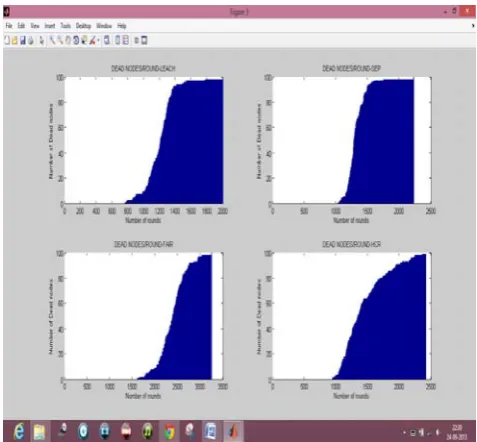
Performance of algorithms is analysed by simulations performed and implementing algorithms in MATLAB for a selected application environment against the set of qualitative performance metrics. Algorithms simulated are LEACH, EHRP, SEP, FAIR. Algorithms are compared on parameters like network lifetime, packet transmission rate, number of dead nodes.
A. Count of Dead Nodes and Energy Dissipation
Fig. 1 Count of Dead Nodes
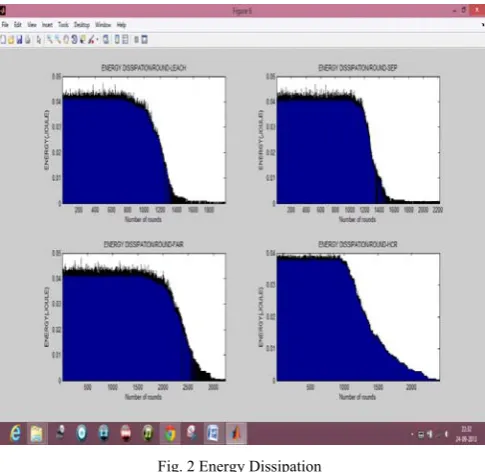
Fig. 2 Energy Dissipation
Second set of graphs below in fig 2 shows energy dissipation. X-axis represents number of simulation rounds and Y-axis represents amount of energy dissipated. Energy dissipation depends upon amount of overhead involved in routing.
B. Packet Transmission Rate and Network Lifetime
Fig. 3 Example of an unacceptable low-resolution image
Third set of graphs shown below in fig 3 shows a measure of packet transmission rate. X-axis represents number of simulation rounds and Y-axis represents number of packets transmitted to BS. EHRP shows highest rate of packet transmission as it has one of the maximum peak values than others.
Network lifetime [9] means time period for which network stay alive. The definition of network lifetime [17] used in this work as the time until all nodes have been drained of their energy. Fig.4 shows measure of network lifetime for all the four algorithms.
Fig. 4 Network Lifetime
C. Comparison Matrix
Table below gives a snapshot of the comparison between the routing protocols in terms of their operation and performance.
TABLEII
COMPARISON OF SELECTED PROTOCOLS
Protocol Cluster Formation
Heterogeneity Consideration
Packet Transmission
Network Lifetime LEACH Random,
Poor No Average Least SEP Good Yes Good Average EHRP Best Yes Best Good FAIR Good Yes Good Best
V. CONCLUSIONS
In this paper, objectives were studying hierarchical-based routing protocols where nodes are considered to be forming clusters and one of the nodes acts as a cluster-head in a cluster. Cluster formation and election of cluster-heads play a major role in determining network lifetime of a network. Optimal and efficient election of cluster-heads can enhance performance and lifetime of a network. Thus, our objective was to study various hierarchical routing protocols and analyze their performance. Four hierarchical routing protocols that are LEACH, EHRP, SEP and FAIR have been studied and implemented in MATLAB. Simulation Rounds of all these algorithms were analyzed and performance of each routing protocol is measured on some performance parameters like network lifetime, packets transferred to BS, number of dead nodes etc.
utilization of the channel bandwidth. Based on the study and results analysis of various hierarchical routing algorithms, it can be seen that FAIR algorithm provides maximum lifetime for a wireless sensor network since FAIR allows for optimal distribution of extra energy over existing nodes. Whereas, EHRP shows a better performance in terms of number of data packets sent to the BS (Base Station).
ACKNOWLEDGMENT
This work was carried out while Ankita was a postgraduate student at HCTM Technical Campus under guidance of Er. Anish Soni.
REFERENCES
[1] [1]. Carlos F. García-Hernández, Pablo H. Ibargüengoytia-González†, Joaquín García-Hernández, and Jesús A. Pérez-Díaz, “Wireless Sensor Networks and Applications: a Survey", In IJCSNS International Journal of Computer Science and Network Security, VOL.7 No.3, March 2007
[2] [2]. Shangwei Duan and Xiaobu Yuan, “Exploring Hierarchy Architecture for Wireless Sensor Networks Management", In Wireless and Optical Communications Networks, IFIP International Conference 2006.
[3] [3]. Qing Bian, Yan Zhang, and Yanjuan Zhao, “Research on Clustering Routing Algorithms in Wireless Sensor Networks", In 2010 International Conference on Intelligent Computation Technology and Automation on 11-12 May 2010, pp: 1110 – 1113, IEEE.
[4] [4]. Jamal N. Al-karaki, and Ahmed E. Kamal, “Routing Techniques in Wireless Sensor Networks: A Survey”, Wireless Communications, IEEE (Volume:11 , Issue: 6 ), Dec. 2004. [5] [5]. Kemal Akkaya, and Mohamed Younis, "A survey on routing
protocols for wireless sensor networks", Proc. Ad Hoc Networks 3 (2005), pp: 325–349.
[6] [6]. Rachid Ennaji, Mohammed Boulmalf, “Routing in Wireless Sensor Networks", Multimedia Computing and Systems, 2009. ICMCS '09. International Conference on 2-4 April 2009, pp: 495 - 500.
[7] [7]. Wendi Rabiner Heinzelman, Anantha Chandrakasan, and Hari Balakrishnan, “Energy-Efficient Communication Protocol for Wireless Microsensor Networks", in the Proceedings of the Hawaii International Conference on System Sciences, January 4-7, 2000. [8] [8]. Amir Mollanejad, Leili Mohammad Khanli, Mohammad
Zeynali, Hadi Bahrbegi, "EHRP: Novel Energy-aware Hierarchical Routing Protocol in Wireless Sensor Network," In Ultra Modern Telecommunications and Control Systems and Workshops (ICUMT), 2010 International Congress on 18-20 Oct. 2010.
[9] [9]. Isabel Dietrich and Falko Dressler, “On the Lifetime of Wireless Sensor Networks”, in ACM Transactions on Sensor Networks, Vol. 5, No. on 1, January 2009, pp: 1-38.
[10] [10.] Georgios Smaragdakis, Ibrahim Matta and Azer Bestavros, “SEP: A Stable Election Protocol for clustered heterogeneous wireless sensor networks”, in Second International Workshop on Sensor and Actor Network Protocols and Applications (SANPA 2004).