Improving the Translation Environment for
Professional Translators
Vincent Vandeghinste1,† , Tom Vanallemeersch1,‡, Liesbeth Augustinus1 , Bram Bulté1 ,Frank Van Eynde1 , Joris Pelemans1,§, Lyan Verwimp1, Patrick Wambacq1 , Geert Heyman1,¶ , Marie-Francine Moens1 , Iulianna van der Lek-Ciudin1, Frieda Steurs1,† , Ayla Rigouts Terryn2 , Els Lefever2 , Arda Tezcan2, Lieve Macken2 , Véronique Hoste2 , Joke Daems2 , Joost Buysschaert2 , Sven Coppers3 , Jan Van den Bergh3 and Kris Luyten3
1 KU Leuven; [email protected]
2 Ghent University; [email protected]
3 Hasselt University; [email protected]
* Correspondence: [email protected]; Tel.: +32-16-325089 † Current address: Instituut voor de Nederlandse Taal, Leiden ‡ Current address: CrossLang
§ Current address: Apple Inc.
k Current address: Nokia Bell Labs
Version April 24, 2019 submitted to Preprints
Abstract: When using computer-aided translation systems in a typical, professional translation 1
workflow, there are several stages at which there is room for improvement. The SCATE(Smart 2
Computer-Aided Translation Environment) project investigated several of these aspects, both from 3
a human-computer interaction point of view, as well as from a purely technological side. This 4
paper describes the SCATE research with respect to improved fuzzy matching, parallel treebanks, 5
the integration of translation memories with machine translation, quality estimation, terminology 6
extraction from comparable texts, the use of speech recognition in the translation process, and human 7
computer interaction and interface design for the professional translation environment. For each of 8
these topics, we describe the experiments we performed and the conclusions drawn, providing an 9
overview of the highlights of the entire SCATE project. 10
Keywords: computer-aided translation; machine translation; speech translation; translation
11
memory-machine translation integration; user interface; domain-adaptation; human-computer 12
interface 13
1. Introduction
14
The SCATE project (Smart Computer Aided Translation Environment) was a four year research 15
project that ran from March 2014 till February 2018, in which a consortium of three Flemish 16
universities investigated several aspects and stages in the professional translation workflow, aiming at 17
improvements in each of them. This paper describes the highlights of our research. Section2presents 18
related work, whereas the remainder of the paper describes the work done within the SCATE project. 19
Figure1provides an overview of most parts of the project, through a prototype user interface 20
(which is described in detail in section7) of theSmart Computer-Aided Translation Environment.1 A 21
professional translates a sentence under translation A using a large text entry box centrally on 22
the screen B. The central placement provides space for context; G preceding and H subsequent 23
sentences, overall translation progress (I) and configuration options in the top bar. Autocomplete F 24
assists translators during their task. Suggestions come from multiple sources, all related to technologies 25
1 A demo version of the prototype is available athttp://scate.edm.uhasselt.be/.
developed or improved within the project. A translator can accept the default suggestion, choose an 26
alternative term from the presented options D or start typing a different translation. 27
When starting the translation of a sentence, the default translation comes from hybrid machine 28
translation. The complete translated sentence is presented immediately below the text box C and 29
can be copied using a single shortcut. The hybrid machine translation builds on the research on both 30
machine translation and fuzzy matching, discussed in section3. As other results from fuzzy matching 31
can help during translation, the top results are also presented to the translator in E. At the right-hand 32
side of both the hybrid machine translation C and fuzzy matches E quality estimations are presented. 33
Research on quality estimation is described in section4. The relevant terms of these fuzzy matches are 34
also presented in the list of alternative D, just as results from an automatically extracted term list, for 35
which frequency information in the source is also presented. Results on the topic of term extraction are 36
discussed in section5. The integration of speech recognition in the translation process is described in 37
section6. 38
Figure 1.An overview of the SCATE interface. A The sentence to translate, B the editing field, C the hybrid MT that also includes pretranslations, D a list of translation alternatives coming from the term base, TM and MT, E fuzzy matches, F suggestion from autocomplete, G previous source sentences, H upcoming source sentences and I a progress bar.
2. Related Work
39
As translators rely on their computer-aided translation tools (CAT tools) to increase their 40
productivity, end user satisfaction has become essential when developing new tools. Previous studies 41
have shown that these aspects have been rather neglected in the past and the user interface design has 42
been driven by the needs of the translation clients and not by the needs of the translator. [1,2] 43
Various surveys and field studies [3,4] investigating human-computer interaction, show that 44
translators value improved translation memory (TM) - machine translation (MT) integration methods 45
(e.g. copy/paste, drag-and-drop within editor). [5–7] show that reuse of sub-segments is possible 46
through interactive translation prediction (ITP), a method in which users are presented, as they type, 47
with translation suggestions from all available resources. 48
Suggestions are displayed either in a drop-down list or directly under the target segment. 49
Translators seem to prefer ITP to classical post-editing because it minimises the number of keystrokes 50
this technology in different ways and use different terminology to refer to it, such aspredictive typing, 52
AutoSuggest, Autocomplete,orAutowrite. 53
[10] shows that metadata can help translators make well-informed decisions. He concludes that 54
metadata ”helps translators adapt their translation strategies more easily according to the suggestion 55
type”. [4] indicates that translators like information about the provenance of the MT suggestions and 56
estimation of their quality. In the context of post-editing, [11] argues that translators value on-the-fly 57
highlighting of word alignment in order to keep the connection between source and target text. In 58
other words, it appears useful to explicitly link parts of a source sentence with parts of the translation 59
suggestion. 60
In SCATE we developed visual aids that explain the origin of the translation suggestions and 61
their link with the source text. 62
3. Translation Technologies
63
Amongst the main translation technologies, besides a term-base (TB), that are accessible to most 64
translators in their professional CAT environment are a TM system and an MT engine. Section3.1
65
describes how a TM system can improve the matching of existing translations with the segment to 66
translate. Section3.2investigates integrating TM and MT technologies. Section3.3describes our efforts 67
in the creation and accessibility of parallel treebanks (i.e. syntactically annotated parallel sentences) 68
for syntax-based MT. 69
3.1. Improved Fuzzy Matching 70
CAT tools have become indispensable in the environment of the modern translator. They help 71
increase consistency, productivity and quality. One of the core components of a CAT tool is the TM 72
system, which contains a database of already translated fragments, the TM. Given a sentence to be 73
translated, the traditional TM system looks for source language sentences in a TM which are identical 74
(exact matches) or highly similar (fuzzy matches), and, upon success, suggests the translation of the 75
matching sentence to the translator. 76
Similarity calculation can be done in many ways. In current TM systems, fuzzy matching 77
techniques mainly consider sentences as simplesequences of wordsand contain very limited linguistic 78
knowledge, such as stop word lists. Few tools use more elaborate linguistic knowledge. We include 79
syntactic informationfor detecting TM sentences which are not only similar when comparing words, 80
but also when comparing the syntactic information associated with the sentences. Such information 81
can consist of lemmas, part-of speech tags or syntax parse trees. We investigate whether such abstract, 82
syntax-based matching is able to assess the usefulness of matches in a better way than methods purely 83
based on sequences of words. 84
We designed a flexible and time-efficient framework which applies and combines different metrics 85
in the source and target language. We measure the correlation of fuzzy matching metrics scores with 86
the evaluation score of the suggested translation to find out how well the usefulness of a suggestion 87
can be predicted, and we measure the difference in recall between fuzzy matching metrics by looking 88
at the improvements in meanTranslation Edit Rate(TER) [12] as the match score decreases. 89
Our comparison of the baseline matching metric,Levenshtein distance[13], with linguistically 90
aware and unaware matching metrics, has shown that the use of linguistic knowledge in the matching 91
process provides clear added value, especially when several metrics are combined into a new metric 92
using a regression tree. The correlation of combined metrics with the evaluation score is much stronger 93
than the correlation of the baseline. Moreover, there is significant improvement in mean evaluation 94
score, and the difference in recall with the baseline increases as match scores decrease. Full details of 95
this study can be found in [14]. 96
The improved fuzzy matching system is implemented as a web service available through an 97
application programming interface (API) and is used in the SCATE interface prototype, as shown in 98
Figure 2.Fuzzy matches (bottom right) and integrated TM-MT suggestion (middle) in the prototype.
3.2. Integration of Translation Memory with Machine Translation 100
We test the integration of MT and TM, in order to increase the quality of and potentially the 101
confidence in MT output. The TM-MT system consists of two main components: (1) fuzzy match 102
repair, i.e. the automatic editing of close matches found in the TM, and (2) span pretranslation, in 103
the context of which MT output is constrained by including certain consistently aligned subsegments 104
coming from one or more TM matches. Both components use a TM with fuzzy matching techniques 105
and a statistical MT (SMT) system with related alignment information. Different metrics are used for 106
the retrieval and scoring of fuzzy matches, including the syntactic fuzzy matching metric described in 107
section3.1. We performed experiments on ten language pairs (English↔German, French, Hungarian, 108
Dutch and Polish) which involve multiple language families, using the DGT dataset [15]. We applied 109
phrase-based SMT without span pretranslation [16],pureTM and a recurrent neural network (RNN) 110
encoder-decoder neural MT (NMT) system [17] as baselines, and evaluated the translations using 111
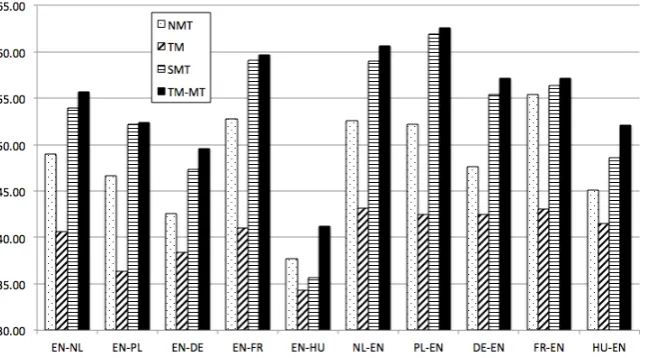
several metrics. The tests show that this approach has potential. As shown in Figure3, significantly 112
higher BLEU scores [18] for nine of the ten language combinations were reported, and also METEOR 113
[19] and TER [12] scores show comparable patterns. More details are available in [20]. The system 114
is, as shown in Figure2, also integrated in the SCATE prototype, which provides translators with 115
informed MT output and which is described in section7. 116
Figure 3.Overview BLEU scores TM-MT integration and baselines [20]
3.3. Parallel Treebanks 117
Parallel treebanks [21] are syntactically annotated versions of parallel corpora. While the latter 118
treebanks can be used to improve syntax-based statistical MT ([23], [24]) by taking advantage of 120
linguistic information, allowing higher levels of abstraction than in phrase-based SMT. 121
Work on parallel treebanks also has potential to improvetree-based NMT, which is a very recent 122
research topic.Tree-to-stringapproaches are, amongst others, described in [25], [26] andstring-to-tree 123
approaches in, amongst others [27] and [28]. While we are not aware of anytree-to-treeapproaches in 124
NMT (yet), we consider it only a matter of time before such approaches appear, as such techniques are 125
already being used for e.g. computer program translation between different programming languages 126
[29]. 127
Below, we explain the concept of alignment (Section3.3.1), leading to results like parallel treebanks, 128
and the creation of MT rules from alignments (Section3.3.2). We explain the SCATE work on enriching 129
parallel treebanks with semantic information in order to bridge syntactic divergences and to facilitate 130
MT rule creation (Section3.3.3), and the work on allowing to search parallel treebanks (Section3.3.4). 131
3.3.1. Sub-sentential Alignment 132
Alignment consists of linking segments of a source text with translation-equivalent segments of 133
the target text, i.e. the translation of the source text. Starting at thedocument level, alignment is usually 134
performed using an iterative refinement strategy. Alignment proceeds at thesentence level, and may 135
continue at thesub-sentential leveland theword level. 136
Sentence alignment is more or less considered a solved problem, at least for parallel documents.2 137
Sub-sentential alignment consists of aligning elements below the sentence level, such as words, chunks 138
or constituents at deeper levels of syntactic hierarchy. Word alignment deals with issues such as NULL 139
links (untranslated words, or words added during translation), crossing links (changes of order of 140
words during translation), and fuzzy links (e.g. translation of groups of words as a whole rather than 141
as individual words). Word alignment in sentence pairs is typically produced using statistical tools 142
such as GIZA++ [30], which also create a set of lexical probabilities based on the word alignments of a 143
large set of sentence pairs. These probabilities indicate the likelihood a source word is translated by a 144
target word or vice versa. The word alignment and lexical probabilities allow for the alignment of word 145
groups, aligned groups being integrated into a so-called phrase table for SMT systems. Sub-sentential 146
alignment may apply linguistic information by aligning chunks [31], which result from a superficial 147
syntactic analysis of a sentence (detection of the boundaries of noun phrases and verb phrases), or by 148
aligning nodes in parse trees, which provide a deep syntactic hierarchy of a sentence. 149
We focus on the alignment of nodes in syntactic parse trees (a.k.a. tree alignment), as this allows 150
more flexible translation patterns for MT engines than mere word alignment. Several tree aligners 151
exist ([32–34]) taking syntactic parse trees as input, using word alignments and lexical probabilities as 152
input. Tree alignment leads to parallel treebanks. In other words, such treebanks [21] are syntactically 153
annotated versions of parallel corpora. 154
3.3.2. Machine Translation rules 155
Based on alignment results, translation rules can be created. Data-driven MT systems such as 156
phrase-based SMT [16] and NMT [17], at least in its standard form, use parallel corpora without 157
annotations. Parallel treebanks, on the other hand, can be used to create syntax-based MT rules, and 158
hence to develop syntax-based statistical MT systems ([23,24]). The linguistic information incorporated 159
in their rules allows for higher levels of abstraction and more flexible patterns than the rules derived 160
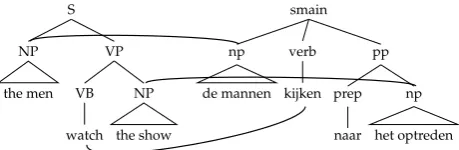
from non-annotated corpora. Figure4shows a sub-sententially aligned pair of parallel trees. 161
S
VP
NP
the show VB
watch NP
the men
smain
pp
np
het optreden prep
naar verb
kijken np
de mannen
Figure 4.An example node-aligned parallel tree.3
The translation-equivalent sentences in parallel corpora may show syntactic divergences, i.e. use 162
different syntactic means to convey the same meaning as a result of linguistic necessities or translators’ 163
choices. This makes alignment based on syntactic structure complex. 164
3.3.3. Semantic information 165
While the syntactic structure of sentences often changes during translation, semantic information 166
tends to remain constant. Therefore, we investigated whether aligning parse trees based on such 167
information facilitates alignment and leads to higher quality MT rules with respect to alignment purely 168
based on syntactic information. We focus on shallow semantics, in the form of predicates and roles. 169
We apply a five-step approach in order to obtain semantically motivated MT rules: 170
Step 1:Creation of a semantic role labeler. As tools for automatically assigning semantic predicates 171
and roles are scarce resources, we apply a crosslingual projection approach and train a semantic role 172
labeler from the projected information. We annotate syntactic parse trees in the resource-rich language 173
(English) with a semantic role labeler and project the predicate and role labels to the syntactic parse 174
trees in the target language (Dutch) through a non-linguistic tree aligner, LENG (Lexically Equivalent 175
Node Grouping) [35], which we developed in SCATE. Details of this aligner can be found below. 176
Step 2:From the projected labels, we train a semantic role labeler, requiring a minimum of manual 177
intervention. The labeler contains a model with mappings between syntax and semantics. 178
Step 3:We align parse trees via semantic labels, word alignment and lexical probabilities. 179
Step 4:We derive translation rules based on the aligned parse trees. 180
Step 5:We extend a phrase-based SMT system with the translation rules. 181
Evaluation results for step 3 and 5 indicate that enriching parse trees with semantic predicate 182
and role labels leads to more precise tree alignment results, and that combining a phrase table with 183
semantic translation rules helps in improving translation quality. While we performed tests on the 184
language pair English-to-Dutch, our approach is sufficiently generic for tests on other language pairs. 185
More details can be found in [35]. 186
The LENG tree aligner, being non-linguistic, may also be applied in a broader context, beyond 187
semantically motivated MT. It combines the language pair and parser independence of [34] with the 188
higher performance of [33]. It looks for pairs of isomorphic source and target subtrees in which pairs 189
of nodes show a strong lexical equivalence. The tree alignment consists of linked subtree pairs that do 190
not overlap with each other. As opposed to [34], LENG does not only use lexical probabilities, but also 191
the word alignment of the sentence pair (similarly to [33]), imposes less well-formedness constraints, 192
and only links nodes to each other if there is strong evidence for doing so. 193
We compared LENG with [34] and [33] on the last 35 sentences in the 125-sentence Lingua-Align 194
gold standard, using the lexical probabilities and word alignment included with the gold standard. 195
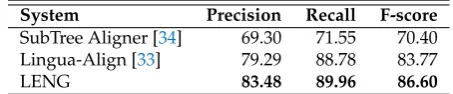
Evaluation statistics are shown in Table1. It shows that we clearly perform better than [34] on precision, 196
recall and F-score, and also outperform [33]. 197
System Precision Recall F-score SubTree Aligner [34] 69.30 71.55 70.40 Lingua-Align [33] 79.29 88.78 83.77
LENG 83.48 89.96 86.60
Table 1.Subtree alignment accuracy on English-Dutch gold standard
3.3.4. Searching Parallel Treebanks 198
Parallel treebanks can not only be used for creating MT rules, but also as a resource for studying 199
translation phenomena. We built an updated version (with improved parses and improved alignment) 200
of the parallel Europarl treebank for Dutch and English [21]. This treebank istree aligned(see also 201
section3.3.1) and can be queried with Poly-GrETEL [36]. 202
Poly-GrETEL is an online tool4 which enables example-based syntactic querying in parallel 203
treebanks, and which is based on the monolingual GrETEL (Greedy Extraction of Trees for Empirical 204
Linguistics) environment [37]. The tool provides online access to the Europarl parallel treebank 205
for Dutch and English, allowing users to query the treebank using either an XPath expression or 206
an example sentence in order to look for similar constructions.5 The treebank contains automatic 207
alignments between the nodes. By combining example-based query functionality with node alignments, 208
we limit the need for users to be familiar with the query language and the structure of the trees in the 209
source and target language, thus facilitating the use of parallel corpora for comparative linguistics 210
and translation studies. Poly-GrETEL will become part of the CLARIN6linguistic infrastructure for 211
researchers. 212
4. Quality Estimation of Computer-Aided Translation
213
Quality Estimation (QE) is defined as the task of providing a quality indicator for 214
machine-translated text without relying on reference translations. The aim of QE is to predict a 215
quality score at sentence and/or document level or more fine-grained error labels at word level that 216
indicate the need for post-editing. The general approach to QE consists of feature engineering, which 217
is the task of finding informative predictors (or features) of MT quality, and applying various Machine 218
Learning (ML) algorithms to build prediction models, which associate features with quality labels. 219
Today, despite their widespread adoption, ML models of QE remain mostlyblack boxes, where no 220
explanation for the predicted quality is provided [40–42]. In order to gain wide-spread acceptance, 221
besides building more accurate systems, one of the main challenges of QE can be considered to build 222
white boxsystems whose predictions can be justified. Based on the definition of the post-editing task, 223
one way of doing this would be to take a two-step approach, by detecting different types of MT errors 224
in the first step, which are then used in a second step to estimate a global score at sentence level. Such 225
systems would not only be beneficial for MT developers and end users to make a meaningful analysis 226
about the translation errors a certain MT system makes, but they can also yield higher productivity 227
gains in CAT workflows that utilise MT and can improve the acceptability of MT by post-editors, by 228
filtering out the sentences with the more challenging error types and by highlighting errors. In the 229
SCATE project, we use automatic error detection as a basis to two-step, informative quality estimation 230
systems for MT, which are able to justify the reasons for estimated quality. 231
In Section4.1, we first describe a new taxonomy and annotated data set of MT errors. Section4.2
232
describes our approach to building informative quality estimation systems. 233
4 http://gretel.ccl.kuleuven.be/poly-gretel/
5 Currently, this is limited to the years 2000 and 2001. After we speed up the process using [38] and [39], we expect to expand this to the entire Europarl corpus, version 7.
4.1. Taxonomy and Annotated Data Set of Machine Translation Errors 234
Despite the link between MT errors and post-editing effort, most QE systems predict overall 235
post-editing effort, without making a distinction between error types. Automatic error detection is 236
essential to build informative QE systems that are specialised in localizing different types of errors. To 237
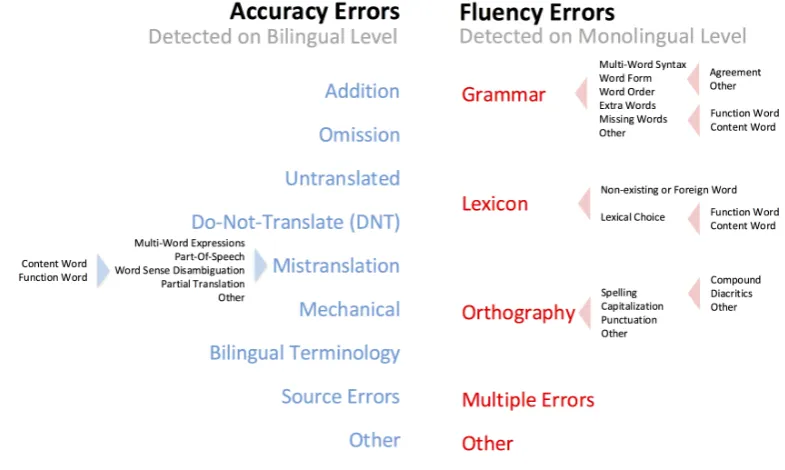
this end, in Figure5, we present the SCATE MT error taxonomy, a fine-grained, hierarchical taxonomy, 238
in which errors are classified according to the type of information that is needed to detect them. We 239
refer to any error that can be detected in the target text alone as afluency error. Fluency errors are 240
concerned with the well-formedness of the target language, regardless of the content and meaning 241
transfer from the source language. There are five main error subcategories under fluency errors: 242
grammar, lexicon, orthography, multiple errorsandother fluency errors.Accuracy errors, on the other hand, 243
are concerned with the extent to which the source content and the meaning is represented in the target 244
text and can only be detected when both source and target sentences are analyzed together. Accuracy 245
errors are split into the following main subcategories:addition, omission, untranslated, Do-Not-Translate 246
(DNT), mistranslation, mechanical, bilingual terminology, source errorsandother accuracy errors. 247
Figure 5.The SCATE MT error taxonomy
Certain similarities can be observed between some of the accuracy and fluency error categories 248
in the error taxonomy, such asextra wordsvs. addition,missing wordsvs. omissionsororthography -249
capitalisationvs.mechanical - capitalisation. As the main distinction between accuracy and fluency errors 250
in the taxonomy is based on the type of information that is needed to be able to detect them, accuracy 251
errors do not necessarily imply fluency errors, or vice versa for that matter [43]. 252
Using the SCATE MT error taxonomy, for the English-Dutch language pair, we built corpora of 253
MT errors consisting of output from three MT systems that are based on different MT paradigms: 254
SMT, Rule-Based MT (RBMT) and NMT. In these corpora of MT errors, we obtained error annotations 255
provided by multiple annotators, yielding high Inter-Annotator Agreement (IAA). We used Google 256
Translate (2014) as SMT system, Systran Enterprise Edition, version 7.5 as RBMT system and Google 257
Translate (2017) as NMT system to obtain MT output for all source sentences. The source sentences in 258
the corpus of SMT errors are extracted from the Dutch Parallel Corpus [44] and consist of an equal 259
number of sentences from three different text types:external communication, non-fiction literatureand 260
journalistic texts(698 sentences in total). Furthermore, we extended the corpus of SMT errors (2,963 261
build automatic error detection systems, which are further explained in the next section. The details of 263
the MT error taxonomy, the corpora of MT errors and the IAA analysis can be found in [43]. 264
4.2. Quality Estimation 265
We first discuss the predictive power of SMT errors in section4.2.1, before discussing automatic 266
error detection in section4.2.2and informative quality estimation in section4.2.3. 267
4.2.1. The predictive power of MT errors on temporal post-editing effort 268
From a post-editor’s perspective, MT quality can be considered of the highest level when the MT 269
system makes no serious translation errors, in other words when the effort required to post-edit is 270
minimal. Despite the obvious relationship between the cognitive effort involved in post-editing and 271
the translation errors made by the MT system, the impact and the predictive power of different types 272
of MT errors on post-editing effort are yet to be fully understood. 273
With the hypothesis that the different error types an MT system makes can explain the cognitive 274
effort involved in correcting them, we investigate whether ML techniques can be used to estimate 275
Post-Editing Time (PET), an indirect measure of cognitive effort, by using gold-standard MT errors as 276
features. We analyzed the SCATE corpus of SMT errors in combination with post-edits obtained for 277
each MT output by two post-editors and the average PET calculated per sentence. 278
By using the gold-standard error annotations, we showed that PET can be estimated with high 279
accuracy, provided that the types of errors in the MT output are known. We obtained these results by 280
applying different ML techniques to the largest data set ever used in similar studies [45]. 281
While these findings suggest that building two-step, informative quality estimation systems is 282
possible in theory, accurate detection of all MT error types can be considered to be a challenging 283
task, considering the different linguistic properties they represent. On the task of predicting PET, we 284
applied various feature selection methods not only to seek a minimal subset of MT error types without 285
reducing QE performance but also to reveal the predictive power of different error types on PET. Our 286
results show that high QE performance can be achieved by using only eight error types (compared 287
to all 33 error types) in the SCATE error taxonomy, corresponding to 31% of all gold-standard error 288
annotations in the corpus. We observed theAccuracy - MistranslationandFluency - Grammarerrors as 289
two main error categories, whose sub-categories correspond to error types with high predictive power. 290
Our findings suggest that we do not need to detect all error types to estimate PET successfully and 291
error detection systems that focus only on error types with high predictive power on PET can lead to 292
high quality sentence-level QE performances. For the details of our findings, we refer to [45]. 293
4.2.2. Automatic error detection 294
Considering the informativeness of the different types of MT errors on PET, we propose novel 295
RNN architectures for word-level automatic error detection forFluencyandAccuracyerrors as bases to 296
building informative QE systems for predicting PET on sentence level. 297
In order to train Neural Networks (NNs) on the task of detecting fluency errors, which are 298
concerned with the well-formedness of the target text alone, we propose a new word representation 299
method, in which we transform each word in a given MT output into a feature vector using multi-hot 300
encoding, which consists of three types of information: Part-of-Speech (PoS), morphology and 301
dependency relation, which we extract by using the Alpino dependency parser for the Dutch language 302
[46]. In each word vector, all elements are assigned the value of 0, except the elements representing the 303
linguistic features of each word, which are assigned 1. Unlike word embeddings, the morpho-syntactic 304
representation strips out semantic features from words. One difficulty of using dependency parsing 305
on MT output is that the generated parse trees can be unreliable when the MT output itself contains 306
errors. On the other hand, multiple studies demonstrated that parse trees obtained on MT output 307
Figure6shows an example source sentence (EN), its machine-translated version (NL) and the 309
morpho-syntactic representation for the wordzijn (are). The MT output in this figure contains aFluency 310
- Grammarerror in the form of subject-verb agreement in number between the wordszijn (are)(plural) 311
andkans (chance)(singular). 312
Figure 6.Binary vector forzijn (are)consisting of 1s for its PoS, morphology and dependency features and 0s for the remaining items in the vocabulary.
Besides surface context windows (n-grams), we utilised syntactic context windows for each given 313
target word, which we extracted from the dependency parse tree for each given MT output. Syntactic 314
n-grams enable us to capture long-distance dependencies in MT output, which can be considered 315
as an important piece of information especially for detectingFluency - Grammarerrors. Combining 316
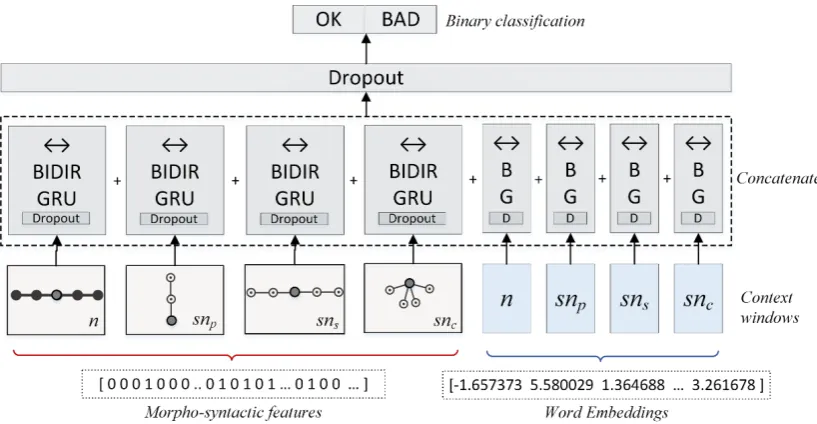
morpho-syntactic features with surface and syntactic n-grams, we propose an RNN architecture, which 317
is illustrated in Figure7. 318
Figure 7.The proposed neural network architecture for detecting fluency errors. Whilenrepresents a surfacen-gram,snp,snsandsncrepresent syntacticn-grams obtained around the target word by considering its parents, siblings and children as context in a given dependency tree.
In the proposed RNN architecture, we provide morpho-syntactic feature vectors and 319
word-embedding vectors of a target word in the form of surface and syntacticn-grams into eight 320
parallel Gated Recurrent Unit (GRU) layers, whose output is concatenated before they are connected 321
to the output layer. This network, as a result, predicts if a given word contributes to a grammatical 322
error or not as a binary classification task. 323
Our findings showed that the combination of the two types of information achieved better QE 324
performance on the task of detecting all fluency errors, than using either type of information as 325
input in isolation. Moreover, on the task of detectingFluency - Grammarerrors in SMT output, we 326
achieved a marked improvement in performance by using accurate morpho-syntactic features over 327
To detect accuracy errors, we modify the proposed RNN architecture and instead of using 329
morpho-syntactic features of the target text, we use word-embedding information obtained on the 330
source and target texts as input. Our approach additionally incorporates automatic word alignment 331
techniques to extract relevant information from the source text. We show that the proposed method 332
achieves the best results compared to other NN configurations that utilise morpho-syntactic features 333
as additional input. For the details of our experiments on automatic error detection, we refer to [49]. 334
4.2.3. Informative quality estimation 335
Automatic error detection of fine-grained error categories remains a highly challenging task. 336
However, the predictions obtained from the error detection systems on more coarse-grained error 337
categories, such as dedicated systems for all accuracy and all fluency errors perform relatively well and 338
serve as valuable features for building informative QE systems to predict PET. Furthermore, additional 339
experiments show that the predictive power of such informative sentence level QE systems could 340
be maximised with additional sentence-level features obtained on a given source/MT output pair, 341
yielding 96% of the Pearson’s correlation score of the upper boundary we observed on this task by 342
using gold-standard error annotations as features [49]. 343
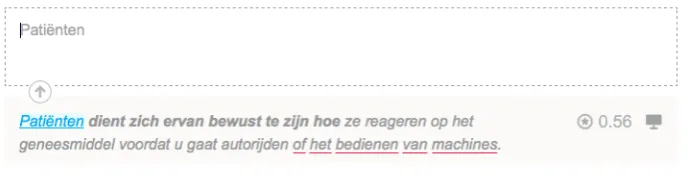
Figure 8.Quality estimation output in the SCATE user interface.
One of the aims for building informative QE systems is to inform the users about the reasons 344
for the estimated quality. Figure 8 shows how informative QE is presented to the user on the 345
SCATE platform. Words that are underlined in red are the words that correspond to fluency errors, 346
which are detected automatically. The score to the right of the MT output (0.56) corresponds to the 347
predicted sentence-level quality, which is based on the output of word-level error detection systems 348
and additional sentence-level features, calculated as 1−TER.7As illustrated in this figure, the SCATE 349
platform not only highlights the type and location of errors in a given MT output but also uses this 350
information to predict its sentence-level quality. 351
Even though predicting the exact location of MT errors remains a challenging task, we observe 352
that the proposed systems approximate the location of errors with greater success. Moreover, despite 353
the given challenges, our findings confirm that using automatic error detection systems as a basis for 354
sentence-level QE is a promising approach to build informative QE systems. We demonstrate that the 355
proposed methods deliver QE systems that perform well on estimating temporal post-editing effort, 356
while providing meaningful predictions about the type and location of the translations made by a 357
given MT system. For further details, see [49]. 358
5. Terminology Extraction
359
We first describe our observations of translator’s methods for acquiring terminology (Section5.1), 360
before we describe our approach to automatic term extraction from comparable text (Section5.2). 361
5.1. Studying translator’s methods of acquiring domain-specific terminology 362
To identify translators’ terminology strategies of acquiring new domain knowledge, we launched 363
an online questionnaire and visited language professionals at their workplaces. The questionnaire 364
contained a total of 46 questions out of which 13 concerned demographics and professional experience, 365
9 concerned the translation work environment, and 9 concerned terminology activities. The 366
questionnaire was answered by 187 language professionals worldwide, out of which more than 70% 367
were freelance translators and the rest were in-house translators/revisers, terminologists, interpreters, 368
post-editors, and project managers. The questionnaire was online between December 2014 and 369
February 2015. 370
In the field, we observed 13 translators and 3 terminologists in their authentic professional work 371
environment (freelance, commercial and institutional settings) by applying the Contextual Inquiry [50], 372
and Think Aloud Protocol (TAP) [51] research methods. The workplace visits took place in Belgium, 373
the Netherlands and Luxembourg and were spread over a period of 6 months between November 374
2014 and June 2015. For more details we refer to [3]. 375
The study reveals information about translators / terminologists’ terminology acquisition and 376
management practices, web search behaviour and usage of online linguistic resources to solve 377
terminological problems. Out of 187 survey respondents, about 139 indicated performing terminology 378
activities. About 88% collected terms manually, while 22% used semi-automatic term extraction 379
programs. More then half (about 52%) stored their terms in their CAT termbase, while 43% in 380
a spreadsheet. The rest preferred a text processor (27%) and standalone translation management 381
systems (15%). More than half stored only the language equivalents in their termbases. As for term 382
research activities, the online resources were most exploited, followed by personal resources and 383
client’s resources. Finally, the survey helped us identify needs and shortcomings of the terminology 384
management component integrated in CAT tools, related to the integration with online databases and 385
exchange of terminological data. For more information see [52]. 386
During the contextual inquiries at translators’ workplaces we noticed the following types of 387
terminology problems that occurred during translation: 388
(1) Related to specialised terminology: the translator does not know the meaning of the source 389
term; the translator does understand the source term but does not know how to translate it in the 390
target language; the translator does not know which target language equivalent to select from several 391
translation alternatives coming from a large database. 392
(2) Related to general language. 393
(3) Related to the translation of named entities, acronyms, ambiguity, low quality of the source 394
text, and punctuation. 395
To find a solution, translators used various tools, search and retrieval strategies both from local 396
and online resources. We summarise the main findings below: 397
Both the survey and the field observations revealed that translators rely more on their TMs than 398
on termbases to retrieve translation solutions. When no matches are found, the translator can perform a 399
bilingual concordance search, in which the source term is highlighted and a target sentence is shown as 400
such, with no highlight of the translation equivalents. The translators has to copy/paste the preferred 401
translation from the concordance result window into the target sentence. We saw that the concordance 402
feature was the second preferred CAT tool feature, after the TM match retrieval functionality. The 403
over-reliance on TMs is signalled and discussed in early studies as well, e.g. [53,54]. While parallel 404
corpora can be very useful to analyse translation equivalents in their context, [55] warns that they can 405
have a major drawback in the fact that“they require the existence of a translation history”and they are 406
not“faithful to linguistic uses in the target language.”She further emphasises that comparable corpora 407
(collections of original texts in two or more languages assembled on the basis of similarity) can also be 408
a good alternative to acquire specialised knowledge and terminology for under-resourced languages 409
corpora are hardly exploited for terminology and knowledge acquisition, the only resource mentioned 411
being Wikipedia. SketchEngine that contains the TenTen Corpus Family8was mentioned only by one 412
participant out of 139 who indicated performing terminology activities. 413
Besides the concordance feature, the translator can also use the term extraction feature 414
incorporated in their CAT tool to quickly retrieve term candidates from their TMs and reference 415
corpora, validate the term and add them to their termbase for future use. Most tools incorporate a 416
monolingual term extraction component, whereas our research shows that there is also a need for 417
bilingual and multilingual automatic term extractors. In addition, the survey showed that only 19 418
of a total of 187 used the term extraction feature in their CAT tool. Some reasons for the low usage, 419
revealed during the observations: the users did not know how to configure the extraction parameters 420
and the validation of the term candidates was time-consuming due to the amount of noise. 421
Besides TM, the institutional translators also had access to a custom MT system that they could 422
used to retrieve possible translation suggestions for terms, phrases or entire segments when there were 423
no matches coming from the TMs. None of the commercial translators we observed used MT via the 424
plugins integrated in their CAT tools. 425
Another method to search for terminological information or translation equivalents is to look 426
up terms and phrases in external databases directly from the CAT tool’s translation editing interface. 427
Although most translation environments offer look-up functionality in external terminology databases 428
(e.g. IATE, UnTerm, EuroTerm) and parallel corpora (e.g. MyMemory), our research shows that the 429
integration with CAT tools is not optimal. Both commercial and institutional translators indicated 430
that more advanced filtering techniques are required in order to query the IATE database directly 431
from the CAT tool’s interface. In addition, online databases are not always up to date, may contain 432
outdated references, or may reflect the terminology used by a specific organisation. Nevertheless, 433
things have changed since the study finished.The IATE team has launched a new version of IATE that 434
is user-friendlier. Recently, in a JIAMCATT local meeting,9it was announced that SDL was developing 435
a plugin for IATE to allow translators search the database directly from the interface of SDL Trados 436
Studio. 437
When the local resources did not return any useful results for terminology and translation 438
problems, the translators switched to the Web to look for a solution by consulting various websites, 439
online dictionaries and platforms. Similarly to the results of the TTC survey [57], both our survey and 440
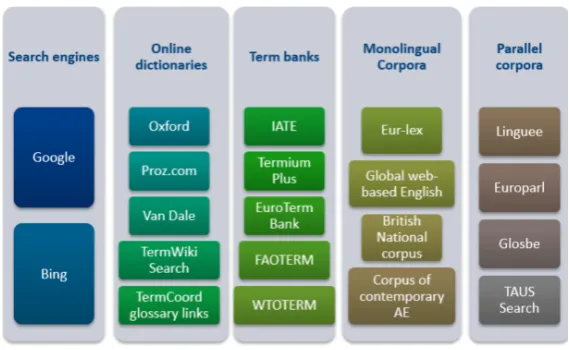
field research revealed that online resources are the most popular linguistic resource for researching 441
terminology. Figure9shows the most used resources from each category. 442
8 https://www.sketchengine.eu/documentation/tenten-corpora/
Figure 9.Most used online terminological resources
During the observations, we noticed lots of back and forth switching between several types of 443
online resources before taking a final decision.The web research path was often decided by the number 444
of hits Google gave with the web searches resulting in desktop clutter as the user did not know how 445
to manage the search results. For this purpose, one of our subjects developed a strategy not to keep 446
more than three tabs open on his desktop. He also used the Ditto clipboard manager to record his 447
searches, which saved time. Though the Google search engine was often used, out of the 16 translators 448
we observed only 2 used some advanced search operators in Google. When a translation solution was 449
found, it was copied/pasted in the translation grid and confirmed in the Translation Memory. Useful 450
websites were added to the Favourites toolbar. At the European Parliament, for example, the web 451
links were usually centralised and shared via the internal portals of the terminology and translation 452
units. Out of 16 observations, we noticed only one instance when the translator actually stored the 453
information about the researched term in their term base. These findings correlate with the results of 454
the survey that revealed the reasons why translators do not perform proper terminology management: 455
lack of knowledge about terminology management, someone else’s responsibility, no added-value, 456
time consuming, termbases are complex. 457
Another method of acquiring domain-specific terminology is manual compilation of small 458
thematic corpora with materials collected from the Web, which can be followed by manual term 459
extraction of a list of term candidates, validation, and import of the final terms into the terminology 460
database. The source term entries are then researched and completed with target-language equivalents. 461
This practice was observed during the observations of the 3 institutional staff terminologists. While the 462
manual collection of the corpora and extraction of terms are reliable methods of harvesting terminology, 463
the participants indicated that it was time-consuming. Ideally, the users should be able to collect 464
corpora automatically and query directly from their translation environment tool. Although there are 465
standalone corpus compilation and query tools, such as Sketch Engine, BootCat, AntCont, the SCATE 466
survey shows that they are hardly known and used by translators. This might be due to the fact that 467
such tools are not supported in the CAT tool. In 2016, Sketch Engine developed a plugin for SDL 468
Trados Studio to enable translators and terminologists to perform searches in their large collections of 469
corpora (e.g. EurLex) directly from the Translation Editing interface. The pilot showed that the plugin 470
was hardly used by translators and, therefore, further development stopped. 471
Overall, the field research confirms the finding of previous studies that terminology management 472
is mainly done on anad hocbasis due to time pressure, lack of resources, limited knowledge of how to 473
manage terminology properly, and lack of immediate financial compensation. A systematic approach 474
was observed only at the European Institutions and large commercial organizations which had a 475
dedicated terminologist in each translation unit. Translators seem to rely heavily on their specialised 476
TMs rather than on termbases and/or comparable corpora. Semi-automatic term extraction, though 477
the preparation stage of a translation project. The Web represents a rich resource for knowledge and 479
terminology acquisition but very few adopted the automatic tools for corpora compilation and query. 480
Finally, more efficient web search strategies are needed in order to avoid desktop clutter and save 481
and store the relevant information in an efficient way. The findings have implications for translators 482
educators and software developers alike. 483
One way of optimizing the exploitation of external linguistic resources for the purpose of 484
terminology acquisition is a seamless integration of more sophisticated terminology extraction methods 485
from comparable corpora. 486
5.2. Terminology extraction from comparable text 487
We experimented with three types of comparable corpora. The first type are corpora compiled 488
from Wikipedia articles, which are a valuable resource for compiling comparable corpora. Wikipedia 489
articles have the benefit that they are annotated with the categories they belong to as well as with 490
interwikilinks, which link an article to its counterparts in other languages. Both types of annotations 491
allow easy compilation of a comparable corpus that is both domain-specific (using the category 492
labels) and strongly comparable across languages (using the interwiki links). For our experiments, 493
we constructed an English-Dutch comparable corpus in the medical domain, containing about 1000 494
document pairs. Datasets with aligned Wikipedia articles can be found online for many language pairs 495
on the website of linguatools.10 496
The second type are corpora compiled from Reuters news articles. News articles are another 497
resource to create comparable corpora. We experimented with the Reuters news dataset,11 a 498
multilingual collection of news articles published within the same time span. From this collection, 499
we created a weakly-comparable corpus by comparing the topic labels (e.g.,global, economy, etc.) that 500
are annotated on the Reuters documents, for example: when an English document and a Spanish 501
document are both annotated with the same global label they are considered to have comparable 502
content and are added as a document pair to the comparable corpus. We analysed the resulting dataset 503
with multilingual probabilistic topic models: Bilingual Latent Dirichlet Allocation (BiLDA)[58] and 504
Comparable Bilingual Latent Dirichlet Allocation (C-BiLDA)[59]. We found that, although the C-BiLDA 505
model could uncover some interesting cross-lingual topics (clusters of related words), the dataset was 506
not well-suited for inducing translations as the domain was too broad and the comparability across 507
languages too low. We therefore conclude that to construct comparable corpora from news articles 508
merely relying on high-level topic labels is insufficient. Other clues like named entities (persons, 509
locations) and publication dates should be taken into account. 510
The third type are existing comparable corpora. Several automatically crawled and cleaned 511
comparable corpora have been made freely available online in the context of the TTC project.12 These 512
are all specialised corpora in specific domains, such as wind energy and mobile technology. They are 513
available in different formats and in seven languages: English, French, German, Spanish, Russian, 514
Latvian and Chinese. These characteristics make the corpora especially suited for experiments with 515
automatic term extraction from comparable corpora. An additional advantage is that there are also 516
(very) limited, manually validated reference term lists available for the evaluation of monolingual 517
automatic term extraction. A final advantage is that the corpora have been used in previous 518
experiments with automatic term extraction from comparable corpora, so any new results can easily 519
be benchmarked against the state of the art. 520
We split cross-lingual terminology extraction into two subproblems: (1) term extraction, the 521
identification of which words and phrases are (in-domain) terms ; and (2) term linking, where the 522
10 https://linguatools.org/tools/corpora/wikipedia-comparable-corpora/ 11 http://trec.nist.gov/data/reuters/reuters.html
aim is to link terms to their correct translation. We focus mainly on term linking. We investigatie 523
word-level methods for bilingual lexicon induction (BLI), the task of finding translations for words 524
and phrases from non-parallel texts; we propose a novel BLI model that integrates character-level and 525
word-level representations; and we implement a hybrid compound splitter for Dutch that combines 526
corpus frequency information with linguistic knowledge. 527
5.2.1. Comparison of weakly-supervised word-level BLI models 528
During the course of the project, we saw the rise of word embeddings in natural language 529
processing. These vector representations have shown to encode useful syntactic and semantic 530
properties of words and have also been used to build cross-lingual spaces where translations are 531
mapped to similar representations. Most techniques that build such cross-lingual representations 532
require parallel corpora or bilingual dictionaries, however. We study approaches that can learn 533
cross-lingual representations without the need for an initial seed dictionary. 534
In particular, we compare two bilingual topic models, BiLDA and C-BiLDA, with a bilingual 535
extension of the continuous skip-gram model calledBilingual Word Embedding Skip Gram (BWESG)[60]. 536
All three models learn bilingual word representations from subject-aligned document pairs only. 537
Multilingual topic modeling has shown to be a robust framework for learning bilingual representations 538
from such non-parallel data: BiLDA has been successfully applied to BLI [61] and C-BiLDA is a more 539
recent extension to BiLDA that learns higher-quality representations when the aligned document pairs 540
exhibit a lower degree of parallelism [59]. BWESG is a simple but effective extension to continuous 541
skip-gram. It merges each aligned-document pair in a single bilingual document and then runs 542
monolingual skip-gram with negative sampling [62] on the resulting document collection. To evaluate 543
the models, we use a corpus of subject-aligned Wikipedia documents (English-Dutch) in the medical 544
domain. From the English side of the corpus we selected 500 words, which were translated into Dutch 545
to form the ground truth. We found that BWESG yields the best performance which indicates that also 546
in a weakly-supervised settings, without parallel data, word embeddings are important BLI features. 547
5.2.2. Combining word-level and character-level representations 548
From our word-level experiments, we observe that for our dataset (consisting of Wikipedia articles 549
in the medical domain) morphology is an important clue for identifying translations. Most recent 550
work in BLI focuses solely on word-level features, however. For this reason, we design a model that 551
seamlessly integrates word-level features (e.g., continuous skip-gram embeddings) and character-level 552
features. Most related work in bilingual lexicon induction manually defines a cross-lingual similarity 553
metric between word feature vectors. For instance, many methods use cosine distance to measure the 554
similarity between embeddings. It is not trivial to define a similarity metric that incorporates both 555
word- and character-level information, however. Therefore, we frame bilingual lexicon induction as a 556
classification problem. We train a binary classifier that predicts whether two given words are each 557
other’s translation. The classifier’s parameters are learned from a seed lexicon of known translations. 558
We identify two key advantages of a classification framework for BLI. Firstly, it does not rely on 559
anad hoccombination of features, but learns the patterns over different features from the bilingual seed 560
lexicon. Secondly, the classification framework enables learning useful character-level features from 561
the seed lexicon. This in contrast to using handcrafted features like normalised edit distance. In our 562
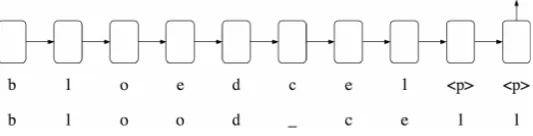
model, we obtain a character-level representation by feeding the concatenation of source and target 563
characters to an LSTM network (see Figure10). As word-level representations, we used continuous 564
skip-gram word embeddings. The concatenation of word and character features serves as the input to 565
a feed-forward neural network that outputs a score between 0 and 1. The higher the score, the more 566
Figure 10.Character-level representation in an LSTM framework
Our experiments show that the LSTM representation outperforms handcrafted morphology 568
features like normalised edit distance. Furthermore, the model that combines character-level 569
information and word-level information outperforms other baselines (including BWESG, the strongest 570
word-level model) by a margin. For more details, see [63]. 571
In follow-up work [64], we verify that we can extend the BLI system, which could only find 572
translations for single words, to deal with phrases. Specifically, we find that, after extracting phrases 573
using a simple data-driven heuristic, we can treat phrases as if they were a single word: To learn 574
character-level representations, we treat whitespace as any other character, and to learn word-level 575
representations, phrases are tokenised as a single token. 576
5.2.3. Datasets and Gold Standards for Future Research 577
Finding comparable corpora for bilingual term extraction is not easy. Wikipedia is a useful 578
resource, but for very specialised subjects or smaller languages, coverage is not always optimal. 579
Moreover, while the strong comparability per document is useful, it is rare in other resources. 580
Compiling comparable corporaad hoc, such as the one from Reuters new articles, is convenient, 581
but still requires identification of the terminology. Finally, a few comparable corpora are available with 582
manual term annotations, such as the one used from the TTC project. However, these are very rare 583
and often contain only monolingual annotations or a very limited list of cross-lingual links. This lack 584
of good resources means that evaluation can be challenging, and it is an important obstacle for the 585
development of supervised ML approaches for both monolingual and multilingual term extraction 586
from comparable corpora. 587
To address this, we started building a dataset for term extraction, which can be used both as 588
a gold standard and as training data for a supervised ML approach. To ensure re-usability of the 589
data, we collect corpora in three different languages (English, French, and Dutch) and four domains 590
(corruption, dressage, heart failure, and wind energy). These corpora are partly based on previous 591
research (e.g. the wind energy corpus uses the French and English parts of the TTC corpus). In each 592
corpus, around 50,000 tokens are manually annotated, using an annotation scheme with three different 593
term labels and elaborate guidelines. The guidelines, including information about the term labels, are 594
freely available online.13 This results in a total of over 100,000 manual annotations in all corpora. We 595
are currently experimenting with an ML approach to term extraction based on these data. 596
While this is already a useful resource, as explained in the previous sections, multilingual term 597
extraction from comparable corpora involves two tasks: identifying terms and linking equivalent 598
terms across languages. Since the described data only addresses the former, more annotation work 599
was required to provide data for the latter. Therefore, the trilingual corpus about heart failure was 600
selected and both inter- and intralingual links between terms were manually identified: equivalents 601
across languages, synonyms, abbreviations, alternative spellings, hypernyms, hyponyms etc. In total, 602
7,385 unique terms and named entities in three languages were annotated this way. This dataset 603
is particularly suited as a gold standard for multilingual term extraction from comparable corpora 604
for two reasons. First, the inclusion of information about related terms means that a more nuanced 605
evaluation can be made in cases when the automatically suggested target language term is not exactly 606
an equivalent of the source term, but is still strongly related. Second, the fact that all terms have 607
been annotated in this corpus means that the origin of wrongly suggested equivalents can be traced: 608
either the system could not find the equivalent, or it was not present in the corpus. After all, since 609
comparable corpora are not aligned, it is not unusual for a term to exist in one language of the corpora 610
and not the other. 611
While these datasets could not yet be used to evaluate the systems presented in the previous 612
section, they have already proven to be valuable sources of information about both terminology and 613
comparable corpora [65]. For instance, the lack a of restriction about length or part-of-speech of the 614
terms revealed that, as expected, nouns and noun phrases are most common, but that, somewhat 615
surprisingly, other part-of-speech patterns were often identified as well, e.g. adjectives and even 616
verbs. Single-word and two-word terms appeared most often, but longer terms, up to around five 617
tokens, were no exceptions. Ongoing research will have to confirm the further use of the data for the 618
development of new tools. The dataset will be made available through a shared task on supervised 619
machine learning approaches for automatic term extraction in 2020. 620
6. Speech Recognition
621
In the context of post-editing, using speech instead of typing can speed up the work of the 622
translator. The accuracy of automatic speech recognition (ASR) can be improved by making use of the 623
extra information present in the translation model (Section6.1) and by adapting the language model 624
to the current domain or topic (Section6.2). Additionally, we explore the challenging task of speech 625
translation in Section6.3. 626
6.1. Adaptation of the Speech Recognition Language Model by Machine Translation 627
The aim of this research is to employ improved language models (LMs) and achieve higher 628
recognition accuracy for spoken translations. We investigate two ways of improving the LMs: (1) using 629
word translations to cluster similar words, which improves the reliability of word frequency statistics; 630
(2) using the source language text and MT probabilities to steer the recognition in the right direction. 631
The first approach assumes that two words are similar, both semantically and syntactically, if they 632
share the same translation in multiple languages. Similar words can then be clustered, which enables 633
context sharing within each cluster and hence more reliable statistics forn-gram LMs containing these 634
words. By filtering out translation errors based on part-of-speech, context and morphology, we are 635
able to derive meaningful synonym clusters, but this does not result in improved recognition, mostly 636
due to context insensitivity, i.e. words may be synonymous in certain contexts, but not in others. 637
The second approach investigates how to improve speech recognition, based on the source 638
language text and MT probabilities. Research in the past largely focused on rescoring either ASRn-best 639
lists or word lattices, using the MT probabilities of the source language text. This has the disadvantage 640
that it requires two steps, which slows down recognition and requires intermediate storage. Moreover, 641
such multi-pass approaches are often inferior to integrated approaches because information that is lost 642
during the first step can never be recovered in the second step. Therefore we focus on integrating the 643
source language text and MT probabilities into the LM directly. By weighing then-gram probabilities 644
with the translation probabilities of the source language text, a new LM can be created for each 645
sentence/paragraph which can directly be used by an ASR decoder. This implementation allows to 646
reduce recognition errors by ca. 5% absolute and 20% relative on spoken Dutch translations from 647
English, while having little to no negative effect on recognition time. Moreover, compared to an 648
existing model [66], our model takes up only 2.8% of disk space compared to a normalized model and 649
dramatically reduces the execution time. More information can be found in [67]. 650
Although the above implementation drastically improves the efficiency of MT-based LM 651
the source language text can only correspond to one word in the target language text. This is a strong 653
assumption that does not hold in reality: every language has its own way of verbalizing concepts with 654
some using a single word and others using multiple words for the same concept. In MT this issue is 655
addressed by phrase-based translation models. 656
We integrate phrase-based models into our implementation, without compromising the 657
recognition time. We also extend the recognizer with named entity models. These models attempt 658
to improve recognition for proper nouns by estimating their pronunciation and language behavior. 659
We exploit the fact that many named entities remain unchanged during English-to-Dutch translation 660
implying that we can make reliable estimates for relevant named entities based on the source language 661
text. Experiments show that the combination of phrase-based translation models and named entity 662
models further reduces the recognition error to ca. 6.5% absolute and 25% relative on the same spoken 663
Dutch translations from English. Moreover, the extensions come with the same efficiency benefits as 664
the word-based model which allows their use in a real-time CAT environment. To our knowledge this 665
is the first MT-based language model adaptation technique using a phrase-based translation model. 666
More information can be found in [68]. 667
6.2. Automatic Domain Adaptation 668
We also investigate the effect of automatic domain adaptation for speech recognition. We study 669
both cross-domain adaptation and within-domain adaptation: the first approach adapts a model 670
trained on a specific domain to other domains, while the second approach adapts to the current topic 671
of the text. 672
For cross-domain adaptation, we chose to create a new data set. Previous recognition experiments 673
were always performed on spoken translations of literature for which the domain is not always very 674
confined. For this task we instead chose to work with 14 documentaries provided by VRT,14all of 675
which have a specific domain i.e. mostly fauna and flora. For these data we have the following parallel 676
data streams: (1) audio in English (original), (2) script in English (original), (3) audio in Dutch (voice 677
over), (4) script in Dutch (as input for audio in Dutch), and (5) subtitles for the deaf in Dutch. 678
The audio is converted to the correct format and background noise is filtered out as much as 679
possible. Subtitles are normalized to generate a ground truth transcription which is aligned with the 680
audio to produce the necessary timing information. Baseline experiments with models that do not 681
employ any domain adaptation yield acceptable word error rates, ranging from 9% to 33%. 682
In a first attempt we investigate two methods of exploiting domain knowledge: (1) fully 683
automatic terminology extraction; (2) user-guided terminology extraction. The first method uses 684
BiLDA to automatically extract relevant Dutch terminology based on the English translation. In the 685
second approach, we develop semi-automatic methods in which the user/translator enters a Dutch 686
query/description of the translation task. This query is then used to retrieve relevant terminology, 687
using one of the following methods: 688
1. Word-to-word similarity based on a Latent Semantic Analysis (LSA) model [69] 689
2. Word-to-word similarity based on a continuous skip-gram model [70] 690
3. Document-to-document similarity based on LSA, followed by extraction of the most relevant 691
words from the best matching document. 692
These methods are incorporated into the SCALE toolkit, which is described in [71]. Each of the 693
investigated methods is first evaluated on text: for each documentary, the extracted terminology is 694
compared to out-of-vocabulary (OOV) words: the most promising method is the one that is able to 695
retrieve the most OOV words. In a next step, this terminology is added to the pronunciation lexicon 696
and language model of the speech recognizer, and the word error rate of the domain-adapted speech 697