Managing Negotiation Knowledge with the Goal of developing Negotiation Decision
Support Systems
Dr. Emilia Bellucci
International Corporate Governance Research Institute, Victoria University
Email: [email protected] Professor John Zeleznikow
International Corporate Governance Research Institute, Victoria University
Email: [email protected]
Abstract
While Information Technology has been used to support negotiation there is little research in the domain of knowledge management in legal negotiation. In this paper we discuss the nature of negotiation knowledge and how such knowledge can be utilized to construct negotiation decision support systems. We conduct an in-depth examination of the notion of a BATNA (Best Alternative to a Negotiated Agreement) and given a useful BATNA, how we can use issue and preference elicitation and compensation and trade-off strategies to provide
negotiation decision support. We conclude by indicating how current negotiation support systems can be extended to support Online Dispute Resolution and haw we can extend theFamily_Winner system in light of the need to more adequately manage negotiation knowledge.
Keywords
Negotiation, Knowledge Management, Online Dispute Resolution, Interest-based Negotiation
INTRODUCTION
Legal practice is primarily concerned with the transfer of strategies, derived from the legal knowledge, from practitioners to clients. Whilst lawyers may draft contracts and make representations on behalf of their clients, their primary task is to advise their clients on appropriate remedies and courses of action. (Rodriguez et al
2002) claim that a lawyer sells what he knows, often in the form of a document (a contract, an opinion, a report) and much more often in a trial before a court or in a negotiation with a counterpart. (Khandelwal and Gottschalk 2003) claim that lawyers can be defined as knowledge workers. They are professionals who have gained knowledge through formal education (explicit) and through learning on the job (tacit).
(Ross 1980) states “the principal institution of the law is not trial; it is settlement out of court”. Recent figures from a survey in The Netherlands illustrate this statement. Around 48% of all disputes were settled out of court and just 4% is decided by litigation (Van Velthoven and Ter Voert 2004). In the United States, (Williams 1983) notes that whilst the figures may vary in different jurisdictions, of all the cases listed before the courts only about 5% of the cases are ever heard by the court and only 1% of the cases result in judicial decision-making. Thus negotiation is a very important factor in legal practice. Yet very little emphasis has been placed upon managing negotiation knowledge. Indeed, there are very few guidelines as to what is useful negotiation knowledge and how it should be used.
We all agree that a major function in preparing for a negotiation is collecting knowledge – but how, and what knowledge? Does the collection of negotiation knowledge differ from the preparation of a legal case and the discovery of relevant information? If Information Technology is to be used to support negotiation, how should the relevant knowledge be collected?
In this paper we will be addressing these issues as well as demonstrating their use in a Negotiation Support System developed by our laboratory, Family_Winner.
THE CONCEPT OF A BATNA
Negotiation is a process by which two or more parties conduct communications or conferences with the view to resolving differences between them. Disputants are more likely to be satisfied with (and most importantly adhere to) the suggested result if they participated in reaching this result.
Principled negotiation (Fisher and Ury 1981) emphasizes that parties look for mutual gains wherever possible, and when interests conflict, parties should come to a agreement that is independent of the beliefs of either side. Principled Negotiation introduces the concept of a BATNA (Best Alternative To a Negotiated Agreement). A BATNA can be used as a tool for negotiators to cope with power imbalances, e.g. one party may have a stronger bargaining position, or more (financial) resources than her opponent. They claim that, if negotiators do take account of their options outside a negotiation, they are better protected against agreements that should be rejected. It also helps them to reach agreements that better satisfy their interests. In order to assess whether an offer should be rejected, a party in a dispute has to establish what can be accomplished in alternative procedures to the one currently being conducted. This may include exiting the procedure altogether, or handing over the case to a court. Once the alternatives are known, these can be compared to what one expects to win by accepting an offer in the current procedure. If the proposal is worse than the (best) alternative outside the procedure, it should be rejected; if it is better it should be considered for acceptance. In this respect each party's BATNA serves as a point of reference or a value with which to compare offers (Raiffa et al. 2002).
Another reason why knowing one’s BATNA is important, is that it influences negotiation power. Parties who are aware of their alternatives will be more confident about trying to negotiate a solution that better serves their interests (Fisher and Ury 1981). When trying to sell one's car to a second hand car dealer, knowing what other car salesmen (or even individuals) offer or have offered for your (or a similar) car, helps in obtaining a reasonable price for your vehicle.
The BATNA concept is a useful metaphor in all dispute resolution procedures where parties have the option to exit the process, such as negotiation and mediation. A BATNA in this sense is a way to put pressure on the other party. If terminating the process has advantages over accepting the other party's offer, it should be an incentive to continue the negotiation, else if the other party is unwilling to reconsider the offer, walking out is a very sensible option.
BATNAs not only serve a purpose in evaluating offers in the dispute, they can also play a role in determining whether or not to accept a certain dispute resolution method. (Mnookin 2003) wrote that having an accurate BATNA is part of the armoury one should use to evaluate whether or not to agree to enter a negotiation. We believe this to hold for many dispute resolution methods, including arbitration and mediation, but also for tools and techniques within these methods, such as (blind) bidding, persuasion dialogues, and final offer arbitration. Comparing the possible (range of) outcomes with alternative options encourages parties to accept methods that are in the interests of disputants and enables them to identify those that are not. It is likely that most parties, to some extent, test the values of their BATNAs when assessing whether or not to opt for a certain dispute resolution method.
Although BATNAs are an important aspect of the dispute resolution, there is reason to believe that parties engaged in actual disputes are not very good at determining their BATNAs.
As (Zeleznikow and Bellucci 2004) note, an important way in which mediators encourage disputants to resolve their conflicts is through the use of compromise and trade-offs. Once the trade-offs have been identified, other decision-making mechanisms must be employed to resolve the dispute. From efforts to build negotiation support systems, Zeleznikow and Bellucci (2004) noted that while it appears counterintuitive:
• The more issues and sub-issues in dispute, the easier it is to form trade-offs and hence reach a negotiated agreement, and
• • They choose as the first issue to resolve the one on which the disputants are furthest apart – one party wants it greatly, the other considerably less so.
(Nash 1953) and (Raiffa 1982) have conducted significant research on using game theory to provide negotiation support. (de Vries et al 2005) gives an in depth overview about the benefits of using BATNAs to provide negotiation decision support.
DECISION SUPPORT FOR MANAGING NEGOTIATION KNOWLEDGE
Over the past decade research systems have been developed which use artificial intelligence techniques to provide decision support to human negotiators. The earliest negotiation support system that used artificial intelligence was LDS (Waterman and Peterson 1980), which assisted legal experts in settling product liability cases. SAL (Waterman et al 1986) helped insurance claims adjusters evaluate claims related to asbestos exposure. These two systems represented the first steps in recognising the virtue of settlement-oriented decision support systems.
INSPIRE (Kersten, 1997) enables disputants to negotiate through the Internet, making extensive use of email and web browser facilities. The system displays previous and present offers, and uses utility functions to evaluate proposals determined to be Pareto-optimal1. Disputants communicate by exchanging offers and electronic mail, and can check the closeness of a package to their initial preferences through a utility graph function.
Smartsettle (Thiessen and McMahon 2000) assists parties to overcome the challenges of conventional negotiation through a range of analytical tools to clarify interests, identify tradeoffs, recognise party satisfaction and generate optimal solutions. The aim is to better prepare parties for negotiation or to support them during the negotiation process.
Game theoretic techniques and decision theory were the basis for the AdjustedWinner algorithm (Bellucci and Zeleznikow 1998), which implemented the procedure of (Brams and Taylor 1996). AdjustedWinner is a point allocation procedure that distributes items or issues to people on the premise of whoever values the item or issue more. The two players are required to distribute 100 points across the range of issues in dispute. The Adjusted Winner paradigm is a fair and equitable procedure. At the end of allocation of assets, each party accrues the same number of points, in a manner similar to that of the Nash equilibrium2. It often leads to a win-win situation. Although the system suggests a suitable allocation of items or issues, it is up to the human mediators to finalise the agreement acceptable to both parties.
What all these systems have in common is that they require disputants to indicate the issues in dispute and to explicitly describe their preferences for the allocation of issues or options. Hence, we can conclude that a negotiation support system requires a list of issues in dispute and an indication of disputant preferences against the issues. These systems are mainly differentiated by the manner in which the negotiation is supported and decisions are made.
In the following section we will describe issues in the management of negotiation knowledge in family law, in particular with respect to justice. We also analyse a fundamental concept in negotiation support - Principled Negotiation to make comparisons against existing NSS with regard to negotiation theory and to extract strategies for decision-making.
MANAGING KNOWLEDGE IN AUSTRALIAN FAMILY LAW
Negotiation support systems are, in general, very context sensitive. We chose as our domain to be modeled Australian family disputes. Family Law (Ingleby 1993) varies from other legal domains in that in general:
1) There are no winners or losers - save for exceptional circumstances, following a divorce both parents receive a portion of the property and have defined access to any children.
2) Parties to a family law case often need to communicate after the litigation has concluded. Hence the Family Court of Australia encourages negotiation rather than litigation.
The overriding principle in Australian Family Law is the consideration of the paramount interests of the children. Many men’s rights groups have claimed Australian Family Law is feminist. Whilst there is no basis for such claims in any legislation, the incontrovertible fact is that following divorce, the place of primary residence for most children is with their mother. Given this fact, and that the Family Court of Australia is obliged to place the interests of children first, it is inevitable that primary caregiver mothers will receive a greater share of marital property than would other women. This is particularly the case in marriages that have minimal financial resources. These principles are significant in developing BATNAs for Australian Family Law Property distribution.
There are however some disadvantages in assuming a bargaining based approach to negotiation. (Zeleznikow and Bellucci 2003) did so and noted problems in ensuring just family law decisions.
1
In December 2002, they met with a number of family law solicitors at Victoria Legal Aid (VLA) to evaluate the performance of their Family_Winner system. They used the Context, Criteria, Contingency Evaluation framework of (Hall et al 2003). Whilst the solicitors were very impressed with how Family_Winner suggested trade-offs and compromises, they had one major concern – that Family_Winner in focusing upon mediation had ignored issues of justice.
(Alexander 1992) has illustrated that women tend to be more reluctant than men to continue conflict and are more likely to wave their legal rights in a mediation session. If their major goal is to be the primary care giver for their children, they may reach a negotiated settlement, which whilst acceptable to them is patently unjust. The wife may for example, give the husband the bulk of the property, in return for her being granted the primary care of the children. Whilst such an arrangement may meet the goals of both parents, it does not meet the paramount interests of the children, who will be deprived of subsequent financial resources. Family Law is one domain where mediation conflicts with notions of justice. In such domains, the use of negotiation support systems that attempt to equally satisfy both parties is limited.
Similarly, suppose two parents both want primary residence of their children, to the exclusion of any other matters or indeed, the interests of the children. Although a compromise, acceptable to both parents, might be to have the children move households every night, no judge would sanction such a course of action, since it would be detrimental to the welfare of the children.
The judge (who is the final arbiter on what constitutes the paramount interests of the children) can over-ride an agreement negotiated by the parents. Indeed, since legal professionals are aware that judges are unlikely to approve a settlement where children move house every night, they would caution their clients against even proposing such a solution.
Hence, bargaining theory has its limitation in providing decision support for family law negotiation. However, (Zeleznikow and Bellucci 2003) have noticed that various negotiation domains are far more suitable than family law, for modeling using integrated game theory and knowledge based systems to advise upon trade-offs. These domains included enterprise bargaining and company acquisitions and mergers.
If we rely upon Principled Negotiation to discover elements of knowledge management in negotiation, we find that the theory requires a list of issues in dispute and their preferences supported by a list of underlying values to justify their position. All of the systems reviewed in Section 3 required specification of issues and an indicator of their preferences with respect to each issue. The theory advocates several decision-making techniques to resolve the negotiation. Notably most of these involve inventing options for mutual gain. Examples include brainstorming, expanding the pie, compensation and logrolling strategies.
What is lacking in the systems described above, are strategies based on Principled Negotiation’s methods to resolve the dispute. Family_Winner specifically addresses this problem by using a combination of compensation and trade-off strategies to resolve the dispute. In addition, no use is made of underlying values in a way that would allow them to contribute to the decision making process.
As most negotiations take place in the shadow of the law, an important aspect of BATNA advice is to know what might be the results of a court procedure.
Split-Up, a system that advises on property distribution following divorce (Stranieri et al, 1999), gives its users an insight into the likely outcomes of a court procedure. The approach used in this project was to identify relevant factors in the distribution of property under Australian family law. Ninety-four variables were identified as relevant for a determination in consultation with experts. The way the factors combine was not elicited from experts as rules or complex formulas. Rather, values on the 94 variables were extracted from cases previously decided. The Split-Up system was able to learn how the variables related to each other by using Knowledge Discovery from Databases (KDD). KDD is particularly suited to the discovery of knowledge in discretionary domains. The resulting Split Up system was capable of deciding new cases in a similar manner to which judges decided the cases used in the Split Up training set.
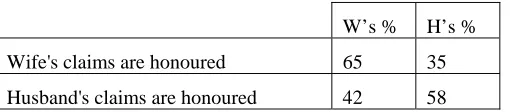
The knowledge available in Split Up can be used to establish BATNAs. The way this works is that the system first shows both litigants what they can expect to be awarded by a court if their claims are accepted. It gives them relevant advice as to what will happen if some or all of their claims are rejected. The Split-up system can also provide information about hypothetical situations, for instance what the effect on the property distribution will be if one of the parties is given the custody of the children.
Wife's claims are all honoured, her ex-husband will receive 35% of the marital assets, whereas she will get the remaining 65%.
W’s % H’s % Wife's claims are honoured 65 35 Husband's claims are honoured 42 58
Table 1. Use of Split-Up to provide predictions on the distribution of marital assets
However, as the parties in our dispute are unaware of the chances of getting their claims rewarded, this table in itself does not provide complete BATNAs. Suppose that the wife proposes the following distribution of assets:
W’s % H’s % Wife's proposal, including her getting custody over the children 60 40 Table 2. Use of Split-Up to provide negotiation advice
The proposal includes as a condition that she receives custody over the children. If the husband thinks he has a lower than 50% chance of winning a court procedure, and given that he has access to the BATNAs provided by the Split-Up system, he would be well advised to accept 40% of the common pool (otherwise he would also risk paying large legal fees and having on-going conflict).
Whilst a BATNA provides disputants with a flexible bottom-line or ball-park figure, negotiation knowledge requires more than just an appreciation of what will happen if the dispute is not resolved. As (Lodder and Zeleznikow 2005) state, as well as providing a BATNA, a truly useful negotiation support system needs to provide the disputants with the opportunity to make arguments in support of their claims as well as providing advice about compensation arising from accepting trade-offs. In the next section, we will discuss trade-offs in Australian Family Law and how the Family_Winner system provides advice about trade-offs.
At this stage we ask the question: what negotiation knowledge is specifically required to support decisions? This depends on how the decision is made, that is which strategies and techniques are employed. For example, in Smartsettle and INSPIRE, disputants are required to set preferences against options for each issue in dispute. These options are then combined to form packages. The systems use mathematical tools to find the package that is optimal when compared against a disputant’s initial set of preferences.
Family_Winner on the other hand allocates issues to disputants using trade-off strategies, and then uses a system of compensation to model changes in a disputant’s set of initial preferences.
In Smartsettle and INSPIRE, knowledge of mathematical tools to rate packages forms part of their negotiation knowledge. In Family_Winner, knowledge of trade-off strategies and the manner in which they are employed form its negotiation knowledge. In the next section we will describe the manner in which Family_Winner uses its set of negotiation knowledge to suggest a possible settlement.
DECISION SUPPORT IN AUSTRALIAN FAMILY LAW: THE FAMILY_WINNER
SYSTEM
Family_Winner is a negotiation support tool that has been primarily trialed in the domain of Australian Family Law. Family_Winner uses Principled Negotiation as the underlying negotiation strategy, in which decision-making is enhanced by trade-off and compensation strategies. The Issue Decomposition Hierarchy embedded in the system allows for the incorporation of sub-issues, which forms our attempt to increase the number of issues in dispute. Principled Negotiation Theory advocates ‘Expanding the Pie’ as a strategy to reach agreement. Input is in the form of issues and numerical ratings, which represent the importance disputants’ place on issues. Family_Winner output consists of a list of allocations the system has made.
Users of the Family_Winner system enter information such as the issues in dispute, indications of each issue’s importance to the respective parties (ratings) and how the issues relate to each other. An analysis of the information is compiled, which is then translated into graphical trade-off maps. The maps illustrate the relevant issues, their importance to each party and the trade-off capabilities of each issue pair.
Actual screen shots of the Family_Winner system in operation can be found in Appendix 1 of [Bellucci, 2004]. These have not been included in this paper due to paper length constraints.
The user is asked if the issues can be resolved in their current form. If this is the case, the system then proceeds to allocate the issue. Otherwise, the user is asked to decompose an issue chosen by the system as the least contentious. Essentially the issue on which there is the least disagreement (one party requires it greatly whilst the other party expresses little interest in the issue) is chosen to be the issue first considered. Users are asked to enter sub-issues. As issues are decomposed, they are stored in the Issue Decomposition Hierarchy, with all links intact. This structure has been utilised because we recognise there may be sub-issues within issues on which agreement can be attained. It is important to note that the greater the number of issues in dispute, the easier it may be to allocate issues, since the possibility of trade-offs increases. While this may seem counter intuitive, we argue that if only one issue needs to be resolved, then suggesting trade-offs is not possible.
This process of decomposition continues through the one issue, until the users decide the current level is the lowest decomposition possible. At this point, the system calculates which issue to allocate, then removes this issue from the each of the party’s respective trade-off maps, and makes appropriate numerical adjustments to the remaining issues linked to the issue just allocated. The resulting trade-off maps are displayed to the users, so they can see what trade-offs have been made in the allocation of issues. Once all issues at the current level are allocated, then the decomposition of issues continues in a sequential manner, re-commencing from the top level of issues.
Trade-offs are made between issues so that each party obtains all or most of their preferred outcomes on important issues but concedes on issues of little or no importance. (Thompson, 1990), (Wertheim et al 1992) and (Mnookin et al 2000) argue that integrative negotiations exist and can be solved through strategies which use trade-offs and compromise. The issues involved in trade-offs are determined by the principles of trade-offs, while the amount of any compensation resulting from triggering a trade-off has been empirically determined from an analysis of data.
Family_Winner does not employ any of the fairness principles of (Brams and Taylor, 1996) and (Pruitt and Carnevale, 1993). The system interprets fairness as promoting satisfaction between the disputants. We argue a disputant’s satisfaction is important as is their need for a fair outcome. Family_Winner supports satisfaction by allocating issues based on party evaluations. Trade-offs are utilised in forming compensation, satisfying the system’s attempt to make the allocation fair for both parties.
(Bellucci and Zeleznikow, 2005) includes an example of how Family_Winner operates using a hypothetical case in Australian Family Law. Outputs from the system include a series of trade-off maps that display relevant trade-offs applicable after an issue allocation, and a list of allocations per party that forms the suggested solution. It should be stressed that Family_Winner is designed to be used by mediators rather than by the disputants. The suggestions are relayed to the mediator who then attempts to structure an acceptable solution. The next section will describe Family_Winner’s applicability to domains other than Family Law.
THE USE OF FAMILY_WINNER AS A LEGAL KNOWLEDGE MANAGEMENT
SYSTEM
So far, reference has been made to Family_Winner’s application in Family Law. When evaluating Family_Winner, we observed that the system, in focusing upon providing advice with regard to bargaining, had neglected considering issues of justice. In a domain such as Family Law, issues of justice are of paramount concern.
When Family_Winner was used in a variety of other negotiation domains (international disputes, enterprise bargaining and company mergers) the advice offered strongly resembled the eventual negotiated outcome. Family Law is a less suitable domain for building Negotiation Support Systems than is Enterprise Bargaining. We considered the Enterprise Bargaining Agreements of VLA for the period 2000-3. Issues in dispute were pay, the use of technology, flexi-time, overtime, pre-natal leave, childcare, working from home and performance management. The solution generated by Family_Winner was very similar to that eventually concluded by VLA and its employees.
hijackers were protesting the conviction of Shiites for committing acts of terrorism. The Cypriot and Algerian governments negotiated with the hijackers, allowing the plane to land on their territory, and providing the hijackers with deliveries of food and access to the media. Family_Winner advised upon negotiations between the Kuwaiti government and the hijackers. Issues covered were allowing the plane to land, fuel, food, access to media, release of hostages, release of convicted terrorists and the possible conviction of the terrorists. Family_Winner’s advice coincided with the eventual outcome of the siege.
An example taken from (Brams and Taylor 1996) considered a negotiation held between two companies discussing a company merger. Issues in dispute were name, headquarters, chairman, chief executive officer and layoffs. The settlement reached by Brams and Taylor was identical to that achieved using Family_Winner. The results obtained from this example demonstrate the effectiveness of point assignments to show the importance value of an issue to a party, coupled with trade-off equations to assist in the allocation of issues valued closely by the respective parties.
An investigation of these examples has shown the benefit of Family_Winner for advising upon trade-offs, compensation and the sequencing of negotiations as long as the issues can be described and remain static and points can be allocated to issues.
In (Bellucci, 2004), a comprehensive evaluation of Family_Winner against other negotiation support systems is documented. The conclusions of this study were:
• Family_Winner provided disputants with a different way to prioritise and represent issues, which leads to a clearer understanding of the dispute. The ratings of a party sum to a nominal figure, in this case to 100. As a result, disputants clearly distinguish their want of the issues. Trade-off maps are used to visually represent the priorities disputants have imposed. The algorithm of Adjusted Winner (Brams and Taylor 1996) uses a similar method of prioritisation. Family_Winner however combines several theories to reflect the aims of a negotiation support system.
• Family_Winner is dynamic in the way it models fairness in allocation. The system uses ratings given by disputants to allocate issues. Following an allocation, these ratings change to reflect improved or decreased opportunities for allocation in the next round. No other system seemed to model this aspect.
Whilst each system surveyed had their definite merits, all of those surveyed negotiated over packages. Family_Winner represents a shift from this traditional method of negotiation, to reveal possibilities in sequential issue allocation.
FUTURE WORK
A Three Step Online Dispute Resolution Environment
Online Dispute Resolution (ODR), the application of Internet technology to ADR, has become an alternative method for resolving disputes that arise both from online transactions and in the offline context. We are currently developing a generic environment for the development of Online Dispute Resolution Systems (Lodder and Zeleznikow 2005). Given that disputants require both negotiation advice and the opportunity to communicate about their desires, we are developing a three-stage process for developing an on-line dispute resolution environment. These stages include:
a) The provision of an appropriate BATNA;
b) A stage that enables direct communication and negotiation between the parties that does enable interest based communication – similar to the research of (Lodder 1999) who developed argumentation tools that support disputants to communicate about their conflict. ;
c) A stage that provides negotiation support through the use of compensation and trade-off strategies – similar to the work of (Bellucci and Zeleznikow 2001).
If the advice suggested by the negotiation support system is acceptable to the parties, then the dispute is resolved. Otherwise, the parties agree to those issues resolved through the use of the negotiation support system and then return the remaining issues in dispute to the dialogue system. This process continues until either all issues are resolved or a stalemate is reached. A stalemate occurs when no further issues are resolved on moving from the argumentation tool to the negation support system, or vice versa.
The following scenarios can arise through the use of our online dispute resolution environment:
• Some issues are resolved, but a stalemate occurs. One of two scenarios can then occur:
• Either the parties do not agree to accept the partial resolution of the issues resolved during the process and no progress is reported, or
• The parties agree to some or all of the issues resolved during the process and partial success is reported.
• The dispute is resolved and success is reported.
The JustReason Shell (constructed using Toulmin Argumentation) is used as a tool for building our On Line Dispute Resolution Environment. This environment is being tested in Family Law Negotiation and Plea Bargaining between VLA and the Victorian Office of Public Prosecutions. The Family Law Negotiation System will incorporate elements of both the Split-Up and Family_Winner systems.
Plea Bargaining in The Victorian Magistrates Court
In (Hall et al 2005) we have reported on the development of a web-based decision support system to support VLA lawyers to make arguments about the sentencing of offenders in the Victorian Magistrates Court. We have built a modified Toulmin argument structure to model judicial discretion in the sentencing of criminals in Victorian lower courts in Australia. The majority of knowledge based sentencing information systems attempt to draw expert like inferences for judges, but due to the gravity of the inferences they cannot be adopted. The system does not attempt only to provide an inference nor supply relevant information to the judge but to also importantly present the underlying reasoning in a way that is transparent and easily comparable to other sentences.
VLA is the principal provider of legal aid in Victoria, in fact VLA is the largest criminal law practice in the State and handles upwards of eighty percent of criminal law defence cases in Victoria. It employs solicitors to act on behalf of people and provides a range of specialist legal services. It is funded by a combination of Commonwealth government, Legal Practice Board’s Public Purpose Fund and state government monies also legal cost received by VLA. It is in their interests to be able to provide sound advice regarding possible sentences as the result of guilty pleas. The sentencing decision support prototype and its ability to provide the reasoning behind a sentence as well as a sentence range means that VLA lawyers can better negotiate with Office of Public Prosecution lawyers and police prosecutors. The reasoning behind a particular sentence can act as an argument in favour of a particular charge over another.
In a similar way to presenting underlying reasoning regarding the sentencing of offenders in Victorian Magistrates Courts, we are looking at ways in which the underlying values or human interests can be incorporated and used in deriving a mutually satisfying settlement. A major tenet in Principled Negotiation is the isolation of a negotiator’s interest, or motivation behind their position. These interests are then used to develop settlements that sustain each negotiator’s interests. Essentially this system guarantees a successful outcome as it satisfies each disputant’s interests behind the original positions. In terms of negotiation knowledge, the interests behind a negotiation are of great significance to the outcome of a negotiation. Family_Winner at the moment uses mathematical reasoning in suggesting possible agreements; there is no use made of human interests or underlying values. It would be interesting to model the incorporation of human interests and underlying values into the decision making process so as in an attempt to truly model Principled Negotiation using Information Technology.
The Plea Bargaining System has currently being developed in conjunction with VLA and JUSTSYS (Vincent and Zeleznikow 2005).
Mediation of Body Corporate Disputes
(Leshinsky 2005) has noted that Bodies corporate law is built on the underlying principles of property law. More particularly, this rapidly evolving area of law stems from Victorian legislation and case law. There are 65,000 bodies corporate in Victoria today. Apartment living is on the rise3 and so too are the legal disputes (unit owners vs unit owners) and (unit owners vs the body corporate).
We are developing a model that will rely on theoretical strategies in artificial intelligence & law and use legislation, legal philosophical and theoretical frameworks (jurisprudence), legal reasoning, knowledge
discovery, working legal practices and dispute resolution methodologies to consider the feasibility and utilitarian effect of an Online Dispute Resolution intelligent model for Victorian bodies corporate legal disputes.
Mediation in Australia Family Law
We are developing a suite of Family Law software using principles developed in the Split Up and Family_Winner projects. The three step process of (Lodder and Zeleznikow 2005) is being used as the basis of the Online Dispute Resolution System.
a) The system provides advice about the dispute (BATNA) by using the Split-Up system to provide advice about property distribution. Advice about child welfare issues is not provided by automated software: it comes from expert opinions and occasionally the user will be referred to links to legal advice.
b) The users are then given the opportunity for online communication (argumentation) with other parties to the dispute.
c) A system (similar to Family Winner) is provided to advise upon trade offs for those systems in dispute. The JUSTSYS software (www.justsys.com.au) is used to develop decision support systems and facilitate argumentation. We have concluded that a stand-alone system is not commercially viable. Instead we are working in conjunction with mediators and family lawyers. Each of the potential developers of the software has different needs.
a) A research or professional body - such as Victoria Law Foundation, the Law Institute of Victoria and the Family Court of Australia is interested in a proof of concept system - to show what negotiation support systems can perform. They will leave it to others to develop systems.
b) Victoria Legal Aid and other similar bodies view the software as an efficient way to support their overworked lawyers.
c) Law firms or similar bodies will use such a system to gain publicity (as a leader in the area) and market share. They would want the system to refer hard cases to their specialists.
CONCLUSION
This paper has discussed the relationship between knowledge management and negotiation, with particular emphasis on the legal domain. We have investigated what constitutes negotiation knowledge and how this knowledge can be used to support negotiation through Negotiation Support Systems. A mini-literature review revealed that most NSS requires a concise list of issues and an indication of disputant preferences. Where these systems differed was the manner in which negotiation knowledge was used to support decisions. We use Principled Negotiation, as it is the most widely accepted theory and successful method to conduct negotiations. This theory introduced us to another set of negotiation knowledge, knowledge concerned with the support of decision making which included BATNAs, trade-off and compensation strategies. The Family_Winner system has been demonstrated as a negotiation support system capable of managing and using negotiation knowledge to provide decision support using trade-offs and compensation strategies. Finally we discuss future work with respect to developing an ODR environment and examples in the domains of family law and sentencing. Other future work involves the extension of Family_Winner to include interest-based decision making, in attempting to make Family-Winner model more closely all the principles of Principled Negotiation.
REFERENCES
Alexander, R. 1992, Mediation, violence and the family. Alternative Law Journal 17(6): 276-99
Bellucci, E. 2004, Developing Compensation Strategies for the construction of Negotiation Decision Support Systems. PHD thesis, La Trobe University, Bundoora 3086, Victoria, Australia
Bellucci, E. and Zeleznikow, J. 1998, A comparative study of negotiation decision support systems. Proceedings of the Thirty-First Hawaii International Conference on System Sciences. Los Alamitos, Cal., IEEE Computer Society: 254-262.
Bellucci, E. and Zeleznikow, J. 2001, Representations for decision making support in negotiation. Journal of Decision Support. 10(3-4): 449-479.
Brams, S. J. and Taylor, A. D. 1996, Fair Division, From cake cutting to dispute resolution, Cambridge, U.K.: Cambridge University Press.
Fisher, R. and Ury, W. 1981, Getting to YES: Negotiating Agreement Without Giving In, Boston: Haughton Mifflin.
Hall, M. J. J., Calabro, D., Sourdin, T., Stranieri, A. and Zeleznikow, J. 2005, Supporting discretionary decision making with information technology: a case study in the criminal sentencing jurisdiction. To appear in
University of Ottawa Law and Technology Journal.
Hall, M. J. J., Hall, R. and Zeleznikow, J. 2003,A method for evaluating legal knowledge-based systems based upon the Context Criteria Contingency-guidelines framework. Proceedings of the Ninth International Conference on Artificial Intelligence and Law, Edinburgh, Scotland: ACM Press, 274-283.
Ingleby, R., 1993,Family Law and Society, Butterworths, Sydney
Kersten, G. E. 1997.,Support for Group Decisions and Negotiations, in: J. Climaco (Ed.) An Overview, in Multiple Criteria Decision Making and Support, (Heidelberg: Springer Verlag).
Khandelwal, V.K. and Gottschalk, P. 2003, Information Technology Support for Interorganizational Knowledge Transfer: An Empirical Study of Law Firms in Norway and Australia, Information Resource Management Journal, 16(1):14-23
Leshinsky, R. 2005, The ABC of Victorian Bodies Corporate Hybrid Publishers, Melbourne, Australia.
Lodder, A. R. 1999, DiaLaw - on legal justification and dialogical models of argumentation, LAPS Vol. 42, Dordrecht: Kluwer Academic Publishers.
Lodder, A. R. and Zeleznikow, J. 2005, Developing an Online Dispute Resolution Environment: Dialogue Tools and Negotiation Systems in a Three Step Model, Harvard Negotiation Law Review, Vol. 10:287-338. Mnookin, R. 2003, When Not to Negotiate, University of Colorado Law Review, 74, 1077-1107.
Mnookin, R., Peppet, S. R. and Tulumello, A. S. 2000, Beyond Winning: Negotiating to Create Value in Deals and Disputes, The Belnap Press of Harvard University Press.
Nash, J. F. 1953, Two person co-operative games. Econometrica, 21:128-140.
Pruitt, D. G. and Carnevale, P. J. 1993, Negotiation in Social Conflict, Open University Press, Buckingham. Raiffa, H. 1982, The Art and Science of Negotiation. Harvard University Press.
Raiffa, H., Richardson, J. & Metcalfe, D. 2002, Negotiation Analysis: The Science and Art of Collaborative Decision Making, Cambridge, Massachusetts: The Belknap Press.
Rodríguez Morcón,C., Pérez García,J. and Sigüenza Pizarro, J. A. 2002, Knowledge Management in a Law Firm, UPGRADE (www.upgrade-cepis.org) 3(1):51-55
Ross, H.L. 1980, Settled Out of Court, Aldine.
Stranieri, A., Zeleznikow, J., Gawler, M. and Lewis, B. 1999, A Hybrid rule- neural approach for the automation of legal reasoning in the discretionary domain of family law in Australia. Artificial Intelligence and Law 7 (2-3): 153-183.
Sycara, K. 1998, Multiagent Systems, AI Magazine 19(2):79-92.
Thiessen, Ernest M. and McMahon, Joseph P. 2000. Beyond Win-Win in Cyberspace. Ohio State Journal on Dispute Resolution, 15: 643.
Thompson, L. 1990, Negotiation Behaviour and Outcomes: Empirical Evidence and Theoretical Issues,
Psychological Bulletin, 108, 515-532.
Van Velthoven, B.C.J. and Ter Voert, M.J. 2004, Geschilbeslechtingsdelta The Hague: WODC/Boom
Waterman, D.A. and Peterson, M. 1980., Rule-based models of legal expertise, Proceedings of the First National Conference on Artificial Intelligence, Stanford University: AAAI: 272-275.
Waterman, D. A., Paul, J. and Peterson, M. 1986, Expert systems for legal decision making, Expert Systems 3 (4): 212-226.
Wertheim, E., Love, A., Littlefield, L. and Peck, C. 1992, I Win: You Win Penguin Books, Ringwood, Victoria, pp. 130-135.
Zeleznikow, J. and Bellucci, E. 2003, Family_Winner: integrating game theory and heuristics to provide negotiation support. Proceedings of Sixteenth International Conference on Legal Knowledge Based Systems, IOS Publications, Amsterdam, Netherlands: 21-30.
Zeleznikow, J and Bellucci, E. 2004, Building negotiation decision support systems by integrating game theory and heuristics, Proceedings of the IFIP International Conference on Decision Support Systems, Monash University, Melbourne Australia.