V
I
C
T
O
R
I
A
S
C
H
O
O
L
O
F
M
A
N
A
G
E
M
E
N
T
WORKING PAPER SERIES
Operations Planning Process for a Whole Supply
Chain: Concepts and a Meat Processing Application
Ian Sadler
Peter Hines
Operations Planning Process for a Whole Supply Chain:
Concepts and a Meat Processing Application.
Dr Ian Sadler
Professor Peter Hines
Victoria University
Lean Enterprise Research Centre
School of Management
Cardiff Business School
Email:
[email protected]
Cardiff
U. K.
Abstract
Planning processes for the operations of entire supply chains require examination because business competition demands coherent strategies from them. Research into processes for strategic operations planning has defined the steps and procedures required. Some research has partially addressed planning processes for integrated supply chains. The present research begins to specify a process and investigate how a team of managers from the companies in a supply chain can be helped to formulate strategic plans for operating the whole chain, to benefit each company and to benefit the whole chain. Building on previous research, this theoretically-based paper proposes a framework to enable such a process. This chain-wide planning process is illustrated in the Australian meat processing supply chain, with encouraging results.
Keywords:
Operations Strategy, Planning Process, Meat Industry, Supply Chain Management
The requirement to add Logistic Chain Partners into Operations Strategy
Problem introduction and review of knowledge
It is valuable to examine planning processes for the operations of entire supply chains because business competition demands coherent strategies from such chains (Jouffrey and Tarondeau, 1992; Porter, 1985; Hines et al., 1999). Before the planning process can be reviewed, the content which the process ‘manipulates’ must be identified. This section reviews the purpose and structure of an integrated supply chain (ISC) before summarising the most developed study of ISCs known.
Strategic operations and logistics decisions aim to identify policies which will achieve customer criteria for order placement. The following customer criteria are described by Hill (1989) for manufacturing strategy:
• Price • Features (product range)
• Quality • Design leadership
• Delivery Speed and Reliability • Technical support • Flexibility (demand increases)
These manufacturing (or operations) criteria are not significantly changed for supply chain planning (Slack, 1991) since the overall purpose of the supply chain in serving customers is the same as that of the manufacturer of products for the same ultimate customers.
(1990), given below, which are quite comparable with those used in a major survey of ‘World Class Logistics’ (Bowersox et al., 1995):
• Facilities • Quality
• Capacity • Control Policies
• Span of Process • Suppliers
• Processes • New Product
• Human Resources
However, the processes through which managers might create such a plan have not been fully addressed. In this paper we define an integrated supply chain and refer to previous work by one author, before returning to the processes required for ISCs in the following sub-section. The term ‘logistics chain’ is used interchangeably in this work with ‘supply chain’. ‘Logistics’ is a preferred word, because it does not emphasise ‘in-bound’ logistics (supply) over ‘out-bound’ logistics, but ‘supply chain’ will frequently be used in keeping with current practice.
The definition of a supply chain and the limited knowledge available to assist companies to formulate operations and logistics strategy for the management of integrated supply chains is reviewed. Bowersox et al. (1995) conclude, from a large international survey, that manufacturers and merchandisers are sufficiently similar to justify the use of one model to describe capability and competency. Whilst Bowersox states that logistics strategy requires co-ordinated planning between all firms in the integrated supply chain. The evidence he presents from US experience suggests that such planning has not been implemented. Perry (1997) finds supply chain partnerships to be an essential part of a Quick Response model in the Australian textile, clothing and footwear industry. Joint planning between several tiers of component suppliers to the automobile industry (Lamming, 1989) has been the closest observation.
Mabert and Venkataramanan (1998, p. 537) describe the management of the chain as follows:
Due to its impact on firms competing in today’s global economy, managing the flow of materials from supply sources to the ultimate customer represents a major challenge for today’s business leaders. The concept of supply chain management has been adopted by many leaders as an important way to assist in designing, planning and controlling the network of facilities and tasks that comprise the numerous stages of the supply chain.
Womack and Jones (1994) suggest that the management of supply chains should be taken one step further with the formation of a ‘lean enterprise’ which they define as ‘a group of legally separated but operationally synchronised companies’. They envisage such an enterprise achieving an enormous increase in the performance of the supply chain:
If individual breakthroughs can be linked up and down the value stream that creates, sells and services a family of products, the performance of the whole can be raised to a dramatically higher level. (1994, p.93).
The channel integrator is an approach where one party, a channel leader, plays the key role in steering the overall strategy for the channel and in getting channel members involved in and committed to the channel strategy. ( 1997, p. 72).
Typically there are multiple suppliers to the integrator and multiple customers supplied by the integrator (Cooper et al., 1997). These authors use the analogy of the channel being a ‘Value Tree’ in which the company is the trunk of the tree, its multiple suppliers are the branches and its multiple customers are the roots of the tree. ‘Value’ refers to Porter’s (1985) concept that each function should add value to the chain.
The firm should discriminate among the branches above the trunk to build tailored styles of relationships with numerous branches at varying levels. These relationships should :
• be tailored to provide specific advantages to the participating organisations,
• assist in maximising the value adding activities of the firm, and
• ensure the sustainable nature of the resultant advantage (Cooper et al., 1997, p. 79).
In addition to this physical structure, Integrated Supply Chains are highly dependent upon the information which flows between logistic chain partners to plan and affect the flows of materials and products (Lewis and Talalayevsky, 1997, p. 146-153). These authors state that information distribution is so important to supply chains that it should have its own structure, linking all producers, intermediaries and retailers, in order to optimise information flows serving these partners. Supply Chain information can be typified as comprising transaction planning, order placement, operations scheduling and logistics organisation at each link (level) in the chain. It must be very accurate. The purposes of such information are to provide better visibility of physical goods, to promote better communications between chain links, and to reduce the need for warehousing and distribution (Ibid).
Fabbe-Costes and Colin’s study (1994) is considered to be the most developed in ISC planning because it recommends that logistics management should ‘imagine and develop’ strategic logistic actions made possible by strong logistics competencies. They see logistics as ‘a cross functional and deliberately open-ended management domain in the firm’ (p. 38) which enables the firm to achieve differentiation from its competitors. They show how their ideas have been applied in over thirty firms and then propose a number of analysis grids which document ways in which firms could evolve through a series of strategic moves. However, Fabbe-Costes and Colin’s study does not contain any reference to the processes required or the supports that could be provided to increase the chance of success.
Having briefly discussed what an ISC is, the next section describes the development of an operations planning process to encompass immediate logistics policies.
Applications of operations and logistics planning model
The MAA was then modified into a Strategic Operations and Logistics Planning (SOLP) process for meatworks and other companies. SOLP is an approach to derive plans for the operations and logistics functions of companies. It is implemented by a team of managers filling in a set of worksheets in a series of meetings. The progressive worksheets stimulate the managers to develop action plans for several families of products made by the company. An external facilitator guides the team so that team members have considerable autonomy. The SOLP process is informed by the firm’s strategic business objectives and the requirements of customers from the operations and logistics functions. The first application of SOLP was limited to the immediate logistics of the firm (i.e. not explicitly including supply chain partners). The approach used was action research (Susman and Evered, 1978) in which the researcher engages closely with company personnel over a period of time. A more longitudinal process was developed so that changes in the managers’ decision making performance could be observed. This involved observations made by the facilitator during team meetings. In addition each team member was interviewed at the start and end of the SOLP process to obtain views of the process and the plans. The workshop format was refined, and less emphasis was placed on audit and ‘SWOT’ analysis. An extra worksheet is provided in the SOLP process to record the actions required for a particular product group against a forward time scale.
The SOLP process was applied in two meatworks which had previously lacked strategic operations planning, with the addition of internal logistics requirements (Sadler, 1999b). The first application at ‘Flock’ meatworks (names are disguised) was carried out over three months. Flock is a privately-owned company that supplies domestic markets. A team of seven managers and an external facilitator were appointed by Flock’s Managing Director. The team split into two to derive strategies for individual product groups. Although supply chain partners were not involved in the process, a major customer discussed his needs with the team. The second application took place at ‘Wilson’ meatworks that had less-developed management structures and less educated managers who found it very difficult to envisage future strategic requirements. Wilson is a small privately-owned company selling meat on local domestic markets. Process supports were similar to ‘Flock’ but less advantage was made of them.
This work provided insights into the dynamics of the meat processing industry and identified modifications to content and process for the application of SOLP in that industry. This meatworks testing led to two changes relevant to the present research: • a requirement that representatives of supply chain partners should serve on the planning
team, and
• strong encouragement for teams to add logistics criteria and policies into order-winning criteria, performance reviews and operations policies.
Need to address a wider environment
Supported by the literature reviewed above and previous research (Sadler, 1999b), we argue that the operations and logistics functions of all enterprises in a supply chain need to connect their strategies. The aim is to formulate a set of strategies, represented by a series of actions, which will achieve the future aims of all partners in the supply chain in sourcing, manufacturing and distributing products to satisfy customer needs at a profit. Figure 1 illustrates the general structure of a meatworks supply chain. The enterprises in the lower part of the figure are called links. If an individual enterprise carries out its own operations and logistics strategy, it will tend to sub-optimise its own part of the chain. In the car industry Womack and Jones (1994, p.102) refer to part of this planning process when they say “The assembler and the supplier go over every detail of the supplier’s production process looking for ways to cut cost and improve quality”. Further Jouffrey and Tarondeau (1992, p. 170-172) suggest that
‘the search for coherence between products and technologies should spread across all layers of the organisation, and to all industrial activities management modes. … the third (management mode) is material flow management, that is inter-operations or stock operations in the product manufacturing cycle as a whole, from the supplier to the customer.’
A greater range of alternatives would be generated by joint planning between all firms involved in the entire supply chain. Therefore, it is very likely that planning conducted in concert by all members of the supply chain would enable better overall strategies to be derived than if each made separate plans, working at arm’s length. This requires some loss of sovereignty by each company, which could be a stumbling block for such joint plans. Joint planning would achieve part of the ‘lean enterprise’, proposed by Womack and Jones (1994), which they believe would lead to dramatic improvements in supply chains.
The supply chain planning process investigated in the present research has some similarities to that found by Christopher (1997) for a marketing perspective. It aims to move supply chain managers away from an introspective view of the world. However it does not reduce the need for the operations and logistics functions of each company to co-ordinate their strategies with those of other internal functions (Mills and Gardner, 1995).
Figure 1Links in the integrated Supply Chain for processed meat products
Supply Chain Information
Suppliers Manufacture Primary Manufacture Secondary Packing & Order
Assembly
Information from Retailers
Van delivery Trade Industrial Products
E n d
C o n s u m e r s
LEGEND
Transport
Distribution Centre
and Closs, 1996). We argue that this evolution of logistics management implies the need for a similar evolution of strategy derivation. We support the argument of Stevens (1989, p.4) that a strategic perspective is required for the supply chain that both develops objectives for the chain as a whole and specifies its shape and organisational structure to achieve a competitive package. He considers that there is great potential to recognise the connections between component parts of the supply chain. This ensures a good fit between its design and operations and the company’s competitive strategy so that real benefits flow from the impact of increased market share and a lower cost base (ibid, p.8). The novelty in this present research is that it presents an integrated operations perspective rather than an approach limited to one end of the business. Most previous research has concentrated on in-bound logistics, manufacturing or distribution. These latter approaches risk being out of touch with the business realities.
The proposed process required to form strategy for an ISC is now developed from processes designed for operations strategy. There has been some research into partnering between two supply chain members (Lambert et al., 1999). In the context of logistics partnerships between a major company and its third-party service provider, this research found:
A key element of any successful partnership is joint planning. When the Whirlpool / ERX (logistics service provider) partnership first started, there was not a high level of joint planning, but both firms felt that it was necessary. Today, joint teams are assigned to address issues and problems and do long-range planning. Whirlpool distribution centre managers and regional personnel meet regularly with ERX representatives to discuss current performance, possible improvement, and long-range plans. (1999, p. 174).
Partnering is not sufficient: we argue that processes are required in which representatives of all the enterprises in the ISC are ‘equal’ members of the planning team (Lamming, 1993). Platts and Gregory (1992) made a significant contribution to operations planning process development with the Manufacturing Audit Approach which is based on Hofer and Schendl’s (1978) seven steps in strategy formulation. The MAA requires a multi-disciplinary team from a manufacturing company to complete a series of seven worksheets which document the intuitive mental processes they undertake. The worksheets are:
1. Profiles of Market and Performance 2. Basic Data about Product Groups 3. Competitive Criteria
4. Existing Performance Audit 5. Opportunities and Threats
Recent work also suggests that planning of logistics functions should incorporate operations of supply chain partners, upstream and downstream, as well as a firm’s own logistics function (Jouffrey and Tarondeau, 1992 and Harland, 1995). The need to link operations and logistics functions is recognised and the theory and practice of joint operational and tactical management of those functions is comparatively well-established (Fabbe-Costes & Colin, 1994). However, no previous research into the process of developing strategy for both functions simultaneously is known. Assuming that companies already have business strategies, this research examines the development of underpinning functional strategies.
The requirement for logistics to be planned together with operations comes from the considerable extent of commonality. Both functions require the acquisition of materials and products in single locations, selection of products for particular customer orders, scheduling of working resources, and consolidation of disparate goods for delivery. Logistics may be summarised as dealing with flow, storage and optimisation whilst meeting customer demands (Fabbe-Costes & Colin, 1994) where the corresponding operations areas are materials handling, processing and productivity.
Development of Theoretical Framework
The process is called integrated supply chain planning because it attempts to involve all partner-companies, or intermediaries, in the supply chain planning process. In contrast, much previous research, although called ‘supply chain’, do not develop planning by all intermediaries (Gattorna and Walters 1996; Fabbe-Costes and Colin 1994; Lamming 1989; and Rice 1997). These processes are predominantly limited to manufacturers.
The theoretical foundation of the process, informed by the literature reviewed and the two tests of SOLP comprises:
1. Planning is a democratic, creative process in which natural process steps, which allow intuition (Mintzberg and Quinn 1991, Platts 1993, Menda and Dilts 1997), are preferred to a complex, logical series of planning decisions (Ansoff, 1965).
2. Decisions on the policy, practices and resources required by a product-family-channel (see 3. below), to remove current weaknesses, are made by a team representing all parts of the ISC (Slack 1991, Perry 1997, Mabert and Venkataramanan 1998) to achieve the strategic vision for operations and logistics (Cooper et al. 1997).
3. The entity planned is the ‘product-family-channel’ (extended from Platts and Gregory, 1990) which means a cohesive group of products, a segment of the ISC, going through a particular set of links, or intermediaries, to the consumer and the information that drives that process.
We define the following concepts and entities to represent essential components of the integrated supply chain:
• A link is part of a chain and it forms an intermediary between raw material producers, such as farmers, and end consumers. It is a separate enterprise, or company function, which manages part of the information and goods that flow along the logistics chain. All links are involved in the flow of information, materials or products from farmers to manufacturers to retailers for some product channels;
• the integrated supply chain is represented by a number of links which, together, satisfy the requirements of the end consumer. The integrated supply chain addresses the ‘total supply network’ (Slack, 1991) of
- first and second tier suppliers providing materials and services to manufacturers, - manufacturers who transform those materials into finished products, and
- intermediaries who are involved in the distribution of such products with attendant services to end consumers. Such intermediaries typically comprise wholesalers, retailers and providers of storage and transport services.
A more holistic term for an integrated supply chain is supply constellation (Norman and Ramirez, 1994) which means a group of enterprises using knowledge and resources to design and produce products and services together to create value for themselves by delivery to customers. Implicit in this definition is a move away from linear flow (Porter, 1985) to a mixture of forward, backward and sideways flows (Christopher et al., 1999);
• transformation refers to the physical and chemical changes made to input materials, such as pigs, to convert them into finished products for consumers. In the meat processing industry transformation frequently comprises two separate links;
• a distribution centre is a facility where finished products are received from manufacturing plants, stored at the right temperature and assembled into the exact order quantity requirements of individual retail stores. Distribution centres are owned by wholesalers, supermarket chains or service providers;
• wholesalers exist in the chain between manufacturers and retailers for some product-family-channels, but they are not named as separate links. They occur as owners of distribution centres, distribution networks or supermarket chains;
• meetings are workshops attended by representatives of each link in the integrated supply chain in which team members complete each stage in the SOLP process with the help of an external facilitator; and
such information and data required by an integrated supply chain is centralised by intranet and internet electronic communications (Silber, 1998) so that activities, such as scheduling, can be more effectively carried out. This centralisation of information holds the potential for optimal strategies to be pursued.
The following assumptions are made so that the problem may be more simply expressed: 1. In the supply chain, the link of farmers typically comprises multiple suppliers, and the
link of retailers typically comprises numerous customers of the manufacturer.
2. Capacity to produce or move is one of the policies available to enterprises. It includes inventory, since inventory is a means of matching capacity to customer demand. 3. The manufacturer is assumed to be a major driving force in the supply chain (see
Cooper et al. 1997, p. 72) because the manufacturer has a profound interest in the products being created through the supply chain.
4. The process assists a supply chain operating with consumer products rather than industrial products (Hill, 1994).
5. The integrated supply chains being planned have a sufficiently long life to make planning worthwhile.
6. The SOLP process addresses the strategic response to needs of consumers through the supply chain rather than operational or tactical decisions.
7. Change, of requirements, is included as a customer criterion to remind planning team members that consumer needs alter with time. This change goes beyond the change in volume supplied to customers.
8. In practical application, there will be points in the process at which team members decide to repeat earlier steps. Such iterations are not mentioned in this description. 9. The interaction of operations/ logistics with other functions in each link is
acknowledged, although not explicitly mentioned.
Having explained the theoretical foundation of the process and the concepts and assumptions involved in it, the method of carrying out the extended SOLP process with members of the entire supply chain is now described. Table 1 provides the context in which the process is carried out. Three sets of parameters involved in the process are shown around the outside of Table 1:
• Links, defined above, comprise all the intermediaries involved in the flow of materials and products from farmers to manufacturers to retailers for some product-family-channels. The value-adding steps that are listed as links include both product development and manufacturing/distribution cycles. ‘Information flow’ (defined above) between links is included beside links because of its importance to the planning process, since information-flows between links control the flow of products, although ‘information flow’ is not a link.
chain aims to satisfy these needs by maximising the likelihood that the customers served by a product channel will place orders with the chain through a retailer. Order winning criteria may change over time. These criteria consist of Order Qualifiers (for which a certain level must be obtained before customers will consider placing orders) and Order Winners (other criteria for which greater achievements will lead to a greater proportion of available orders being ‘won’ by the business) [Hill, 1994].
• Policies are structural and infrastructural decision areas (Hayes and Wheelwright, 1984) that the management of supply chain enterprises configures to achieve the required flow of materials, products and information through the chain so that customer criteria are achieved at a profit. The policies required to achieve customer criteria comprise allocation of resources and development of capabilities to win business.
Given the context of these three sets of parameters, the proposed process stages are shown on the diagonal of Table 1 to emphasise that they sit within that domain. The ‘outputs’ indicated on the right hand side of Table 1 are the set of Action Plans derived for each product-family-channel for each link in the supply chain.
Table 1 Context for proposed process stages for supply chain planning Policies:
Links:
Facilities Capacity Link Integration
Processes & Technology
Transport Product Quality Control Policies & Information Supply Logistics
Distribution New Product Channel Supply Chain Objectives & Planning Product Channels Output Competitive Criteria
Link Criteria Link
Com-petencies
Audit
Opportunit-ies & Threats
Formulate Chain Strategies Formulate Link Strategies Chain Action Plans I N F O R M A T I O N F L O W Farmer Dressing and Chilling Boning & Manufacture Transport: Inbound, Bulk, Delivery Distribution Centre
Retailer Link Action
Plans O U T P U T S *
Order Win.
Criteria: Quality Features Safety Price/Cost/Profit Flexibility Delivery
-Shelf Life -Reliability
Consumer Change
The proposed arrangement of stages to be followed by the planning team is given in Figure 2 with their inputs and outputs. The team, which represents all links in the chain, works together to plan the whole supply chain. The team uses an external facilitator to provide democratic coordination. With this support, team members work through the following ten stages in a series of meetings:
1. Decide supply chain business objectives, such as delivery of acceptable products to particular customer-markets and return required on resources employed. State the context from which team members start. This stage may include activities to motivate the planning team if required. An example of such an activity is the profile of market requirements versus achieved performance (Platts and Gregory, 1992) which was used at Flock and Wilson.
2. Partition the range of required customer-markets into a number of product-family-channels, which require distinct treatment through the chain. This is necessary to enable team members to design strategies that are tailored to meet the precise needs of customers via the product channel. It is analogous to Platts and Gregory’s (1992) use of product families within the operations of enterprises.
3. Determine the order winning criteria (i.e. outputs) that each product channel is required to meet, both now and at the end of the planning period. These are the results obtained at the consumer end of the supply chain by the cumulative efforts of all the links.
4. Determine the criteria that each link along the chain is required to meet for each product-family-channel so that the chain, as a whole, achieves the output criteria for end consumers. Decide the competencies of process and people that will be built by chain members so that the chain is able to compete when present needs change.
Stages 5 to 10 are carried out for two product-family-channels at a time, with half the team members concentrating on each product channel and describing their outputs to the whole team. This uses the same method found to be helpful at Flock and Wilson. Team members start with the most important product channels, then repeating these stages for subsequent channels.
5. Audit the current capabilities of operations, information and logistics throughout the chain, by product-family-channel, to determine how well they meet the capabilities required by the output and link criteria. Output criteria are those required by consumers at the end of the supply chain. Link criteria are those at intermediate parts of the chain. Determine performance measures that indicate the extent to which the desired capabilities have been achieved.
6. Assess the opportunities and threats that are likely to affect the supply chain in the planning period.
7. Formulate the alternative strategies required in each policy area and the practices to be adopted by the whole supply chain, to modify its capabilities in order to attain the competitive criteria.
9. Decide which actions are required to move from current to required policy settings and the sequence of those actions, in broad terms, across the whole supply chain. 10. Convert the chain-wide action plans, decided in stage 9, into the time-phased actions
1.Set Supply Chain Objectives Business’s Objectives 2. Partition product- family-channels 3./4. Decide Competitive Criteria, Output & Link 5. Audit current policies 6. Assess opportunities & threats 7./8. Formulate required strategies, Chain & Link
9./10. Determine Action Plans, Chain & Link
Product range & channel options End consumer needs Current policy status Signals in industry STEPS: Order Winning criteria Alternative feasible strategies Chosen Strategies, Action Plans & Vision INPUTS: OUTPUTS:
The supply chain planning process requires external facilitation to allow democratic co-operation between all team members representing different links in the chain. In practice, it is argued, that team members will have both joint and separate meetings. The content of individual decisions in each of these types of meetings cannot be specified, because it will vary with the specific planning process.
Methodology
The SOLP process was extended in an attempt to provide effective integrated supply chain planning for operations in the Australian meat processing industry. The extended process aims to have operations policies for all firms in the supply chain considered by members of the planning team. Attempts were made to involve operations managers of suppliers and distributors in the planning team. The team was strongly encouraged to add logistics criteria and policies into order winning criteria, performance reviews and operations policies. A key assumption in such planning is that each supply chain firm is prepared to give up some of its sovereignty for the good of the whole chain and its status with customers.
A smallgoods meatworks (salami, sausage and other processed meat products) in Melbourne, referred to as ‘Bradley’, was chosen because its management had the required capabilities. A meeting with Bradley’s Operations Manager engendered great interest and recognition that the timing would soon be right for Bradley to undertake a SOLP process. At a further meeting with the Operations Manager and the General Manager permission to proceed was obtained. A team of twelve managers was appointed and it held seven meetings over seven weeks (refer Table 2).
The particular changes at Bradley were:
• The operations manager was advised that it is important to include representatives of supply chain partners in the team, starting with the company which rears the animals and continuing through the chain to the retailers who sell to end consumers.
• An invitation was issued to the general manager of the boning room, which supplied most of the meats for the smallgoods manufacturer, to join the planning team.
• Although not invited on to the planning team, retail customers were consulted and visited.
• The logistics, purchasing and packaging managers of the meatworks were included in the planning team to play an active part throughout.
The researcher acted as external facilitator with the planning team in a series of workshops. Team members were interviewed before and after the process to determine their understanding of the SOLP and to measure how the firm was changed by the process.
Three months after the first process, Bradley’s management decided to apply the process for a second time with four more product families. The researcher was asked to set down the preconditions and content of a second SOLP process. This led to a meeting with the Operations Manager and the Organisation Development Manager, at which the decision to proceed was made. The second process took place in a similar manner to the first with a team of twelve which held seven meetings over a period of three months (refer Table 2). Again, team members were interviewed before and after the process. Two senior managers were also interviewed at Bradley six months after the second SOLP process finished. These interviews aimed to review the effect of the SOLP process on decision-making at Bradley sufficiently later to assess the degree of implementation and process effectiveness.
Application at Bradley
This account of the applications of SOLP covers: • a description of the company involved,
• a brief explanation of the steps followed by the team for each application, and • the results of the planning process.
meetings. This size resulted from the structure of the meatworks and from the Operations Manager allowing all interested managers to be involved.
First Process
There were two concerns about starting the first process at Bradley. The first was the lack of support from the marketing function. The second concern was the anticipated cynicism of the long-term Bradley managers on the team, who had seen five separate continuous improvement programs take place over the previous eight years without any improvement in the key performance indicators. The researcher started the first step of the SOLP method, in which members complete product profile worksheets to emphasise the gains available from the process.
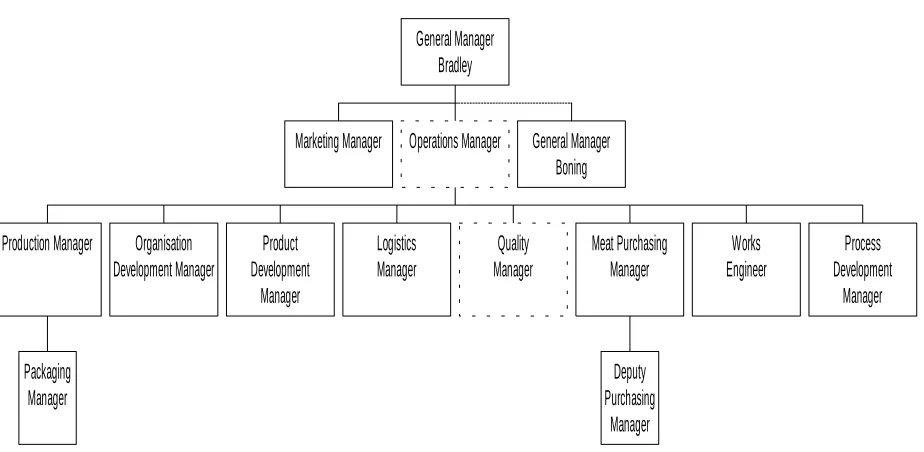
Marketing Manager
Packaging Manager
Production Manager Organisation Development Manager
Product Development
Manager
Logistics Manager
Quality Manager
Deputy Purchasing
Manager Meat Purchasing
Manager
Works Engineer
Process Development
Manager Operations Manager General Manager
Boning General Manager
Bradley
The manager of the boning room that supplied the company with most of its meat was a member of the planning team for the whole process.
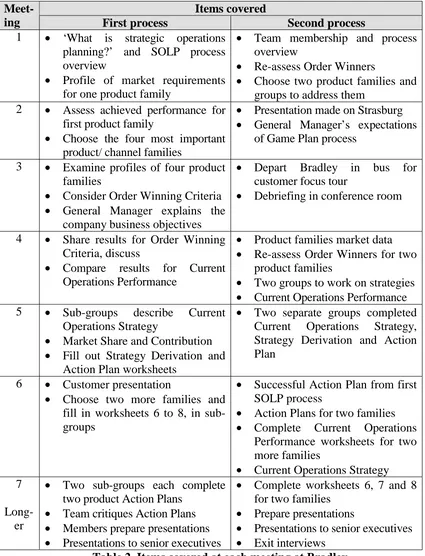
The second column of Table 2 lists the main areas covered at each of the seven meetings, held over a period of seven weeks. Meetings generally lasted two to three hours, with the final meeting lasting six hours. The Marketing Manager attended a few meetings but was not committed to the process. The General Manager attended parts of meetings where his involvement was required.
The Operations Manager called together the twelve team managers for a first meeting at which he stated: “In future ‘Bradley’ needs to integrate the strategic direction of its operations with that of the whole business using a market driven management structure with both internal and external focus which will include logistics, packaging, procurement, product development and quality. A product range can be represented by more than one product family where it has more than one significant distribution channel.” The facilitator then explained the use of Strategic Operations and Logistics Planning, the benefits that Bradley managers would obtain from such planning and gave an overview of the steps of the SOLP process.
Tasks carried out by the team in each of the subsequent meetings are summarised in Table 2.
In the final extended meeting, the team moved off-site, to complete several worksheets and prepare presentations to the General Manager and other senior executives. The four chosen members gave their presentations in turn, as follows:
1. Presentation by the Product Development Manager on the product-channel family Fresh Sausage- Retail;
2. Presentation by the Works Engineer on the product family Bacon;
3. Presentation by the Packaging Manager on the product family Frankfurters Packaged; and
4. Presentation by the Deputy Purchasing Manager on the product family Hams and Cooked Meats.
There was close involvement of everyone in this meeting. The offsite venue helped to focus members on the job at hand.
A week after the meeting, the Organisation Development (OD) Manager, issued a 19-page document “Strategic Operations and Logistics Plan for Bradley Smallgoods” which contained Operations Plans and Action Plans for the above four product families.
Second Process
Organisation Development Manager was appointed joint facilitator with the researcher. The Operations Manager, the facilitator and the OD Manager formed a steering committee that met before team meetings to consider the best way to pursue the planning process.
Items covered
Meet-ing First process Second process
1 • ‘What is strategic operations planning?’ and SOLP process overview
• Profile of market requirements for one product family
• Team membership and process overview
• Re-assess Order Winners
• Choose two product families and groups to address them
2 • Assess achieved performance for first product family
• Choose the four most important product/ channel families
• Presentation made on Strasburg • General Manager’s expectations
of Game Plan process 3 • Examine profiles of four product
families
• Consider Order Winning Criteria • General Manager explains the
company business objectives
• Depart Bradley in bus for customer focus tour
• Debriefing in conference room
4 • Share results for Order Winning Criteria, discuss
• Compare results for Current Operations Performance
• Product families market data • Re-assess Order Winners for two
product families
• Two groups to work on strategies • Current Operations Performance 5 • Sub-groups describe Current
Operations Strategy
• Market Share and Contribution • Fill out Strategy Derivation and
Action Plan worksheets
• Two separate groups completed Current Operations Strategy, Strategy Derivation and Action Plan
6 • Customer presentation
• Choose two more families and fill in worksheets 6 to 8, in sub-groups
• Successful Action Plan from first SOLP process
• Action Plans for two families • Complete Current Operations
Performance worksheets for two more families
• Current Operations Strategy 7
Long-er
• Two sub-groups each complete two product Action Plans
• Team critiques Action Plans • Members prepare presentations • Presentations to senior executives
• Complete worksheets 6, 7 and 8 for two families
• Prepare presentations
• Presentations to senior executives • Exit interviews
The facilitator held a preliminary discussion with the Operations Manager to consider the involvement of the sales department, the products to be planned and the method of facilitation in which the OD Manager would take a lead role, assisted by the researcher. Next this steering group had a meeting with two senior sales managers who acknowledged that there was limited contact between operations, logistics and sales at Bradley. It was recognised that progress had been made with four product-family-channel Action Plans in the first process. In particular, implementation of Fresh Sausage-Retail into a major Australian supermarket chain, reached a very positive result. The need for operations managers to visit a number of customers was agreed. It was decided to hold meetings two hours in length every two weeks on Friday mornings. The work done in the first process was presented to a meeting of sales managers.
The third column of Table 2 lists the main areas covered at each of the meetings held. The twelve managers involved in all the meetings largely came from the operations, logistics and marketing functions, as shown on the organisation structure in Figure 3. After two meetings lasting three hours each, team members spent a whole day with a range of customers discussing the implications of their needs for Bradley's SOLP. This process application was pursued with more rigour than the first. Again a longer final meeting was held to complete strategies and action plans.
Discussion
From the foregoing description of the work carried out at Bradley meatworks, a number of findings can be drawn.
Previous approaches to strategic Operations planning (Platts and Gregory, 1990; Menda and Dilts, 1997; and Sadler, 1999b) have been extended into a Supply chain process covering all companies in an integrated supply chain from farmers to retailers. At the heart of this process is the creation of a team of managers that represents all the firms in the supply chain. This team, carrying out action research with an external facilitator, goes through the steps of the SOLP process in a number of meetings. Essential steps are:
• the formation of product-family channels,
• the determination of order-winning criteria for those channels, • derivation of the operations and logistics objectives to steer towards, • audit of operations and logistics policies throughout the supply chain, and • formulation of the strategies required to achieve those objectives in the form of
and the danger that confidential information might be divulged. So the extended process meets the criteria required for joint operations planning by partners in entire supply chains but further testing is needed to judge its full capability.
The four concepts in the theoretical approach (refer p.9 above) are now reviewed. Experience at Bradley supports the concept that democratic planning with natural process steps is the most supportive approach. Bradley managers formulated new strategies for several product-family-channels (pfc) in the SOLP process. This is akin to the Value Stream approach suggested by Womack & Jones (1994). This contrasted with Bradley’s previous difficulties in making change. The use of a team representing all parts of the integrated supply chain was only partly achieved in this case, highlighting the difficulty of applying theories to practical cases. The Bradley team included a boning room manager but excluded representatives of other links.
The concept of planning physical operations and information across all the links in a pfc is partially supported by the present research. The use of pfc’s to focus minds of team members on concrete parts of the business was very successful. It led to action plans being implemented. These plans were skewed towards the manufacturing link compared the other links in the Integrated Supply Chain (ISC). There was very little consideration of the information required to drive the future operations of pfc’s. The concept that the ISC profitably achieve competitive criteria for customers was bourn out by the Bradley experiences. Considerable extra turnover and profit was reported by Bradley management (Sadler, 1999b, p.232) in several pfc’s and major improvements in one.
Just as gains are made by strategic alignment of several functions in a company in the service of customers (Mills and Gardner, 1995), so considerable gains are anticipated from the alignment of the operations and logistics functions of all significant enterprises in the integrated supply chain from farmer to retailer. It is very difficult to achieve such alignment without coercion. Specific benefits from applying the SOLP process to the integrated supply chain are considered to be:
• greater ability to supply the actual product that the end consumer requires; • ability to design effective and profitable integrated supply chains for individual
product-family-channels;
• postponing production and minimising inventory at each link by sharing information between chain partners;
• recognition of industry or customer changes through information from all chain partners in order to plan strategic responses in advance of competitors;
The research provides evidence that the extended SOLP process can be used for all the partners in a supply chain both in the food sector and in any manufacturing industry, provided the managers are sufficiently capable and prepared to devote time to undertake the creative thinking required. The application of the Manufacturing Audit Approach at Trico and Engineering workshops (Sadler and Sohal, 1994; Sadler et al., 1995) supports the likelihood that extended SOLP can work in other industries.
It is possible to imply some of the conditions which need to be met to achieve full cooperation between supply chain partners in the planning team. The proposed conditions are:
• The product-family channels being planned are handled by single organisations at each link in the channel. If multiple organisations are involved at any link, they are required to have cooperative rather than competitive relationships,
• Cases where strong threats to the commercial success of the channels increase the need for members to plan together to survive, and
• Partners have such a strong hold on the supply chain sales that its members do not fear commercial competition.
Has a contribution been made to the methodology of action research? Observations made during the SOLP process (Sadler, 1999b) suggest that AR is an important factor in making the process effective. The ability to have a researcher present with his or her own set of duties, the responsibility to facilitate team workshops, is very important in engendering success because team members do not fear that the researcher will interfere in their business. The researcher is able to educate and guide the planning team without adding any (significant) bias to the outcomes.
The period taken by the process, in which workshops take place over several months, enables the researcher to get to know team members in depth. This engenders trust and makes each manager prepared to share his/her reaction to the process. The richness of the resulting data exceeds that available from other methodologies. The longitudinal process is also considered to increase the likelihood of successful strategy formulation. The repeated effect of workshops interspersed with other duties is believed to be more effective than a long, once-off workshop (used by Platts and Gregory, 1992; and Miller, 1988). The longer process allows time for ideas to develop and for consultation between team members.
Conclusion
This problem may be solved by research in another industry where commercial sensitivity is lower. Such proposed research also needs to cover each link in the chain to a sufficient depth relative to their standing in the supply chain. Provided these two conditions are met, it is believed that an operationalised method of addressing Strategic Operations and Logistics Planning for integrated supply chains would result.
More work is needed on joint operations and logistics strategies for complete supply chains. The work carried out on such chain-wide strategies in this paper must be regarded as preliminary. It is necessary to work with all the partners in a number of supply chains to complete the design and practical steps required to enable the whole supply chain to plan its operations and logistics in one process. This process will lay the foundation for competitive advantage that includes innovation, effectiveness and efficiency.
Findings at one company indicate that strategic actions have been engendered and that the process is successful in enabling the team to formulate strategies for product families across the whole supply chain. This case has also illustrated the difficulties of applying theories to practice in a real world setting. The Action Research approach taken has infrequently been used in operations or logistics strategy formulation (Eden and Huxham, 1988). However, its use here has been beneficial and can be seen to have been more effective than traditional non-interventionist approaches such as survey and interviews.
Acknowledgment
The support of Professor Amrik Sohal, doctoral supervisor of the first author, is gratefully acknowledged. Amrik provided advice and direction that was a major factor in the success of the research described.
References
Ansoff, H.I. 1965, Corporate Strategy, McGraw-Hill, New York.
Bowersox, D.J., Calantone, R.J., Clinton, S.R., Closs, D.J., Cooper, M.B., Droge, C.L., Fawcett, S.E., Frankel, R., Frayer, D.J., Morash, E.A., Rinehard, L.M. & Schmitz, J.M. 1995, World Class Logistics: The Challenge of Managing Continuous Change, Council of Logistics Management, Oak Brook, Il, USA.
Christopher, M., Harrison, A. & van Hoek, R. 1999, ‘Creating the Agile supply chain: issues and challenges’, Logistics in the Information Age, Proc. of International Symposium on Logistics ‘99, eds Pawar, K.S. & Muffatto, M., Florence, Italy, pp. 101-106.
Christopher, M. 1997, Marketing Logistics, Butterworth Heinemann.
Gattorna, J.L. & Walters, D.W. 1996, Managing the Supply Chain: A Strategic Perspective, Macmillan Business, Basingstoke, U.K., pp. 165-175.
Hayes, R.H. & Wheelwright, S.C. 1984, Restoring our Competitive Edge, Wiley, New York.
Hill, T. 1994, Manufacturing Strategy: Text and Cases, 2nd ed., Irwin, Burr Ridge, Il. Hines, P., Sullivan, J. & Holweg, M. 1999, ‘Waves, beaches and breakwaters: new
insights into supply chain dynamics’, Logistics in the Information Age, Proc. of International Symposium on Logistics ‘99, eds K.S. Pawar & M. Muffatto, Florence, Italy, pp. 67-72.
Fabbe-Costes, N. & Colin, J. 1994, “Formulating Logistics Strategy” in Logistics and Distribution Planning, Cooper J., ed., Kogan Page, London, pp. 36-50.
Jouffrey, F. & Tarondeau, J.C. 1992, “A Methodological framework for the formulation of an industrial strategy” in Voss C.A. ed., Manufacturing Strategy: Process and Content, Chapman and Hall, London, pp.167-186.
Lambert, D.M., Emmelhainz, M.A. & Gardner, J.T. 1999, ‘Building successful logistics partnerships’, Journal of Business Logistics, vol. 20, no.1, pp. 165-181.
Lamming, R. 1989, The Causes and Effects of Structural Change in the European automotive components industry, report of the International Motor Vehicle Program, Massachusetts Institute of Technology, Cambridge, USA, pp. 21-32.
Lamming, R. 1993, Beyond Partnership: Strategies for Innovation and Lean Supply, Prentice-Hall, Hemel Hempstead.
Lewis, I. & Talalayevska, A. 1997, Journal of Business Logistics vol. 18, no. 1, pp. 141-156.
Mabert, V.A. & Venkataramanan, M.A. 1998, “Special Research Focus on Supply Chain Linkages: Challenges for Design and Management in the 21st Century”, Decision Sciences, vol. 29, no. 3, pp. 537-541.
Menda, R. & Dilts, D. 1997, “The manufacturing strategy formulation process: linking multifunctional viewpoints”, Journal of Operations Management, vol. 15, pp. 223-241.
Mills, J. & Gardner, G. 1995, ‘What’s in a Strategy? Toward a common language for the Strategic Alignment of Technical Functions”, Technological Innovation and Global Challenges, Bennett D. & Steward F. eds, European Conference on Management of Technology, Birmingham, pp. 37-44.
Mintzberg, H. & Quinn, J.B. 1991, The Strategy Process: Concepts, Contexts and Cases, Prentice Hall, New Jersey.
Perry, M. 1997, Effective Quick Response Manufacturing Strategies and Practices for the Australian Textiles, Clothing and Footwear Industry, PhD thesis, Faculty of Business and Economics, Monash University, pp. 227-262.
Platts, K.W. 1993, ‘A Process Approach to Researching Manufacturing Strategy’, I.J. of Operations and Production Management, vol. 13, no. 8, p.8.
Platts, K.W. & Gregory, M.J. 1990, ‘Manufacturing Audit in the Process of Strategy Formulation’, I.J. of Operations and Production Management, vol. 10, no. 9, pp. 6-26. Porter, M.E. 1985, Competitive Advantage, The Free Press, New York, chapters 2 and 7. Rice, J. 1997, ‘Demystifying Supply Chain Management: Accomplishments and
Challenges’, Council of Logistics Management Annual Conference Proceedings, Chicago, pp. 239-255.
Sadler, I. & Sohal, A.S. 1994, "Applying the Manufacturing Audit Approach to Manufacturing Strategy Formulation", Operations Strategy and Performance,
Proceedings of the First European Operations Management Association Conference, University of Cambridge Manufacturing Engineering Group, pp.119-124.
Sadler, I., Harvey, D. & Kovacs, Z. 1995, "Strategic Operations Planning for an Emergency Service: Using a Transformed Manufacturing Audit Approach", Proceedings of the Sixth International Conference on Manufacturing Engineering, IEAust, Melbourne, pp.53-62.
Sadler, I. 1999a, ‘Planning Supply Chain Operations: Testing a Process of Strategic Operations and Logistics planning’, Logistics in the Information Age, Proc. of 4th Int. Symposium on Logistics, eds. Pawar K.S. & Muffatto M., Florence, Italy.
Sadler, I. 1999b, Strategic Operations and Logistics Planning of Australian Meatworks, PhD thesis, Department of Management, Monash University, Melbourne.
Silber, K. 1998, Incorporating the Internet into the indirect purchasing function, Masters Thesis, Department of Management, Victoria University of Technology, Melbourne, pp. i-iii.
Slack, N. 1991, The Manufacturing Advantage: Achieving Competitive Manufacturing Operations, Mercury, London.
Stevens, G.C. 1989, “Integrating the Supply Chain”, I.J. of Physical Distribution and Materials Management, vol. 19, no. 8, pp. 3-8.
Susman, G.I. & Evered, R. D. 1978, “An Assessment of the Scientific Merits of Action Research”, Administrative Science Quarterly, vol. 23, pp. 582-602.
Womack, J.P. & Jones, D. T. 1994, “From Lean Production to the Lean Enterprise”,