IJEDR1602272
International Journal of Engineering Development and Research (www.ijedr.org)1519
An Enhancement of GEAR Protocol using Particle
Swarm Optimization in Wireless Sensor Network
1
Amandeep Kaur,
2R.S.Uppal,
3Bhalinder Kaur
1Student, 2Head of Department, 3Assistant Professor 1Electronics and Communication Engineering Department,
1Baba Banda Singh Bahadur Engineering College, Fatehgarh Sahib, Punjab,India
________________________________________________________________________________________________________
Abstract - A large number of multi functional sensor nodes having low cost, low power and small size are used for the formation of wireless sensor networks.For the design of wireless networking protocols, Minimizing the energy utilization and maximizing the network lifetime are the key requirements because lifetime of sensor nodes depends on the lifetime of battery power. In the field of WSN, routing is the core technology.So,a number of routing protocols are proposed for WSN having different objectives. This paper briefly presents the Geographic and Energy Aware Routing (GEAR) protocol and the Particle Swarm Optimization technique which is used to optimize the GEAR protocol.GEAR Protocol is generally a location based and energy efficient protocol, uses the energy aware neighbour selection to route a packet towards the target region and uses recursive geographic forwarding and or restricted flooding algorithms to disseminate the packet inside the destination region.In this paper the PSO technique is applied on GEAR protocol to increase the network lifetime and to reduce the energy consumption.
Index Terms - WSN,GEAR Protocol, GPSR Protocol,PSO,Energy, Nodes Lifetime
________________________________________________________________________________________________________
I.INTRODUCTION
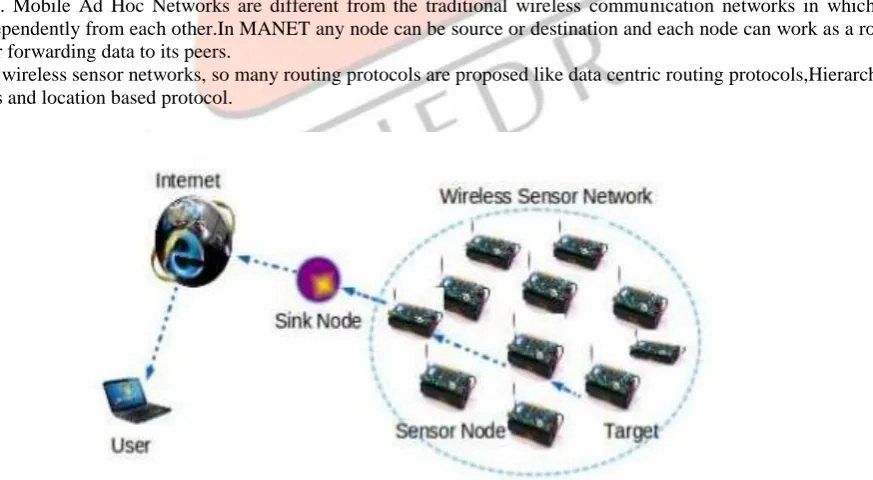
A large number of sensor nodes having sensing and computation capabilities are densly deployed over a large geographical region and networked through wireless links are used for the making of wireless sensor networks.Each sensor node in WSN has capability to communicate with each other and base station is used for the data integration and circulation.In WSN each and every node can become transmitter and receiver.A key feature for these networks is that their nodes are unattended.For these networks an important design consideration is energy efficiency and routing is a core technology for WSN Communication[11].
MANETS i.e. Mobile Ad Hoc Networks are different from the traditional wireless communication networks in which the nodes move independently from each other.In MANET any node can be source or destination and each node can work as a router which is used for forwarding data to its peers.
For routing in wireless sensor networks, so many routing protocols are proposed like data centric routing protocols,Hierarchical routing protocols and location based protocol.
Figure 1. Wireless Sensor Network
IJEDR1602272
International Journal of Engineering Development and Research (www.ijedr.org)1520
position of forwarding node,intermediate nodes and the destination. The source adds its estimated location information of destination in every data packet.II. REVIEW OF GEARAND GPSRPROTOCOL
A. Geographic and Energy Aware Routing (GEAR) Protocol
The GEAR Protocol uses the energy aware and geographically known neighbor choice heuristics to route a packet towards the destination region.Recursive geographic forwarding is employed to disseminate the packet within the certain region.To some specific regions for routing queries GEAR is designed.It is assumed that all the nodes should know their remaining energy and locations by means of such as GPS.Also, all the nodes knows about the remaining energy and location of their neighbor nodes.GEAR collects this information to build a heuristic function to avoid energy holes and select sensors to route a packet towards the destination region.
GEAR protocol only sends the data to the certain region instead of a whole network which restricts the number of interests. As we know the main idea of this protocol is using the location information.The packet forwarding process to all the nodes in the target region consists of two phases:
1.Packets forwarding towards the target region:
As we know GEAR uses a geographical and energy aware neighbor selection heuristic for packet routing towards the target region.There are two cases arises:
(a)When a neighbor closer to the destination exists: A next hop node is picked by GEAR among all the neighbors that lies closer to the destination.
(b)When no nearest nighbor exists:When this type of condition arises then there is a hole.In this case GEAR algorithm picks a next-hope node which reduces some cost of value of this neighbor.
2. Packet disseminating within the region:
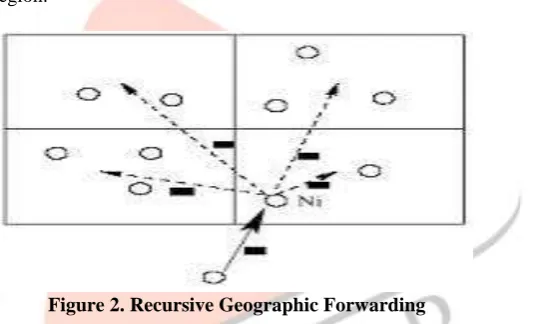
Figure 2. Recursive Geographic Forwarding
Recursive Geographic Forwarding is used to circulate the packet within the region.Under some conditions, recursive geographic forwarding doesn’t terminate.In this case GEAR algorithm uses Restricted Flooding[7].
B. Greedy Perimeter Stateless Routing (GPSR)Protocol
Greedy Perimeter Stateless Routing (GPSR) Protocol is a well-known location or position based protocol used for large geographical area.To make a forwarding decisions for WSN, it is based on position of routers and packets destination.GPSR makes forwarding decisions for sending packet from one node to the destination by selecting the minimum distance path possible.In GPSR ,greedy forwarding is used. To make greedy forwarding decisions for a packet tranmission the information about the router’s nearest neighbors in network topology is used.Where greedy forwarding fails,the routing is done around the perimeter of region[2][11][12].
Greedy Perimeter Stateless Routing (GPSR) protocol is widely used in classes of networks include Sensor networks,Rooftap networks,Vehicular and Ad-hoc networks(MANETs).In GPSR,location service scheme is used by source so that latest location of the destination should be find out and in the header of every packet location information is provided .
In GPSR,The packet is forwarded from source to destination by choosing shortest path.If there is case in which the destination is not directly reachable then the source forwards the packet to the neighbor node which places closer to the destination node.
IJEDR1602272
International Journal of Engineering Development and Research (www.ijedr.org)1521
Figure 3. Greedy forwarding example.y is x’s closest neighbor to destination D
III.PARTICLE SWARM OPTIMIZATION
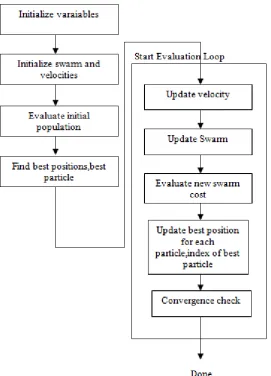
PSO is a invented in 1995 by Kennedy and Eberhart to solve non-linear continuous optimization problems.PSO is a bio inspired population (swarm) based optimization technique which performs a parallel search on a solution space and provides a search procedure in which the individuals known as particles can change their position with time.PSO is generally a search algorithm which is inspired from bird flocking and fish schooling.Each particle in this algorithm moves for searching the optimum solutions and hence has a velocity.
The optimum solution is received from set of randomly generated initial solutions by moving particles around in the search space by swarms following the best particle.There is a particular velocity and position for each particle.To update the position of particle,a new velocity value is used calculated at each iteration.This process iterates until reaching stopped condition.
Particle Swarm Optimization combines local search methods through self experience with the global search methods using neighboring methods trying to balance exploration and exploitation[16].PSO is generally a approach to the problems whose solutions can be shown as a point in an n-dimensional solution space.Through this space number of particles are randomly set into motion.During each round or iteration they check their fitness and fitness of their neighbors and appraoch successful neighbors that has current position shows better solution than theirs, by moving towards them.
IJEDR1602272
International Journal of Engineering Development and Research (www.ijedr.org)1522
So,In the PSO algorithm, Each particle having position and velocity.
knows its own position and the value assocaited with it.
Also knows the best position it ever achieved (local best)and the value associated with it.
Each particle also knows about its neighbors and their best positions (global best)and values.
Position of particle is determined by velocity.Let 𝑥𝑖(𝑡) denote the position of particle i in the search space at time t. The position of particle is changed by adding velocity 𝑣𝑖(𝑡) to the present or current position[4].
𝑥𝑖(𝑡 + 1) = 𝑥𝑖(𝑡) + 𝑣𝑖(𝑡 +1) (a)
𝑣𝑖(𝑡) = 𝑤𝑣𝑖 (𝑡 − 1) + 𝑐1 𝑟1 (𝑙𝑜𝑐𝑎𝑙𝑏𝑒𝑠𝑡(𝑡) − 𝑥𝑖(𝑡 − 1) + 𝑐2𝑟2(𝑔𝑙𝑜𝑏𝑎𝑙𝑏𝑒𝑠𝑡(𝑡) − 𝑥𝑖(𝑡 − 1) (b)
Equation (a) is used to calculate the position of particle and To calculate the velocity of particle equation (b) is used. Where, 𝑐1 =Cognition parameter which represents how much the particle trusts its own past experience.
𝑐2=Social parameter
𝑟1& 𝑟2=random numbers between 0 and 1.
w= Inertia weight which controls the momentum of the particle.
Fitness Function Evaluation: In this paper node distance and node power are used to evaluate the fitness of possible routes.The fitness value can be calculated by using the equation (c):
CFit=(w1*NdDis)+(w2*Ndpower) (c)
Where CFit=Fitness function calculation
w1 & w2 are the weighting factors for route distance and route power respectively.
IV.SIMULATION RESULTS
The simulation results presents the comparison between GEAR,GPSR and Proposed GEAR (PSO-GEAR) protocols. In this paper GEAR Protocol is enhanced using Particle Swarm Optimization technique and compared with the old approach.
The comparison is made by using two factors that are Average energy Consumption and Nodes Lifetime.
Nodes Lifetime:Figure 5, 6 and 7 shows the nodes lifetime in GEAR ,GPSR and Proposed GEAR(PSO-GEAR) Protocols.As the figures shows that nodes lifetime is more in PSO-GEAR.So Nodes lifetime is increased by optimizing the GEAR Protocol using Particle Swarm Optimization as shown in figure 6.
IJEDR1602272
International Journal of Engineering Development and Research (www.ijedr.org)1523
Figure 6.Nodes Lifetime in Proposed GEAR(PSO-GEAR)
In this figure Proposed GEAR nodes lifetime is shown.The nodes lifetime is increased in this approach.In PSO-GEAR the nodes undergo dead condition after 5000 iterations approx.
Figure 7.Nodes Lifetime in GPSR Figure 7 shows that after 210 iterations the nodes starts to be die
.
Figure 8.Comparison between PSO-GEAR ,GEAR and GPSR Nodes Lifetime
IJEDR1602272
International Journal of Engineering Development and Research (www.ijedr.org)1524
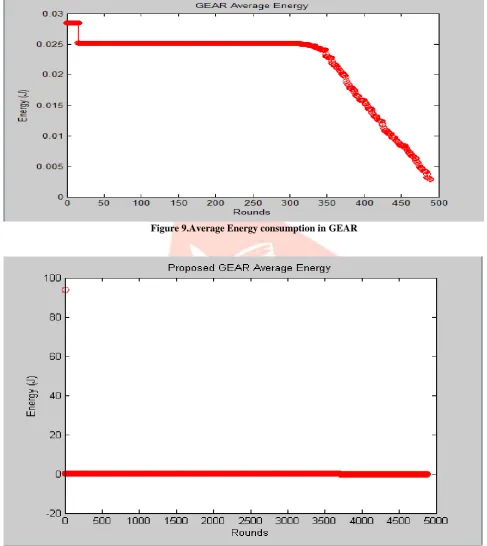
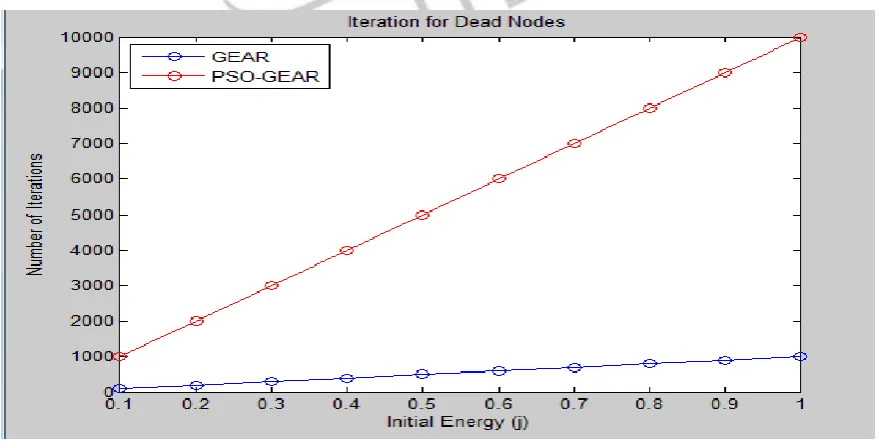
iterations all the node become dead and in GEAR upto 500 iteartions and in PSO-GEAR the nodes lifetime is upto 5000 iteartions.Average Energy Consumption:The challenging factor in the design of WSN is Energy Consumption.The figure 9,10 and 11 shows the energy consumption in GEAR,PSO-GEAR and GPSR respectively.Results shows that energy consumption is less in Proposed GEAR (PSO-GEAR) than the old approach.
Figure 9.Average Energy consumption in GEAR
IJEDR1602272
International Journal of Engineering Development and Research (www.ijedr.org)1525
Figure 11.Average Energy consumption in GPSR
Figure 12.Comparison of Energy Consumption between PSO-GEAR ,GEAR and GPSR
The figure 12 shows the comparison of energy consumption between GPSR ,GEAR and PSO-GEAR protocols.We can see that energy consumption in the proposed GEAR (PSO-GEAR) is less than the both GPSR and GEAR protocols.
Figure 13.Iteartions at different Initial Energies
IJEDR1602272
International Journal of Engineering Development and Research (www.ijedr.org)1526
V.CONCLUSION AND FUTURE SCOPE.
In this paper we present a GEAR Protocol i.e Geographic and Energy Aware Routing Protocol which is enhanced by using the Particle Swarm Optimization Technique for efficient routing process.The PSO is used to reduce the energy consumption and increase the network lifetime of GEAR Protocol than the old approach.In this paper Particle swarm intelligence method is used for cluster head selection. From the results obtained it is concluded that this optimized protocol i.e.PSO-GEAR is better than the traditional GEAR and GPSR routing protocol. The optimized route is obtained that is considered to be efficient. A comparison is performed that shows the proposed GEAR protocol using PSO is better than the traditional GEAR and GPSR protocol .
From the results obtained it is concluded that the network lifetime is increased and the energy consumption of the nodes is decreased. The network becomes more efficient as the life time of the network is increased .The cluster head selection method is improved by using optimization algorithm.
In future this protocol can be further enhanced to increase the life time of the network.Along with this the trending swarm intelligence technique like BFO,ACO,GA or their hybridization can be used to further improve the cluster head selection method.
REFERENCES
[1] Anant Baijal, Vikram Singh Chauhan and T Jayabarathi(July 2011), “Application of PSO, Artificial Bee Colony and Bacterial Foraging Optimization algorithms to economic load dispatch: An analysis” IJCSI International Journal of Computer Science Issues, Vol. 8, Issue 4, No 1.
[2] B. Karp and H. T. Kung, “GPSR: Greedy Perimeter StatelessRouting for Wireless Networks,” Proceedings of the 6th Annual International Conference on Mobile Computing and Networking, pp. 243-254, Boston, MA, USA, August 2000.
[3] Degui Xiao (June, 2011) “An Improved GPSR Routing Protocol”, International Journal of Advancements in Computing Technology Volume 3, Number 5, pp 132-139.
[4] Dian Palupi Rini,Siti Mariyam Shamsuddin,Siti Sophiyati Yuhaniz(2011), “Particle Swarm Optimization: Technique, System and Challenges” International Journal of Computer Applications (0975 – 8887) Volume 14– No.1, January 2011.
[5] Dr.R.KalaiMagal(2014), “A Survey on Wireless Sensor Network Protocols” , ISET - International Journal of Innovative Science, Engineering & Technology, Vol. 1 Issue 6,Pp 548-562.
[6] Gaurav Srivastav(2013), “Effective Sensory Communication using GEAR Protocol “ International Journal of Science and Research (IJSR) vol 9, issue 4 , Pp 1809-1815.
[7] Haixia Zhao(2013) , “A New Secure Geographical Routing Protocol Based on Location Pair wise Keys in Wireless Sensor Networks”, IJCSI International Journal of Computer Science Issues, Vol. 10, Issue 2, No 2,Pp 365-372
[8] K.Gandhimathi(2014), “A Survey on Energy Efficient Routing Protocol in Wireless Sensor Network” , International Journal of Advance Research Computer Science and Management Studies , Vol 2,issue 8,Pp 174-181
[9] Loveneet Kaur, Dinesh Kumar(2014), “Optimization techniques for Routing in Wireless Sensor Network”, International Journal of Computer Science and Information Technologies, Vol. 5 (3) , 2014, 4719-4721.
[10] Lovepreet Kaur(2014), “Energy-Efficient Routing Protocols in Wireless Sensor Networks: A Survey “International Journal of Computer Applications ,Volume 100– No.1,Pp 25-29
[11] Monica R Mundada (2012), “A Study on Energy Efficient Routing Protocols in Wireless Sensor Networks “International Journal of Distributed and Parallel Systems (IJDPS) Vol.3, No.3,Pp 311-330.
[12] Natarajan Meghanathan (November, 2010) “An Energy-aware Greedy Perimeter Stateless Routing Protocol for Mobile Ad hoc Networks”, IJCA, Volume 9– No.6, pp 30-35.
[13] Neeraj Dewli (2015), “A Comparative Analysis of M-GEAR and MODLEACH Energy Efficient WSN Protocols “(IJCSIT) International Journal of Computer Science and Information Technologies, Vol. 6 (3) , pp 2641-2644
[14] Rama Sundari Battula (2013) , “Geographic Routing Protocols for Wireless Sensor Networks: A “International Journal of Engineering and Innovative Technology (IJEIT) Volume 2, Issue 12,Pp 39-42.
[15] Shahram Jamali, Leila Rezaei, Sajjad Jahanbakhsh Gudakahriz(2013), “An Energy-efficient Routing Protocol for MANETs: a Particle Swarm Optimization Approach”,Journal of Applied Research and Technology,Vol.11,December 2013,Pp 803-812.
[16] Shital Y. Agrawal(2013), “A Survey on Location Based Routing Protocols for Wireless Sensor Network “International Journal of Emerging Technology and Advanced Engineering Website, Volume 3, Issue 9, Pp 123-126.
[17] Shruti Dixit ,Rakesh Singhai(2015), “A Survey Paper on Particle Swarm Optimization based Routing Protocols in Mobile Ad-Hoc Networks”, International Journal of Computer Applications (0975 – 8887) Volume 119 – No.10, June 2015.