Word Sense Annotation of Polysemous Words by Multiple Annotators
Rebecca J. Passonneau
1, Ansaf Salleb-Aoussi
1, Vikas Bhardwaj
1, Nancy Ide
21Center for Computational Learning Systems
Columbia University New York, NY, USA
[email protected], [email protected], [email protected]
2Department of Computer Science
Vassar College
Poughkeepsie, NY, USA, [email protected]
Abstract
We describe results of a word sense annotation task using WordNet, involving half a dozen well-trained annotators on ten polysemous words for three parts of speech. One hundred sentences for each word were annotated. Annotators had the same level of training and experience, but interannotator agreement (IA) varied across words. There was some effect of part of speech, with higher agreement on nouns and adjectives, but within the words for each part of speech there was wide variation. This variation in IA does not correlate with number of senses in the inventory, or the number of senses actually selected by annotators. In fact, IA was sometimes quite high for words with many senses. We claim that the IA variation is due to the word meanings, contexts of use, and individual differences among annotators. We find some correlation of IA with sense confusability as measured by a sense confusion threshhold (CT). Data mining for association rules on a flattened data representation indicating each annotator’s sense choices identifies outliers for some words, and systematic differences among pairs of annotators on others.
1.
Introduction
In comparison to morphosyntactic properties of language, word and phrasal meaning is fluid, and to some degree, generative (Pustejovsky, 1991; Nunberg, 1979). As a re-sult, variation in word sense annotation across annotators should be expected as a consequence of usage variation. We report on a second phase of a word-sense annotation task for polysemous words. It was carried out by multiple annotators on a heterogeneous corpus. This phase is sim-ilar to an earlier pilot study (Passonneau et al., 2009) but with more data and partly different annotators. We observe that different words lead to higher or lower interannotator agreement (IA). Given that the same annotators were being compared, and given that they had nearly the same train-ing and experience, we hypothesize the differences in IA to result from semantic properties of the words themselves, and the contexts they occur in. We believe these aspects of usage should be explicitly modelled in order for Natural Language Processing (NLP) applications to handle mean-ing more robustly.
2.
Related Work
There has been a decade-long community-wide effort to evaluate word sense disambiguation (WSD) systems across languages in the four Senseval efforts (1998, 2001, 2004, and 2007, cf. (Kilgarriff, 1998; Pedersen, 2002a; Ped-ersen, 2002b; Palmer et al., 2005)), with a corollary ef-fort to investigate the issues pertaining to preparation of manually annotated gold standard corpora tagged for word senses (Palmer et al., 2005). Differences in IA and system performance across part-of-speech have been examined, as in (Ng et al., 1999; Palmer et al., 2005). Pedersen (Peder-sen, 2002a) examines variation across individual words in
evaluating WSD systems, but does not attempt to explain it. Factors that have been proposed as affecting human or sys-tem WSD include whether annotators are allowed to assign multilabels (V/eronis, 1998; Ide et al., 2002; Passonneau et al., 2006), the number or granularity of senses (Ng et al., 1999), merging of related senses (Snow et al., 2007), sense similarity (Chugur et al., 2002), sense perplexity (Diab, 2004), entropy (Diab, 2004; Palmer et al., 2005), and in psycholinguistic experiments, reactions times required to distinguish senses (Klein and Murphy, 2002; Ide and Wilks, 2006). We continue our previous investigation (Passonneau et al., 2009) into the hypothesis that the inherent semantics of words, and the specificity of contexts words occur in, affect the level of agreement among annotators.
3.
The Annotation Task
The Manually Annotated Sub-Corpus (MASC) project is creating a small, representative corpus of American En-glish written and spoken texts drawn from the Open Ameri-can National Corpus (OANC).1The MASC corpus includes
hand-validated or manual annotations for a variety of lin-guistic phenomena. One of the goals of the project is to support efforts to harmonize WordNet (Miller et al., 1993) and FrameNet (Ruppenhofer et al., 2006), in order to bring the sense distinctions each makes into better alignment. As a starting sample, we chose ten fairly frequent, moderately polysemous words for sense tagging, targeting in particular words that do not yet exist in FrameNet, as well as words with different numbers of senses in the two resources. The ten words are shown in Table 1.
One thousand occurrences of each word, including all oc-currences appearing in the MASC subset and others
semi-1
randomly chosen from the remainder of the 15 million word OANC,2 were annotated by at least one of six
undergrad-uate annotators at Vassar College and Columbia Univer-sity. Fifty occurrences per word were annotated by all six in phase one of a multi-annotator task (Passonneau et al., 2009). For the current phase, one hundred additional oc-currences of each word were annotated by five or six anno-tators from the same pool; four of the annoanno-tators did both phases. For this phase of annotation, annotators were con-strained to select a single WordNet sense. In ongoing anno-tation phases, annotators can assign multiple senses if they cannot decide on a single best one.
4.
Interannotator Agreement
We report IA using one of the family of agreement coef-ficients that factor out chance agreement: Krippendorff’s Alpha (Krippendorff, 1980). Our use of this metric has been discussed in previous work (Passonneau, 2004; Pas-sonneau, 2008); for a review of the use of agreement coef-ficients, see (Artstein and Poesio, 2008). Values range from 0 for agreement levels that would be predicted by chance, given the rate at which annotation values occur, to 1 for perfect agreement or -1 for perfect disagreement.
To insure values of Alpha are comparable where we have five versus six annotators, we compared alpha for six anno-tators with the average alpha for all pairs of five annoanno-tators, and found no significant difference (Student’s t=0.0024, p=0.9982). We conclude that agreement varies little for five versus six annotators on the same word. This suggests we met our goal for all the annotators to have had equal training, and to be equally proficient. This contrasts with prior work on a different, multi-site concept annotation task where individual annotators had quite distinct ranks (Pas-sonneau et al., 2006).
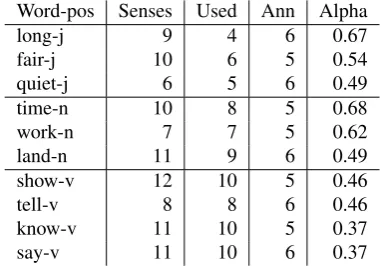
Table 1 shows the ten words, grouped by part of speech, with the number of WordNet senses, the number of senses selected by annotators in this phase (used), the number of annotators, and Alpha. We see the same phenomenon here reported on in our earlier pilot (Passonneau et al., 2009). Agreement varies from a high of 0.68 to a low of 0.37. To some degree, the part-of-speech of the word correlates with a different range of agreement. Adjectives and nouns have nearly the same range (0.68 to 0.49), while agreement on verbs is much lower.
The number of senses per word does not correlate with IA (ρ=-0.38). The number of senses used has a very modest inverse correlation with IA (ρ=-0.56). We conclude that the factors that can explain the variation in IA pertain to the meanings of the words themselves, their contexts of use, and individual differences among annotators that re-flect sociolinguistic and ideolectal differences, rather than deficiencies in annotation performance.
5.
Intersense Similarity
We applied an inter-sense similarity measure (ISM) pro-posed in (Ide, 2006) to the sense inventories of each of the
2The occurrences were drawn equally from each of the
genre-specific portions of the OANC.
Word-pos Senses Used Ann Alpha long-j 9 4 6 0.67 fair-j 10 6 5 0.54 quiet-j 6 5 6 0.49 time-n 10 8 5 0.68 work-n 7 7 5 0.62 land-n 11 9 6 0.49 show-v 12 10 5 0.46 tell-v 8 8 6 0.46 know-v 11 10 5 0.37 say-v 11 10 6 0.37
Table 1: Interannotator agreement on ten polysemous words: three adjectives, three nouns and four verbs
ten words to test the hypothesis that words with very similar senses have lower IA scores.
ISM is computed for each pair of a word’s senses, using a variant of the Lesk measure (Banerjee and Pedersen, 2002). ISMs range from 0 to 1.44.3 Theconfusion threshhold CT
for each wordwis:
CTw=µISMw+σISMw
whereISMwis the intersense similarity for a distinct pair
ofw’s senses.4
Word Pairs Max Mean Std. Dev %>CT
long-j 36 0.71 0.28 0.18 0.17
fair-j 45 1.25 0.28 0.34 0.18
quiet-j 15 0.32 0.12 0.10 0.20
time-n 45 1.88 0.42 0.43 0.11
work-n 21 0.63 0.22 0.16 0.14
land-n 54 1.44 0.17 0.29 0.07
tell-v 28 1.22 0.15 0.25 0.07
show-v 66 1.38 0.18 0.27 0.12
know-v 55 0.93 0.23 0.25 0.18
say-v 55 1.05 0.12 0.16 0.09
Table 2: ISM statistics
Table 2 shows the number of sense pairs, the max, mean and standard deviation for each word’s ISMs, and the percent-age of senses that are greater than the word’s CT. We find a good correlation of IA with %>CT for nouns (ρ=0.73), but not for verbs or adjectives. When we restrict the calculation of CT to the senses actually selected by annotators, rather than all senses, the correlation of IA with %>CT is 0.96 for nouns. Although this is a very high correlation, three data points for nouns is too small a sample for a definitive con-clusion. Overall, there is a modest correlation of 0.59 of IA with the confusion threshhold for senses used, indicating that a larger study might be worthwhile.
3
Note that because the scores are based on overlaps among WordNet relations, glosses, examples, etc., there is no pre-defined ceiling. For the words in this study, we compute a ceiling as the maximum of ISM for sense with itself, here 4.85.
4In our earlier paper, we used CT equal to the mean plus two
6.3. Verbs
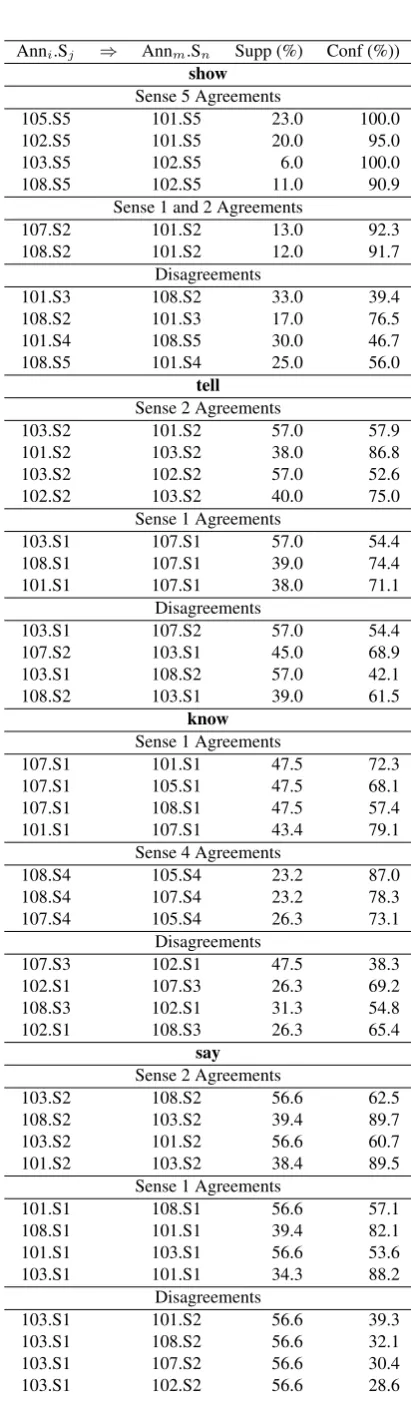
For verbs, the observed sense frequency does not reflect the ordering predicted by WordNet. For example, agreement rules for sense 5 ofshowhave the greatest support, and for
sayandtell, sense 2 agreement rules have the greatest sup-port (Table 5). Despite the relatively poor IA on verbs, there are two verbs that have association rules on sense agree-ments with support above 50%, although in both cases the confidence is relatively lower: tellwith 5, andsaywith 8. In both cases, the senses that have high support agreement rules also have high support disagreement rules. We see for example, that 56.6% of the time, 103 uses sense 2 ofsay, and if 103 does, 108 does so 62.5% of the time. However, in 32.1% of these cases, 108 uses sense 1. Overall, verbs have a higher proportion of disagreement association rules than do adjectives or nouns.
7.
Conclusion
IA results for our second phase of annotation of ten pol-ysemous words show improvement in IA on some words, and continue to exhibit a clear variation across words, in-dependent of part of speech. Given that the same five or six annotators did each word, with the same level of training and experience, and little difference among annotators in overall performance, we claim that it is the word meanings, contexts of use, and individual differences among annota-tors that account for the IA variations. We find some corre-lation of IA with sense confusability as measured by a sense confusion threshhold (CT), particularly if we consider only the senses used, rather than all the senses in a word’s in-ventory. However, CT is dependent on the WordNet path structures, and may differ for different parts of speech, and for different lexical domains or even words, depending on the current state of WordNet development.
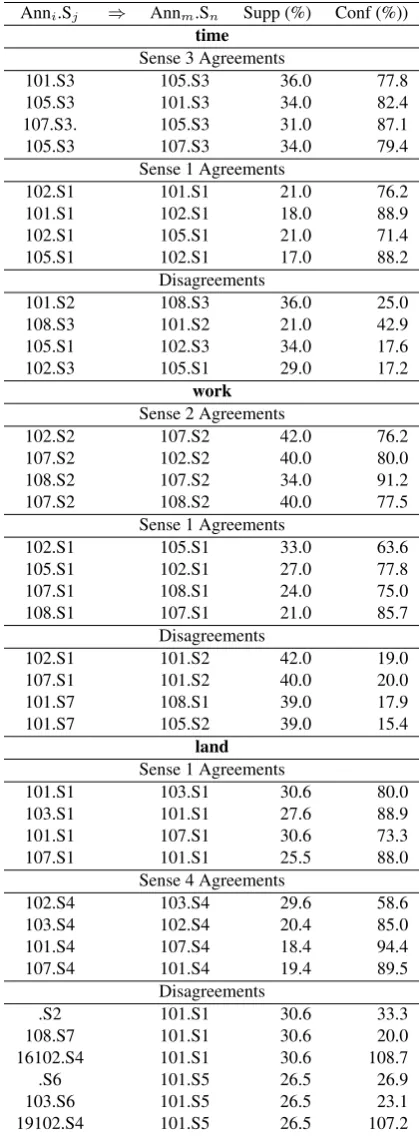
Of necessity, the number of association rules found at dif-ferent levels of support and confidence are consistent with the IA measures, but the same levels of IA can be associ-ated with quite distinct patterns of association rules. Fur-ther, the association rules provide a fine-grained analysis of annotator behavior, showing patterns of agreement and dis-agreement among subsets of annotators. For example, our three adjectives and three nouns had similar ranges of IA, but quite distinct patterns of association rules. Adjectives were characterized by fewer senses used, and higher sup-port for association rules in comparison to nouns. In future work, we aim to provide metrics that quantify character-istic patterns of agreement and disagreement in similarly fine-grained fashion.
Acknowledgments
This work was supported by NSF CRI RI-0708952.
8.
References
Rakesh Agrawal, Tomasz Imielinski, and Arun N. Swami. 1993. Mining association rules between sets of items in large databases. In Peter Buneman and Sushil Jajodia, editors,Proceedings of the 1993 ACM SIGMOD Interna-tional Conference on Management of Data, Washington, D.C., May 26-28, 1993, pages 207–216. ACM Press.
Ron Artstein and Massimo Poesio. 2008. Inter-coder agreement for computational linguistics. Computational Linguistics, 34(4):555–596.
Satanjeev Banerjee and Ted Pedersen. 2002. An adapted Lesk algorithm for word sense disambiguation using WordNet. InProceedings of the third International Con-ference on Intelligent Text Processing and Computa-tional Linguistics (CICLing-2002), pages 136–45, Mex-ico City, MexMex-ico.
Irina Chugur, Julio Gonzalo, and Felisa Verdejo. 2002. Polysemy and sense proximity in the senseval-2 test suite. InProceedings of the SIGLEX/SENSEVAL Work-shop on Word Sense Disambiguation: Recent Successes and Future Directions, pages 32–39, Philadelphia. Mona Diab. 2004. Relieving the data acquisition
bottle-neck in word sense disambiguation. In Proceedings of the 42nd Annual Meeting on Association for Computa-tional Linguistics, pages 303–311.
Nancy Ide and Yorick Wilks. 2006. Making sense about sense. In E. Agirre and P. Edmonds, editors,Word Sense Disambiguation: Algorithms and Applications, pages 47–74, Dordrecht, The Netherlands. Springer.
Nancy Ide, Tomaz Erjavec, and Dan Tufis. 2002. Sense discrimination with parallel corpora. In Proceedings of ACL’02 Workshop on Word Sense Disambiguation: Recent Successes and Future Directions, pages 54–60, Philadelphia.
Nancy Ide. 2006. Making senses: Bootstrapping sense-tagged lists of semantically-related words. In Alexan-der Gelbukh, editor, Computational Linguistics and In-telligent Text, pages 13–27, Dordrecht, The Netherlands. Springer.
Adam Kilgarriff. 1998. SENSEVAL: An exercise in eval-uating word sense disambiguation programs. In Pro-ceedings of the First International Conference on Lan-guage Resources and Evaluation (LREC), pages 581– 588, Granada.
Devra Klein and Gregory Murphy. 2002. Paper has been my ruin: Conceptual relations of polysemous words.
Journal of Memory and Language, 47:548–70.
Klaus Krippendorff. 1980. Content analysis: An intro-duction to its methodology. Sage Publications, Beverly Hills, CA.
George A. Miller, Richard Beckwith, Christiane Fellbaum, Derek Gross, and Katherine Miller. 1993. Introduction to WordNet: An on-line lexical database (revised). Tech-nical Report Cognitive Science Laboratory (CSL) Re-port 43, Princeton University, Princeton. Revised March 1993.
Hwee Tou Ng, Chung Yong Lim, and Shou King Foo. 1999. A case study on inter-annotator agreement for word sense disambiguation. In SIGLEX Workshop On Standardizing Lexical Resources.
Geoffrey Nunberg. 1979. The non-uniqueness of seman-tic solutions: Polysemy. Linguistics and Philosophy, 3:143–184.
dis-tinctions. Journal of Natural Language Engineering, 13.2:137–163.
Rebecca J. Passonneau, Nizar Habash, and Owen Rambow. 2006. Inter-annotator agreement on a multilingual se-mantic annotation task. InProceedings of the Interna-tional Conference on Language Resources and Evalua-tion (LREC), pages 1951–1956, Genoa, Italy.
Rebecca J. Passonneau, Salleb-Ansaf Aouissi, and Nancy Ide. 2009. Making sense of word sense variation. In
Proceedings of the NAACL-HLT 2009 Workshop on Se-mantic Evalutions: Recent Achievements and Future Di-rections (SEW-2009), pages 2–9.
Rebecca J. Passonneau. 2004. Computing reliability for coreference annotation. InProceedings of the Interna-tional Conference on Language Resources and Evalua-tion (LREC), Portugal.
Rebecca J. Passonneau. 2008. Formal and functional as-sessment of the pyramid method for summary content evaluation. Natural Language Engineering.
Ted Pedersen. 2002a. Assessing system agreement and in-stance difficulty in the lexical sample tasks of Senseval-2. InProceedings of the ACL-02 Workshop on Word Sense Disambiguation: Recent Successes and Future Direc-tions, pages 40–46.
Ted Pedersen. 2002b. Evaluating the effectiveness of en-sembles of decision trees in disambiguating SENSEVAL lexical samples. InProceedings of the ACL-02 Workshop on Word Sense Disambiguation: Recent Successes and Future Directions, pages 81–87.
James Pustejovsky. 1991. The generative lexicon. Compu-tational Linguitics, 17(4):409–441.
Josef Ruppenhofer, Michael Ellsworth, Miriam R. L. Petruck, Christopher R. Johnson, and Jan Scheffczyk. 2006. Framenet ii: Extended theory and practice. Avail-able from http://framenet.icsi.berkeley.edu/index.php. Ansaf Salleb-Aouissi, Christel Vrain, and Cyril Nortet.
2007. Quantminer: A genetic algorithm for mining quantitative association rules. In IJCAI, pages 1035– 1040.
Rion Snow, Daniel Jurafsky, and Andrew Y. Ng. 2007. Learning to merge word senses. In Proceedings of the 2007 Joint Conference on Empirical Methods in Natural Language Processing and Computational Natural Lan-guage Learning, pages 1005–1014, Prague.
Jean V/eronis. 1998. A study of polysemy judgements and inter-annotator agreement. InSENSEVAL Workshop, pages Sussex, England.
Mohammed Javeed Zaki, Srinivasan Parthasarathy, Mit-sunori Ogihara, and Wei Li. 1997. New algorithms for fast discovery of association rules. InKDD, pages 283– 286.
Anni.Sj ⇒ Annm.Sn Supp (%) Conf (%)) show
Sense 5 Agreements
105.S5 101.S5 23.0 100.0
102.S5 101.S5 20.0 95.0
103.S5 102.S5 6.0 100.0
108.S5 102.S5 11.0 90.9
Sense 1 and 2 Agreements
107.S2 101.S2 13.0 92.3
108.S2 101.S2 12.0 91.7
Disagreements
101.S3 108.S2 33.0 39.4
108.S2 101.S3 17.0 76.5
101.S4 108.S5 30.0 46.7
108.S5 101.S4 25.0 56.0
tell Sense 2 Agreements
103.S2 101.S2 57.0 57.9
101.S2 103.S2 38.0 86.8
103.S2 102.S2 57.0 52.6
102.S2 103.S2 40.0 75.0
Sense 1 Agreements
103.S1 107.S1 57.0 54.4
108.S1 107.S1 39.0 74.4
101.S1 107.S1 38.0 71.1
Disagreements
103.S1 107.S2 57.0 54.4
107.S2 103.S1 45.0 68.9
103.S1 108.S2 57.0 42.1
108.S2 103.S1 39.0 61.5
know Sense 1 Agreements
107.S1 101.S1 47.5 72.3
107.S1 105.S1 47.5 68.1
107.S1 108.S1 47.5 57.4
101.S1 107.S1 43.4 79.1
Sense 4 Agreements
108.S4 105.S4 23.2 87.0
108.S4 107.S4 23.2 78.3
107.S4 105.S4 26.3 73.1
Disagreements
107.S3 102.S1 47.5 38.3
102.S1 107.S3 26.3 69.2
108.S3 102.S1 31.3 54.8
102.S1 108.S3 26.3 65.4
say Sense 2 Agreements
103.S2 108.S2 56.6 62.5
108.S2 103.S2 39.4 89.7
103.S2 101.S2 56.6 60.7
101.S2 103.S2 38.4 89.5
Sense 1 Agreements
101.S1 108.S1 56.6 57.1
108.S1 101.S1 39.4 82.1
101.S1 103.S1 56.6 53.6
103.S1 101.S1 34.3 88.2
Disagreements
103.S1 101.S2 56.6 39.3
103.S1 108.S2 56.6 32.1
103.S1 107.S2 56.6 30.4
103.S1 102.S2 56.6 28.6