Combining terminology resources and statistical methods for entity
recognition: an evaluation
Angus Roberts, Robert Gaizauskas, Mark Hepple, Yikun Guo
Department of Computer Science, University of Sheffield, Regent Court, 211 Portobello, Sheffield S1 4DP
{initial.surname}@dcs.shef.ac.uk
Abstract
Terminologies and other knowledge resources are widely used to aid entity recognition in specialist domain texts. As well as providing lexicons of specialist terms, linkage from the text back to a resource can make additional knowledge available to applications. Use of such resources is especially pertinent in the biomedical domain, where large numbers of these resources are available, and where they are widely used in informatics applications. Terminology resources can be most readily used by simple lexical lookup of terms in the text. A major drawback with such lexical lookup, however, is poor precision caused by ambiguity between domain terms and general language words. We combine lexical lookup with simple filtering of ambiguous terms, to improve precision. We compare this lexical lookup with a statistical method of entity recognition, and to a method which combines the two approaches. We show that the combined method boosts precision with little loss of recall, and that linkage from recognised entities back to the domain knowledge resources can be maintained.
1.
Introduction
Specialist domains are characterised by extensive use of technical and domain specific terminology. Term recog-nition is an important step towards Named Entity Recogni-tion (NER) in these domains: entities, or things in the real world, are often referred to by terms in the text. Large scale knowledge resources such as terminologies and ontologies are typically available in these same domains. We might expect such resources to have some use in term and entity recognition. We might also expect entity recognition to add value by linking entities back to these knowledge resources, making additional information available to applications and their users.
Although large scale resources offer big advantages, they also have a major disadvantage: most have not been de-signed with natural language processing in mind. They may suffer from low coverage in some area of importance to an application, and from problems of ambiguity in other areas. Through combining dictionary lookup with statistical mod-els, we hope to overcome these disadvantages, while retain-ing the advantages of linkretain-ing to the underlyretain-ing resources. Can, in practice, use of these large scale resources be shown to benefit entity recognition? This is our research question. Our question parallels a long-standing question of gazetteer use for NER in Information Extraction: are large gazetteers useful for NER (Stevenson and Gaizauskas, 2000), or can statistical models of context alone provide sufficient per-formance (Mikheev et al., 1999)? We examine this ques-tion with respect to biomedicine. Specifically, we look at clinical documents. This domain is characterised by com-plex terminologies, and by a wealth of large terminology resources. Our question is, however, pertinent to any tech-nical domain.
Dictionary lookup in the biomedical domain is especially prone to problems of ambiguity. This has been noted for gene names (Proux et al., 1998; Hirschman et al., 2002), but is also true for clinical text. Large numbers of abbrevi-ations are used, and these are often ambiguous with short
words in general language. For example, many one and two character words are abbreviations for chemical elements, after which medical investigations are named. “I” is an ab-breviation for Iodine, and used to mean an Iodine test, but of course most commonly appears as the personal pronoun. Some dictionary lookup methods, our own included, match morphological roots of tokens, rather than token strings. For example, the verb “be” (and therefore its derivatives if matching morphological roots) is ambiguous with “BE”, an abbreviation for Bacterial Endocarditis.
Hirschman et al. (2002), looking at gene names, demon-strated the scale of this problem with a simple baseline ex-periment. Using a standard resource, they extracted gene names from research paper abstracts, with a precision of 7% and a recall of 31%. By eliminating potential names of three or less characters, precision rose to 29%, while re-call only dropped to 26%. Several solutions to this problem have been investigated. From the examples above, it would seem sensible to use additional information, such as part of speech, to disambiguate dictionary matches. Proux et al. (1998) used such an approach to recognise gene names ambiguous with general language words: a potential gene name was eliminated from consideration if it had a non-noun part-of-speech. Other solutions have shown that syn-tactic information is not always necessary, instead using the domain specificity of potential terms. For example, Steven-son and Gaizauskas (2000) looked at entity recognition in newswire, showing that large gazetteers can improve recall, but that they may also introduce ambiguity. They used two methods to overcome this. First, they removed those words from the gazetteer that also occur in a standard dictionary. Second, they removed those words that occurred more fre-quently in their training corpus as non-terms than terms. Both of these methods showed improved results.
identify these, we ran Termino over our development cor-pus, and manually inspected the results. From all matches, we created a list of spurious terms in the development cor-pus, as follows:
1. Add all unique terms of length= 1to the list.
2. For all unique terms of length≤6, manually inspect, and for each:
• add to the list if it matches a common general language word, a common abbreviation (e.g.pm, orMr), or an SI unit;
• add to the list if it has a numeric component;
• reject from the list if an obvious technical term;
• reject from the list if none of the above apply.
This gave a list of 232 terms, which we call thefilter list. This list was added to Termino, as a list of terms to ignore. The list counters the tendencies of dictionary lookup meth-ods to over-recognise. In use, it performs a similar function to the methods of Hirschman et al. (2002) and Stevenson and Gaizauskas (2000) discussed in the Introduction. Fil-tering uses no syntactic information, and instead relies on simple heuristics (such as term length), and on knowledge of the domain specificity of terms.
A second list was created at the same time, of terms that were not recognised by Termino, and of special significance according to domain experts. This list consists of 6 terms, mainly of typeIntervention. This list, called the sup-plementary list, was added to Termino as a list of additional terms to recognise. Neither of these lists took more than a few hours to construct. Their benefits will be demonstrated in the results section.
3.2. Statistical entity recognition
There are many algorithms suitable for statistical entity recognition. We build supervised statistical entity recog-nition models using SVMs, which have the advantage of good performance over the sparse training data commonly found in text applications. By using SVMs, we are compar-ing our dictionary based lookup with an approach used in many popular and state of the art systems. We use a variant SVM algorithm, SVM with uneven margins, as provided with the GATE text mining toolkit’s Learning API (Li et al., 2005). Kernel parameters were set to those that gave the best results in initial experiments with a pilot corpus, prior to the construction of the corpus used for the experiments reported here.2 All other GATE Learning API parameters
were left at their defaults.
SVMs are binary classifiers, and so different classifiers must be trained to recognise the different entity types. Fur-thermore, our classifiers apply to individual tokens, and so multi-token entities are recognised using a BE (Begin/End) style of boundary learning. This is handled by the GATE Learning API. A pair of binary classifiers are trained for each entity type: one for the begin (B) token, and one for
2Specifically, we used a polynomial kernel with degree 3, cost
parametercof 0.7, and the uneven margins parameterτset to 0.6.
the end (E) token. For our five entity types, ten binary clas-sifiers are therefore built. Each is applied independently of the others.
For each entity type, post-processing combines pairs of B and E tokens to find the boundaries of candidate entities, according to these rules:
1. each token classified as a B is paired with all following tokens classified as E;
2. a token that is classified as both a B and an E by a pair of classifiers will be considered a candidate single token entity;
3. for overlapping candidates:
(a) remove those candidates that do not have the same length as any training entity of the same type;
(b) select the remaining candidate with the maxi-mum confidence, where candidate confidence is the product of confidences calculated from the outputs of the B and E classifiers.
We use a very simple set of token features for our mod-els. Features are constructed for a window of one token on either side of the token being classified.
The features and window size used have been derived by trial of various combinations, and are those that gave the best results (some of this experimentation is currently under review for publication). It is possible that better results can be achieved by extending and tailoring the feature set, but those used give reasonable performance, and are an easily implemented basis for the experiments reported. Our pur-pose is a comparison of statistical and non-statistical meth-ods, not optimisation of SVMs. The following token fea-tures are used:
• Morphological root
• Affix
• Generalised part of speech (POS) category
• Orthographic type (e.g. lower case, upper case)
• Token kind (e.g. number, word)
Most of these features are provided by the standard to-keniser and POS tagger components of the GATE toolkit. The exception is generalised POS category, which is the first two characters of the full POS tag. This takes advan-tage of the Penn Treebank tagset used by GATE’s POS tag-ger, in which related POS tags share the first two characters. For example, all six verb POS tags start with the letters “VB”.
Entity type Metric Termino SVM + tokens SVM + tokens IAA UMLS UMLS+filter UML+filter + best Termino
+supplementary
Condition P 0.1971 0.4656 0.4656 0.7994 0.8186
R 0.7224 0.7171 0.7171 0.5670 0.6540
F1 0.3097 0.5646 0.5646 0.6604 0.7242 0.7504
Drug or device P 0.2680 0.6224 0.6224 0.7333 0.8301
R 0.7308 0.7205 0.7205 0.4433 0.5920
F1 0.3922 0.6679 0.6679 0.5456 0.6840 0.7808
Intervention P 0.2921 0.5158 0.5272 0.8102 0.7500
R 0.5582 0.5582 0.6301 0.5753 0.6157
F1 0.3835 0.5362 0.5741 0.6504 0.6649 0.5535
Investigation P 0.1841 0.5438 0.5438 0.8349 0.8308
R 0.6941 0.6763 0.6763 0.5608 0.6592
F1 0.2910 0.6029 0.6029 0.6671 0.7300 0.7448
Locus P 0.4453 0.5654 0.5654 0.8057 0.8004
R 0.7409 0.7409 0.7409 0.5298 0.6158
F1 0.5563 0.6413 0.6413 0.6347 0.6940 0.7925
Overall P 0.2458 0.5224 0.5238 0.7931 0.8065
R 0.6999 0.6939 0.7042 0.5417 0.6308
F1 0.3638 0.5961 0.6008 0.6423 0.7071 0.7373
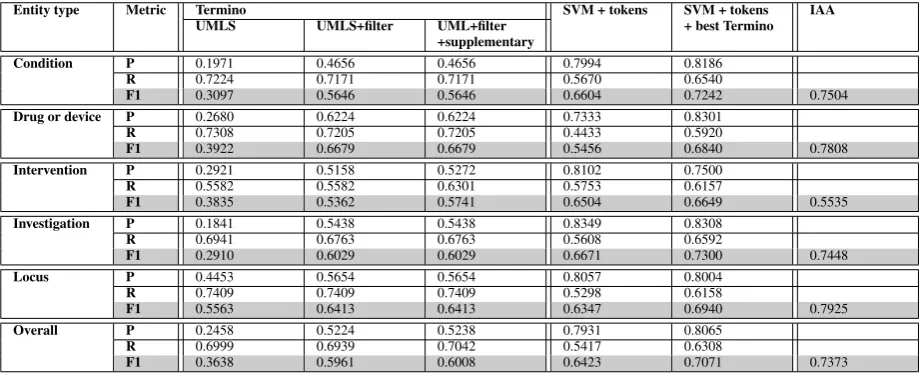
Table 2: Entities found by Termino using UMLS and other term lists; entities found by SVM trained with token features; and entities found by SVM trained with token features plus features from the best Termino configuration. All scored on corpus C77, and shown with inter-annotator agreement for the same corpus.
4.
Evaluation
Evaluation metrics are defined in terms of true positive, false positive and false negative matches between entities in a system annotatedresponsedocument and a gold stan-dardkeydocument. A response entity is a true positive if an entity of the same type, and with the exact same text span, exists in the key. Matching of response entities to key en-tities is therefore strict (i.e. overlapping key and response entities do not contribute to scoring). Corresponding defi-nitions apply for false positive and false negative. Counts of these matches are used to calculate standard metrics of Recall (R), Precision (P) andF1measure.
As Termino does not need any gold standard training data, evaluation of Termino is by a direct comparison of the gold standard entities to the terms matched by Termino, assum-ing that each term matched corresponds to an entity. For Termino, we report metrics for entity types macro-averaged across all documents. As our statistical entity recognition is supervised, we need the gold standard for training data. We have therefore trained and evaluated using ten fold cross-validation, with metrics macro-averaged over all ten folds. The metrics do not say how hard entity recognition is: there is nothing against which to compare the system. We there-fore provide Inter Annotator Agreement (IAA) scores from the gold standard. The IAA score gives the agreement be-tween the two independent double annotators. It is equiv-alent to scoring one annotator against the other using the
F1metric (Hripcsak and Rothschild, 2005). Note that the measure compares two human annotators. As the system is trained on a third consensusannotation, the IAA does not give an upper bound on performance. It is possible for the system to score a higherF1than the IAA for the same entity type.
5.
Results
5.1. Dictionary Lookup
The first set of experiments looked at various configurations of Termino, with and without filter terms and supplemen-tary terms. These show the performance of simple
dictio-nary lookup based on UMLS, and of dictiodictio-nary lookup tai-lored with additional cheaply constructed lists. The results of these experiments are reported on the left of Table 2. The table shows that Termino loaded with just UMLS gave a re-call of>0.69 for all entity types exceptIntervention
at 0.55. Precision, however, was low at between 0.18 and 0.47. Overall precision was 0.25. Error analysis with our development corpus showed that the low precision was due to the large amount of ambiguity inherent in such large scale resources, as discussed above. The second column shows the effect of using a filter term list to disallow these common spurious matches. Precision more than doubles in most cases, to 0.52 overall. Recall drops by less than 2% in all cases, not changing at all in some. The filter list clearly makes a big difference to performance. The terms that it removes are almost always spurious, and rarely genuine. We also added a small list of terms considered important by domain experts in the CLEF project, but not included in UMLS. The results for Termino with this list included are show in the third column. The supplementary list only has an effect onIntervention, where recall increases by
>7%. This is clearly significant in the case of a specific entity type, but has little overall impact (<0.5% increase in overallF1)
With both lists added, Termino achieves anF1around 10% to 20% below IAA for most entity types. The exception to this isIntervention, which is>1.5% above the IAA.
Interventionhas the lowest IAA, 0.55, indicating that
is difficult for human annotators to reach agreement on this entity type. This difficulty is reflected by the fact that a dictionary lookup performs just as well.
5.2. Statistical Models
perfor-Entity type CUIs assigned
0 1 2 3 4 5 >0
Condition Number 40 180 54 14 1 2 251
% 13.75 61.86 18.56 4.81 0.34 0.69 86.25
Drug or device Number 10 101 8 1 0 0 110
% 8.33 84.17 6.67 0.83 0 0 91.67
Intervention Number 47 21 55 0 0 0 76
% 38.21 17.07 44.72 0 0 0 61.79
Investigation Number 20 68 36 5 0 0 109
% 15.50 52.71 27.91 3.88 0 0 84.50
Locus Number 29 116 37 11 5 1 170
% 14.57 58.29 18.59 5.53 2.51 0.50 85.43
Total Number 146 486 190 31 6 3 716
% 16.94 56.38 22.04 3.60 0.70 0.35 83.06
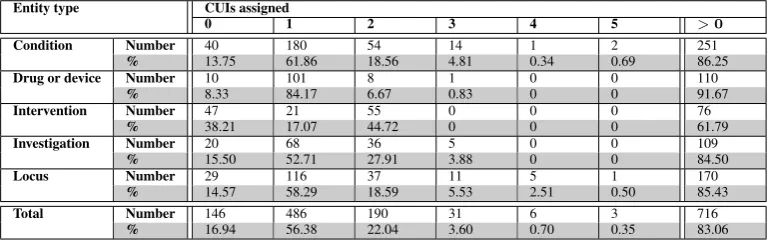
Table 3: Numbers of external resource identifiers (UMLS CUIs) assigned to terms found in a development corpus of 50 documents, by a combined SVM and Termino system.
When the SVM was combined with dictionary lookup, by training on term features in addition to the lexico-syntactic features, precision was maintained overall, although it did drop for specific entity types. Recall improved significantly in all cases, although it did not attain the overall recall lev-els of the best dictionary lookup. This system gave the best overallF1of 0.71, 3% below the overall Inter Annotator Agreement. The combined system also retained an advan-tage of dictionary lookup, by achieving linkage from recog-nised entities to domain resources in 83% of cases. We have shown that large scale terminology resources can be used to benefit clinical entity recognition, and that sta-tistical models can overcome some of the shortcomings of dictionary lookup over such resources.
Availability Most of the software described here is open source and can be downloaded as part of GATE. We are currently packaging Termino for public release, at which point the whole application will be made available.
Acknowledgements
CLEF is funded by the UK Medical Research Council. We would like to thank the Royal Marsden Hospital for pro-viding the corpus, and our clinical partners in CLEF for as-sistance in developing the annotation schema, and for gold standard annotation.
7.
References
S. Ananiadou and G. Nenadic. 2006. Automatic termi-nology management in biomedicine. In S. Ananiadou and J. McNaught, editors,Text Mining for Biology and Biomedicine, chapter 4, pages 67–97. Artech House. A. Aronson. 2005. Filtering the umls metathesaurus for
metamap. Technical report, U.S National Library of Medicine, Lister Hill National Center for Biomedical Communications, Cognitive Science Branch.
H. Cunningham, D. Maynard, K. Bontcheva, and V. Tablan. 2002. GATE: A Framework and Graphical Development Environment for Robust NLP Tools and Applications. In Proceedings of the 40th Anniversary Meeting of the As-sociation for Computational Linguistics, pages 168–175, Philadelphia, PA, USA.
H. Harkema, R. Gaizauskas, M. Hepple, N. Davis, Y. Guo, A. Roberts, and I. Roberts. 2004. A Large-Scale Re-source for Storing and Recognizing Technical Terminol-ogy. InProceedings of 4th International Conference on
Language Resources and Evaluation, pages 83–86, Lis-bon, Portugal.
L. Hirschman, A. Morgan, and A. Yeh. 2002. Rutabaga by any other name: extracting biological names. Journal of Biomedical Informatics, 35(4):247–259.
G. Hripcsak and A. Rothschild. 2005. Agreement, F-measure and reliability in information retrieval. Jour-nal of the American Medical Informatics Association, 12(3):296–298.
Y. Li, K. Bontcheva, and H. Cunningham. 2005. SVM based learning system for information extraction. In De-terministic and statistical methods in machine learning: first international workshop, number 3635 in Lecture Notes in Computer Science, pages 319–339. Springer. D. Lindberg, B. Humphreys, and A. McCray. 1993. The
Unified Medical Language System.Methods of Informa-tion in Medicine, 32(4):281–291.
A. McCray, O. Bodenreider, J. Malley, and A. Browne. 2001. Evaluating UMLS Strings for Natural Language Processing. InProceedings of the 2001 American Med-ical Informatics Association Annual Symposium, pages 448–452, Portland, OR, USA.
A. McCray, A. Browne, and O. Bodenreider. 2002. The lexical properties of the gene ontology (go). In Proceed-ings of the 2002 American Medical Informatics Associ-ation Annual Symposium, pages 504–508, San Antonio, TX, USA.
S. Mika and B. Rost. 2004. Protein names precisely peeled off free text. Bioinformatics, 20(Supplement 1):i241– i247.
A. Mikheev, M. Moens, and C. Grover. 1999. Named En-tity recognition without gazetteers. InProceedings of the ninth conference of the European chapter of the Asso-ciation for Computational Linguistics (EACL’99), pages 1–8, Bergen, Norway.
S. Pakhomov, J. Buntrock, and P. Duffy. 2005. High throughput modularized NLP system for clinical text. In Proceedings of the 43rd Annual Meeting of the Associa-tion for ComputaAssocia-tional Linguistics (ACL’05), interactive poster and demonstration sessions, pages 25–28, Ann Arbor, MI, USA.
D. Proux, F. Rechenmann, L. Julliard, V. Pillet, and B. Jacq. 1998. Detecting gene symbols and names in biological texts: a first step toward pertinent information extraction. Genome Informatics, 9:72–80.
A. Rector, J. Rogers, A. Taweel, D. Ingram, D. Kalra, J. Mi-lan, P. Singleton, R. Gaizauskas, M. Hepple, D. Scott, and R. Power. 2003. CLEF — Joining up Healthcare with Clinical and Post-Genomic Research. In Proceed-ings of UK e-Science All Hands Meeting 2003, pages 264–267, Nottingham, UK.
A. Roberts, R. Gaizauskas, M. Hepple, N. Davis, G. Demetriou, Y. Guo, J. Kola, I. Roberts, A. Setzer, A. Tapuria, and B. Wheeldin. 2007. The CLEF Corpus: Semantic Annotation of Clinical Text. InProceedings of the 2007 American Medical Informatics Association An-nual Symposium, pages 625–629, Chicago, IL, USA. M. Schuemie, J. Kors, and B. Mons. 2005. Word sense
disambiguation in the biomedical domain: An overview. Journal of Computational Biology, 12(5):554–565. M. Stevenson and R. Gaizauskas. 2000. Using
Corpus-derived Name Lists for Named Entity Recognition. In Proceedings of the Sixth Conference on Applied Natural Language Processing (ANLP-2000), pages 84–89, Seat-tle, Washington, USA.
L. Tanabe and W. Wilbur. 2002. Tagging gene and protein names in biomedical text. Bioinformatics, 18(8):1124– 1132.