Flemish-Dutch HLT policy: evolving to new forms of collaboration
P. Spyns
1,2, & E. D’Halleweyn
1 [1] Nederlandse TaalunieLange Voorhout 19, 2514 EB Den Haag, Nederland {pspyns, edhalleweyn}@taalunie.org; http://taalunieversum.org [2] Vlaamse overheid, Departement Economie, Wetenschap en Innovatie
Koning Albert II-laan 35, bus 10, 1030 Brussel, België Abstract
In the last decade, the Dutch Language Union has taken a serious interest in digital language resources and human language technologies (HLT), because they are crucial for a language to be able to survive in the information society. In this paper we report on the current state of the joint Flemish-Dutch efforts in the field of HLT for Dutch (HLTD) and how follow-up activities are being prepared. We explain the overall mechanism of evaluating an R&D programme and the role of evaluation in the policy cycle to establish new R&D funding activities. This is applied to the joint Flemish-Dutch STEVIN programme. Outcomes of the STEVIN scientific midterm review are shortly discussed as the overall final evaluation is currently still on-going. As part of preparing for future policy plans, an HLTD forecast is presented. Also new opportunities are outlined, in particular in the context of the European CLARIN infrastructure project that can lead to new avenues for joint Flemish-Dutch cooperation on HLTD.
1.
Introduction
Many languages have an official status in different countries and or regions. Some of these countries and regions have created joint organisations or platforms in order to strengthen the position of their shared language. The Organisation internationale de la Francophonie
(OIF), the Comunidade dos Países de Língua Portuguesa
and the Asociación de Academias de la Lengua Española
f.e. are each in their own way committed to the status and corpus of a language spoken by millions of users, The Netherlands and Flanders took their collaboration a step further. In 1980 the Belgian1 and Dutch governments signed a treaty to cooperate in promoting the Dutch language and created the Dutch Language Union (Nederlandse Taalunie - NTU). It meant that they gave up a part of their autonomy and decided to conduct – to a certain degree – a joint language policy. In doing so they significantly strengthened the position of the Dutch language. In 2004 Surinam joined the Nederlandse Taalunie as an associated member. The intensive cooperation has many advantages: duplication of efforts can be avoided, expertise can be shared and funds be pooled.
In the last decade, the NTU has taken a serious interest in digital language resources and human language technologies (HLT), because they are crucial for a language to be able to survive in the information society. In 1999, the Dutch and Flemish governments decided to collaborate on HLT for Dutch and set up an HLT Platform (Beeken et al. 2000), which later became the HLT steering board2. The HLT Platform organised a number of
1
As a consequence of the Belgian state reform (federalisation), Flanders became the official partner of the treaty.
2
It is a coordinated effort of the Dutch Ministry of Economic Affairs, Agency NL (the innovation agency of the Dutch Ministry of Economic Affairs), the Dutch Organisation for Scientific Research (NWO), the Dutch Ministry of Education, Culture and Science, the department of Economy, Science and
activities, (Binnenpoorte et al. 2002a, Cucchiarini et al. 2002) which eventually resulted in a stimulation programme for HLT for the Dutch language (Cucchiarini and D’Halleweyn 2004). This programme, called STEVIN3, its goals and related initiatives, have already been described previously (D’Halleweyn et al. 2006 and Spyns et al. 2008).
In this paper we report on the current state of the joint Flemish-Dutch efforts in the field of HLT for Dutch (HLTD) and how follow-up activities are being prepared. We present the most relevant (and updated) results of a midterm scientific review of the STEVIN R&D programme (section 2), outcomes of an HLTD forecast exercise in Flanders (section 3), and some (at the time of writing still on-going) plans for new forms of collaboration between Flanders and the Netherlands concerning HLTD (section 4). The paper ends with a conclusion (section 5).
All these topics will be situated in the framework of what is called the policy cycle, i.e. how a government administration organises its policy preparation process. The fact that two governments and several governmental organisations are involved in the Dutch-Flemish policy on HLTD, adds a significant degree of complexity in
Innovation (EWI) of the Flemish government, the Flemish Agency for Innovation by Science and Technology (IWT), and the Research Foundation Flanders (FWO-Vlaanderen). The NTU, as an intergovernmental organisation, coordinates the endeavour. The HLT steering board (TST-bestuur) supervises the STEVIN programme (www.stevin-tst.org), the HLT Agency (http://www.inl.nl/en/tst-centrale) and the HLT info desk (http://taalunieversum.org/taal/technologie).
3
synchronising the policy cycles. Despite of these apparent disparities, the Flemish and Dutch ministers responsible for innovation and scientific research have in 2008 formally renewed their common intention for collaboration in science and innovation, including the area of HLTD. The existence of a well established (for 30 years already) intergovernmental organisation such as the Dutch Language Union enables cross-border cooperation on all aspects of the Dutch language and largely facilitates structural and large scale cooperation initiatives.
2.
Evaluating an R&D programme
2.1. Background
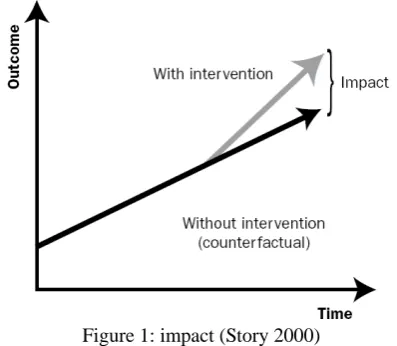
In a well organised policy cycle, R&D programmes are set up based on certain (societal) needs or (technological) gaps experienced, are monitored during their execution, and evaluated on impact (see Figure 1) after their completion. Decisions whether or not to continue/extend a programme or set up a follow-up programme as well as how to define future goals to be achieved, are based on the results of a final evaluation.
Ideally an evaluation provides necessary “ammunition” to define follow-up (R&D) activities. It can give inspiration content-wise and experiences or lessons learnt help articulating the justifications and shaping the organisation of follow-up activities.
Figure 1: impact (Story 2000)
steps stand for a gradual increase of phistication.
EVIN evaluation complies r not) with these six steps.
and some factual data has been updated and is available.
A good evaluation of a programme consists of several
steps. According to (Storey 2000), it is not enough (i) to describe some given factual information on the participating organisations (e.g., size, money spent, location, …), (ii) to ask for the opinion of the participants (e.g., were submission procedures cumbersome, which were the problems encountered, …), nor (iii) to collect views on the desirability of the programme (e.g., would a funded activity have happened anyhow, even without funding offered by the programme). The main problem is that there is no counterfactual data available to support or invalidate the views provided by the respondents. Therefore, these three steps are considered as belonging to the “monitoring level”. They indicate where a
programme is in terms of achieving its goals, while the three evaluation level steps (see below) show if a programme has achieved impact on performance (Storey 2000). The six
so
In order to reach the evaluation level, counterfactual data (steps iv to vi) has to be collected. This is comparable to e.g. a treatment and control group or a comparison between a learning and test corpus. Step (iv) thus consists of establishing a control group (of companies or research organisations that did not receive funding by the programme). Making sure that the control group consists of comparable or matching organisations – not just typical ones – is step (v). In many cases step v is hard to cope with. Nevertheless, it may happen that non observed factors are responsible for the difference in performance between the treatment and matching control group. The selection of members to the matching control group appears to be biased (not a perfect match). So one might erroneously conclude that the funding by the R&D programme has made the difference, whilst this is due to some unobserved factor(s). Hence, the last step (step vi) consists of taking these biases into account. In the following sections, we show to which extent the ST
(o
From the onset of the STEVIN programme, the importance of evaluation was stressed and consequently structurally embedded in the programme. It started with the establishment of a base line (see section 2.2) to serve as a reference point for the anticipated positive development of the HLTD landscape (see Figure 1). In 2008, a scientific midterm programme review took place (see section 2.2) by the STEVIN International Assessment Panel (IAP), a committee of international HLT experts4 responsible for the evaluation of STEVIN project proposals. At the time of writing the final evaluation of STEVIN (see section 2.4) is in progress. Hence, although we cannot yet provide detailed and conclusive evaluation information, many of the outcomes of the midterm (scientific) review still apply (and can be reported on)
2.2. Base line
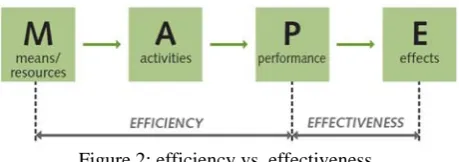
A proper evaluation needs a base line reference in order to be able to compare the situation before (ex ante) with the situation after (ex post) the “intervention in question”. In this way it is possible to assess whether or not the programme goals initially set are attained. In the case of the STEVIN HLTD R&D programme, the financial input (means) of STEVIN was aimed at having effects on the HLTD domain due the activities of the participating research institutes and companies of which the
performance is measured (in terms of key indicators such
4
as scientific respectively commercial output) – see Figure 2. Eventually, the impact of the research programme is a lasting improvement of some more general societal need or situation (c.q., safeguarding the position of Dutch in the modern information society)
Figure 2: efficiency vs. effectiveness
in Flanders and the Netherlands (Akkermans et al. 004).
h specific HLTD chnology a company is using etc.
ates in order to reach the step vi
ngs. fterwards, a report by the IAP, to which the PC added its
ch
ality and quantity? Which are
dealt with in the
timulating
raging
ional field of HLT research, the
.
The preliminary study by (Akkermans et al. 2007) was meant to establish a base line reference. The data were gathered by sending an extensive questionnaire regarding HLTD activities and resources to various research organisations and private companies in Flanders and the Netherlands. For the research institutions, it was an update of an earlier exploration of the HLTD research domain
2
Due to practical circumstances, the base line reference was only completed during the second year of the STEVIN programme. Nevertheless, more HLT companies than were participating at that moment in time in STEVIN activities have received the questionnaire. The questionnaire was sent to almost all research groups active in HLTD in Flanders (12) and the Netherlands (14) and to the most relevant companies in Flanders (16) and the Netherlands (32). All the respondents have been explicitly asked to only consider the situation before the start of STEVIN. 21 companies (FL: 7 and NL: 14) and 18 research institutes (FL: 9 and NL: 9) have returned a completed questionnaire. In Flanders more than twice as many groups have participated compared to the 2004 exploration. The questions in the questionnaire concerned e.g., the amount of turnover for HLTD, the number of FTEs working on HLTD, whic
te
These same parties were asked to participate in the survey of the final evaluation (see section 2.4) in order to establish the effect of the STEVIN programme on their “behaviour” and performance. The fact that we know now that not all of the respondents have enjoyed STEVIN funding – even after having submitted a proposal – should make it possible to constitute a matching control group of organisations – and hence achieve a step v evaluation (see section 2.1). However, a careful analysis should reveal if the private companies concerned are indeed good matching candid
in evaluation level.
2.3. Scientific (midterm) monitoring
2.3.1. Set-up
In May 2008, a midterm scientific review has been organised to check whether or not the STEVIN programme was on track. Both the scientific programme committee (PC5) and the IAP had to answer a set of nine (groups of) questions (see below). For the PC it meant a self assessment while the IAP performed an external scientific peer review. Storey (see above) would consider this as the monitoring step iii. The input for both the IAP and PC were a fact file containing the most important data (short description of accepted projects, the publication list, member lists of all the STEVIN committees etc.) and the progress reports from the various projects. Furthermore, a one-day workshop was organised during which all projects had to present their status (including achievements and problems) to their peers and the IAP members and the PC presented its self assessment. The IAP members (and the audience) had the opportunity to ask questions. At the end of the workshop, the IAP separately discussed and formulated its findi A
comments, has been presented to the HLT board in whi the funding bodies take part. For the final scientific evaluation, the PC and IAP will repeat this exercise. The set of nine (groups of) questions is the following:
1.Do you think the STEVIN programme has (so far) sufficiently reached its main aims and objectives described in the programme text?
2.Does the selection of the research projects reflect the stratified chain approach of the STEVIN programme, i.e. address all four innovation levels in an appropriate way? Are there any critical gaps in the programme that should still be addressed?
3.Is the (scientific) output of the STEVIN projects adequate in terms of qu
the most outstanding results? Are the results made available in a non-discriminative way? Do you think that IPR policy is adequately
STEVIN programme?
4.Is there enough evidence indicating that collaboration between academia and industry in Flanders and the Netherlands is being achieved?
5.Is the programme (so far) successful in s
network relations between the different types of actors that are involved in developing, implementing or embedding HLT technologies, and in encou knowledge transfer between these actors?
6.Are the STEVIN programme and its results visible to the (inter)nat
terested industry, and the interested public?
7.What is the (scientific) impact of the STEVIN programme on the HLT field in Flanders and the Netherlands?
5
8.Is the organisational structure of the programme appropriate to sufficiently guarantee a transparent, impartial and objective proposal evaluation, project monitoring and decision taking in general while
ade-h potential conflicts of interest?
2. In g com Belo ad
6 proposals) and two master class projects (out of 3 proposals) have been
ad
ch to early end user product development), consists of
of the actual R&D funding money
r, network and demand imulation.
ad
esults deserve high(er) quality publication hannels. Less positive is that high impact
ad Dutch
dustrial and academic partners have been set up. 30
ad various types of calls for
project proposals (demonstration, educational,
ad
n et al., 2006), lays a crucial role in this respect. Initially some
t practice.
ad had to be made and smaller
problems had to be solved in the course of the ecific calls for tender,
s issued for the final amme. The overall
amme reg
aspects,
o impact and dissemination towards the
OT analysis. Also, a survey of the LTD field similar to the one that resulted in the base line quately dealing wit
9.Were the installed procedures for granting, launching and monitoring the projects and for transferring and approving the project results adequate?
3.2. Main outcomes
eneral, the IAP has congratulated the STEVIN munity with the work and results obtained (so far).
w we present some of their detailed comments. 1: The IAP has judged that STEVIN has reached the overall majority of its scientific goals. The various calls served well at attaining the various goals: 16 R&D projects (out of 52 proposals), 14 demonstration projects (out of 40 proposals), 3 educational projects (out of
financed. Early 2010, the PC has proposed to discontinue the calls for master classes and educational activities as these calls did not generate enough interest in the field.
2: The STEVIN programme being a mixed programme (ranging from fundamental resear n
four conceptual layers: creation of basic language resources (i), R&D resulting in HLTD components (ii), application development with embedded HLTD components (iii) and demand stimulation (iv). Overall, 51%
(around € 10 M) has been spent on basic language resources for Dutch, 23.3% on HLT strategic R&D, 15.4 % on application development and 10.2% on technology transfe
st
Topics not covered left for future (research) programmes are semantic web applications, morphological analysis, speech synthesis and multimedia corpora.
3: The IAP members have elegantly stated that the STEVIN r
c
publications are claimed by the researchers to have decreased due to the strong (initial) focus of STEVIN on producing basic resources instead of cutting edge research.
4: New collaborations between Flemish and in
companies participated in the STEVIN programme (23% from Flanders and 77% from the Netherlands). This comes close to the traditional 1/3–2/3 allocation policy between Flanders and the Netherlands.
5: The combination of
master class, applied R&D projects) and networking grants have well contributed in encouraging collaboration between the various actors of the four layers mentioned above.
6: Notwithstanding some exceptions, the R&D results are made available in a non discriminative way. The HLT Agency (Boekestei
p
procedures (including IPR licenses) were insufficiently well developed due to time constraints. Also, the programme itself in general should be more widely advertised as bes
ad 8: Conflicts of interest have been avoided or adequately dealt with. The IAP appreciated that its initial ranking of the R&D project proposals has largely been respected.
9: Some adjustments programme (e.g., issuing sp
reinforcing progress monitor procedures, defining administration workflows). They have been adequately dealt with.
2.4. O erall final evaluation v
At the end of 2009 a public tender wa evaluation of the STEVIN progr
assignment was to evaluate the STEVIN progr arding its:
• general way of operating including
o organisational
o scientific performance,
scientific field and other societal groups as well as the knowledge transfer towards industry;
• customer or stakeholder satisfaction.
Aspects such as accountability, efficiency, effectiveness, added value, relevance, additionality, governance, monitoring, positioning have to be analysed and represented by a SW
H
reference (and with the same parties) has to be repeated to determine the impact of STEVIN. As at the time of writing the overall evaluation is still ongoing, we cannot provide details yet.
from their country is in proportion to the funding their country has contributed to the programme (called “juste retour”). Figure 3 indicates the absolute amounts (and percentages) of funding money distributed over the various call categories for the entire STEVIN programme.
ore than their expected roportional share (35%) of the funding via R&D funding
Figure 3: STEVIN funding (in € K) per call type6 Figure 4 shows the relative distribution of funding shares of industry (IND) and academia (KI) per country over the various call categories. Overall, Flanders (FL) receives slightly more (34,83%) compared to its overall financial input (33,3% - the dotted line in Figure 4). It is also clearly visible that HLT industry in Flanders (FL IND) is underrepresented and/or not so well developed as in the Netherlands (NL IND). Flemish industry does not benefit at all from funding for networking, master classes and educational activities. Flemish research groups (FL KI) seem to have taken up m
p
(80% of the total budget – see Figure 3). The Netherlands receive more management money (varia) as NWO and Agency NL, both located in the Netherlands, run the STEVIN programme office.
Figure 4: Distribution of STEVIN funding (in %) per country and type of beneficiary
3.
Predicting the future: HLTD Forecast
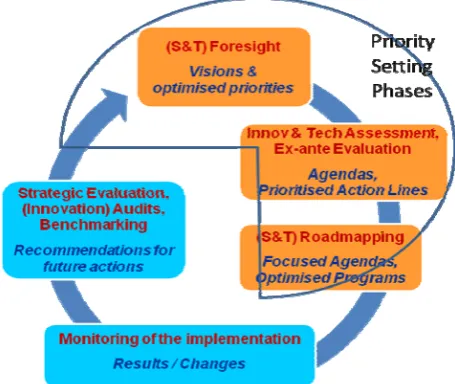
A policy cycle (see Figure 5) is not only “fed” by insights acquired after evaluating a(n) (almost) finished R&D programme, but also by forward looking hypotheses about what the state of the art might be within five, ten ort state to the foreseen state of the art. In 2008 the Flemish
formal brainstorm by the Computational Linguistics in
3 civil rvants and 19 senior academic researchers actually
6
In fact, ‘varia’ is a catch all category that includes costs for PR and dissemination, administration, etc.
twenty years. Future scenarios are to be drawn. Based on such scenario’s, a technological gap analysis can be made, and by means of backward reasoning technology roadmaps (and their anticipated costs) can be determined indicating how to lead technology from the curren department of Economy, Science and Innovation (EWI) organised an HLT forecast exercise (looking five years ahead) to determine which topics should receive attention during a potential STEVIN follow up programme.
Figure 5: Policy cycle
3.1. Set-up
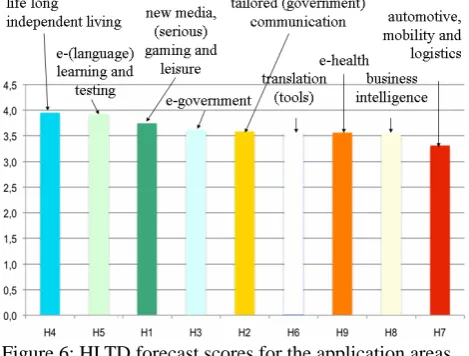
The HLTD forecast has been organised as a Delphi study (Linstone and Turoff., 1975) consisting of three rounds. In the first round, the Flemish EWI department selected nine major HLTD application areas, e.g., ‘e-language learning and testing’, ‘e-health’, ‘new media, serious gaming and leisure’ (see Figure 6) for each of which five statements were defined. The setting for this HLTD forecast was that members of a carefully selected panel (157 invited persons) subsequently had to provide a score indicating the desirability of the situation depicted by a statement within a five years’ time frame. E.g., “HLTD and serious gaming technology are able to deliver enriched learning environments” (in the area of ‘multimedia and leisure’ – statement 1.5) or “HLTD can automate language learning tests“ (in the area of ‘(e-) language learning and testing ‘– statement 5.1). The application areas and associated statements were based on i) the outcomes from an in
Flanders community (CLIF7) together with represen-tatives from industry, ii) a report ordered by the Dutch innovation agency, and iii) a broader innovation policy survey (Smits et al. 2006) and iv) other related literature8. In the second round, 42 industry professionals, 1 se
participated. They all individually entered their degree of 7
See www.clif.be 8
www.stevin-tst.org/programma/#toekomst [in Dutch]
35,02% 55,81% 7,03%
2,14%
9,65% 23 63,72%
,52% 3,12%
32,13% 53,03% 14,84%
0,00%
0,00% 0,00% 0,00% 100,00%
29,23% 0,00% 46,17% 24,60%
32,40% 50,44% 12,94%
4,22%
19,15% 80,85%
34,83% 65,17%
R&D demo educa master netw ork total varia grand total
FL KI FL IND NL KI NL IND varia
1149 10%
R&D 8909 80% network
41 0%
master 18 0% educa
100 1%
(dis)approval (together with explanations, objections, justifications) of these statements via a web form, made available by an external consultant (Kenis 1995). In the third round, the same experts (63 of the 74 who participated in the previous round) had access to the anonymised scores and comments of their peer panel members and could, if wanted, adjust their own score and
ts of their peers. Subseque
statement 1.2: LTD can automate the generation of meta data and
plication areas, ork out more in detail some scenario’s, analyse what is
icantly change over the two ds. In both rounds, statement 1.2 resp. 7.4 scores best nts – these
tes a sing importance:
data ia sources
voices can help (in particular young) speech impaired persons (score 4,18);
imilar or opposite answer
behavi xercise when
compa s show that no
systematic positive (trying to promote own group r
on for HLTD for government
ed earlier, an analysis of the actual state of (technological)
as react on the commen nt An easily identifiable cluster of statements constitu
top seven. In order of decrea processing of the scores and comments led to a ranking of
the statements (and hence of HLTD application domains) and eventually to recommendations for policy makers.
3.2. Main outcomes
Figure 6 shows the average scores of the nine HLTD application areas. Without going too much into details, the outcomes (Kenis 2008) of the Delphi study point to a well pronounced conviction that the government needs to invest in HLTD, without clearly identifying high priority application areas. Conversely, the scores imply that none of the nine selected application areas have been rebutted by the Flemish HLT professionals. Only two areas have received a (relatively) better score than the others: “livelong independent living” (H4) and “e-(language) learning and testing” (H5). In many of the areas some statements have clearly met overall approval. The highest overall score (4,38) was given to the
‘H
indices needed to accessing multimedia sources’. Other statements are clearly discarded: the statement 7.4: ‘HLTD can transform your car into your mobile office.’ received the overall lowest score (2.56).
A next step is to select some relevant ap w
needed technology-wise and resource or effort-wise (= ex ante evaluation) to realise these scenario’s, and define R&D activities to bridge the gap between the projected and current technological state of the art.
Figure 6: HLTD forecast scores for the application areas
3.3. Some detailed observations
Few experts have modified their opinion in the third
round. Hence, the ranking of the average scores given to the statements did not signif
roun
resp. worst (see above). Only in a few cases, some experts have entered very negative scores and comme
experts are in general consistently more negative on all statements than their peers.
- 1.2: HLTD can automate the generation of meta and indices needed to accessing multimed (score 4,38);
- 5.2: language interfaces can support language teaching (score 4,27);
- 4.6 HLTD can help to guide visually impaired persons to their destination (score 4,19); - 4.3: personal synthetic
- 6.4: translation software can offer opportunities in the EU-context (and its enlargement) (score 4,12); - 1.3 HLTD enables passage retrieval in audiovisual
material (score 4,12).
A cluster analysis of the score patterns has revealed that statements can be linked - mostly statements of the same application area - which shows that the experts have participated in a consistent manner. Also, each expert has given his/her opinion on an individual and “honest” basis as no expert exhibited a very s
our over the global Delphi e red to other experts. These check
interests) or negative (trying to block interests of othe groups) biases have occurred.
4.
New initiatives
4.1. Joint Flemish-Dutch HLTD R&D activities
Next to the Flemish HLTD forecast, the NTU has organised round tables, panel discussions, and/or surveys on the topics ‘HLTD in Education’ and ‘HLTD in Care’. A policy recommendati
organisations has been finalised. Summary reports will be published in the near future. Furthermore, the NTU is committed to raise awareness on the advantages HLTD can provide. Also the STEVIN PC plans to organise roadmap workshops.
4.2. Activities for the ESFRI CLARIN project
Even if there is not yet a clear outlook on new large scale joint Flemish-Dutch R&D activities, the European Science Forum for Research Infrastructure (ESFRI) initiative has provided another opportunity for Flanders and the Netherlands to collaborate as well as to have specific national focuses in the HLTD domain. The EU FP7 preparatory project Common Language Resources and Technology Infrastructure (CLARIN9) (Váradi et al. 2008), in a nutshell, aims at facilitating e-science, for the human and social sciences mainly by providing easy access to HL resources and giving support through HL tools – see e.g., (Van Uytvanck et al. 2010). The EC funds ollecting user and functional
e CLARIN-FL-NL project consists EWI) and Dutch
the preparatory phase (i.e., c
requirements, studying IPR issues etc.), while national funding organisations should provide the money to actually build (c.q. implement) and exploit the CLARIN research infrastructure.
4.2.1. Institutional context
The Dutch government has already granted € 9,01 M to CLARIN-NL 10 (Odijk 2010) for the preparatory, implementation and exploitation phases. In Flanders, as a first step a more modest amount of € 255K has been provided by EWI for funding the preparatory phase (CLARIN-FL)11. In a second phase EWI committed € 792K (CLARIN-FL-NL) to define common standards and a workflow system for web services on the one hand, and on the other to develop three Flemish demonstrators (including adapting STEVIN results to comply to the CLARIN standards) to fit in the CLARIN workflow – see below. The standards and workflow project is a common Flemish Dutch endeavour. The various demonstrator projects are nationally oriented. On the Dutch side twelve demonstrators have been selected12. They comprise curation projects (INTER-VIEWS, TDS Curator, WFT-GTB), historical projects (CKCC, Adelheid), mainly technical projects (TICCLops, DUELME-LMF, ADEPT, AAM-LR, TQE), and integration projects (MIMORE, Sign-LinC). More details can be found in (Odijk 2010). Contrary to STEVIN (and its common pot model of funding), th
of separate Flemish (controlled by
(managed by the CLARIN-NL consortium) budget lines (but still respecting the 1/3 Flemish and 2/3 Dutch funding proportion). The NTU is not involved in these aspects of CLARIN.
4.2.2. Overview of CLARIN-FL-NL
Humanities and social sciences researchers provide use cases for all demonstrators. The first Flemish demonstrator (NederBooms) will set up an environment (user interface, documentation) to allow less tech-savvy linguists to use treebanks for their empirical research on 9
www.clarin.eu 10
www.clarin.nl 11
http://www.ccl.kuleuven.be/CLARIN 12
http://www.clarin.nl/node/70 and
http://www.clarin.nl/node/76#CKCC
Dutch syntax and semantics, e.g. in the context of dictionary development. The second demonstrator (Stylene) will implement stylometric and readability web services. Researchers in literature will be able to upload texts to acquire insights on stylistic characteristics of an author (e.g., author attribution problems), while social scientists will be able to test hypotheses on e.g. the personality of the author (author profiling). The third demonstrator (spraak2taal) is a speech demonstrator. It aims at creating a speech recognition framework for processing transcribed speech (combining the
anscriptions and the original speech files). The
ated use cases can be summarised as making audio archives
atic transcription and indexing. tr
framework will be applied to investigate pregnancy of texts within ideological contexts – e.g. the difference of vocabulary used in political speeches compared to written brochures or leaflets.
The standard and workflow system project will also involve real users and use cases. A text oriented use case will focus on a named entity recognition task combined with spatio-temporal semantics. This happens in the context of a large multidisciplinary archaeological excavation project of an antique Roman city in Turkey (Sagalassos): all topographical names related to the site need to be discovered in a document collection and related one to another (also diachronically). A second text related project investigates the use and function of proper names in Dutch modern novels. The speech rel
available thanks to autom
The subsequent step is to perform a content analysis (e.g., of news broadcasts, sessions of Parliament, audio recordings of interviews with missionaries).
4.2.3. CLARIN-ERIC