Finding Domain Terms using Wikipedia
Jorge Vivaldi
1, Horacio Rodríguez
21Institute for Applied Linguistics, Roc Boronat 138, UPF, Barcelona, Spain 2Software Department, Jordi Girona Salgado 1-3, UPC, Barcelona, Spain
E-mail: [email protected], [email protected]
Abstract
In this paper we present a new approach for obtaining the terminology of a given domain using the category and page structures of the Wikipedia in a language independent way. The idea is to take profit of category graph of Wikipedia starting with a top category that we identify with the name of the domain. After obtaining the full set of categories belonging to the selected domain, the collection of corresponding pages is extracted, using some constraints. For reducing noise a bootstrapping approach implying several iterations is used. At each iteration less reliable pages, according to the balance between on-domain and off-domain categories of the page, are removed as well as less reliable categories. The set of recovered pages and categories is selected as initial domain term vocabulary. This approach has been applied to three broad coverage domains: astronomy, chemistry and medicine, and two languages: English and Spanish, showing a promising performance. The resulting set of terms has been evaluated using as reference those terms occurring in WordNet (using Magnini's domain codes) and those appearing in SNOMED-CT (a reference resource for the Medical domain available for Spanish).
1.
Introduction and motivation
Since the 80s there was an acute need, from different disciplines and goals, to automatically extract terminological units from specialized texts. Computational linguists, applied linguists, translators, interpreters, scientific journalists and computer engineers have been interested in automatically isolating terminology from texts for a number of purposes: building of glossaries, vocabularies and terminological dictionaries; text indexing; automatic translation; building of knowledge databases; improving automatic summarization systems, construction of expert systems and corpus analysis. Typical approaches involve linguistic and/or statistical systems with results not fully satisfactory (see Cabré et al., 2001 for a revision). One of the reasons of this behaviour is that none of first approaches use semantic knowledge.
In Vivaldi et al. (2002) we faced the problem of automatically extracting domain terminology using Domain Markers (DM), with WordNet (WN), Fellbaum, 1999, as Knowledge Sources. We defined a DM as a WN or EuroWordNet1 (EWN, Vossen, 2004) entry (a synset) whose attached strings belong to the domain, as well as the variants of all (or at least most of) its descendents through the hyponymy relation. In that initial research, DMs were selected manually starting with a set of seed words for the domain, looking for the corresponding synsets in WN and exploring their environment. As this procedure is costly and difficult to scale up, in Vivaldi et al. (2004) we faced the problem of automatically selecting the DM. The basic Knowledge Source was in this case a glossary of initial terms for the domain. So, a fatal loop was found: For extracting terminology (in our approach) it was necessary a set of DM that in turn needed an initial terminology for being extracted. In this paper a new approach is presented that tries to break the loop using an
1
We applied our method to English and Spanish.
external Knowledge Source, Wikipedia, for providing the initial set of terms for the domain, which triggers the whole procedure.
Wikipedia2 (WP), is by far the largest encyclopaedia in existence with more than 3 million articles in its English version (EWP) contributed by thousands of volunteers. WP experiments an exponential growing. There are versions of WP in more than 200 languages although their coverage (number of articles and average size of each article) is very irregular.
WP categories WP pages
A B
C
D E
F
G
P1
P2
P3
Redirection table
… …
… …
…
… …
… …
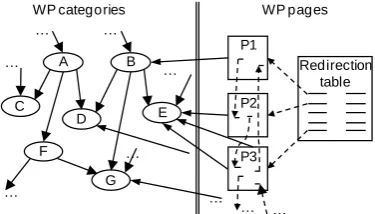
Figure 1: The graph structure of WP
WP information unit is the "Article" (or "Page"). Internally, an article may contain links to other articles in the same language by means of "Article links". There are about 15 output article links (links are not bidirectional) in average in each WP article. The set of articles and their links in WP form a directed graph.
The whole article is assigned to one or more WP categories (through "Category links") in such a way that categories can be seen as classes that are linked to pages (belonging to the category). At the same time, a category is linked to one or more categories (super and sub categories) structuring themselves as classes that are also organized as a graph (see Zesch, Gurevych, 2007, for an interesting analysis of both graphs). In Figure 1 we can
2
see an overall image of both connected graphs. This bi-graph structure of WP is far to be safe. Not always the category links denote belonging of the article to the category; the link can be used to many other purposes (see, for instance, Suchanek (2008)). The same problem occurs in the case of links between categories, not always these links denote hyperonymy/hyponymy and so the structure shown in the left of figure 1 is not a real taxonomy.
Besides article and category links, WP pages can contain "External links”, which point to external URLs, and "Interwiki links", from an article to a presumably equivalent, article in another language. There are in WP several types of special pages: "Redirect pages", i.e. short pages which often provide equivalent names for an entity, and "Disambiguation pages", i.e. pages with little content that links to multiple similarly named articles.
While edges between categories usually (but not always) have a clear semantics (hypernymy, hyponymy), edges between pages lack tags or explicit semantics. Also, some categories are added to WP by convenience for structuring the database or due to its encyclopaedic character (e.g. “scientists by country”, “Chemistry timelines” or “Astronomical objects by year of discovery” among many others). Other categories are used temporally for monitoring the state of the page (e.g. "All articles lacking sources", “Articles to be split” ...), we name these categories "Neutral Categories". Due to such facts it becomes difficult, just navigating through its structure, to discover which entry belongs to which domain.
WP has been extensively used for extracting lexical and conceptual information: Ponzetto, Strube, 2008 and Suchanek, 2008, build or enrich ontologies from WP, Milne et al., 2006 derive domain specific thesauri, Atserias et al, 2008 produce a semantically annotated snapshot of EWP, Medelyan et al., 2008, Mihalcea, Csomai, 2007, and Wu et al., 2007 perform semantic tagging or topic indexing with WP articles. Closer to our task are the works of Toral et al., 2006 and Kazama, Torisawa, 2007 which use WP, particularly the first sentence of each article, to create lists of named entities. Relatively low effort has been devoted to exploit the multilingual information of WP. Ferrández et al., 2007, Richman, Schone, 2008 and, more recently, Erdmann et al., 2008 are notable exceptions. See Medelyan et al.
(2009) for an excellent survey.
Extracting information from WP can be done easily using a Web crawler and a simple HTML parser. The regular and highly structured format of WP pages allows this simple procedure. There are, however, a lot of APIs providing easy access to WP online or to the database organized data obtained from WP dumps3. Some interesting systems are Waikato's WikipediaMiner toolkit4, U. Alicante's wiki db access5, Strube and
3
http://en.wikipedia.org/wiki/Wikipedia_database
4 http://wikipedia-miner.sourceforge.net/
5 http://www.dlsi.ua.es/~atoral/
Ponzetto's set of tools6, Iryna Gurevych’ JWPL7, etc. We have used this later resource for our research.
The proposed system should be language and domain independent. Therefore, for any language to be considered the only limitation, regarding both quality and quantity, depends only of the WP for such language.
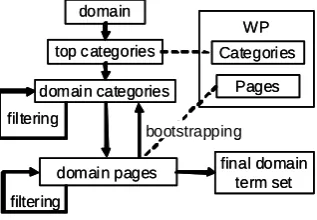
The key idea of our approach is using the category graph of WP starting with a top category that we identify with the name of the domain. From this top, we extract the set of (presumably) relevant categories, traversing the graph following sub-category links. For avoiding noise we apply rigid constraining on the categories to visit. From the set of categories selected, the collection of corresponding pages is extracted, also under some constraints. For reducing noise a bootstrapping approach implying several iterations is used. The set of recovered pages and categories is selected as initial domain term vocabulary.
After this introduction the organization of the paper is as follows: Section 2 presents an overview about the research already done in this area. Section 3 shows with some details our approach to this issue while section 4 and 5 presents our experiments and evaluation results respectively. Finally in section 6 we will derive some conclusions and proposals for future work.
2.
State of the art
Bernardini et al. (2006) propose the Wacki system, a method for extracting both corpora and terminology for a domain. The approach is recall-oriented and so not useful for our purposes.
(Magnini et al., 2000) have enriched WN with domain information on the basis of a general classification that includes 164 domains/subdomains (structured in a rather flat taxonomy). Following a semiautomatic procedure, one or more domain tags have been assigned to each synset.
(Montoyo et al., 2001) propose a way of enriching WN with about 30 IPTC subject codes. Their approach follows the Specification Marks Method, previously used for Word Sense Disambiguation tasks. Also (Buitelaar, et al., 2001) propose a method for domain specific sense assignment using GermaNet together with a set of relevance measures. A closely related task is the automatic extraction of domain ontologies from general ones using domain corpora. (Missikoff et al., 2002) present an interesting approach.
In an automatic term extraction system, applied to the medical domain, (Vivaldi, Rodríguez, 2002) use DM, as defined before. About 50 borders were manually identified and used as a basis for term extraction. In (Vivaldi, Rodríguez, 2004) it is showed how public
6 http://www.eml-research.de/english/research/nlp/download/
10 20 30 40 50 60 70
1 2 3 4 5 6
p
rec
is
io
n
iteration Medicina (Medicine)
ES-loose-WN
10 20 30 40 50 60 70
1 2 3 4 5 6
p
rec
is
io
n
iteration Medicina (Medicine)
ES-loose-WN ES-loose-WN
10 20 30 40 50 60 70
1 2 3 4 5 6
p
rec
is
io
n
iteration Medicina (Medicine)
ES-loose-WN ES-loose-WN ES-loose-SNOMED
10 20 30 40 50 60 70
1 2 3 4 5 6
p
rec
is
io
n
iteration Medicina (Medicine)
ES-loose-WN ES-loose-WN ES-loose-SNOMED ES-strict-SNOMED
Figure 5. Results for several iterations (Medicine)
In spite of the specialized character of the evaluation resource, it accepts as valid term sequences like “whisky”,
puro (“cigar”), tortura (“torture”), ubre (“udder”) and
fuego (“fire”) but no accept others like oral cancer that clearly seems to be a medical term. The point here is that
whisky and other beverages are in the “substances” subtree of SNOMED-CT probably because they are the cause of a number of diseases.
Others terms are rejected due to minor differences:
enfermedades del sistema digestivo (“gastrointestinal tract
diseases”) versus enfermedades del sistema digestivo
(“gastrointestinal tract disease”) or simply by missing like
espina ilíaca antero-superior (“anterior superior iliac spine”), medicina intensiva (“intensive-care medicine”) or
fisiopatología (“pathophysiology”).
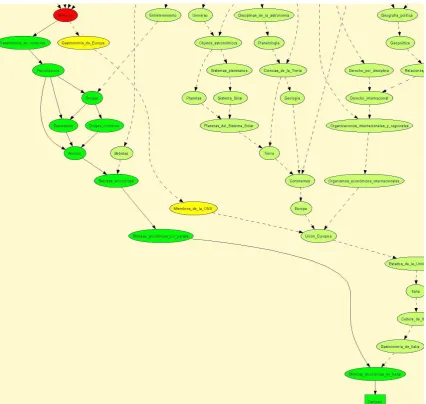
We observe that there are some systematic errors as for example the inclusion of Named Entities. Figure 6 shows a typical example: the entity “Campari” is considered as belonging to the domain due to the existence of a path (“alcoholic beverages by country” “alcoholic beverages” “alcohol” “psychotropics”) to the domain name node. The appropriate way to cutting this path is detecting that “alcoholic beverages by country” is not a taxonomic link. Cutting these links can be done by simple pattern matching techniques.
5.
Conclusions
In this paper we present a new approach of obtain the terminology of a domain using the category and page structures of WP in a language independent way. This approach has been applied to some domains and languages showing a promising performance.
Using the same list of words, the evaluation results show a clear improvement when using a specialized and complete resource in the domain (SNOMED-CT instead of WN). In our opinion this fact shows that quality of the results for Chemistry and Astronomy are better than those showed by the evaluation. The problem is to obtain a good enough resource to perform the evaluation. Another problem is that an outdated WN was used to evaluate the results. Some of the problems commented in the evaluation section (like terms belonging to two domains, ex. “medicines” designates to both chemical and pharmaceutical compounds) are solved with newer versions on WN.
As mentioned above, the filtering procedure shows some drawbacks (as the inclusion of Named Entities in the term list) that could be improved by cutting some category links.
In the next future we plan to apply our method to other languages, other domains and other reference resources (using domain glossaries and/or any kind of reference term list). Using not only the categories and pages titles as proposed terms for the domain but also the vocabulary contained in the best scored pages is another line of research we are currently exploring.
6.
Acknowledgements
This research has received support from the project KNOW2 (TIN2009-14715-C04-04), from the Spanish Ministry of Science and Innovation. We also thank three anonymous reviewers for their comments and suggestions.
7.
Bibliography
Atserias, J. Zaragoza, H. Ciaramita M. and Attardi. G. (2008). “Semantically Annotated Snapshot of the English Wikipedia”. Proceedings of the Sixth International Language Resources and Evaluation (LREC'08).
Bernardini, S.; Baroni M. and Evert S. (2006). “A WaCky Introduction”. Wacky! Working papers on the Web as Corpus, Bologna: Gedit. 9-40.
Cabré, M. T.; Estopà, R. y J. Vivaldi (2001) “Automatic Term Detection: A Review Of Current Systems”. In Bourigault, D.; Jacquemin C. y M.C. L'Homme (eds.)
Recent Advances in Computational Terminology. John Benjamins Publishing Company. Amsterdam.
M. Erdmann, K. Nakayama, T. Hara, S. Nishio (2008): Extraction of Bilingual Terminology from a Multilingual Web-based Encyclopedia, in IPSJ Journal of Information Processing (Jul. 2008).
Fellbaum, C. (ed.) (1998) WordNet: An Electronic Lexical Database. Cambridge, MA: MIT Press.
Ferrández, S. Toral, A. Ferrández, O. Ferrández, A. Muñoz R. (2007) Applying Wikipedia's Multilingual Knowledge to Cross-Lingual Question Answering. NLDB 2007: 352-363
Kazama, J. and Torisawa, K. (2007) Exploiting Wikipedia as External Knowledge for Named Entity Recognition. Joint Conference on Empirical Methods in Natural Language Processing and Computational Natural Language Learning
Magnini B. and G. Cavaglià, (2000). “Integrating Subject Field Codes In WordNet”. In Proceedings of the 2nd LREC International Conference. Athens, Greece Medelyan, O, Milne, D.N., Legg, C., Witten, I. H. (2009)
Mining meaning from Wikipedia. International. Journal. Human-Computer Studies. 67(9) pages 716-754 (2009) Medelyan, O. Witten, I. H. Milne D. (2008) Topic
indexing with Wikipedia. In Proc of Wikipedia and AI workshop at the AAAI-08 Conference. Chicago, US Mihalcea, R. Csomai A. (2007) Wikify!: linking
documents to encyclopedic knowledge CIKM 2007: 233-242
Milne, D., Medelyan, O. and Witten, I.H. (2006) Mining Domain-Specific Thesauri from Wikipedia: A case study. In Proc IEEE/WIC/ACM International Conference on Web Intelligence, WI'06, pp. 442-448, Hong Kong, China,.
Ponzetto, P; Strube, M. (2008). “WikiTaxonomy: A large scale knowledge re source”. In: Proceedings of the 18th European Conference on Artificial Intelligence, Patras, Greece, 21-25 July, 2008 pp. 751-752.
Richman, A.. and Schone, P. (2008) Mining Wiki Resources for Multilingual Named Entity Recognition. In Proceedings of ACL-08
Suchanek F. (2008) Automated Construction and Growth of a Large Ontology PhD-Thesis. Max-Planck-Institute for Informatics. U. Saarbrücken, Germany
Toral, A. Muñoz. R. (2006) A proposal to automatically build and maintain gazetteers for Named Entity Recognition using Wikipedia. In Proceedings of the Workshop on New Text, 11th Conference of the European Chapter of the Association for Computational Linguistics. Trento (Italy). April 2006.
Vivaldi, J. and Rodríguez, H, (2002). “Medical Term Extraction using the EWN ontology”. In Proceedings of Terminology and Knowledge Engineering (pp 137-142). Nancy.
Vivaldi J. y H. Rodríguez (2004) "Automatically selecting domain markers for terminology extraction". In: Proceedings of the 4th LREC International Conference. Pp. 1729-1732.
Vossen P. (2004) EuroWordNet: a multilingual database of autonomous and language specific wordnets connected via an Inter-Lingual-Index. International Journal of Lexicography, Vol.17 No. 2, OUP, 161-173.