Assessing the Costs of Machine-Assisted Corpus Annotation
Through a User Study
Eric Ringger, Marc Carmen, Robbie Haertel, Kevin Seppi, Deryle Lonsdale, Peter
McClanahan, James Carroll, Noel Ellison
Computer Science Department Brigham Young University
Provo, Utah 84602
E-mail: [email protected], [email protected], [email protected], [email protected], [email protected], [email protected], [email protected]
Abstract
Fixed, limited budgets often constrain the amount of expert annotation that can go into the construction of annotated corpora. Estimating the cost of annotation is the first step toward using annotation resources wisely. We present here a study of the cost of annotation. This study includes the participation of annotators at various skill levels and with varying backgrounds. Conducted over the web, the study consists of tests that simulate machine-assisted pre-annotation, requiring correction by the annotator rather than annotation from scratch. The study also includes tests representative of an annotation scenario involving Active Learning as it progresses from a naïve model to a knowledgeable model; in particular, annotators encounter pre-annotation of varying degrees of accuracy. The annotation interface lists tags considered likely by the annotation model in preference to other tags. We present the experimental parameters of the study and report both descriptive and inferential statistics on the results of the study. We conclude with a model for estimating the hourly cost of annotation for annotators of various skill levels. We also present models for two granularities of annotation: sentence at a time and word at a time.
1.
Introduction
In the construction of annotated corpora, we are constrained by fixed budgets for expert annotation. Although a fully annotated corpus is required, we can afford only to label a subset. Obtaining human annotations for linguistic data is labor-intensive and typically the costliest part of the acquisition of an annotated corpus. Hence, there is strong motivation to reduce annotation costs, but not at the expense of quality. The current work focuses on part-of-speech tagging, although other annotation tasks can also benefit from the techniques discussed. In addition to a labeled corpus, we also aim to produce a probabilistic tagger that can accurately tag future texts. The annotation environment incorporates the probabilistic tagger in order to facilitate the annotation process: annotators are able to focus on correcting the tough cases missed by the automatic tagger while avoiding work on the cases tagged correctly in the pre-annotation. Future work will evaluate the comparative merits of annotation from scratch versus correction of pre-tagged text. In this work, a probabilistic part-of-speech tagger is incrementally trained from the labeled subset of a given corpus and employed to tag automatically the remainder of the corpus.
One important question that naturally arises in this setting of machine-assisted annotation is how to best focus the attention and expertise of the human annotator(s). One aspect of this question is: on which instances in the data should the annotators focus? This is the question
more than 28 users had participated in the study, templates were re-used.
We control for model accuracy by training three MaxEnt POS taggers of differing quality in an iterative fashion as follows. After the available training data (sections 2-21 of the Penn Treebank) was randomly ordered, a small batch of sentences was added to the (initially empty) annotated set, the model was retrained, and its accuracy on a held out set (section 24 of the PTB) was computed.
Model Tag Accuracy
Unknown Word Tag Accuracy
Sentence Tag Accuracy
Tag50 54.3% 47.1% 0.4%
Tag75 75.1% 65.6% 1.5%
Tag95 95.3% 86.9% 36.9%
Table 1: Accuracy figures for the three models used to select sentences.
This process was repeated until the desired accuracy was achieved and the resulting model was saved. This was done for each of three desired accuracy levels: 50%
(Tag50), 75% (Tag75), and 95% (Tag95); the actual accuracies obtained are shown in Table 1.
In order to control for length, we fit a log-normal distribution to the lengths of the sentences in the training data. The 25th, 50th, and 75th percentiles were used to create three distinct length buckets of [1, 15], [16, 21], and [22, 30] words, respectively. We excluded sentences having more than 30 words. We considered it better to present to the annotators a larger number of sentences in the time allotted to annotators than to have annotations on extremely long sentences.
28 remaining sentences in each of the buckets. A template was created by taking two sentences from each of the 18 buckets; half of them are presented the same way they were chosen (i.e., to be annotated as a full sentence if chosen using the sentence-at-a-time algorithm), and the other half were presented using the word-at-a-time method.
2.5 User Interface
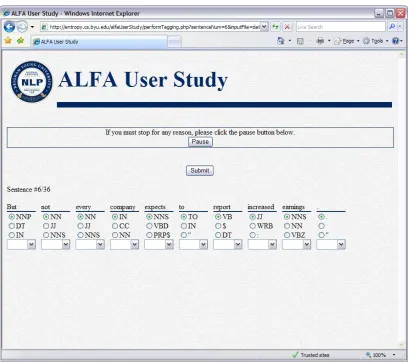
The web study was implemented as a PHP application, and all session templates and results were encoded in XML. On the matter of how to present the cases to the user, we settled on the use of radio buttons for the top three tags with a drop-down for the other options. The top three tags are the three most likely correct tags as determined by the probabilistic tagger. The order of the tags in the drop-down list is static so that users do not have to “hunt” for the location of the desired tag. Figures 1 and 2 illustrate with screenshots of the interface for the annotation of sentences and words, respectively.
2.6 Subjects
The majority of the subjects for this study were undergraduate linguistics students in their third week of an undergraduate syntax course. They had received a
general review of phrase types and word classes. The students received no special training in part of speech tagging, the tag set employed in the Penn Treebank, or even linguistic experimentation. The assignment was optional, and the equivalent value of a small homework assignment was awarded upon completion of the study. They were also rewarded for enrolling up to two additional people in the study. Ten of the 47 students were non-native speakers of English, and four of the 47 had participated in an earlier round of the study. When subjects finished the study they were given a brief survey in which they were asked several questions related to their ability and their performance in the study, as described in greater detail below.
3.
Descriptive Statistics
We present the results of this study in two parts: first we introduce the data gathered and present descriptive statistics. Second, we model the data and draw conclusions using inferential statistics.
The web-based annotation tool described in the preceding sections gathered the following data during the annotation study:
same linear regression techniques, and the resulting hourly model is:
h 4.261 l 4.683 5.579 /3600
As before, l = length, and c = the number of tokens needing correction. For this model, the RSE is 76.57, and the adjusted R2 is 0.2345.
If we consider only the beginners (self rating is 2 or lower), then we are limited to 606 sentences in the data. The resulting model is:
h 3.441 l 3.441 20.752 /3600
For this model, the RSE is 94.98, and the adjusted R2 is 0.1622.
Next, we analyze the sentences having high annotation accuracy. The number of sentences having an annotation accuracy of at least 95% (annotations come from the user study subjects) is 111. The linear model on this subset of the data is:
h 0.711 l 5.174 47.876 /3600
For this model, the RSE is 76.64, and the adjusted R2 is 0.1109.
For the word-at-a-time data, there were 1035 cases of annotated words. We discarded extreme outliers having time less than or equal to one second or greater than or equal to 200 seconds. This left 915 sentences. The hourly cost model computed on the word-at-a-time data by means of linear regression is as follows:
h 14.193 5.670 /3600
where b is a binary indicator reflecting whether or not the word in question actually needed correction. As before, this model was preferred by the Bayesian Information Criterion. For this model, the RSE was 15.76, and the adjusted R2 is 0.0256. The next best model according to BIC included the length of the sentence in which the word occurred, as in the sentence-at-a-time model. Intuitively, length may play a small role, for instance, affecting the time to scan for and find the word to be tagged; also, in longer sentences larger context may be needed by the subject to disambiguate more distant co-reference.
5.
Future Work
Based on this analysis, we have simple linear models with which to predict the time required to annotate data using each presentation technique, whether sentence-at-a-time or word-at-a-time. Our future work focuses on the application of these results in the context of active learning. Our previous work demonstrates that by applying active learning techniques, a state of the art tagging model can be trained on as little as one-half of the amount of data required by more traditional machine-assisted annotation schemes to achieve the same levels of accuracy. These results assumed that cost was measured in terms of the number of sentences annotated. We will also evaluate the cost of annotation with the new models and assess overall cost reductions in terms of time
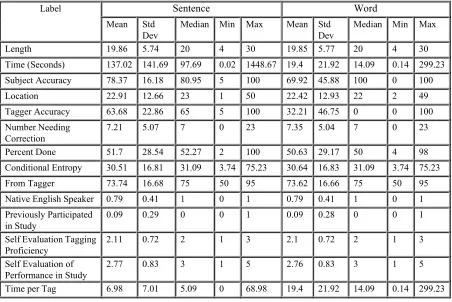
Label Sentence Word
Mean Std Dev
Median Min Max Mean Std Dev
Median Min Max
Length 19.86 5.74 20 4 30 19.85 5.77 20 4 30
Time (Seconds) 137.02 141.69 97.69 0.02 1448.67 19.4 21.92 14.09 0.14 299.23
Subject Accuracy 78.37 16.18 80.95 5 100 69.92 45.88 100 0 100
Location 22.91 12.66 23 1 50 22.42 12.93 22 2 49
Tagger Accuracy 63.68 22.86 65 5 100 32.21 46.75 0 0 100
Number Needing Correction
7.21 5.07 7 0 23 7.35 5.04 7 0 23
Percent Done 51.7 28.54 52.27 2 100 50.63 29.17 50 4 98
Conditional Entropy 30.51 16.81 31.09 3.74 75.23 30.64 16.83 31.09 3.74 75.23
From Tagger 73.74 16.68 75 50 95 73.62 16.66 75 50 95
Native English Speaker 0.79 0.41 1 0 1 0.79 0.41 1 0 1 Previously Participated
in Study
0.09 0.29 0 0 1 0.09 0.28 0 0 1
Self Evaluation Tagging Proficiency
2.11 0.72 2 1 3 2.1 0.72 2 1 3
Self Evaluation of Performance in Study
2.77 0.83 3 1 5 2.76 0.83 3 1 5
Time per Tag 6.98 7.01 5.09 0 68.98 19.4 21.92 14.09 0.14 299.23
and therefore money. It is ultimately expenditures of money that are limited by our project budgets.
We also plan to apply the models of annotation cost derived here in the current work to select the presentation style for annotation. By adaptively presenting cases one word-at-a-time or one sentence-at-a-time, we expect to be able to further minimize annotation time and, therefore, cost.
References
Engelson, S. and Dagan, I. (1996). “Minimizing manual annotation cost in supervised training from corpora.” ACL. Pp. 319-326.
Hwa, R. (2000). “Sample selection for statistical grammar induction”. In Proceedings of EMNLP/VLC-2000. Pp. 45-52.
Lewis, D., and Catlett, J. (1994). “Heterogeneous uncertainty sampling for supervised learning.” ICML. Lewis, D., and Gale, W. (1995). “A sequential algorithm
for training text classifiers: Corrigendum and additional data.” SIGIR Forum, 29 (2), Pp. 13-19. Ngai, G. and Yarowsky, D. (2000) “Rule Writing or
An-notation: Cost-efficient Resource Usage for Base Noun Phrase Chunking.” ACL. Pp. 117-125.
Osborne, M., & Baldridge, J. (2004). “Ensemble-based AL for Parse Selection”. HLT-NAACL 2004, Boston, Massachusetts, USA. Pp. 89―96.
Ratnaparkhi, A. (1996). “A Maximum Entropy Model for Part-Of-Speech Tagging.” EMNLP.
Ringger, E., McClanahan, P., Haertel, R., Busby, G., Carmen, M., Carroll, J., Seppi, K., & Lonsdale, D. (2007). “Active Learning for Part-of-Speech Tagging: Accelerating Corpus Annotation”. ACL Linguistic Annotation Workshop (LAW) 2007. Prague, Czech Republic.
Seung, H., Opper, M., & Sompolinsky, H. (1992). “Query by committee”. COLT. Pp. 287-294.
Thrun S., and Moeller, K. (1992). “Active exploration in dynamic environments.” NIPS.
Tomanek, K., Wermter, J., & Hahn, U. (2007). “An Approach to Text Corpus Construction which Cuts Annotation Costs and Maintains Reusability of An-notated Data.” EMNLP. Pp. 486-495.
Toutanova, K. & Manning, C. (2000). “Enriching the Knowledge Sources Used in a Maximum Entropy Part-of-Speech Tagger.” EMNLP. Pp. 63-70.