© 2018 IJSRCSEIT | Volume 3 | Issue 4 | ISSN : 2456-3307
A Novel Approach for Secure Protocols for Developed Cloud
Computing
Adapa Gopi
Ph.D Scholar, Department of Computer Science & Engineering, Madhav University, Bharja, Rajasthan, India
ABSTRACT
A new concept called Cloud Computing (CC) has recently emerged in heterogeneous distributed computing. Cloud computing gives a supportive on request for network access to a shared pool of configurable preparing assets. Assets allude to computing applications, network assets, stages, programming services, virtual servers, and computing foundation.Assets allude to computing applications, network assets, stages, programming services, virtual servers, and computing foundation. Cloud computing can be considered as another preparing unique that can give benefits on ask for at an irrelevant cost. The propose comprehended and routinely used administration models as a piece of the cloud perspective are Software as a Service SaaS), Platform as an administration (PaaS), and foundation as a Service (IaaS). In this paper we propose Data security in cloud movement considering shared pool of resources. In SaaS, programming with the related data is sent by a cloud supplier association, and clients can use it through the web programs. Data security in the cloud computing is more convoluted than data security in the standard data frameworks. The main problems in the cloud computing join resource security, resource administration, and resource checking. By and by, there are no standard precepts and headings to pass on applications in the cloud, and there is a nonappearance of regulation control in the cloud.
Keywords : Data Security, Cloud Computing(CC), Shared Pool
I.
INTRODUCTION
Cloud computing is about the delivery of computing to clients from a remote area. Utilizing cloud computing a client can store his data on cloud, which get halfway put away in the cloud and can be accessed whenever from anyplace through web. Trusted cloud servers can just access the encoded data by our proposed Data security terms implemented for every server with infrastructure sharing.
Cloud computing suppliers are trusted to keep up data integrity and accuracy. Regardless, it is vital to create the outside supervision framework other than
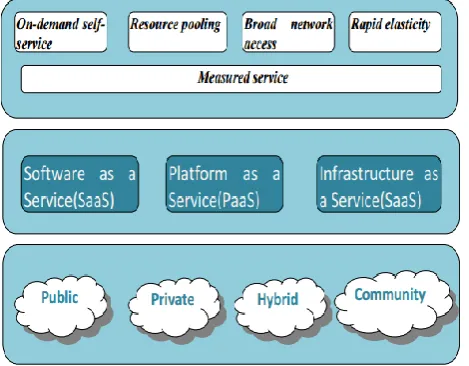
Figure 1. Visual Model of NIST Working Definition of Cloud Computing
Securities accept an essential part in the present time off since a long time back imagined vision of computing as an utility. It can be apportioned into four subcategories: security systems, cloud server checking or following data grouping, and keeping up a vital separation from malignant insiders' unlawful operations and administration capturing. Data security framework for cloud computing systems is proposed.
The following are the considerations: 1. Data Integrity
2. Data confidently 3. Data availability 4. Data Privacy
5. Data segregation Backup
Barriers to Cloud Computing Adoption in the Enterprise
Despite the fact that there are many benefits to adopting cloud computing, there are likewise some huge barriers to its adoption. Be that as it may, it is essential to in any event get out what a portion of the other barriers to adoption are:
1.Security 2.Privacy
3.Connectivity and open access
4.Reliability
5.Independence from CSPs 6.Interoperability
7.Economics esteem 8.IT governance
Figure 2. Challenges/Issues Ascribed to the „Cloud‟
II.
EXPERIMENTAL VIEW
Today Cloud is the new trendy expression. This is generally in light of the fact that the data and programming needs developed exponentially for the businesses and governments. It is altogether different in idea from the early offerings, and the incomprehensibly bigger. In any case, many individuals in the business, even those specifically required in the cloud choices and movement don't generally know much about it. The objectives of this study are:
1. To discover the threats/assaults on the framework 2. To discover the data security and uprightness
issues in WSN
3. To shield the objective from the individuals who might, deliberately or accidentally, do it hurt
Data Integrity
data integrity suggests protecting data from unapproved deletion, modification, or manufacture. Managing component's consent and rights to specific attempt assets ensures that huge data and services are not mishandled, misused, or stolen. Data uprightness is easily refined in an independent framework with a singular database. Data respectability in the independent framework is kept up by methods for database prerequisites and exchanges, which is regularly wrapped up by a database management framework (DBMS).
Exchanges should take after ACID (nuclear, consistency, separation, and quality) properties to ensure data respectability. Most databases reinforce ACID exchanges and can shield data trustworthiness. Endorsement is used to control the passageway of data. It is the segment by which a framework makes sense of what level of Access a particularly approved customer should need to secure assets controlled by the framework. Data integrity in the cloud framework infers sparing data trustworthiness. The data should not to be lost or adjusted by unapproved clients. Data genuineness is the commence to give cloud computing administration, for instance, SaaS, PaaS, and IaaS.
Data confidently
Data secrecy is essential for clients to store their private or mystery data in the cloud. Validation and access control systems are used to ensure data secrecy. The data order, validation, and access control issues in cloud computing could be had a tendency to by expanding the cloud trustworthiness and unwavering quality.
Since the clients don't trust the cloud suppliers and cloud stockpiling supplier associations are in every practical sense hard to discard potential insider chance, it is especially dangerous for clients to store their delicate data in cloud stockpiling particularly. Direct encryption is gone up against with the key administration issue and can't reinforce complex
essentials, for instance, question, parallel adjustment, and fine-grained endorsement.
Data availability
Data accessibility implies the accompanying: when accidents, for example hard disk damage, IDC fire, and network failures occur, the degree that client's data can be utilized or recuperated and how the clients confirm their data by strategies instead of relying upon the credit ensure by the cloud specialist co-op alone. The issue of putting away data over the Trans visitor servers is a genuine worry of clients in light of the fact that the cloud merchants are represented by the nearby laws and, along these lines, the cloud clients ought to be discerning of those laws.
Additionally, the cloud specialist organization ought to guarantee the data security, especially data mystery and integrity. The cloud supplier should impart guarantees of data safety and explain jurisdiction of local laws to the clients. The cloud merchant ought to give assurances of data wellbeing and clarify ward of neighborhood laws to the clients. The fundamental concentrate of the paper is on those data issues and difficulties which are related with data stockpiling area and its relocation, cost, accessibility, and security. Finding data can help clients to build their trust on the cloud.
Data Privacy
Privacy is the capacity of an individual or gathering to withdraw them or data about themselves and in this way uncover them specifically. Privacy has the accompanying elements.
1. When: a subject might be more worried about the present or future data being uncovered than data from the past
3. Extent: a client may rather have his/her data detailed as an uncertain locale instead
This cloud display advances accessibility and is made out of five basic attributes, three administration models and five sending models.
Private cloud
Private clouds are assembled particularly for a solitary association. It is claimed and worked by particular association and all cloud assets are additionally devoted to that association as it were. It offers more noteworthy control on data security, which needs in public cloud. Associations fabricate private cloud to manage their business basic applications.
Public cloud
Public cloud is a cloud environment which is made accessible to public clients by a specialist co-op. It is claimed and worked by cloud specialist co-ops. Assets in this cloud are accessible to public clients on demand over the web. Client can lease assets and can scale assets up or down on the premise of their need. Cases of public cloud suppliers are Google, Amazon, Microsoft and Rack space.
Community cloud
It is closely resembling private cloud. A private cloud is committed for a specific gathering, while community cloud is devoted to a shut community which includes individuals of comparable interest. With community cloud, association having comparative goals can cooperate. Case of community cloud is Media Cloud.
Hybrid cloud
Hybrid clouds are combination of at least two clouds (private, public or community cloud). With hybrid cloud, associations can understand the advantage of various cloud organization models. It gives expansion
of private cloud with assets of public cloud keeping in mind the end goal to handle any surprising surges in workload.
Data segregation
Multi-tenancy is one of the significant qualities of cloud computing. Because of multi-tenancy multiple clients can store their data using the applications given by SaaS. In such a circumstance, data of different clients will live at a similar area. The intrusion of data of one client by another winds up noticeably conceivable in this environment. This intrusion should be possible either by hacking through the escape clauses in the application or by injecting customer code into the SaaS system.
A customer can compose a veiled code and inject into the application. In the event that the application executes this code without check, at that point there is a high capability of intrusion into other's data. A SaaS model should, along these lines, guarantee a reasonable limit for every client's data.
The limit must be guaranteed at the physical level as well as at the application level. The administration ought to be sufficiently intelligent to isolate the data from various clients. A vindictive client can utilize application vulnerabilities to handcraft parameters that sidestep security checks and access touchy data of different occupants. The following appraisals test and approve the data isolation of the SaaS merchant in a multi-inhabitant sending:
SQL Injection flaws
Data validation
Insecure storage
Backup
debacle like hardware disappointment. And to avert incidental leakage of moved down data, a solid encryption plan ought to be utilized. High Security Distribution and Rake Technology (HS-DRT), Parity Cloud Service Technique (PCs), and Cold and Hot Backup Service Replacement Strategy (CBSRS) are some reinforcement and recuperation strategies that have been produced in cloud domain.
III.
Implementation Note
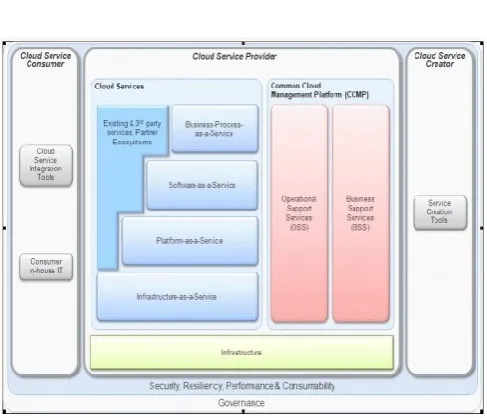
Figure 3. Cloud Computing Architecture
Cloud computing security is an advancing sub-space of Computer security, network security, and more broadly, data security. It suggests a far reaching course of action of approaches, advancements, and controls sent to secure data, applications and the related infrastructure of cloud computing. Cloud security is not to be mixed up for security software offerings that are "cloud-based". The degree of the cloud security navigates over all the three service transport models sent in any of the four cloud game plan models (private, open, cross breed and gathering cloud) and displaying the five central characteristics of the cloud.
It is this cross of the degree of security in the cloud that makes it imperative and in the interim profoundly ensnared. The wide degree of the security subsequently has distinctive elements
including yet not constrained to security related to the application, data transmission, data stockpiling, confirmation and endorsement, system, virtualization and physical hardware. This brings up various issues regarding each of these perspectives.
1. Clouds utilize the idea of ―multi-tenancy‖ where by different Clients data is handled on the same physical hardware.
Some late data occurrences events are the sidekick cloud disaster in 2009, the breakdown of Amazon's Elastic Computing Cloud in 2010, and diverse scenes are appearing now and again. In this way, disregarding the way that securing data in the cloud is fiscally charming for the cost and multifaceted nature of whole deal broad scaled at limit, it's lost of offering strong affirmation of data Integrity, Secret and Availability may discourage its wide gathering by both attempt and individual cloud customers.
By Encrypting and encoding or copying the data before securing in the cloud can manage the Secret and Availability issues independently. Nevertheless, affirming the Integrity of outsourced data is a troublesome errand without having an area copy of data or recouping it from the server. Due to this reason, the unmistakable cryptographic primitives, for instance, Hashing, Signatures gets ready for data Integrity are not particularly applicable.
It is unlikely for the Clients to download the all set away data with a particular true objective to endorse its Integrity as this would require a costly I/O cost and correspondence overhead finished the framework. From now on, to ensure the cloud data stockpiling Integrity affirmation and actualize the idea of cloud storage advantage, it is essential to require a capable and capable system for the Clients to check the Integrity of their data set away in the cloud with slightest calculation, correspondence and limit overhead.
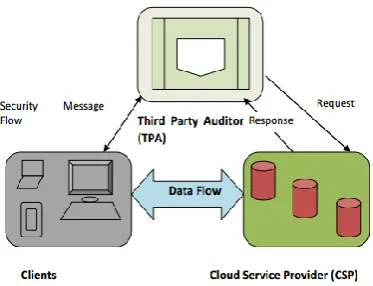
Cloud Service Provider (CSP) and Third Party Auditor (TPA).
Figure 4 . Cloud Data Storage Architecture
Cloud service supplier (CSP)
Cloud Service Providers (CSPs) are the individuals who have significant assets and skill in building, overseeing cloud storage servers and give applications, infrastructure, hardware, empowering innovation to Clients as a service by means of web. Outside Auditor (TPA) who has aptitude and abilities that Client might not have and confirms the Integrity of data put away in cloud in the interest of Clients. In light of the review result, TPA could discharge a review answer to the Client.
In cloud processing worldview, the Clients store their data documents in cloud and get to them with help of Cloud Service Provider (CSP) at whatever point and wherever they require. The cloud comprises of an arrangement of cloud servers, which are running in a concurrent, collaborated and cloud way. Data redundancy can be utilized with the procedure of deletion amending code to additionally endure issues or server crash as client's data and scramble the data can keep the data spillage.
Also, the Client can every now and again check the Integrity of data without having a nearby duplicate of data record. On the off chance that, the Clients don't have room schedule-wise, attainability or assets to screen their data, they designate this errand to Third Party Auditor (TPA). The TPA checks the
Integrity of data for the benefit of Clients. Now and again, the Clients may need to perform square level operations on his data for useful applications. The most broad types of these operations are blocked refresh, erase, embed and affix.
There are numerous applications that can be envisioned to embrace this model of outsourced data storage framework. For e-Health applications, a database containing a delicate and vast measure of data about patients 'restorative history is to be put away on the cloud servers. We can consider the e-Health association to be the data proprietor and the doctors to be the approved clients with proper get to ideal to the database.
In cloud data stockpiling framework, the Clients store their data in the cloud and didn't generally have the data locally. After data goes into the cloud, the Client loses control over it. If such data stockpiling is helpless against attacks or Byzantine disillusionments, in which the adversary can adjust or delete the data or implant polluted data into the data stockpiling servers or may get to the data. These ambushes or disillusionments would pass on sad hardships to the Clients since their data is secured in a questionable stockpiling pool outside the limit attempts.
IV.
METHODOLOGY
Quantitative research is for the most part utilized when alluding to data collection method or data examination technique that produces or relies upon numerical data. Moreover, it intends to clarify wonders by social occasion numerical data which are prepared utilizing scientifically based methods and exploratory based methods.
V.
Conclusions
Since this paper works with the security of data on selection of the cloud computing innovation subsequently it would be vital for an association, college to make their data safe from the outer get to. Many mix-ups are being made and some turned out to be very costly. We are watching nowadays, many organizations/colleges have moved to the cloud taking the counsel of providers, who have self-intrigue, or from providers or accomplices who know close to they do.
VI.
REFERENCES
[1]. International Journal of Modern Engineering Research (IJMER) www.ijmer.com Vol.2, Issue.1, Jan-Feb 2012 pp-320-325 ISSN: 2249-6645 - Improving the Security of Cloud Computing using Trusted K. Elissa, “Title of paper if known,” unpublished.
[2]. International Journal of Computer Applications (0975 – 8887) Volume 131 – No.7, December2015 Trusted Cloud Computing Platform into Infrastructure as a Service Layer to Improve Confidentiality and Integrity of VMs.
[3]. Virtualization in Cloud ComputingM. Young, The Technical Writer's Handbook. Mill Valley, CA: University Science, 1989.
BIBLIOGRAPHY OF AUTHOR