Human annotation of ASR error regions:
Is “gravity” a sharable concept for human annotators?
Daniel Luzzati
1Cyril Grouin
2Ioana Vasilescu
2Martine Adda-Decker
2,3Eric Bilinski
2Nathalie Camelin
1Juliette Kahn
4Carole Lailler
1Lori Lamel
2Sophie Rosset
21Universit´e du Maine, EA 4023, LIUM 2CNRS, UPR 3251, LIMSI
72085 Le Mans, France 91403 Orsay, France
[email protected] [email protected]
3Universit´e Sorbonne Nouvelle Paris 3, UMR 7018, LPP 4LNE
75005 Paris, France 78197 Trappes, France
[email protected] [email protected]
Abstract
This paper is concerned with human assessments of the severity of errors in ASR outputs. We did not design any guidelines so that each annotator involved in the study could consider the “seriousness” of an ASR error using their own scientific background. Eight human annotators were involved in an annotation task on three distinct corpora, one of the corpora being annotated twice, hiding this annotation in duplicate to the annotators. None of the computed results (inter-annotator agreement, edit distance, majority annotation) allow any strong correlation between the considered criteria and the level of seriousness to be shown, which underlines the difficulty for a human to determine whether a ASR error is serious or not.
Keywords:Annotation; ASR Seriousness Errors; Speech Recognition
1.
Introduction
When addressing the issue of transcription errors in auto-matic speech recognition (ASR) systems, we may adopt two distinct perspectives:
• We may be interested in etiology, trying to establish a causal relationship between the properties of the speech signal entering the ASR system and the tran-scription errors in the output. In this case, we argue in a systemic way, trying to relate the errors to causal error categories.
• A different way of looking into ASR errors consists of judging the impact of such errors on further process-ing, be it automatic or human. Taking an axiological perspective, our aim is then to qualify the seriousness of ASR errors on a seriousness scale ranging from mi-nor to huge mistakes.
In the automatic speech recognition literature, word error rates are regularly reported, however few studies focus on ASR error analyses. In general, such studies aim at identifying major reasons of error (Duta et al., 2006; Adda-Decker, 2006; Nemoto et al., 2008; Goldwater et al., 2010; Dufour et al., 2012) classifying errors according to their phonetic characteristics (Greenberg and Chang, 2000) or at comparing automatic and human performances (Lippmann, 1997; Shen et al., 2008; Vasilescu et al., 2011).
Studies on ASR error seriousness in link with further
processing (Woodland et al., 2000) tend to be lacking. In contrast, error seriousness assessment is very popular subject in foreign language teaching and learning (Vann et al., 1991; Hyland and Anan, 2006).
In this paper, we address the issue of error “gravity” or se-riousness in ASR. For this first experiment, we deliberately chose not to give precise guidelines to human judges (no hierarchy concerning linguistic levels involved in errors) nor to specify a precise framework concerning further pro-cessing (subtitling, information retrieval, translation, etc.). Instead, error seriousness decisions are individually taken by the independent participating assessors. This procedure raises the following questions:
• Do judges evaluate the seriousness of an error in the same way?
• Are judges consistent during evaluation, or is the eval-uation similar to a random trial?
• When judging errors on a commonseriousnessscale,
do judges follow different strategies (e.g., are errors harmful w.r.t. global understanding, language syntax, dialog systems, named entity recognition, etc.) de-pending on their personal competence and interests or is there a sharablegenericview of theseriousness con-cept?
We would like to mention that this study is not meant to replace perceptual studies, but rather to determine findings which can be helpful in designing further investigations.
2.
Material and methods
2.1.
Corpora
0 0.5 1 1.5 2 2.5 3 3.5 4
0 0.5 1 1.5 2 2.5 3 3.5 4 0
0.5 1 1.5 2 2.5 3 3.5 4
0 0.5 1 1.5 2 2.5 3 3.5 4
Corpus 1 Corpus 4
0 0.5 1 1.5 2 2.5 3 3.5 4
0 0.5 1 1.5 2 2.5 3 3.5 4 0
0.5 1 1.5 2 2.5 3 3.5 4
0 0.5 1 1.5 2 2.5 3 3.5 4
Corpus 2 Corpus 3
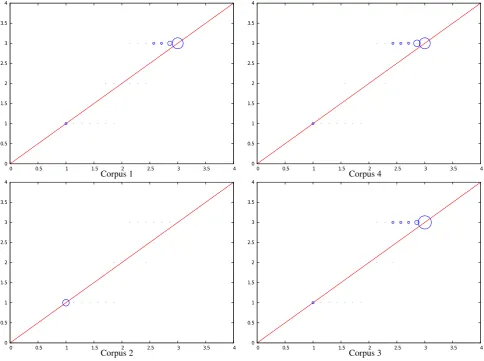
Figure 4: Mean Annotation w.r.t. Majority Annotation. Y-axis labels 1, 2 and 3 refer to low, intermediate and high level of seriousness. Y-axis label 0 refers to no majority annotation (i.e., the higher number of annotations per level is shared by two levels of seriousness)
We can observe that between 78 and 83% of the error re-gion fall within a majority judgment class. The class C rep-resents all the error region with complete undecided judg-ments. Only between 17% and 25% of the error region to be evaluated fall in this class.
4.4.
Distance between hypothesis and reference
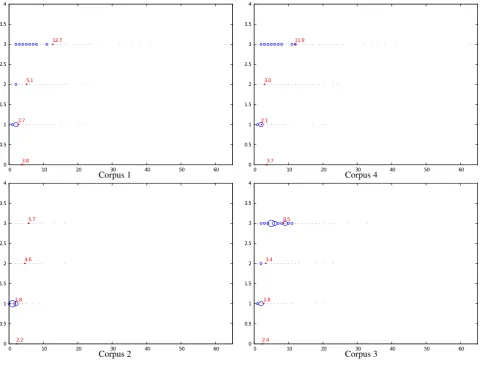
One hypothesis is that there may be a strong correlation between seriousness error and edit distance between hy-pothesis and reference. In order to validate this hyhy-pothesis, we computed edit distances for each error zone. Figure 5 shows the density annotation for each level of seriousness with respect to edit distance for all corpora while Figure 6 details the results for each corpus.
We can observe that the highest level of seriousness the highest the edit distance is (as shown with red numbers on these two figures). The distribution of these edit distances differs between Corpus 2 and the other corpora which con-firms that Corpus 2 is different from the other ones. More-over, at the high level of seriousness, we also observe an important number of short edit distances which means that edit distance alone is not enough to give a clear idea of the seriousness error.
0 0.5 1 1.5 2 2.5 3 3.5 4
0 10 20 30 40 50 60
2.3 4.3
10.6
3.2
A., and Galibert, O. (2012). The ETAPE corpus for the evaluation of speech-based TV content processing in the french language. InProc of LREC, Istanbul, Turkey. Greenberg, S. and Chang, S. (2000). Linguistic dissection
of switchboard-corpus automatic speech recognition
sys-tems. In ISCA Workshop on Automatic Speech
Recog-nition: Challenges for the New Millennium, ASR2000, Paris.
Hyland, K. and Anan, E. (2006). Teachers’ perceptions of error: the effects of first language and experience. Sys-tem, 34(4):509–519.
Lippmann, R. P. (1997). Speech recognition by machines
and humans.Speech Communication, 22(1):99–115.
Nemoto, R., Vasilescu, I., and Adda-Decker, M. (2008). Speech errors on frequently observed homophones in french: perceptual evaluation vs automatic classification. InProc. of LREC, Marrakesh, Morocco.
Shen, W., Olive, J. P., and Jones, D. A. (2008). Two pro-tocols comparing human and machine phonetic recogni-tion performance in conversarecogni-tional speech. InProc. of Interspeech, Antwerp, Belgium.
Vann, R. J., Lorenz, F. O., and Meyer, D. M. (1991). Error gravity: faculty response to errors in written discourse of nonnative speakers of english. In Hamp-Lyons, L.,
editor, Assessing second language writing in academic
contexts. Ablex Publishing, Norwood, NJ.
Vasilescu, I., Yahia, D., Snoeren, N. D., Adda-Decker, M., and Lamel, L. (2011). Cross-lingual study of ASR er-rors: on the role of the context in human perception of
near homophones. InProc. of Interspeech, pages 1949–
1952, Florence, Italy.