An efficient and user-friendly tool for machine translation quality estimation
Kashif Shah§, Marco Turchi†, Lucia Specia§
§Department of Computer Science, University of Sheffield, UK
{kashif.shah,l.specia}@sheffield.ac.uk †Fondazione Bruno Kessler, University of Trento, Italy
Abstract
We present a new version of QUEST– an open source framework for machine translation quality estimation – which brings a number of improvements: (i) it provides a Web interface and functionalities such that non-expert users, e.g. translators or lay-users of machine translations, can get quality predictions (or internal features of the framework) for translations without having to install the toolkit, obtain resources or build prediction models; (ii) it significantly improves over the previous runtime performance by keeping resources (such as language models) in memory; (iii) it provides an option for users to submit the source text only and automatically obtain translations from Bing Translator; (iv) it provides a ranking of multiple translations submitted by users for each source text according to their estimated quality. We exemplify the use of this new version through some experiments with the framework.
Keywords:Machine Translation, Translation Evaluation, Translation Quality Estimation
1. Introduction
Metrics to predict the quality of texts translated auto-matically by Machine Translation (MT) systems have become a necessity in many scenarios. These metrics, referred to as quality estimation (QE), or also confi-dence estimation, are aimed at MT systems in use. They consist in prediction models generally built us-ing supervised machine learnus-ing algorithms from ex-amples of source texts and their machine translations (i.e., no access to reference translations) described through a number of features and labelled for qual-ity. The notion of “quality” in QE metrics is defined according to the application and represented by labels – post-editing effort, gisting reliability, etc. – and fea-tures – for example, a binary grammar checker feature will be important for fluency prediction, but less use-ful for gisting reliability prediction.
A number of positive results have been reported in recent work in the field. Examples include improv-ing post-editimprov-ing efficiency by filterimprov-ing out low qual-ity segments which would require more effort or time to correct than translating from scratch (Specia et al., 2009; Specia, 2011), selecting high quality segments to be published as they are, without post-editing (Sori-cut and Echihabi, 2010), selecting a translation from either an MT system or a translation memory for post-editing (He et al., 2010), selecting the best transla-tion from multiple MT systems (Specia et al., 2010; Avramidis, 2013), and highlighting sub-segments that need revision (Bach et al., 2011). For recent overviews of various algorithms and features we refer the reader
to the WMT12-13 editions of the shared task on QE (Callison-Burch et al., 2012; Bojar et al., 2013).
QUEST(Specia et al., 2013) is an open-source frame-work for QE which provides a wide range of fea-ture extractors from source and translation texts, as well as external resources and tools. These lead to an average of 150 features (depending on the language pair) and go from simple, language-independent fea-tures, to advanced, linguistically motivated features. They include features that rely on information from the MT system that generated the translations, and fea-tures that are oblivious to the way translations were produced. In addition, QUEST integrates a well-known machine learning toolkit, scikit-learn,1 and other algorithms that are known to perform well on this task, facilitating experiments with existing fea-tures and techniques for feature selection and model building. QUEST also provides documentation for users to add their own features and learning algo-rithms. However, QUEST is not directly usable by end-users, such as professional translators. The tasks of installing and configuring the toolkit, obtaining the necessary resources, and building new models from data require technical knowledge of natural language processing, machine translation and machine learning.
In this paper we describe a number of improvements over the current version of QUESTwhich are meant to make it more accessible to non-expert users, as well as more efficient (i.e., faster). In particular, we provide
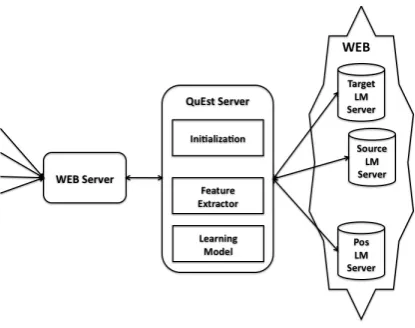
ac-Figure 1: Client-Server skema.
• Predictions: An estimated quality score for the translated sentence given the source sen-tence, produced using Support Vector Regression (SVR) and pre-built models for specific language pairs.
• Ranking: The ranking of multiple translations submitted by the user for a given source sentence. This is done based on SVR quality predictions for each source-target sentence pair performed inde-pendently.
The Web interface is developed using PHP and XML-RPC for communication across the main QUEST server and resource servers. For the convenience of users, we have also integrated the free Bing transla-tion API to this Web interface.2
The pipeline of the framework accessed via its Web interface is the following:
• User inputs a file containing source sentences only or tab separated source sentences and their translation(s) – as many translations as desired.
• User selects the language pair and text type (do-main, etc.).
• File is uploaded to the Web server, and read line by line (sentence by sentence).
• If the input file contains only source sentences, a request is sent to Bing’s API with the selected target language.
• Based on the choices (language pair, text type) selected by the user, an instance of QUESTwith the appropriate prediction model and resources is triggered.
2Please note that the free version only allows 2,000,000
characters to be translated per month per user.
• QUEST extracts the features by calling the Fea-ture Extractor module. LMs, other resources and prediction models are already loaded into mem-ory by a fake call.
• QUEST generates a prediction for each source-target combination by applying the prediction model for that language pair.
• If the input file contains multiple translations for the same source sentence, QUEST ranks these translations.
These functionalities require prediction models previ-ously trained offline for each language pair of inter-est. Options to build models from examples of trans-lations, quality scores and language resources will be added to the interface in the future.
4. Experiments
QUEST has recently been benchmarked on a number of datasets (Shah et al., 2013b; Shah et al., 2013a). To make this paper self-contained, we provide exper-iments with models trained offline which are already available through the Web interface. We also present figures in terms of the running time of our models.
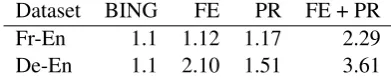
Our experiments include two language pairs, i.e., French-English and German-English, and two differ-ent tasks: absolute quality scores prediction and rank-ing of up to five translation options. The data used and results for these tasks are given in Tables 1 and 2. For both tasks, a set of 17 well establishedbaseline features was used.3The language models and other
re-sources were built using standard tools: SRILM (Stol-cke, 2002) and GIZA++ (Och and Ney, 2003). SVR
3This corresponds to those used by thebaselinesystem
Dataset SRC-LM TGT-LM POS-LM GIZA NGRAM Offline QUEST Online QUEST Fr-En 40M 35M 348K 16M 8.6M 2,021 (0.224) 343 (0.038) De-En 2G 1.1G 980K 73M 438M 110 (0.300) 22 (0.060)
Table 3: Sizes of resources and cumulative response time in minutes for QuEst offline vs QuEst online for all sentence pairs (and per sentence pair) on each of the two test sets. The resources used to extract the features are source and target 3-gram language models (SRC-LM and TGT-LM), part-of-speech tag source language model (POS-LM), source-target Giza++ lexical table (GIZA), and raw counts of 1-3 grams in a corpus of the source language (NGRAM).
F. Josef Och and H. Ney. 2003. A Systematic Com-parison of Various Statistical Alignment Models. Computational Linguistics, 29(1):19–51.
M. Potet, E. Esperana-Rodier, L. Besacier, and H. Blanchon. 2012. Collection of a large database of french-english smt output corrections. In LREC12, Istanbul, Turkey.
K. Shah, E. Avramidis, E Bic¸ici, and L Specia. 2013a. Quest - design, implementation and extensions of a framework for machine translation quality estima-tion. Prague Bull. Math. Linguistics, 100:19–30. K. Shah, T. Cohn, and L. Specia. 2013b. An
Investi-gation on the Effectiveness of Features for Trans-lation Quality Estimation. In Proceedings of MT Summit XIV, pages 167–174.
R. Soricut and A. Echihabi. 2010. Trustrank: Induc-ing trust in automatic translations via rankInduc-ing. In ACL11, pages 612–621, Uppsala.
L. Specia, M. Turchi, N. Cancedda, M. Dymetman, and N. Cristianini. 2009. Estimating the Sentence-Level Quality of Machine Translation Systems. In EAMT09, pages 28–37, Barcelona.
L. Specia, D. Raj, and M. Turchi. 2010. Ma-chine translation evaluation versus quality estima-tion. Machine Translation, 24(1):39–50.
L. Specia, K. Shah, J.G.C. de Souza, and T. Cohn. 2013. Quest - a translation quality estimation framework. In51st Annual Meeting of the Associa-tion for ComputaAssocia-tional Linguistics: System Demon-strations, ACL-2013, pages 79–84, Sofia, Bulgaria. L. Specia. 2011. Exploiting objective annotations for measuring translation post-editing effort. In EAMT11, pages 73–80, Leuven.