Recent Developments in DRK
Marc Kupietz, Harald Lüngen
Institute for the German Language (IDS)R5 6–13, 68161 Mannheim, Germany {kupietz|luengen}@ids-mannheim.de
Abstract
This paper gives an overview of recent developments in the German Reference Corpus DRK in terms of growth, maximising relevant corpus strata, metadata, legal issues, and its current and future research interface. Due to the recent acquisition of new licenses, DRK has grown by a factor of four in the first half of 2014, mostly in the area of newspaper text, and presently contains over 24 billion word tokens. Other strata, like fictional texts, web corpora, in particular CMC texts, and spoken but conceptually written texts have also increased significantly. We report on the newly acquired corpora that led to the major increase, on the principles and strategies behind our corpus acquisition activities, and on our solutions for the emerging legal, organisational, and technical challenges.
Keywords:German reference corpus, very large corpora, legal issues
1.
Introduction
We report on recent developments in DRK, theArchive of General Reference Corpora of Contemporary Written German hosted at the Institut für Deutsche Sprache in Mannheim (IDS). DRK is designed as a very large general-purpose corpus archive. Its primary purpose is to serve as an empirical basis for linguistic research on con-temporary written German, i.e. it is not designed specifi-cally for lexicography, but for all fields of language research where quantitative analyses requiring large corpora are con-ducted.
DRK is probably the largest linguistically motivated archive of German texts. It contains fictional texts, newspa-per texts, specialised texts, scripted speech, internet-based communication, and many other text types. DRK is con-tinually being expanded. Only complete texts are included, originating from around 1956 or later. DRK is anno-tated on multiple linguistic levels, e.g. with POS tagging and syntactic dependency structures.
Unlike other reference corpora, DRK is not designed to be balanced in any way, because what kind of balance is ap-propriate always depends on the research question and the language domain under scrutiny. We think that researchers ideally should be able to answer questions likeWhich lan-guage domain do I want to examine? Is 20% or 30% or 50% fictional texts to be considered as balanced? Which language strata are relevant? themselves and should have means at their disposal to compile a suitable corpus accord-ingly. Hence, DRK is designed to serve as aprimordial sampleof language use, from which users can draw strati-fiedvirtual corporathat are representative or balanced w.r.t. their research question (cf. Kupietz and Keibel, 2009; Kupi-etz et al., 2010). The primordial sample design ensures an optimal usability of the corpus data for the maximum num-ber of potentially relevant research questions. It also allows for an optimisation of the cost-benefit ratio, e.g. data offered to us for free need not be declined.
The present paper reports on newly acquired corpora that led to a recent major increase of DRK, on the principles and strategies behind our corpus acquisition activities, and on our solutions for the emerging legal, organisational, and
technical challenges. While our general aim is to inform the scientific community about current developments and results, we also intend this paper as a contribution to the on-going specialised exchange among the national corpora and very large reference corpora initiatives (e.g. Geyken, 2007; Przepiórkowski et al., 2010; Ransmayr et al., forthcoming).
2. Legal issues
The IDS does not own any of the texts contained in DRK. In order to be able to use them and make them available to the scientific community, we had to conclude license con-tracts with the respective copyright holders. The rights of use formulated in these licenses have some limitations, most importantly that a.) only academic use is allowed whereas commercial use is explicitly forbidden, b.) access is a only allowed via specialised query software, which technically prevents the reconstruction, let alone download of com-plete texts, and c.) only authenticated users may be granted access. Note that without such compromises, we would not be able to compile a corpus like DRK, as less re-strictive license terms are extremely expensive. Currently, DRK contains texts from more than 200 donors (pub-lishing houses or individual authors).
By the two major types of agreements, the corpora are made available for IDS employees and guests only, or made avail-able world-wide. To be avail-able to specify the complex rights situations, we propose one newmain categoryand four new
additional modifiers as an extension of the CLARIN sys-tem originally proposed by Oksanen et al. (2010). As a new main category besides PUB, ACA, and RES, we propose
QAO(query and analysis only):
QAO– not downloadable, the end user has the right to query and analyse the resource for academic pur-poses via specialised software provided by the copyright curator
As four newadditional modifiers,which can in principle be combined with any main category, we propose:
QAO-NC academic, non-commercial, query-and-analysis only (i.e. accessi-ble only via COSMAS-II) use
QAO-NC-LOC:ids academic,
non-commercial, query-and-analysis-only (i.e. accessi-ble only via COSMAS-II) use, only at the site of the IDS
QAO-NC-LOC:ids-NU:1 academic,
non-commercial, query-and-analysis-only (i.e. accessi-ble only via COSMAS-II) use, only at the site of the IDS, only by one user at a time
ACA-NC academic, non-commercial
use, no re-distribution by the end user
ACA-NC-LC academic, non-commercial
use, no re-distribution by the end user, license con-tract ŵith copyright holder required
CC-BY-SA other e.g. Wikipedia
Table 1: Combinations of CLARIN and newly proposed laundry symbols used in DRK
LC – a signed license contract with the copyright holder is required
NU:n– the resource can only be made available to nend users at a time
TER – a territorial restriction, e.g. TER:Germany for use only in Germany
According to this proposal, each DRK subcorpus is now specified with one of the values listed in Table 1 in the
<availability>element of its TEI header.
We are convinced that these or similar additions to the CLARIN classification system would raise its coverage, granularity and usefulness significantly, as, because of the affected third parties’ rights, almost all contemporary cor-pora are not available for download, but only accessible, searchable and analysable through specialised software (cf. Hinrichs and Beck, 2011, p. 47ff). Apart from being a le-gal and economical reality and necessity in most European countries, making corpora available in such a way makes also sense from a computer scientific point of view, ideally putting Jim Gray’s (2003) famous postulateput the compu-tation near the dataand one of the founding motivations for CLARIN, namelygetting away from the download-first paradigm, into practice. We are of course aware of the implications on the responsibilities of corpus curators and providers to make the data, even though it cannot be down-loaded, as useful for researchers, as legally and practically possible (see section 6.).
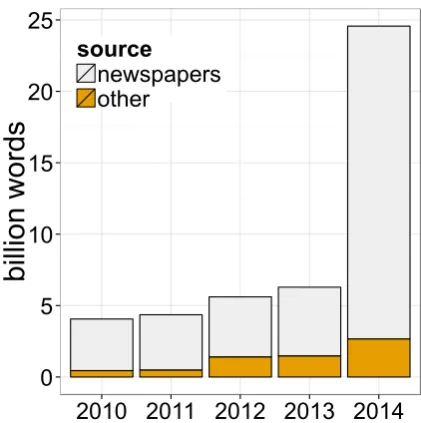
Figure 1: DRK growth since 2010
3. Growth
DRK is continually expanded and presently one of the biggest corpus archives of texts in (contemporary) German. It contained over four billion running words in 2010, and as a result of recent campaigns and major acquisition deals, DRK has grown to over six billion running words in 2013 and has further grown by a factor of four in the first half of 2014 to more than 24 billion words (see Figure 1). DRK’s present growth rate (considering the regularly in-coming text data) is 1.7 billion words per year. Note that size is not an end in itself. Language is known to contain a large number of rare events – not only lexical events, but also events defined by a combination of conditions. The bigger a corpus is (while other parameters remain the same), the more reliable conclusions can be drawn from it about rarer and more diversified phenomena.
3.1. Recent campaigns and acquisitions
With respect to DRK’s design as a primordial sample, activities to expand DRK further are guided by two prin-ciples: maximisation of size and maximisation of dispersion with respect to potentially relevant strata. In practice, fur-ther criteria play a role, such as demand from IDS-internal and -external projects, supply by right holders or projects in which corpora are built, and in particular, licensing costs and the costs of preparing the raw data for integration in DRK.
Hence, a major part of the continual growth of DRK has been due to the regular supply of the latest digital editions of 15 German language newspapers according to existing agreements with the publishers, and the genre of newspaper text has traditionally been a prevailing stratum in DRK. Due to the primordial sample design, relative differences of the sizes of strata are not relevant in the case of DRK, as virtual corpora with the desired proportions can always be drawn. What matters, however, in this context are absolute sizes – especially in the case of sparsely populated strata.
3.1.1. Fiction
One of the weaker strata in DRK has been the stratum of fictional texts, and to develop it further, our 2011 acqui-sition campaign focused on fiction. 69 publishers of fiction in German-speaking countries were contacted. Eleven of them answered that they were willing to support DRK, and further negotiations resulted in eight new license agree-ments, in which the respective publishers would grant free licenses for the use of works of fiction in DRK. Six of them actually sent text data in the end. While most publish-ers grant a selection of 10 to 20 books, two of the six granted all titles from their respective backlists. Consequently, the subcorpora of fictional texts in DRK have increased by 50% since 2010 and presently comprise 17.6 million word tokens.
The books were delivered in formats as diversified as EPUB, InDesign, and PDF. As the markup of these for-mats is mostly layout-oriented and varies much even among the texts from the same publishing house, a consider-able amount of labour had to be invested into developing new converter modules and adapting existing conversion pipelines to convert the data into the IDS text model. Due to these circumstances, the expenses for the acquisition and curation of one word of fictional text are presently about 25,000 times higher than the expenses for one word of news-paper text.
3.1.2. Web-based corpora
Several recent big data corpus initiatives have introduced new methods to derive clean text from web pages and have improved POS-tagging to deal with the peculiarities of web language and web documents (Jakubíček et al., 2013; Schäfer and Bildhauer, 2012; Baroni et al., 2009). How-ever, due to DRK’s quality standards to include only li-censed material and to provide sufficient metadata for en-abling users to derive virtual subcorpora, we cannot readily use the web as a source. It is hard to impossible to obtain or derive useful metadata for web documents, not even ba-sic ones such as authorship, let alone the time of compo-sition, the author’s native language or geographical affilia-tion (cf. also Jakubíček et al., 2013). For many web doc-uments, it is hard to determine whether their text content has been composed by a human at all. Moreover, German and European copyright laws lack the notions of fair use
andimplied license, hence an explicit license would have to be obtained from every single author of a candidate web-page or forum entry, which seems infeasible (see also Gue-vara, 2010). For these reasons, our strategy to cover spe-cific web genres in DRK is to focus on web archives and collections that have been published under sufficiently
lib-eral licenses, or where there is a central authority, such as a major forum or blog host, with whom we can negotiate a comprehensive license. Under these preconditions, we have adapted the complete archive of German Wikipedia arti-cles and discussion pages for DRK in 2011 (Bubenhofer et al., 2011), and again in 2013 (Margaretha and Lüngen, in preparation)1. The 2011 Wikipedia conversion comprises 830 million word tokens and formed the bulk of DRK’s increase in 2012. The 2013 conversion comprises more than 1 billion word tokens.
Wikipedia discussions are an instance of computer-mediated communication(CMC). CMC represents written, but conceptually spoken language and is an important mani-festation of contemporary language (Lemnitzer et al., 2012). Within a new project on orthographic usage, started in 2013 in cooperation with the Council for German Orthography, we currently seek to acquire further CMC data from web sources such as forums, newsgroups, and blogs under the premises sketched above.
3.1.3. Conceptually written language
In 2012, we also extended the stratum of medially spo-ken, but conceptually written language. We acquired the German Political Speeches Corpus compiled by Barbaresi (2012)2, and the parliamentary debates corpus PolMine3, comprising the complete protocols from the sessions of the 18 German national and state-level parliaments since 2000. The conversion tools used for the PolMine corpus were in parts developed in a co-operation between the IDS and the PolMine group of the University of Duisburg-Essen and are employed for regular updates of this corpus with the newest protocols. We intend to also curate the debate proto-cols from the parliaments in Austria, and German-speaking Switzerland and Belgium, as well as the protocols from be-fore the year 2000. The political speeches and PolMine cor-pora within DRK presently comprise 316 million run-ning words.
3.1.4. News database archive
In 2013, we struck a deal with a commercial German-language news database provider, according to which DRK obtained licenses for about 102 million documents (69 GB zipped XML) of press text, specialised journals and e-books. The size of the archive posed major challenges for the technical infrastructure of DRK and for the corpus extension project.
All documents came marked up according to the provider’s own XML format, which also included metadata specifying for each document the source, issue, date, page number, ti-tle, and (partly) one or more domain categories and one or more keywords (mostly names of people or locations). The basic text structure markup exhibited some variation w.r.t. to the marking of paragraphs, headings, and subheadings. For the latest DRK release DRK-2014-I, we selected the press data part which contained consecutive editions of 98 national and regional newspapers and magazines, mostly
1also available for download, see http://www.ids-mannheim.de/kl/projekte/korpora/verfuegbarkeit.html
starting between 2000 and 2003.
Preparation As a pre-processing step, we applied some standard filters, i.e. discarding texts that had the same ID or the same md5 checksum as a previously seen text, texts con-taining less than ten words, texts with more than 10% dig-its, and finally texts with less than 15% function words. (In the future, we will also apply our proper duplicate detection and encode the duplicate and near duplicate relations in the corpus files as described in Kupietz (2005) and Klosa et al. (2012)).
We designed an XSLT stylesheet to convert the XML sources into the I5 markup (see Section 5.), applying heuris-tics to extract further metadata such as the author of an ar-ticle, to deal with the variation in text structure and to mark up regions of text in more detail than the original, e.g. ad-ditionally annotating openers and bylines. We also applied our topic classification (see Weiß, 2005; Klosa et al., 2012) and sentence splitting routines and added the respective re-sults to the I5 encoding.
For quality assurance (in addition to the above described filtering), we manually inspected a sample of documents chosen from the set of the 12 major papers. As a result, we further adjusted the functions for identifying author and subtitle towards a better precision.
Eventually, the resulting corpus ready for inclusion in DRK comprised more than 70 million documents (i.e. news articles), containing more than 16 billion word tokens and using up more than 380 GB of disk space. The entire processing (i.e. filtering, XSL transformation, XML valida-tion, and word count) ran in 13 parallel threads on 48 cores at 50% CPU load and took 14 hours altogether.
Usually, we provide DRK data with linguistic annota-tions on three syntactic layers as standoff annotation (see Belica et al., 2011), but DRK with the annotations has al-ways been bigger by a factor of 40 i.e. would amount to 15.2 TB for DRK including the new corpora. Since presently we do not have that much storage space available, we have provided only a part of the release DRK-2014-I with lin-guistic annotations for the time being. For the future, we have ordered 24 TB additional disk space.
4. Internal variance in the new DRK
release
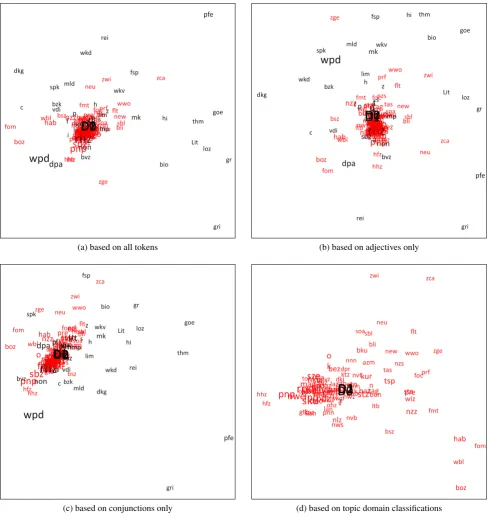
The release DRK-2014-I contains over 24 billion word tokens altogether (in contrast to the previous release DRK-2013-II which contained 6.6 billion tokens). Since we knew that the present IDS’ corpus search, management and analysis system COSMAS II cannot handle an archive of this size with reasonable indexing and query response times, we thought of ways to prioritise the new data to al-low for choosing the “most important” subcorpora for inclu-sion in COSMAS, so that they can be used even before the launch of our new and more powerful corpus platform Ko-rAP (see Section 6. and Bański et al., 2014, in this volume). Since in the primordial sample design it is always desirable to increase the internal variance of the primordial sample, we tested all subcorpora for similarity/distance to each other and to the old DRK (DRK-2013-II) as a whole, using Kilgariff’s (2001) word frequency list-based distance mea-sures for comparing corpora. The intention was to
prefer-ably include the most dissimilar of the new subcorpora in COSMAS as they would increase variance most, and among them those with the best coverage of strata that are usu-ally under-represented w.r.t. to typical virtual corpus defi-nitions, such as fiction and history (as opposed to finance and local announcements). For each subcorpus to be com-pared, we derived random samples of 1 million tokens, and to be on the safe side, we derived three such samples from DRK-2013-II as a whole. Then for each pair of samples to be compared, we took the lists of the 500 most frequent words in the union of both samples according to Kilgariff’s (2001) method and calculated their similarity/distance us-ing Kilgariff’sχ2-based measure. We transformed the re-sulting distance matrix into a two-dimensional map using non-metric multidimensional scaling (NMDS), see Figure 2a. The three DRK-2013-II samples (D0,D1,D2) got located next to each other in the centroid of the map, re-flecting that they are the most average samples, and show-ing that samplshow-ing, distance measure, and projection were sufficiently robust for our purposes. Each new subcorpus from the newly acquired corpora is shown in red, and each old subcorpus is shown in black. The most distant among the old corpora are corpora containing transcribed spoken language (pfe), fairy tales (gri), fiction (thm, goe, loz, …), political speeches (rei), and Wikipedia (wpd)4. The major groups of distant “outliers” from the newly acquired corpora are made up by domain-specific magazines (zca, zge, zwi, flt, …), business newspapers and mags (fom, boz), and lo-cal papers (hhz, hfz, pnp). To check for possible biases e.g. caused by region-related names which might be dominating in certain samples and to focus away from domain aspects in the direction of register and text type aspects, we made the same calculations based on frequency lists containing adjectives only (Figure 2b), and conjunctions only (Figure 2c) according to our TreeTagger-POS-annotations (Schmid, 1994; Belica et al., 2011). With respect to our purpose of getting an idea of which additions to the part of DRK that can be made available with COSMAS II would most effec-tively increase the dispersion in the direction of the desired strata, the results were, however, quite equivalent, all hav-ing zge, zca, zwi, neu, flt, wwo among the first candidates. In order to verify our interpretations of the axes and regions of the previous NMDS-projections we eventually also com-puted the pairwise distances of the topic-classification dis-tributions in the DRK-samples and the samples of the newly acquired sources (Figure 2d).
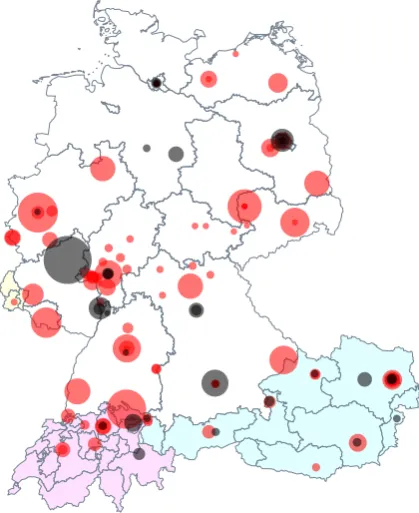
Another strategy to increase the variance in the archives made available in COSMAS would be to preferably include newspaper corpora from locations that increase the disper-sion in the geographical distribution of sources most. As can be seen in Figure 3, the newly acquired corpora will help close gaps in the coverage of DRK of the German-speaking areas, especially of Austria, Switzerland, Luxem-bourg, and the west and east of Germany, still leaving a gap in the north.
Figure 3: Geographical distribution and size of newspaper sources. Old sources shown in black, newly ac-quired sources shown in red.
decided to annotate the parliamentary debate protocols de-scribed under 3.1.3. according to the markup from the TEI P5 performance text module that is also available in I5, e.g. using <sp>and<speaker>for the oral contribution and the name or ID of a speaker, respectively, and<stage>for mentions of extra-linguistic events such as acclamation, but also for interjections. Due to the performative character of a debate, the markup could be used in a straightforward way. Within the metadata section (idsHeader), we now specifiy the relevant combination of “laundry tags” to describe the type of license (see Section 2.) in the<availability> ele-ment.
6. Access
Since 1993 DRK can be accessed free of charge (for aca-demic use) via the Corpus Search, Management and Analy-sis System COSMAS (al Wadi, 1994; Bodmer, 2005; Bod-mer Mory, 2014; IDS, 1991�2014). It is currently used by more than 32,000 registered users from all over the world and has been actively developed in the past years. Recent additions include e.g.,
• the ability to handle multiple morphosyntactic annota-tion layers
• a GUI assistant to help constructing queries based on these
• improved possibilities for the construction of virtual corpora
• query language extensions concerning distance oper-ators and regular expressions over part-of-speech se-quences
• result views with optional random order and optional break down by metadata categories like topic and text type
• a web service API, that allows access, e.g., from CLARIN and TextGrid
As the design and important parts of the code base of COS-MAS II however date back to the early nineties and new developments as well as coping with the enormous growth of DRK becomes more and more expensive, in 2011 we have started to develop the new corpus platform KorAP from scratch. Being horizontally scalable, KorAP will sup-port an in principle unlimited number of tokens and annota-tion layers (for details, see Bański et al., 2012, 2013, 2014). Its public beta release is scheduled for summer 2014.
7. Conclusion and prospects
We have given an overview of recent developments in the German Reference Corpus DRK in terms of growth, maximising relevant corpus strata, metadata, legal issues, and its current and future research interface. Due to the re-cent acquisition of new licenses, DRK has grown by a factor of four in the first half of 2014, mostly in the area of newspaper text, and presently contains over 24 billion word tokens. Other strata, like fictional texts, web corpora (in particular CMC), and spoken but conceptually written texts have also increased significantly, though their share in DRK is still relatively low due to the present con-ditions of their acquisition and curation. Through the lat-est acquisitions, the supply of newspaper archives seems to have reached a ceiling, and we will be able to allocate more resources to curating texts from other genres in the future. We described recent additions to I5, the TEI customisa-tion of the IDS text model. In the future, there will be a need to harmonise I5 with the text models of other institu-tions which are also using variants of the TEI P5 and with which we collaborate within the EU CLARIN framework (CLARIN-D AP-5, 2012). For this purpose, we are cur-rently developingIgel, a web-based application for exam-ining and comparing a collection of document grammars and deriving an overview of their differences and similari-ties (Sperberg-McQueen et al., 2013).
In connection to CLARIN, we will also rebase our metadata export for OAI-PMH (OAI-PMH, 2008) to our centre for the long-term-preservation of German linguistic research data which is currently being established at the IDS (Fankhauser et al., 2013). The metadata will then be exported as CMDI records (Broeder et al., 2011) for all three levels of granu-larity within DRK (corpus, document, text).
8. References
al Wadi, D. (1994).COSMAS - Ein Computersystem für den Zugriff auf Textkorpora. Institut für Deutsche Sprache.
Aston, G. and Burnard, L. (1998). The BNC Handbook. Edinburgh University Press.
Bański, P., Diewald, N., Hanl, M., Kupietz, M., and Witt, A. (2014). Access Control by Query Rewriting: the Case of KorAP. In Proceedings of the Ninth Inter-national Conference on Language Resources and Eval-uation (LREC’14), Reykjavik. European Language Re-sources Association (ELRA). in this volume.
Bański, P., Fischer, P. M., Frick, E., Ketzan, E., Kupietz, M., Schnober, C., Schonefeld, O., and Witt, A. (2012). The New IDS Corpus Analysis Platform: Challenges and Prospects. In Calzolari, N., Choukri, K., Declerck, T., Doğan, M. U., Maegaard, B., Mariani, J., Odijk, J., and Piperidis, S., editors,Proceedings of the Eighth Interna-tional Conference on Language Resources and Evalua-tion (LREC’12), Istanbul. European Language Resources Association (ELRA).
Bański, P., Frick, E., Hanl, M., Kupietz, M., Schnober, C., and Witt, A. (2013). Robust corpus architec-ture: a new look at virtual collections and data ac-cess. In Hardie, A. and Love, R., editors, Cor-pus Linguistics 2013 Abstract Book, pages 23–25, Lancaster. UCREL. http://ucrel.lancs.ac.uk/ cl2013/doc/CL2013-ABSTRACT-BOOK.pdf.
Barbaresi, A. (2012). German political speeches, cor-pus and visualization. 2. version. Technical report, ENS Lyon. http://perso.ens-lyon.fr/adrien. barbaresi/corpora/technical-paper_v2.pdf.
Baroni, M., Bernardini, S., Ferraresi, A., and Zanchetta, E. (2009). The WaCky wide web: a collection of very large linguistically processed web-crawled corpora.Language Resources and Evaluation, 43(3):209–226.http://dx. doi.org/10.1007/s10579-009-9081-4.
Beißwenger, M., Ermakova, M., Geyken, A., Lemnitzer, L., and Storrer, A. (2012). A TEI schema for the represen-tation of computer-mediated communication.Journal of the Text Encoding Initiative, 3.
Belica, C., Kupietz, M., Lüngen, H., and Witt, A. (2011). The morphosyntactic annotation of DRK: Interpre-tation, opportunities and pitfalls. In Konopka, M., Kubczak, J., Mair, C., Šticha, F., and Wassner, U., ed-itors,Selected contributions from the conference Gram-mar and Corpora 2009, pages 451–471, Tübingen. Gunter Narr Verlag.
Bodmer, F. (2005). COSMAS II. Recherchieren in den Ko-rpora des IDS. Sprachreport, 3/2005:2–5.
Bodmer Mory, F. (2014). Mit COSMAS II »in den Weiten der IDS-Korpora unterwegs«. In Steinle, M. and Berens, F. J., editors, Ansichten und Einsichten. 50 Jahre In-stitut für Deutsche Sprache, page 376–385. Institut für Deutsche Sprache, Mannheim.
Broeder, D., Schonefeld, O., Trippel, T., van Uytvanck, D., and Witt, A. (2011). A pragmatic approach to XML in-teroperability – the Component Metadata Infrastructure (CMDI). InProceedings of Balisage : The Markup Con-ference 2011, volume 7 of Balisage Series of Markup Technologies.
Bubenhofer, N., Haupt, S., and Schwinn, H. (2011). A comparable Wikipedia corpus: From Wiki syntax to POS Tagged XML. In Hedeland, H., Schmidt, T., and Wörner, K., editors,Multilingual Resources and Multi-lingual Applications. Proceedings of the Conference of the German Society for Computational Linguistics and Language Technology (GSCL), volume 96B ofWorking Papers in Multilingualism, pages 141–144, Hamburg. Hamburg University.
CLARIN-D AP-5 (2012). CLARIN-D User
Guide. CLARIN. http://de.clarin.eu/de/
sprachressourcen/benutzerhandbuch.html.
Fankhauser, P., Fiedler, N., and Witt, A. (2013). Forschungsdatenmanagement in den Geisteswis-senschaften am Beispiel der germanistischen Linguistik.
Zeitschrift für Bibliothekswesen und Bibliographie (ZfBB), 60(6):296–306.
Geyken, A. (2007). The DWDS corpus: A reference cor-pus for the German language of the twentieth century. In Fellbaum, C., editor, Idioms and collocations: Corpus-based linguistic and lexicographic studies, page 23–40. Continuum, London.
Gray, J. (2003). Distributed Computing Economics. Tech-nical Report MSR-TR-2003-24, Microsoft Research.
Guevara, E. R. (2010). NeWac: a large web-based corpus for Norwegian. InProceedings of the NAACL HLT 2010. Sixth Web as Corpus Workshop, pages 1–7. Association for Computational Linguistics.
Hinrichs, E. and Beck, K., editors (2011). D-SPIN: Deutsche Sprachressourceninfrastruktur – Schluss-bericht. Abteilung Allgemeine Sprachwissenschaft und Computerlinguistik; Seminar für Sprachwissenschaft; Universität Tübingen.
Ide, N., Bonhomme, P., and Romary, L. (2000). XCES: An XML-based encoding standard for linguistic corpora. In
Proceedings of the Second International Language Re-sources and Evaluation Conference (LREC’00), Paris. European Language Resources Association (ELRA).
IDS (1991–2014). COSMAS I/II Corpus Search, Management and Analysis System. http://www. ids-mannheim.de/cosmas2/.
Jakubíček, M., Kilgarriff, A., Kovář, V., Rychlý, P., and Su-chomel, V. (2013). The TenTen corpus family. In Ab-stract Book of the 7th International Corpus Linguistics Conference CL2013, pages 125–127, Lancaster.
Klosa, A., Kupietz, M., and Lüngen, H. (2012). Zum Nutzen von Korpusauszeichnungen für die Lexikogra-phie. Lexicographica, 28:71–97. Berlin/New York: de Gruyter.
Kupietz, M. (2005). Near-Duplicate Detection in the IDS Corpora of Written German. Technical Report kt-2006-01, Institut für Deutsche Sprache. ftp://ftp. ids-mannheim.de/kt/ids-kt-2006-01.pdf.
Kupietz, M., Belica, C., Keibel, H., and Witt, A. (2010). The German Reference Corpus DRK: A Primordial Sample for Linguistic Research. In Calzolari, N., Choukri, K., Maegaard, B., Mariani, J., Odjik, J., Piperidis, S., Rosner, M., and Tapias, D., editors, Pro-ceedings of the Seventh conference on International Lan-guage Resources and Evaluation (LREC’10), page 1848– 1854, Valletta, Malta. European Language Resources Association (ELRA). http://www.lrec-conf. org/proceedings/lrec2010/pdf/414_Paper.pdf (24.10.2013).
Kupietz, M. and Keibel, H. (2009). The Mannheim German Reference Corpus (DRK) as a basis for empirical linguistic research. In Minegishi, M. and Kawaguchi, Y., editors, Working Papers in Corpus-based Linguistics and Language Education, No. 3, page 53–59. Tokyo University of Foreign Studies (TUFS), Tokyo. http://cblle.tufs.ac.jp/assets/files/ publications/working_papers_03/section/ 053-059.pdf (12.06.2009).
Lüngen, H. and Sperberg-McQueen, C. M. (2012). A TEI P5 Document Grammar for the IDS Text Model.Journal of the Text Encoding Initiative, 3:1 – 18.
Lemnitzer, L., Beißwenger, M., Ermakova, M., Geyken, A., and Storrer, A. (2012). DeRiK: A German Reference Corpus of Computer-Mediated Communication. In Con-ference abstracts of the Digital Humanities 2012, pages 259–263, Hamburg. Hamburg University Press.
Margaretha, E. and Lüngen, H. (in preparation). Build-ing lBuild-inguistic corpora from wikipedia articles and discus-sions.
OAI-PMH (2008). The open archives initiative protocol for metadata harvesting (oai-pmh). www.openarchives. org/OAI/openarchivesprotocol.html.
Oksanen, V., Lindén, K., and Westerlund, H. (2010). Laun-dry symbols and license management: Practical consid-eratios for the districution of lrs based on experiences from clarin. InProceedings of LREC 2010: Workshop on Language Resources: From Storyboard to Sustainability and LR Lifecycle Management.
Przepiórkowski, A., Górski, R. L., Łaziński, M., and Pęzik, P. (2010). Recent Developments in the National Corpus of Polish. In Calzolari, N. C. C., Choukri, K., Maegaard, B., Mariani, J., Odijk, J., Piperidis, S., Rosner, M., and
Tapias, D., editors,Proceedings of the Seventh Interna-tional Conference on Language Resources and Evalua-tion (LREC’10), Valletta, Malta. European Language Re-sources Association (ELRA).
Ransmayr, J., Mörth, K., and Ďurčo Matej (forthcoming). Linguistic variation in the austrian media corpus. dealing with the challenges of large amounts of data. In Proceed-ings of the International Conference on Corpus Linguis-tics (CILC), University of Alicante.
Schäfer, R. and Bildhauer, F. (2012). Building large cor-pora from the web using a new effcient tool chain. In Calzolari, N., Choukri, K., Declerck, T., Dogan, M. U., Maegaard, B., Mariani, J., Odijk, J., and Piperidis, S., ed-itors,Proceedings of the Eight International Conference on Language Resources and Evaluation (LREC’12), page 486–493, Istanbul. ELRA.
Schmid, H. (1994). Probabilistic part-of-speech tagging us-ing decision trees. InInternational Conference on New Methods in Language Processing, page 44–49, Manch-ester, UK.
Sperberg-McQueen, C. M., Schonefeld, O., Kupietz, M., Lüngen, H., and Witt, A. (2013). Igel: Comparing document grammars using XQuery. InProceedings of Balisage: The Markup Conference 2013, volume 10 of Balisage Series on Markup Technologies, Montreal. doi:10.4242/BalisageVol10.Schonefeld01.