A Multimodal Dataset for Deception Detection
Ver´onica P´erez-Rosas
1, Rada Mihalcea
2, Alexis Narvaez
3, Mihai Burzo
41Computer Science and Engineering, University of North Texas
2Computer Science and Electrical Engineering, University of Michigan
3Mechanical Engineering, University of North Texas
4Computer Science, Engineering, and Physics, University of Michigan - Flint
[email protected], [email protected], [email protected], [email protected]
Abstract
This paper presents the construction of a multimodal dataset for deception detection, including physiological, thermal, and visual responses of human subjects under three deceptive scenarios. We present the experimental protocol, as well as the data acquisition process. To evaluate the usefulness of the dataset for the task of deception detection, we present a statistical analysis of the physiological and thermal modalities associated with the deceptive and truthful conditions. Initial results show that physiological and thermal responses can differentiate between deceptive and truthful states.
Keywords:deception detection, multimodal processing, corpus construction
1.
Introduction
The act of deception can be defined as the action of inten-tionally causing another person to believe something that is known to be false by providing evidence to support that false belief (Mahon, 2007). Deception is present in our everyday life in the form of lies, misrepresentations, and omissions.
Identifying deceptive behavior is an open problem for the research community and has been studied under several contexts and perspectives. Research work has been exten-sively done in the psychology, security, and criminology areas. As a result, numerous clues have been identified as possible indicators of deceit. For example, physiological responses such as heart rate and skin responses; linguistic patterns such as self-references and cognitive words; facial behaviors such as blinking or smiling; body postures; and speech fluctuations.
These studies have been typically conducted over written deceptive and non-deceptive statements, one-to-one inter-views, or by observing people behavior while being un-der a specific stimuli. Data acquisition in such cases was mainly focused on the clues to be analyzed and consists of either text statements, audio/visual recordings, or physio-logical sensor measurements. However, given the potential benefits of using multiple modalities at the same time to measure deceptive behaviors, it would be desirable to per-form the data acquisition simultaneously over multiple data channels.
This paper describes the construction of a multimodal de-ception dataset. We use three deceptive scenarios to elicit deceptive and truthful responses. Data is collected in a mul-timodal setting where we acquire video/audio, thermal, and physiological recordings of the participants. Our initial re-sults show that physiological and thermal responses can ef-fectively differentiate between deceptive and truthful states.
2.
Previous work
Deception on written content has been studied for a wide range of applications such as spam mail identification,
anal-ysis of public profiles in online websites, blog content and opinions (Hao et al., 2011). One common strategy is to an-alyze messages from deceivers and true tellers in order to find deception indicators. Linguistic clues such as self ref-erences or positive and negative words have been used to profile true tellers from liars (Newman et al., 2003). Other work has focused in identifying linguistic constructs such as the number of words, sentences, self references, affect, spatial and temporal information associated with deceptive content (Qin et al., 2005).
Research done towards deceit detection has also considered the measurement and analysis of physiological responses such as heart rate, skin conductance, and body temperatures (Frank et al., 2012). For instance, skin responses have been studied for the detection of criminal intent (Ewout H. Mei-jer and Merckelbach, 2010), whereas temperature profiles of per orbital and forehead areas have been analyzed to dis-criminate between deceptive and non deceptive behavior of subjects while being under a specific stimulus (Zhu et al., 2007) .
There have also been several efforts to identify deceit us-ing visual and acoustic clues. Experiments consistus-ing of the elicitation of genuine, masked, simulated and neutral-ized emotions have been done to study involuntary emo-tional leakage in the form of micro expressions (Porter et al., 2012). Facial behaviors have been also evaluated by using the facial action units (AUs) system to identify de-ceptive responses (Ekman, 1993).
Finally, researchers have also focused instead on analyz-ing verbal behaviors exhibited by people while deceivanalyz-ing (Howard and Kirchh¨ubel, 2011; Vrij et al., 2010). Speak-ing rate, energy, pitch, range as well as the identification of salient topics have been found useful to distinguish be-tween deceptive and non-deceptive speech (Hirschberg et al., 2005).
3.
Methodology
we performed a set of experiments where subjects were asked to elicit deceptive or truthful responses according to three different scenarios, namely mock crime, best friend, and abortion.
Our choice of topics was motivated by previous research were linguistic behaviors have been studied under simi-lar conditions and showed important differences between truth tellers and liars. However, unlike previous studies, we are incorporating visual, acoustic, physiological and ther-mal modalities to better sense differences between decep-tive and truthful responses.
3.1.
Materials
For our recordings we used a thermal camera FLIR Ther-movision A40 with a resolution of 340x240 and a frame rate of 60 frames per second, and two regular web cameras: Quick Cam Orbit AF Logitech and HD webcam C525, each with a maximum resolution of 980x720 pixels and a frame rate of 30 frames per second. For physiological data acqui-sition, we used four different sensors: blood volume pulse (BVP sensor), skin conductance (SC sensor), skin temper-ature (T sensor), and abdominal respiration (BR sensor).
3.2.
Participants
30 graduate and undergraduate students participated in the experiments.The sample consisted of 5 female and 25 male participants, all expressing themselves in English, from var-ied ethnical backgrounds (Asian, African-American, Cau-casian, and Hispanic), with ages ranging between 22 and 38 years.
3.3.
Procedure
We first presented each participant with an overview of the experimental procedure and hardware settings. We in-structed them to respond either truthfully or deceptively, depending on the scenario being run. Also, two different stations were identified; one was a private area in the lab and the other was the experimental system station. Before each recording session, each participant was asked to sit at the recording station. Then, the participant was connected to the physiological sensors and both the thermal camera and the web cameras were adjusted according to each user height.
Participants were also asked to avoid any excessive move-ments with their head or hands because of the equipment motion sensitivity. The aim of the movement restrictions was to obtain high quality data from the cameras and the physiological sensors. This is particularly important for the temperature and the skin conductance measurements, since they are obtained using wired sensors that need to be in permanent contact with the skin. An alternative to this re-strictive setting would be to use wireless sensors, which are non-invasive, provide acceptable accuracy, and allow mo-bility.
3.3.1. Scenario 1. Mock crime
In this experiment, participants were asked to be either de-ceptive or non dede-ceptive in a mock crime scenario where they presumably stole a $20 dollar bill. Each participant was told that in order to complete the task successfully, they
must not admit to the examiner that they have seen or taken the bill. Therefore, participants who did not have the bill were telling the truth while those who had the bill were ly-ing. Experiment instructions for each participant were as follows:
1. Go to a private area of the lab and look for a hidden en-velope, and take (presumably) a $20 bill from this area. 2. Return to the recording station for a one-on-one inter-view.
Before the interview, the physiological sensors were cali-brated for one minute in order to obtain an accurate sam-pling of the heart and breathing rates. Next, the exam-iner stated the following instructions: “Please listen and respond to each question truthfully. Please answer clearly and loudly. Please try not to move your head and shoulders during the interview, so that the sensors will not be affected by your movements.“. The interview is as follows: 1. Are the lights on in this room?
2. Regarding that missing bill, do you intend to answer truthfully each question about that?
3. Prior to 2012, did you ever lie to someone who trusted you?
4. Did you take that bill?
5. Did you ever lie to keep out of trouble?
6. Did you take the bill from the private area of the lab? 7. Prior to this year, did you ever lie for personal gain? 8. What was inside the white envelope?
9. Please describe step by step, in as much detail as you can, what you did while you were behind the white board. Please aim at a clear description of about 2-3 minutes. 10. Do you know where that missing bill is now?
3.3.2. Scenario 2. Best Friend
In this experiment participants were asked to provide both a true description of their best friend, as well a deceptive description about a person they cannot stand. Each partici-pant was asked to speak freely for about 2-3 minutes. The experiment session consisted of two independent record-ings for each case, when a participant was either telling the truth or lying. Before each recording the examiner stated the following instructions:
1. First, think about your best friend. Talk about your friendship with him or her, mentioning the reasons for which you are such good friends, include anecdotes or anything that seems to you relevant to describe your relationship and what keeps you together. Thus, in this description you will have to tell the truth about what you feel about your best friend. Try to be clear, detailed and sincere. Please aim at a description of about 2-3 minutes.
3.3.3. Scenario 3. Abortion
In this experiment the participants were asked to provide a truthful and a deceptive opinion about their feelings regard-ing abortion. Participants were asked to imagine a scenario where they took part in a debate on abortion in which they had an available time slot of 2-3 minutes to express their opinions.
The experiment session consisted of two independent recordings for each case, when the participant was either telling the truth or lying. In the first part of the experiment, the participant had to defend his or her point of view re-garding abortion. In the second part of the experiment, the participant was asked to give a convincing statement de-fending the point of view opposite to his or her beliefs; in other words, the participant was asked to lie about what he or she really thinks about abortion. Before each recording the examiner repeated the following instructions:
1. Prepare a brief speech about your real opinion on abor-tion. Thus, in this speech you will have to tell the truth about what you believe about abortion. Remember that you will remain anonymous (your name will not be recorded), so please be truly honest in expressing your opinion. Try and explain the reasons that push you to take that position in the clearest, most detailed and most sincere way possible. Please aim at a speech of about 2-3 minutes.
2. Prepare a brief speech expressing the opposite of your opinion on abortion. That is, in this speech you will have to lie about what you actually believe about abor-tion. Once again, please try to be as detailed as possi-ble. Please aim at a speech of about 2-3 minutes.
3.3.4. Thermal and Video Recordings
During each recording session two videos were obtained using the cameras described in section 3.1. The first camera was used to record a face close up whereas the second cam-era recorded the upper body, including the head, neck and arms. To acquire the thermal data we used the Flir Therma-Cam Researcher software; in the case of the web cameras, we used the Logitech recording software. Two computers were used to control the signals and videos obtained; two experimenters were needed to control the data acquisition process and to conduct the interviews.
3.3.5. Physiological Measurements
Four sensors were attached to the non-dominant hand of the participants. Two skin conductance electrodes were placed on the second and third fingers whereas the skin tempera-ture and blood volume blood volume sensors were placed at the thumb and index fingers respectively. The respiration sensor was placed comfortably around the thoracic region. The output of each sensor was obtained from a multimodal encoder connected to the main computer using an USB in-terface device. We recorded the combined output with the Biograph Infinity Physiology suite, which allowed us to vi-sualize and control the data acquisition process.
4.
Initial Experiments
4.1.
Multimodal Features
After the data collection, we obtained a total of 30 obser-vations for each scenario, including their corresponding vi-sual, thermal, and physiological recordings. Table 1 shows the data distribution over the deceptive and truthful condi-tions. The raw data was then processed to obtain the fol-lowing features to represent each modality.
Facial micro expressions: We automatically extracted 30 action units corresponding to muscle movements of eyes, eyebrows, nose, lips and chin. Additionally, we extracted smile intensity estimates as well as head pose orientation. Each feature was measured at frame level using CERT (Littlewort et al., 2011), and then av-eraged to obtain a single feature vector for each video recording.
Acoustic variations in speech: We extracted prosody, en-ergy, voicing probabilities, spectrum, and cepstral co-efficients to represent variations in speech. We use OpenEar(Schuller, 2009), an open source software for acoustic feature extraction. Overall, we obtained a set of 28 acoustic features. Each feature was computed using a frame sampling of 25ms and normalized using z-standardization. Since each feature was obtained at the frame level we averaged each feature value over all the frames in the audio recording to obtain a single feature vector.
Physiological responses: We obtained physiological fea-tures by processing the raw signal from each sensor. We used a commercial software called Biograph In-finiti Physiology suite1to obtain physiological
assess-ments for temperature, heart rate, blood volume pulse, skin conductance, and respiration. We obtained raw signal measurements as well as statistical descriptors for each physiological response, including maximum and minimum values, means, standard deviations, and mean amplitudes (epochs).
Thermal response: From the thermal recording, we ob-tained two different sets of features, one correspond-ing to face temperatures and the second one corre-sponding to the entire frame. Each set consisted of raw measurements of minimum and maximum tempera-tures, as well as statistical descriptors such as means and standard deviations. Each feature was measured at frame level and then averaged over the number of thermal frame samples.
4.2.
Exploratory Analysis
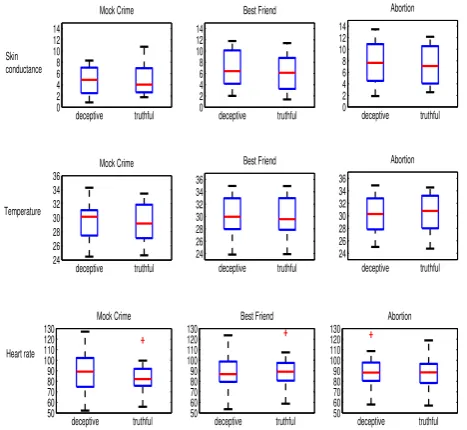
As a preliminary analysis to identify relations between sin-gle modality features and deceptive behavior, we analyzed the percentile ranking among the deceptive and truthful groups. During this preliminary analysis, we also per-formed the percentile ranking analysis for visual and acous-tic features, but they did not show a significant difference between groups.
1
Hao, P., Chen, X., Cheng, N., Chandramouli, R., and Sub-balakshmi, K. P. (2011). Adaptive context modeling for deception detection in emails. InProceedings of the 7th international conference on Machine learning and data
mining in pattern recognition, MLDM’11, pages 458–
468, Berlin, Heidelberg. Springer-Verlag.
Hirschberg, J., Benus, S., Brenier, J. M., Enos, F., Fried-man, S., GilFried-man, S., Gir, C., Graciarena, M., Kathol, A., and Michaelis, L. (2005). Distinguishing deceptive from non-deceptive speech. InIn Proceedings of Inter-speech¨ı¿122005 - Eurospeech, pages 1833–1836. Howard, D. M. and Kirchh¨ubel, C. (2011). Acoustic
cor-relates of deceptive speech: an exploratory study. In Proceedings of the 9th international conference on
Engi-neering psychology and cognitive ergonomics, EPCE’11,
pages 28–37, Berlin, Heidelberg. Springer-Verlag. Littlewort, G., Whitehill, J., Wu, T., Fasel, I., Frank, M.,
Movellan, J., and Bartlett, M. (2011). The computer ex-pression recognition toolbox (cert). InAutomatic Face Gesture Recognition and Workshops (FG 2011), 2011
IEEE International Conference on, pages 298 –305,
march.
Mahon, J. E. (2007). A definition of deceiving. Interna-tional Journal of Applied Philosophy, 21(2):181–194. Newman, M., Pennebaker, J., Berry, D., and Richards, J.
(2003). Lying words: Predicting deception from linguis-tic styles. Personality and Social Psychology Bulletin, 29.
Porter, S., ten Brinke, L., and Wallace, B. (2012). Secrets and lies: Involuntary leakage in deceptive facial expres-sions as a function of emotional intensity. Journal of
Nonverbal Behavior, 36(1):23–37.
Qin, T., Burgoon, J. K., Blair, J. P., and Nunamaker, J. F. (2005). Modality effects in deception detection and ap-plications in automatic deception-detection. In Proceed-ings of the 38th Hawaii International Conference on Sys-tem Sciences.
Schuller, F. E. M. W. B. (2009). Openear - introducing the Munich open-source emotion and affect recognition toolkit. InACII.
Vrij, A., Granhag, P. A., and Porter, S. (2010). Pitfalls and Opportunities in Nonverbal and Verbal Lie Detection. Psychological Science in the Public Interest, 11(3):89– 121, December.
Zhu, Z., Tsiamyrtzis, P., and Pavlidis, I. (2007). Forehead thermal signature extraction in lie detection. Conf Proc