Realignment from Finer-grained Alignment to Coarser-grained
Align-ment to Enhance Mongolian-Chinese SMT
Jing Wu Hongxu Hou Congjiao Xie
College of Computer Science
Inner Mongolia University
Hohhot, 010021, China
[email protected]
Abstract
The conventional Mongolian-Chinese sta-tistical machine translation (SMT) model uses Mongolian words and Chinese words to practice the system. However, data sparsity, complex Mongolian morphology and Chinese word segmentation (CWS)
er-rors lead to alignment errors and ambiguities. Some other works
use finer-grained Mongolian stems and Chinese characters, which suffer from in-formation loss when inducting translation rules. To tackle this, we proposed a meth-od of using finer-grained Mongolian stems and Chinese characters for word alignment, but coarser-grained Mongolian words and Chinese words for translation rule induc-tion (TRI) and decoding. We presented a heuristic technique to transform Chinese character-based alignment to word-based alignment. Experimentally, our method outperformed the baselines: fully finer-grained and fully coarser-finer-grained, in terms of alignment quality and translation per-formance.
1
Introduction
Mongolian is an agglutinative language and has complex morphology. The current scale of Mon-golian-Chinese parallel corpus is very small. These two reasons make data sparsity a very serious
problem in Mongolian-Chinese SMT. Using finer-grained Mongolian stems rather than Mongolian words can reveal the word semantics and alleviate data sparsity. On the other hand, CWS is a neces-sary process to separate Chinese words, because Chinese words are not naturally separated by space (Jiang et al., 2009). CWS can achieve high accura-cy, but does not necessarily guarantee better per-formance of alignment (Chang et al., 2008; Zhang et al., 2008; Xiao et al., 2010). Besides, CWS also brings errors (Xiao et al., 2010). Using of finer-grained Chinese characters, which are separated without using of CWS, can avoid the CWS errors and alleviate data sparsity. However, coarser-grained basic units are proved perform better in translation rule induction (TRI). (Philipp Koehn et al., 2003).
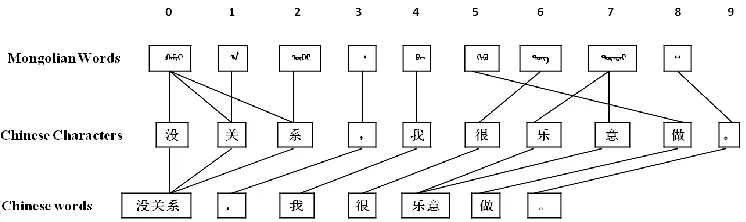
So inspired by the work of (Xi et al., 2011; Xi et al., 2012), we proposed a method that uses differ-ent granularity respectively for alignmdiffer-ent and TRI. We train a finer-grained alignment using Mongoli-an stems Mongoli-and Chinese characters. Afterwards, we realign it to Chinese words and Mongolian words alignment for the following TRI and decoding. We design a technique to convert finer-grained align-ment to coarser-grained alignalign-ment. The conversion can be unambiguous after carefully processing the differences brought by Mongolian word lemmati-zation and CWS.
In the experiments, our method outperformed the baselines of fully finer-grained and fully coars-er-grained, in terms of alignment quality and trans-lation performance. The experiments indicate that using finer-grained basic units for alignment and
coarser-grained basic units for TRI performs better than other granularity combinations.
The rest of the paper is organized as follows: Section 2 explains how our method designed and how can it have good influence on alignment and translation. Section 3 demonstrates the realignment model and analyzes how it works for better align-ment. Section 4 describes the evaluations. Section 5 is the conclusion.
2
Design of different Granularity
Align-ment
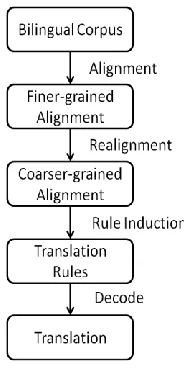
The conventional practice of SMT uses Mongolian and Chinese words in the process of word align-ment and TRI (Brown et al., 1993). We proposed a method of using finer granularity for word align-ment but coarser granularity for TRI to enhance the Mongolian-Chinese SMT system. The process of the method is depicted in Figure 1:
Figure 1. Process of the method
(1) In the first step, we get the finer-grained alignment by using Mongolian stems and Chinese characters as basic units;
(2) In the realignment procedure, we transform finer-grained alignment into coarser-grained alignment through a converting technique;
(3) In the step of TRI and decoding, we use the coarser-grained alignment.
Mongolian words are formed by stems and suf-fixes (Hou et.al., 2000). For some examples: when a noun plays different constituents in sentence, like subject or object, the case suffixes added to it are different; a verb adds different inflectional suffixes
when it is under different tenses or followed by different nouns; a word has different forms (with the same word stem but different suffixes) when it is in different positions of the sentence. Therefore, Data sparsity is a very serious problem in lian-Chinese SMT because of the complex Mongo-lian morphology and the small scale parallel cor-pus. Mongolian stems-based alignment can miti-gate this problem, because Mongolian words in different forms but with the same semantic mean-ing will become one same stem after removmean-ing some suffixes. Besides, using Chinese characters for alignment can avoid the errors brought by CWS. Table 1 shows the token distribution of Mongolian words and Mongolian stems in corpus. We can see that the unique tokens in stem-based corpus reduce almost 10% than those in word-based corpus. Table 2 shows the frequency distri-bution of words and characters of Chinese corpus. The tokens whose frequency is no than 4 has a lower percentage in character-based corpus. We see that the unique tokens in character segment corpus are only one-third of those in word segment corpus. In the fined-grained Chinese corpus, the frequency of 77.88% tokens are equal to or more than 5, while the percentage of word tokens in coarser-grained Chinese corpus is only 38.74%. The above statistical data prove that coarser-grained word alignment suffers from more serious data sparsity than finer-grained word alignment.
Word Stem Total Tokens 37140 29861 Unique Tokens 20859 14340 Percentage (%) 56.16 48.02
Table 1. Unique tokens of Mongolian word and stem
Frequency Word (%) Character (%) 1 31.25 9.34 2 14.91 5.85 3 8.84 3.47 4 6.26 3.46 5+ 38.74 77.88
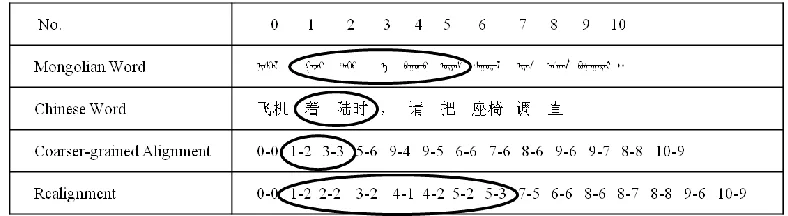
Figure 3. Comparing coarser-grained alignment with realignment
from Chinese character-based alignment rather than by Chinese words directly, there are fewer invalid alignment options. We believe this prob-lem is avoided by the feature of co-occurrence and distortion used by alignment models which ex-plained in detail by (Xi et al., 2012).
Moreover, we find that our method can mitigate word alignment errors which caused by incorrect CWS result. As shows in figure 3, the correct segmentation should be “飞机 着陆 时” but not “飞机 着 陆时”. The correct alignment should make No.1, No.2, No.3, No.4 and No.5 of Mongo-lian words align to the No.1 and No.2 of Chinese words, but Chinese word-based alignment only gets the right alignment 1-2, but wrongly aligns No.3 of Mongolian word to the Chinese comma as showed in the fourth row of figure 3. In our meth-od, we can get a more precise alignment result based on characters “着”, “陆” and “时”. The rea-lignment based on a wrong word segmentation result will lead to a wrong word alignment inside the phrase “着陆时”. However, as showed in the fifth row of the figure 3, we find that because of the better character-based alignment, the phrase “着陆时” as a whole still can be realigned more precisely to its corresponding Mongolian phrase.
In conclusion, due to a more precise Chinese character-based alignment, our realignment based on Chinese word segmentation (even based on a wrong word segmentation result) can get a more precise word alignment result.
4
Experiments
We implement Moses as our basic SMT system and built it as follows: alignment performed by GIZA++ (Och and Ney, 2003). A phrase-based MT decoder similar to the work of (Koehn et al., 2007) was used with the decoding weights
opti-mized by MERT (Och, 2003). We use a 3-gram language model. Mongolian language resources and Mongolian processing tools are scarce. CWMT’2009 (Zhao et al., 2012) was used for the experiments. It is a small training set when com-pares to major language training set because as a small language, public Mongolian and Chinese parallel corpus is limit. The lemmatization tool we used is the same as (Yu and Hou, 2011; Hou et.al., 2009). Table 3 shows the data set in detail. Mo is the abbreviation of Mongolian and Ch is the ab-breviation of Chinese.
Train Dev Test Bilingual sentence pairs 66808 1000 1000 Scale 18.3MB 214KB 213KB Total Mo words/stems 869168 11239 11134 Total Ch words 846574 8765 8697 Total Ch characters 1096551 12569 12526
Table 3. Data set
using them though the whole translation process is better (table 8), because stems and characters are too finer to induct the translation rules.
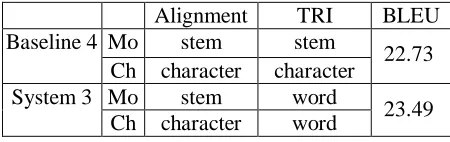
(3)Using our method of finer-grained for align-ment and coarser-grained for TRI improved the conventional SMT system and outperformed other grammatical components (table 5 and table 8);
(4) Using our method only in one side of source language or target language also performed better (table 6 and table 7).
5
Conclusion
We presented a method of using finer-grained Mongolian stems and Chinese characters as basic units for alignment, but coarser-grained Mongolian and Chinese words for TRI. Our method outper-forms four baselines, mitigates the data sparsity and enhances the alignment quality and translation performance. Through the experiments we find some conclusions as follows: applying finer-grained units can perform a better word alignment result; Using finer-grained basic units for align-ment, but coarser-grained for TRI can be a more efficient way than fully finer-grained or fully coarser-grained; using our method for both source language and target language can achieve better performance than using it for either source or tar-get language. We do the same experiments on the Chinese-Mongolian SMT system and get the same conclusion. The experiments indicate that using finer-grained basic units for alignment and coars-er-grained basic units for TRI performs better than other granularity combination. We also find that using Chinese characters contribute more than us-ing Mongolian stems in Chinese-Mongolian SMT, which partly because of the errors brought by lemmatization. If we can combine more features (Elming and Habash, 2007) to do the realignment, and have a higher accuracy tool of lemmatization, our method can be better.
Acknowledgments
We thank PACLIC29 reviewers. This work is sup-ported by the National Natural Science Foundation of China (No. 61362028) and the Postgraduate Scientific Research Innovation Foundation of Inner Mongolia (No. 1402020201).
Reference
Peter F. Brown, Stephen A. Della Pietra, Vincent J. Della Peitra, Robert L. Mercer. 1993. The Mathemat-ics of statistical machine translation: parameter esti-mation. Computational Linguistics, 19(2):263-311.
Pichuan Chang, Michel Galley, and Christopher D. Manning. 2008. Optimizing Chinese word segmenta-tion for machine translasegmenta-tion performance. In pro-ceedings of third workshop on SMT, pages 224-232.
Yonggang Deng and Bowen Zhou. 2009. Optimizing word alignment combination for phrase table training. In Proceedings of the ACL and the 4th IJCNLP of the AFNLP, pages 229–232
Vilar, David, Maja Popovic, and Hermann Ney. 2006. AER: Do we need to “improve” our alignments? In Proceedings of the International Workshop on Spo-ken Language Translation, pages 205–212,
Jakob Elming and Nizar Habash. 2007. Combination of statistical word alignments based on multiple pre-processing schemes. In Proceedings of the Associa-tion for ComputaAssocia-tional Linguistics, pages 25-28.
Wenbin Jiang, Liang Huang, and Qun Liu. 2009. Au-tomatic adaptation of annotation standards: Chinese word segmentation and POS tagging - a case study. In Proceedings of ACL and the 4th IJCNLP of the AFNLP, pages 522-530.
Hongxu Hou, Qun Liu, Nasanurtu. 2009. Mongolian word segmentation based on statistical language model. Pattern Recognition and Artificial Intelli-gence, 22(1): 108-112.
Philipp Koehn, Hieu Hoang, Alexandra Birch, Chris Callison-Burch, Marcello Federico, Nicola Bertoldi, Brooke Cowan, Wade Shen, Christine Moran, Rich-ard Zens, Chris Dyer, Ondrej Bojar, Alexandra Constantin, and Evan Herbst. 2007. Moses: Open source toolkit for statistical machine translation. In ACL
Philipp Koehn, Franz Josef Och, and Daniel Marcu. 2003. Statistical phrase-based translation. In Pro-ceeding of NAACL.
Yang Liu, Qun Liu, and Shouxun Lin. 2005. Log-linear models for word alignment. In ACL ’05: Proceed-ings of the 43rd Annual Meeting on Association for Computational Linguistics, pages 459–466.
Franz Josef Och and Hermann Ney. 2003. A systematic comparison of various statistical alignment models. Computational Linguistics, 29(1): 19-51.
Ning Xi, Guangchao Tang, Boyuan Li, and Yinggong Zhao. 2011. Word alignment combination over mul-tiple word segmentation. In Proceedings of the ACL2011 Student Session, pages 1-5.
Ning Xi, Guangchao Tang, Xinyu Dai, Shujian Huang, Jiajun Chen. 2012. Enhancing Statistical Machine Translation with Character Alignment. In Proceed-ings of the ACL2012, pages 285-290.
Xinyan Xiao, Yang Liu, Young-Sook Hwang, Qun Liu, and Shouxun Lin. 2010. Joint tokenization and trans-lation. In Proceedings of the 23rd International Con-ference on Computational Linguistics, pages 1200-1208.
Ming Yu and Hongxu Hou. 2011. Researching of Mon-golian word segmentation system based on diction-ary, rules and language model. Inner Mongolian University.
Ruiqiang Zhang, Keiji Yasuda, and Eiichiro Sumita. 2008. Improved statistical machine translation by multiple Chinese word segmentation. In Proceedings of the Third Workshop on Statistical Machine Transla-tion, pages 216-223.