
Two Types of Multiple Subject Constructions (MSCs) in Korean
Ji-Hye Kim Eunah Kim James Hye-Suk Yoon
Baird University College College English Program Department of Linguistics Soongsil University
Seoul, Korea
Seoul National University Seoul, Korea
University of Illinois, Urbana-Champaign
[email protected] [email protected] U.S.A.
Abstract
Although Multiple Subject Constructions in Korean have received significant attention in theoretical literature, few experimental investigations of various syntactic and semantic properties of these constructions have been conducted. In this study, we administered a Magnitude Estimation (ME) experiment in order to compare the acceptability of Multiple Subject and related Single Subject Constructions (MSCs vs. SSCs) and that of two types of MSCs (Possessor-type vs. Adjunct-type MSCs). The results showed that MSCs received lower acceptability than SSCs. In addition, the Adjunct-type MSCs received higher acceptability scores than the Possessor-type MSCs. Possible reasons for these results are discussed.
1 Introduction
Korean has a type of sentence where more than one nominative-marked NP occurs in a single clause, as shown in (1). These sentences are called Multiple Nominative Constructions (MNCs) or Multiple Subject Constructions (MSCs): (1a) and (1c) show a sentence with two nom-marked NPs, and (1b) and (1d) show a sentence with more than two nom-marked NPs.
(1) a. Cheli-ka kho-ka khu-ta
Cheli-nom nose-nom is-big-decl
‘It is Cheli whose nose is big.’
b. Cheli-ka apeci-ka kho-ka Cheli-nom father-nom nose-nom khu-ta
is-big-decl
‘It is Cheli whose father’s nose is big.’ c. Yelum-i maykcwu-ka coh-ta
summer-nom beer-nom good-decl
‘In summer, beer is good.’
d. I cip-i kyewul-i this house-nom winter-nom ohwu-ka ttattusha-ta
afternoon-nom is-warm- decl
‘This house is warm in winter afternoon.’
In the literature, MSCs have been classified according to certain interpretive relationships between the multiple nom-marked NPs. For example, the two NPs in (1a, b) stand in a Possessor-Possessee (Part-Whole relation) as indicated by the paraphrases (2a, b), whereas the first NP in (1c, d) functions as a scene-setting or temporal Adjunct with respect to which the event denoted by the second NP and its predicate is interpreted.
(2) a. Cheli-ka/uy kho-ka khu-ta
Cheli-nom/gen nose-nom is-big-decl
‘It is Cheli whose nose is big.’
b. Cheli-ka/uy apeci-ka/uy kho-ka Cheli-nom/gen father-nom/gen nose-nom khu-ta
is-big-decl
‘It is Cheli whose father’s nose is big.’ c. Yelum-i/ey maykcwu-ka coh-ta
summer-nom/gen beer-nom good-decl
by PR from a single subject construction (SSC) where the first NP is licensed as a Possessor (cf. 4a).
(4) a. [Cheli-uy khi-ka] khu-ta
Cheli-gen height-nom is-tall-decl
‘Cheli is tall.’
b. Cheli-ka khi-ka khu-ta
Cheli-nom height-nom is-tall-decl
‘(It is) Cheli (who) is tall.’
The effect of PR is to demote the NP Cheli-uy khi-ka from subject status and create a new subject Cheli-ka.
PR cannot extend to A-type MSC in (5a, c), in which the first NP cannot be expressed as a Possessor of the second. Therefore, these MSCs must be licensed differently. Youn (1990) proposes that in A-type MSCs, the second NP is the subject, while the 1st NP is topic/focus, under the additional
assumption that the nominative particle doubles as topic/focus particles (see also Yoon 1989; Schutze 2001).
(5) a. ?*Yelum-uy maykcwu-ka coh-ta summer-gen beer-nom good-decl ?‘It is during the summer that beer is good.’
b. Yelum-i maykcwu-ka coh-ta summer-nom beer-nom good-decl
‘In summer, beer is good. (=It is during the summer that beer is good.)’
c. ?*Pihayngki-uy 747-i khu-ta airplane-gen 747-nom big-decl ?‘It is747 that airplane is big.’
d. Pihayngki-ka 747-i khu-ta airplane-nom 747-nom big-decl
‘As for airplanes, 747 is big. (=/=?It is airplane that 747 is big)’
Since the analyses of the two types of MSCs are quite different, we examined whether native speakers distinguish between the two types in their acceptability judgments.
There have been only a few experimental studies conducted on various syntactic and semantic properties of MSCs. Kim (2015) conducted an acceptability judgment of MSC sentences, testing
whether the two interpretive conditions4 mentioned
above – characteristic property predication by SPs (cf. 3d) and the newsworthiness requirement on MSs (cf. 3e) – play a role in native speakers’ judgments. The results demonstrated that the native speakers of Korean are sensitive to the two interpretive conditions. However, Kim (2015) focused on the Possessor-type MSCs only and did not examine the Adjunct-type MSCs in her study.
Lee (2014) tested the acceptability of different types of MSCs, adopting Ryu (2013)’s classifications of semantic relations which hold between the two nominative NPs in MSCs.5
Although the focus of Lee (2014) was not the distinction between P-type vs. A-type MSCs, either, the materials of his study included both types of MSCs. Among his data sets, sentences such as (6b) are P-type MSCs, since (6b) can be paraphrased as (6a).
(6) a. Thokki-uy kwi-ka kil-ta. Rabbit-gen ear-nom long-decl
‘The ears of rabbits are long.’
b. Thokki-ka kwi-ka kil-ta. Rabbit-nom ear-nom long-decl
‘The ears of rabbits are long.’
On the other hand, (7b) are A-type MSCs. Unlike (6b), (7b) cannot be analyzed as derived from a sentence with possessed-NP subject.
(7) a. ?Yelum-ey maykcwu-ka summer-loc beer-nom masiss-ta
tasty-decl
‘In summer, beer is tasty.’
b. Yelum-i maykcwu-ka masiss-ta summer-nom beer-nom tasty-decl
‘It is during the summer that beer is tasty.’
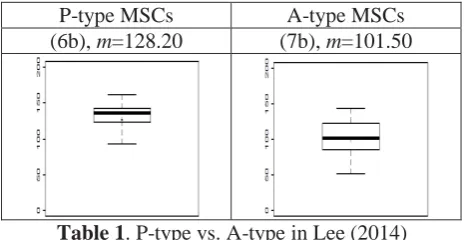
Lee’s (2014) results for P-type and A-type MSCs are as follows. He used line-drawing Magnitude Estimation in his experiment, and the range of score was 0mm-170mm.
4 See Yoon (2004, 2007, 2009, 2015) and Kim (2015) for
more detailed discussions of characteristic/characterizing properties of SP and newsworthiness of MS.
5 Ryu (2013) proposed a unified analysis of Multiple Subject
P-type MSCs A-type MSCs (6b), m=128.20 (7b), m=101.50
Table 1. P-type vs. A-type in Lee (2014)
As shown in this table, the acceptability of P-type MSCs was higher than that of A-type MSCs. Lee’s (2014) results suggest that P-type MSCs and A-type MSCs are judged differently by native speakers, perhaps because they are licensed in different ways, as posited under the theoretical analyses sketched in the previous section. It also seems that P-type MSCs are judged better than A-type MSCs. However, Lee’s (2014) study had different classification in the type of MSCs and there were not enough tokens for the clear division of the two types of MSCs. We therefore investigated whether the two types of MSCs are accepted differently by native speakers based on a larger data set.
3 Research Method
3.1 Research Questions and Hypothesis
We conducted an experimental study investigating Korean native speakers’ acceptability of P-type and A-type MSCs, as well as the differences in acceptability between MSCs and closely related SSCs. The research question and hypothesis of this study are as follows:
Research Question: Between the Possessor-type (P-Possessor-type) and the Adjunct-Possessor-type (A-Possessor-type) MSCs, which type is more acceptable?
Hypothesis: Korean speakers will regard P-type MSCs as more acceptable than A-type MSCs.
Our hypothesis was based on Lee’s (2014) results. This hypothesis is also not improbable given the theoretical analyses reviewed earlier: While P-type MSCs have been treated in terms of PR, A-type MSCs have been treated mostly as having a focused (or topic-like) initial NP. Since interpreting focused/topical NPs in a sentence
presented without a context is not easy, it is plausible that A-type MSCs would be considered as less acceptable than P-type MSCs.
The following sections will be dedicated to explanation of the methodology of our experiment. Presentation of the results and discussion will then follow.
3.2 Participants
Seventy Korean native speakers (age range=21~45) residing in and near Seoul, who were either current university students or graduates of universities in Korea, participated in the experiment.
3.3 Task, Materials & Procedures
The main task used in the experiment was an acceptability judgment task using Magnitude Estimation (ME) in which the participants were asked to draw different lengths of lines to indicate the naturalness (acceptability) of a given sentence (after reading the sentence).6
Test materials were composed of 80 Korean sentences: There were 40 target MSC sentences divided into 20 P-type MSCs and 20 A-type MSCs. The other 40 sentences were SSCs (single subject constructions), which were identical to the 40 target MSCs except for having a single subject. This was done to compare the acceptability ratings of SSC sentences and related MSC sentences. Examples of the experimental sentences are shown in (8). (8a) shows an example of P-type MSC, whereas (8b) shows an example of A-type MSC. (8c, d) are the examples of SSC sentences that are the counterparts of (8a, b).
(8) a. Cheli-ka apeci-ka pwuca-ita. Cheli-nom father-nom rich-decl
‘It is Cheli whose father is rich.’ b. Chicago-ka kenmwultul-i nop-ta Chicago-nom buildings-nom high-decl
‘In Chicago, buildings are tall. ’
c. Cheli-uy apeci-ka pwuca-ita. Cheli-gen father-nom rich-decl
‘Cheli’s father is rich.’
d. Chicago-uy kenmwultul-i nop-ta Chicago-gen/loc buildings-nom high-decl
‘Chicago’s buildings are tall. ’
6 For more information about the Magnitude Estimation task
Participants were first given a brief questionnaire about biographical information such as age, gender and dialect(s) together with a consent form. They were then asked to take the main task. In the main task, participants were required to draw a line for each sentence, according to the degree of acceptability/naturalness of the given sentence.
3.4 Statistical Analysis
After the data collection, normality tests were first performed in order to check if the values followed normal distribution, so as to determine the applicability of parametric tests. If the distributions of the data follow normal distribution, parametric tests are applicable, such as a t-test, an ANOVA, or (ordinary) linear regression tests. However, if the distributions do not follow normal distribution, non-parametric tests must be applied such as a Wilcoxon test, a Friedman test, or generalized linear regression tests.
When normality tests were performed, it was found that most of the data sets did not follow normal distribution. Some were positively skewed, and others had a slightly bimodal distribution. Thus, a non-parametric test – a generalized linear regression test – was performed with a Gaussian distribution, in order to examine how the Possessor/Adjunct distinctions affected the acceptability of sentences.
4 Results
4.1 Descriptive Analysis
In our data set, two factors tested (SSC/MSC and Possessor/Adjunct). SentenceType is the variable which indicates whether the sentence is a Single Subject Construction (SSC) or a Multiple Subject Construction (MSC), and ConstType is the variable which indicates whether the sentence corresponds to a Possessor type (P-type) or an Adjunct type (A-type).
We first compared the acceptability of SSC with that of MSC. Figure 1 below illustrates the degree of acceptability of SSCs and MSCs.
Figure 1. Bar Plots for the SSC vs. MSC
Figure 1 demonstrates that the mean values for SSCs are much higher than those of MSCs. That is, the participants considered MSCs less acceptable than SSCs.
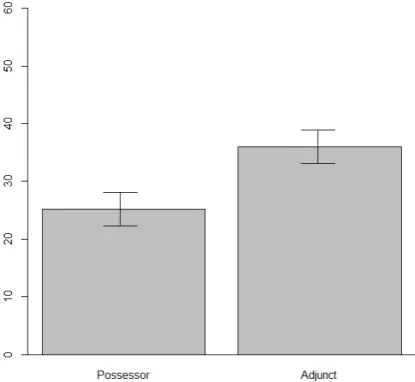
Secondly, we compared the acceptability of P-type MSCs with that of A-P-type MSCs. The pattern of results is shown in Figure 2.
Figure 2. Bar Plots for the P-type vs. A-type MSC
4.2 Inferential Analysis
In order to examine how two factors (SentenceType and ConstType) affected the acceptability of sentences, a generalized regression test was performed. The following table illustrates the results.
Estimate sd t p
(Intercept) 40.058 0.3073 130.364 <<<.001 SentenceType -9.634 0.3073 -31.353 <<<.001 ConstType 3.988 0.3073 12.977 <<<.001 SentenceType:
ConstType
2.243 0.3073 7.298 <<<.001
Table 2. Results of Regression Tests
As this table shows, both factors (SentenceType and ConstType) significantly influenced the acceptability of the sentences (p<.001, highly significant). There is also an interaction between two factors, as the p-value of SentenceType:ConstType indicates (p<.001).
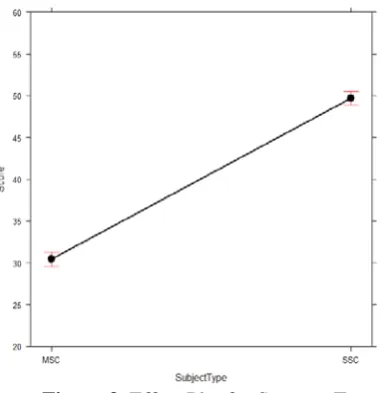
To graphically examine the effects of the factors and their interactions, the effect plots were drawn for the data set. Figure 3 has the effect plot for the factor SentenceType.
Figure 3. Effect Plot for SentenceType
In this figure, the mean score of SSCs is much higher than that of MSCs. Furthermore, 95% CIs (Confidence Interval) are clearly distinguished. This implies that native speakers clearly prefer SSC to MSC.
Figure 4 has the effect plot for the factor ConstType.
Figure 4. Effect Plot for ConstType
As shown earlier in Figure 2, the average score of Adjunct is much higher than that of Possessor, and the 95% CIs do not overlap, suggesting that native speakers prefer the A-type MSCs to P-type MSCs.
Figure 5 has the effect plot for the interactions between two factors SentenceType and ConstType.7
Figure 5. Effect Plot for SentenceType:ConstType
The effect plot in this figure demonstrates that there is an interaction between the two factors SentenceType and ConstType. If there is no interaction between two factors, the two lines in MSC and SSC have to be parallel. If there is an interaction, however, the two lines will not be parallel. Note that the two lines in Figure 5 are not parallel. This means that there is an interaction between two factors SentenceType and ConstType.
In this figure, note that the differences in MSCs are much bigger than those in SSCs. This suggests
7Since the comparison of the two types of MSCs is meaningful
Ik-Hwan Lee. 1987. Double Subject Constructions in GPSG. Harvard Studies in Korean Linguistics II:287-296.
Yong-hun Lee. 2014. Semantic Relations and Multiple Case Constructions: An Experimental Approach. Linguistic Research 31(2): 213-247.
Byung-Soo Park. 1973. On the Multiple Subject Constructions in Korean. Linguistics, 100: 63-76.
Byung-Soo Park. 2001. Constraints in Multiple Nominative Constructions in Korean: A Constraint-based Lexicalist Approach. The Journal of Linguistic Science, 20:147-190.
Chongwon Park. 2010. The Role of Metonymy in the Interpretation of Korean Multiple Subject Constructions. Language Sciences, 33(1): 206-228.
Byong-Rae Ryu. 2010. Licensing Nominals in the Multiple Nominative Constructions in Korean: A Mereological Perspective. Proceedings of the 24th Pacific Asia Conference on Language, Information and Computation (PACLIC 24).Tohoku University, Sendai, Japan..
Byong-Rae Ryu. 2013.Multiple Case Marking Constructions in Korean Revisited. Language and Information, 17(2):1-27.
Byong-Rae Ryu. 2014. Semantic Constraints on Multiple Case Marking in Korean. In Doris Gerland, Christian Horn, Anja Latrouite and Albert Ortmann (eds.),Meaning and Grammar of Nouns and Verbs:77-112. dup, Düsseldorf.
Carson Schütze. 2001. On Korean ‘Case Stacking’: The Varied Functions of the Particles -ka and -lul. The Linguistic Review, 18:193-232.
Shou-Hsin Teng. 1974. Double Nominatives in Chinese. Language, 50: 455-473.
James Hye-Suk Yoon. 2004. Non-nominative (Major) Subjects and Case-stacking in Korean. In Peri Bhaskararao and Karumuri VenkataSubbarao (eds.), Non-nominative Subjects, volume 2:265-314.Mouton de Gruyter, Berlin.
James Hye-SukYoon. 2007. Raising of Major Arguments in Korean and Japanese. Natural Language and Linguistic Theory, 25:615-653.
James Hye-Suk Yoon. 2009. The Distribution of Subject Properties in Multiple Subject Constructions. Proceedings of Japanese/Korean Linguistics, 64-83. CSLI, Stanford, CA.
James Hye-Suk Yoon. 2015. Double Nominative and Double Accusative Constructions. In Lucien Brown and Jaehoon Yeon (eds.), The Handbook of Korean
Linguistics, First Edition. 79-97. John Wiley & Sons, Inc.
Jong-Yurl Yoon. 1989. On the Multiple -ka and -lul Constructions in Korean. Harvard Studies in Korean Linguistics III:383-394. Hanshin Publishing Company, Seoul.
![DEVELOPMENT OF METHOD FOR EXTRACTIVE SPECTROPHOTOMETRIC DETERMINATION OF Cu (II) WITH OF 2 [2 (4 CHLORO BENZOTHIOZOLE) IMINO] 5 NITRO PHENOL AS AN ANALYTICALREAGENT](data:image/gif;base64,R0lGODlhAQABAIAAAP///wAAACH5BAEAAAAALAAAAAABAAEAAAICRAEAOw==)