Using Reordering in Statistical Machine Translation based on Recursive
Alignment Block Classification
Marta R. Costa-juss`a and Jos´e A. R. Fonollosa and Enric Monte
TALP Research Center {mruiz,adrian,enric}@gps.tsc.upc.edu
Abstract
Statistical Machine Translation (SMT) is based on alignment models which learn from bilingual corpora the word correspondences between the source and target language. These models are assumed to learn word reorderings. However, the difference in word order between two languages is one of the most important sources of errors in SMT. This paper proposes a Recursive Alignment Block Classification algorithm (RABCA) that can take advantage of inductive learning in order to solve reordering problems. This algorithm should be able to cope with swapping examples seen during training; it should infer properties that might permit to reorder pairs of blocks (sequences of words) which did not appear during training; and finally it should be robust with respect to training errors and ambiguities. Experiments are reported on the EuroParl task and RABCA is tested using two state-of-the-art SMT systems: a phrased-based and an Ngram-based. In both cases, RABCA improves the translation quality.
1.
Introduction
The introduction of Statistical Machine Translation (SMT) has yielded significant improvements over the initial word-based translation. At the end of the last decade the use of context in the translation model (phrase-based approach) represented a clear improvement in the translation qual-ity (Zens et al., 2004).
In parallel to the phrase-based approach, the use of a lan-guage model of bilingual units gives comparable results to the phrase-based approach (Mari˜no et al., 2006).
In both systems, the introduction of some reordering capa-bilities is of crucial importance for some language pairs. In our approach, we introduce order modifications to the source corpora so that alignments and translation become more monotonic by using the alignment information and a classification algorithm. The proposed algorithm parses alignments to detect reorderings. Unseen candidates to reordering are dealt with pairs of swapping blocks (se-quences of words) belonging to an specific group. These block groups have been created following recursively a co-occurrence block criterion.
The report is organized as follows. Section 2 reports the reordering process and the algorithm which infers the re-orderings. Section 3 briefly describes the two baseline sys-tems: phrase-based and Ngram-based system. Both capa-ble of producing state-of-the-art SMT translations. Section 4 sets the Evaluation Framework and dicusses the experi-ments and results. Finally, Section 5 draws the conclusions.
2.
Reordering based on Alignment Blocks
Classification
2.1. Motivation
SMT systems are trained by using a bilingual corpus com-posed of bilingual sentences. Each bilingual sentence is composed of a source and target sentence, and we align them at the word level by using GIZA++ (Och and Ney, 2003). Generally, this alignment contains a certain amount of errors which deteriorates the translation quality.
One way of improving this alignment is by monotoniza-tion (Kanthak et al., 2005), i.e. reordering the words in the source sentence following the order of the words in the target sentence. For instance in a Spanish to English trans-lation, the original sentence El discurso pol´ıtico fue largo would be modified as El pol´ıtico discurso fue largo. And it would monotonize the alignment: El#The pol´ıtico#political
discurso#speech fue#was largo#long. In (Popovic and Ney, 2006), they perform rules based on Part of Speech (POS) tags and reorder pairs of words both in the train-ing and test sentences. Similarly, we propose one type of monotonization: pairs of consecutive blocks which swap if swapped generate a correct monotonic translation. The main difference with (Popovic and Ney, 2006) is that our approach learns the blocks which swap instead of follow-ing a pre-defined set of rules. Figure 1 shows an example of this type of pairs. The reordering based in blocks covers most cases as shown in (Tillmann and Zhang, 2005).
2.2. Reordering process
Our purpose is to model the effect of local block reorder-ing to: (1) monotonize the source trainreorder-ing corpus; and (2) generalize this monotonization in the test stage to perform a correct monotonic translation. In order to fulfil (1) and (2), the reordering process consists of the following steps:
• Given a word alignment, we extract a List of Align-ment Blocks (LAB). An Alignment Block consists of a pair of consecutive source blocks whose target trans-lation is swapped. See Figure 1.
• Given the LAB, we apply the Recursive Align-ment Block Classification (RABCA), see section 2.3., which allows us to decide whether two consecutive blocks have to be reordered or not.
• We use the criteria of the RABCA to reorder the source corpora (including training, development and test sets).
Figure 1: Example of an Alignment Block, i.e. a pair of
consecutive blocks whose target translation is swapped
• Given the monotonized alignment, we build the SMT systems and translate the monotonized source test set.
2.3. Recursive Alignment Block Classification Algorithm
The objective of this algorithm is to perform block reorder-ings in case the order of the blocks swaps from source to target. These block reorderings will take into account re-orderings that appear in the database, and will generalize to unseen blocks. The set of blocks to be swapped will be de-noted as Generalization groups (Gg). The algorithm should be able to cope with swapping examples seen during train-ing; it should infer properties that might allow reordering in pairs of blocks not seen together during training; and fi-nally it should be robust with respect to training errors and ambiguities.
The algorithm consists of two steps:
1. Given the LAB, the algorithm filters the ambigu-ous Alignment Blocks (i.e. either misaligned or inherently ambiguous). We will define the fil-tered LAB as LABf ilt, which will be a
sub-set of LAB and consists of m pairs of blocks {(α1, β1),(α2, β2), . . . ,(αm, βm)}.
2. From the LABf ilt, we create the sets A =
{α1, α2, . . . , αm} and B = {β1, β2, . . . , βm} and
the groups G1. . . Gn. . . GN. A given group Gn
is created following recursively a co-occurrence block criterion (see 2.4.) and has the form Gn =
{(α1, β1), . . .(αp, βp)} wherepis the cardinality of
Gn; within each group Gn we create also the sets
An = {α1, . . . αp} andBn = {β1, . . . βp}. From
each groupGnwe build a Generalization group (Ggn,
wheren = 1, . . . N) defined as the Cartesian prod-uct between the subsets An ∈ A and Bn ∈ B,
i.e. Ggn = An ×Bn which will allow to reorder
cases such as(αr, βs)withαr ∈ An, βs ∈ Bn and
(αr, βs)∈/ LABf ilt. We can deal with possible
incon-sistencies, by increasing the filtering threshold, and therefore limiting the number of allowed unseen pairs, and also by processing with morphological informa-tion. Note that we assume that only the elements in
Ggnthat appear in the training and test corpus set are
correct generalizations (see Subsection 4.2).
2.4. Outline of the algorithm
The first phase of the algorithm filters the possible bad alignments or ambiguities, by using the following criteria:
• Pairs appearing less thanNmintimes are discarded.
• Pairs of blocks with a swapping probability (Pswap)
less than a threshold are also discarded. We define the swapping probability as the ratio between the num-ber of times that two blocks are swapped and the total number of times that the same two blocks appear con-secutively.
The second phase of the algorithm infers the generalization groupsGgnfrom the filtered LAB (LABf ilt).
• Given theLABf ilt, the generalization groupsGgnare
constructed as follows:
1. Initialization: set n ← 1 and LABtmp ←
LABf ilt.
2. Main part: whileLABtmpis not empty do
– Gn ={(αk, βk)}where(αk, βk)is any
ele-ment ofLABtmp
– Recursively, move elements (αi, βi) from
LABtmp to Gn if there is an element
(αj, βj)∈Gnsuch thatαi=αjorβi=βj
– Increasen(i.e.n←n+ 1)
3. Ending: For eachGn, construct the two setsAn
andBnwhich consists of the first and second
el-ement of the pairs inGn, respectively. Then the
Cartesian product ofAn andBn is assigned to
Ggn, i.e.Ggn ←An×Bn.
2.5. Using extra information
Additionally, the Alignment Block Classification can be used for extracting blocks from a lemmatized corpora. The resulting Ggn will be able to deal with grammar
agree-ment between eleagree-ments of each block, for instance the pair (conf erencia, parlamentario), which does not have gen-der agreement, would be a correct generalization if we take each block as a lemma. And, therefore the generalization would not be influenced by the particular distribution of word inflexions in training database.
0 50 100 150 200 250 300 350
0 50 100 150 200 250 300 350
Success
Fails lemmas
lemmas+tags diagonal
Figure 2: Relation between number of successes and fails (with different parameters -Nmin,Pswap- for the reordering
based on Alignment Block Classification: (1) using lemmas and (2) using lemmas plus tags), for the manually aligned reference corpus
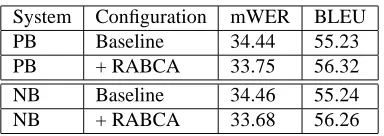
System Configuration mWER BLEU
PB Baseline 34.44 55.23
PB + RABCA 33.75 56.32
NB Baseline 34.46 55.24
NB + RABCA 33.68 56.26
Table 3: Results in the EuroParl Es2En task for the
phrase-based system and the Ngram-phrase-based system.
If we compare the performance of the algorithm in both sys-tems, the quality of translation is improved in both cases. It is in the phrase-based system where the RABCA seems to slightly achieve a higher gain. Analysing the errors, we see that in some cases the Ngram-based baseline system has al-ready performed a solution for the reorderings which are solved here, see (Crego et al., 2005).
Discussion. The RABCA infers better local reorderings than the ones provided only by the translation units (both phrases or tuples). Both measures, mWER and BLEU, im-prove significantly.
This task is relatively monotonic. Nevertheless, adding lo-cal reordering to the SMT systems leads to a better transla-tion performance.
5.
Conclusions
This paper has introduced a local statistical reordering ap-proach which improves both a phrase and Ngram-based SMT systems. When dealing with local reorderings, better reorderings can be infered when comparing with the ones provided only by the translation units (both phrases or tu-ples). Experiments are reported in the EuroParl task (Span-ish to Engl(Span-ish), but the algorithm can be used in any pair of languages. Results have shown that the RABCA algorithm improves the translation quality.
6.
References
T. Brants. 2000. Tnt - a statistical part-of-speech tagger.
Proceedings of the Sixth Applied Natural Language
Pro-cessing.
X. Carreras, I. Chao, L. Padr´o, and M. Padr´o. 2004. Freel-ing: An open-source suite of language analyzers. In
4th Int. Conf. on Language Resources and Evaluation, LREC’06, Lisboa, Portugal.
J. M. Crego, J. Mari˜no, and A. Gispert. 2005. Reordered search and tuple unfolding for ngram-based smt. MT
Summit X.
A. de Gispert and J. Mari˜no. 2003. Experiments in word-ordering and morphological preprocessing for transducer-based statistical machine translation. In
IEEE Automatic Speech Recognition and Understanding Workhsop, ASRU’03, pages 634–639, St. Thomas, USA.
A. de Gispert. 2005. Phrase linguistic classification for im-proving statistical machine translation. In ACL 2005
Stu-dents Workshop, Ann Arbor, USA, June.
S. Kanthak, D. Vilar, E. Matusov, R. Zens, and H. Ney. 2005. Novel reordering approaches in phrase-based sta-tistical machine translation. In Proceedings of the ACL
Workshop on Building and Using Parallel Texts: Data-Driven Machine Translation and Beyond, pages 167–
174, Ann Arbor, MI, June.
P. Koehn, F.J. Och, and D. Marcu. 2003. Statistical phrase-based translation. In Proc. of the Human Language
Technology Conference, HLT-NAACL’2003, pages 48–
54, Edmonton, Canada, May.
P. Lambert, A. de Gispert, R. Banchs, and J. Mari˜no. 2006. Guidelines for word alignment and manual alignment.
Language Resources and Evaluation, 39(4):267–285.
J.B. Mari˜no, R.E. Banchs, J.M. Crego, A. de Gispert, P. Lambert, J.A.R. Fonollosa, and M.R. Costa-juss`a. 2006. N-gram based machine translation.
Computa-tional Linguistics, 32(4):527–549, December.
G.A. Miller, R. Beckwith, C. Fellbaum, D. Gross, K. Miller, and R. Tengi. 1991. Five papers on WordNet.
Special Issue of International Journal of Lexicography,
3(4):235–312.
313.
S. Nießen and H. Ney. 2004. Statistical machine trans-lation with scarce resources using morpho-syntactic in-formation. Computational Linguistics, 30(2):181–204, June.
F. J. Och and H. Ney. 2003. A systematic comparison of various statistical alignment models. Computational
Linguistics, 29(1):19–51.
M. Popovic and H. Ney. 2006. Pos-based word reorder-ings for statistical machine translation. In 5th
Interna-tional Conference on Language Resources and Evalua-tion (LREC), pages 1278–1283, Genoa, May.
A. Stolcke. 2002. Srilm - an extensible language modeling toolkit. In Proc. of the 7th Int. Conf. on Spoken
Lan-guage Processing, ICSLP’02, pages 901–904, Denver,
USA, September.
C. Tillmann and T. Zhang. 2005. A localized prediction model for statistical machine translation. In ACL. R. Zens, F.J. Och, and H. Ney. 2004. Improvements in
phrase-based statistical machine translation. In Proc.