Example-based Automatic Phonetic Transcription
Christina Leitner, Martin Schickbichler, Stefan Petrik
Signal Processing and Speech Communication Laboratory, Graz University of Technology, Austria Inffeldgasse 12, 8010 Graz, Austria
[email protected], [email protected], [email protected]
Abstract
Current state-of-the-art systems for automatic phonetic transcription (APT) are mostly phone recognizers based on Hidden Markov mod-els (HMMs). We present a different approach for APT especially designed for transcription with a large inventory of phonetic symbols. In contrast to most systems which are model-based, our approach is non-parametric using techniques derived from concatenative speech synthesis and template-based speech recognition. This example-based approach not only produces draft transcriptions that just need to be corrected instead of created from scratch but also provides a validation mechanism for ensuring consistency within the corpus. Im-plementations of this transcription framework are available as standalone Java software and extension to the ELAN linguistic annotation software. The transcription system was tested with audio files and reference transcriptions from the Austrian Pronunciation Database (ADABA) and compared to an HMM-based system trained on the same data set. The example-based and the HMM-based system achieve comparable phone recognition rates. A combination of rule-based and example-based APT in a constrained phone recognition scenario returned the best results.
1.
Introduction
Phonetic transcriptions of speech recordings are a valu-able resource in speech technology and phonetic sciences. Their production, however, is a tedious, expensive, and er-ror prone manual process. Automatic phonetic transcrip-tion (APT) is therefore a desirable supporting technology for linguists and phoneticians. There are two specific ways in which APT may aid in the production of phonetically transcribed speech corpora. First, by providing draft tran-scriptions to the transcriber that only need to be corrected instead of being created from scratch. And second, by pro-viding a validation mechanism to ensure accuracy and con-sistency either among a team of transcribers or over differ-ent subsets of the produced corpus.
Current state-of-the-art systems for automatic phonetic transcription are mostly phone recognizers based on Hid-den Markov models (HMMs) (Cucchiarini and Strik, 2003). HMM-based systems provide good accuracy when trained with large amounts of audio data. Moving from broad to narrow phonetic transcription, however, this task is becoming more and more challenging, as not only the number and hence the confusability of phones increases, but also the amount of readily available material for train-ing the individual phone models of the APT system goes down. At the same time, an HMM-based decoder does not provide a direct solution for validating transcriptions. The phone labels are assigned based on the likelihood of only the current audio frame given the HMM parameters regard-less of all the other instances of this label in the corpus. As an alternative solution that addresses these two issues, we propose a non-parametric approach for producing a nar-row automatic phonetic transcription that is inspired by concatenative speech synthesis (Taylor, 2009) and recent work on template-based speech recognition (De Wachter et al., 2007). In concatenative speech synthesis an utter-ance is synthesized from a given input phone sequence by concatenating pre-recorded audio samples of the required phones. A phone string is used here as a database key to
Database of examples
“Aquarell”
-Candidate selection
(opt.)
- Pattern
comparison
? ?
?
- Synthesis
?
[ a k v a R e o l ]
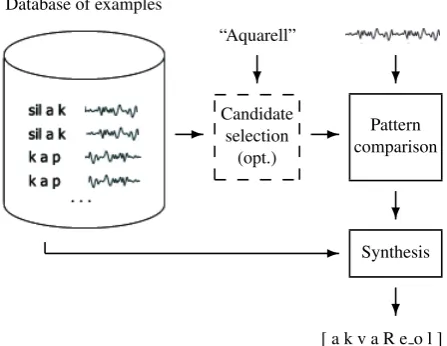
Figure 1: Example-based APT: the input utterance is com-pared to examples in a database, and the transcriptions of the most similar examples are concatenated to form the new transcription.
obtain the proper audio samples from a database of audio examples. In example-based automatic phonetic transcrip-tion this process is inversed as shown in figure 1. For recog-nizing an input utterance, the audio recording is compared to a database of example transcription segments1. In this
case, we use audio samples as database key to retrieve tran-scription bits from this database of example trantran-scriptions. The best matching audio samples are determined with an audio pattern comparison algorithm. These are then used to derive the phonetic transcription of the given utterance in a final synthesis step.
Our approach is similar to translation memory systems: With every draft transcription hypothesis all similar exam-ples of the database are available to the transcriber as a
ref-1
In the rest of this paper, we refer to pieces of audio data as
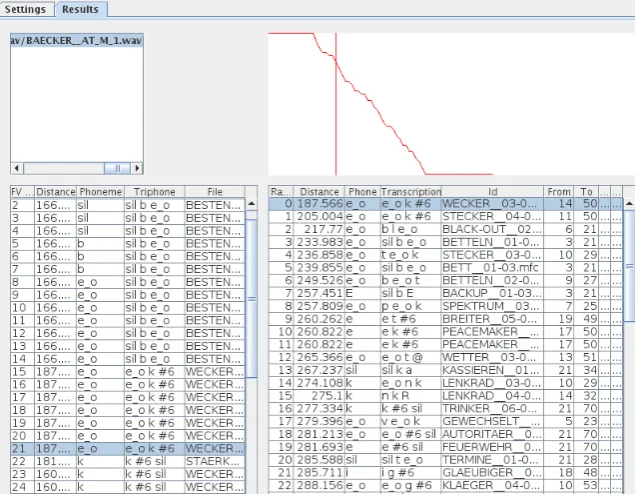
transcrip-Figure 5: The EXTRA transcription analysis tool shows the comparison results of each frame in the input utterance and the DTW warping path. In the left list the frames of the new utterance are listed. The right list displays the n-best matching database examples for the currently selected frame.
Variety of German Phonetic transcription in IPA
Austrian [akva"öefll] German [akva"öEl]
Table 2: Phonetic transcription of the word “Aquarell”. This example shows the fine degree of detail that is nec-essary to indicate the difference between the pronunciation variants.
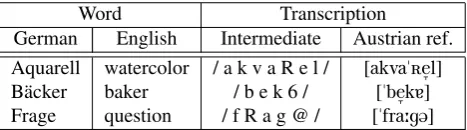
were done with 44.1 kHz sampling frequency under stu-dio conditions. The utterances were transcribed with a set of 89 phonetic symbols, which is more than in common broad transcriptions for German (45 phonetic symbols for SAMPA-German). These narrow transcriptions capture the variation in pronunciation between the different varieties of German (see table 2). Frequent pronunciation variations concern, e.g., aspiration, voicing in dental fricatives and different degrees of opening in vowels.
For the experiments the Austrian male speaker was selected as single test speaker. The wave files were divided into 85% training data for building the database of examples, 5% development data for parameter tuning and 10% actual test data.
The example-based system was compared with a tuned HMM-based system to evaluate the significance of our re-sults. The standard approach of 5-state left-to-right context-dependent triphone models with up to 16 GMMs was used for the acoustic models. The features were extracted by the same acoustic frontend as described in section 2.1. For the evaluation of both systems the percentage of correct phones
PC=N−D−S
N ×100% (1)
and the phone accuracy
PA=N−D−S−I
N ×100% (2)
were computed, whereN is the total number of phones in the reference transcription,Dis the number of deletions,S
the number of substitutions andIthe number of insertions (Young et al., 2006).
Additional tests were applied to decide on the statisti-cal significance of the performance difference between the example-based and HMM-based implementations. Follow-ing the discussion in (Gillick and Cox, 1989), McNemar’s test and a Matched-Pairs test were selected. In uncon-strained phone recognition a phone error is independent from any proceeding phone errors in the same word. Mc-Nemar’s test requires errors to be independent and there-fore is used for the unconstrained scenario. In constrained phone recognition the possible phone sequence is limited. Consequently, within one word an error may depend on pre-ceding errors. The Matched-Pairs test is suitable to deal with such a scenario.
5.
Results
5.1. Constrained phone recognitionFigure 6: Screenshot of the ELAN-EXTRA extension. The phonetic transcription including phone boundaries is shown in the “Transcription” tier.
Int. Tr. HMM Example-based
PC 83.36% 90.88% 91.95% PA 81.22% 88.83% 89.89%
Table 3: Percentage of correct phones (PC) and phone ac-curacy (PA) for the intermediate phonemic transcription (Int. Tr.), HMM and example-based system for constrained phone recognition. The test set contains 1273 words and 9454 phones.
slightly better in both, percentage of correct phones and phone accuracy. According to the Matched-Pairs test this difference in performance is statistically significant at the 0.1% level.
A closer inspection of the substitution errors made by the example-based system shows that in most cases closely re-lated phones are confused such aseandefl(/e/ and open-mid /e/), o andofl(/o/ and open-mid /o/),tandth(/t/ and aspirated /t/) and different /s/-variations (s- /s/, sff- advanced /s/;s
ˇ -voiced /s/). Obviously, most errors occur when there is only a subtle distinction between one phone or the other. These cases are also difficult to judge for a human transcriber as the transitions between phones are smooth and there is no clear boundary. In other words these are the cases where both man and machine reach the limit of their capacities. Further experiments can be found in (Leitner, 2008).
5.2. Unconstrained phone recognition
In Table 4 the results of our tests for the system with un-constrained phone recognition are presented. Tests were performed with two different feature sets: one set with 13 MFCCs per frame (basic coefficients) and the other with 39 MFCCs per frame (basic plus delta and acceleration coeffi-cients). For the feature set of 13 MFCCs the example-based system outperforms the HMM-based system. If 39 features are used, as commonly is done in automatic speech
recog-HMM Example-based
# of features 13 39 13 39
PC 78.55% 88.10% 85.10% 85.21%
PA 75.66% 86.96% 82.25% 82.38%
Table 4: Percentage of correct phones (PC) and phone accu-racy (PA) for unconstrained phone recognition. The same test set as for constrained phone recognition with 1273 words and 9454 phones was used.
nition (ASR), the HMM system outperforms the example-based system which does not benefit significantly from these derivative features. We believe that the poor perfor-mance of the HMMs with 13 features is caused by their lack of trajectory modelling, as explained in (De Wachter et al., 2007). Example-based systems do not have this weak-ness. Our results support the argument, that trajectory in-formation of the acoustic features is significant for ASR and APT. When using HMM-based systems, this informa-tion can only be incorporated at the feature level by using derivative features.
6.
Conclusion
We present a non-parametric approach to automatic pho-netic transcription inspired by concatenative speech syn-thesis and template-based speech recognition. Our method is based on pattern comparison of the input utterance to a large database of example transcriptions by dynamic time warping.
With two demonstration applications, we show how this example-based approach to transcription supports the pro-duction of phonetically transcribed speech corpora. First, an extension to the ELAN transcription software provides draft transcripts of the audio that only need to be corrected by experienced transcribers instead of being transcribed from scratch. And second, a transcription analysis tool al-lows for consistency checks within the corpus.
The approach was evaluated with audio files and reference transcriptions from the Austrian Pronunciation Database (ADABA). The example-based transcription system proved to be significantly better than transcription based on letter-to-sound rules and comparable to an HMM-based transcrip-tion system. The best results were achieved with a combi-nation of rule-based and example-based APT.
7.
Acknowledgements
We would like to thank Rudolf Muhr from the University of Graz for providing the audio and transcription data of ADABA, and for valuable support in linguistic questions. This research has been carried out in the context of the projects NFN-SISE and COAST-ALSO. We gratefully ac-knowledge funding by the Austrian Science Fund un-der the project number S10604-N13, Austrian KNet pro-gram, ZIT Zentrum f¨ur Innovation und Technologie, Vi-enna, Steirische Wirtschaftsf¨orderungsgesellschaft mbH and Land Steiermark.
8.
References
Catia Cucchiarini and Helmer Strik. 2003. Automatic pho-netic transcription: An overview. Proceedings of ICPhS, pages 347–350.
Mathias De Wachter, Mike Matton, Kris Demuynck, Patrick Wambacq, Ronald Cools, and Dirk Van Comper-nolle. 2007. Template-based continuous speech recog-nition. IEEE Transactions on Audio, Speech, and Lan-guage Processing, pages 1377–1390.
L. Gillick and Stephen Cox. 1989. Some statistical is-sues in the comparison of speech recognition algorithms.
Proceedings of ICASSP, pages 532–535.
Christina Leitner. 2008. Data-based automatic phonetic transcription. Master’s thesis, Graz University of Tech-nology.
Rudolf Muhr. 2008. The Pronouncing Dictionary of Austrian German (AGPD) and the Austrian Phonetic Database (ADABA) – Report on a large phonetic re-sources database of the three major varieties of German.
Proceedings of LREC.
Alex Park and James R. Glass. 2005. Towards unsu-pervised pattern discovery in speech. IEEE Workshop on Automatic Speech Recognition and Understanding, 2005, pages 53–58.
Lawrence Rabiner and Biing-Hwang Juang. 1993. Funda-mentals of Speech Recognition. Prentice Hall PTR. Paul Taylor. 2009. Text-to-Speech Synthesis. Cambridge
University Press.
Paolo Tormene, Toni Giorgino, Silvana Quaglini, and Mario Stefanelli. 2009. Matching incomplete time se-ries with dynamic time warping: an algorithm and an application to post-stroke rehabilitation. Artificial Intel-ligence in Medicine, pages 11–34.
Peter Wittenburg, Hennie Brugman, Albert Russel, Alex Klassmann, and Han Sloetjes. 2006. ELAN: a profes-sional framework for multimodality research. Proceed-ings of LREC, pages 1556–1559.
S.J. Young, N.H. Russell, and J.H.S Thornton. 1989. To-ken passing: a simple conceptual model for connected speech recognition systems. Technical report, Cam-bridge University Engineering Department.