Pattern-Based Extraction of Negative Polarity Items
from Dependency-Parsed Text
Fabienne Fritzinger
1, Frank Richter
2, Marion Weller
11Universit¨at Stuttgart 2Universit¨at T¨ubingen
Institut f¨ur maschinelle Sprachverarbeitung Seminar f¨ur Sprachwissenschaft
– Computerlinguistik– Abteilung Computerlinguistik
Azenbergstr. 12 Wilhelmstr. 19
D 70174 Stuttgart D 72074 T¨ubingen
[email protected] [email protected]
Abstract
We describe a new method for extracting Negative Polarity Item candidates (NPI candidates) from dependency-parsed German text corpora. Semi-automatic extraction of NPIs is a challenging task since NPIs do not have uniform categorical or other syntactic properties that could be used for detecting them; they occur as single words or as multi-word expressions of almost any syntactic category. Their defining property is of a semantic nature, they may only occur in the scope of negation and related semantic operators. In contrast to an earlier approach to NPI extraction from corpora, we specifically target multi-word expressions. Besides applying statistical methods to measure the co-occurrence of our candidate expressions with negative contexts, we also apply linguistic criteria in an attempt to determine to which degree they are idiomatic. Our method is evaluated by comparing the set of NPIs we found with the most comprehensive electronic list of German NPIs, which currently contains 165 entries. Our method retrieved 142 NPIs, 114 of which are new.
1.
Introduction
The goal of the research presented here is to extend the set of known Negative Polarity Items (NPIs) in German, and to improve our understanding of their properties and their dis-tribution in corpora. To this aim we develop a new method for extracting NPIcandidates from corpora. The immediate goal is to expand the subcollection of 165 German NPIs in the electronicCollection of Distributionally Idiosyncratic Items(CODII, (Trawi´nski et al., 2008)), compiled in a sub-project of the formerSonderforschungsbereich 441.1 Due
to the striking frequency of multi-word NPIs in CODII, and based on the assumption that there is an affinity between the properties of NPIs and at least some classes of idiomatic expressions, our new method targets multi-word NPI candi-dates. We adapt an extraction pipeline that was previously successfully applied in the identification of multi-word ex-pressions (MWEs, (Heid et al., 2008) using statistical as-sociation measures and two linguistically motivated scores, the degree of morpho-syntactic fixedness (Weller and Heid, 2010) and semantic opacity (Fritzinger, 2009) of an expres-sion. Our approach will be compared to results of the ex-traction algorithm in (Lichte and Soehn, 2007), which is the only other work on NPIextraction from corpora that we are aware of. However, in contrast to our method, the algorithm by Lichte and Soehn, in its basic form, targets single-word NPIs. They capture multi-word NPIs only indirectly in an extension to their basic extraction mechanism by building lemma chains of lengthn+ 1from lemma chains of length nand checking if extending a lemma chain makes it a better NPIcandidate.
Section 2 gives a very brief overview of NPIs and their li-censing contexts. In Section 3 we characterize our corpora
1
www.sfb441.uni-tuebingen.de/a5/codii/
and our extraction methods for multi-word expressions, be-fore we say more about how we model NPIlicensing con-texts in Section 4. In Section 5 we present optimizations to the statistical processing of NPI candidates that we apply to achieve a higher ratio of NPIs at the top of our candi-date lists, and we propose some linguistic measures for the identification of idiomatic candidate expressions. Section 6 discusses the results. We conclude with a short outlook on future work in Section 7.
2.
N
PIs and N
PILicensing
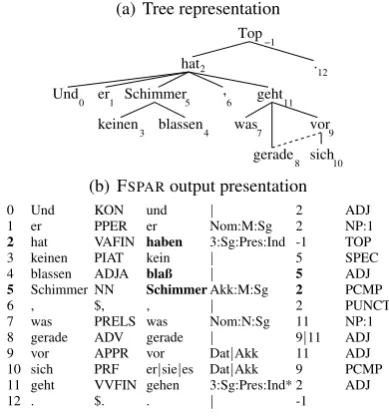
pairSchimmer habenfrom Figure 1 is shown in Table 2.
v lem subj acc obj acc obj det acc obj num acc obj mod
haben er Schimmer kein sg blaß
Table 2: Database entry forSchimmer haben.
Having stored every dependency relation relevant to our task listed in the parse output, we can work with patterns of varying form and length. In this study, we investigate the following patterns: verb+object (NV), adjective+object+verb (ANV), preposition+noun+verb (PNV), noun+preposition+noun+verb (NPNV) and prepo-sition+adjective+noun+verb (PANV). Examples for each of the patterns are given in Table 3(a), their occurrence frequencies in Table 3(b). Due to the fact that some patterns are subsets of others (e.g.ANVis a subset ofNV), their respective candidates occur in the results of their super-patterns as well (e.g.Faden verlieren, is part of the
NVresult list, while the complete expression,roten Faden verlieren, is contained in the results forANV).
(a) Examples for investigated patterns pattern trivial, idiomatic,NPI
NV Frau danken,Rede halten,Hehl machen
ANV sachlich Grund sehen,rot Faden verlieren,blass Schimmer haben
PNV auf Agenda stehen,unter Druck setzen,¨uber Herz bringen
NPNV Herr f¨ur Rede danken,Wind aus Segel nehmen,Blatt vor Mund nehmen
PANV zu neu Debatte f¨uhren,f¨ur bar M¨unze nehmen,mit recht Ding zugehen (b) Occurrence frequencies of the patterns
NV ANV PNV NPNV PANV
types 2 069 393 1 143 104 6 337 849 3 033 148 2 475 122 tokens 5 194 941 1 442 865 11 420 865 3 388 758 2 906 645
Table 3:Overview of syntactic patterns.
4.
Modelling Negative Contexts
Following the lead of (Lichte and Soehn, 2007), we identify the negative licensing contexts of multi-word NPIs on the basis of a finite list of determiners, verbs, adverbs and other elements (and syntactic structures) occurring with the NPI. A few examples are listed below:
overt negation sent. adverb:nicht, determiner:kein nouns niemand, nichts
adverbs kaum, selten, nur, wenig, ebensowenig, nie, niemals, nirgendwo, nirgends, nirgendwohin, nirgendwoher, keinesfalls, keineswegs inherently negative verbs bezweifeln, anzweifeln, abstreiten, bestreiten,
verhindern, weigern, verweigern, ablehnen, dementieren
The extraction method comprises a component that recog-nizes negative contexts by the presence of at least one of our lexical or structural criteria for licensing contexts. When-ever an MWEoccurs in such a context, the respective oc-currence of the MWEis labelled with NEG, otherwise with NONEG. This format meets the requirements of the sta-tistical association measures that are applied (Section 5) to distinguish multi-word NPIs from regular, occasionally negative constructions.
In the following, we give four examples for licensing con-texts we found for the NPI alle Tassen im Schrank haben
(lit. ‘to have all cups in the cupboard’: ‘to have lost one’s
marbles’), which illustrate the wide variety of licensing possibilities found in corpora:
1) Nichtalle Tassen im Schrankzuhabenmag ja durchaus produktiv sein f¨ur derlei Theater.
‘not tohave::::::all::::cups::in:::the::::::::cupboard might be quite produc-tive for this sort of fuss.’
2) Kein M¨order, deralle Tassen im Schrank hat, w¨urde mich umbringen.
‘no murderer who:::has:::all::::cups::in:::the::::::::cupboard would kill me.’
3) . . . sollte sich dar¨uber hinaus allerdings fragen lassen, ob Vorstansdsmitglied P.S. nochalle Tassen im Schrank hat
‘and besides (he) should be asked if the member of the ex-ecutive board, P.S., still:::has::all::::cups::in:::the::::::::cupboard.’
4) Jeder, der nochseine f ¨unf Tassen im Schrank hat, weiß, daß . . .
‘Everybody who still:::has:::his::::five:::::cups::in:::the:::::::::cupboard, knows that . . . ’
In (1), the verb haben(‘to have’) is simply modified by the sentential negation adverbnicht (‘not’), exemplifying the most straightforward case. Similarly, in (2), the subject noun phrase is a negative quantifier due to the determiner
kein(‘no’). In the construction in (3), the clause containing the expressionalle Tassen im Schrank habenis an indirect question, which is a legitimate nonveridical licensing envi-ronment of the NPI. (4) is an instance of NPIlicensing in the restrictor of a universal quantifier, in this case the nom-inal quantifierjeder(‘everyone’). Restrictors of universal quantifiers are downward entailing, which is the most im-portant semantic licensing condition. Replacing the univer-sal with a proper noun or a definite noun phrase removes this semantic property and results in an ungrammatical ut-terance.2
There are some obvious limitations to our selective and rather syntactic approach to modelling negative contexts: since there are, in principle, infinitely many forms of valid licensing environments, it is impossible to define a syn-tactic pattern for every single one of them. The situation would become even more difficult if we decided to try to systematically detect cases in which a given pattern is not a licenser due to additional effects such as intervening quan-tifiers between a licenser and a potential licensee. This task would minimally presuppose some analysis of quantifier precedence conditions depending on word order. Moreover, some licensing environments are just not reliably identifi-able without deep syntactic or semantic analysis. Examples in German are extraposed relative clauses (which might be in a downward entailing environment depending on the noun phrase they attach to), comparative clauses with ad-jectives plus als-clause, subjunctive clauses, and opaque conditionals of the formYou say anything, and I kill you
(with anything being an NPI licensed by the conditional construction).3 Our working assumption is that our model
2
The substitution ofseine f¨unf(‘his five’) foralle(‘all’) in the phrasealle Tassenin (4) is an instance of creative language use and does not change the meaning of the expression.
3This list of problematic cases is taken from a slide
captures a sufficiently large portion of NPIlicensing envi-ronments to produce good enough candidate lists.
5.
Optimization
At this point of our procedure, we have extracted a huge number of potential NPIcandidates (cf. Table 3). Amongst these are valid NPIs and other idiomatic multi-word con-structions, but the vast majority are trivial combinations, i.e. they are semantically transparent constructions such as
auf Stuhl setzen(‘on chair sit’: ‘to sit down on a chair’), possibly with an accidental high co-occurrence ratio with negative contexts in our corpora. There is no automatic procedure to validate NPIs, and manual annotation is an indispensable step for our extraction method. A native speaker has to check if the use of a candidate expression without a negative context always leads to ungrammatical-ity, i.e. if it is categorically impossible to use a candidate expression felicitously (under constant meaning) without a licensing context. Even strong statistical tendencies in large corpora cannot guarantee this. However, some of the NPI -characteristic features (e.g. negation, fixedness, significant co-occurrence) can be automatically accessed. In the fol-lowing sections, we describe how we used some of these features to create a list of manageable size with an en-hanced number of valid NPIs by sorting candidates accord-ing to associative strength with their respective negative contexts and linguistic features (morpho-syntactic fixed-ness or translational behavior). This preprocessing consid-erably reduces the necessary but time-consuming manual annotation efforts.
5.1. Statistical Processing
A number of statistical association measures such as log likelihood ratioor t-score have been successfully applied to identify MWEs (see e.g. (Evert, 2004)). Such measures indicate the associative strength of a word pair by taking into account the observed vs. expected frequencies of pairs and of their components in isolation. Assuming that NPIs are significantly associated with their negative context, we compute the associative strength between each MWE and its context label (which is NEGfor negative contexts, and NONEGfor others) to determine whether a negative con-text is obligatory for an expression. An example pair is: (blassen::Schimmer::haben,NEG).
NPIs in top 500 NV ANV PNV NPNV PANV log-likelihood 21 74 28 5 4
t-score 16 65 21 5 4
z-score 21 76 29 5 4
poisson 29 77 31 5 4
chi-squared 21 76 30 5 4
Table 4: NPIs found for each of the syntactic patterns when sorted according to standard association measures.
We used the UCStoolkit4to calculate five standard
associ-ation measures for each of our candidate lists (cf. Table 3; there is a candidate list for each syntactic pattern). In the
4
UCS-toolkit: www.collocations.de (Evert, 2004)
next step these lists were sorted in decreasing order accord-ing to the resultaccord-ing scores. Finally, the highest scoraccord-ing 500 candidates with a strong statistical tendency to be associ-ated with a NEG context label were manually annotated: ‘+’ for valid NPIs and ‘−’ for other MWEs or trivial com-binations.
The numbers of valid NPIs found amongst the top 500 can-didates are given in Table 4. Even thoughpoissonslightly outperformed the other measures, all results turned out to be quite similar. Furthermore, we also found that the NPIs often were the same: All 16 NPIs of the category NV
found in thet-scoresorting are a subset of those found by
log-likelihood,z-scoreandchi-squared, while all 21 NPIs found by the latter ones are contained in the results for pois-son. Similar observations were made for the other syntactic patterns.
(a)
NPNV-pattern with negative context f position
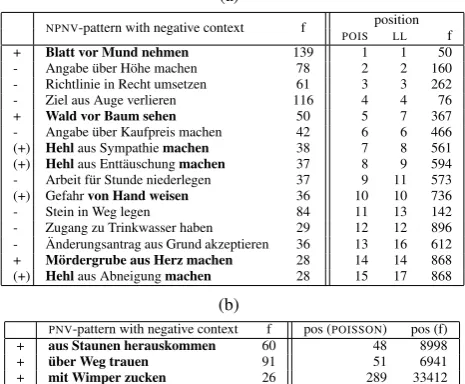
POIS LL f + Blatt vor Mund nehmen 139 1 1 50 - Angabe ¨uber H¨ohe machen 78 2 2 160 - Richtlinie in Recht umsetzen 61 3 3 262 - Ziel aus Auge verlieren 116 4 4 76 + Wald vor Baum sehen 50 5 7 367 - Angabe ¨uber Kaufpreis machen 42 6 6 466 (+) Hehlaus Sympathiemachen 38 7 8 561 (+) Hehlaus Entt¨auschungmachen 37 8 9 594 - Arbeit f¨ur Stunde niederlegen 37 9 11 573 (+) Gefahrvon Hand weisen 36 10 10 736
- Stein in Weg legen 84 11 13 142
- Zugang zu Trinkwasser haben 29 12 12 896 - Anderungsantrag aus Grund akzeptieren¨ 36 13 16 612 + M¨ordergrube aus Herz machen 28 14 14 868 (+) Hehlaus Abneigungmachen 28 15 17 868
(b)
PNV-pattern with negative context f pos (POISSON) pos (f) + aus Staunen herauskommen 60 48 8998 + ¨uber Weg trauen 91 51 6941 + mit Wimper zucken 26 289 33412
Table 5: Samples of log-likelihood orderings for two pat-terns: (a)NPNV: poisson and log-likelihood and (b)PNV.
Table 5(a) shows the top 15 entries of theNPNVpattern that are labelled with NEG. The candidates are ordered accord-ing to theirpoissonscores. The first column contains the manual annotation in terms of NPIvalidity (+/−). The ab-solute frequency of the NPIcandidates is indicated in col-umn 3 (‘f’) while the last colcol-umns give the ranks according topoisson,log-likelihoodandfrequencyordering, respec-tively. Note that the ranks obtained by thepoissonmethod andlog-likelihooddo not differ substantially.
Since most NPIs are relatively infrequent, they would be hard to find in a list sorted by frequency. Sorting accord-ing to association measures seems to move NPIs towards the top of the list, as candidates hardly ever occurring in a non-negative context are considered to be highly associated with their negative context. Table 5(b) illustrates the huge differences between ranking positions of NPIs in the two different lists.
5.1.1. Difficult Cases
zu Trinkwasser haben(‘to have access to potable water’) we found 29 occurrences all of which appear in a negative context. This is straightforward to explain if we consider that we do not expect a journalist to write about existing access to potable water.
Another obstacle for the statistical approach are contexts that we can still not model reliably, and the creative use of language: the NPIWald vor Baum sehen(lit. ‘not to see the forest for the trees’: ‘not to see the obvious’) (cf. table 5, table 6) occurred 46 of 50 times in a trivially negative con-text. The complete expression, as it might be listed in a dictionary isden Wald vor lauter B¨aumen nicht sehen, i.e. the verb is negated withnicht, which corresponds exactly to the 46 observed negative forms.
The remaining four occurrences are more difficult cases: the first, a question (5), is a known nonveridical licensing environment (which we can model), while the second and third occurrences are a modal context (6) and a conditional clause (7), which are not among the contexts we modeled. In the last sentence, however, there is no real negative con-text. Regardless of the lack of an obvious negative licensing environment, the sentence is well-formed.
5) Sieht er dann den Wald vor lauter B¨aumen?
6) Doch wie immer, sollte man zun¨achst einmal den Wald vor B¨aumen sehen.
7) H¨atte die Kommission eindeutige und anerkannte Priorit¨aten und k¨onnte sie den Wald vor B¨aumen sehen, h¨atten wir nicht diese Aussprache heute Nachmittag.
8) Manchmal sieht M. L. vor lauter B¨aumen dennoch den Wald.
One has to keep in mind that to allow for extraction of neg-ative contexts, the syntactic pattern of this context – be it a question, some form of conditional or a preceding verb – has to be specifically implemented. The examples above illustrate negative contexts that are not easy to detect auto-matically. As shown in (8), in some cases we might even find constructions with clear NPIs that are used in contexts which cannot be easily categorized as being negative.
5.2. Linguistic Processing
In order to further improve the ordering of the lists, we add more linguistic knowledge to the statistical method. This may also help to handle the problem of overlapping results: the entries marked with ‘(+)’ in table 5(a) would be com-plete with only one noun, and therefore belong to theNV
class rather thanNPNV. Conversely, there are patterns con-taining candidates that are not yet complete.
We enriched our result lists with the following linguisti-cally motivated scores:
#NEG the percentage of negative contexts FIX degree of morpho-syntactic fixedness TE degree of diversity when translated PDA percentage of trivial translations
We use the percentage of the candidates’ negative oc-currences (#NEG) as a possible indicator for NPIs in our extraction process (cf. table 6).
The morpho-syntactic fixedness score (FIX) is motivated by previous work on the extraction of idiomatic MWEs. Since many multi-word NPIs have properties similar to idiomatic expressions, we expect them to be syntactically frozen to
NPIcandidate contexts freq. #NEG
+ aus Kopf gehen NEG: 47 NONEG: 0 47 100% + Wald vor Baum sehen NEG: 46 NONEG: 4 50 92% + von Fleck kommen NEG: 111 NONEG: 14 125 88.8% - zu Schaden kommen NEG: 247 NONEG: 198 445 55.3%
Table 6: Illustration of #NEGscore calculation.
a certain degree, which means that they should not permit the usual morphological range of variation of the noun with respect to syntactic features like number, or the use of all syntactically compatible articles. While extracting candi-dates, information on the nouns’ number and article use is collected. For each candidate, we compute the frequency distribution of the number values (SG,PL) and possible de-terminers (e.g. DEF,INDEF,NONE). Then, the highest per-centages of both categories are taken to represent the can-didate’s preferences. In the case of PNV triples, we also measure the distance of verb, noun and preposition, as id-iomaticPNVtriples are most often (immediately) adjacent. The FIX score is then calculated for each NPI candidate based on the average of:
(i) the #NEGscore
(ii) the percentage of number and article setting
(iii) in case ofPNVtriples: the averaged adjacency-scores.
In order to approximate the semantics of NPI candidates, we use translational entropy (TE) and the proportion of de-fault alignments (PDA). Both scores rely on the assumption that multi-word NPIs have a non-compositional semantics, i.e. they are to be translated as a whole while trivial com-binations of the same syntactic form would exhibit literal translations of their components. To model the translations,
we take word equivalences from the EUROPARL corpus
(Koehn, 2005). Roughly speaking, the TEscore indicates the degree of diversity in a word’s translation, while the PDAexpresses the percentage of literal (or default) transla-tions. Descriptions of the these two scores can be found in (Villada Moir´on and Tiedemann, 2006).
The linguistic scores are used as follows: we take the top500 of the lists ordered by poissonand re-order these lists according to each of the linguistic scores. In order to measure the quality of the different orderings, we use the uninterpolated average precision (UAP), for details see (Manning and Sch¨utze, 1999). Table 7 shows the results for selected syntactic patterns. Note that for the TE and PDAvalues, we could only use the EUROPARLcorpus (30 million words). As a consequence, some of the NPI can-didates cannot be assigned either score (TE or PDA), and are thus skipped in the calculation. The rightmost column contains the resultingUAPvalue when sorted according to a combination of morpho-syntactic fixedness and transla-tional behavior.
sorted by poisson NEG FIX TE PDA TE+PDA+FIX NV 0.105 0.069 0.121 0.1 0.124 0.157
ANV 0.233 0.26 0.212 0.174 0.165 0.307
PNV 0.118 0.125 0.145 0.103 0.163 0.2
Table 7: UAPscores for re-orderings of top500poisson.
(mono-lingual) morpho-syntactic and multilingual features out-perform the respective poisson orderings. The morpho-syntactic and translational features are independent and thus benefit from each other when combined. While we achieved our aim to enhance the sorting quality of the can-didate lists, the improvement is not great. This is mainly due to the fact that most NPIs are relatively low-frequent: the TEand the PDAscore are not designed for low-frequent data, and computing morpho-syntactic preferences works better for high-frequent data as well.
6.
Results and Discussion
CoDII, the largest collection of German NPIs, comprises 165 entries. Subtracting duplicates that occur in different extraction patterns, our method retrieved 142 NPIs. 28 of these are in CoDII, 114 are new. Another relevant compar-ison is John Lawler’s collection of English NPIs5, which comprises roughly three dozen entries. Jack Hoeksema’s collection of Dutch NPIs, which is by far the largest known collection of NPIs and has been developed for 15 years, re-portedly contains 670 entries.6 However, Hoeksema’s col-lection is not limited to grammatical NPIs in the narrow sense, i.e. it is not restricted to expressions that are per-ceived as ungrammatical by native speakers when presented outside of an appropriately negative context. Beyond such expressions, Hoeksema also collects expressions that are statistically strongly associated with negation, which means that they tend not to occur outside of a negative context, al-though they would still be perceived grammatical if they did.
Lichte and Soehn (2007) do not report how many NPIs their method found. They say that they retrieved 112 items from (K¨urschner, 1983)’s list of 344 items. However, accord-ing to them, K¨urschner’s list contains about 200 pseudo-NPIs, i.e. items which exhibit a high collocational associ-ation with negassoci-ation but can still occur felicitously in con-texts without negation (which makes the empirical scope of K¨urschner’s list comparable to Hoeksema’s). Given that Lichte and Soehn’s extraction algorithm primarily targeted single-word NPIs, and that all NPIs that they identified are in CoDII, the overlap between the items they extracted and ours must be small (equal to or below 28).
The types of NPIs found with the three most successful search patterns, NV (29), PNV (31), and ANV (77) show interesting differences. ThePNVlist contains a high num-ber of idiomatic expressions ((mit etw.) hinter dem Berg halten, (sich) in die Karten schauen (lassen), auf den Mund gefallen (sein)), and only a small number of semantically transparent MWEs (mit Vorw¨urfen sparen, mit keinem Wort erw¨ahnen). The list NV is similar, containing a some-what smaller but still sizable number of non-decomposable idioms. Finally, the third list, ANV, is markedly differ-ent, containing mostly non-idiomatic, semantically trans-parent MWEs such as wesentliche ¨Anderungen erwarten, (sich) einen anderen Rat wissen, eine andere Wahl se-hen, and a smaller number of clearly idiomatic expres-sions (einen blassen Schimmer haben, schlafende Hunde
5
www-personal.umich.edu/∼jlawler/NPIs.pdf
6
www.let.rug.nl/∼hoeksema/lexicon bestanden/v3 document.htm
wecken). These differences between the lists could ex-plain the varying success with reordering the top500 by tak-ing ltak-inguistic knowledge about the fixedness of expressions into account.
7.
Conclusion and Future Work
As we mentioned several times, many NPIlicensing envi-ronments exhibit the logical property of being downward entailing, which means that they support inferences from supersets to subsets (see the example in Section 2). For this reason, detecting downward entailing environments is highly relevant for determining textual entailments. In a re-cent paper, Danescu-Niculescu-Mizil et al. (2009) exploit the licensing requirements of NPIs and use a set of English NPIs to extract downward-entailing operators from text. In a sense, this is the converse task to ours, but it presupposes a lexicon of NPIs. Knowledge of a larger set of NPIs in a given language as provided by our method should help im-prove extraction of downward-entailing operators, and may thus ultimately contribute to improving textual entailment tasks.
We showed that by sorting candidate-context pairs accord-ing to their log-likelihood scores, NPIs could be retrieved with considerable precision. In a second step, we applied linguistically motivated scores in order to enhance sorting quality for the top500 entries of the log-likelihood sorting. We saw that our results were very promising, as we man-aged to increase the number of known NPIs in German by more than two thirds. However, we also believe that there is still much room for improvement by integrating linguis-tic knowledge and statislinguis-tical processing more tightly. With a more fine-grained definition of negative contexts, as pro-vided by the linguistic literature, we would hope for even better results.
Looking at NPIresearch from the perspective of theoreti-cal linguistics, there should also be much to gain from ex-traction methods such as ours: Many questions about the syntactic, semantic and pragmatic nature of NPIs and their licensing environments are still open. Having a much larger empirical base for investigating these issues should con-tribute significantly to improving the linguistic theory.
Acknowledgments
We are very grateful to Manfred Sailer for his generous help in checking our lists of NPIcandidates for true NPIs, and to Timm Lichte for giving us very useful background informa-tion on his work on NPI extraction, including the original Perl script of the NPIextraction algorithm of (Lichte and Soehn, 2007) with his complete definition of licensing en-vironments. Thank you to Janina Rad´o for proofreading.
8.
References
Cristian Danescu-Niculescu-Mizil, Lillian Lee, and
Richard Ducott. 2009. Without a ‘doubt’? Unsuper-vised discovery of downward-entailing operators. In
Proceedings of NAACL HLT, pages 137–145.
Fabienne Fritzinger. 2009. Using parallel text for the ex-traction of German multiword expressions. Lexis - E-journal in English Lexicology, 4.
Ulrich Heid, Fabienne Fritzinger, Susanne Hauptmann, Ju-lia Weidenkaff, and Marion Weller. 2008. Providing cor-pus data for a dictionary for German juridical phrase-ology. In Angelika Storrer, Alexander Geyken, Alexan-der Siebert, and Kay-Michael W¨urzner, editors,Text Re-sources and Lexical Knowledge – Selected Papers from the 9th Conference on Natural Language Processing KONVENS 2008, Berlin, New York. Mouton de Gruyter. Phillip Koehn. 2005. Europarl: a parallel corpus for statis-tical machine translation. InProceedings of the 10th MT Summit 2005, Phuket, Thailand.
Wilfried K¨urschner. 1983. Studien zur Negation im
Deutschen. Gunter Narr, T¨ubingen.
Timm Lichte and Jan-Philipp Soehn. 2007. The
Re-trieval and Classification of Negative Polarity Items us-ing Statistical Profiles. In Sam Featherston and Wolf-gang Sternefeld, editors,Roots: Linguistics in Search of its Evidential Base, pages 249–266. Mouton de Gruyter, Berlin.
Christopher D. Manning and Hinrich Sch¨utze. 1999. Foun-dations of Statistical Natural Language Processing. The MIT Press, Cambridge, Massachusetts.
Michael Schiehlen. 2003. A cascaded finite-state parser for German. In Proceedings of the 10th EACL, Budapest, Hungary.
Beata Trawi´nski, Jan-Philipp Soehn, Manfred Sailer, and Frank Richter. 2008. A Multilingual Electronic Database of Distributionally Idiosyncratic Items. In Elisenda Bernal and Janet DeCesaris, editors, Proceed-ings of the XIII Euralex International Congress,
vol-ume 20 of Activitats, pages 1445–1451, Barcelona,
Spain. Universitat Pompeu Fabra.
Ton van der Wouden. 1997. Negative Contexts. Colloca-tion, Polarity and Multiple Negation. Routledge, Lon-don.
Bego´na Villada Moir´on and J¨org Tiedemann. 2006. Identi-fying idiomatic expressions using automatic word
align-ment. InProceedings of the EACL 2006 Workshop on
multiword-expressions in a multilingual context, Trento, Italy.
Marion Weller and Urlich Heid. 2010. Multi-parametric extraction of German multiword expressions from parsed corpora. InProceedings of the Linguistic Resources and Evaluation Conference, LREC 2010, Valetta, Malta. Frans Zwarts. 1995. Nonveridical Contexts. Linguistic
Analysis, 25:286–312.