Entity Mention Detection using a Combination of
Redundancy-Driven Classifiers
Silvana Marianela Bernaola Biggio, Manuela Speranza, Roberto Zanoli
Fondazione Bruno KesslerVia Sommarive 18, Povo, 38123 Trento, Italy E-mail: bernaola, manspera, zanoli{@fbk.eu}
Abstract
We present an experimental framework for Entity Mention Detection in which two different classifiers are combined to exploit Data Redundancy attained through the annotation of a large text corpus, as well as a number of Patterns extracted automatically from the same corpus. In order to recognize proper name, nominal, and pronominal mentions we not only exploit the information given by mentions recognized within the corpus being annotated, but also given by mentions occurring in an external and unannotated corpus. The system was first evaluated in the Evalita 2009 evaluation campaign obtaining good results. The current version is being used in a number of applications: on the one hand, it is being used in the LiveMemories project, which aims at scaling up content extraction techniques towards very large scale extraction from multimedia sources. On the other hand, it is being used to annotate corpora, such as Italian Wikipedia, thus providing easy access to syntactic and semantic annotation for both the Natural Language Processing and Information Retrieval communities. Moreover, a web service version of the system is available and the system is going to be integrated into the TextPro suite of NLP tools.
1.
Introduction
We present an experimental framework for Entity Mention Detection, which exploits Data Redundancy attained through the annotation of a large text corpus, and a number of Patterns extracted automatically from the same corpus.
Entity Mention Detection (EMD) is an extension of Named Entity Recognition (NER), the task of recognizing different types of entities mentioned in a text. While NER systems are required to identify only proper name mentions, EMD systems are expected to deal with additional mention levels (categories). The system we present recognizes proper name mentions (NAM), e.g. “Alessandro Delpiero”, nominal mentions (NOM), e.g. “the player”, and pronominal mentions (PRO), e.g. “he”. It distinguishes four types of entities: Person (PER), e.g. “Alessandro Delpiero”, Organization (ORG), e.g. “Juventus”, Location (LOC), e.g. “Mount Everest”, and Geo-Political Entities (GPE), e.g. “Torino”.
The system draws from two different systems we developed earlier, one that took part in the Automatic Content Extraction 2008 evaluation for English (ACE081) and one that was ranked highest in the Named Entity Recognition task at the Evalita 2009 evaluation campaign for Italian (Zanoli et al., 2009).
In those two systems, two new types of features were introduced to recognize NAM mentions:
Data Redundancy, which is attained when the same entity occurs in different places in different documents.
Patterns, i.e. 3-grams, 4-grams and 5-grams preceding and following recognized mentions.
1
http://www.itl.nist.gov/iad/mig/tests/ace/2008/
The present work continues along the same lines and shows that Data Redundancy, and to a lesser extent Patterns, are useful in recognizing not only NAM but also NOM and PRO mentions.
The system has been evaluated in the Evalita 2009 evaluation campaign obtaining good results. Currently, it is being applied in LiveMemories, a project that aims at scaling up content extraction techniques towards very large scale extraction from multimedia sources, as well as for the annotation of Italian Wikipedia. Furthermore, a web service version of the system is now available and the system is going to be integrated into TextPro (Pianta et al. 2008), a collection of NLP tools whose functions range from tokenization to PoS tagging, NER, and cross-document co-reference.
The paper is structured as follows. Section 2 describes some related work; Section 3 describes the system’s architecture; Section 4 presents the results obtained by the system at Evalita 2009 and some experiments we made to evaluate the impact of Data Redundancy; Section 5 describes two current applications of the system; Section 6 describes the system as a web service application; finally, in Section 7, we draw some conclusions
2.
Related work
Spurred on by the Message Understanding Conferences (MUC), several evaluation campaigns have been organized (among these, CoNLL2 and ACE3 are probably the most competitive and prestigious) and a considerable amount of work has been undertaken on NER in recent years. There are two main approaches to NER: one is based on Machine Learning methods (such as Support Vector Machines, Hidden Markov Models, and Maximum
2 http://cnts.uia.ac.be/conll2002/ner/ 3
Entropy) and exploits a set of features (e.g. Part of Speech, orthographic features, information about the context in which a word appears, etc.) to perform statistical classifications; the other one is based on knowledge-based techniques and uses a set of hand-written rules in order to implement a specific grammar for named entities.
A number of systems have been developed for each approach: concerning the knowledge-based systems, it is worth mentioning the work done by Maynard et al. (2001) and Arevalo et al. (2004); as for machine learning systems, Carreras et al. (2002), Mayfield et al. (2003), and Florian et al. (2003).
Further work on NER tried to exploit global information (i.e. the fact that the same entity may occur more than once in the same document); for example, Mikheev et al. (1998) used information from the whole document, Borthwick (1999) proposed an additional system based on maximum entropy, trying to correct mistakes by using co-reference resolution (i.e. finding mentions referring to the same entity), and Chieu and Ng (2003) exploited information from the whole document to classify words using just one classifier.
3.
System architecture
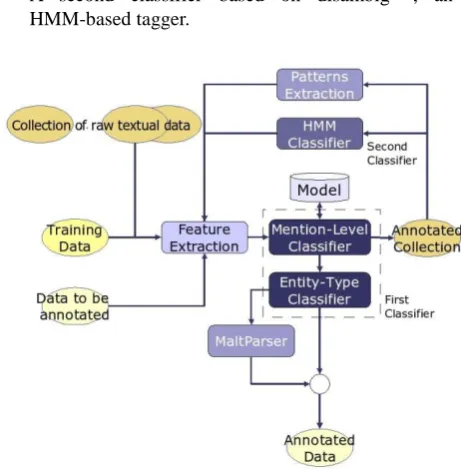
Our system is composed of the combination of two classifiers in cascade:
A first classifier based on YamCha4, an open source implementation of Support Vector Machines (SVMs);
A second classifier based on disambig 5 , an HMM-based tagger.
Figure 1: The system architecture
Figure 1 shows the system architecture; the system runs in two main phases.
In the first phase, the first classifier trained on manually
4
http://chasen.org/~taku/software/YamCha
annotated data (training data) is used to identify NAM, NOM and PRO mentions in an external collection of raw textual data (approximately one billion words) extracted from local and national newspapers as well as from Italian Wikipedia. The annotation produced by the first classifier (annotated collection) is used to extract a number of patterns and to train the second classifier. Then, the second classifier performs a new annotation of the
training data and a preliminary annotation of the data to be annotated.
In the second phase, the first classifier performs the final annotation of the data to be annotated exploiting Patterns and Data Redundancy as two additional features and produces the annotated data.
It should be noted that the first classifier also consists of two classifiers in a cascade: (i) a mention level classifier, which identifies the syntactic head of a mention and its mention level and (ii) an entity type classifier which recognizes its type. In addition, in order to recognize the extension of a mention we used an implementation of MaltParser for Italian that took part at Evalita 2009 in the Dependency Parsing task (Lavelli et al. 2009).
3.1 Patterns
We considered as candidate patterns all 3-grams, 4-grams and 5-grams that precede and follow each recognized mention in the annotated collection.
Based on the intuition that certain patterns are more related to a type of mention, we used a formula based on TF-IDF (Term Frequency – Inverse Document Frequency) to select the patterns for each category (GPE, LOC, ORG, PER).
For each pattern pk, we calculated the Pattern Frequency for each category cj; see Formula 1, where #(pk, cj)
denotes the number of times the pattern pk appears with mentions belonging to the category cj. Then, we calculated the Pattern Frequency Inverse Category Frequency (pficf); see Formula 2, where #C(pk) denotes the number of categories with which the pattern pk
appears at least once. This formula is based on:
(a) the pattern frequency assumption: the more frequently the pattern pk occurs with the category cj, the more important it is to cj.
(b) the inverse category frequency assumption: the more categories the pattern pk occurs with, the smaller its contribution is in characterizing the semantics of a category which it co-occurs with.
pf (pk, cj) = 1 + log #(pk, cj), if#(pk, cj) > 0
0 otherwise
Formula 1. Probability that a pattern co-occurs in a particular category
pficf(pk, cj) = pf (pk, cj) * log |C| /#C(pk) Formula 2. TF-IDF weight of a pattern with a certain
category
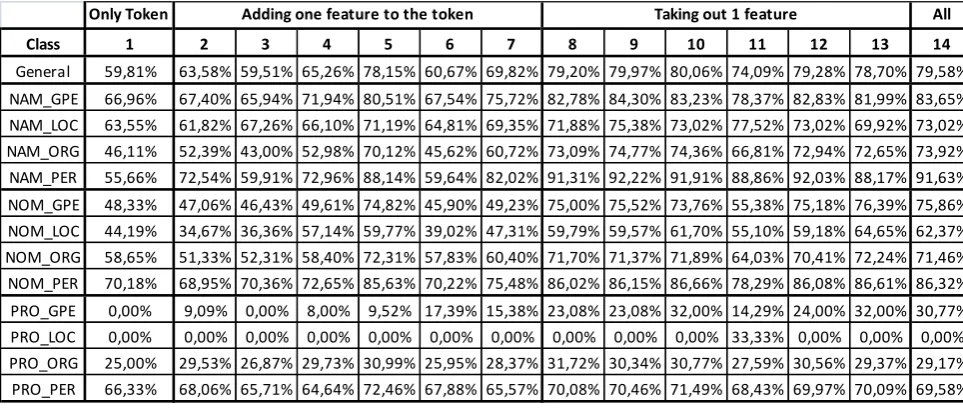
Only Token All
Class 1 2 3 4 5 6 7 8 9 10 11 12 13 14
General 59,81% 63,58% 59,51% 65,26% 78,15% 60,67% 69,82% 79,20% 79,97% 80,06% 74,09% 79,28% 78,70% 79,58% NAM_GPE 66,96% 67,40% 65,94% 71,94% 80,51% 67,54% 75,72% 82,78% 84,30% 83,23% 78,37% 82,83% 81,99% 83,65% NAM_LOC 63,55% 61,82% 67,26% 66,10% 71,19% 64,81% 69,35% 71,88% 75,38% 73,02% 77,52% 73,02% 69,92% 73,02% NAM_ORG 46,11% 52,39% 43,00% 52,98% 70,12% 45,62% 60,72% 73,09% 74,77% 74,36% 66,81% 72,94% 72,65% 73,92% NAM_PER 55,66% 72,54% 59,91% 72,96% 88,14% 59,64% 82,02% 91,31% 92,22% 91,91% 88,86% 92,03% 88,17% 91,63% NOM_GPE 48,33% 47,06% 46,43% 49,61% 74,82% 45,90% 49,23% 75,00% 75,52% 73,76% 55,38% 75,18% 76,39% 75,86% NOM_LOC 44,19% 34,67% 36,36% 57,14% 59,77% 39,02% 47,31% 59,79% 59,57% 61,70% 55,10% 59,18% 64,65% 62,37% NOM_ORG 58,65% 51,33% 52,31% 58,40% 72,31% 57,83% 60,40% 71,70% 71,37% 71,89% 64,03% 70,41% 72,24% 71,46% NOM_PER 70,18% 68,95% 70,36% 72,65% 85,63% 70,22% 75,48% 86,02% 86,15% 86,66% 78,29% 86,08% 86,61% 86,32% PRO_GPE 0,00% 9,09% 0,00% 8,00% 9,52% 17,39% 15,38% 23,08% 23,08% 32,00% 14,29% 24,00% 32,00% 30,77%
PRO_LOC 0,00% 0,00% 0,00% 0,00% 0,00% 0,00% 0,00% 0,00% 0,00% 0,00% 33,33% 0,00% 0,00% 0,00%
PRO_ORG 25,00% 29,53% 26,87% 29,73% 30,99% 25,95% 28,37% 31,72% 30,34% 30,77% 27,59% 30,56% 29,37% 29,17% PRO_PER 66,33% 68,06% 65,71% 64,64% 72,46% 67,88% 65,57% 70,08% 70,46% 71,49% 68,43% 69,97% 70,09% 69,58%
Adding one feature to the token Taking out 1 feature
Table 4: Experiment results
pronouns, an increase of 33% for PRO-LOC when not using the redundancy feature does not mean that the feature is not helpful for this class, but rather that the small number of instances of this class could not be recognized.
The second feature we introduce is Patterns, which, according to experiments 12 and 14, seems to make no difference in the general FB1 score. But for the NOM-LOC class, the FB1 score decreases around 3% when not taking this feature into account.
Finally, when removing the gazetteer feature (experiment 13), the general FB1 measure is practically unaltered. Moreover, it seems to have a small negative effect for NOMs. The list of gazetteers we used for PER, ORG, GPE and LOC entities were obtained automatically from several resources such as the Italian phone book and Wikipedia, among others. It seems that the benefit that Data Redundancy gives to the classifier can be replaced by this feature.
5.
Applications
The current version of the system is being used in a number of applications. Among these it is worth mentioning the annotation of Italian Wikipedia as well as two corpora within the LiveMemories project.
5.1 LiveMemories
Nowadays people share and preserve their memories using applications such as Facebook, BBC Memoryshare, and Flickr, among others. In addition, there is a lot of information available on the web which could be exploited to enrich these memories. The LiveMemories project6 aims to do this for two specific Italian corpora, (i) articles from the local newspaper “L'Adige” (620,641 articles from January 1st 1999 to October 15th 2009) and (ii) blogs posted by students living in the university residence “San Bartolomeo” (located in Trento, Italy).
Corpus
“L’Adige” “San Bartolomeo”
Tokens 257,255,240 2,974
Mentions 26,569,147 32,291
PER 16,736,169 (62.99%) 1,759 (58.36%) ORG 5,692,208 (21.42%) 761 (25.25%) GPE 3,475,461 (13.08%) 423 (14.03%)
LOC 665,309 (2.50%) 71 (2.36%)
Table 5: Data about the LiveMemories annotated corpora
The EMD system has been used to identify all the mentions occurring in these two corpora; the results of the process can be seen in Table 5. Approximately 26 million mentions where found in the “L’Adige” corpus, of which 63% belong to the PER type, 21% to ORG, 13% to GPE and less than 3% to LOC. A similar distribution of mention types follows the “San Bartolomeo” corpus: around 58% of the mentions detected belong to the PER type, 25% to ORG, 14% to GPE and almost 3% to LOC.
5.2 Italian Wikipedia
The importance of the electronic encyclopedia Wikipedia7 is constantly increasing, not only as a source of information for human users, but also as a resource for NLP research. Atserias et al. (2008), for instance, annotated the Wikipedia in English and made it freely available; along the same lines, we have created SWiiT (Semantic WIkipedia for ITalian), which is distributed under a GNU license.
SWiiT is the Italian Wikipedia8 annotated at five different levels: (i) basic NLP processing, (ii) entity mentions, (iii) entity subtypes, (iv) entity co-reference and (v) dependency parsing. The annotation of Wikipedia is still a work in progress; the first two levels of annotation have been completed and we are now working on the third level
7
Fairfax, Virginia, USA.
Montemagni, S., Barsotti, F., Battista, M., Calzolari, N., Corazzari, O., Zampolli, A., Fanciulli, F., Massetani, M., Raffaelli, R., Basili, R., Pazienza, M.T., Saracino, D., Zanzotto, F.M., Mana, N., Pianesi, F., Delmonte, R. (2003). Building the Italian Syntactic-Semantic Treebank. In Abeillé (Ed.), Building and Using Parsed Corpora. Language and Speech series, Kluwer, Dordrecht, 189-210.
Pianta, E., Girardi, C., Zanoli, R. (2008). The TextPro tool suite. In Proceedings of LREC 2008, 28-30 May 2008, Marrakech, Morocco.
Popescu, O., and Magnini, B. (2007). Web People Search Using Name Entities. In Proceedings of SemEval-2007 Workshop, co-located with ACL 2007, Prague, CZ, 23-24 June 2007.
Speranza, M. (2009). The Named Entity Recognition Task at EVALITA 2009. In Proceedings of Evalita 2009, workshop held at AI*IA, 12 December 2009, Reggio Emilia, Italy.