CSEIT1846199 | Published – 08 May 2018 | May-June 2018 [ (4 ) 6 : 1051-1057 ]
National conference on Engineering Innovations and Solutions (NCEIS – 2018)
International Journal of Scientific Research in Computer Science, Engineering and Information Technology
© 2018 IJSRCSEIT | Volume 4 | Issue 6 | ISSN : 2456-3307
1051
Fine Tuning Of State Estimator Using Phasor Values From
Pmu’s
Prayaga Kavya1, R S Shivakumara Aradhya2
1PG scholar, Department of EEE, Acharya Institute of Technology, Bangalore, India
2Professor, Department of EEE, Acharya Institute of Technology, Bangalore, India
ABSTRACT
State estimation is a key function of the Energy Management System (EMS), providing a reliable and consistent data, by processing the information obtained from telemetering or remote units. Traditional power system state estimators are subject to considerable changes because of the extensive application of Phasor Measurement Unit (PMU). The availability of synchro-phasor data has raised the possibility of a linear state estimator if the inputs are only complex currents and voltages and if there are enough such measurements to meet observability and redundancy requirements. The unique ability to calculate synchronized phasors at high precision makes the phasor measurement unit (PMU) an important measuring device to improve the accuracy of state estimation. In this paper, the linear model of state estimation is proposed to show the important contribution of PMU measurements to the power system state estimation. The effectiveness of the proposed state estimation algorithm is validated using standard IEEE 14 bus test system and real time 637 bus southern grid network of Indian power system.
Keywords: PMU, EMS, State estimator, linear estimator, SRPG System
I.
INTRODUCTION
State estimation (SE) plays a key role in real-time monitoring and control of the power system. The basic idea of SE is to estimate voltage magnitude and angle at each bus in the system based on the measured data. Voltage-dependent quantities, such as transmitted real and reactive power, are computed based on the estimated bus voltages. A state estimator requires that the measured input data must contain redundancy. This redundancy leads to an over-determined system of equations, whose optimal solution is given by minimization of the estimation errors. In the case of non-linear relationship between the voltages and other electrical quantities in the network, the solution is obtained iteratively starting from an initial guess. Conventional state estimators
utilize the weighted least square (WLS) approach, which converts the non-linear equations into the linear form, by using first-order Taylor‘s series expansion. However, the development of a time synchronized phasor measurement units (PMUs) based wide-area monitoring system (WAMS) has brought a paradigm shift in the manner in which the SE problem can be solved [10].
PMUs are quite accurate, PMU measurements are synchronized and time-stamped, and phasors can be acquired and refreshed every 20–50 ms, which is a much faster rate compared to the SCADA system [1]. The phasor measurements-based static SE has received significant attention in recent years. Phadke et al. [2] suggested the concept of linear state estimator. A key advantage of such a linear state estimator is that GPS-synchronized voltage and current phasor measurements from PMUs can be linearly expressed in terms of system states, eliminating the need for iterative SE algorithms. However, such estimators neglect the traditional scalar SCADA measurements, therefore, reducing the measurement redundancy.
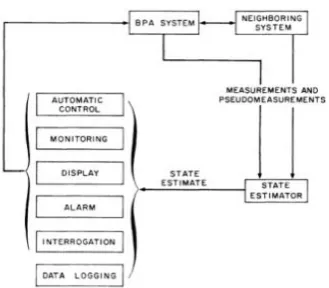
In [3], a multi-area state estimator was suggested for the large-scale power system SE, assuming that the neighboring subsystems affect only boundary buses. But, SE solutions for the internal buses are also affected by the measurements in the neighboring subsystems. An alternative to use the phasor measurements in SE was suggested in [4] by keeping the existing SE software in place. Phasor measurements were used in the post-processing step of the traditional WLS state estimator. A three-phase state estimator utilizing both SCADA and the phasor measurements was proposed in [5]; however, such an estimator involves an additional quadratic term in the representation of measurements, thereby, demanding changes in existing SE software in energy management systems (EMSs) as in fig 1.
Figure 1: Location and function of state estimator in system
This paper addresses one specific aspect of PMU applications, viz. the utilization of PMU data data in the SE process. It is intended to derive maximum benefits of phasor measurements by including them in the SE process while keeping the existing SE models the same.The paper is organized as follows. Section 2 gives a brief description of traditional SE, based on non-synchronized SCADA measurements such as voltage magnitude, real and reactive power flows, and power injections. Section 3 explains the proposed phasor assisted SE and Section 4 provides the simulation results of the proposed methods. Finally, in section 5 conclusions drawn based on the results of the study are presented.
II.
TRADITIONAL WLS METHOD
The system measurement equation is as follows [1]:
𝑧=h(𝑥)+𝑒 (1) linearized using the Taylor series expansion, retaining the first two terms and ignoring higher-order terms. This leads to a linear WLS problem having the solution
function h(x) can be linear or nonlinear. H is a constant matrix (m × n) in the case of linear function, and it needs only one iteration to converge. Alternatively, the solution is
𝑥 = (𝐻𝑇𝑅−1𝐻)−1𝐻𝑇𝑅−1𝑧
III. PROPOSED PHASOR-ASSISTED STATE
ESTIMATOR
Once PMUs are installed, say at a few substations, the voltage and current phasors from these buses are available. These phasor measurements can be used to improve the SE. A literature review reveals that many attempts have been made to include the voltage phasor measurements and the current phasor measurements after deriving new set of equations, which relate current as a measurement to the state vector into the traditional state estimator [3, 5, 7, 8].
Figure 2. Pi equivalent of transmission line
From the pi network of a transmission line, a current measurement bus incidence matrix is defined in a manner similar to the element bus incidence matrix. It has as many rows as measurements of currents and as many columns as there are buses (excluding ground). If m is the number of current measurements, n the number of lines measured, p the number of buses with voltages measurements, and q the number of buses in the system then A is an m × q incidence matrix and y is an m × m diagonal matrix of admittances.
Fig 3: Six(m) current measurements on four(n) lines, three(p) voltage measurements and four (q) buses [2]
Where II is a unit matrix from which rows corresponding to missing bus voltages are removed.
Unlike the earlier state estimator, this estimator is linear and hence no iterations are needed. Once the measurements are obtained, the estimate is obtained by matrix multiplication. The matrix M which converts the measurements to the state estimate is constant as long as the bus structure does not change. It can be computed off-line, and stored for real-time use. Under certain conditions of measurement configuration, the matrix M becomes real, simplifying the computations even further.
IV.
SIMULATION RESULTS
The SE programs using MATLAB, based on the proposed SE techniques were developed and tested on the IEEE 14-bus system, and the Indian southern Region Power Grid (SRPG). Measurements for traditional SE consisted of real and reactive power flows in all the lines, real and reactive power injections at all the generator buses, and voltage magnitude at all the buses. The solution accuracy of the proposed state estimators was verified through comparison of the test results and compared with the conventional WLS state estimator. Each PMU is assumed to measure the bus voltage phasors and the current phasors in all the lines connected to the PMU bus. The phasor angles were adjusted such that the reference bus angle is zero.
The simulation results on the test systems are discussed as follows.
i) IEEE 14-bus System
The conventional WLS state estimator and linear SE were run in order to estimate the states of the system. Table lists the accuracy of the estimates obtained by the SE methods. Results presented in clearly show that the use of phasor measurements improves the accuracy of SE.
Test cases were run, and the results revealed that the maximum error in angle estimation, using the proposed phasor-assisted SE, was limited to 0.181 and the error in magnitude estimation was limited to ˙0.04 p.u.
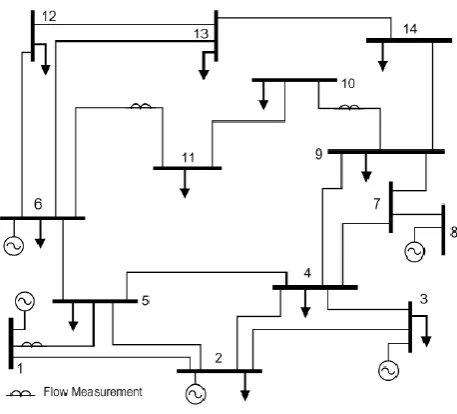
Figure 4. IEEE 14 bus Test system
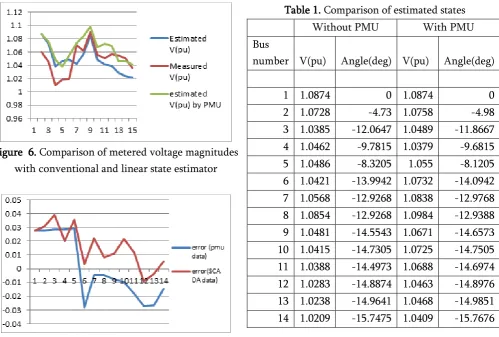
It is observed from the test results that the addition of phasor measurements greatly improves the voltage magnitude estimation. To reflect them as PMU data, their weightage is increased from 10000 to 25000(table 1). Figures 5, 6 and 7 show the comparision of the values estimated by the conventional and linear estimator respectively. The error magnitude in comparision to the metered and estimated values is also shown.
Figure 5. Comparison of voltage magnitudes by conventional and linear state estimator
State estimation for 14 bus test system
Without PMU
Figure 6. Comparison of metered voltage magnitudes with conventional and linear state estimator
Fig 7: Comparison of error magnitudes
Effect of PMU measurements is speed and accurate. Elapsed time of state estimation by WLS method with metered data is 15 sec. For PMU measurements along with metered data elapsed time is 8 sec.
Table 1. Comparison of estimated states Without PMU With PMU Bus
number V(pu) Angle(deg) V(pu) Angle(deg)
1 1.0874 0 1.0874 0 2 1.0728 -4.73 1.0758 -4.98 3 1.0385 -12.0647 1.0489 -11.8667 4 1.0462 -9.7815 1.0379 -9.6815 5 1.0486 -8.3205 1.055 -8.1205 6 1.0421 -13.9942 1.0732 -14.0942 7 1.0568 -12.9268 1.0838 -12.9768 8 1.0854 -12.9268 1.0984 -12.9388 9 1.0481 -14.5543 1.0671 -14.6573 10 1.0415 -14.7305 1.0725 -14.7505 11 1.0388 -14.4973 1.0688 -14.6974 12 1.0283 -14.8874 1.0463 -14.8976 13 1.0238 -14.9641 1.0468 -14.9851 14 1.0209 -15.7475 1.0409 -15.7676
ii) SRPG 637 bus System
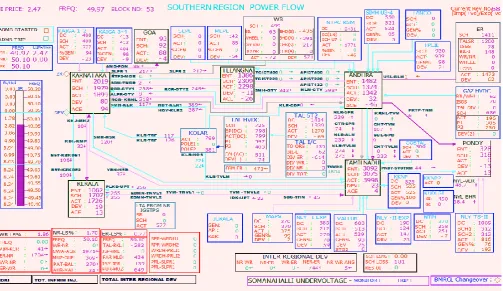
The SRPG network is the among the five regional electricity boards in India that comprise the six states. A reduced representation of the SRPG system has been considered, which consists of 637 buses (220 and 400 kV only) and 1593 branches (lines/transformers).
The performances of the proposed phasor-assisted SE were tested for this practical system, assuming that 50 PMUs are placed in the system, which are strategically placed. The proposed estimators have been applied on this test system. There were 637 voltage magnitude measurements. The SD of the phasor measurements is much smaller than the conventional SCADA measurements.
Figure 7. Southern region 637 bus grid
Figure 8. voltage magnitudes estimated by linear state estimator
Figure 9. Comparison of voltage magnitudes by conventional and linear state estimator for 637 bus
system
Figure 10. Error in linear state estimator and metered values for 637 bus system
V.
CONCLUSION
It is concluded that states obtained with PMU measurements are more accurate compared to metered data. An attempt has been done to linearize the state estimation procedure.
VI. REFERENCES
1. Jun, D., Ze-xiang, C., and Keying, W., ―An overview of state estimation based on wide-area measurement system,‖ Automat. Elect. Power Syst., Vol. 30, No. 7, pp. 5–9, 2006.
2. Phadke, A. G., Thorp, J. S., and Karimi, K. J., ―State estimation with phasor measurements,‖ IEEE Trans. Power Syst., Vol. 1, No. 1, pp. 233– 240, February 1986.
3. Zhao, L., and Abur, A., ―Multiarea state estimation using synchronized phasor measurements,‖ IEEE Trans. Power Syst., Vol. 20, No. 2, pp. 611–617, May 2005.
4. Zhou, M., Centeno, A., Thorp, J. S., and Phadke, A. G., ―An alternative for including phasor measurements in state estimation,‖ IEEE Trans. Power Syst., Vol. 21, No. 4, pp. 1930–1937, November 2006.
5. Stefopoulos, G. K., Alaileh, R. H., Cokkinides, G. J., and Meliopoulos, A. P. S., ―On three phase state estimation in the presence of GPS synchronized phasor measurements ,‖Proceedings of 39th North American Power Symposium, pp. 406–412, Las Cruces, NM, 30 September– 2 October 2007.
6. Monticelli, A., State Estimation in Electric Power Systems—A Generalized Approach, Boston: Kluwer Academic Publishers, 1999
7. TP Vishnu, Vidya Viswan and Vipin A M ―Power System State Estimation and Bad Data Analysis Using Weighted Least Square Method‖, IEEE International Conference on Power, Instrumentation, Control and Computing (PICC),20152.
8. A.G.Phadke,‗Synchronized phasor measurements in power systems‘, IEEE Transactions on computer application, Power, vol. 6, no. 2, pp. 10–15, 1993.
9. Ankhi Gulati, Niyati Gulati and Anil Kumar, ―Effect of Bad measurements on IEEE-14 Bus System in Power System State Estimation‖, Vol. 4, No. 2, August 2014, pp. 100-103, ISSN 2230-7656 ©MIT Publications
![Fig 3: Six(m) current measurements on four(n) lines, three(p) voltage measurements and four (q) buses [2]](https://thumb-us.123doks.com/thumbv2/123dok_us/1046687.1130693/3.595.86.235.473.538/fig-m-current-measurements-lines-voltage-measurements-buses.webp)