CSEIT1725124 | Received : 05 Oct 2017 | Accepted : 16 Oct 2017 | September-October-2017 [(2)5: 733-739]
International Journal of Scientific Research in Computer Science, Engineering and Information Technology © 2017 IJSRCSEIT | Volume 2 | Issue 5 | ISSN : 2456-3307
733
Occluded Object Reconstruction with Partial Appearance
Thi Thi Soe
*1, Zarni Sann
2*1Faculty of Computer Science, Computer University, Mandalay, Myanmar 2
Faculty of Computer System and Technology, Computer University, Mandalay, Myanmar
ABSTRACT
Objects in a scene are often occluded each other. Reconstructing their appearance from their visible parts plays an important role in object detection, image analysis, scene understanding, and depth estimation. This paper introduces an integrated approach that utilizes inpainting and image segmentation for reconstructing the appearance of occluded objects. In the first stage of the system, inpainting or filling-in the removing region is done by the patch-based method of replicating the remaining color information of an image. Localized region-patch-based Active Contour Model (LRACM), segmentation method is applied to segment the visible parts of the occluded object from the additional image frame in the second stage. Finally, the extracted visible parts are composited onto the inpainted background scene obtained from the first stage. We demonstrate the proposed algorithm with a number of still images. Experimental results show that the reconstructed scenes are natural and plausible like real view.
Keywords:
Inpainting, Segmentation, LRACM, Occluded Object ReconstructionI.
INTRODUCTION
Humans live in a world of objects. When we taking lots of photos, some objects are occluded by the other (foreground) objects. We want to know what is hidden behind the foreground object and how to recover it. Humans have strong ability to recognize the whole object from the visible parts. If multiple views of an object are available from different camera position, we can reconfigure the whole object. Image inpainting is a method that can repair a portion of damaged or removed (unwanted foreground) object by using the information from the remaining area of the image. The technique can be used in photo restoration, zooming, image coding, wireless image transmission, and special effects and inpainting from multiple view points [19]. In the field of computer vision, the image segmentation has been the subject of intensive research for many years [17, 12]. There is a broad range of applications such as medical imaging and object detection, which strictly relies on the image segmentation.
In this work, we introduce an approach that integrates the inpainting, and image segmentation for occluded object reconstruction. The main goal of this paper is to
reconstruct the appearance of whole object by collecting the different view of visible parts of the occluded object. Doing so requires removing the unwanted foreground object from the front view image and reconstructing visually plausible background scene. This is performed by replicating the sample patch from the surrounding areas of the image. Also requires segmenting and extracting the partial appearance of visible parts of object from left side and right side of additional image frame. This process is accomplished by localizing region-based active contour model (LRACM) segmentation method and these extracted parts are composited onto the inpainted background scene. The organization of remaining sections of the paper is as follows: Section 2 provides the brief overview on image inpainting and image segmentation approaches. The proposed approach for occluded object recognition is discussed in section 3. The experimental results are demonstrated in section 4. Finally, section 5 concludes the paper.
II.
METHODS AND MATERIAL
A. Image Inpainting Approaches
The word “inpainting” is initially used by the manual retouching work of museum artists [1]. The term of digital inpainting was first appeared in the pioneering work of Bertalmio et al. [16]. A typical inpainting based image reconstruction technique work as follows. First, the image region to be inpainted is selected, usually manually. Next, appropriate color for this region is searched from the known image region. Finally fill this color into the removing region and produce the inpainted result with an undetectable manner.
A pioneering inpainting algorithm using partial differential equations (PDEs) was presented in Bertalmio et al. [16]. Later several researchers were further presented to the fields of PDEs based inpainting methods [4, 18, 5]. Almost all of these approaches addressed the image filling issue for the task of image restoration, where scratches, speckles, and overlapped text are removed. The drawback of PDEs method for replacing large regions is lack of consideration for texture information of images. In order to remedy the inpainting results of PDEs algorithm for large regions, the concept of texture synthesis algorithms have been considered.
A large body of researches [15, 13, 14] in texture synthesis has provided techniques to fill in regions with various textures. The problem with the above approaches was the assumption the inpainting domain was a pure texture. In practice, an image that needs to be filled has in some structure to it. Bertalmio et al [9] have tackled the problem of filling in missing domain with both texture and structure information. Recent exemplar-based inpainting scheme works at the image patch level. These exemplar-based approaches [10, 20, 6, 21] addressed the image filling problem for the task of image reconstruction, where undesired foreground objects were removed. Ideally, these removing objects occupied large area from an image. The researchers termed the texture synthesis based approaches for removing large objects as “image completion”.
Compared with other kinds of approaches, exemplar-based approaches were very effective in reducing the undesired blurring artifacts and applicable to both the small and large regions.
B. Image Segmentation Approaches
Segmentation is one of the fundamental steps in machine vision and image analysis. Active contour or snake is one of the most widely used methods in image segmentation problems. The original active contour model is introduced by Kass et al [2]. Active Contour Model (ACM) can obtain closed object contours as segmentation results, which can be conveniently used for shape analysis and recognition. The active contours can utilize various types of prior knowledge, such as image intensity distribution information, boundary shape information, and texture information [22], to obtain accurate results for object boundaries in image analysis. ACM can be categorized as edge-based models or region-based models [8, 7, 11]. Edge-based models often use an image gradient to force the active contours to move toward the desired object’s boundaries. Region-based models use image statistical information to attract the active contours to the object boundaries.
LRACM Framework
This section overviews the framework of LRACM [11], Assume that the foreground and background regions will be locally different. The analysis of local regions leads to the construction of a group of local energies at each point along the curve. In order to optimize these local energies, each point is considered individually, the point’s component of the local energy is computed by splitting the local neighborhoods into local interior and local exterior using the evolving curve.
The derivative of ( ), a smoothed version of the variables each represent a single point in Ω. Using this notation, the characteristic function ( ) in terms of a radius parameter r can be described as follows:
( ) { ‖ ‖
(3)
( ) to mask local region. Using ( ), we define an energy functional in terms of a generic force function F, energy functional ( ) is as follows: each point along the contour. This energy relies on the assumption that foreground and background regions should have maximally separate mean intensities which can cause the curve to move.
Therefore, a localized region-based energy formed from the global energy by substituting local means for global ones is shown here as in [3]: outside local region, only contributions from the points within the radius r of the contour are considered. Finally, in order to the keep the curve smooth, a regularization term is added as is commonly done in active contour segmentation energies. Meanwhile, the arclength of the curve is penalized and weighted by a
By taking the first variation of this energy with respect to , the following evolution equation is obtained:
energies can be put into this framework.
III.
PROPOSED APPROACH
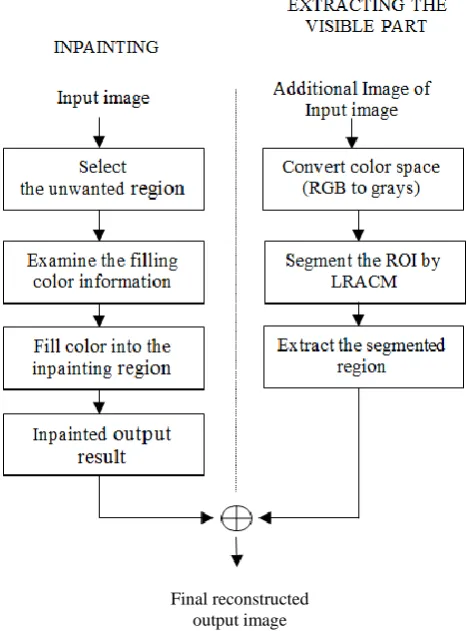
Figure 1. Processing steps for object recognition system
In phase one, inpainting phase, the system needs to mark the unwanted region from an image manually. In our image reconstruction system, the user also has the possibility to indicate the filling sides. The color information are adopted from the left, right, upper or bottom side of the removing region as in Figure 2. To capture the texture content properly, we complete the removing region with blocks of pixels instead of individual pixels. The patch size is the same as the size of the user selected rectangle. The algorithm iterates this filling process until all pixels have been painted in the selected region. In this way, the inpainted background scene is obtained.
Figure 2. Filling with left side patch
If we have seen the partial appearance of occluded object behind the foreground object from left side and right side view image frame, need to extract these visible parts in the phase two. First, the RGB-based image is converted into the gray level one. Then the regions of interest, visible parts are segmented by LRACM [11]. The two extracted visible parts are then added back together to obtain the whole view of the occluded object over the inpainted background scene.
IV.EXPERIMENTAL RESULTS
Preliminary investigation on some images has been tested for image reconstruction. In the first experiment, an image with uniform background is tested, the grassland image with the girl, Figure 3 (a). User initially marked the filling part with red rectangle at the top of the removing region in Figure 3 (b) and next filling part is shown in Figure 3 (c). These regions are painted by using right neighborhood pixels patch. Reconstructed background scene, produced by our method is given in Figure 3 (d), which is completely removing the girl.
(a) (b)
(c) (d)
Figure 3.Removal of a girl from the grass land
Next experiment is the building image with a girl, Figure 4 (a) and the first selected removing area is given in Figure 4 (b). Intermediate stages of the filling process are depicted in Figure 4 (c). To obtain the structure property from the building we use the right neighborhood information of the final remaining marked region which is described in Figure 4 (d). After removing the girl by our method we completely see the building in the scene as in Figure 4 (e). Experiment Final reconstructed
output image
Unwanted region Known region
show that our image reconstruction system successfully remove large object under complex background.
(a) (b)
(c)
(d) (e)
Figure 4.Removal of a girl in a complex background
Original image with the foreground person and user selected removing region are shown in Figure 5 (a) and 5 (b) respectively. The patch from left side of selected region is used to fill this region and next selected part is given in Figure 5 (c). In this scene, we found that the important structures behind the foreground person. To connect these structures in the filled result, user separately marked the removing region. Final reconstructed background scene generated by the reconstructing system is illustrated in Figure 5 (d).
(a) (b)
(c) (d)
Figure 5.Reconstructing the background scene
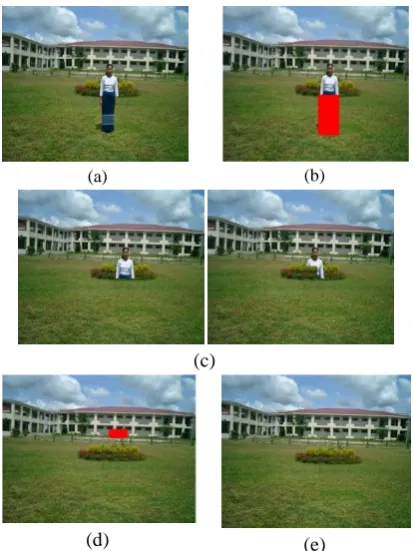
Often in our natural images, some objects are occluded by foreground object. The visible parts of the occluded object can be taken by moving the camera in left and right side from the front view image frame. By using these visible parts we can reconstruct the occluded object over a digitally inpainted result. In all of the above experiments, there are no additional image frames to recover the object behind the removing region. Therefore we reconstructed only the background scene. For the front view image in Figure 6 (a) we see the partial appearance of the object behind the foreground person from the left and right side view image frame as described in Figure 6 (b-c).
(a)
(b)
(c)
Figure
6
.Front view image and additional imagesIn this experiment, we initially removes the foreground person in the front view image frame. Intermediate stage and reconstructed background scene are in Figure 7. Marked region is filled with the patch from the left side. There may be noticeable a seam at the boundary of the filled region. Here we reduce the seam with the red, green, blue color value at 30 pixel length.
(a) (b)
(c) (d)
Figure 7. Inpainted background scene with intermediate
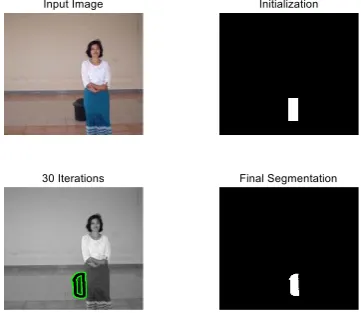
Then LRACM [11] segmentation method is applied to extract the visible parts from the left side and right side of the additional image frame, Figure 6 (b-c). Segmentation results and extracted visible parts are shown in the following figures. Here localization radius is 21 pixels.
Figure 8. Segmentation of left visible part
Figure 9. Segmentation of right visible part
Figure 10. Extracted visible parts
These two extracted visible parts are then joinly back together to obtain the whole view of the occluded object over the inpainted background scene in Figure 7 (d). Final reconstructed whole view of occluded object is shown in the following figure.
Figure 11. Reconstructed occluded object
V.
CONCLUSION
In this paper, the image reconstruction system is developed in which patch based inpainting and LRACM segmentation method are integrated We focused on the reconstructing of background image by removing the foreground object from an image. Furthermore, occluded object in behind of the removing object is reconstructed by using the available information from the nearest frames. The images with homogeneous and complex background textures behind the removing region are tested in the experiment. Our approach can be generated the pleasing reconstructed scene for human visual system. Sometimes, the quality of the result of some images is not as good as expected. Despite these effects, the resulting images look plausible if not examined in detail.
VI.REFERENCES
[1] S. Walden, “The Ravished Image” St. Martin’s Press, New York, 1985.
[2] M. Kass, A. Witkin and D. Terzopoulos. (1987) “Snake : Active Contour Model,” International Journal of Computer Vision. v. 1, n. 4, pp. 321-331
[3] A. Yezzi, A. Tsai, and A. Willsky. (2002) “A fully global approach to image segmentation via coupled curve evolution equations”. Journal of Visual Communication and Image Representation, 13:195–216, 2002.
[4] T. F. Chan, J. Shen.(2002) “Mathematical models for local non texture inpaintings” SIAM Journal on Applied Mathematics, 62(3): pp. 1019–1043, 2002.
[6] S. Grover, S. Gupta, A. K. Sarje, Ankush. (2005) “A Unified Approach for Digital Image Inpainting Using Bounded Search Space” ICGST International Journal on Graphics, Vision and Image Processing, GVIP, Vol.05, 2005
[7] T. Chan, L. Vese. (2001) “Active contours without edges”. IEEE Transaction on Image Processing 10: 266–277. doi:10.1109/83.902291
[8] A. Vasilevskiy, K. Siddiqi. (2002) “Flux maximizing geometric flows”. IEEE Transactions on Pattern Analysis and Machine Intelligence 24: 1565–1578. doi:10.1109/TPAMI.2002.1114849
[9] M. Bertalmio, L. Vese, G. Sapiro, and S. Osher. (2003) “Simultaneous structure and texture image inpainting” IEEE Trans. Image Processing, vol. 12, no. 8, pp. 882-889, August 2003.
[10] A. Criminisi, P. Perez, and K. Toyama.(2004) “Region filling and object removal by exemplar-based inpainting” IEEE Trans. Image Process., vol.13, no.9, pp.1200–1212, 2004.
[11] S. Lankton and A. Tannenbaum. (2008) “Localizing region-based active contours”. IEEE Transactions on Image Processing, 17(11):2029– 2039, 2008.
[12] R. Nikhil Pal and K. Sankar Pal. (1993) “A review on image segmentation techniques” Pattern Recognition, 26(9), pp 1277-1294. [13] D. J. Heeger, and J. R. Bergen. (1995)
“Pyramid-based texture analysis/synthesis” In Proceedings of ACM SIGGRAPH 95, ACM Press, 229–238, 1995.
[14] R. Paget and D. Longstaff. (1995) “Texture synthesis via a nonparametric markov random field” In Proceedings of DICTA-95, Digital Image Computing: Techniques and Applications, volume 1, pp. 547–552, 1995.
[15] H. Igehy, and L. Pereira. (1997) “Image replacement through texture synthesis” In IEEE International conference on Image Processing, vol. 3, pp. 186–189. 1997.
[16] M. Bertalmio, G. Shapiro, V. Caselles and C. Ballester. (2000) “Image Inpainting” SIGGRAPH’00, pp.417–424, 2000.
[17] J. Freixenet and X. Mu. (2002) “Yet another survey on image segmentation: Region and boundary information integration”. In 7th European Conference on Computer Vision (ECCV), pp 408-422.
[18] T. F. Chan, S. Kang, and J. Shen. (2002) “Euler’s elastica and curvature based inpaintings” SIAM J. Applied Mathematics, 63(2): pp. 564–592, 2002.
[19] 1. K. Timothy Shih and Rong-Chi Chang. (2005) “Digital Inpainting – Survey and Multilayer Image Inpainting Algorithms” Proceedings of the Third International Conference on Information Technology and Applications (ICITA’05) 0-7695-2316-1/05
[20] H. Cheng, W. Hsieh, K Lin, W. Wang and L Wu. (2005) “Robust Algorithm for Exemplar-based Image Inpainting” in Proceedings of International Conference on Computer Graphics, Imaging and Vision, pp. 64-69, Jul. 2005, Beijing, China. [21] J. Sun, L. Yuan, J. Jia, and H.-Y. Shum (2005)
“Image completion with structure propagation” In SIGGRAPH, 2005.